← The Speed of Culture Podcast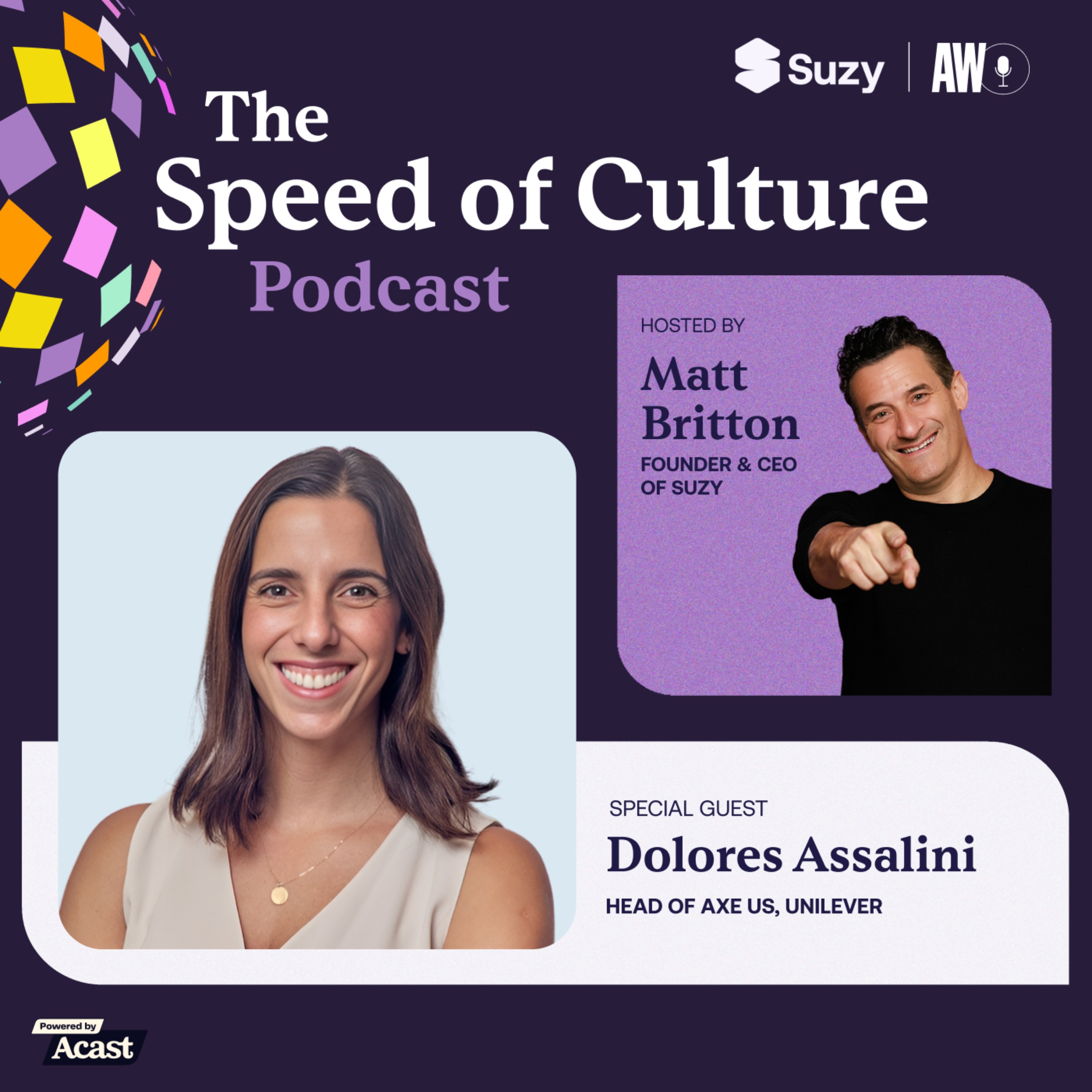
The Speed of Culture Podcast
Second Wind: How Axe is rewriting the marketing spray-book for a new gen
00:28:29
Loading summary
Transcript73 lines
- [00:01]
A
Does using social media ever make you feel like you're just yelling into an algorithmic void? That feeds have started to feel a lot less, you know, social? Well, we're doing something about it. I'm Chelsea Bakken, head of audience development and social at Adweek, and I'm so excited to invite you to Social media week. This April 14th through 16th. We're bringing together creators, marketers, and social leaders in a vibrant IRL space in New York City for three days of connection, collaboration, and learning. You'll get the chance to dish on the latest tools and tricks, hear fresh perspectives on the year's most viral moments, and get the slot free inspiration you need to connect with your audience and optimize performance. Head to adweek.com events to learn more.
- [00:41]
B
Howdy, howdy ho, and welcome to Fantasy Fan Fellas. I'm Hayden, producer of the Fantasy Fan Girls podcast and your resident lover of all things Sanderson.
- [00:49]
C
And I'm Stephen, your bookish Internet goofball, but you can call me the Smash Daddy.
- [00:53]
B
And we are currently deep diving Brandon Sanderson's fantasy epic Mistborn. But here's the catch. Steven here has not read Mistborn before.
- [01:01]
C
That's right.
- [01:02]
D
Hey.
- [01:02]
C
Hey. So each week you'll get my unfiltered raw reactions to every single chapter.
- [01:06]
B
And along the way, we'll do character deep dives, magic explainers, and Steven will even try to guess what's next. Spoiler alert. He'll be wrong.
- [01:13]
C
News flash. I'm never wrong. Episodes come out every Wednesday, and you can find Fantasy Fan fellows wherever you get your podcasts.
- [01:23]
E
Does it ever feel like you're a marketing professional just speaking into the void? But with LinkedIn ads, you can know you're reaching the right decision makers. A network of 130 million of them. In fact, you can even target buyers by job title, industry, company seniority, skills, and. Did I say job title? See how you can avoid the void and reach the right buyers with LinkedIn ads. Spend $250 on your first campaign and get a free $250 credit for the next one. Get started at LinkedIn.com campaign terms and conditions apply.
- [01:54]
D
Creatives are a huge part of this campaign. We want to make sure that we're involving people in our campaign versus just the brand speaking to our guys. Young guys don't want brands just speaking at them anymore. They want to feel like they're part of the culture. They want to feel like they're part of the conversation. And bringing creators in to help tell our story has already made a Huge difference. And we're giving creators a lot of liberty with this campaign and letting them talk about potentially their experience in overdoing it, almost handing the reins to these creators to help tell the story. It's been resonating incredibly well. It makes the story just that much more authentic versus us telling guys directly about our new technology. It just creates a much more interesting story.
- [02:41]
F
To thrive in a rapidly evolving landscape, brands must move at an ever increasing pace. I'm Matt Britton, founder and CEO of Suzy. Join me and key industry leaders as we dive deep into the shifting consumer trends within their industry, why it matters now, and how you can keep up. Welcome to the Speed of Culture. Up today on the Speed of Culture podcast, we're thrilled to welcome Dolores Asolini, the head of Axe us. Dolores leads the brand behind one of the most iconic names in men's personal care, helping evolve acts for a new generation. From redefining the body spray category it created to building culturally relevant campaigns like the History of Overdoing it, she's shaping how the brand connects with young men today through innovation, humor, and authenticity. Delor, so great to see you today. Thanks so much for joining.
- [03:28]
D
I'm out. Thanks for having me.
- [03:30]
F
Absolutely. So we'd love to hear from you. Sort of the evolution of the Axe brand over time and more importantly, where it is today and what you're hoping to achieve with the brand moving forward.
- [03:41]
D
Yeah. So Axe is a very big brand in the U.S. it's actually originated in France in 1983, and it came to the U.S. in 2003. And ever since it came into the U.S. it's been a cultural phenomenon. Almost one out of every two guys was using Axe in 2008. So it really is a brand that just made a huge cultural splash. So for me, it's really important to respect the legacy of this brand. It was such a cultural phenomenon at its launch, and I want to make sure we continue to respect that and honor that past while also helping the brand guide it into its next chapter and into the future. So figuring out how we can bring this brand into 2026 while still respecting its past.
- [04:27]
F
So what does it mean to redefine a brand, especially in a category that, I mean, let's be honest, X kind of create it, especially here in the US what is it going to take to redefine it? Does it have to do with product packaging, messaging? All of the above? Love to hear from your standpoint in the seat you sit in, how you're attacking this challenge.
- [04:47]
D
So we are attacking it from always. So as you said, this brand really created the body spray category. That is a category that did not exist before Axe came into it. So ensuring that we continue to evolve what that product looks like from an innovation standpoint. And you can see that clearly in the new technology that we launched this year in 2026 with the new spray technology. The second piece is also evolving with guys in the way that they use personal care products. How guys think about grooming habits has really evolved over time. Guys today pay a lot more attention on how they look, the products they use, and they have become so much more sophisticated than they were when first came onto the market in the US in the early 2000s. So making sure that we evolve with our grooming and personal care habits is really important to us. The third piece is how they consume media. So making sure that we meet our guys where they are and where they're wanting to speak with brands. Right? So it's a lot more social these days. They want to engage with brands versus just consume the content that they're creating. So those are really the three areas that we're looking at to ensure that we keep this brand relevant in today's times and with how guys are evolving.
- [06:01]
F
And how about just the notion of distribution? Because obviously I know you've been at Unilever for a while and one of the biggest changes we've seen obviously coming out of COVID is just a different way consumers are purchasing consumer packaged goods. Obviously you have Instacart and so many other options. How does that impact the way that you look at building the brand and leaning into new types of packaging, form factors, et cetera, to meet the needs of the new consumer today.
- [06:27]
D
So from a distribution standpoint, we really focus on Walmart. Right? Walmart has been a huge strategic partner for us as they take this brand into the future. And we're looking at a brick and mortar standpoint traditionally. So making sure that the product stands out, looks visually beautiful is there to we can showcase what the brand stands about through the packaging. So in store is really important to us. Secondly, we look at online as well, right? So guys right now want ease of purchase. They want to be able to find their product wherever they're looking for. And so making sure that everything is driving to purchase on E Commerce is really important to us. So if you look at everything we do from TikTok to YouTube to all of our other social channels, everything is driving to purchase on Walmart.com and we really try to make sure that our Pages on Walmart.com have the right level of information that our guys and their moms need to make that purchase. Making sure that we have our claims on their images, fragrance details and everything that they need in order to help them make that purchase.
- [07:31]
F
And obviously one of the huge benefits you get in partnering with Walmart the way you do is just huge distribution and the power of the retail media network and so many things that a platform like Walmart brings to the table. But at the same time, what you don't get versus other direct to consumer marketers is you don't get to collect all that first party data. And just wondering here in 2026, as first party data becomes so important, or increasingly important, I should say, especially in the age AI, how are you and the brand tackling the opportunities unlocked through first party consumer data?
- [08:05]
D
Yep. So we always as Unilever, we capture first party data as consumers come into the brands, but really our focus is on delivering amazing content that will help our guys make that decision. Right. So very much around making sure that we can get the right level of coverage around what our product is giving our guys so that when they search for it, they have all the information they need to make that decision. So it's more about making sure that we're offering everything that they need up to them so that they make the decision that they can make the decision that they need to purchase our product. So a lot of ensuring that our claims are out there that we explain to them what our product gives to them, both from a functional standpoint, from a fragrance standpoint, and from an emotional standpoint. So making sure that all of that base is there so that they are able to come and make the right decision to purchase a product.
- [08:55]
F
So let's talk about some of that first party content I mentioned during the onset initiative you're doing called the History of Overdoing it, which is obviously a content platform around the notion of humor and would love to hear from you what that campaign or initiative is all about and why it was something that you thought was worthwhile to lean into.
- [09:14]
D
Yeah, so this campaign was a really fun and interesting one. It really intentionally leans into our legacy with humor and honesty in a way that we've never done before. So guys have always joked about guys overdoing it and doing too much, both from a dating standpoint and from a really our product standpoint. So it's an area that we've never really explored in the way that we're doing it with this campaign.
- [09:39]
F
You mean like applying too much body spray?
- [09:41]
D
Yes, yes. Applying too much body spray and trying to do too much and dating as well. So the campaign really leans into how guys try to do too much when trying to date. And with our new product technology, we're helping them understand how to be a little bit more subtle. So again, both in dating and in how they use our product. So what this technology does is it delivers a more controlled spray that really removes what people call the AX Cloud. Right. That product that just gets everywhere. I'm sure you've experienced it. If not, you can talk to any middle school teacher and they'll tell you about the Axe Cloud, Right?
- [10:21]
F
Happens with cologne and perfume, too, right?
- [10:23]
D
Yes, exactly. But with a body spray. In the past, our body spray really did have that bit of a cloud. So with this new technology, it delivers a more controlled, lighter spray to help guys be a little bit more subtle and help them not overuse our product, which has been a real problem in the past. So we're really leaning into that in a way that we haven't done before.
- [10:45]
F
It reminds me of what they have on the liquor bottles for bartenders to make sure they don't put too much alcohol in people's drinks. Same thing, same general concept. So, just curiously, like, what came first? Was it the product innovation that led to the marketing insight? Was it the consumer insight that led to the product innovation, which then led to the content? Like, how does something like this come together at such a large organization like Unilever?
- [11:11]
D
Yeah, that's a great question. It really came together, right? The technology always comes first in terms of, as I mentioned in the beginning, always trying to improve our product and making sure that we're delivering our guys with the best technological advances to deliver the best product experience. And at the same time, he'd always heard about this Axe Cloud. We know it's there. We know it happens. We see it on social. We hear it from consumers that they just. They. Anytime somebody sprays the product, it really goes beyond their body, and everybody in their vicinity is smelling it. So it's really has been a joke in culture almost since the product launch, and we've always really ignored that piece of it. And in this campaign, as we brought this new technology to help fix that product problem, then we said, let's tackle our history head on and let's talk about it. Let's put it out in the open in a way that we haven't done before. So that insight really got us excited because it was really a perfect combination to say, hey, you've been using our product too Much. And now not only are we going to talk about it in a way that's really funny and hits on the social insight, but also it comes with an innovation that helps prevent that overspraying. So that was really a winning combination for us for this campaign.
- [12:30]
F
You're paying it off. Like I think a lot of brands, they try to create content and sometimes they lose the script, no pun intended. And they're creating content just to garner engagement and attention, but to the consumer, they end up not remembering what brand delivered because it's not really connected to whatever the value proposition is from the brand or the product. So what I like about this is it's pretty tightly knit together where it's pretty clear why Axe is doing it. It's obviously a very easy product insight to understand and it seems like it's rich territory to provide platform for social content that really uncovers because how people interact, especially younger people on social media, on platforms like TikTok and Instagram is they'll take videos and they'll forward it to somebody and be like, that's so you. Or that so John. Right. And I could see this being an insight that kind of eviscerates that type of. Rather evokes that type of reaction.
- [13:25]
D
Yeah, absolutely. And I think we're really trying to get this brand back into the cultural zeitgeist and we're doing so by poking fun one, at ourselves and two, and guys behavior in a way that feels fun and interesting and relatable. I think we all know a guy who has posted a picture holding a fish and you will see that reflected in our campaign where guys do love that and it's a social insight and girls make fun of it. And it's okay I think to just put it out in the open and say hey, women, don't want to see your fish. And make a campaign around that. It's really landed quite well.
- [14:06]
F
We'll be right back with the speed of culture after a few words from our sponsors.
- [14:09]
E
Does it ever feel like you're a marketing professional just speaking into the void? But with LinkedIn ads you can know you're reaching the right decision makers, a network of 130 million of them. In fact, you can even target buyers by job title, industry, company seniority, skills and Did I say job title? See how you can avoid the void and reach the right buyers with LinkedIn ads. Spend $250 on your first campaign and get a free $250 credit for the next one. Get started at LinkedIn.com campaign terms and conditions apply.
- [14:42]
A
Does using social media ever make you feel like you're just yelling into an algorithmic void? That feeds have started to feel a lot less, you know, social? Well, we're doing something about it. I'm Chelsea Bakken, head of audience development and social at adweek, and I'm so excited to invite you to Social media week this April 14th through 16th. We're bringing together creators, marketers and social leaders in a vibrant IRL space in New York City for three days of connection, collaboration and learning. You'll get the chance to dish on the latest tools and tricks, hear fresh perspectives on the year's most viral moments, and get the slot free inspiration you need to connect with your audience and optimize performance. Head to adweek.com events to learn more.
- [15:22]
B
Howdy, howdy ho, and welcome to Fantasy Fan Fellas. I'm Hayden, producer of the Fantasy Fangirls podcast and your resident lover of all things Sanderson.
- [15:30]
C
And I'm Stephen, your bookish Internet goofball, but you can call me the Smash Daddy.
- [15:34]
B
And we are currently deep diving Brandon Sanderson's fantasy epic Mistborn. But here's the catch. Steven here has not read Mistborn before.
- [15:43]
C
That's right. Hei hei. So each week you'll get my unfiltered raw reactions to every single chapter.
- [15:48]
B
And along the way we'll do character deep dives, magic explainers, and Steven will even try to guess what's next. Spoiler alert. He'll be wrong.
- [15:55]
C
Newsflash. I'm never wrong. Episodes come out every Wednesday and you can find Fantasy fanfellas wherever you get your podcasts.
- [16:05]
F
Given that this seems to be a social first campaign and clearly a content driven campaign versus traditional advertising campaign, which is really the only way to go right now targeting Gen Z and increasingly Gen Alpha consumers, I would imagine creators play a big role in this because that's obviously how you gain that mass distribution and it's proven to be increasingly powerful versus just paid media on social channels. So how are you looking at creators as a part of the overall mix of this initiative?
- [16:33]
D
Creators are a huge part of this campaign. We want to make sure that we're involving people in our campaign versus just the brand speaking to our guys. Young guys don't want brands just speaking at them anymore. They want to feel like they're part of the culture. They want to feel like they're part of the conversation. And bringing creators in to help tell our story has already made a huge difference and we're giving creators a lot of liberty with this campaign and letting them talk about potentially their experience in overdoing it in dating or overdoing it with our product. Again, tackling the social insight straight on, both from the brand side and from the creator side. And we're letting guys tell authentic stories in a way that again, we haven't done in the past. So that's been really fun to see because we're almost handing the reins to these creators to help tell the story and it's been resonating incredibly well. So we're seeing that guys are really relating to that and it makes the story just that much more authentic versus us. Us telling guys directly about our new technology, it just creates a much more interesting story.
- [17:40]
F
Right? I mean the reality is that no one's going to TikTok to see content about body spray. And I think some brands kind of lose the. Obviously it doesn't mean you can't show the product, but people go to social media to laugh or cry or smile or share. You know, they want to be moved emotionally and it's content that does that. And I believe one of the biggest shifts, especially that larger traditional CPG companies still haven't largely understood, is that we are moving away or have moved away from the advertising era, which is like what is my unique selling proposition? How can I buy a 30 second spot and shove it down a consumer's throat whether they like it or not, to a content driven world, which is more about what does my consumer care about what they wake up in the morning and where's my brand fit in? And just curiously. And you've been at Unilever working on variety brands, I know you spent some time working on Dove as well. Has that been a hard shift for you to be able to drive with your agency partners? And even internally you clearly get it and it's reflective on our conversation we've had thus far. But has that been a hard shift to kind of bring a brand through? Because I know a lot of CPG companies are so focused on those USPs that sometimes they can lose sight of what the consumer really cares about.
- [18:58]
D
I will say it was a big culture shift. Going from dove directly to ACTS and speaking from moms to 13 year old boys has been certainly a shift. But I think in terms of how we we go to market and how we speak to these guys, it has been a really big shift. And I think even this brand, up until two years ago we were still spending part of our media budget on linear tv. So when I came into this role a year and A half ago we said this needs to be a social first, digital only plan. And that's what we did. And not only is it social first, because it's not about taking a 30 second TV spot and putting on TikTok. That doesn't work anymore. So what we needed to do is find a way to engage the community. That has been the biggest thing that has changed on Axe, which is that we're no longer shoving content on their throat. We're helping them be a part of the content creation. We're engaging them. Every single post that we look at and we approve, we talk about how are we engaging our community, how are we speaking to them, what are we saying to them and what do we want them to say back? What do we want them to do as we put this content out there? It needs to be more than just consume the content, believe in our message and go buy our product. That doesn't work anymore. That linear model is dead. So now what we need to think about is how do we engage the community, make them a part of our story authentically, and then that's what's going to get them to want to buy your product. Because they feel like they're a part of our story and a part of our brand and it's just as much theirs as it is ours.
- [20:29]
F
That's right. So I think we've set a record here in 2026 because we've gone way more than half of the podcast long without mentioning AI, But I think now it's time in the episode that we do so. And, and I think it shows that you guys, you know, you're not kind of grabbing on the AI pixie dust. Like this is a type of campaign that I think is rooted in, again, a real consumer insight and first campaign. I'm just curious, given that, how does AI play a role not only in this campaign, but in your job on an everyday basis? How are you looking at deploying AI personally with your team? And what are some opportunities you think exist for the brand in the category at large?
- [21:07]
D
Yeah, it's a huge, huge question and I don't think any of us really have all the answers, but I think what we're trying to think about is how do the tools help us tell our story in the most effective way. So we are seeing that these large language models are starting to influence how consumers search for and evaluate products. And I think the most important thing for us to think about is what messages are we putting out there that are going to be picked up by these language Models, right. We're seeing people already refer to this as the new buy box. So for us, it's really important to make sure that our messaging is clear enough to be picked up by these models. So we want to make sure that we have the right messaging, the right channels, and really the credibility and authenticity to be picked up by that. So I did do a little bit of a test a few days ago, and I asked one of the models what they thought about Axe in 2026. And I think our insight on this campaign has been so strong that what we got back was really the essence of the campaign. It's very much around, you know, the history of what we're doing, it, the product, technology, everything, all the work that we put into the campaign is being picked up by the language model. So that was really exciting to see because it tells me that we're doing something right. There's always more to do and there's always more to think about with these models and how they' evolved, because they're evolving every single day. But I think that the most important thing that we did in this campaign is have a strong social insight, a clear answer to a problem, and that is being picked up already in what we're doing.
- [22:41]
F
I think the important point there is it's not like a normal consumer is going to ask that same question, but they will ask questions that will circle around your category. And if that large language model generally understands where the brand is, then contextually it's going to insert the brand in conversations in the way that you want it inserted. And I think that's really what's important. And I think you're right. Like, I think the biggest opportunity in 2026 is the Internet now has a. Or is increasingly having a new front door. And I think for the last two and a half decades, it was find things on Google and then maybe you're in the consideration layer on places like Instagram, Facebook, et cetera, and then you go to Amazon to buy. And that seems to be increasingly collapsing where, you know, these large language models. Obviously Google has a tremendous large language model in their own right in Gemini. They're doing everything. And I think consumers are going to increasingly buy over these platforms as well. And it creates obviously a massive opportunity for marketers, but also a big challenge, especially for those kind of incumbent brands that have spent the last two and a half decades establishing their brand, becoming the top ranked brands in their category on Google. And now that's all being torn down and you have to really think of things in A slightly different way.
- [24:01]
D
Yeah, I think that's right. And really also started with TikTok as well, because I think that traditionally you would have certain number of followers on Instagram, for example, or on Facebook, and you would put a post out there and you would know that Most of your 2,300,000 followers would see that post. That's not the way anymore. A creator that has one follower can get 5 million views on a video.
- [24:25]
F
Isn't that crazy?
- [24:26]
D
It's insane.
- [24:27]
F
It's been democratized a lot. You know, it's like ultimately it's about the quality of the content versus how many followers you've missed. I remember in the early years of social media, I remember specifically Mazda ran a Super bowl spot and their whole call to action was go to Facebook and like our page. Because back then that is what got you distribution. And it's shifted so much. And now it really is about how good is your content. And the quality of the content is not nearly a correlation with how much money you spend on the content either. It needs to be content that's native to the platform, things that look like they're authentic versus things that are glossy and overproduced as well.
- [25:06]
D
100%. And I think it works for creators as well. We talked about creators a little bit earlier. That creator can have 10 million followers, but if your content is not good, it's not going to get more than a thousand views. And so as we think about how we bring our message out there, then we need to make sure that it feels authentic and that it's great content. Because I can put paid behind bad content, but at the end of the day, that's not going to resonate, and consumers are too smart for that these days. They don't care if your content hits on all the brand messages, if it's not entertaining, informing, interesting, funny. You're going to skip right past that.
- [25:46]
F
Absolutely. So let's shift gears as we wrap up here. You've been in associate, brand manager or brand manager roles for the better part of the last 15 years. And of course now in your role of head of axe, which is almost like the uber brand manager, if you will. And obviously, sure, you have much broader responsibilities, but in that regard, how does brand stewardship or how has it evolved over time? Because when you were at Avon in the early 2000 and tens, it was at the dawn of Instagram and really the early years of the social media era. And now we've gone through, I don't want to say the peak of social media, but when you look at a platform like Facebook having over 3 billion users, it's pretty much topped off in terms of its growth. And now obviously, we're seeing this new AI era and who knows what's going to unlock. But through it all, and through all these changes, what has stayed the same about being a brand manager and a steward of a big brand at a company like Avon or Unilever, and what is completely different here in 2026?
- [26:46]
D
Well, first of all, you make me sound very old without talking about my history.
- [26:50]
F
More wise and seasoned.
- [26:52]
D
Yeah, exactly. That sounds better. So everything is changing every day. The speed of change has changed, truly accelerated so much that it's really important for me as the head of this brand, to make sure that I stay on top of everything. Or at least that's what I tell my husband when I scroll through TikTok 10 hours a day. It's part of my job, but really making sure that we stamp up on what's happening to help understand. And it really makes my job really interesting because it's not every year you brief a campaign, you get a 30 second asset, you do a 15 second asset, you do your PR pitches. It's not that simple anymore. But I think that makes it really fun because every day we try to think about new ways to reach our consumers. Which leads me into what doesn't change. What doesn't change is that people want to hear great stories. They want to hear about great brands, they want to know about your product and your innovation, but they want to hear about it in a way that appeals to them and how they're consuming media and products today. So whereas before they wanted to be entertained with a really funny TV asset in between the shows that they watch, today, they want to hear about it through TikTok and talk about it in the comments section, talk about which of their friends has pictures holding a fish on their Tinder profile. That's what they want to hear about from brands. And that is still storytelling, authenticity, humor, entertainment. It's all the same things I was talking about when I was doing the Avon pamphlets in the 2010s, but it's just in a different medium today. And we have to continue to evolve how those media change. But at the end of the day, it's still the same. Consumers want to know about great products, they want to see great advertising. Whether it's a TikTok comment, a Reddit thread, or it's something that ChatGPT spit up for them, they want to hear about that. And that's what makes My job, really fun, and that's what brought me into marketing in the first place. And that's what's going to keep me in it. Just telling great stories.
- [28:54]
F
Absolutely. And for some of our younger listeners here on the podcast, what do you think are the most important skill sets for those just starting out in their career journey that they should really lean into to set themselves up for success?
- [29:08]
D
I'm going to give you a slightly different answer. Rather than a skill set, I think it's find something that you're passionate about. If you find something that you enjoy, something that you love, then the skills will come because you want to learn and understand more about what it is that you're passionate about. That's what it is for me. I'm passionate about telling great stories, and it makes me want to understand how quad works and ChatGPT works and Gemini works and what's feeding into it, because those are the vehicles for me getting to my consumer to tell great stories. So I think I would say just find something that you love, something that you're interested in, you're passionate about, and then the skills will come because you will want to learn how to make that happen.
- [29:49]
F
Yeah, I think that's fantastic advice. And I think obviously we all can work at brands as cool as Axe or do things that are so exciting, but I think you have to find something within that role that you're passionate about, and you know that makes you excited every day. And lean into that, because if you do, I think that's where you'll find a lot of success. So to wrap up here, Dolores, we always ask our guests as we finish the podcast if there's a saying or mantra that's helped encapsulate their professional journey. So what do you got for us today?
- [30:21]
D
This might be a cliche one, but I think everybody knows the Seth Goden quote that marketing is no longer about the stuff that you make, but about the stories you tell. But that's, again, what brought me to marketing. I love telling cool stories and telling people about the products that we have. So I think continuously finding interesting and authentic ways to tell great stories, whether it's on Dove on Avon, Vaseline, or Acts today, in telling great stories, is just a fascinating thing to do for work.
- [30:50]
F
I love Seth Godin. In fact, his first book, Permission Marketing, came out right when I graduated college and actually was the book I read that got me into the marketing practice to begin with. So I love that you gave him a shout out and that was the answer you gave. So thanks for that, of course. Yeah. So this has been a great conversation. I can't wait for our audience to hear it. Huge fan of you and the Axe brand and can't wait to see what you'll continue to do to drive this brand and reinvent the brand of the category along the way. And appreciate you taking the time today.
- [31:17]
D
Great. Thanks man. It was lovely chatting with you.
- [31:19]
F
Absolutely. On behalf of Susie and Ivory Team, thank you again to Dolores Asolini, the head of Axe Us, for joining us today. Be sure to subscribe, rate and review the Speed of Culture podcast on your favorite podcast platform. Till next time. See you soon, everyone. Take care. Bye bye. The Speed of Culture is brought to you by Suzy as part of the Ad Week Podcast Network and a Guest Creator Network. You can listen subscribe to all Adweek's podcasts by visiting Adweek.com podcasts to find out more about Susie, head to Susie.com and make sure to search for the Speed of Culture in Apple Podcasts, Spotify or anywhere else podcasts are found, click follow so you don't miss out on any future episodes. On behalf of the team here at Suzy, thanks for listening.
- [32:18]
E
Does it ever feel like you're a marketing professional just speaking into the void? But with LinkedIn ads, you can know you're reaching the right decision makers. A network of 100, 130 million of them, in fact. You can even target buyers by job title, industry, company, seniority, skills and. Did I say job title? See how you can avoid the void and reach the right buyers with LinkedIn ads? Spend $250 on your first campaign and get a free $250 credit for the next one. Get started@LinkedIn.com campaign. Terms and conditions apply.
- [32:50]
A
Does using social media ever make you feel like you're just yelling into an algorithmic void? That feeds have started to feel a lot less, you know, social? Well, we're doing something about it. I'm Chelsea Bakken, Head of Audience Development and Social at adweek, and I'm so excited to invite you to Social media week this April 14th through 16th. We're bringing together creators, marketers and social leaders in a vibrant IRL space in New York City for three days of connection, collaboration and learning. You'll get the chance to dish on the latest tools and tricks, hear fresh perspectives on the year's most viral moments, and get the slot free inspiration you need to connect with your audience and optimize performance. Head to adweek.com events to learn more.
- [33:30]
B
Howdy, howdy ho, and welcome to Fantasy Fan Fellas I'm Hayden, producer of the Fantasy Fangirls podcast and your resident lover of all things Sanderson.
- [33:38]
C
And I'm Stephen, your bookish Internet goofball, but you can call me the Smash Daddy.
- [33:43]
B
And we are currently deep diving Brandon Sanderson's fantasy epic Mistborn. But here's the catch. Steven here has not read Mistborn before.
- [33:51]
C
That's right.
- [33:52]
F
Hey.
- [33:52]
C
Hey. So, each week, you'll get my unfiltered raw reactions to every single chapter.
- [33:56]
B
And along the way, we'll do character deep dives, magic explainers, and Steven will even try to guess what's next. Spoiler alert. He'll be wrong.
- [34:03]
C
News flash. I'm never wrong. Episodes come out every Wednesday, and you can find Fantasy fanfellas wherever you get your podcasts.