← The Speed of Culture Podcast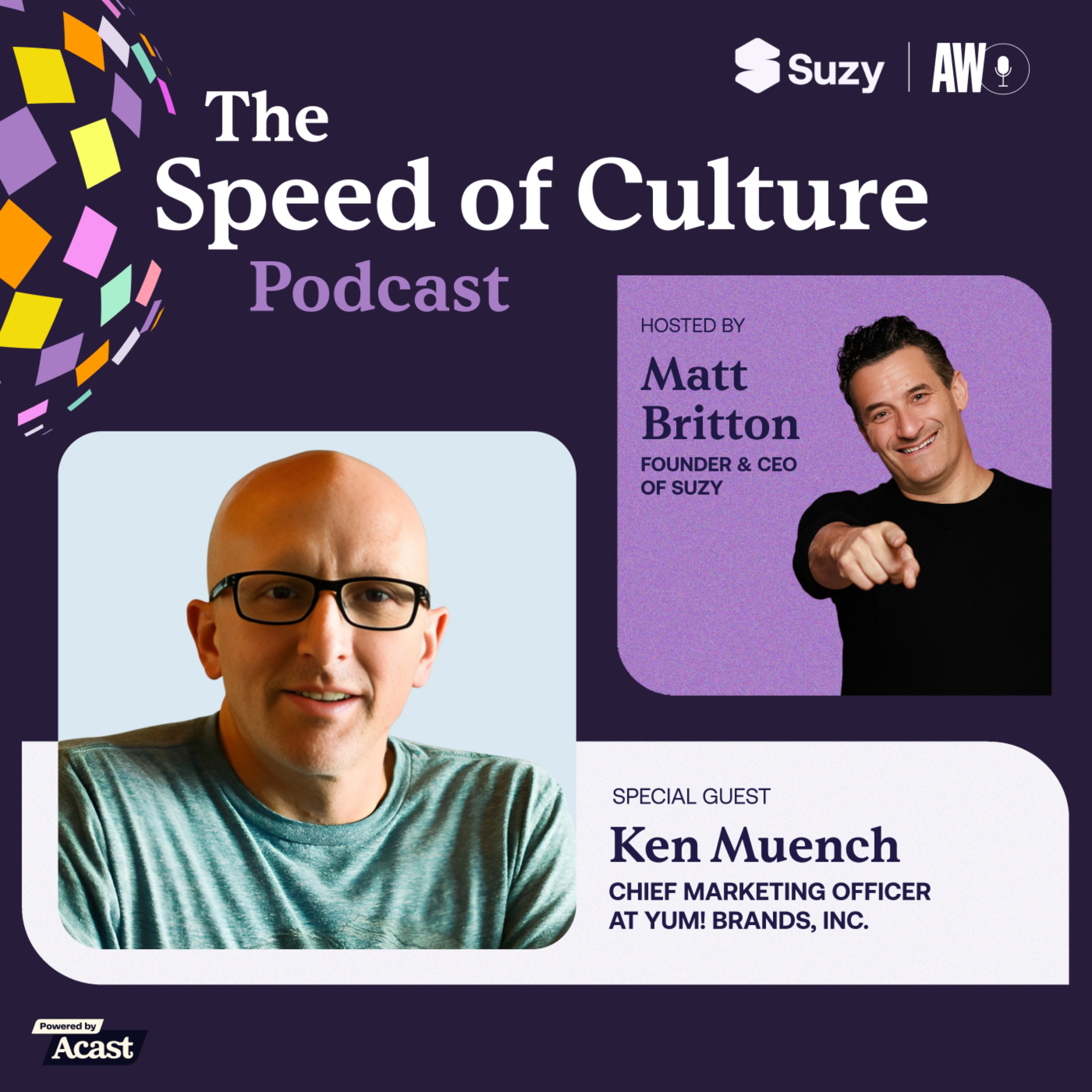
The Speed of Culture Podcast
Secret Menu: CMO Ken Muench Reveals How Taco Bell, KFC and Pizza Hut Stay Fresh
00:29:19
Loading summary
Transcript80 lines
- [00:00]
LinkedIn Advertiser
Does it ever feel like you're a marketing professional just speaking into the void? Well, with LinkedIn ads you can know you're reaching the right decision makers. You can even target buyers by job title, industry, company seniority, skills. Wait, did I say job title yet? Get started today and see how you can avoid the void and reach the right buyers with LinkedIn ads. We'll even give you a $100 credit on your next campaign. Get started at LinkedIn.com results terms and conditions apply. Omaha Steaks makes it easy to keep great food on hand so dinner time is simple and convenient. And right now you can get 12 free burgers and free shipping for life when you shop@omahasteaks.com onRepeat at Omaha Steaks, you're in control. Order once or set up recurring shipments for more savings, more convenience and inflation proof pricing. Visit omahasteaks.com ONRepeat to get started today and get 12 free burgers and free shipping for life. Minimum purchase. May apply. See site for details.
- [01:03]
Ken Minch
Don't get me wrong, we are highly invested in digital and I mean we have an ungodly number of folks working on digital and AI and they're an incredible, incredible job. The stuff that we're seeing in our experimental labs is crazy. But the question is, how do you balance it? How do you use it to empower human connection versus replace it?
- [01:26]
Matt Britton
To thrive in a rapidly evolving landscape, brands must move in an edge, ever increasing pace. I'm Matt Britton, Founder and CEO of Suzy. Join me and key industry leaders as we dive deep into the shifting consumer trends within their industry, why it matters now and how you can keep up. Welcome to the Speed of Culture.
- [01:47]
Ken Minch
Up.
- [01:48]
Matt Britton
Today we are thrilled to welcome Ken Minch, the Chief Marketing Officer of Yum Brands, the powerhouse behind Taco Bell, kfc, Pizza Hut and more. With a career spanning cutting edge marketing strategies and a passion for cultural insights, Ken has been instrumental in driving innovation and growth across Yum's exciting portfolio. Ken, so great to see you today.
- [02:05]
Ken Minch
Same here. Super excited to be here Matt. Really appreciate the invite.
- [02:08]
Matt Britton
Absolutely. I've been really looking forward to this because I'm a big fan of all your brands and your career and your work and just to dive in, I'd love to hear a little bit about your journey and the road that took you to the role that you're in today.
- [02:21]
Ken Minch
Yeah, absolutely. So I started off as a copywriter, believe it or not, and I was doing, I think my first gig was to write the two minute script every week for the California Lottery. We the person doing the announcements on the television every Thursday or Wednesday or whenever it was. But then it eventually did create, you know, it was a senior copywriter, creative director at a bunch of different ad agencies, transitioned over to strategic planning. I eventually ended up at FCB in Chicago, one of the three leads of strategy there. Very large shop, super cool on strategy, anyways. And then eventually started working on the Taco Bell business as a head of strategy. But their problem really wasn't advertising as much as it was maybe some of the structural things or cultural things that they had in the business. So we started working on that, really got into their business and eventually they asked us to come on over. We didn't want to, so they basically became our first client and we set up our own shop called Collider. We had a bunch of other clients doing sort of positioning work, cultural research, but really more on the positioning and brand and product side. And eventually I think Yum got annoyed that we had other clients and they just acquired us because you don't often.
- [03:35]
Matt Britton
Hear like a CPG or QSR company acquiring an ad agency. That's sort of unique.
- [03:39]
Ken Minch
It is unique. But to be honest with you, we had a couple interesting DID parties that were from other categories. And we'd never met anybody like Yum Yum made and makes decisions super quickly, very aggressively. They don't mess around. And it was like within weeks of we really need you to work on KFC Global. And we're like, like we're slammed. We have so much other work. And so eventually they just said, okay, well one day to the next, let's just acquire you and game over. And that was that.
- [04:07]
Matt Britton
So when they acquired you guys, I imagine there was a marketing team at Yummy. Did you guys replace that marketing team, work with them? How did that integration take place?
- [04:15]
Ken Minch
So there wasn't. It's an interesting setup. At Yum Yum doesn't have any or had any marketing team per se. They've had Creative Directors or CMOs in and out of the past, but it really. I don't think it ever actually worked. And I'll tell you why.
- [04:29]
Matt Britton
And this was 10 years ago, timestamp, it was 2015.
- [04:31]
Ken Minch
Yeah, that's right. So yeah, I mean, we started working them 2011, really.
- [04:35]
Matt Britton
Right. But when the acquisition happened.
- [04:37]
Ken Minch
When the acquisition happened. But when the acquisition happened was 2014, 2015, something like that. But before that, really, some of the old CEOs were marketers themselves, so they sort of acted as a CMO and CEO, had everything all wrapped up in one. But they never really had marketers that Yum because they let the brands do whatever they wanted and they were run in their own directions and they were.
- [04:58]
Matt Britton
Extremely right because you guys were basically a holding company. So individual brands.
- [05:03]
Ken Minch
That's right. Eventually what happened is as Collider started working with them, we realized, you know what, there's a lot we can leverage across. What KFC Global is doing is killer. What Taco Bell us is doing is amazing. A lot of the delivery stuff and first party stuff that Pizza is doing is outstanding. Why don't we start sharing all these best practices and why don't we start refining and pushing things forward and trying new things. And that's what ended up being Collider's role really is like going into certain countries and fixing them or helping Taco Bell learn what KFC already knows and helping KFC get as good on social as Taco Bell already is in the us. And so we became sort of the centerpiece, the center of excellence, if you will.
- [05:44]
Matt Britton
Yeah, I was just about to say it sounds like you're a center of excellence where you're setting the bar for the individual Yum brands in terms of what it means to market well at the standards in which Yum dictates across the board. And then you're just helping them get better.
- [05:59]
Ken Minch
Exactly. Because each cmo, you know, Taylor runs Taco Bell and everybody runs their own brand and they're really independent. That's one of the belief systems of yum, which is we're going to hire rock stars and those rock stars can have a lot of free will to do their own thing. We're not like some other companies that are going to be really, here's the limits, here's the rules. Don't you dare cross it. As a matter of fact, it's quite the opposite, which is, look, these are best practices. We know these things work, we'll help you build them, but you've got a gut run with it. So they have complete autonomy to do whatever they want, which makes it an exciting place to work.
- [06:32]
Matt Britton
So from your perspective, we were just break down the three brands of Taco Bell, KFC and Pizza Hut. How would you describe the ethos of each brand and what do you think? They really each individually done well to push their brands forward over the last five to ten years.
- [06:46]
Ken Minch
Look, Taco Bell is what they call the cultural rebel or they have that muse kind of inspiration point. The cultural rebel. It's a really nice little space because it's very clear and you can execute it quite easily. Okay, I'm going to do something rebellious. I'm not going to do what everybody else is doing as a creative or a strategist. It's lovely because you're not some weird, complicated emotional space. This is really clear. You are a cultural rebel. So anything that you do, store design, packaging, product, anything that you do has to be rebellious, has to be different, has to be unique and extraordinary. On that, even if you go way back 20 years ago, it was think outside the bun, make a run for the border. Those are old taglines. So those were rebellious in and of themselves. Even at the very beginning, when I was born, when Glen Bell created Taco bell, it was versus McDonald's, it was versus a sea of hamburgers. Right, right.
- [07:37]
Matt Britton
Challenger brand in a lot of ways.
- [07:39]
Ken Minch
Totally 100% challenger brand. And that really sort of set it up for life. Then they, of course, they just dominate incredibly well value. And so it's a rebellious value, youth kind of aura brand. And they do very well with that. Now, what they do, I think, bar none, probably best in the industry is the social and the amount of noise that they need online and the stunts and the content. And it's just so inspiring to work with them.
- [08:04]
Matt Britton
It's very much like a Gen Z marketing playbook if you think about it in terms of how to reach the new mobile first audience and how to build content around their lifestyle 100%.
- [08:13]
Ken Minch
And what makes it interesting is they hire just really out there people, people that are just really. We were just talking to one of them right now and she was saying we hire what we call chronically online, people that are chronically. No, the nuance and they live it and they're just obsessed with every twist and tweak. And then their bar is very, very high. We've never met a brand that has a bar that high. Never in my advertising career at agencies where you would see a phenomenal idea and they would say, not good enough. We need something that is bolder, sc riskier, more challenging, more bold. So it's a great place to work.
- [08:48]
Matt Britton
That's a very hard mandate to keep up over time. Because first of all, the ability to hire great people internally, the ability to work with great agencies and people within those agencies to consistently output a bar that's so high. A lot of brands, they slip up over time. They may have a big moment, but over time they kind of lose their way. It seems like. I do agree that Taco Bell has operated at a very high level consistently for a very long time.
- [09:13]
Ken Minch
Yeah, that's right. I think in 2011, I think the opening for us was that they had had slipped up in 2011 and they were not delivering great work and they weren't really seeing bold, outlandish stuff. So all we did was help them get back on that track and give them some frameworks to help reorient the company. But in general they just knock it out of the park every time and it's really sort of almost like a cult there, sometimes to a fault. I remember when they launched nuggets, they wanted to do chicken nuggets 10 years ago or something and we said, hey look, we did the research and let me give you some insights into nuggets. People really want normalcy. That's what it's a nugget is all about, normalcy, comfort. But they would say, nope, we're going to launch these flat triangular nuggets, we're going to squish the chicken down and we're going to call them naked chicken chips. And very rebellious, very cool, very much on brand. But of course nobody wanted it. So they're always playing that line, they're always toeing that line. I remember there was a creative 20 years ago that I used to love that I would say advertising marketing is like a tennis game and nobody in the audience leans in and goes ooh. When the ball goes nice down the middle in a safe way. But when you hit that ball right on the line, the whole audience, the crowd just oohs and ahhs and Taco Bell does that they for that line every time.
- [10:30]
Matt Britton
So let's move on to kfc.
- [10:31]
Ken Minch
So KFC an amazing powerhouse globally. Unreal.
- [10:36]
Matt Britton
I hadn't realized that.
- [10:37]
Ken Minch
Yeah, there's several markets where they just blow away everybody in the competition. They are the one of the fastest growing QSRs out there. They dominate in China, South Africa, so many countries throughout Asia. They're just an incredible powerhouse. So they do very well. And a lot of those key markets have incredible marketing and advertising. South Africa, Australia, uk, just grade A level, exciting marketing. Spain, incredible as well. But I think their specialty really lies in the fact that they have an incredibly craveable product. And they have this ethos from the Colonel and this everything that he did. And they've modernized it around the world and made it so exciting and delicious and tasty and in many ways they picked up a lot of the things that Taco Bell has been doing, which is exciting, cool, cultural stuff and they dominate. I mean, I just saw a survey the other day in South Africa. It was among young people and said name your coolest brands. And I think brand one was Nike, brand two was code, brand three was KFC above Apple.
- [11:39]
Matt Britton
And it seems like KFC's also kind of held onto its heritage. The Conor Sanders and just like who the brand is, like they've maintained a lot of that moving forward and even a little bit of nostalgia.
- [11:50]
Ken Minch
Yeah, they have. And see that's always a double edged sword because you want it to be nostalgic, but if you go too far then it becomes dated.
- [11:58]
Matt Britton
You don't want to be mom or dad's. I see.
- [12:00]
Ken Minch
You absolutely do not. Right. Any brand around the world, same thing. You see that constantly. Brands that play that space sometimes step over it into the old and dated space. So it's how do you modernize what KFC is all about without losing the essence becomes the challenge.
- [12:16]
Matt Britton
And how about Pizza Hut?
- [12:17]
Ken Minch
So Pizza Hut, it was a very different brand. If you look back 50 years it was red roof, dine in restaurants. That's what it was. And then as the pizza industry moved over to more carry out delivery, Pizza Hut started transitioning as well. And what they do phenomenally well is massive database, incredible one to one communications. Just leagues ahead of almost every QSR out there. Because of course as delivery has carry out and they just do a really excellent job about that, they've also over the years really built up a lot of what we would call products, iconic products to have a lot of distinctive brand equity to them. The stuffed crust, the pan pizza, meat lovers, veggie lovers, these are things that almost everybody in the world has heard of, which is no small feat. So the pizza is a tough business of course though, because. Highly competitive, highly competitive, much more competitive than just basic qsr because some consumers wouldn't be able to recognize the difference between one pizza or the other. And so they're just going to be deciding on price. And so you start fighting on price. But Pizza Hut fortunately has an edge with quality and brand love. And there's a lot of equity there in the past that they can activate.
- [13:28]
Matt Britton
Yeah. So zooming out and looking at the QSR category, obviously the consumer has an expectation of everything being digital first in terms of how they experience just the whole food ordering process. Obviously there's platforms like Doordash and Uber Eats which I know also partners with some of your brands. But at the same time I know that your brands have also focused on that digital experience for the customer. Can you talk a little bit about why that's so important and what some of the Strategies have been for your brands in that area.
- [13:58]
Ken Minch
So look, we're in a category called fast food quick service restaurants. So anything that speeds it up is going to be a mandatory, there's no question. So digital sped it up. It also allowed us to know who our customer is because you know them on the kiosk, you know them on the app, eventually you'll know them at every one of the touch points. So it's a huge benefit from a know your customer standpoint. But I think the main point is consumer expectations. When they're in a rush especially you're going to want some digital transactions. I will tell you that the most interesting realization for us is you can go too far down that path. You can get excited about digital and AI and making everything seamless and frictionless. We've seen all these concepts pop up around the world. We have a few ourselves of course, because we experiment everywhere where you don't have a single person interacting with customers, it doesn't feel quite right. And you see this, there was a salad concept in the UK that we were watching for a while and people walked in. The salads are great. They never saw anybody and they would say it felt like an episode of Black Mirror. And that's a really interesting trend which is at post Covid what happens is you've got Gen Z saying, yeah, I've been locked in my house for a couple years, I think I'm done with this. I've been doom scrolling. I think I'm done with this. Can I have some human contact and some human warmth? And believe it or not, that's sort of the frontier is how are you going to use digital and AI to empower that, to create that human connection, get them to stop doing the order taking, which isn't very interesting, and get them to start doing more of the human interacting. It's more rewarding for the employee, more rewarding for the customer. So I think that's the frontier. Just blindly digitizing and AI ing everything. I don't think is a winning long term strategy.
- [15:45]
Matt Britton
Yeah, I mean even if you think about like the drive through, you know, I read an article that some restaurants are playing around with having the voice be AI that you talk to instead of a real person. I think what you're getting at is that the authenticity of the experience of going into, you know, a restaurant, the people are part of it and your interaction with them are part of it. And once you start to take that away, you kind of enter in completely new form factor which can get away from what your brands are known as.
- [16:10]
Ken Minch
Yeah, and I don't think the book is written on that one yet because it's interesting. Obviously we do have stores that are AI taking orders and they do quite well because they don't get tired, they don't get annoyed. And so there is some benefits, of course.
- [16:24]
Matt Britton
Right. It's just the fine line or like.
- [16:26]
Ken Minch
I'm overflowing, I'm rushed, I've got people at the counter, I've got somebody coming through the drive through. Okay, AI can take over and take the order and be polite and be kind. And I think though, if you strip out all humanity, it would be a complete mess. It's not what most of Mercers want, It's not what the employees want. I don't think anybody wants that. Which is a larger question for humanity. Not that we're solving humanity here, but as AI rolls out, do what happens to the human? Of course. And I think the answer is the human continues to maintain a special part in everybody's heart and having that human connection, at least what we're seeing in market. We just did this huge study around the world where we went to seven different countries and we worked with experts in Gen Z and it was super cool. We have a documentary coming out on it. And I just have to say they weren't super thrilled about digital as much as you would expect. They were more thrilled about spending time with their friends or their family. Stuff that felt kind of quaint.
- [17:22]
Matt Britton
Yeah, it will definitely be interesting moving forward to see how brands balance the two. The efficiency, the automation, all the great things. The convenience that you're giving the consumer through AI versus the need for human connection. I mean, that ultimately is the balancing act that I think every business is going to have to walk down to be successful in the age of AI.
- [17:42]
Ken Minch
Absolutely. I mean, and we're, don't get me wrong, we are highly invested in digital and I mean we have an ungodly number of folks working on digital and AI and they're an incredible, incredible job. The stuff that we're seeing in our experimental labs is crazy. But the question is, how do you balance it? How do you use it to empower human connection versus replacement?
- [18:04]
Matt Britton
We'll be right back with the Speed of Culture after a few words from our sponsors.
- [18:11]
LinkedIn Advertiser
Race the rudders.
- [18:13]
Ken Minch
Race the sails. Race the sails.
- [18:15]
Matt Britton
Captain, an unidentified ship is approaching.
- [18:18]
Ken Minch
Over. Roger, wait, Is that an enterprise sales solution?
- [18:23]
LinkedIn Advertiser
Reach sales professionals, not professional sailors. With LinkedIn ads, you can target the right people by industry, job title and more. We'll even give you a $100 credit on your next campaign. Get started today at LinkedIn.com results. Terms and conditions apply.
- [18:41]
Wix Advertiser
Running a business can be exhausting. Building your website shouldn't be. With wix, you can express your ideas, give direction, then leave the heavy lifting to AI, from site creation to branded content and images. Have fun with the details, customize what you want the way you want, and manage your whole business from a centralized dashboard with expert AI tools. Build, scale and enjoy the incredible results. You can do it all yourself on wix.
- [19:11]
Matt Britton
So, Ken, you've mentioned a lot during this interview so far, just about international, the importance of international. And for many like myself who haven't had big global roles, how should I understand the nuances of being a global marketer? How do you go about kind of distilling down different cultures around the world in a way that allows you to get clarity on a strategy? Because I imagine that's not easy when you're trying to keep the consistency of a global brand. At the same time, you know what.
- [19:39]
Ken Minch
It'S a debate that we have every single day. I think the first step from a global position is you have to get out into the market. You have to go spend time in China, you have to go sit in Korea, you have to go to South Africa, you just have to be there. And once you're there, your perspective changes. It stops being so US centric, it's a poison pill. The moment you start becoming US centric, you start losing the big picture. KFC is a powerhouse globally, a powerhouse. And when you go visit it in South Africa, it's exciting. When you see it in Australia, it's cool when you see it in China and there's lines out the door, it's exciting. And you know thousands and thousands of KFCs around the world that are like that. So the most important shift, I would say is perspective. US matters, of course it matters matters. But as you start taking into consideration the other 166 countries or whatever that we're in, you start having a much broader perspective. And so what may work in the US may not work in China. And back and forth, you have to have some flexibility. So your main question is how much flexibility. And that is a moving target. But there's no question that having a strong central brand and a strong understanding of who your muse is and what your emotional area that you're playing in, all that stuff is going to help a lot. Your brand standards with your distinctive brand assets. You got kernel, you got red stripes, you got finger licking good. You've got 11 herbs and spices. Those things are gold. You can't walk into a country and lose any one of those things. But when you go to a country, can you flex a little on the flavors? Yes. Can you flex a little on the form? Yes. Can you flex on flavors and forms and function? No. You start losing it. So you really sort of have to try to keep it together within bounds and have enough flexibility to be successful. I think in some cases, other brands have tried to go into countries with zero flexibility and they fail. They get booted out of the country.
- [21:35]
Matt Britton
Multibillion dollar loss, it just doesn't translate there.
- [21:38]
Ken Minch
It just doesn't translate. But if you have some flexibility, it does. And that's where the art part of the equation is, what are we flexible on and what are you going to hold firm to? Because that's eventually going to become a very important, distinctive brand asset in that country. Sure.
- [21:52]
Matt Britton
So shifting gears a little bit as we wrap up up here, Ken, obviously, you know, you have a fascinating role and you're helping the most culturally relevant brands out there navigate the path forward in order for you to succeed in your role. How do you spend your time and more specifically, how do you make sure that you're continuing to keep your finger on the pulse to consumer as tastes and trends change over time?
- [22:13]
Ken Minch
Yeah. So look, the reality is probably true for everybody listening to your podcast is the most of your growth is going to come from the actual projects that you're working on.
- [22:22]
Matt Britton
Right. Being in the market, doing stuff.
- [22:24]
Ken Minch
Exactly. When KFC South Africa calls us and said, hey, you know what? We're not growing trans as fast as we could. Help us figure it out. And we fly to South Africa and we spend a week on the ground interviewing everybody, then doing quantitative and then working with our people in the stores and working with research companies in South Africa, whatever. That's where your learning happens. That's where your growth happens. That's where it gets exciting. Now what we also do is we publish every year a global trends report for everybody within. Yum. That helps set the tone and the strategies for all the brands globally. And that is a really serious endeavor. Like I just said, In December, 30 of us from our division went to seven different countries and we brought in influencers and experts from the university, cultural trend experts. And we just sat in those markets and did cool stuff for a week, filmed it, creating a documentary out of it, really digging into the Gen Z youth mindset, if you will, and how that's evolving in these seven countries. Compare and contrast, and it's super enriching.
- [23:22]
Matt Britton
Is there anything that popped out that surprised you or that's a key takeaway?
- [23:26]
Ken Minch
Yeah. Over and over. I would say you tend to think of Gen Z as super cool young tech forward. And I was pretty surprised at how universally they were looking at tech. A little skeptically. They felt a little maybe robbed of their human experience. Not in the category, of course, but just the amount of time they're spending on social media. It's starting to bubble up.
- [23:46]
Matt Britton
Yeah. Well, you still have the mental health issues that. Exactly right. Gen Z is going through. They went through Covid and there's definitely seems to be fatigue with all this that didn't maybe exist five, ten years ago.
- [23:57]
Ken Minch
Yeah. And that maybe that's just my Gen X sort of hopeful mentality for the future. But we saw it with Gen Z too, and that was a surprising part. A lot of them said this is toxic.
- [24:06]
Matt Britton
Yeah. Some people think it's going from FOMO Fear of missing out to Jomo. Joy of missing out.
- [24:11]
Ken Minch
Yeah, the joy of missing out. Yeah, exactly. Yeah. That was pretty interesting. The other one is, I think in the retail space, we saw a lot of young, cool brands doing something that we're calling dynamic retail, which is you have a key location or you have. Every location has a little bit of a different spin to it. And that was really cool. Especially in Asia, off the charts, if you're into retail or consumer experience. Any country in Asia, especially Japan and Korea and China, of course, is just mind blowing how far they've taken it. It's so far ahead of the U.S. it's silly. Once you come back from Korea, once you come back from Japan or China and you experience it in the us you realize we're in the Stone Age in many ways here with cx and that is incredible customer service. These stores that are just outlandish and amazing and interesting. We were at a record store in Japan and they have several locations throughout Japan, except that this one was in a food market. So they only had records that were about food somehow and record covers that were food and people loved it. It was a destination. So that sort of stuff, you know, gentle monster, I'm sure you've seen that. But we went to the Gentle Monsters around the world and they were super cool. Each store is like a piece of art, but they have a pastry restaurant in a lot of them called Nudake or Nudake. And it's just extraordinary. Every cake is presented to you like an art form. Beautiful little tiny croissants that taste like, like magic, very much as centerpiece product, as icon product, as something to, for lack of a better word, glorify. And they do really cool about that. So that was a really cool experience. Is seeing that firsthand in a lot of countries.
- [25:45]
Matt Britton
Yeah, it sounds like it's about scaling the unscalable because a lot of the retail experience we see here in America is just very cookie cutter. It's the same thing everywhere. It doesn't have that type of personality like the Japanese record store you're talking about. And to be able to do that, I think definitely enriches the consumer experience and probably pays off from a business perspective as well.
- [26:04]
Ken Minch
It does, absolutely. Because then it's exciting. It's interesting. Oh, this is the kfc and I think it's called Bramfenstein in South Africa that has the certain sandwich that you can't get anywhere else. And by the way, it's also a party on Friday nights. And I mean, our transactions are much higher in those kind of places. This is exciting. It's a destination. People want to go there, they want to experience it, they want to hang out, they want to have that uniqueness. And in a world where everything's a click away, suddenly you have something IRL that you can't get online or that you can't get at other locations and it becomes hot.
- [26:34]
Matt Britton
That's right. So wrapping up here, Ken, I'd love to hear from you. Obviously you're in a super cool role and just such a fascinating journey from running an ad agency which gets acquired by young brands and being the best you are today. When you look back on your career, what were some of the decisions that you think in the rearview mirror were the right ones that you made that set you up for the success that you've had in your career?
- [26:54]
Ken Minch
Yeah, I mean, for me, I think the biggest one is starting in creative. I can tell you the number of people in strategy that you encounter throughout the industry that really don't get it. They have the strategic chops or the research chops, but do you understand how that's going to translate to an idea? And what is an idea? An idea is kind of a fuzzy thought. When you start in creative, there is no choice but to understand extremely clearly what is and isn't an idea. What is a concept, what has legs, what doesn't have legs. So I always look at creatives at agencies as the gold mine because they really have a handle on. This is a concept, this is an idea, this has legs. And this I don't know, it's just some one off, fun thing. They get that. So starting in Creative gave me that perspective. I would say that's the biggest thing that did that. And then the second thing is falling in love with the academia of strategy. So from the Byron Sharp's to How Brands Become Icons with Douglas Holt and really diving deep into that, we actually even wrote a book, Red Marketing. As we merged all these different schools of thought into one, we wrote a book and published it. Just our system is really, really big. So the book was probably the best way to get it out to the system. So falling in love with the academics of it, which is incredible because academics already know the answer, they just don't know how to put it into practice. And people doing the practice often don't love the academia. But if you merge those two, it's a gold mine. So that's, I think the two things that define my career. Starting with creative and falling in love.
- [28:23]
Matt Britton
With academia totally makes sense. And I love the starting creative. I do agree with you that especially in this age of AI where we're going to see continued outsourcing and automation, creativity is one of the things that makes us uniquely and innately human. And I think getting those skill sets and working out your brain in that way just is going to contribute to your career in so many different ways.
- [28:45]
Ken Minch
Yeah, absolutely. I just had a chat with ChatGPT about this because we obviously use all kinds of AI at work and to magnify everything that we do. And I said, oh, that's a great idea. And I was dugging it, so can you come up with original ideas? And the AI said, no, it's an illusion of creativity. It's not actual creativity. It's an illusion of creativity, which I love that one. It's an illusion of creativity. And I said, what about the insights? And they said, also this is an illusion of an insight. It's not really an insight, which is a fascinating thought because that is something, thank God that humans can still do that. AI hopefully will never be able to do them. We all have.
- [29:20]
Matt Britton
That's right. So finally here, Kim, we asked our guests if there's a quote or a mantra that properly summarizes their career journey today. And I was just wondering what might come to mind for you.
- [29:30]
Ken Minch
It's a little functional, but I would say lead with ideas or ideas first, which is something that we say at Collider all the time. Ideas first. Yes, that's an interesting strategic space. Yes, that's a thing. But it's all about the idea and ideas first. And are you coming up with a cool thing? We just launched Saucy, which is a new restaurant concept by kfc. We just launched it in Florida and a lot of people said, well, is that really kfc? Is that on strategy? Is that off? Idea is genius. Just launch it. So sometimes you just gotta get outta your way and fall in love with an idea and run with it. It's also exciting to work that way. You're using your gut, your instinct, you're moving quickly. It's not just all left brain.
- [30:12]
Matt Britton
Yeah. Well, I really appreciate you taking the time today and walking us through your journey and some of your strategies on the great brands you're working on. Super insightful and I know our audience getting a ton of value out of it, so thank you so much.
- [30:22]
Ken Minch
Well, really appreciate the time, Matt. It was very exciting and I love your podcast. Congratulations.
- [30:26]
Matt Britton
It's really, it's great to hear and thanks for being a listener. On behalf of Susie Adwee Team, thanks again to Ken Minch, the Chief Marketing Officer of Young Brand, for joining us today. Be sure to subscribe rate Review the Speed of Culture podcast on your favorite podcast platform. Till next time. See you soon everyone. Take care. The Speed of Culture is brought to you by Susie as part of the Ad Week Podcast Network and a guest Creator Network. You can listen subscribe to all Adweek's podcasts by visiting Adweek.com podcast to find out more about Suzy, head to Suzy.com and make sure to search for the Speed of Culture in Apple Podcasts, Spotify or anywhere else podcasts are found. Click follow so you don't miss out on any future episodes. On behalf of the team here at Suzy, thanks for listening.
- [31:27]
Ken Minch
Earn rewards with the IHG1 rewards Premier Business credit card, you can earn up to 200,000 bonus points with this limited time offer. Visit ihg.com businesscard cards issued by JP Morgan Chase bank and a member FDIC offers subject to change terms apply.
- [31:43]
Wix Advertiser
Running a business can be exhausting. Building your website shouldn't be. With wix, you can express your ideas, give direction, then leave the heavy lifting to AI. From site creation to branded content and images. Have fun with the details, customize what you want the way you want and manage your whole business from a centralized dashboard with expert AI tools. Build, scale and enjoy the incredible results. You can do it all yourself on wix.