← The Speed of Culture Podcast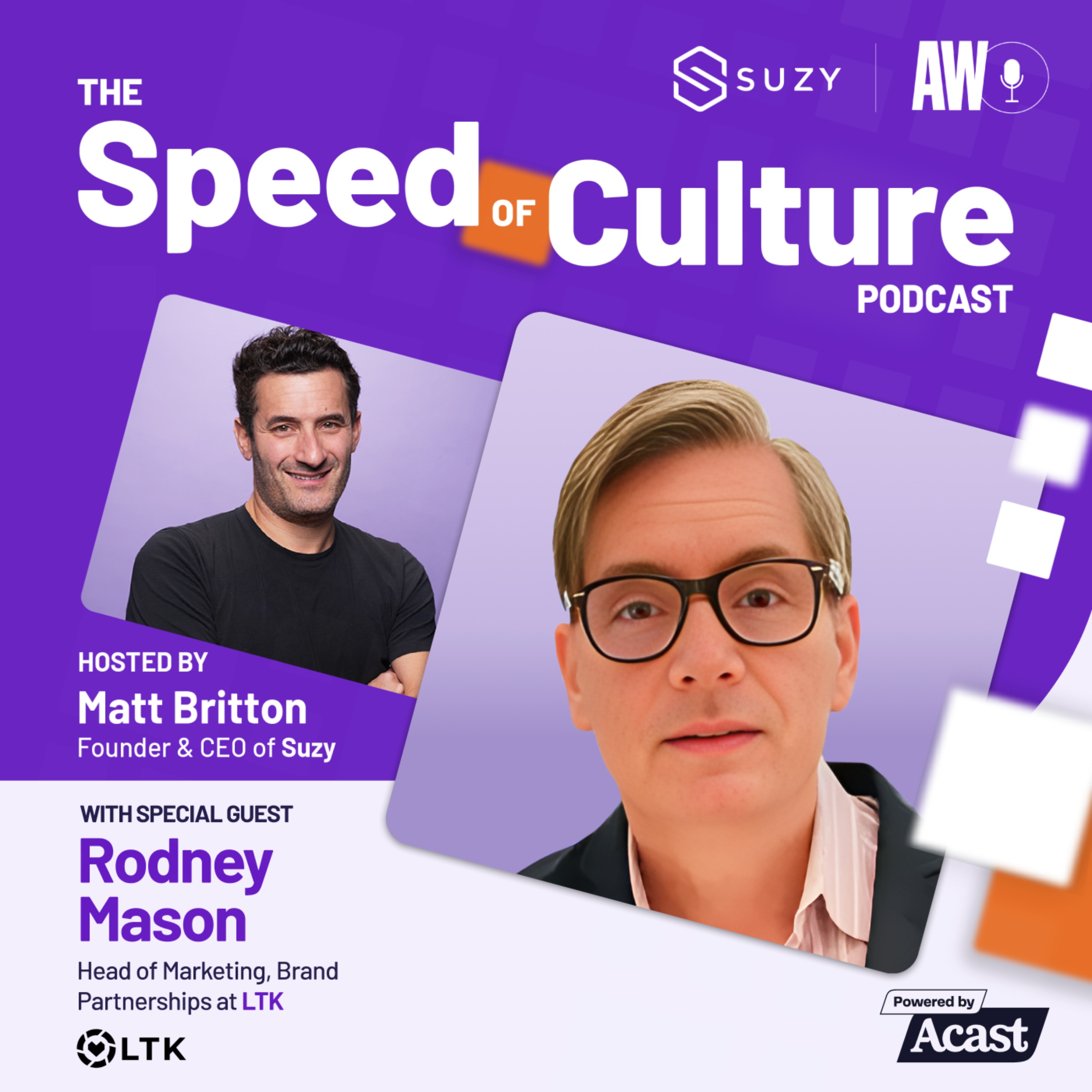
The Speed of Culture Podcast
The $5 Billion Blueprint: Rodney Mason Shares LTK’s Vision for Creator-Led Brand Growth in 2025
00:22:20
Loading summary
Transcript121 lines
- [00:00]
Marc Maron
This episode is brought to you by Progressive Insurance. Do you ever think about switching insurance companies to see if you could save some cash? Progressive makes it easy to see if you could save when you bundle your home and auto policies. Try it@progressive.com Progressive Casualty Insurance Company and affiliates. Potential savings will vary. Not available in all states.
- [00:19]
Unknown
This podcast is brought to you by eHarmony, the dating app, to find someone you can be yourself with. What makes eharmony so special? You. No, really, the profiles and conversations are different on eharmony and that's what makes it great. EHarmony's compatibility quiz brings out everyone's personality on their profile and highlights similarities on your discovery page. So it's even easier to start a conversation that actually goes somewhere. So what are you waiting for? Get who gets you on eharmony? Sign up today.
- [00:51]
Marc Maron
Our focus with brands now is to help them grow their audiences because that's what they really care about. Yeah, the sales are great. They're trying to grow their audiences and we're doing that in every imaginable way through creators.
- [01:05]
Matt Britton
To thrive in a rapidly evolving landscape, brands must move at an ever increasing pace. I'm Matt Britton, founder and CEO of Suzy. Join me and key industry leaders as we dive deep into the shifting consumer trends within their industry, why it matters now, and how you can keep up. Welcome to the Speed of Culture. Today on the Speed of Culture, we are joined by Rodney Mason, the head of and brand partnerships at ltk. With a wealth of experience across industries and a focus on innovation, Rodney's at the forefront of the creator economy, helping brands harness the power of creators to drive authentic connections and measurable growth. We're here at Media Week in New York City. Rodney, thanks so much for joining us today.
- [01:46]
Marc Maron
Yeah, thank you for having me. Super excited.
- [01:47]
Matt Britton
Absolutely. So the creator economy is something that has gained such momentum over the last couple years. It's not necessarily a new thing. I mean, the creator economy is really old to social media itself. And the interview. I was just having the conversation. We were talking, talking about how people like Martha Stewart were really creators as well, which predates social media. Why has the creator economy gained such steam as of late? What have been the really drivers of that acceleration?
- [02:14]
Marc Maron
Yeah, there's been a couple things. So LTK was founded more than 13 years ago by Amber and Baxter Box and they had the vision. They're the ones that really monetized and created the industry and it's really grown. It's kind of been quiet along the way, but something happened and that was Covid and then everybody was stuck at home and they had to buy stuff and it was easier to buy it on their phone than to get their laptop out. And then they were nervous because they hadn't bought that much stuff online and they had to buy everything and they trusted creators. So it's like, oh, I can see her wear the dress, she's my size. Or put the makeup on. Or the guy says, oh, this is my shoe size, this is how it's going to fit. So they started engaging in that way and it was kind of a safety thing. But along the way, in just the past couple of years, they follow creators entire lifestyle.
- [02:57]
Matt Britton
Yeah, they sure do.
- [02:57]
Marc Maron
It's become entertainment. It truly is entertainment. And creators have this worldview. They're all their own unique individuals and they see the world in different ways and they built these fan bases. So now it's just become this thing where it's like entertainment. And they will flip through their phones to see what the creator's saying or doing. And impulse buys are like through the roof. So you just see an exponential growth in the industry through those behaviors and habits.
- [03:22]
Matt Britton
Yeah, and you also have Gen Z, the oldest Gen z, I think 27, 28 years old. So they are growing in buying power. They're slowly becoming the heads of the household. And obviously one of the big differentiators of Gen Z is the first generation to grow up with the iPhone in the home. So they know no other world but a world with an iPhone. So to basically go to the phone for all these things is far more intuitive than this for say a Gen X or had to change the habits.
- [03:46]
Marc Maron
Yeah, and that's a great point. I mean, Gen Z, they were the first to flip open their phone and have liquor delivered to their house, whatever, food, whatever, always on their phone. And creators are that filter for them just to make sure that they're making the right purchases. It makes it easier. And so yeah, intuitively Gen Z is engaged more with creators than anybody else. But I will say millennials are massively into creators as well.
- [04:08]
Matt Britton
Sure. And of course there's a shift going on from when you talk about following people's lives and having it drive consideration, ultimately purchase. The major shift going on is consumers used to spend a lot of their time consuming scripted content. Right. They would watch TV shows and they still do to some extent. And now they find individuals who are unscripted, living their life in public, in real time, far more interesting. And the pie chart of content consumption away from scripted content to actual real life content, I think is a driver of more engagement, more eyeballs, et cetera. What are the types of, I guess, creators or unscripted content that you find growing the fastest, whether it be by vertical or industry?
- [04:50]
Marc Maron
Yeah, so it really started kind of in fashion and beauty, and now it's in every facet of industry as far as creators promoting products. But it's just more they entertain and they share their lifestyle. So you see, like, Home Depot is heavy into creators and Best Buy and I mean, it really doesn't matter. Automotive, banking, everybody is into it because this is how the creator is conducting themselves and they experience it and they'll tell you the truth if it's good or bad or not. And so you really see it in all those facets. But I would say what's different is the entertainment. It's the personality of the creator that people are really engaged with. It used to be like, oh, they look like me or they have my skin color. Now it's just literally, these folks are exactly someone that I identify with my personality. It has nothing to do with their how they dress or those types of things. It's more like they're fascinated by these creators.
- [05:45]
Matt Britton
It's also all video now, too. Like, if you think about the evolution of social media, first it was like I had pizza for lunch, they were tweeting or just writing copy. Then it was Instagram and taking photos. And now every creator has video as part of the overall platform. And video obviously brings a person to life, is far more engaging, and gives you a more of a vested interest in the decisions people make, which ultimately gives them more influence over your purchases.
- [06:09]
Marc Maron
Yeah, video is huge. And in the early days of creators, it was all flat pictures and it was. It started on blogs, and then it kind of got into Instagram and then went all over. Obviously, TikTok came in and changed a lot of things. YouTube has always been. Creators have done well with long form on YouTube. Now with shorts, it's growing, but video is massive. And that's really what people are entertained by. And that's why they love these creators. On ltk, on our platform, we've actually got a place where creators can put their homes. So on average, a creator is across three or four platforms. People go across all those platforms and follow them, they come back to their home. On LTK, we have 40 million monthly followers, shoppers that come into LTK, and one of the things we've done there is taken the actual experience and expanded video. So when you're on your phone, if you want to see that creator's video. It fills up your whole phone so you get that entire experience because video has become so huge. Yeah.
- [07:01]
Matt Britton
So let's zoom out for a little bit. And for the audience that doesn't know what LTK is, tell us about the company, its history and its offerings today.
- [07:08]
Marc Maron
Yeah. So way back in 2010, there was a personal shopper, Amber Vince Box lived in Dallas, Texas. Some super high end customers, just impeccable taste. And she was a personal shopper and she started a blog. And when she started that blog, all of her customers started following the blog. And then they're like, oh, this is great, I'll buy this myself. Because there's a website.
- [07:30]
Matt Britton
I basically personal shopping at scale.
- [07:32]
Marc Maron
She was right. And the Dallas Morning News picked up on it and she was on the COVID of the newspaper and I was like the blogger. This is the future. This is what's going to happen. Personal tastemakers are going to take off like they never have before for not just for the social media, for everybody. And they were right. And so. But Amber's business quickly tanked because everybody was following her blog and they weren't buying through her. So she wasn't getting her commission.
- [07:55]
Matt Britton
No shock. Right.
- [07:57]
Marc Maron
And she just so happened to be dating this cool guy that went to school in California, Baxter Box. He's from Texas, but he went to school at San Diego, UC San Diego. And he's an amazing technology guy. And he's like, I think we can monetize this. And so he put it all together and the technology and a platform. They got some friends together and the first week they started selling items on what is today ltk. But what LTK really is, ultimately we're the first and largest creator platform in the world. And we were built for creators to actually monetize their business and make a living. But what that's evolved to is this shopping app with 40 million shoppers. We work with pretty much every major brand retailer and all types of brands.
- [08:38]
Matt Britton
So walking through how it works with the creator. So a creator signs up to become one of a creator as part of ltk.
- [08:44]
Marc Maron
Yeah.
- [08:45]
Matt Britton
And then how they interacting with your platform ultimately monetize their presence.
- [08:48]
Marc Maron
Yeah. So they're on our platform and we give them a lot of education and training. So we have AI tools that will help say, okay, this creator has this type of content and they do. Well, this would be good for this brand.
- [09:00]
Matt Britton
This mean this product?
- [09:02]
Marc Maron
Yes.
- [09:02]
Matt Britton
So you match creators based upon their content and their audience with products that you think they could sell and monetize.
- [09:08]
Marc Maron
Absolutely. Or that align with their esthetic. Sure. Their lifestyle. And as far as that association with that brand, they have to like the brand. So Creator will not promote anything.
- [09:20]
Matt Britton
If they don't, they do, they lose authenticity. And ultimately they're.
- [09:22]
Marc Maron
They do. So they're very protective of that. So we provide all those opportunities for creators and then what happens is they'll post it on their blogs, they'll post it on social, they put it on their LTK and all their followers will buy and there's tracking. So we, when they buy on ltk, whether it's.
- [09:38]
Matt Britton
They're driving the end user to LTK purchases.
- [09:40]
Marc Maron
Yeah. So they're users to ltk, but tens of millions of people come to LTK anyway.
- [09:44]
Matt Britton
They're already there.
- [09:45]
Marc Maron
Yeah. Because they've become fans of Creator. It's kind of like Monday Night Football, Sunday Night Football for creator fans. Super fans.
- [09:51]
Matt Britton
Right.
- [09:52]
Marc Maron
So they all come in there and they can shop and they can look at their creators. They like the consumers can look around. But anyway, we provide that experience and then it's trackable. So if they buy a sale from a major department store, I won't say any names or from a big discounter or whoever, it actually ends up on their site and the transaction is made, but it's all tracked and everybody earns commissions from it. And they're not just paid, we scale. So that's one way they're monetized. But really our focus with brands now is to help them grow their audiences because that's what they really care about. Yeah. The sales are great, but they're trying to grow their audiences. And we're doing that in every imaginable way through creators.
- [10:29]
Matt Britton
Gotcha.
- [10:30]
Marc Maron
Yeah.
- [10:30]
Matt Britton
And how are you building your brand with creators? Because I would imagine a big part of it is building that network of creators because that's essentially the content and the lifeblood of the business.
- [10:39]
Marc Maron
Yeah. So again, we work with a variety of clients and the way they built their brands with Creator, we've actually done brand lift studies for some of the biggest retailers in the world. A large percentage people, especially Gen Z and also millennials, will say, I started shopping at this store more, or I shopped the store more because of LTK creators. So you get that brand lift out of it, you get that authenticity out of it. But there's other things besides commissionable links that we do, you know, like connected TV and all types of ads, user generated content on the site. So they're demonstrating the products. It might be a shoe brand demonstrating it on a retail website that not only demonstrates the shoes and the size and the color, but it also helps with the SEO.
- [11:21]
Matt Britton
Sure. But not only are you clamoring for brands, but you also need a platform that creators feel comfortable coming to monetize their presence because there are other platforms in the marketplace. What is marketing to creators look like and how do you make sure your platform continues to become appetizing for creators to call home?
- [11:39]
Marc Maron
Yeah. So creators have an affinity to us because we were the first and we've continued to innovate and we have tools that nobody else has.
- [11:48]
Matt Britton
Yeah, Functionality.
- [11:50]
Marc Maron
Yeah. I mean like we have leaderboard for brands. LTK Leaderboard. It shows a brand all of their top performers and they're not just the top performers from a creator that you paid. It's organic creators that are talking about. And so that's a benefit for a creator. It works both ways. We also have ways for them to develop their content and monetize it. We created products like LTK Boost where we're actually taking the creators post and then we're having the brands invest dollars to scale.
- [12:19]
Matt Britton
That's cool.
- [12:19]
Marc Maron
That creator. So if the creator is working, it's like let's scale it. We immediately everybody happens and then the creator grows their audience, the brand grows their everybody wins. Plus you can hyper target on that. So if a brand is based in New York and they want to talk to New York and la, you can take that creator post that's reaching people nationally and then you can start geotargeting.
- [12:37]
Matt Britton
The power of programmatic media.
- [12:39]
Marc Maron
But I kind of sum that up. There's just a lot of different ways it's a win win for the brand and the creator and the consumer because we're a three sided marketplace.
- [12:48]
Matt Britton
We'll be right back with the speed of culture after a few words from our sponsors.
- [12:53]
Unknown
This podcast is brought to you by eHarmony, the dating app to find someone you can be yourself with. What makes eharmony so special? You. No, really, the profiles and conversations are different on eharmony and that's what makes it great. Eharmony's compatibility quiz brings out everyone's personality on their profile and highlights similarities on your discovery page. So it's even easier to start a conversation that actually goes somewhere. So what are you waiting for? Get who gets you on eharmony? Sign up today.
- [13:21]
Marc Maron
This episode is brought to you by Progressive Insurance. Do you ever think about switching insurance companies to see if you could save some cash? Progressive makes it easy to see if you could save when you bundle your home and auto policies try it@progressive.com Progressive Casualty Insurance Company and affiliates. Potential savings will vary. Not available in all states.
- [13:43]
Matt Britton
So in terms of the platforms Today, you have TikTok, you have Snapchat, you have Instagram, Instagram Reels, YouTube, et cetera. Who are the ones that really seem to be gaining steam with creators and I guess overall consumer adoption. And who do you think is going to continue to have that momentum heading into 2025?
- [14:00]
Marc Maron
Yeah. So we have this law at LTK, it's called the LTK law. Every three years a new platform emerges, becomes dominant, and it might be dominant.
- [14:08]
Matt Britton
So what's emerging now?
- [14:09]
Marc Maron
Well, that's a great question. So definitely TikTok exploded.
- [14:13]
Matt Britton
Yeah.
- [14:14]
Marc Maron
Instagram was doing great. You've got shorts coming on. We've even seen a resurgence in. Well, all these platforms are doing great, but there's more interest in Pinterest now. There's more interest even in Twitter. Believe it or not, people think that's controversial, but we do a lot of studies and we see that.
- [14:28]
Matt Britton
So I'd say interesting.
- [14:29]
Marc Maron
All platforms are doing well. What's kind of going on in the social sphere. And creators are not just in the social sphere, but what's going on there is the platforms have really gotten to the algorithm of getting people to scroll.
- [14:41]
Matt Britton
Yeah.
- [14:42]
Marc Maron
Because they get to run ads so that it's less of a community. So consumers are still going there and being entertained, but for their community, they're sticking with creators and going to their home. That's why, I mean, LTK has really exploded. A few years ago, we didn't have 40 million people on the platform. And there's other places that they go. So people still want community. And I think social media is going to go back to community. Certainly they're going to monetize.
- [15:04]
Matt Britton
You're going there to connect with other people.
- [15:06]
Marc Maron
And right now, like, if you wanted to see your friends on a major platform, you can't even see what's going on with them because someone didn't like it 10 times in the first two minutes.
- [15:15]
Matt Britton
Right. So the algorithm kind of buried them.
- [15:16]
Marc Maron
Yeah. And it's gone to. Which is.
- [15:18]
Matt Britton
That's what you only see the popular people overall and.
- [15:21]
Marc Maron
Exactly.
- [15:22]
Matt Britton
Beauty used to be your old high school friend. You see what they're up to. It's all you have to seek it out.
- [15:26]
Marc Maron
Linear television, basically, this is what's on. Except linear television that knows exactly the kind of things that you like. But if you see it over and over and over, really interesting, it gets kind of boring.
- [15:36]
Matt Britton
And I think what's happened as a result, you look at a platform like Instagram and no one's really posting on their walls anymore.
- [15:41]
Marc Maron
Yeah.
- [15:42]
Matt Britton
Because they're not getting as much engagement, they're not getting as much likes. And as a result, that kind of further drives what you're talking about. There's fewer and fewer people that are creating and they're creating more, but those people aren't necessarily your friends, which then makes it devoid of community.
- [15:59]
Marc Maron
Yeah. Now I would say it's a little bit different for creators just because their fans are super. I mean, first of all, people like their stuff right away.
- [16:07]
Matt Britton
High school friend. It's just different.
- [16:09]
Marc Maron
Yes.
- [16:09]
Matt Britton
Yeah.
- [16:09]
Marc Maron
So, I mean, creators still do well on the platforms, but just that communities right now at this point, it doesn't mean that anybody's doing anything wrong. They're trying to monetize and they're doing a good job of it. But that's really how it has evolved. And that's a big shift in the consumer that we're seeing. Consumers are looking for places for community like ltk. Right. I mean, it's crazy.
- [16:28]
Matt Britton
And you've also seen these new habits in social media where you can just publish, like a close friends or small group.
- [16:34]
Marc Maron
Yes.
- [16:34]
Matt Britton
Can't keep in touch. And obviously there's WhatsApp groups and.
- [16:37]
Marc Maron
Yes.
- [16:37]
Matt Britton
IMessage groups and other ways that people are building community outside the social sphere.
- [16:41]
Marc Maron
Yeah. Even Snap, like Gen Z, if you sit with someone in college, they sit here and they do this and they take a picture of like their forehead or their nose or something, they're sending it to each other, like saying, yeah, yeah, I'm here, I'm still alive.
- [16:51]
Matt Britton
Yeah.
- [16:52]
Marc Maron
Still doing this stuff.
- [16:53]
Matt Britton
Yeah.
- [16:54]
Marc Maron
I mean, that's what social media was and that's not what most of the platforms are now.
- [16:58]
Matt Britton
People do pray that it's like Reddit too, where they're in community.
- [17:01]
Marc Maron
Absolutely.
- [17:02]
Matt Britton
Yeah.
- [17:02]
Marc Maron
Yeah. And just even being able to communicate in those kinds of ways, even if it's just a simple picture of your nose or waving or some kind of liking a picture.
- [17:11]
Matt Britton
I'll send you a picture of my nose later.
- [17:12]
Marc Maron
It means that, hey, I'm thinking about you. I thought of you. I was here, I passed by. And that's really important.
- [17:17]
Matt Britton
Yeah. So what role do you see AI playing in the creator economy? And are we going to be seeing more AI created influencers or more content that's actually not really created by creators because they're just using canvas, I'm told, to do it. Like, how do you see that evolving the Social media experience.
- [17:32]
Marc Maron
Yeah. So we really see AI as a massive opportunity for creator. Not in the way that people think. They're like, oh, you're going to have these avatars and it's. I mean, that's going to be out there and it is a little bit, but it's really not that. So the way we think about creator is kind of in three ways. If you just kind of break it down, there's the reporting and insights, and then you have the creative and the content and then you have the media and the personalization. So in each of those areas you have to have data to fuel that.
- [18:03]
Matt Britton
Yeah.
- [18:03]
Marc Maron
And that's something that we have. That's why we're excited, because we have more data than anybody else. We have the platform been around longer. But what happens is everything gets easier to take creator across all types of media and optimize it. So you might have a creator that's perfect on YouTube in a long form to help sell a car. That's not going to be so good on TikTok.
- [18:25]
Matt Britton
Right.
- [18:25]
Marc Maron
And it just helps you figure all those kinds of things out or what type of messaging to deliver. Also, it can help creators as they're developing their creative. AI now has tools. There's a lot of them. I could name them, I won't do that. But there's a lot of tools that will say, don't examine what you're writing or how you write. And then you got your tone of voice. Then they're like, oh, I want to write this about this. And all of a sudden their content's done for them in a matter of seconds. And then they can edit it. So it helps them in. I want to write it for these platforms so it helps them get to market faster. It also because we have so much data, we can see shopper data and what they engage with, or we can see the types of content that is appealing and all of that stuff is really helpful. We do have tools like LTK360 and it literally shows brands like every point of connection in a campaign that they've run organic or paid from, of course, roas, but like earned media, value, sentiment, impressions, and then we build in there like the leaderboard and here's all the creators, the ones you're paying, the ones you aren't paying, and how they're performing for you and these different ways. It's like you can geek out on it, but not too far from now. You can plug that into your AI and then it's going to have you cherry pick what you want and, and move faster.
- [19:35]
Matt Britton
So when you talk about brands and obviously it sounds like LTK has some awesome tools that really enable brands to understand attribution and things of that nature. Is it easier now to get brands bought in on buying into this? Because obviously they have a finite amount of dollars and they're still spending money on linear television and search and direct paid social. And now there's something alternative which is becoming less alternative every day, which is ltk. What is the story of the brands and how much easier has it been given all the buzz around creators to get them to buy in?
- [20:06]
Marc Maron
Yeah, so I'm not sitting here promoting ltk. I'll just add some validity to this.
- [20:10]
Matt Britton
You can, that's fine.
- [20:11]
Marc Maron
Well, we partnered with Northwestern University and last year and this year we did brand studies this year with 185C level marketing decision makers. And at the very top of their list on growth and investment and where they're spending, at the very, very top is two things connected, TV and creator. And they're doing that because they're seeing it work for them across all swaths. So for us to get brands to buy into creator, we don't have to do that anymore. We don't have to convince them. It's more about where are we using them, how are we using it, how can we scale it? They want events, we're doing events. And you heard it today at Media Week, people were talking about events. Creators can add another level to events. But if you're looking across all media, it's more about a brand is showing up in what used to be maybe the affiliate marketers or the performance marketers or the PR people. Now, even from our study with Northwestern, the number one group in a marketing organization that works with creators is media and number two is the branding group. And way down at the bottom is the affiliate and all these others. So the whole creator is like moved across the entire organization.
- [21:21]
Matt Britton
Right. It's gone from really tactical and functional to being something that, yeah, is great, I guess. Full funnel.
- [21:27]
Marc Maron
Exactly. That's what we call it and that's why we have 360. And when you're talking, it's a different conversation that you're having. And you have to really understand the brand, what their message is, how they're doing it, which we always hear it about that, but it's more about how can they get in the conversation, how does that weave in the conversation and where are all the touch points to do it. And those are the kind of conversations that we have every day.
- [21:48]
Matt Britton
Makes sense. So, wrapping up around me, is there a creator that you love to follow on social media that we should know about?
- [21:54]
Marc Maron
So I will give a plug. I probably shouldn't do this, but there's a creator on LTK and I follow her because she has a similar taste to my wife and her name is interior designer Ella. I guess when she started, she was a school teacher. She's a LTK millionaire. She makes millions of dollars. People follow her, but she has excellent taste. And the reason that I follow her is mainly for gifts for my wife because they're similar.
- [22:18]
Matt Britton
It's very sweet.
- [22:19]
Marc Maron
Yeah.
- [22:20]
Matt Britton
Yeah.
- [22:20]
Marc Maron
So it makes it easy for me.
- [22:21]
Matt Britton
Gotcha. Very cool. And just to wrap up here, do you have a mantra saying that you like to live by that maybe sums up your career and what you're doing in ltk?
- [22:28]
Marc Maron
Yeah. So I always just tell everybody, be excellent at everything that you do. Like, just do your best and that's all you have to do. If you do that, that's going to carry you.
- [22:38]
Matt Britton
Easier said than done sometimes, right?
- [22:39]
Marc Maron
It is, but it's not. I mean, it doesn't matter what your job is or what you're doing in life. If you just try to be your personal best at that, you really try. And you don't say, oh, man, I'm sitting here, I'm doing this. Like, you are the best at whatever that is, your best. That's going to follow you, it's going to carry you.
- [22:53]
Matt Britton
So awesome. We're going to leave with that. Thanks so much for taking the time very Media Week to share your deep insights and wish you nothing but luck as you continue to build the LTK business.
- [23:02]
Marc Maron
All right, thank you so much. Appreciate it.
- [23:04]
Matt Britton
On behalf of student adwee Team, thanks again to Rodney Basin, head of marketing and brand partnerships at ltk, for joining us today. Be sure to subscribe, rate and review to Speed of Culture podcast and your favorite podcast platform. Till next time, see you soon, everyone. Take care. The Speed of Culture is brought to you by Suzy as part of the Adweek Podcast Network and a guest creator network. You can listen subscribe to all Adweek's podcasts by visiting Adweek.com podcast. To find out more about Suzy, head to Suzy.com and make sure to search for the Speed of Culture in Apple Podcasts, Spotify or anywhere else podcasts are found. Click follow so you don't miss out on any future episodes. On behalf of the team here at Suzy, thanks for listening.
- [24:03]
Unknown
If you're a facilities manager at a university, you know students rely on the cafeteria for breakfast, lunch, dinner and the occasional late night snack. So when a dishwasher breaks down and dirty plates pile up, the mess hall can turn messy in the blink of an eye. Enter Grainger. With over a million industrial grade products and fast delivery, the product you need now is never far away. So you can turn that dishwasher back into a lean, clean washing machine. Call click grainger.com or just stop by Grainger for the ones who get it done.
- [24:34]
Marc Maron
Hey, it's Marc Maron from WTF here to let you know that this podcast is brought to you by Progressive Insurance. And I'm sure the reason you're listening to this podcast right now is because you chose it well. Choose Progressives Name your price tool and you could find insurance options that fit your budget so you can pick the best one for your situation. Who doesn't like choice? Try it@progressive.com and now some legal info. Progressive Casualty Insurance Company and affiliates price and coverage match limited by state law not available in all states.