← The Speed of Culture Podcast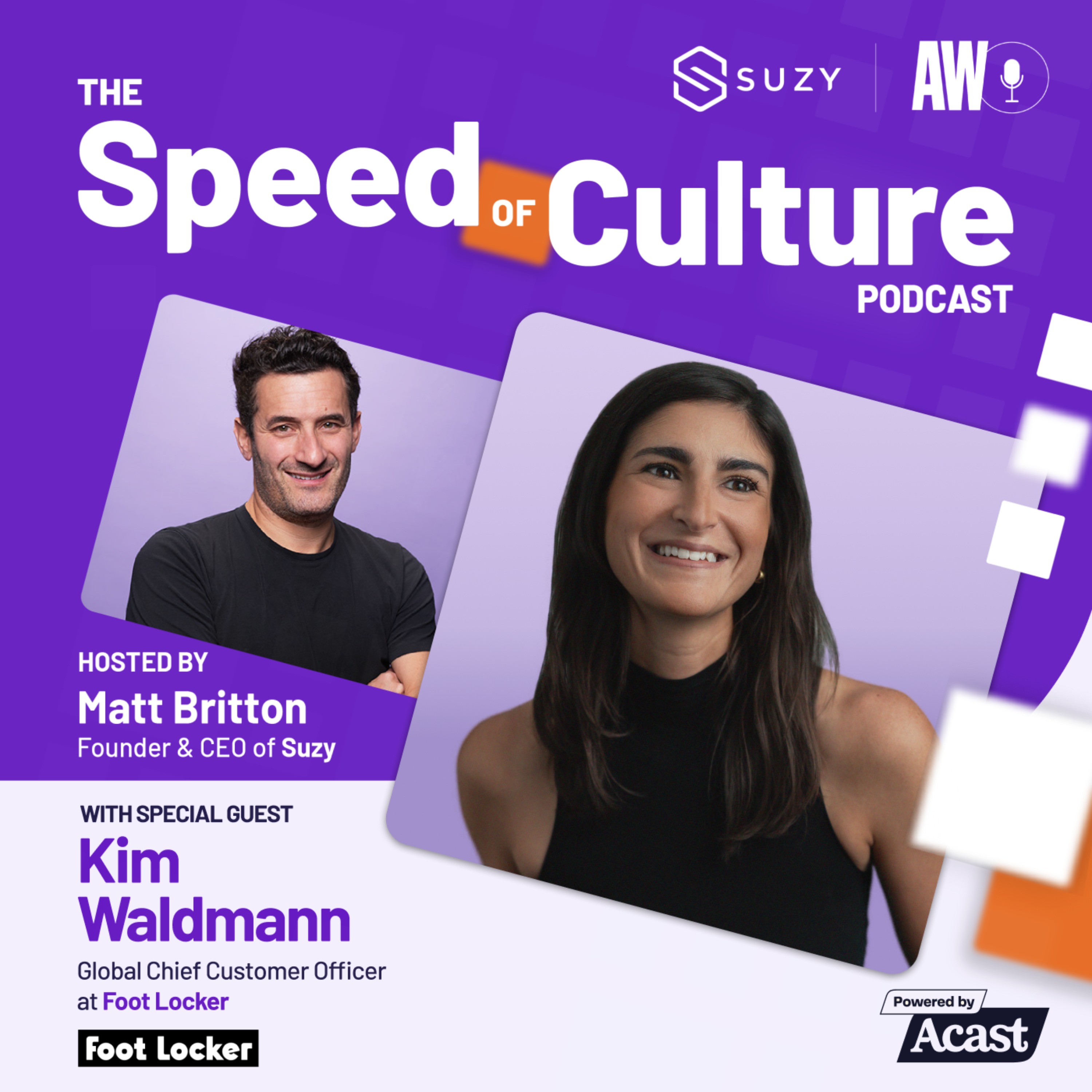
The Speed of Culture Podcast
The Future of Sneaker Culture: Kimberly Waldmann on Foot Locker’s Innovative Retail Strategy
00:31:29
Loading summary
Transcript69 lines
- [00:00]
Shopify Representative
Selling a little or a lot. Shopify helps you do your thing however you cha ching. Shopify is the global commerce platform that helps you sell at every stage of your business. From the launch your online shop stage to the first real life store stage all the way to the did we just hit a million orders?
- [00:19]
Kim Waldman
Stage.
- [00:20]
Shopify Representative
Shopify is there to help you grow. Shopify helps you turn browsers into buyers with the Internet's best converting checkout 36% better on average compared to other leading commerce platforms because businesses that grow grow with Shopify Get a $1 per month trial period at shopify.com work shopify.com work.
- [00:42]
Kim Waldman
My dad works in B2B marketing. He came by my school for career day and said he was a big roas man. Then he told everyone how much he loved calculating his return on ad spend. My friends still laugh at me to this day.
- [00:56]
Matt Britton
Not everyone gets B2B, but with LinkedIn you'll be able to reach people who do. Get $100 credit on your next ad campaign. Go to LinkedIn.com results to claim your credit. That's LinkedIn.com results. Terms and conditions apply. LinkedIn the place to Be to be.
- [01:16]
Kim Waldman
Today you got to get your brand codes right. You have to have your platform right. You got to have what you stand for right. But ultimately, taste makers, culture bearers are going to interpret that and that's actually what's going to impact your customers at the end of the day.
- [01:30]
Matt Britton
To thrive in a rapidly evolving landscape, brands must move at an ever increasing pace. I'm Matt Britton, Founder and CEO of Suzy. Join me and key industry leaders as we dive deep into the shifting consumer trends within their industry, why it matters now, and how you can keep up. Welcome to the Speed of Culture update on the Skeet of Culture podcast. We are thrilled to be joined by Kim Waldman, the Global Chief Customer Officer at Ford Foot Locker. Kim has been at the forefront of driving digital transformation and customer engagement, helping to expand sneaker culture and shape Foot Locker's future. Kim, so great to see you today.
- [02:06]
Kim Waldman
Yeah, thanks so much for having me Matt. Excited to be here.
- [02:09]
Matt Britton
So the sneaker category has for so long kind of been a driver of consumer culture. You date back to the Air Jordans and kind of everything that's happened since. And obviously sneakers themselves have kind of crossed the chasm just from being performance or sports related to being more of a fashion statement as well as we know in pop culture. How has the sneaker category evolved from where you stand over seeing kind of the whole customer segment of Foot Locker?
- [02:37]
Kim Waldman
Yeah, absolutely. I think it's a really exciting time to be a part of sneaker culture. And really kind of our main mission at Foot Locker is to unlock the inner sneaker, head in everyone and invite more people into the category. And I think where we're seeing that happen is a couple different places. Number one was with women. And women's is actually the fastest growing business within our total business at Foot Locker. And that's a lot driven out of the fact that we are seeing more women engaged in sneaker culture, whether that's through the lens of basketball as the new tunnel walk, or whether that's through the lens of more and more women actually dressing kind of from the shoes up and anchoring their looks in the sneakers that they're wearing. So I think that's one really key example. I also think the sort of words of sports, music and kind of pop culture are really merging, where you have kind of athletes being influencers in their own rights and then influencers and artists playing sports off the court, and that being part of the cultural zeitgeist. And I think sneaker culture plays into all of that.
- [03:36]
Matt Britton
Absolutely. And how do you guys look at sort of this burgeoning resale market with all these companies where. And a lot of young kids, frankly, that are taking their old sneakers and reselling them? Is that a good thing for Foot Locker because it's kind of like a rising tides raises all boats, or does that hurt your share volume because less people are buying new sneakers?
- [03:55]
Kim Waldman
Yeah, I mean, the resale market has been part of the ecosystem for a long time, and it will continue to be. And I think it creates some indication of heat and covetability within the market, and we appreciate that. And so we think it has its role to play. Ultimately, though, the vast majority of consumers want to buy through kind of the store experience that we provide and a more mass market offering. And that's really where we play a role.
- [04:18]
Matt Britton
Yeah, I mean, if you think about it, the sneaker culture kind of drives the fringe, and the fringe drives the masses, and the masses are going to come in the footlocker and buy their sneakers. But without that fringe, there probably would be less momentum for the category overall.
- [04:31]
Kim Waldman
We definitely see it playing an incredible role. And I think there's a lot of other things that authenticate kind of what is cool within sneaker culture, and then we help really accelerate that with a young consumer who is trend forward, but then kind of further authenticates it more broadly in the marketplace and what we hear again and again from our customers is two things that Foot Locker provides. Right. One is there's nowhere out there where you're going to get the same level of broad assortment that we offer, whether it's resale or neighborhood. Right. Like we offer kind of that choice for the consumer. And then two, our stripers, our store associates, like the confidence that they give you to try something new. And that heat on your foot looks really, really good. You're not going to get that in a resale marketplace. And I think that's not going to change over time.
- [05:17]
Matt Britton
Agreed. So obviously we've seen so much consumer purchasing behavior shift online. And just from a focus group of one, I have a hard time ordering sneakers online because it can't ever really replace the feeling of trying them on and walking around like one of your stores and seeing how they feel. How have consumers change over? Because I know that's just me and. But at the same time, a lot of people are buying sneakers online. How has the, I guess, mix evolved over time with the consumer, particularly with regards to sneakers?
- [05:49]
Kim Waldman
Yeah, so I would say sneakers is one of the most kind of omnichannel shopping experiences you can have. And I think what's exciting that we see within our business is definitely more and more shoppers are shopping both channels. And so it's not like as our digital business has grown and will continue to grow, like all of a sudden people aren't going into the stores actually. It's just an incremental purchase and an incremental visit. Or we see more and more that they're doing their pre shopping online and figuring out exactly what they want, but then sort of validating that to your point that it fits and it looks great in the store environment. And so the two channels are really fueling each other. A key investment we're making kind of against that is our new mobile app experience, which is coming out and I think really fuels that idea of, okay, I'm going to get inspired by this new hot release, but I'm going to go get it in store or I'm going to be in the store and they maybe don't have the exact colorway that I want, but I can really, really quickly scan that shoe, look it up and see where it's available online. I know that it fits, but I just want a different color and I'm going to order that from our site.
- [06:47]
Matt Britton
Yeah, and you mentioned your stripers, and it's such a great point because I think where a lot of companies struggle with retail, physical retail, is that there's no real value add of the store itself. So with you, you have these stripers, you have the ability to try on the shoes. There's a lot that you're offering the consumer for going into the store. And I would imagine that's an important part of making sure that the livelihood of your brick and mortar establishments continues over time.
- [07:14]
Kim Waldman
Yeah. I mean, Mary, our CEO, has a line, and I totally agree with it, which is like, the death of the store has been greatly exaggerated. We're like, we don't see any of that within our business. Right.
- [07:23]
Matt Britton
And a lot of companies are saying that right now.
- [07:25]
Kim Waldman
Yeah. And we just launched our new store experience. We're calling it Footlocker Reimagined. And in that store experience, you have at the front of the store a trend zone that tells you exactly kind of what the latest kind of sneaker culture trends are. You've got experiences where you can actually figure out what your size is, if you don't know which. We see a lot in the kids business. And so there's so many ways. And then, not to mention. Right. The stripers and sort of them being able to tell you kind of about their product knowledge and what the latest trends are. But there's so much in that physical environment that I think is not going to be replicated by technology and will continue to fuel our business in the future.
- [08:02]
Matt Britton
Absolutely. So at the onset of this interview, you were talking about women's sports and women's basketball, and obviously WNBA is seeing dramatic increase in viewership and value of teams and kind of across the board. And catalysts like Caitlin Clark have a lot to do with it, but just the sport has gotten so much more popular, and it's been kind of growing for time, but it feels like it's just kind of hit a tipping point when you see, I guess, that type of growth in a particular category. How does that make you think about the total store layout and experience? Because growing up, I can't recall there being a huge woman's presence, specifically in a footlocker. And it seems like over time, it's continued to get larger. How do you see that evolving?
- [08:42]
Kim Waldman
Yeah, that's exactly right. And it's a huge area of focus and commitment for us in our new store experience, you'll see a much greater portion of the space dedicated to women's. But it's not just the store. It's also kind of our marketing and storytelling. And so what you've probably seen in the last year from us and you'll continue to see is more kind of women centric campaigns where we do lead with, whether it's sports leaders like Sabrina or Brianna Stewart who have amazing signature basketball shoes, or artists like Coi Lerae or Flo Milley who are culture bearers, but also really appear to like a core Gen Z audience that's into sneaker culture. We're really leading with style and trend through the lens of women's in a way that maybe Footlocker hadn't in the past.
- [09:24]
Matt Britton
Absolutely. And then another thing I saw a couple of weeks ago, which I thought was awesome, was this partnership you guys have with the Bulls. And specifically it's around the part of that partnership is about kind of this tunnel walk concept. And I think the concept of the tunnel walk for those of our listeners that might not be as familiar is, I think over time, especially with social media, the game is extending and it's extending in a lot of ways before the game in terms of how do people walk up to the venue, what are they wearing? And that's kind of like a fashion statement that before social media, most people wouldn't get exposed to. So it really does kind of, to your point earlier, Kim, kind of merge sports and fashion in a way that we haven't seen before. Talk to us about the Bulls partnership and the tunnel walk program specifically.
- [10:07]
Kim Waldman
Yeah, super excited about that partnership. And I think it was just kind of a no brainer for us when you think about sort of the role that Chicago plays in the history of sneakers. And then in 1985, Air Jordan won just such an iconic city when it comes to sneaker culture. An important sneaker buying market today. And so it felt like a natural kind of partnership for us with them. And then the tunnel walk experience itself, I think is a really fun way to manifest that. So essentially it's branded with some of our Foot Locker brand codes, our striper, really kind of exciting background for influencers and players to walk through before the game and after the game every single day to showcase the latest fits. And we'll be creating a lot of content around that that again brings together to your point, kind of athletes and the shoes that they love and really creating looks around it.
- [10:56]
Matt Britton
Yeah. And I think a big driver which will definitely make a program like this successful is the fact that your core audience, I would imagine, is largely Gen Z. Right. They're ages 12 to 27. Huge purchase. It's not your only demographic, but huge purchase of sneakers. Gen Z, obviously what distinguishes them is they were the first generation to grow up with the iPhone in the household. So it's very first mobile first. And when this generation is looking at their phones, they're not really looking as much at content from traditional broadcast sources. They're looking at content in news feeds from other people. Which, of course brings up the big trend of kind of creator culture and creators in general. How is Foot Locker looking at the creator movement and what are some of the ways you're looking to tap into influencers to make sure that you can capture appropriate mind share amongst the Gen Z demographic?
- [11:41]
Kim Waldman
Yeah, I think that's exactly right. And I tell my team that all the time. I'm like, gone are the days where, like, a brand would control its narrative and sort of all the content associated with how it wanted to show up. Today you got to get your brand codes right, you have to have your platform right, you got to have what you stand for right. But ultimately, tastemakers, culture bearers are going to interpret that, and that's actually what's going to impact your customers at the end of the day. And so we think about that a lot, and I think a perfect example of that is when we launched the AE1 shoe, Anthony Edwards first basketball signature shoe. One of the biggest launches in sneaker culture over the last year. We did a sweet night experience at a Timberwolves game, and through that, launched the shoe that way, essentially inviting in a bunch of players but influencers in the sneaker culture community to sort of see the shoe experience the brand, and then they shared that out across their channels to generate heat around the product. And I think that's sort of a playbook that you'll see from us across the board, in addition, obviously, to the brand campaigns that we create, because we think that's so important in terms of how we're going to reach the young consumer, for sure.
- [12:46]
Matt Britton
And when Footlocker in general looks at planning for 2025 and you think about allocating resources to make sure that you're capturing mindshare, you're driving growth for the business. How are you looking at something like working with creators and getting content created and getting it in the newsfeed versus more traditional media, whether it be television or radio or billboards or things that in a lot of ways are associated with an old way of marketing, but a lot of marketers will still say, drive a lot of great roi. So how are you looking at the overall mix moving forward?
- [13:17]
Kim Waldman
Absolutely. I mean, ultimately, you got to start with, like, what's the objective for your brand and what are the challenges that you have at Foot Locker? We have over 90% brand awareness, people know who we are and really the goal is going from being what is an iconic brand to being an influential brand. And I think that strategy obviously impacts our media mix. There is still going to be a role for those big billboard moments. And I think it's important again to reinforce kind of the core ethos of the brand, the brand codes and who you stand for in a way that you can really kind of own and control. But for us, a lot of the mix really is going to be through kind of the lens of influencers, creators and working with our brand partners as well to tell that story at broader scale makes sense.
- [14:02]
Matt Britton
So obviously being a retailer, especially being on the channel, you have the ability to capture first party data, which is something that a lot of CPGs and food and beverage companies don't have the ability to do, which in this day and age is kind of marketing gold because you get to know so much more about your consumer. How are you guys leveraging that first party data to drive your go to market strategy?
- [14:24]
Kim Waldman
To your point, it is marketing gold, but I think with marketing gold comes great responsibility to like be relevant. And I think that that's the sort of high bar that we want to set for ourselves is how are we leveraging that insight to really deliver kind of a personalized and relevant experience. And I think part of the goal of relaunching our loyalty program, FLX Rewards was to be able to do that in a more effective way. So over the summer we relaunched the program to really kind of democratize the value proposition and invite more customers in so that tomorrow anybody that signs up can get benefit out the gates through getting cash back for the points that they earn, that's going to allow us to have more people kind of in the ecosystem and then be able to tailor communications to you. If you're a basketball fan about the latest signature shoes, if you're more interested in trend and style that low profile is in, and here are some recommendations for you. Or if you're more of an active athlete and a performance runner, we're going to focus on the latest trend in intact and cushioning. And I think that's what having this new, more widely adopted loyalty program will really do for us.
- [15:31]
Matt Britton
Yeah, and when you talk about personalization, which is obviously buoyed by your ability to capture first party data, which obviously you earn through like quality programs, personalization I think is going to take a huge leap in the years ahead because of AI and I think the notion of one to one newsletters, for example, or one too many where you're basically saying one newsletter to males 18 to 34 versus females, et cetera. I think it's going to be everybody who signs up for Footlocker is going to get their own email.
- [15:59]
Kim Waldman
I think that's right, yeah.
- [16:00]
Matt Britton
So how far are we and how far is Footlocker away from a world where you can bring that to life?
- [16:06]
Kim Waldman
Yeah. So just to kind of back up what you said, I think consumer expectations are going to change so quickly around this. I mean, if anybody who's used ChatGPT, right. You can just put in a question in your own language, in your own context and it like gets you. And so I think as a result, the expectations for any consumer interaction interface are going to be that. It's just like it gets you. It's super relevant.
- [16:29]
Matt Britton
I'm so glad you said that. I mean, Gen Alpha, by the way, they're the next generation. They're age 0 to 15 now. They're going to be the first generation to grow up with the AI in household. So just like how Gen Z knew no other world but one with an iPhone. Gen Alpha, which is probably already. Some of your customers know no other world but world AI and their expectations are going to be everything you just said as the baseline.
- [16:50]
Kim Waldman
As a baseline. And if it's not that, like, no, thank you, I'm moving along. And so I think it is early phases on some of this stuff, but I think the adoption curve is going to move super quickly. I mean, one thing where we do see it showing up is powering our search results as well as kind of our browse results on our website. Gone are the days where any two consumers are going to see the same products at the top or the same kind of merchandising. It's really going to be all about sort of what is most relevant to you based on the various signals we have about your behavior and interests.
- [17:22]
Matt Britton
We'll be right back with the speed of culture after a few words from our sponsors.
- [17:25]
Kim Waldman
For all your meeting, event and workplace needs. Convene is a partner, not just the place. A preeminent global hospitality company within the meeting, event and shared workplace industries. The company and its portfolio of brands provide clients with concierge style service in house, food and beverage in house, event production resources and dedicated service staff, all to ensure a seamless and memorable experience.
- [17:54]
Shopify Representative
Selling a little or a lot. Shopify helps you do your thing. However you Cha ching. Shopify is the global commerce platform that helps you sell at every stage of your business. From the launch your online shop Stage to the first real life store stage. All the way to the did we just hit a million orders Stage. Shopify is there to help you grow. Shopify helps you turn browsers into buyers with the Internet's best converting checkout 36% better on average compared to other leading commerce platforms. Because businesses that grow grow with Shopify. Get a $1 per month trial period at shopify.com work shopify.com work My dad.
- [18:36]
Kim Waldman
Works in B2B marketing. He came by my school for career day and said he was a big Rozman. Then he told everyone how much he loved calculating his return on ad spend. My friends still laugh at me to this day.
- [18:50]
Matt Britton
Not everyone gets B2B, but with LinkedIn you'll be able to reach people who do get a hundred dollar credit on your next ad campaign. Go to LinkedIn.com results to claim your credit. That's LinkedIn.com results. Terms and conditions apply. LinkedIn, the place to be. To be. And what are some other ways you're thinking about AI either currently impacting your work or doing so in the future? Whether it be on the creative side, the data side, et cetera. I'm just curious from where you sit, how you're looking at it.
- [19:21]
Kim Waldman
Yeah, we're excited about across a variety of areas, but one area where we really started to dabble our toe in is the creative side of things. And I think a great example is we operate across Europe and you can imagine any one time sort of the variety of consumer preferences, trends and styles, but also temperatures across different countries. And so what we're doing is leveraging AI to dynamically update the setting and the background for all of our different images so it's contextually relevant for the consumer. That may be in the Netherlands versus in Naples, Italy. And that way we don't have to create 17 versions in order to serve the customer across that marketplace.
- [19:58]
Matt Britton
Yeah. So as a retailer and obviously a big and important cultural category, you see a lot of brands come in and out and go up and down and we're really seeing that in the sneaker category right now. You have these new entrants like on and Hoka and all these new companies where it used to be for so long it was just like Nike, Adidas, Reebok, and now you have these new players that are popping up that are gaining a lot of momentum. Why do you think that is? And from where you sit, what is the commonality when you see a brand really take off, that they do, Right?
- [20:29]
Kim Waldman
Absolutely. I mean, I definitely agree, like consumers want More choice. And I think to the conversation we just had, right. We're seeing that across a variety of kind of needs, preferences and categories. And that is absolutely entering into sneaker culture. And I think what that does is it's exciting because it creates a way to tell a broader range of stories. And also those brands like you mentioned on and Hokar are inviting new consumers into sneaker culture. Those in particular are definitely over indexed into women. And so I think that is super cool to see in terms of kind of what makes brands successful. I think that the themes that we see across are definitely product innovation, what's new that they're kind of bringing to the table. That's kind of a hook. And to be interesting, I think a lot of these brands like the drop model and consistent newness really, really works very, very well to engage the customer. And then it's got to work like performance and pay off. And I think we're seeing a ton in the lifestyle running space where the anchor is really in kind of performance and running and you got to be able to do a run in it. But ultimately it's got kind of a high level of style and that visible technology makes it covetable from a fashion perspective as well.
- [21:38]
Matt Britton
Yeah, I love that you brought up the drop model because there's kind of a dichotomy. You're almost saying in fashion in general, you have the drop model, which is all about exclusivity and getting what's on the bleeding edge of new. But then there's also kind of a counterculture trend that's embracing nostalgia. And people love like the old school stuff. Even Gen Z loves nostalgia about things that they never lived through. It's not like they're hearkening back to their childhood days because in a lot of ways they're still teenagers, but it seems like they want to go back to a time when things are more simple. And we've seen that in fashion with bell bottoms coming back and things like that. Just curious, do you see emerging trends like nostalgia or any others pop up that I guess are relevant more broadly to the marketing world?
- [22:18]
Kim Waldman
Yeah, we definitely see nostalgia as a trend, particularly around things like retro running and that look where you look at like the Samba or the Puma Palermo and it's like that very kind of 70s lifestyle or low profile look and then also the Y2K trend. And so that definitely is kind of popping up across culture. New Balance has done a great job kind of tapping into that heritage. And I think where they're really successful and where we see brands be the most successful is where they're able to tap into that nostalgia and heritage, but tweak it and introduce it in a new way for today's consumer. And to your point, collaborations play a big role in that as well.
- [22:56]
Matt Britton
Absolutely. Another emerging trend we've seen kind of outside your category, which I believe probably has a trickle down effect. Yours is like GLP1s. So the rise of weight loss drugs like ozempic. Right now, 42% of American adults are obese. I would think that if somebody's obese, they're less likely to run or be as active, which means they're probably not buying as many sneakers. But when less people are obese, it probably not only is it good for society because people are healthier, but they probably are more prone to want to work out and exercise or get sneakers. Like are you guys seeing any impact from that or do you expect to in the years ahead?
- [23:30]
Kim Waldman
Yeah, I think honestly we see sneaker culture as being like one of the most inclusive spaces that exists out there. And there's like a huge range of people who are buying sneakers for different occasions and end uses. Some of that is activity, some of that is fashion, and some of that is because they have an identity and community associated with sneakers and they get some status from it. And so I think that's kind of where it's been and probably isn't going to change.
- [23:54]
Matt Britton
It was less about being exclusive to people of any certain categories, just more like obviously if you're running more, then you're going to go through sneakers more and you're going to want to buy sneakers sooner. And if you're not as active, you probably aren't using the sneakers.
- [24:07]
Kim Waldman
Yeah, I mean to that point I think there is just like a sort of mass trend towards kind of casualization because people are having a healthier lifestyle and the bridge. But there's no longer like my work self and my non work self. Those things are becoming fluid. And people want apparel as well as shoes that kind of can transition seamlessly. And we absolutely see that within the business.
- [24:29]
Matt Britton
Yeah, I mean I'm doing a lot of research right now on consumer trends for 2025. And one I point to is the notion of like quantified self where people using like the Apple watch or the whoop band or sleep devices to track data from your body. And in the world of AI, that data could be synthesized and tell you more that hopefully would reinforce better behaviors like playing basketball or tennis. So I think that's another trend I would Think that that provides a lot of tailwinds for Foot Locker.
- [24:55]
Kim Waldman
Yeah, I think it's funny. I feel like there's both things happening at the same time. People who are kind of like more digitally connected and more data connected and using that to inform their lifestyle. And then also people who are just like wanting to go off the grid and sort of disconnect and from digital and then connect in real life. I mean, we're actually seeing that at Champs. One of our banners, we've got a run club and the number of people showing up to do an in person event, to go running, to just be able to meet other human beings in person. It's kind of like the new dating app. So I feel like you're kind of seeing both ends of that barbell.
- [25:26]
Matt Britton
Absolutely. So let's shift gears a little bit and talk about you and your career as we round the corner here. Just looking at your kind of background, you spent five years at Sephora, which is obviously a different category. Sure, there's like some overlaps, but were there any takeaways that you got from your days at Sephora in terms of what they do? Well, because obviously a great company that you found applicable as you moved on to the category that you're in now?
- [25:50]
Kim Waldman
Absolutely. There were actually a ton of parallels. I mean, if you think about like the business model, a very highly engaged category, consumer driven by newness, high heat palettes, high heat sneakers, and sort of the consumption of that from a consumer perspective, how important brands are, how important storytelling is. And so I think we've definitely taken a lot of inspiration from sort of the beauty category in terms of how we can kind of drive energy and heat through digital within sneakers and footlocker. The other piece is loyalty programs. I mean, Sephora has a best in class loyalty program. The vast majority of consumers are in that loyalty program. And it's been a huge business driver over time, both in terms of migrating customers up the value chain, but also to your point earlier on, kind of data and insight to then deliver personalization at scale. And so that's also been kind of an inspiration as we've thought about how to grow our loyalty program and relevance to consumers at Foot Locker makes sense.
- [26:48]
Matt Britton
And of course, before you ended up in your current footlocker, you also spent some time at Athleta. And I guess when you make decisions in your career to make that jump going from one company to the next, obviously you've had high profile roles at all these places. So it's probably doesn't come without a Lot of consideration. What are the drivers for you, to give you conviction. It's time for me to make the leap and go to this new company.
- [27:12]
Kim Waldman
Yeah, I mean, like you said, it's a variety of factors. More broadly, something that I say is like, I always chose bosses, not roles. And I think that that's super important because it's like we spend a lot of time at work and to be confident that you're going to enjoy working with the person that you're going to work with, but also that they're the kind of person that's going to invite you into decision making as well as career opportunities for growth. That's been super important to me and a driver of a lot of my decisions. And then ultimately I think you need to know what gives you energy. And for me, I'm a builder. Like, I like to chart the next course of where things are going. And so being at Foot Locker, at the stage that we're at with our lace up plan, which is really a transformation for the next five years, that mandate and mission just gave me so much energy.
- [27:56]
Matt Britton
Yeah, I could see why. And when you look at, obviously in order for you to have energy and be successful and drive transformation, you can't do it alone, you do it with a team. And you're probably always bringing new people into your team. What are some of the hallmarks of a great team member at Foot Locker that maybe can help some of our younger listeners figure out really where to focus on and the skill sets to hone in on?
- [28:16]
Kim Waldman
Yeah, so when I think about sort of leadership philosophy at Foot Locker and sort of what I adopt, I really think about kind of three key competencies, if you will. Number one is you've got to have functional expertise. What are you bringing to the table that you know really, really well? And it doesn't have to be like you're the foremost expert on it, but you have some level of technical skill that you're bringing to bear and insight and perspective. The second one though is enterprise mindset. And I think that's where it's sometimes hard to have somebody who both has experience in a specific area, but also is curious enough to think about the other areas of business and really be oriented towards making decisions on what's right for the total company, what's right for the customer beyond the one specific thing that they do. So, number one, functional expertise, number two, enterprise mindset. And then three would be collaboration. And for us that is critical. It is a complex business. Stores, online marketing, merchandising, multiple geographies multiple channels. And so having somebody who is not just going to coordinate with others, but actually kind of lean in and collaborate and is excited about bringing ideas together and partnership is critical.
- [29:28]
Matt Britton
Yeah, for sure. And we hear that very similar things from a lot of other leaders who are similar businesses in terms of driving collaboration and of course, that deep domain expertise you need because you're competing at the highest level. When you look at your career and you take a look back, what are some of the things you think you did right along the way that put you in a position where you are now in the C suite at a really important company? When you look back, what can you say? I'm glad I did that right consistently.
- [29:56]
Kim Waldman
So I think two things really come to mind that I think ultimately have paid off. Number one is I think, a sort of a bias to yes. And I think sometimes it's hard when you're like, I'm doing fine, I'm in my job and I know how to do this thing and it works. I mean, an opportunity comes your way. And I think I've always sort of had the attitude of like, what's the worst that happens in terms of kind of leaning in and trying something new and being curious about whether it's a new role, a new function, a new company and sort of gaining that experience. So it's definitely kind of biased to. Yes. And then the second, I would say is sort of having the patience to think about career as more of a jungle gym versus a ladder. And there are a couple instances where maybe I could have moved up more quickly and gotten that kind of higher title, but ultimately I would have kind of gotten stuck at that level because I actually needed more additional adjacent functions in order to get the bigger role. And so choices that I've made to move laterally in order to get another set of experiences that ultimately when I put those together, I was the better candidate for the big job because I had had a bigger breadth of experience. And I think that that has benefited me.
- [31:01]
Matt Britton
Yeah, I think a lot of people, especially in this world of everyone comparing against other people's highlight reels on Instagram that you can make, especially earlier in your career, short term decisions where you're trying to get to the next title, get to a higher salary, but maybe not doing what's best for you, or doing things that lead into what makes you unique, or your best skill sets which might help you tomorrow but won't help you two, three, five years down the road.
- [31:25]
Kim Waldman
I think that's so well said. And ultimately Getting kind of the gold star or the trophy or whatever it is, like the thing that everybody else wants. One, it's not going to make you happy, but two, if you optimize for that, like, you're probably not going to be that great at your job because it's not kind of where your soul and passion is. So I think ultimately, to also be kind of successful, really orienting yourself towards, like, what is in your heart of hearts is going to be the best path forward.
- [31:50]
Matt Britton
Yeah, that's fantastic advice. And lastly, Kim, is there a quote or mantra that you like to live by that kind of sums up the way you look at your professional journey?
- [31:58]
Kim Waldman
Yeah, so there's this Walt Whitman quote that I definitely paraphrase, but I think it's something around the reexamine what you know and dismiss what insults your soul. And that really resonates with me for a couple reasons. One, obviously, kind of in consumer marketing, I think it's super important to be grounded in the reality of the consumer and data and not assume what you've learned in your past or what's worked before or what you thought about the consumer was true. Reexamining what you know in the face of the reality of what's happening on the ground. But then also there is a gut, and there is a this just feels right, or is this really our brand? And I think no spreadsheet is going to tell you that. And so you kind of have to hold those two things in your head at the same time. Reexamining what you know in the face of data and being curious to learn, but also really holding your values at the center and believing in your instinct. And both of those things are really important, for sure.
- [32:54]
Matt Britton
I think in a world full of data, we can often lose sight of the importance of intuition, and I think that's what makes uniquely human. AI doesn't have intuition. And intuition is where great ideas and great companies are born.
- [33:07]
Kim Waldman
Exactly. And I think we're in a creative field, and so if we lose sight of that, then, yeah, we're not going to be very successful. So I think you got to have both of those things in mind.
- [33:15]
Matt Britton
Fantastic. We're going to leave it with that. Thank you so much, Kim. It's been a fantastic discussion, and I continue to be a fan from afar of all the great work you're doing at Foot Locker and wish you tons of success as we head into 2025.
- [33:27]
Kim Waldman
Thanks so much, Matt. It's been a pleasure.
- [33:29]
Matt Britton
Absolutely. On behalf of Susie and Adwike Keen, thanks again. To Kim Waldman, the Global Chief Customer Officer of Foot Locker, for joining us today. Be sure to subscribe Rate Review to Speed of Culture Podcast on your favorite podcast platform. Till next time. See you soon everyone. Take care. The Speed of Culture is brought to you by Susie as part of the Ad Week Podcast Network and Agues Creator Network. You can listen subscribe to all Adweeks podcasts by visiting adweek.com podcasts to find out more about Suzy, head to Suzy.com and make sure to search for the Speed of Culture in Apple Podcasts, Spotify or anywhere else Podcasts are found. Click Follow so you don't miss out on any future episodes. On behalf of the team here at Suzy, thanks for listening and now a next level moment from AT&T business. Say you've sent out a gigantic shipment of pillows and they need to be there in time for International Sleep day. You've got ATT 5G so you're fully confident, but the vendor isn't responding. An International Sleep Day is tomorrow. Luckily, AT&T5G lets you deal with any issues with ease, so the pillows will get delivered and everyone can sleep soundly, especially you. ATT 5G requires a compatible plan and device. 5G is not available everywhere. See att.com 5G for you for details. Stripe helps many of the world's most influential companies grow their revenue and build a more profitable business. Whether it's Hertz making checkout a smooth ride for their customers, OpenAI answering unprecedented demand, or PGA chipping away at back office inefficiency, Stripe's financial infrastructure platform helps companies achieve ambitious goals. No matter what success looks like for your business, Stripe helps ensure the complexity of financial systems doesn't get in your way. Learn more@swepe.com.