← The Speed of Culture Podcast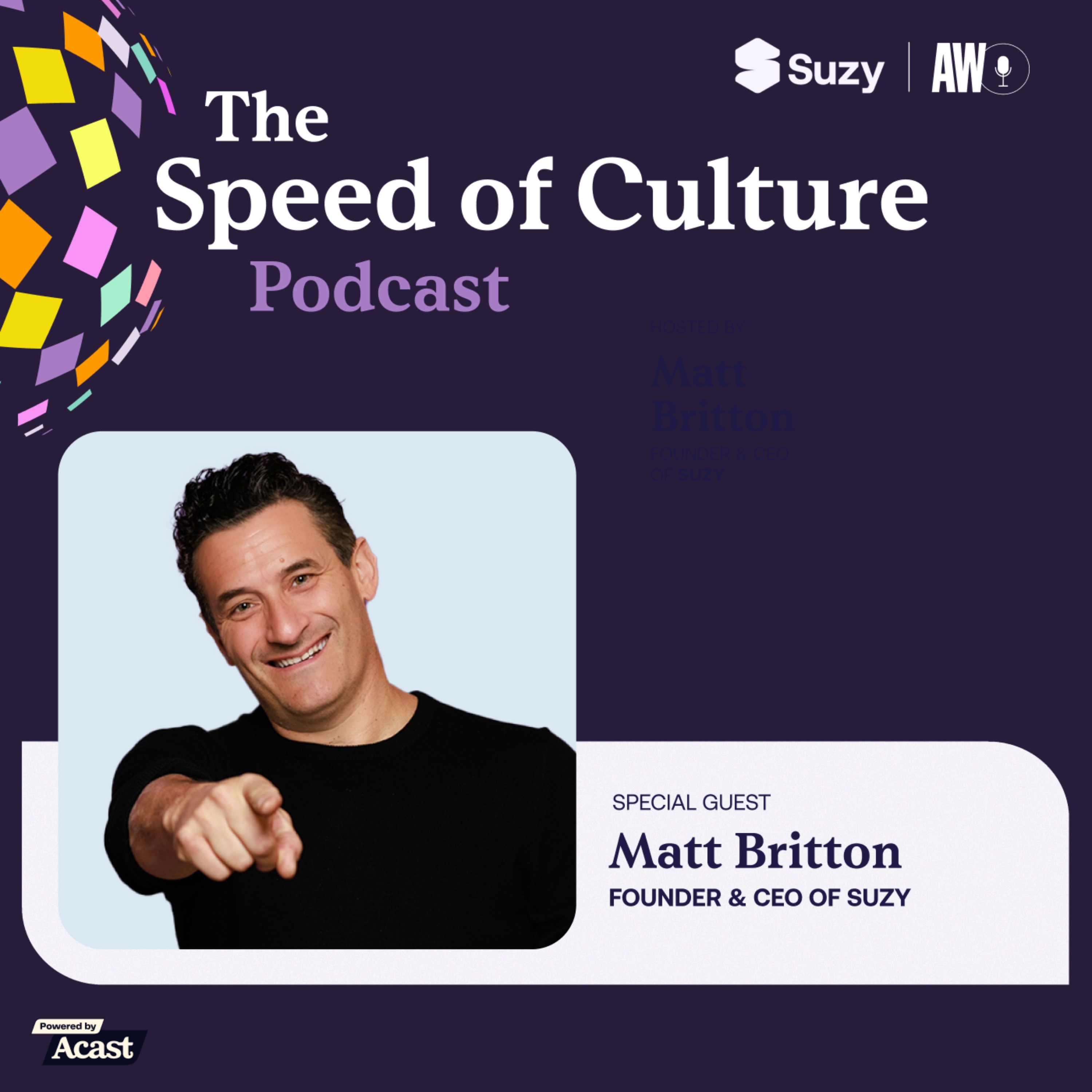
The Speed of Culture Podcast
🎙️ The Speed of Culture Podcast – Special Edition: Matt Britton x Segun Oduolowu – The Future of AI
00:30:51
Loading summary
Transcript97 lines
- [00:00]
Matt Britton
Ready to order? Yes. We're earning unlimited 3% cash back on.
- [00:04]
Capital One Advertiser
Dining and entertainment with a Capital One Saver Card.
- [00:06]
Matt Britton
So let's just get one of everything. Everything. Fire everything.
- [00:10]
Interviewer
The Capital One Saver card is at table 27 and they're earning unlimited 3% cash back.
- [00:15]
Matt Britton
Yes, chef.
- [00:16]
Capital One Advertiser
This is so nice.
- [00:18]
Interviewer
Had a feeling you'd want 3% cash back on dessert.
- [00:20]
Matt Britton
Ooh, tiramisu.
- [00:22]
Interviewer
Earn unlimited 3% cash back on dining and entertainment with the Capital One Saver Card. Capital one what's in your wallet?
- [00:28]
Matt Britton
Terms apply. See capitalone.com for details. Wix. It's where website creation meets AI and where your boldest ideas become real. It just takes one platform to build a site that looks great and does everything you need it to. And it just takes one person you to start taking care of business. Like a 10 person team with AI tools for creating an entire website from scratch or testing new ways to make money. We WIX is there with you from day one. Try it out now@wix.com.
- [00:59]
Experian Advertiser
Finding the right audience shouldn't feel like doom scrolling with Experian. It doesn't. Experian syndicated audiences help you reach holiday shoppers, car buyers and more across over 200 top platforms with over 2,400 pre built audiences. There's no more doom scrolling. It's audience targeting you can trust. Made simple. Learn more@experian.com Adweek that's experian.com Adweek.
- [01:31]
Interviewer
To.
- [01:31]
Matt Britton
Thrive in a rapidly evolving landscape, brands must move in an ever increasing pace. I'm Matt Britton, founder and CEO of Suzy. Join me and key industry leaders as we dive deep into the shifting consumer trends within their industry. Why it matters now and how you can keep up. Welcome to the Speed of cult.
- [01:53]
Experian Advertiser
On this edition of the speed of.
- [01:54]
Matt Britton
Culture, we have a special episode. Our very own host, Matt Britton is.
- [01:59]
Experian Advertiser
Interviewed on the future of AI.
- [02:02]
Matt Britton
Matt is a renowned AI expert and his book generation AI is a national bestseller.
- [02:08]
Experian Advertiser
I hope you enjoy and find it insightful.
- [02:11]
Interviewer
I love these chairs. I feel like I'm in the barber shop.
- [02:13]
Matt Britton
I'm gonna try to spin around this way. There we go.
- [02:16]
Interviewer
All right, so as we're having this conversation, most of you in the room know Matt. Most of you are familiar with his accomplishments. But for the sake of this conversation and this incredible book that he has written, Generation AI, I think it's best to start with what he says on the COVID Why generation Alpha and the age of AI will change everything. That is so bold and brash.
- [02:41]
Matt Britton
Go big or Go home.
- [02:42]
Interviewer
I mean, go big or go home. But Generation Alpha, the oldest person in this generation is 15 years old. What are they changing? I have cologne older than 15 years old.
- [02:53]
Matt Britton
I think I smell it.
- [02:55]
Interviewer
Hopefully it's good. So set the stage. Why do you make such a bold statement on the COVID of the book?
- [03:00]
Matt Britton
Well, first of all, I want to thank everybody for coming. The people in this room represent people I've worked with throughout my career, close friends, family members. And it's just amazing to feel so supported. So thank all of you. I know you have very busy schedules, busy lives. Thank you to all of you for coming. It means a lot to me. Now, back to the book.
- [03:17]
Interviewer
Now, about the book.
- [03:18]
Matt Britton
So you're going to have a generation of people age 0 to 15 that is not going to know a world without AI. They're not going to know a world without technology that you can communicate with. They're going to be growing up leaning in to technology in a way that most of us think is foreign, in some ways, even strange. You're going to see young kids develop intimate relationships with chatbots. Sounds crazy, but it's happening. You're going to see kids turn to AI for mental health therapy. You're going to see kids increasingly turn to AI for medical advice, obviously school, all sorts of things. So technology is going to play such an increased role in these people's lives that once they are older than 15, which is going to start next year, actually it'll be 1 to 16. Right. The next generation gen beta is coming in 10 years from now. They're going to be the people who are starting families. And what does the world look like when people who are starting families know no other world but AI? How are they going to shop? How are they going to interact? What are they going to prioritize in terms of their family life and education? That's why I think it's going to change the world.
- [04:20]
Interviewer
But what makes this so impressive? We've seen technological jumps throughout human history. Whether it's the wheel, whether the assembly.
- [04:29]
Matt Britton
Wheel is a pretty big deal.
- [04:30]
Interviewer
Yeah, well, the wheel was a big deal. So was fire. But the assembly line, the computer, airplanes. We've seen technology make these leaps and we've been able to adapt. There are passages in this book where you frighten us or frighten me, because we might be in a competition where we don't adapt fast enough.
- [04:49]
Matt Britton
So for the first time in human history, something else can perform tasks that were once uniquely human, better than humans. We've seen the latest large language models outperform, actually literally off the scale in terms of IQ tests. People are now saying that they would rather have AI read their X rays, if it's a critical life X ray, than a person. So when it comes to life's most important decisions, when it comes to life's most important jobs, for the first time ever, we are relying on technology. In the past, technology has augmented human potential. Now it threatens to replace human potential. Which is why I think the shift is going to be so very jarring.
- [05:32]
Interviewer
Why you. What makes you so adept at being able to see this, predict this, and write about it?
- [05:39]
Matt Britton
So I've always been really fascinated with technology and change and more specifically, how companies react to it or fail to. I remember being at the Hershey Company in Pennsylvania in 2004 when they said to me, we will never stoop to the level of advertising on computers. Every single time there's a new technology, people first demonize it. They get scared. Some of them lag at their own peril, and in the end, most capitulate and join it. I think what puts me in a unique position to write the book is I'm not just a futuristic or prognosticator that goes on stage and talks big buzzwords. I'm a builder. I build an AI. I've been spending 70 to 90% of every waking hour in the office actually building things in AI myself with my own two hands. I. I'm not an engineer, I'm not a coder, but I figured it out and going through the process of first building a applications for myself personally, which we can talk about, and then for my company, Suzy, it wasn't until then I truly saw the power and I was inspired to actually write the book. And I think you see a lot of people out there who shout from the rooftops about change, but until you get your hands dirty, you really don't know if it's going to drive change or not. And I have and I do.
- [06:49]
Interviewer
You write in the book that when humanity, or when companies like you mentioned with Hershey put a wall up and say, we won't do this, we won't use this. This isn't for me. They lose out, not only personally, but professionally. How are you seeing AI as you've incorporated into the companies that you run, that you've created, how are you seeing AI change the financial landscape and business models?
- [07:14]
Matt Britton
Yeah, I mean, first of all, companies are very scared, and companies are made up of people, and these people are scared of losing their jobs. You know, I have friends that the husband or wife are both in tech, and they're saying that they need to hedge and maybe start a bakery or something because they feel like they're both going to be out of work. And I think that sentiment is shared by probably many in this room and certainly many who I interact with. So people at companies are scared. And because they're scared, their inclination is to push it off, just like the Hershey company did in 2004. And what starts to happen is it gets pushed off the can, gets kicked down the curb. And then younger, more aggressive startups that aren't scared start nibbling at their heels, and one day they sort of swallow them. We're going to see that happen all over again for the same reason there's no longer a Blockbuster Video or a Circuit City, right? Or a Toys R Us. History is going to repeat itself once again.
- [08:04]
Interviewer
History repeating itself, like Shirley Bassey sang, is a great song. However, you are talking about companies becoming obsolete. AI is now having the ability to make humanity obsolete. And you write about that. What fears should we be cognizant of?
- [08:23]
Matt Britton
So I think the future is going to belong in the workforce to people who either go deep into an art or deep into a science. So deep into an art means that you're creative, you're a critical thinker, you're a problem solver. You're doing things that the machines probably will never be able to do, because somebody still needs to be able to tell the machine machines what to make or what to do or what to build, right? It doesn't know on its own unless someone lights the fire, so to speak. That's deep into an art. Deep into a science is learning how to build, code, operate, deploy the machines. I think everything in between is going to get eliminated. So whether that's people who are accountants that do people's taxes, or radiologists that read people's X rays, or lawyers that write people's contracts. The jobs that have been built in the last two decades have been predicated on the knowledge economy. What the knowledge economy is, is people maintain a specified skill set or knowledge, right? I know how to write a contract. I know how to do taxes. But now knowledge is becoming probably commoditized. We all have the power of all the knowledge of the Internet in our pockets and can be outputted instantly in any modality. And the problem is education is still predicated on a knowledge economy, meaning for you to be a good student. It's about memorization and regurgitation. Study hard, cram for the test, and regurgitate it show that you can memorize it and spit it out. But in this new world, that is not going to be the skill set that's going to matter. So it has to start at the youngest of ages. And we're already seeing places like China get it, and they are actually prioritizing AI education to children as young as age 6 to be able to future proof their future leaders.
- [10:02]
Interviewer
Okay, I want to put a pin in that, because I do want to come back to that statement that you made in the audience. Is this beautifully talented young woman named Bella. She's a student at Syracuse studying graphic design. With what you're saying with AI, is she studying the wrong thing? I mean, is mom shelling out bucks for an education that's going to be obstinate?
- [10:25]
Matt Britton
So first of all, where is Bella? Okay, so first of all, Bella. Shout out, Bella. Bella. Everything's going to be okay.
- [10:31]
Interviewer
Yeah.
- [10:32]
Matt Britton
So you probably have all seen and you know, things are becoming mainstream when everyone starts sharing on Instagram. You know, people are turning their dogs into to people, or they're turning themselves into a character and sharing it. And a lot of people think that AI's power starts and ends with that, but I think what the deeper meaning behind that is, there's no graphic designers involved in the creation of that. And if you asked AI to make a beautiful picture of a dog driving a pickup truck in the sunset in the Midwest, it'll make it. And then if you actually wanted to have a cat in the front seat, it'll drop the cat in. And if you want to be nighttime instead of sunset, it'll make it nighttime. Those are jobs that graphic designers used to do. And it's really emblematic of another way I think the world is going to change. Where I think success and power in an AI driven world is less about how to solve the problem and more about defining what the problem is that needs to be solved. Meaning for a graphic designer, they still have to have the idea to have the dog riding the pickup truck in the sunset, but them knowing actually how to do the design, the shadows, the lightings, all those things that will be going away because we're already starting to see it go away. And AI is doubling in its potency every seven months. So seven months, it's only going to be twice as good.
- [11:44]
Interviewer
I don't want to be that guy saying, get off my lawn, AI. But there's a talent and an artistry to what Leonardo used to be able to do. Da Vinci and Picasso and the shading of the light and what graphic designers can do. And you're basically saying that, and you say it in the book, that the most powerful tool, the next leap of AI will be able to write something, and then instead of it just coming up with essay, it's going to actually be able to do motion pictures.
- [12:12]
Matt Britton
It already can.
- [12:13]
Interviewer
It's putting people completely out of work. Shouldn't we be frightened?
- [12:18]
Matt Britton
Absolutely. I mean, I think good. You know, there's this thing called American exceptionalism, where we think that people who lose their jobs are just going to get new jobs. But if you look at a lot of underdeveloped nations around the world, you have the.01% with all the wealth saying that on top of hilltops with pit bulls and guards guarding the fence, and everyone else is fighting for their scraps on the streets. And we think for some reason in America, that's not going to happen here. And we've already seen dramatic wealth disparity already happen where 1% has become the 0.01%. Right. And so we're going to continue. And AI really does create that risk. And I think we can't solve the world's problems. I can't put AI back in a box and make it go away. The only thing we can do for ourselves and our families and our futures is be on the right side of this change. And that's why I wrote the book, is to empower people to take the steps they need to make now, to be experts, to understand how it's going to change the world versus pushing it off.
- [13:15]
Interviewer
So let's talk about that. Empowerment. How. How does the average person, or even those that are initiated and you're using AI, how do they become more adept so that they don't become left behind?
- [13:27]
Matt Britton
Yeah. So a lot of people get overwhelmed with AI because there's so many tools that can do so many things. I often give the analogy is like being if you're hungover at a buffet in Vegas and they have like all this great food and you just circle around, you don't know what to eat because you can eat everything. Right. Speaking for a friend. And I think that paradox of choice is real. And I think what helped me dive in is I started with a problem. And your problem that you want to solve doesn't have to be a business problem. It could be a personal problem. But zero in on that one problem. Second, figure out what data you need to help you solve that problem, and we can talk about that and then what a solution looks like and basically go into an AI chatbot like ChatGPT and say, this is the problem I want to solve and I want step by step instructions. Do not give me step two until I tell you step one is complete it and persevere and focus and hit blocks around the way and don't give up. At the end, you will have something that will help you solve your problem. And going through that process, what's up? You will be able that dog is AI proof. Going through the process, you'll start to see correlations and you'll start to look at the world differently and then you will start to feel empowered. But there's nothing you can replace for actually getting your hands on keyboard and doing the work. This time you can't talk about it, you can't just read about it. You actually need to do it to understand it.
- [14:40]
Interviewer
The dog passing through felt like the Matrix. When that the black hat and the glitz. I was like, oh my God, we're talking about tech. And it's like red pill, blue pill. I was like, oh my gosh. So with this generation Alpha that is going to be, as you write, the first generation AI natives. First AI natives. How do we raise them? How do we talk to them? Right. Is it going to be where Neanderthals met Homo sapiens and the Homo sapiens killed out the Neanderthals? Are we going to be able to coexist with a generation? Because I know there's many people in this room who are like those damn millennials or those damn Gen Xers, like there's friction between the generations. This looks like there's going to be friction with this new native AI generation.
- [15:23]
Matt Britton
Yeah. I think parenting with AI in a household is going to be tricky and it's very much unprecedented. And I think the biggest reason why is there was no adoption curve to learning how to use AI. So with past technologies, you needed some type of technical skill set to be able to use it. Where in using a tool like ChatGPT, you're just interacting with it like you do a friend. You're just texting it and it's texting you back. And because of that, as soon as young people learn how to communicate, they're going to be adept at using it. And it's not always going to be the case that their parents are going to be as adept. And that can become dangerous when you have young developing minds with a tool as powerful as AI in the household under the noses, where parents don't know what's happening on one hand. So my son is. I don't know if he's here yet. Cameron. But Cameron was an innovator because he was the one of the first students in the country that got caught using chatgpt on a term paper. Shout out, Cam, wherever you are. Oh, but he still got into college. It's okay.
- [16:19]
Interviewer
Matt Britton, author, businessman, snitch.
- [16:23]
Matt Britton
He's an innovator. He's an innovator snitch I wrote about in the book. So it's all good. But when he did it, part of me is like, yeah, Cam, because like here I am telling people to use the tools and he used the tool, right? So he did what he's supposed to be doing. And at that point the school, his school didn't know anything about it. And it was very early in the cycle that we're in right now. The point is that parents need to become involved in their kids use of AI. They can nor say don't use it because that will leave them just incredibly unprepared for the world ahead. But they also can't say do whatever you want, lock the door and use it. They have to be involved. And I think it starts at early ages. I mean, what parents of younger kids don't understand is you can use AI to make coloring books out of pictures, you can make songs, you can custom storybooks that you could read to your kids at night. And at early ages, it actually turns on their creative thinking and actually helps them develop exactly the right skill set that they will need to be able to differentiate in the future. So I think parental involvement is incredibly important. Probably more so than any other technical evolution we've seen in the past.
- [17:28]
Interviewer
But we've seen fits and starts with AI. I remember when Alexa was supposed to revolutionize, you know, like hey Alexa, do this. Hey Alexa, do. And it didn't really catch on. Is there any chance that this is just a sound and fury signifying? Not that much.
- [17:45]
Matt Britton
That cat's out of the bag, I think. You know, we saw fits and starts with MySpace or we saw the Arkos MP3 player before the iPhone, right. There have been these sort of like head fake technologies that really were like a genetic marker, if you will, for the real thing that came out. But large language models, the GPUs that power them, the complex software that's behind it, it's just unbelievable. And anyone who has spent their lifetime in technology are all saying the same thing, from Bill Gates all the way down. And as a practitioner and somebody who's seeing firsthand the opportunities and challenges it presents, an entrepreneur, I couldn't Agree more. We'll be right back with the Speed of Culture after a few words from our sponsors.
- [18:29]
Experian Advertiser
Finding the right audience shouldn't feel like doom scrolling with Experian. It doesn't Experian syndicated audiences help you reach holiday shoppers, car buyers and more across over 200 top platforms with over 2,400 pre built audiences. There's no more doom scrolling. It's audience targeting you can trust. Made simple. Learn more at experian.com adweek that's E-P-E-R-I-A N.com adweek.
- [19:02]
Capital One Advertiser
If you love to travel, Capital One has a rewards credit card that's perfect for you. With the Capital One Venture X card, you earn unlimited double miles on everything you buy. Plus you get premium benefits at a collection of luxury hotels when you book on Capital One One Travel. And with Venture X, you get access to over 1,000 airport lounges worldwide. Open up a world of travel possibilities with a Capital One Venture X card. What's in your wallet?
- [19:28]
Matt Britton
Terms apply. Lounge access is subject to change. See capitalone.com for details. A Sapphire Reserve story from Ella Langley I kind of say my first concert ever was for cows. I would climb up to the top of the barn and just perform. Now I still do that. Listen into Apple Music, which I get through my Sapphire Reserve card. And when moo can sound very close to boo, it toughens a girl up. Sapphire Reserve now comes with Apple Music. Chase Sapphire Reserve now even more rewarding.
- [19:53]
Experian Advertiser
See More rewards@chase.com Reserve IT cards issued.
- [19:55]
Matt Britton
By JP Morgan Chase Bank NA member FDIC subject to credit approval terms apply. Apple and the Apple logo are trademarks of Apple Inc. Registered in the US and other countries.
- [20:05]
Interviewer
What are the global impact of this AI race when it comes to the chips that power AI are made over here, but the people that want to control it are over here, and maybe they're not that friendly. So how does this entire AI ecosystem exist outside of us, just the users?
- [20:25]
Matt Britton
Great question. So if you think about it, where would America be without big Tech right now? Where would it be without Google, Apple, Microsoft, Facebook? These companies have been the businesses that propped up the stock market. It's propped up. They propped up our economy. It certainly hasn't been Big auto. It hasn't been manufacturing. There's been so many industries that have been devastated due to globalization, and big tech is really all we have left. One of the issues I personally have, and this is not going to get into a political discussion, but with the deglobalization that we're seeing is China, when left to their own devices, will develop chips. And we heard an announcement last week with Highway. Highway, I think it's pronounced that they're creating their own chips now. And you don't want that. If you have Nvidia here and they are the most powerful chip manufacturer, you want to keep that power in the US And China is moving incredibly fast. They work harder than us, they make a lot less money than us, and they're incredibly motivated to win the AI race. And I think it's a toss up right now who will. And AI isn't just about business. AI is about warfare. AI is about cybersecurity. AI is about so many individual things that give us all the security to be able to be in a beautiful place like this drinking gin and tonics. So it's a big deal. And I think that the US has its work cut out for it to remain a leader.
- [21:42]
Interviewer
You mentioned Nvidia and that is a company that saw exponential growth that you write about in your book 39,000%. So roughly, if you had invested $10,000 in Nvidia 10 years ago, it'd be.
- [21:55]
Matt Britton
Worth about 3.9 million.
- [21:57]
Interviewer
3.9 million now. Darn, we missed that boat. I know a lot of us are kicking ourselves, but how do we identify the next Nvidia? Or is Nvidia going to be the sole arbiter of who gets the chips for America? And those chips are made in Taiwan, as you write. So what exactly is America's position in this AI outside of like ChatGPT and Google? Like, are we going to come up last pretty soon?
- [22:23]
Matt Britton
I don't think we're going to come up last because we still have the best engineers and we still have most powerful technology companies in human history that are incredibly well capitalized. We still have great universities and a ton of innovation coming out of America. I think to your earlier question of how we're going to pick the next Nvidia, I think it's incredibly hard to pick individual stocks. I think any investor will tell you, just invest in low fee index funds over time and focus on yourself. Because yes, you could get lucky and hit the lottery with an Nvidia, or you can invest in all the other companies that aren't nearly as successful.
- [22:56]
Interviewer
What is your advice for people that see the vision, understand that AI is here to stay, but are trying to figure out how to utilize it in their business. Right, so you're a dj. Like Mick is a dj.
- [23:09]
Matt Britton
Shout out Mick.
- [23:10]
Interviewer
Shout out Mick. How does he incorporate AI into The ones and twos? Or should he even be thinking that far ahead that eventually there's going to be someone who's going to come around, figure out AI with music, and it's going to either make me obsolete or I just. He Mick becomes a Spotify playlist.
- [23:26]
Matt Britton
Well, so for somebody like Mick, the question is, is he finding that there's a problem in his profession? You know, is he finding that somebody who's deploying AI, like this quote that you probably heard a million times, it's not AI is going to take your job. It's someone who understands AI, who will. So if I was a DJ and all of a sudden this new DJ was getting hired that was leveraging AI, then it's a problem that I have to get my arms around that's not really seen yet. And I don't know if that will be the case. I mean, Spotify is AI DJs and it's not Mick, right? So I don't know if we're there yet. But for other people in their careers, you brought up graphic design and other areas. There are problems that are starting. You are seeing layoffs, you are seeing companies trying to automate, or at a very minimum offshore to save costs. And we're not talking about companies that are hurting. We're talking about the most wealthy companies in the world are cutting people. And they say the future is already here. It's just not evenly distributed. And it is distributed to Alphabet and Google and Microsoft. They are the companies that are laying people off. Which means I think it's only a matter of time before you see FedEx and Walmart and companies that employ mainstream America doing the same thing. So if you're in one of those careers, I think you need to dive in. And going back to my point earlier, I think you just need to identify one problem. I don't mean to oversimplify it, but sometimes it is that simple. Pick a problem. For me, I pick the problem that I want to stay alive as long as possible. I have young kids, healthcare, so healthcare was that healthcare. So I built my own healthbot, right, to help myself stay alive as long as possible. And I went through the process of loading in 20 years of X rays, MRIs, blood test information, and I've been blessed enough to be pretty healthy throughout my life. But you never know, right? And I start to ask the questions, like, if I'm going to die in five years, what will be the most likely cause and why? And the answers freak me out, right? And if I'm going to Book five doctor's appointments based upon what you know about my health history, which doctors should I book? And it has become an indispensable tool to me. But by going through the process of identifying the problem, staying alive, getting my arms around the data that helped me solve the problem, and knowing what the end solution was, which was a health bot that can help me do so. Then I went to, okay, what's the business data of an X ray or MRI or blood test? And that's how I took it to business and replicated the same approach. So I think start with something you're comfortable with, start with something you're passionate about and try to do a little something to solve a problem. And saying you don't know how is not an excuse. Where there's YouTube or ChatGPT asks you actually how to start, but you need to block out time every week to doing it and actually trying to create something out of it.
- [25:53]
Interviewer
So this becomes a reconfiguring of the.
- [25:56]
Matt Britton
Way we need to think 100%.
- [25:58]
Interviewer
And if we don't, then what?
- [26:01]
Matt Britton
Somebody who understands AI will take your job or will be the CEO that beats your company, and that's ultimately. Or will be the DJ that spins AI versus Nick, which will never happen if I'm in charge. But that's the risk here. And that's why we all need to have our eyes wide open with the changes that are happening.
- [26:18]
Interviewer
You write in your book that we are already seeing AI infiltrate in nefarious ways, in ways sometimes that are so subtle we can't even tell. So what is to stop the people that are more adept using this AI for the most nefarious of purposes, one that you write about is, and it's almost like a throwaway line in the book, that perhaps there are songs that we're listening to that aren't really done by current musicians. They're just an algorithm spitting out music. But what happens now if someone fiddles with the Healthbot, or fiddles with, let's.
- [26:52]
Matt Britton
Say somebody clones your voice and calls your mom and says, I need a hundred thousand dollars, I'm in trouble. Like, that is what's most likely to happen. Not to you, thankfully, but to somebody. And we saw it with cybersecurity. We saw people stealing people's credit cards and hacking and taking. And every single time there's a new technological evolution. You do see bad actors. It's going to happen again. The only hope here is that the same technology the bad guys are using, the good guys can use. And the hope is that will slow it down. But I think that's going to be a big issue with every time there's a new technology, there's positives and negatives to society, and we can't stop the negatives individually. We just have to lean into the positives to better ourselves and better our future.
- [27:34]
Interviewer
So all of this also sounds like it's us. It's us in the room, it's the adults, it's the elders at the table. But the book is about Generation Alpha. Where do they play in with our responsibility?
- [27:48]
Matt Britton
So they're the pacesetters. So when I wrote my first book 10 years ago, it was called Youth Nation. And the premise behind Youth Nation was, for the first time ever, youth culture was no longer counterculture. So before the world of social media, if young people wanted a voice, they would have to go to Woodstock, right? Or they'd have to protest because they didn't have a megaphone to drive the popular discourse. And then with social media, they were the ones choosing the songs that people listen to and the shows that people watch because they had the ability to be able to drive that. And the premise of Youth Nation is it is now a youth nation. Young people are driving culture. It's being driven from the sidewalks to no longer from the boardroom. And 10 years later, that premise is more true than ever before. Younger people are going to drive the future. The decisions they make, the behaviors that they adopt are going to drive the population at large. With a technology that's easier to use and will be adopted at younger stages in life than ever before, how do.
- [28:45]
Interviewer
You want people reading your book to apply it? Is this a book that we keep on the nightstand? Is this a book we reference and refer back to periodically? Because I read it like a manual. I have a five year old. Many of the things that you wrote in there, I could see her doing, I've seen her do with my phone or my wife's phone or her tablet. I've seen what happens when she's not like, alexa, I love you. And then Alexa says, oh, that's sweet. Like, I would never do that when I was a kid. But she does these things because she thinks that they're funny. So I'm reading your book like, oh, my gosh, I got to look at my child in a different way. How do you want people, when they pick up your book to interact with it?
- [29:22]
Matt Britton
Well, first of all, my Oprah moment now is everyone here gets a free copy of the book on the way out tonight on, I think, page five of the book, there's a QR code that you can scan and you can actually talk to the book. So I basically took all the book's contents and I loaded into a chatbot that you actually can talk to. So my hope is that people will consume the book the way that I think people will consume data and content in the future by talking to it. It doesn't mean I don't want them to read it. But if you said to me, you know what, Matt? I stopped at page five. I just been talking with the book the whole time. That would make me happy as well, because through it, you would be able to start to learn what AI can do. But to be honest with you, everybody consumes books in different ways. Some people thumb through it, some people read it page to page. I just wanted to serve as a wake up call and start to alter people's behavior, whether they read three pages or 200 pages, to have an impact on everyone who reads it.
- [30:11]
Interviewer
Is it the ultimate flex that you write a book about AI and actually have AI explain the book that people are read?
- [30:19]
Matt Britton
Yeah, I don't know if it's a flex. I just think that I always like to walk the walk, and I want to show people that I'm not just talking about it, I'm doing it, I'm understanding it. Because that gives me more credibility and makes people more likely that they'll listen to me and I can influence them. And that's why I did that.
- [30:33]
Interviewer
Speaking of credibility, you write a book about AI and you have AI write the forward.
- [30:39]
Matt Britton
Yeah.
- [30:39]
Interviewer
Explain how that came to be and why. I mean, again, very bold.
- [30:43]
Matt Britton
That was a risky one. Yeah.
- [30:44]
Interviewer
Go big or go home. But that's a really bold choice.
- [30:46]
Matt Britton
So every time I tell people I wrote a book about AI, the first thing they say is, well, did you have AI write the book? No, I didn't. I didn't want to sound like a robot, and I wanted to be truly mine, like when at my stage of the career. It's about legacy and having something that's truly my words and seeing how it plays out. But I also want to show people at the very beginning what AI was capable of, especially for those who haven't spent a lot of time in it. So I made the decision to have Claude, which is a large language model by Anthropic, actually write the book in the first person. And the chatbot, or whatever you call it, Claude says, like, I was honored when Matt asked me to write the Ford. It's weird. I don't have A consciousness. I want to shake Matt's hand, but I can't because I'm AI. And it's pretty cool the way it's written. And it really shows people, I think, where we're headed and already how human AI can become.
- [31:33]
Interviewer
Pretend that none of us in this room understand anything more than Terminator.
- [31:41]
Matt Britton
Yeah.
- [31:41]
Interviewer
Like, is it Skynet? Like, are we going to be seeing that level of ability and fear, or is that already here? And the movies, you know, life is already imitating the art.
- [31:51]
Matt Britton
I mean, I'm an AI optimist. I think I like letting people know about what could go wrong. And I think that there's risk, because without risk, I think there's no sense of urgency. And I think we all need to have a sense of urgency. But I don't think this signals the beginning of the end of the world or anything like that. But we all need to understand that. What I believe, at least, is this is going to be a change unlike any other we've seen.
- [32:12]
Interviewer
I'll close with this. You mentioned your son using AI to do a paper. How do you manage AI personally and in your home? Like you said, you walk the walk, talk the talk. How do you manage it and is it replicable for people listening to you and observing?
- [32:31]
Matt Britton
I think the most replicable thing is prioritizing it and making sure that you block out time in your calendar every single week to learn and dig in and build whatever building means. It could be you're building a storybook for your kid. It could be you're building a financial plan and budget for the upcoming year. It could be you're building an ingredient list for a big party and you're cooking for 50 people, whatever that is. Start to go down that path, because until you do, you're always gonna be on the outside looking in. And then one day you'll wake up and you're like, oh, my God, the world's passed me by. Everyone knows so much and I know so little. And I wanna make sure that nobody in this room where nobody that reads the book, ends up that way. Matt Britton, thank you so much, guys. Speed of Culture is brought to you by Suzy. As part of the Adweek Podcast Network and AAST Creator Network, you can listen subscribe to all Adweek's podcast by visiting Adweek.com podcast. To find out more about Susie, head to Suzy.com and make sure to search for the speed of Culture in Apple podcast, Spotify or anywhere else podcasts are found, click follow so you don't miss out on any future episodes. On behalf of the team here at Suzy, thanks for listening.
- [33:56]
Experian Advertiser
Finding the right audience shouldn't feel like doom scrolling with Experian. It doesn't. Experian syndicated audiences help you reach holiday shoppers, car buyers and more across over 200 top platforms with over 2,400 pre built audiences. There's no more doom scrolling. It's audience targeting you can trust made simple. Learn more@experian.com Adweek that's experian.com Adweek.
- [34:29]
Matt Britton
If.
- [34:29]
Capital One Advertiser
You love to travel, Capital One has a rewards credit card that's perfect for you. With the Capital One Venture X card, you earn unlimited double miles on everything you buy. Plus you get premium benefits at a collection of luxury hotels when you book on Capital One Travel. And with Venture X you get access to over 1,000 airport lounges worldwide. Open up a world of trust travel possibilities with a Capital One Venture X card. What's in your wallet?
- [34:55]
Matt Britton
Terms apply. Lounge access is subject to change. See capitalone.com for details.