← The Speed of Culture Podcast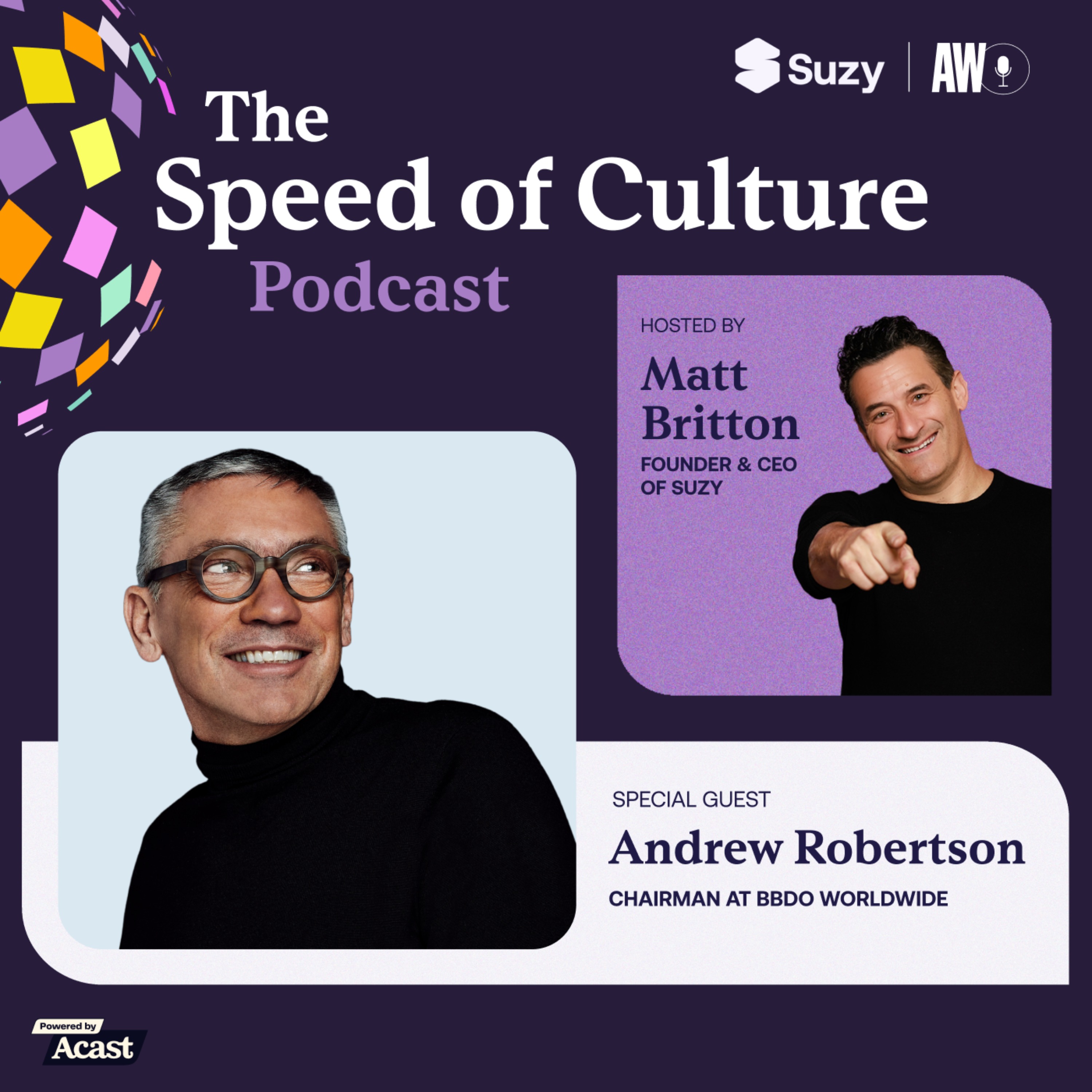
The Speed of Culture Podcast
Why BBDO’s Andrew Robertson believes AI will unleash, not replace, true creative talent
00:34:06
Loading summary
Transcript63 lines
- [00:01]
A
From mindless tasks to industrial grade AI to ease of mind. Supercharge your transformation with industrial AI. Transform the everyday with Siemens.
- [00:15]
B
Your business is one of a kind so your website should be too. With wix it's easy, almost too easy to create a website that's perfectly yours. Just tell AI what kind of site you want to build or choose from thousands of templates, change whatever you want whenever you want and get every everything you need to start running your business your way. No matter what you sell or what you aspire to be, you can do it all yourself on Wix. Go to wix.com.
- [00:47]
C
What is good work? What is great creativity? In my view, it is the ability to capture somebody's attention, which in and of itself is no mean feed to capture and hold somebody's attention while you give them a demonstration, some information or an experience that changes the way they think, the way they feel and the way they behave. That's what it is and I do believe it is a magical ability to be able to do that.
- [01:18]
A
To thrive in a rapidly evolving landscape, brands must move at an ever increasing pace. I'm Matt Britton, founder and CEO of Suzy. Join me and key industry leaders as we dive deep into the shifting consumer trends within their industry, why it matters now, and how you can keep up. Welcome to the Speed of Culture.
- [01:39]
C
Up.
- [01:40]
A
Today on the Speed of Culture podcast, we're thrilled to welcome the legendary Andrew Robertson, Chairman of BBDO Worldwide. Andrew's career in advertising spans over four decades during which he has led BBDO to become one of the most awarded and influential creative agencies in the world. As President and CEO for over 20 years, he has shaped the agency's unparalleled success. Andrew, so great to see you. Let go.
- [01:59]
C
Good to see you, Matti.
- [02:00]
A
Absolutely. I'm a big fan and obviously you've played such a pivotal role in the evolution of the advertising industry for such a long time. And my question for you is, since you've kind of been your current role running bbdo, what are some of the biggest changes in what makes an advertising agency successful?
- [02:18]
C
Well, I'll tell you the things that don't change first and then I'll talk a little bit about the things that do. The first thing is I believe passionately in securing an unfair share of what is a limited pool of truly exceptional talent because it is the truly exceptional talent that does the truly exceptional work that attracts not just the clients, but more importantly in the long run, the people who want to come and do truly exceptional work and generally raises the bar for everything. So you can never have enough of them. You're never going to have as many as you want. But I always wanted us to have an unfair share, more than our market share of truly exceptional talent. That, I think is absolutely the most important thing. The second thing is, at least in our case, having an absolute focus on improving the quality of the work that consumers see, because that's the only thing that matters when all is said and done. Everything else is just kind of meetings and process. But unless what is put in consumers is good, it possibly can be, then we've got nothing. So I think those two things don't change. I think the things that obviously do change, and they change all the time, are technologies which change the way in which consumers interact with our messaging, but also the ways in which we can deliver messaging to them. And they're two separate points. One is how we can actually reach them. The other is how they're engaging with that content when it's put in front of them. And those. And I don't need to tell you this, you, I was about to say you wrote the book, but I think you've written three books about this, which is that it really, that keeps changing. And if I look over my, as you very graciously pointed out, very long career because I'm old, there've been really three huge shifts that have been utterly transformative. The first was the widespread adoption of the Internet, late 90s, early 2000s. The second was the introduction of the smartphone. And then the third is the one we are living with now, which is the rapid deployment of generative AI. And I think the thing that's different about the first two and the third one is the first two were really about how we could get to consumers, the means through which the media, through which we could reach them.
- [04:35]
A
Social media as well, which is somewhere in the middle of that, also is about the media.
- [04:39]
C
Exactly. Whereas the third one, which in many ways is the one I'm most excited about, is about how we actually make stuff, how we actually create and produce content that we distribute through those technologies and platforms. And for me, that's, in a sense, as somebody who has run an advertising agency, that's kind of the most exciting of the three. Now that the other two have taken.
- [05:00]
A
Place, there's a lot to unpack there, and I definitely want to get to AI. But before we do, the first thing you would mention is exceptional talent. And as someone who's employed lots of people throughout my career, I think it's kind of been a moving target in some ways, especially in the advertising industry, like what it means to really be talented, right? Like if you look back at the Mad Men era when people actually had to physically lay out ads, and now when world of Adobe Photoshop and of course AI and everything else, and that's just one example. Like what is the hallmarks of somebody throughout all that that makes somebody talented and effective at a place like bbdo? Because I have to say, Andrew, like so many smart people, incredible people I've interacted with throughout my career have gone through bbdo. It's really like a common trademark of somebody who I can probably know is going to be at a minimum pretty good, if not amazing. And something about the way that you find talent and that you develop is definitely special.
- [05:57]
C
That's very kind of you to say it. Look, I think that there is a particular magic and a particular genius that you find in some people, which is their ability to do two things. One is to spot connections, make connections that other people just can't see. And the second is the ability to really distill and reduce all of that into three or four words or one picture with which you get the whole story. And to me, the most exceptional talent, whether it's working as in the creative function and the planning function or wherever it is, they all share those two things. The ability to spot things, seek, make connections that other people can't make, and the ability to distill and sum up something in just a precise and concise way that makes it really easy for everybody else to work with.
- [06:49]
A
I mean, I think the notion that simplicity is the ultimate form of sophistication is so true. I mean, obviously everyone uses the Apple example, but I think you'll probably be great strategists don't have 10 page briefs, they sometimes have three sentence briefs because that sets the creative up for the most success.
- [07:06]
C
And I think the biggest trap is that people confuse simplicity with being simplistic. And they're two very different things. Simplistic usually is just lazy and it's just taking a very simplistic view of things. Whereas distilling something to its simplicity, finding the simplicity, making something that is complex, simple rather than simplistic is really, really hard. And that is, as you said, that everybody will point to Apple, but it is a real gift and it takes a lot of hard work.
- [07:39]
A
Yeah, it doesn't just take a lot of hard work with the people who work at a place like bbdo, but you also rely on the externalities of the client organization. So BBDO has served so many of the largest brands in the world. And I would imagine a big forcing factor, if you will, for your work to go into market the way that your creatives envision it is getting the clients to have some courage and take a leap and not want to have every knob and button and dial in the creative. Because that is the complete opposite of simplicity in the way that you described it.
- [08:11]
C
Yeah, I mean, I don't think that only applies to advertising. I think that applies to all forms of design and everything that people set out to make magical. I mean, I remember this. We were going to use David Blaine, the magician in a Mountain Dew commercial years ago, and he came into the agency and he was standing outside my partner David Lubar's office, and there were a whole load of people around because obviously it was David Blaine. And right there outside the office, he did what he does in his street show and he just levitated 4 inches off the ground in our office. And everybody was shrieking and going crazy. And I went up afterwards and I said, come on, you gotta tell me, what's the magic? And he said, there is no magic, just preparation. And I thought that was like one of the most beautiful articulations of the reality of what you have to do if you're ever going to deliver magic, which is you have to put in a vast amount of preparation. And that includes working with your clients to make sure that you are reducing the task to its simplest form, that you've got really smart questions rather than just a load of ugly guidelines. Those are things that take hard work. They take trust, they take partnership, and they take preparation. But when you do it, then you just increase your chances. You just increase your chance of making some magic happen. And I also. I realized. It took me a long time to realize something that I and everybody else should have realized earlier. We did an amazing campaign in Australia for the nab, the National Australia Bank. And the problem was that people, the public, thought that the four big banks were working in cahoots with each other and not in the interests of consumers. And NAB had introduced a load of really good products and services that were very customer friendly, but they couldn't get past this kind of narrative that existed in the consumer's mind, that they were part of this oligopoly. And we did a campaign which was called the Big Breakup. It was on Valentine's Day. And in it then NAB broke up with the other banks. So public broke up and said, it's not us, it's you. We're Fed up with your lying and you're cheating. We're going our own way and it's over, you're dumped. All this really beautiful. It was in print, out of home social media. It won Effectiveness Grand Prix both at Cannes and at the Effys. And I went to see the CEO of the bank, who was a very D Scotsman, and I said, that was a really bold thing that you did. And he said, because you mentioned courage. He said, what are you talking about? And I said, well, being prepared to publicly break up with the other banks, that was bold. And he looked at me like I had two heads. And he said, you're out of your mind. I'm a banker. I'm not paid to be bold. I'm paid to manage risk. And when your guys presented that work to me, they were telling me how great it could be. And I could see how great it could be. But none of us could know whether it was going to be great or not. We just had belief. But he said, so what I did was I looked at the downside. I mentally calculated what the downside risk was. And I concluded that we wouldn't lose a corporate client, we wouldn't lose a consumer customer, a retail customer, we'd be laughed at, maybe in the press and on late night comedy channels and things like that. I might have some really awkward moments at the golf club, but after three weeks, all of that would wash away. And on the basis that I could live with the downside, I went ahead with it. So I was able to quantify the downside, but not the upside. But I could live with the downside. So I went ahead with it. And I realized that we, all of us with clients, spend way too much time pursuing certainty rather than managing risk. And the inevitable result of the pursuit of certainty is average. The closer you get to certainty, the closer you will get to the norm. That's just what happens. Whereas this concept of managing risk, not even taking it, don't be quotes bold, don't be reckless, manage it. Identify what the downsides are. Decide if you can live with them or not. If you can't, can you mitigate them? If you can't do something else? But generally we don't do that. Generally we say, going to be fantastic, even though none of us know. And we ask everybody to hold hands and jump. And it doesn't have to be like that. Doesn't have to be like that. So for me, I think whenever I'm working with clients, I try and encourage them to think like bankers manage risk. Don't pursue certainty.
- [12:25]
A
Right. And I think a lot of people do tend to overestimate the downside and underestimate the upside.
- [12:32]
C
That would be okay if they were actually estimating the downside. Generally they don't quantify it, they just it lurks around. It's true of life in general that we're all, all worried about things that may be way worse than they ever actually will be. And if you just stop and think, well, what is the worst thing that could happen? And in his case the worst thing that could happen was being laughed at for three weeks. That's not too bad. I can go ahead with that.
- [12:54]
A
You're not going to go out of business, you're not going to go to jail.
- [12:57]
C
Yeah, exactly. The sun's still going to come up tomorrow. So I do think that taking the time to define and quantify the downside risk seems counterintuitive. But I think it's really essential if you're ever going to realize the upside potential.
- [13:12]
A
Yeah, it's really interesting. I think exercise even if you think about I want to take a new job, I want to ask this girl out, like whatever decision that might give you a little bit of fear or uneasiness, just writing it down, what's the worst that could happen? Literally itemize it and then if you're okay with that, dive in.
- [13:28]
C
And it's usually nowhere near as bad as you fear it might be without thinking about it.
- [13:33]
A
Yeah. So you'd mentioned earlier the quality of work and obviously work in the advertising industry has changed over time. There's been this pendulum swing from brand that performance and a lot of people hate to to categorize work in one category or the other. But we have seen just an explosion of performance based marketing in the age of Google and programmatic etc. And then you obviously have the form factors of advertising. You have to create content now that is built for the Flick and TikTok. You don't always have 30 seconds of a consumer's attention to run spots. So given both those factors like what is high quality work right now that you and your clients are getting excited about and that you're kind of orienting BBDO to be able to produce consistently.
- [14:20]
C
So look, I think that these things always get presented as polar opposites and alternatives and for the best run brands and the best run companies, they're not. They work together to create and capture demand. And those two things are both important. And what you said is right. There's sometimes a swing of the pendulum one way and there has been in the last few years towards capturing demand, because the tools that we've had for doing that have become so much better. And when that happens, everybody just keeps doubling down and doing more and more of it. But the more enlightened marketers and clients are going, well, that's great. We can get ever more efficient at capturing the demand that's already there, but we're going to run out of it. We're not going to be able to grow unless you can grow penetration, unless you can bring in new users. And in order to do that, we have to create demand. So the two need to coexist. And I would say one of the great missed opportunities of the business, if I go back 10 or 15 years, we weren't really good at capturing demand. We're probably really good at creating it, not very good at capturing it. Now we've got really good at capturing it. We need to keep creating that demand because otherwise there isn't going to be enough to capture. And part of that comes from being really clear about what metrics matter. That's something that I don't think enough time and attention goes into, because there was a great line from a guy called Sir Terence Beckett. He was the head of the CBI in the uk and he said we're in danger of attaching greatest importance to the things we can measure most easily and thus ensuring that we're precisely wrong rather than roughly right. We're a lot better off being roughly right than precisely wrong. And the quote that's often attributed to Sam Walton, although there's no evidence that he ever said it, of I know that half of my advertising works. The problem is I don't know which.
- [16:09]
A
John Wanamaker you mean.
- [16:11]
C
Yeah, whoever it is, nobody knows it. But if I look at it coldly, I'd much rather have half of it working and not know which half than know precisely which 99% isn't. But I think this is the nature of life and the business is that we tend to go chasing after things that seem to be working and doing more and more of them and forgetting some of the things that we're going to need to make them successful in the future. And then everybody catches up and they swing back and a proper balance is restored. The answer to your question, what is good work? What is great creativity? In my view, it is the ability to capture somebody's attention, which in and of itself is no mean feed to capture and hold somebody's attention while you give them a demonstration, some information or an experience that changes the way they think, the way they feel and the way they behave. That's what it is. And I do believe it is a magical ability to be able to do that. And to me, that's great work. Whether it is a text message or a two hour long form video that you can make. The piece of work that I most wished we'd done that we didn't. A couple of years ago I was flying from LA to New York and I got a text message from American Airlines. Like this is already the start of a sentence. You don't expect from me that this was a remarkable piece of work. And the text message said, you may want to pack an umbrella. We're expecting heavy storms in the New York area. There'll be delays, possibly cancellations. If you can fly on another date, you should probably consider doing it. It was a text message giving me some really bad news. But because of that opening sentence, you may want to pack an umbrella, I smiled the same information, all caps, weather alert, exclamation mark. Thunderstorms expected, New York area, cancellations probable. Same information, but without that bit of magic would have left me feeling angry instead of happy. So I felt good. I did fly. We were delayed. We were diverted. I spent three hours on the tarmac in, in D.C. before getting home. And while I was sitting there, I was thinking, I wasn't getting mad, I wasn't getting like everybody else was tearing their hair out and going crazy. And I was thinking, is the reason I'm like this now because of how they made me feel yesterday with a text message? And I concluded the answer was yes. That was why I was reacting the way I was reacting to the situation.
- [18:36]
A
We'll be right back with the speed of culture after a few words from our sponsors.
- [18:42]
D
Big news. Wayfair's end of season sale is here. It's Wayfair's Labor Day clearance. Right now you can score up to 70% off everything home at Wayfair. Plus amazing doorbuster deals and 24 hour surprise flash deal on home buying in every style. This is your last chance to score end of season savings and it's happening now. Did we mention fast shipping on everything? Don't wait. Head to Wayfair.com today to score up to 70% off now through September 2nd.
- [19:09]
B
Wayfair, every style, every home. Say what you want about AI, but it's here and it's helping businesses get more done in a day. Wix's website builder is infused with AI so you can stay ahead. Create a beautiful, functional website just by Describing your idea, track how your site appears in AI search results, create custom images on demand, or launch an entire campaign in a matter of minutes. WIX gives you AI wherever you need it. Try it out for yourself@wix.com.
- [19:43]
A
What'S interesting about that story is what is the first word of that sentence? It's you. And we talk a lot about consumer centricity and whoever wrote that was thinking about the recipient first, not about the message or the unique selling proposition. And I think in there kind of lies the distinction between advertising and content because content, if done well, does always think about the consumer first. Where traditionally advertising is about the USP and about commercial messaging, which worked in a world where you can force your messages down the consumer's throat with 30 second spots. But now we're in a whole different world.
- [20:21]
C
Yeah, I mean I think we to some degree have always been a different world. I mean I argue that flicking through the pages of a magazine or a newspaper, the ability to catch my attention with a quarter page ad depended on you being able to create something attention grabbing and interesting in the same way as which it has to if you're trying to create content that somebody's going to engage with today. I mean, I think the wild card in all of this was really television where you were sitting there with nothing else to do and it was being spoon fed that you didn't have anywhere else to go, you had to get up and go and change a channel at one point. That was, that was a lot of effort to avoid it.
- [21:00]
A
And that is when a lot of the most prestigious brands of our era were built. The Hershey's of the world and the crafts and all those brands were built in a point where as long as you had a checkbook you could create that awareness. It's harder now, right? It's harder for new huge brands to be built.
- [21:18]
C
Yeah, it is. But it's been getting like that for 40 years. Ever since I've been in the business, it's been getting harder and harder just because there's been more and more places for consumers to go and it's been easier and easier for them to shift from something that doesn't interest them to something that does.
- [21:33]
A
Right. So shifting gears a little bit here. So one thing you would said at the beginning of his interview that I guess surprised me a little bit is that you said you're really excited about AI and AI is obviously very polarizing for people in the advertising industry because a lot of people, and rightly so, that are creatives, look at what they do as an art form. And when they look at AI creating concepts, whether it's copy or art or video now, which doesn't require the traditional path to get there, a lot of people look at it with disdain and think it's taking away from that art form. And just curious, like, where is the line in the sand in terms of where AI plays a role in your creative process? Where does it make a lot of sense to allow you to push out better work? But at what point does it tip where essentially then you're a sea of sameness because everyone's talking to the same models to get creative.
- [22:23]
C
Yeah, I mean, I think I was talking to a client the other day, and they hire 10,000 people a year, but they get a million applications a year. And obviously the only way you can deal with that is with some form of automated screening of the applications. And then all of the people who are making the applications know that, so they all write their applications in such a way that they're going to get properly screened. So you end up with a snake eating its own tail, really. And the same could end up happening. Look, my position on AI is I like to distinguish between making and creating. And the reason I am so excited about it is because there has been a gap that people who are really creative have had to live with for a long, long time. And that is the gap between having an idea and bringing it to life. And truly creative people are the people who have ideas. All they want is for them to be brought to life. And those have been subject to a gap of time. It's going to take too long, a gap of money, it's going to cost too much money, or a gap of possibility. We can't even do that even if we want to. Those three gaps are being closed by AI, which means that if I'm capable of generating ideas, I'm capable of making them, producing them, bringing them to life in a matter of hours and for hundreds of dollars, not months and millions of dollars or whatever the number is. And truly creative people just like bringing their ideas to life. The craft that you're talking about, of. I used to color this in, or I used to do that. That's all true. But to me, that's part of the production process, not the creation process. The creation process is having an idea. And to me, the amount of time that is currently spent trying to get from having an idea to bring it to life, being able to collapse, that is going to free up the time that we currently don't have. To have even more ideas that we can then bring to life and put in front of people. And so if we do what I think we can do with AI, which is to bring more and more great ideas to life and put them in front of more and more consumers, more often, everybody will win. The consumers will have a much more rewarding experience. The creators will create way more. They'll have way, many more of their ideas brought to life than would otherwise have been the case. That in turn will be good for the platforms and it'll be good for the brands that we're talking about advertising. Everybody will win from that. Apart from, as you rightly point out, somebody whose job was previously to do something that now doesn't need to be done, but at a macro level, that's a win, win, win. That will create bigger, better, stronger brands, it'll create growth. And if you're a creative person, it's going to. Instead of having a portfolio of 20 ideas, you can have a portfolio of 2,000 that have all brought to life. So I'm really optimistic about all of that. If the worst thing that could happen is that we end up concluding that AI is just a fabulous way to put an infinite amount of completely average content in front of people for free, that will be a disservice to the consumer, a disservice to the brands, and a disservice to business. And there's no reason for us to do that. It's too great an opportunity for us to screw up like that.
- [25:46]
A
Yeah. I think in your role, and obviously within the advertising industry, relationships are so important. So you talk about things that will withstand, stand the test of time in the age of AI would argue relationships is front and center in that point. And you've obviously been very successful at building and maintaining relationships with the most powerful people in the advertising industry, particularly on the client side. What have you done well, throughout your career to make you good at relationships? Because I think that is becoming, especially in the age of automation, et cetera, such a lost star and clearly an area in which you've mastered throughout your career.
- [26:25]
C
I think all relationships are built on earned trust and respect. And you earn the trust and respect. And then I'll add a third level, which is just affection. The best relationships have all three. Trust, respect and affection. And I think that comes about from genuinely thinking about what matters to the client that you're talking about what matters to her and what can I do to help and then doing it. And I mean, it sounds so simple, but it's not what most people do. And it comes back to what you said about that text message, which is putting the word you at the front of the sentence. And I think that's the key. Just what really matters to this person and how can I help them deliver that, and bringing them things that do, it's way beyond glad handing. It's a valuable relationship.
- [27:15]
A
I think so many people too, once they get in the room with a cmo, they just go into sell mode and nobody wants that. I mean, people are open to doing business with you, but you need to provide value. And the second you get in the room, if you're just slinging anything you can at someone because they have a budget, that's going to be off putting to them, and that's not what a relationship's about.
- [27:35]
C
Absolutely.
- [27:36]
A
So, Andrew, lastly, I believe that you have a new book that you want to tell us about, and given all the interesting angles that you have on advertising and the customer would love to hear what you're up to, why you decided to write a book and what it's all about.
- [27:51]
C
So the book is called the Creative Shift, and it's coming out in September. And what I've tried to do with it is to provide practical advice on how companies can leverage the genuine creative capability that I think exists inside their organizations, while simultaneously being really good at the things that make companies successful. Predictability, process compliance, operational excellence, financial discipline. All of those things make companies great. But they also unconsciously suppress the creativity that I think exists inside their organizations. And my goal is not to tell those companies they should change. I don't want Wells Fargo being fabulously creative all the time, but to help them use the same discipline and intentionality that they've applied to their operation, to creating the space and the conditions that will allow their people to create genuinely big ideas, which I believe that people have the ability to do. So that's the idea of the book, and I think it's designed to be really practical.
- [29:00]
A
And why do you think now was a good time to write the book? Obviously, there's no great time ever to write a book with the daily demands that we have. But why did you decide to do it now?
- [29:11]
C
Well, because I've spent a long time in this business watching my clients grapple with this issue. I've spent a long time watching them in every kind of vertical, every kind of business that I've seen them struggle with this. They know they need to create new ideas if they're going to compete and grow effectively. They know that. They also know that the things that make their companies currently really successful probably conspire against that. And so to me, the opportunity of how can you do both, how can you both be, operate and build as opposed to being stuck with one or the other, I think is really important for businesses of every size. I think it's true if you're running a startup, which you've done a lot of, or if you're running ExxonMobil, you still need to create the space and the conditions where those ideas can come from your people.
- [30:01]
A
Yeah. And I think in the AI powered world, where execution of so many things becomes easier, creativity is one of those skill sets that I think need to be embraced more in K through 12 education, because it's so hard to teach, especially later in life. And in a lot of ways, AI allows you to be powerful, limited only to your imagination. And imagination comes from creativity.
- [30:25]
C
Well, it comes from behaving like a five year old. I mean, I did, there's quite a lot of good research that I did. But in the 60s, NASA wanted to find out who their most creative engineers were. They had thousands of engineers. Engineers are usually very creative people, but they wanted to know who the most creative ones were so that they could give them the biggest problems to solve. And a guy called John Land developed a test for creativity and it proved to be remarkably predictive. And what he then did was exactly what you just said. He wanted to understand whether creativity is something you're born with or something that you can develop. Right.
- [30:59]
A
Nurture versus nature.
- [31:00]
C
Correct. And he took the test methodology and he took a bunch of five year old kids when they were five years old, 98% of the kids tested as genius for creativity. You took the same kids. When they were 10, it had dropped to 40%, when they were 15, it was 12%. And by the time they were adults, same kids, it was 2%. So the answer is not that you can learn it. The answer is you're born creative. It just gets squashed out of you as you get older.
- [31:28]
A
Is that because of the realities of life?
- [31:30]
C
So a little bit of it is neurological, but the reality of it is you need some compliance and conformity for society, society to function. So what makes you as creative as you are when you're five is you spend a lot of time doing divergent thinking, which is opening up new possibilities, finding new connections, and very little time doing convergent thinking, which is criticism, judgment. As you get older, you have to do a lot more convergent thinking and a lot less divergent thinking, because that's what society needs you to do. So the key to unlocking the creativity that is already there is somehow to create the conditions and motivations for people to behave like they were five again, to play like they were five again. And so I don't think it can be taught, but I do think it can be unlocked. And I think that is the key to really unleashing the creativity that exists in all of these companies and in their people. You have to consciously shift the way you're working to get it, because everything else conspires to have a convergent thinking.
- [32:30]
A
Right. And I think for so long, kids in school were taught to memorize and regurgitate and color inside the lines. And I would argue moving forward, coloring inside the lines is the thing that you don't want to teach younger people to do, because AI can color inside the lines perfectly. Like looking at the COVID of your book, I love it because it kind of connotates that the way that you kind of have that ribbon like structure coming through, it shows that you can't think like everything else and be modular in your thinking, because that is how you unlearn creativity, if you will.
- [33:04]
C
You conform that zero non compliance is what it would say on your tombstone if you were ultimately successful at that. And nobody needs that because, as you say, the machines can do that better than we ever will.
- [33:14]
A
Yeah, but of course, like some artists, like the Beatles, they experiment a lot with psychedelics to unlock it. Like, people will do whatever they can to get out of that conformed state, to live on the edges.
- [33:26]
C
Correct. Fortunately, some of the techniques in my book aren't illegal, which makes it easier for companies that have federal contracts still do it.
- [33:34]
A
Yeah, exactly. But I'm sure you guys are going to write a lot of top hits regardless, so. Super cool. I'm definitely going to be checking out your book, the creative shift, how to power up your organization by making space for new ideas. And that's out this September. Be sure to pick it up anywhere books are sold. And I certainly will be for myself and our employees at Suzy. So to wrap it up here, we often ask our guests if there's a saying or mantra. And given your role and your background, I'm sure you have plenty of taglines and sayings. Just wondering what might come to mind in terms of one that's defined your professional journey to date.
- [34:08]
C
Run towards the fires.
- [34:09]
A
And why does that come to mind first?
- [34:11]
C
Well, because if I come back to that point about how do you create value for yourself, whether it's in a relationship with a client or with your colleagues or your boss, it's by solving big problems for them. And when there's a fire, a lot of the time what you see is everybody running away from it. And I just feel like if you're always the person who's running towards it, you're going to earn the respect, the trust and the affection of your colleagues, your boss and your clients.
- [34:35]
A
Absolutely. I love that. Well, I appreciate you taking the time today, your busy schedule to talk us through your story and where BBDO is at. And congrats on all your success to continue to be a huge fan and can't wait to see what you're going to do next. Thanks again for joining us Andrew. As expected, it's been such a great conversation. Huge fan of yours, your career and all your work at BBDO and looking forward to getting this podcast out to our audience.
- [34:57]
C
Appreciate it. Maddie, thank you.
- [34:59]
A
Absolutely. On behalf of Susan Iwee team, thanks again to Andrew Robertson, Chairman of BBDO Worldwide for joining us today. Be sure to subscribe rate review the Speed of Culture podcast on your favorite podcast platform. Thanks again everyone. Take care. Speed of Culture is brought to you by Suzy as part of the Adweek Podcast Network and a guest Creator Network. You can listen subscribe to all Adweek's podcasts by visiting Adweek.com to find out more about Susie, head to Suzy.com and make sure to search for the Speed of Culture in Apple Podcasts, Spotify or anywhere else podcasts are found. Click follow so you don't miss out on any future episodes. On behalf of the team here at Suzy, thanks for listening.
- [35:57]
B
No one knows your business better than you, so who better to create your website than, well, you. Wix's website builder puts it all in your hands. Create a beautiful website just by talking with AI or choosing from thousands of templates. Customize every detail with simple drag and drop tools and get everything you need to start running business your way. Build more, think bigger and do it all yourself on Wix. Go to wix.com when you think about.
- [36:26]
E
Businesses that are selling through the roof. Sure you think about a great product, a cool brand and brilliant marketing. But an often overlooked secret is actually the businesses behind the business making selling simple for millions of businesses. That business is Shopify. Nobody does selling better than Shopify. They're the home of the number one checkout on the planet and the not so secret shop pay that boosts conversions up to 50%, meaning way less carts going abandoned and way more sales happening. Businesses that sell more sell on shopify upgrade your business and get the same checkout allbirds and skims use Sign up for your $1 per month trial period at shopify.com startselling all lowercase go to shopify.com/start selling to upgrade your selling today. Shopify.com startselling.