Loading summary
Transcript82 lines
- [00:00]
Kaya Burgess
It's tax season, and at Lifelock, we know you're tired of numbers, but here's a big one you need to hear.
- [00:06]
Narrator/Archive Voice
Billions.
- [00:07]
Kaya Burgess
That's the amount of money and refunds the IRS has flagged for possible identity fraud. Now here's another big number. 100 million. That's how many data points LifeLock monitors every second. If your identity is stolen, we'll fix it, guaranteed.
- [00:21]
Narrator/Archive Voice
One last big number.
- [00:22]
Kaya Burgess
Save up to 40% your first year. Visit lifelock.comspecialoffer for the threats you can't control. Terms apply.
- [00:34]
Manveen Rana
From the Times and the Sunday Times. This is the story. I'm Manveen Rana.
- [00:43]
Narrator/Archive Voice
10, 9, 8. We have a go for main engine start. We have main engine start. 4, 3, 2, 1, 0.
- [00:58]
Manveen Rana
More than 50 years ago, Neil Armstrong became the first person to set foot on the moon.
- [01:06]
Narrator/Archive Voice
I'm at the foot of the ladder. The lamb footbeds are only depressed in the surface about 1 or 2 inches, and they're stepped off the lamb. Now that's one small step for man, one giant leap for man.
- [01:26]
Manveen Rana
The team aboard NASA's Apollo 11 were on the moon for less than 24 hours. But the impact down here on Earth was unparalleled.
- [01:36]
Narrator/Archive Voice
Why climb the highest mountain? Why 35 years ago, fly the Atlantic? Why does Rice play Texas? We choose to go to the moon. We choose to go to the moon in this decade and do the other things, not because they are easy, but because they are hard.
- [01:56]
Manveen Rana
And now, all these decades later, we're finally going back.
- [02:02]
Narrator/Archive Voice
Five, four, Stage engine start. Three, two, one. Boosters in.
- [02:08]
Scott Kelly
Ignition.
- [02:09]
Narrator/Archive Voice
And liftoff of Artemis I. We rise together back to the moon and beyond.
- [02:18]
Manveen Rana
In 2019, NASA announced the launch of the Artemis program with the aim of returning to the moon. The second phase of that mission, Artemis 2 is expected to launch today with a planned trajectory that will take humans further than they've ever been into space, thousands of miles beyond the moon. So why is the moon still such an obsession? And why does this mission matter so much? We asked an astronaut, was important for
- [02:50]
Scott Kelly
us to go back and not only learn more about the moon, which is our plan, but also, I think, eventually develop an outpost there which really is part of humanity. I mean, I don't think humans have ever discovered something and then at some point didn't establish a presence, a permanent presence.
- [03:21]
Manveen Rana
The story today, NASA's plan to return to the moon.
- [03:37]
Scott Kelly
When you're in space, you never quite feel normal. You always feel better the longer you spend there. But even after 340 days, which was My longest period of time in space, I never felt like I did on Earth. I mean, your head always feels a little bit full of fluid. You know, your eyes might burn. You never feel completely normal.
- [03:57]
Manveen Rana
That's Scott Kelly, one of the most experienced astronauts in history who spent 520 days in space, including a year aboard the International Space Station. Now he's watching as NASA prepares to return humans to the moon.
- [04:16]
Scott Kelly
Well, when I became an astronaut in 1996, we were convinced that our class was gonn go to the moon and to Mars. We put them both on our class patch. But, you know, like often happens with these programs that are very complex and expensive, the dream and the challenge and the desire, I should say, doesn't always meet the schedule.
- [04:39]
Manveen Rana
What is it like watching another class about to achieve exactly that?
- [04:44]
Scott Kelly
You know, I think it's great. I was saying to Reid Wiseman, the commander, I saw him down in Houston a couple of weeks ago, and, and I said, you know, despite having flown in space four times, meaning myself, I can't even imagine how cool this is going to be. You know, if you think of a, you know, where the space station and the space shuttle flies, if you had like a soccer ball or a football, as you would call it in the uk, the space station would fly like, let's say, an inch off the surface. The moon would be 10ft away. That's the relative distance. They're not going to fly around the moon as close as we did in Apollo, but still, it's going to be a pretty spectacular mission and experience for them and us too, as people of this planet, to see humans go around the moon again and to be able to follow them, too, with the technology we have today and cameras and the video links, I'm really excited about the whole thing.
- [05:46]
Manveen Rana
What is it about the. The moon that makes it such a symbol of fascination for humans? You know, the Apollo moon landing still has this great mythology around it. People are obsessed with trying to understand the thing you see in the sky every day.
- [06:02]
Scott Kelly
Well, throughout history, I mean, humanity, I should say, not history, but humanity, I would imagine, I would guess that from the time humans could look up into the sky and reason and think they've looked at this thing in space that gives us light. If it wasn't for the moon, you may argue, we wouldn't have any life on land because the tides helped give birth and expand early life on this planet. You know, cultures referred to it as a God. Today, we look at it as the closest celestial body to our planet. A place that has Significant scientific and strategic value, I think, for any country. So it's important for us to go back and not only learn more about the moon, which is our plan, but also, I think, eventually develop an outpost there which really is part of humanity. I mean, I don't think humans have ever discovered something and then at some point didn't establish a presence, a permanent presence.
- [07:19]
Kaya Burgess
For some people, maybe going into space seems about as glamorous as kind of commuting. You know, they jump on a rocket, they pop up to the International Space Station. Now, human beings, they're not going 250 miles, they're going 250,000 miles. Humanity's first trip into deep space in, in 53 years.
- [07:36]
Manveen Rana
That's Kaya Burgess, the uniquely titled science and religious affairs correspondent for the Times. I spoke to him as he was packing his bags for Florida to Witness the Artemis 2 launch from the base at the Kennedy Space Center.
- [07:50]
Kaya Burgess
I've long argued that whether you're actually religious or not in the sense of believing in any particular God, that space travel and exploration has always been almost as much about sort of spiritual discovery or at least philosophical discovery as scientific in the sense of, you know, science missions are asking very specific scientific questions. But there are broader questions such as our place in the universe. How did we get here? Are we the only life in the universe? And humanity has had this age old fascination with the moon. There's a cinematic exhibition called Moonwalker that the American actor Tom Hanks narrates. And I just noted down one of the things he said. He said every human being who ever lived on planet Earth looked up at the moon. It's given us our seasons, our day, the length of our month, and we've been moved by it spiritually. We've invented mythology around it. We've imagined the gods live up there. We've written poetry and stories about it. But of course, it was only 57 years ago that human beings were actually able to set foot on it for ourselves.
- [08:50]
Manveen Rana
I mean, it is an incredible symbol of, you're right, human exploration of all that we can dare to try and discover. And yet it has been more than half a century since we attempted it last time. Why has it been so long and why is it happening now?
- [09:09]
Kaya Burgess
Well, the original space face in the 1960s, people used to ask even then, what's the point of it? It's very expensive. Are we just going up there to try and stick a flag in? Do the Americans just want to sort of brag that they could beat the Soviet Union there? But there was a lot of science done in the Apollo missions. They went to find out literally what is the moon made of? How did it come to be there in the first place? Does it have any water or ice or minerals? You know, human beings have explored every corner of the Earth's surface, from the land to the seas and eventually the skies. I mean, our lives today rely almost entirely on satellite technology, whether it's the sat nav in your car or it's doing a zoom call with someone in America or it's watching a live football match from halfway around the world. That all came out of that. But it was expensive. And once the sort of race to the moon had been won, there was a lot of argument over, you know, should we still be spending this money? But I think they've just realized now with robotic landers and with the science that's still being done with samples bought back from the Apollo Ms. There's a lot more to learn about the moon. There's actually a lot of ice and water locked up on the moon, a lot of oxygen locked up in, in the minerals and the rocks. And so they're going to go back and think, can we get a supply of water, a supply of oxygen from the moon? We could build a base on the moon and we could even make rocket fuel out of that to maybe launch missions further afield. Because Mars is actually the end goal of this whole, this whole program, and
- [10:33]
Manveen Rana
this is the first big step towards that. Tell us a bit about Artemis 2. Tell us about the Artemis program and how this fits into it, and who is it that's going up, hopefully to the moon this week.
- [10:45]
Kaya Burgess
There aren't many people who make huge comparisons between Donald Trump and John F. Kennedy, but the Apollo missions were very much sparked by John F. Kennedy in the 1960s, saying, I want us to put someone on the moon by the end of the 1960s. And Donald Trump did do something similar in his first term in 2017. He said, let's go back to the moon.
- [11:02]
Scott Kelly
The directive I'm signing today will refocus America's space program on human exploration and discovery. It marks an important step in returning American astronauts to the moon for the first time since 1972 for long term exploration and use.
- [11:20]
Narrator/Archive Voice
This time, we will not only plant
- [11:23]
Scott Kelly
our flag and leave our footprint, we will establish a foundation for an eventual mission to Mars and perhaps someday to many worlds beyond.
- [11:34]
Kaya Burgess
NASA were only too glad to say, look, you give us the money and we're going. So Artemis is called Artemis because in Greek mythology it's the sister of Apollo. So it's a nice little mythological link there. The Artemis 1 mission, they launched it to the moon a few years ago, empty, no humans on board, just a little figurine of Shaun the Sheep for some reason. And it went round the moon, came back to the Earth and they're like, great. Now this is Artemis 2 and this is a crew of four people. Three Americans, Reid Wiseman, Victor Glover and Christina Koch, who's the first woman to travel to the moon, and a Canadian called Jeremy Hansen. And they will be going further from the Earth than any human being has ever been. They're going round the far side of the moon and that has been done before, but they're actually going quite a long way, thousands of miles past the moon. And they will even be able to look back and see the whole moon and the whole Earth in one, in one vista, which is quite an incredible thing to think of.
- [12:30]
Manveen Rana
Wow.
- [12:31]
Kaya Burgess
They'll come back to Earth safely, hopefully, of course. And then Artemis 3, which will ideally be next year, will test the lander in orbit around the Earth. And this is all in preparation for Artemis 4, scheduled for 2028, when human beings will be landing on the south pole of the moon.
- [12:47]
Manveen Rana
Wow. So it's amazing to see the scope of what this mission is hoping to achieve. Although I have to say, I'm still strugg by Shaun the Sheep. Unexpected. Not even a Disney figure as well. Kind of. I feel like that's a little British flag that's been planted on the moon right there.
- [13:02]
Kaya Burgess
We're very proud of that.
- [13:05]
Manveen Rana
Tell us a bit about this particular mission, Artemis 2. It was actually originally supposed to launch on February 5th. It didn't. Why is that?
- [13:15]
Kaya Burgess
So the moon's got to be in the right place for the launch to happen. And essentially they were always quite honest about we might not be able to launch at the very first instance. This is a new rocket that's never carried human beings into space before. And when they were doing what's called a wet dress rehearsal, where the rockets on the launch pad and they pump all the fuel into it, there were certain little points of leakage of some of the fuel. They tried to fix them in February, they realized that they couldn't fix them on the launch pad and so they very slowly roll it all the way back into the big, huge, what's called the vehicle assembly building. And then about a week or two ago, they rolled it back to the pad. And Wednesday, I think it's about 24 past 11pm UK time is the first possible attempt to launch it.
- [13:58]
Manveen Rana
There is obviously a possibility, depending on weather, depending on other rehearsals, that it might get pushed back again. But fingers crossed, all being well, it does take off on Wednesday.
- [14:08]
Kaya Burgess
Indeed. So I'll be in Florida, first of all. So Cape Kennedy on the coast of Florida, that's where it launches from. It's all looking quite good. I mean, I think at the moment they're confident now about they fixed everything that needs fixing on the rocket. It's just the fact that Florida can be a bit prone to thunderstorms and high winds, so the weather is probably the. The thing to watch most closely. But I think they think it's quite a good chance for Wednesday.
- [14:31]
Manveen Rana
And tell us a bit about the spacecraft that they're going up in. I mean, how big is it? What does it look like?
- [14:37]
Kaya Burgess
The actual rocket itself is new. The Saturn V was that iconic cylindrical rocket that went up in the 1960s that I'm sure lots of kids have got models and posters of.
- [14:46]
Narrator/Archive Voice
At home, when man journeys to the moon, he will use a large and complex transportation system. It's called Apollo Saturn. All told, the assembly is 363ft high and at ignition weighs over 6 million pounds.
- [15:00]
Kaya Burgess
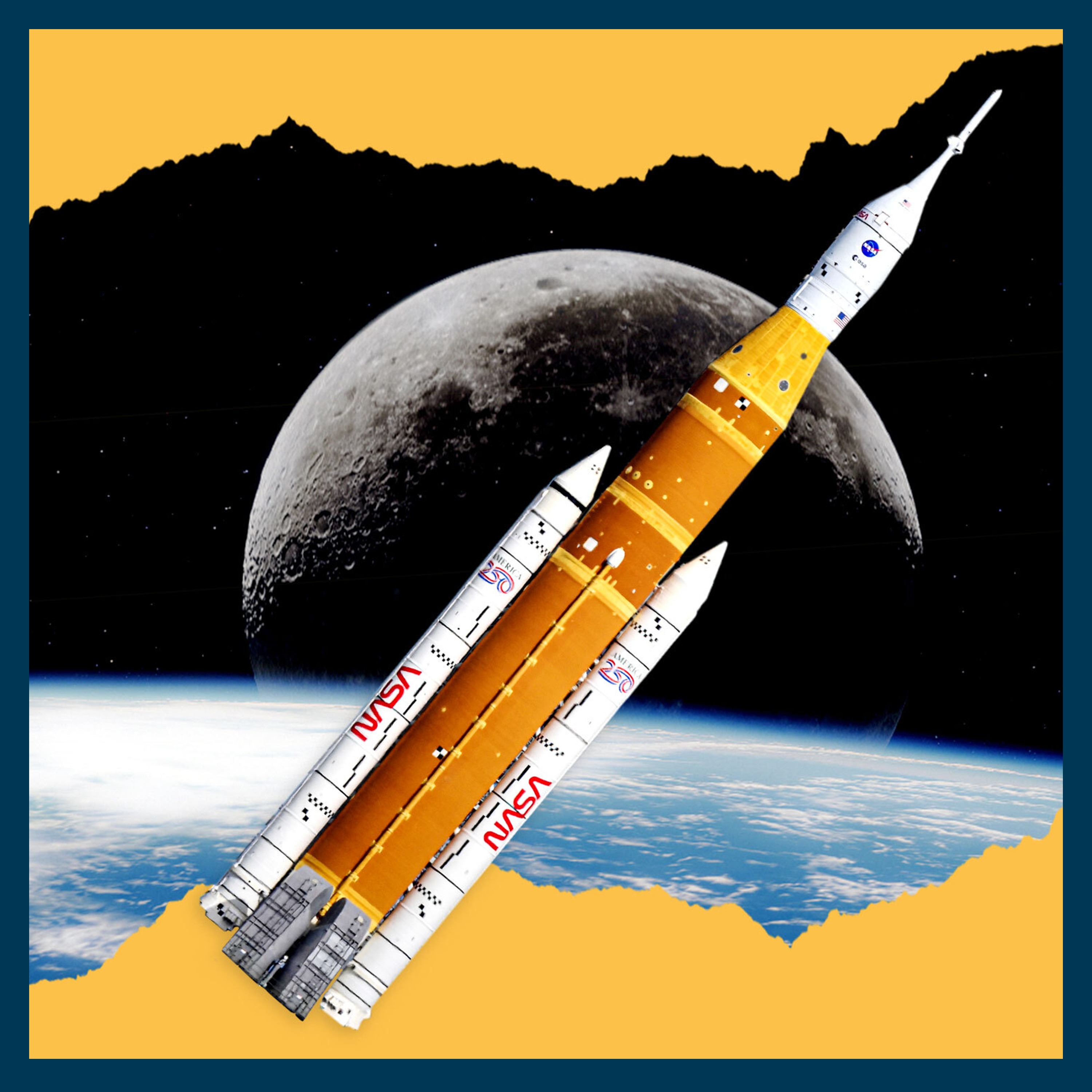
The SLS, as it's called, is the rocket with these solid boosters on the side. The actual spacecraft that will be making the flight is called Orion. And interestingly, all the Apollo missions took three people to the moon, two for landing on the surface and one stayed in orbit around the moon. This is taking four people. The actual space that they'll have for 10 days is not much bigger than the inside of a standard Ford Transit van. It's not particularly roomy. Cozy. Exactly. So it'll be cozy quarters for sleeping and washing and using the toilet always seems to fascinate everybody. The toilet facilities on board a cramped spacecraft. And the point of this mission really is to test how the spacecraft functions
- [15:42]
Manveen Rana
when it's crewed and just describe for us the. The trajectory of this launch, you know, what is the route they'll be taking effectively across space.
- [15:51]
Kaya Burgess
There's a thing in space exploration known as slingshotting. So, for example, nearly 50 years ago, they sent a space probe called Voyager way out into the deep solar system, to Neptune, and then now out into interstellar space. And they did that by approaching a planet. The gravity of that planet would sort of grab the spacecraft and then sling it on to the next planet. That's what they are doing this time with the moon in that they are going to accelerate towards the moon eventually. The moon's gravity takes over from the Earth because they're close enough to it that the Moon is exerting a stronger force on the spacecraft than the Earth. And it will potentially capture them and start to essentially drag them in orbit, if you like, around the moon. But then it slingshots them back towards the Earth. So it'll be a sort of figure of 8 type of configuration. So it starts off, it launches into Earth, it orbits around the Earth. It will then burn its engines to orbit at a higher altitude around the Earth before doing what's called an injection burn which fires it off towards the moon, figure of eight, about 4,000 miles past the Moon and then back towards the Earth again.
- [16:55]
Manveen Rana
Kaya, some experts, like the former British astronaut Helen Sharman, have expressed their concerns that this is being rushed, that they're worried this spacecraft isn't ready for human travel. Not quite safe enough. Is that something the astronauts are worried about?
- [17:12]
Kaya Burgess
I mean, there's an awareness that China wants to put human beings on the moon and, and America is certainly in the lead at the moment. But a little bit like in the 60s, China isn't quite so open about its progress. And so there's always the fear that suddenly they're going to launch a sort of surprise launch. I think the astronauts seem pretty confident. I happened to meet Reed Wiseman by chance, who's the commander when I was in Texas a couple of years ago covering that, covering the solar. It's a good name drop moment. And even back then he seemed very confident and they seemed very relaxed when they were talking to the media on Sunday.
- [17:44]
Scott Kelly
This is the first time we're going to try this. This is the first time we're loading humans on board. And I will tell you, the four of us, we are ready to go. The team is ready to go and the vehicle is ready to go. But not for one second do we have an expectation that we are going. We will go when this vehicle tells us it's ready, when the team is ready to go. So we might go out to the pad and we might have to try again a few more times and we are 100% ready for that.
- [18:07]
Manveen Rana
Coming up, a new space race is underway. But what's the ultimate goal? Is the moon just a stepping stone to Mars? That's in just a moment. Kaya, you were telling us earlier about the race to get Artemis to up in space. It has been more than half a century since we last had people going up trying to get near the moon. Just take us back to that moment, just remind us how the first space race kicked off.
- [18:56]
Kaya Burgess
It was an amazing idea in the sense that the Russians took everyone by surprise when they launched Sputnik, which was just a small metal orb going around the Earth.
- [19:06]
Narrator/Archive Voice
Today, a new moon is in the sky. A 23 inch metal sphere placed in orbit by a Russian rocket.
- [19:12]
Kaya Burgess
So then the Americans said, well, why don't we try and get the first human being in space? And they were beaten again. When Yuri Gagarin went into space, first with the Soviets and again in orbit.
- [19:21]
Narrator/Archive Voice
Man had his first great success in space when the Russians pushed a man across the threshold. He was Yuri Gagarin, the astronaut the Russians lionized as the first to orbit the Earth. It was the propaganda coup of the year.
- [19:35]
Kaya Burgess
So the Americans were beaten to that. The Americans were also beaten to the Soviets by, in the first spacewalk of an astronaut going outside their spacecraft and walking out in space, which really sort of sharpened that senses of, you know, we've got to show we're leaders in this. If the Russians get to the moon first, you know, will they treat it properly? Will they claim it as a Soviet colony?
- [19:54]
Narrator/Archive Voice
I do not regard the first man in space as a sign of the weakening of the free world. But I do regard the total mobilization of men and things for the service of the communist bloc over the last years as a source of great danger to us. And I would say we're going to have to live with that danger and hazard through much of the rest of this century.
- [20:18]
Kaya Burgess
And it just led to, there were the Mercury missions, the Gemini missions, and then the Apollo missions that bit by bit by bit, they just built their knowledge. How do you get something into space? How do you communicate with it once it's around the other side of the Earth? How do you control it? And then of course, that moment, people who were alive or old enough to remember it, remember seeing Neil Armstrong coming down that ladder and putting his sort of footprint on the moon. And you know, this mission could recapture a lot of that. Reed Wiseman said the other day that 60% of the far side of the moon no human eyes have ever set eyes on. It's a pretty rare moment that human beings are going to set human eyes on something that's never been gazed upon before. And I think especially the landing in a couple of years time will really get people in their billions probably huddling back around their screens again.
- [21:06]
Manveen Rana
That really is remarkable. And just remind us what we mean by the far side of the moon.
- [21:11]
Kaya Burgess
Pink Floyd fans have to accept that there is no such thing as the dark side of the moon. Or rather, the dark side of the Moon changes. If it's a full moon, the dark side is on the opposite side. But on a new Moon, the dark side is on our side. What we talk about is the far side of the Moon. And the Moon does spin, but it spins at an exact rate so that it completes one spin in time with one orbit around the Earth. Which means when we look up at the night sky and we see the Moon, we only ever see that one face of the moon. We have never seen from Earth. The back of the Moon, which looks very different. It's hit by a lot more asteroids and meteoroids and stuff that have hit it over billions of years. And we've sent satellites around. The Apollo astronauts saw part of it. But it's. It's a sort of fascinating thing that that part is forever hidden from us on Earth unless we send humans or satellites to look at it.
- [21:59]
Manveen Rana
And presumably it would look very different if we could. If we could see it from Earth. It sounds like it's much more pockmarked, much more created.
- [22:06]
Kaya Burgess
Exactly. There's a degree to which the near side of the Moon is sort of a little bit more protected from collisions because, you know, a lot of that stuff that would have hit the moon would probably have been sucked in by the Earth and burned up in our atmosphere and not made it to the moon. So it does look very different. And the astronauts on. On Sunday, it was really interesting. They said you think of the moon as just being gray, different shades of whitish gray. But actually there are minerals on the moon that when you're close enough, you see oranges and browns. And there's a really famous moment on one of the moon missions where they landed in the 70s of digging in the soil and just finding bright orange kind of mint. You can hear the astronaut like, it's orange.
- [22:44]
Narrator/Archive Voice
Oh, hey, there is orange. So it's all over. It's orange. Wait, I put my visor up. It's still orange. Crazy.
- [22:59]
Kaya Burgess
No one expected. There's a lot more color and texture to the moon, which it must be. I mean, the jealousy of someone who's grown up loving space travel of being able to see that for yourself. It must be remarkable.
- [23:09]
Manveen Rana
Well, now that we are into what feels almost like a second space race, it's no longer America and Russia, who seem to be racing each other, Talk us through the other countries that are part of a space race at the moment. But also, it's not just countries, is it? There are private ventures that are fueling this fascination with space.
- [23:29]
Kaya Burgess
China And India are kind of quite leading in terms of trying to put human beings into space. And China very much is seen as the main rivals for trying to beat the Americans to the moon at the moment. China has really been leading in the last few years on uncrewed sort of robotic probes landing on the moon. A bit like the space race in the 1960s. NASA has always been very open about exactly what it's doing and when and all of its plans. And Russia tended to sort of just go, surprise, we've launched a man into space. And I think there might be a slight element of that with China as well, in terms of it's slightly harder to monitor how close they are. I think people are thinking they're behind and that, like 2030 is a more realistic time frame that they might be doing it. And your point exactly about the private element of these things is that there are more and more commercial space flights. The International Space Station is going to be decommissioned in the next few years and probably going to be replaced by something commercially run that NASA and people can send scientists up to the lander that's actually going to land NASA astronauts on the moon. There's a space race going on between Elon Musk and Jeff Bezos as to whether SpaceX or Blue Origin are going to be building that lander. And so the private involvement is actually ramping up.
- [24:45]
Manveen Rana
And aside from the private involvement, which is fascinating in its own right, when it comes to the battle between China and America, who gets there first? What is the great prize? Is there sort of a set of laws around this? Is there a sense of if you get there first, you get to own it? Lunar dominance, effectively.
- [25:04]
Kaya Burgess
My understanding is that there have been a number of treaties which, at the time in the 1960s, when it was the United States and the Soviet Union kind of very much competing on Earth to exercise their kind of control over various parts of the world. When the Iron Curtain was still down and so on, sort of surprisingly, treaties were signed saying, look, this is not going to be a territorial question, the space race. You can't sort of put your flag in the moon and say the moon is now part of America or part of the Soviet Union part of China. It's not so much particularly, I think, about staking out a kind of territorial claim as much as the sort of the. The kudos, the scientific kudos of getting there first. Of course, you know, China and America are each going to want to choose the absolute prime spot to set up some kind of lunar base. And NASA has announced just in the last week that it's going to spend $20 billion over the next seven years on building a lunar base, making it more and more permanent as time goes on. And so, you know, you want to get there first and say, this is, this is where we're going to be building our base. And NASA's chiefs last week were very much saying, and it's exactly what they said in the 60s, America should be in the lead on this. You know, we are going to be doing it for humanity and for the best science and, you know, expressing perhaps suspicion over what other motives other, other nations might have.
- [26:22]
Manveen Rana
And if at some point, you know, as you were saying earlier, they might find there are minerals, there are things that we would actually benefit from on the moon. You know, if at some point that becomes a mining venture, will we have to, to start again in terms of writing the rules on who owns what?
- [26:38]
Kaya Burgess
It's. It's a really fascinating question because they do talk about, you know, might there be asteroids that are really rich in certain minerals? And I mean, my understanding is that you would have to find such an incredibly exquisitely valuable source of minerals on the moon to be, make it worth the cost to go there, mine them, and then ship them back to Earth. I think it's more likely to be useful to give astronauts what they need on the moon to fuel and build and run a moon base. And, you know, who knows, if humanity ever does end up launching a mission to Mars, maybe that rocket will launch from the moon. The gravity is much less on the moon. It would be easier to get off the ground. There's no air resistance, you know, that sort of thing. It's hard to imagine a time in the even remotely near future where mining is going to be particularly profitable on the Moon. But, you know, perhaps I'll be proved wrong.
- [27:26]
Manveen Rana
So the Moon could end up becoming the launch paddle to Mars. Are there plans, are there potential missions to Mars? Is anybody talking about that at the moment?
- [27:37]
Kaya Burgess
I mean, yes, very explicitly. They are really talking about Artemis as the moon is just stage one on the road to Mars. And that's going to be a long way. If I had to guess, it wouldn't be before the 2000-40s. But right now there are astronauts who have been hidden away for months and months and months, simulating a trip to Mars, essentially looking at the kind of, particularly the psychological effect of being in a confined space with other human beings for a trip to Mars. This trip to the moon is sort of five days there, five days back, whereas Mars, you'd be talking many, many, many months. And so there's a lot to do, but it really is, that is the ultimate aim.
- [28:25]
Manveen Rana
Scott, we've been discussing the space race, the technological advances, space exploration brings us down here on Earth. None of that is possible without the backing of governments and the money they'll throw behind this. How important is it that the political class understands why space exploration is so important?
- [28:47]
Scott Kelly
You know, there was this guy in my astronaut class, one of the other pilots, there were 10 pilots in my class. And this guy used to say, you know, going to Mars is not about rocket science, it's about political science. Because we need the leaders in government that believe in science and technology and doing the hard things, the things no other country can do, building the systems that will benefit our people, our population, motivating our kids. It's really the political science that funds these missions. And turns out that guy's a US Senator right now. Oh, my brother.
- [29:30]
Manveen Rana
Well, that went well.
- [29:33]
Scott Kelly
When he said that. I didn't think he had no idea he was going to wind up in politics someday.
- [29:38]
Manveen Rana
How appropriate is part of it about re energizing public excitement around space so that they can convey the message to politicians?
- [29:49]
Scott Kelly
You know, I don't know if it's necessarily just, you know, space is great because kids are fascinated by it, adults are fascinated by it. It's generally a bipartisan, popular thing to do that people understand is expensive. So. And there are more important things than we do to fly in space. So you always have to find this balance. And having a vibrant space program provides, I think, so much to any country. Sometimes people would say to me, hey, you spent a year on that space station. Did you ever see any money up there? I was like, no, there's no money up there. Or they say, why do we spend so much money in space? I'm like, we don't spend that money in space. All that money is spent on the ground with high tech jobs, people that support their communities, pay taxes, it develops technologies, I mean, that are just so ubiquitous to us today that we could not live without. So, you know, all those things are really critically important to humanity, certainly important to the United States national security. The same goes for international partnerships, you know, but if all that stuff was wrong, like if there was nothing else we got out of it, other than the fact that many, many kids in the United States, around the world. I mean, I've had kids reach out to me from Afghanistan as an example. You know, I actually helped a girl get into college here that reached out to me one time. It's inspirational to a huge, huge part of our population and it inspires them to work hard to study science, math, engineering. All those kids aren't going to go to space and they're all not going to work in the space program. But many of them are going to fill the jobs that are so important for our future, jobs that, you know, define how in the future we interact with artificial intelligence, jobs that solve our energy problems, our climate crisis pandemics, almost as many things as you can think of. The people with the imagination to dream about someday going to space and study science and engineering. Those are the people that build things, that invent things, that make a stronger economy. So I'm hopeful that we never lose sight of that and we continue to support our space programs in, you know, whatever means makes sense. It's not the most important thing, but it is a really important thing and we need to continue to do it. And I'm so excited about this crew getting ready to launch. Two Navy guys, naval aviators, all four good friends. And it's an international crew as well. So that makes it even better.
- [33:13]
Manveen Rana
That was Scott Kelly, former astronaut with NASA and the former commander of the International Space Station. And before that, Kaya Burgess, our science and religious affairs correspondent. There'll be coverage of the Launch live@thetimes.com and updates on Times Radio. The producer today was Julia Webster. The executive producer was Tim Walklate. Sound design and theme composition were by Malicetto. If you can do leave us a review wherever you get your podcasts. And if you'd like to get in touch with us about this or any other episode, do drop us a line to the story@thetimes.com. Craving the coffee flavor you love, but without the caffeine, Cachava's got you covered with their newest coffee flavor. This all in one nutrition shake delivers bold, authentic flavor crafted from premium decaffeinated Brazilian beans with 25 grams of protein, 6 grams of fiber, greens and so much more. Treat yourself to the flavor and nutrition your body craves. Go to kachava.com and use code smoothie. New customers get 15% off their first order. That's K A C H A V A dot com code smoothie.