Loading summary
Transcript68 lines
- [00:01]
Creative Planning Advertiser
From globalization to innovation sustainability to market volatility, there's always more than one side to a story. Explore different perspectives on today's most important business and economic issues with the Flipside podcast from Barclays Investment Bank. Hear two research analysts in a lively debate and get insights from every angle to further inform your view. Listen to the Flipside on your favorite platform. If you're looking for something predictable and low friction over the long term, public markets may be a suitable option. But the moment you want different investment characteristics, it may be time to consider the private markets. See how your wealth can work smarter@creativeplanning.com Access
- [00:45]
Manveen Rahner
from the Times and the Sunday Times. This is the story. I'm Manveen Rahner.
- [01:00]
Katie Gatens
On Saturday morning at about 2 in the morning, me and her photographer were driving towards Bordeaux. The roads were closed and people had evacuated hours and hours before.
- [01:17]
Manveen Rahner
Katie Gatens is Europe correspondent for the Sunday Times, which a few days ago took her into the heart of the wildfires near Bordeaux.
- [01:30]
Katie Gatens
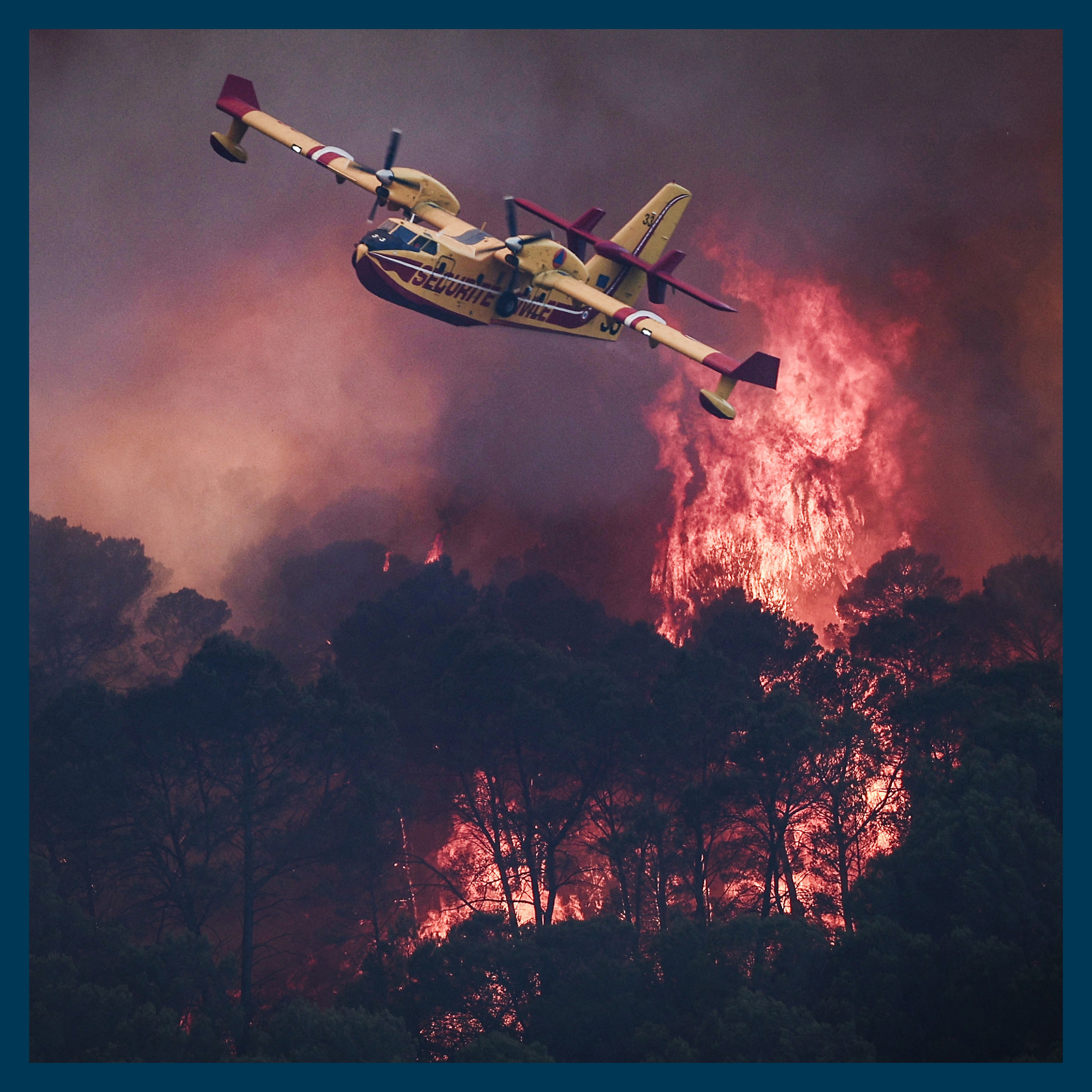
All of a sudden in the distance, there's just thick, thick white smoke. And we're driving into it. Every instinct tells you that this is the wrong way to be driving, but we wanted to report on the story. So we drove into this smoke and it just fills the car. Every breathful felt very difficult and we were staying conscious of signs of CO2 poisoning. You know, we were just sort of trying to stay alert. And there is a lot of adrenaline running through you at that moment because things could change in seconds. No street lights, complete darkness. You know, we turned the full beam on the car and it was almost worse. It was just dazzling straight back at us because of the density of the smoke. It was so thick you don't know what you're driving on. And the things that we saw on the road that we had to be very careful of, as, you know, hot ashes on the tarmac that could melt the rubber of the wheels, which would render your car completely useless. You would be stranded essentially in the middle of a forest fire.
- [02:54]
Manveen Rahner
More than 325,000 people have now had to flee the ferocious wildfires in France and Spain, and firefighters believe the next 48 hours will be decisive as they face a race against time to contain the flames before the next heat wave hits and helps them spread.
- [03:19]
Creative Planning Advertiser
C' est un fou.
- [03:20]
Emma Yeomans
This is a fire that has a
- [03:21]
Creative Planning Advertiser
life of its own.
- [03:22]
Emma Yeomans
It exploits both weather conditions and the nature of the forest to behave in
- [03:26]
Creative Planning Advertiser
a completely erratic manner. It is autonomous and self sustaining, spreading
- [03:30]
Emma Yeomans
unpredictably in all directions.
- [03:38]
Manveen Rahner
That was the Interior Minister of France after an emergency meeting held by President Macron. But while France and Spain struggle to contain the wildfires that are still raging here in Britain, another crisis is unfolding.
- [03:58]
Katie Gatens
This is the worst fire we've had here in living memory and probably a
- [04:03]
Emma Yeomans
lot longer than living memory.
- [04:06]
Creative Planning Advertiser
I myself have seen, you know, fires
- [04:08]
Emma Yeomans
before, but this is something of a. It looks like an apocalyptic scale.
- [04:12]
Manveen Rahner
The story today, a wildfires, the new normal. Katie, you're talking to us at the moment from Barcelona, but we know there have been a series of wildfires across France and Spain. You've been right in the heart of some of them. Just describe what the picture is like right now.
- [04:46]
Katie Gatens
So, as the situation stands, it's probably going to be out of date by the time this podcast comes out, but there have been 220,000 people in the Bordeaux region evacuated because of these forest fires. Whole villages had got the alert at three in the morning, four in the morning, and they've had to take a prepared suitcase, hopefully, you know, a change of clothes, the most prized possessions, and evacuate.
- [05:15]
Manveen Rahner
I mean, you were in Bordeaux. Just describe what it was like.
- [05:20]
Katie Gatens
One of the most shocking things was coming into land on the plane on Friday. You can't see anything out of the window, but you start to smell the smoke gradually, and then all of a sudden you're in it and it's everywhere. And it feels terrifying because you're only a few hundred meters from the ground, but outside every window of the airplane, all you can see is smoke. And actually coming into land, the whole sky is just rippled and black, and you can just see a plume of black smoke coming from somewhere in the distance. It felt incredibly apocalyptic. There was still sunlight when I landed, and the sun is orange. It feels like the sun is on fire. It's just ghostly and glowing and burning, and it feels very unnatural to land a plane into those kind of conditions.
- [06:15]
Manveen Rahner
You were finding your way into Bordeaux as a reporter to be able to report on the fires. Most people who live there were obviously trying to get out. How easy is that at the moment? What is transport like?
- [06:27]
Katie Gatens
Well, at the moment, as it stands, the airport is still open, and I've been checking the arrivals and departures boards. There are flights taking off and landing, although who knows for how long. The government is now warning people not to travel to the region, which was not the case when I got there. The train station is full of people with suitcases. People just want to get as far away as possible.
- [06:53]
Manveen Rahner
When you were there, I mean, where did you stay?
- [06:55]
Katie Gatens
So we were Booked into a hotel, which actually ended up being closed. By the time I even landed, the town that the little bed and breakfast was in was already evacuated and closed. And as you can imagine, there's been hundreds of thousands of people displaced. Every single hotel room in Bordeaux city centre is fully booked. And so we actually had to sleep in the car, the rented car, which wasn't the most restful night's sleep I've ever had, but people have had a lot worse. Yeah, no, I can imagine.
- [07:33]
Manveen Rahner
You did go around parts of Bordeaux visiting some of the evacuation centers where people who live there have been taken to. What was that like?
- [07:45]
Katie Gatens
Yeah, so at about 6 in the morning on Saturday morning, we traveled to the conference center, which is just on the outskirts on the north of the city. And at that point there were estimated to be about 5,000 people there. There were only beds for 800. And it was a surreal experience. I mean, you can imagine a conference center. A lot of people have been to one, you know, like xl. Huge, huge, huge halt. And we walked through the car park. There was a man sitting with his boot open, sort of playing his guitar that he'd managed to grab as he had evacuated. Just passing the time. There were people who have camper vans who had just driven there with their family, and instead of going into the conference center, they were trying to sleep in the van to save the beds for people who really needed it. And you walk into the center itself and you know, it's people lying on the floor, people lying on cardboard, people lying on yoga mats. It's honestly like a refugee center. I've never seen anything like it. One side of the conference center is cordoned off and there are beds for elderly people from care homes. You know, people with tubes coming out of their nose and obviously with respiratory problems, people on crutches, zimmer frames. It's really eye opening and very desperate. You don't expect to see this in France, but this is just a new reality now.
- [09:18]
Manveen Rahner
Just describe how they've gone about conducting this evacuation.
- [09:22]
Katie Gatens
So as we were driving into the Wildfire zone, my phone started frantically buzzing, a really loud alarm saying, this is an evacuation zone, you must leave the area immediately. And that happened for everybody. There was also police and people from the town hall going from door to door, just making sure that everybody who was able to evacuate could evacuate, because there's a lot of elderly people who needed help. People were evacuated systematically from villages with close proximity to the fire and then gradually sort of edging towards the city of Bordeaux. At present, the City of Bordeaux has not been fully evacuated. That would be a major development. But temperatures are set to rise on Tuesday, which is tomorrow, to 37, 38 degrees, which will not help the situation.
- [10:19]
Manveen Rahner
And, Katie, we're speaking on Monday. We know that President Macron is chairing an emergency meeting to try and work out a national response to these fires. Do people feel like enough is being done?
- [10:34]
Katie Gatens
I've been looking on quite a few Facebook groups, and people in the rest of France, perhaps in the vicinity of the region who have not been evacuated, are very angry, actually, because there was a major fire here in 2022. This is not the first time a lot of these people had been evacuated. And apparently President Macron at that time in 2022 promised more firebreaks, more resources, a better response to this. So for the same thing to happen just four years later, people are questioning the. What has really been done, or have these been false promises? And really, how can we stop something of this magnitude happening again?
- [11:18]
Manveen Rahner
It does sound like, you know, there probably wasn't enough capacity with things like the firefighters. I mean, I understand a lot of them are volunteers. Just describe how that's been playing out on the ground.
- [11:28]
Katie Gatens
I think when you have a wildfire of this scale, it's very difficult for. For it to enter a controlled state, which is an official term for wildfires, if it's burning, but it's being controlled. You know, firefighters have a grasp on the spread of it. It has not been contained. And that's no disrespect to the efforts of the firefighters who are working day and night in awful conditions, you know, breathing in smoke and ash at type, incredibly high temperatures. It's just the landscape is so dry. And when you are there, you see these pine trees, honestly, lined up like matchsticks. You can see how quickly it can spread from one tree to another, from one field to another. There's nothing to stop it. And the towns are very much embedded in this forest landscape. Unfortunately, at this point, it's just waiting for the wind to die down, rain or a thunderstorm that will. That will help. You know, it's just a waiting game.
- [12:38]
Manveen Rahner
Having been in Bordeaux and now being in Barcelona, is there a sense that these fires are changing France and Spain, changing Europe, really, for good? I mean, is this going to be the new normal?
- [12:52]
Katie Gatens
This has been the worst wildfire season on record in France. You know, we're only at the end of July. You know, this is not the end of summer. It really feels like this is the year that when climate change has really hit and I personally hope that leads to a bit of a wake up call. I mean, we've seen with the Cairngorms fire in Scotland that this is starting to happen in the UK right now. And I think that we need to be looking at these places like the Austrian Alps, like Scotland, where forest fires or wildfires are completely unheard of and thinking how do we prepare? This is coming for us. So what measures are in place to make sure we we never end up in the same position as the people around Bordeaux?
- [13:52]
Manveen Rahner
All eyes are on Europe, but wildfires are ripping across the UK at an alarming rate. We'll have more on that. Stay with.
- [14:11]
Katie Gatens
Then I thought, what if I've scaled businesses?
- [14:14]
Creative Planning Advertiser
What if I scaled my philanthropy? What if I did as much in one year as I've done in my whole life? See how your wealth could have even Greater meaning@creativeplanning.com impact Healthcare can feel complicated.
- [14:26]
Emma Yeomans
That's why Optum uses technology to connect the people and processes that make healthcare easier and more affordable and more effective. We're making it clearer for you to know exactly what your benefits cover and to help you better manage your health. We're coordinating care between your doctors and your technology. We believe better, simpler healthcare is always possible. That's healthy optimism. That's Optum. Visit optum.com to learn more.
- [14:53]
Creative Planning Advertiser
Most people don't realize how much of their personal information is being bought and sold every day. Data brokers are making billions, pulling details about you from public records and the Internet, then packaging and selling it, usually without your consent. That's how your information lands in the hands of scammers, spammers, even stalkers. It's why you get endless robocalls and why ads seem to follow you everywhere. That's where Aura comes in. Aura actively removes your data from broker sites and keeps it off. They also instantly alert you if your information shows up in a breach or on the dark web. But Aura goes beyond data protection. With one app you get a vpn, antivirus, password manager, spam, call protection, dark web monitoring, and even up to $5 million in identity theft insurance. All backed by 24. 7 US based fraud support. Other companies might sell just credit monitoring or just a vpn. Aura gives you all of it together at the same price competitors charge for just one service. Start your free trial today at aura.com safety. Protect yourself now at aura.com safety.
- [16:17]
Emma Yeomans
I'm Emma Yeomans. I'm a news reporter at the Times.
- [16:21]
Manveen Rahner
And Emmy, you've been looking at the picture across the country in terms of wildfires just paint a picture for us of what's been happening, give us a sense of where these fires are, how bad they've been.
- [16:33]
Emma Yeomans
The fires across the UK are pretty bad. We're used to. Well, not used to, but we're seeing the pretty catastrophic images from France and Spain. And I think in that, we've slightly overlooked how bad things are on our own doorstep. Part of that is to do with how wildfires are recorded in the uk. We have a sort of technical definition that includes size, but let's say 10 meters short of the required wildfire size. Firefighters get something under control, it takes out a load of farmers, crops, it ruins a patch of hillside, actually, that very rarely gets reported. So what I've been doing is, for the first two weeks of July, I surveyed every fire service in England and Wales and asked how many fires they had had in the open, heathland, moorland, grassland, crops, and it was shocking. It was pretty much 300 in two weeks. And that didn't include the awful fire in the Cairngorms, because I only looked at England and Wales for this. So when you add in the fires in Scotland, that will be even more. But it also includes some really, really large 1, 2 now in Wales that have resulted in evacuations. One up in Conwy, which is out, and then the one in the southern part of Snowdonia, which is still burning, where they've been struggling to get helicopter support, struggling to get it under control. A really significant one in the Peak District, which started as two fires which are pretty much merged, that blanketed Manchester in smoke for days. Still burning because it's just peat smouldering. And then, of course, the one in the Cairngorms, which forced the evacuation of a village over the weekend. So it's a very scary picture. And these are some of our most beautiful and most precious habitats that are being lost very, very rapidly.
- [18:22]
Manveen Rahner
It does feel like this is quite new. How unusual is this? I mean, in terms of the numbers, we're not used to seeing wildfires like this, surely.
- [18:31]
Emma Yeomans
No, we're not. So far, compared to last year, this hasn't actually been the worst area on record for burned area. But what we're struggling with, according to firefighters, is a long, persistent period of high fire risk. So there's something called the Fire Severity Index. And what I've been doing is comparing the different data on this and you see when. When you look at the hectares of ground that's burnt this year compared to last, it's a bit Lower last year, looks worse in that way. But what we haven't seen last year and what is happening this year is Fire severity index being off the charts. You know, it's really shocking how high that is. And so that means that because the burned area measurements only pick up fires over 30 hectares, what we're actually seeing is just tons and tons of firefighter resources on endless small fires.
- [19:20]
Manveen Rahner
And, Emma, tell us a bit more about that fire severity index.
- [19:25]
Emma Yeomans
Yeah, this is recorded by the Met Office and Natural England as well, Natural Wales, and it measures the risk of a wildfire in different parts of the uk. It's regional from low through to exceptional. And if you pull it up right now, you know, anyone can have a look at this over the next week or so. Most of England is listed as very high and in a couple of days time later today, even actually, the risk of wildfires around London, Essex and Kent is raising to exceptional.
- [19:53]
Manveen Rahner
And, Emma, whilst it hasn't, as you say, burnt as many hectares as it has in the past, yet, you know, we're not through with summer. Are there more incidents? Are our firefighters noticing? Getting more phone calls?
- [20:04]
Emma Yeomans
It's really hard to get a clear picture of that because it really depends how big you go. And I think this is why fire services are really begging. People at this point don't have barbecues, don't have campfires, don't set off fireworks. Fireworks being the cause of one of these fires in the Peak District. And they are dealing with, as well as sustained significant fires, they're also dealing with call outs to things like a barbecue that's just got a little bit too big, or someone's left a campfire smouldering by the edge of a lake in the Lake District. But it's very hard to unpick because we don't always get a clear impact of their size at the time of the call.
- [20:41]
Manveen Rahner
Well, that's a really good point. How do you define a wildfire? What distinguishes it from being a barbecue in a back garden that's just slightly out of control?
- [20:56]
Emma Yeomans
There isn't a single set definition, but generally most fire services work to the National Fire Chiefs Council definition. And as a general rule, we say more than one hectare in size, so a very significant size. With that, you expect fires to require multiple crews, burn for six hours plus, but generally the hectare rule is a good one. It's very hard to measure because how small do you go? But to give you a good indication of how bad this year is Derbyshire Fire and Rescue Service, which is one of the Fire services dealing with the devastating wildfire in the Peak District say they've attended 128 outdoor fires in in the first two weeks of July alone, of which seven of those fires required at least five fire engines. That's really big resources. Over the past three years, the average number of outdoor fires over the same period was just 70.
- [21:51]
Manveen Rahner
Wow. So almost double at this stage. And that's only two weeks into July. What are the conditions that are making wildfires particularly bad at the moment?
- [22:02]
Emma Yeomans
One of the things that fire services look for is the so called 30, 30, 30 rule. This is over 30 degrees of heat, under 30 degrees of humidity and with above 30 kilometers per hour of wind speeds. That's not about how common fires are to start. They can start in other conditions, but that is a useful metric, at which point fires become quite difficult to contain. They become very unpredictable, volatile, they can spread quickly. And earlier this month, Exeter University has a wildfire lab which studies wildfires across the uk. And they said it's one of the first times that the UK has been consistently meeting that threshold, as opposed to it being a sort of rare couple of hours here and there.
- [22:44]
Manveen Rahner
And what exactly happens when one of these fires starts?
- [22:48]
Emma Yeomans
So the worst of the fires we've seen have been on moorland and what we've got on the moors at the moment, because of the sustained dry weather over the last month and a half longer, really, is a very high fuel load. This is lots of dry brush, dry bracken, dry heather particularly, which burns like a, you know, extraordinarily quickly sitting on top of peat, which we all know, you know, people used to dig peat and use it to fuel their homes. It is flammable. And when that peat has dried out, it's very flammable and it will burn slowly and it will smoulder for a long time. So one of the challenges they're having with the larger fires, and I was speaking to firefighters in the peat district who were quite concerned about this, is that we've got fires that are smouldering down into the peat. And on the surface, it can look like all of the dry brush is burnt. The fire's out, you know, it's just scorched landscape. But underground, that peat is still burning and it can flare up very easily. It can also flare up in unexpected spots and that is proving very difficult for firefighters to get on top of.
- [23:48]
Manveen Rahner
Wow. And has it been quite hard to control partly just because of resources? I mean, we're not used to seeing so many fires in so many places. From the people you've spoken to, how, how easy has it been to get help?
- [24:00]
Emma Yeomans
We've got very, very good fire services at responding. But one thing that's been highlighted by farmers in Wales is difficulties getting aerial firefighting resources. This is the helicopter, the plane responses. I think many of us will have seen the amazing videos of aerial firefighting in France with Canadian planes sent out to help. Well, we don't really have that. We use private companies. And last about 10 days ago, there was a plea from some of the farmers on the edge of the major fire in Wales for helicopter support. They were saying it had been approved by National Resources Wales, but all of our helicopters were occupied in England and Scotland already and they were waiting for those helicopters to become available while the fire burned.
- [24:45]
Manveen Rahner
There's also the question of carbon emissions. Just give us a sense of how bad these fires are for, for carbon.
- [24:53]
Emma Yeomans
So it's a huge concern the amount of carbon these give off, particularly when peat burns. Peat boglands, peat as a moorland habitat. It's an amazing Superpower for the UK, climate wise. Right. They cover about 3% of the Earth's land area, UK and abroad. And by, according to the UN Environment, they hold 30% of all soil carbon. They store more than twice as much carbon as all the forests in the world combined.
- [25:18]
Manveen Rahner
Wow.
- [25:18]
Emma Yeomans
You know, they're this amazing carbon sink and when they burn, that gets released. The moorland management groups reckon that 90% of the carbon emissions from wildfires in the UK are released from the peat. So yes, when they burn, it's a huge issue for the UK and it really, it sets us back in our climate targets.
- [25:38]
Manveen Rahner
That's extraordinary. So normally they're acting as a sponge, capturing and holding the carbon. Suddenly all of that is released and you've got less of the sponge left over later. All of which feels like it's got to be worse for climate change. That is one of the questions everyone is asking, is this a sign of climate change happening?
- [26:03]
Emma Yeomans
I think it's hard to argue that it isn't at this point. These sustained, hot, dry summers create a landscape and environment that is incredibly vulnerable and will burn very, very easily. One of the chiefs at Derbyshire Fire and Rescue Service described the whole of the Peak District right now as a tinderbox. It's just ready to go up. And that I do think is we can't escape the fact that is the result of man made climate change.
- [26:30]
Manveen Rahner
And will that mean that, you know, the fires we're seeing across Europe, in France and Spain, the fires in this country. Is this certainly for the foreseeable. Is this the new normal?
- [26:41]
Emma Yeomans
We have to adapt to it. We have to be ready for this. I don't see how it gets rapidly better unless our climate suddenly becomes a lot wetter. We don't have the rainfall this year. Exactly how climate change affects that I wouldn't want to predict. But I think we have to be prepared that we live in a country that is now wildfire, probably.
- [27:18]
Manveen Rahner
That was Emma Yeomans, news reporter for the Sunday Times. And before that you heard from Katie Gatens, Europe correspondent for the Sunday Times. The producers today were Emily Webb and Jennifer Kennedy. The executive producer was Edward Drummond, sound design was by Dave Creasy and theme composition was by Malicetto. If you'd like to get in touch with us about this or any other story, or if you have any questions for our monthly Q and A podcast, do drop us a line to thestoryatthetimes.com and if you can do, leave us a review wherever you get your podcasts. Thanks for listening. We'll be back tomorrow.
- [27:58]
Katie Gatens
Foreign.
- [28:06]
Creative Planning Advertiser
If you're looking for something predictable and low friction over the long term, public markets may be a suitable option. But the moment you want different investment characteristics, it may be time to consider the private markets. See how your wealth can work smarter@creativeplanning.com access yeah, maxing is so maxing right now bro. Get ready for Spicy Chicken maxing because Carl's Jr. Is saving you big with a 5.99 maxed out double stack Double Stack Double Stack Spicy Chicken sandwich. Seriously. Just $5.99 double stack spicy Chicken. This is unreal value in the bromosphere. The new Spicy Chicken Max Wallet Friendly Max Tasty only at Carl's Jr available for a limited time at participating restaurants. Tax on included. Not valid for use within a combo or a combination with any other offered discount.