Loading summary
Transcript73 lines
- [00:00]
Creative Planning Wealth Advisor
Because you didn't just say, how can I provide these investments? You'd be how do I holistically provide everything? How do I bring in the legal, the accounting, all this and do it at a price point no one else is doing it.
- [00:09]
Oliver Moody
Learn more about how we approach wealth
- [00:10]
Grow Therapy Advertiser
management@creativeplanning.com integrated everyone treats summer like it owes you happiness. Long days, pool parties, your best life on a loop. So what does it mean when you feel worse? The summer blues are real. It's why summer is one of the busiest stretches of the year for people starting therapy. Grow Therapy is here for all the moments when you decide you want more. More support, more clarity, more tools. Grow connects you with thousands of high quality licensed therapists across the US offering both virtual and in person sessions, nights and weekends. The therapist you want takes your insurance on Grow grow accepts over 125 insurance plans. Sessions average $21 with insurance and some pay as little as $0 depending on their plan. Visit growtherapy.com acast today to get started. That's growththerapy.com acast growtherapy.com acast availability and coverage vary by state and insurance plan.
- [01:17]
Manveen Rana
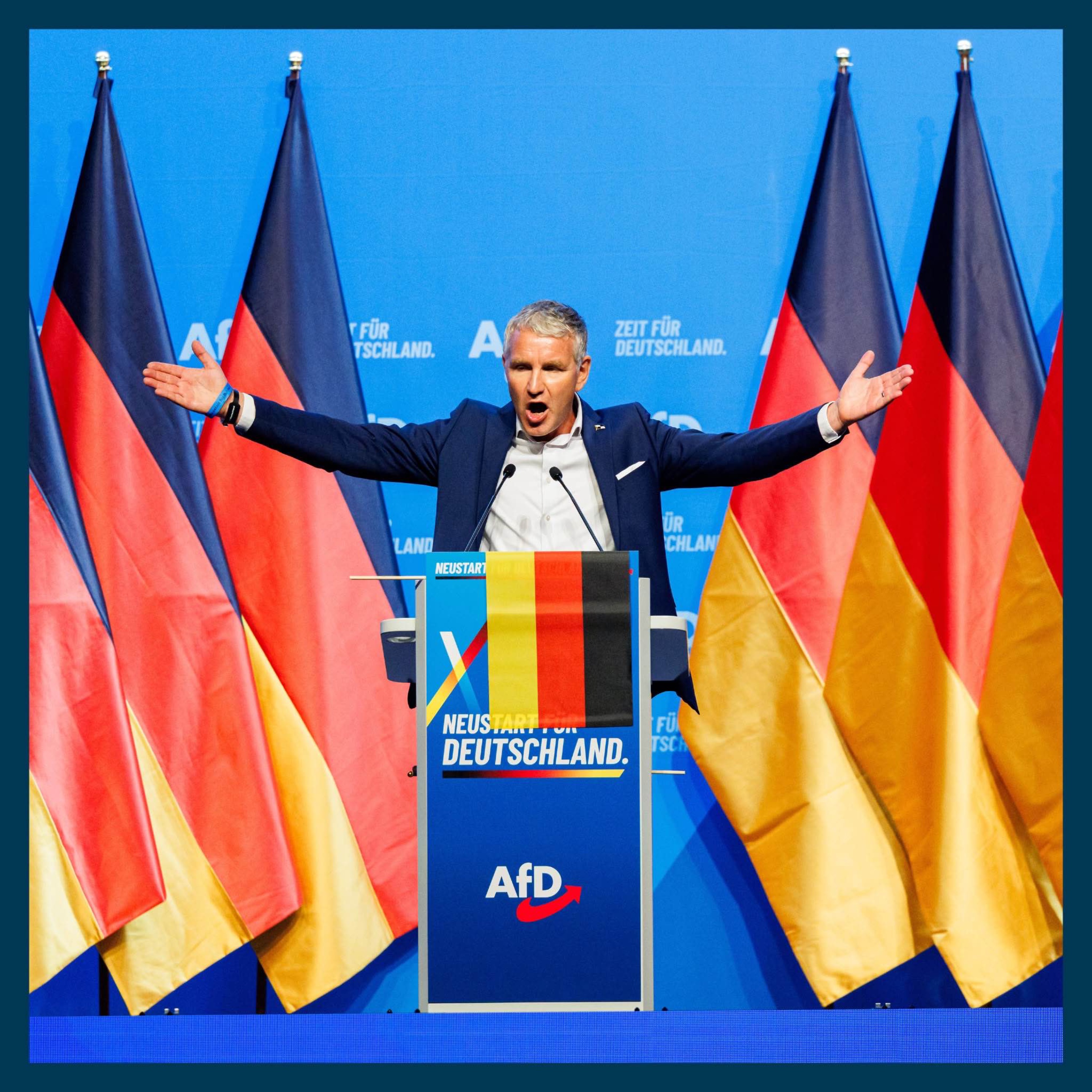
From the Times and the Sunday Times, this is the story. I'm Manveen Rana. In a little recording studio in Germany, atmospherically lit and with a few more potted plants than we have in ours. Ben Bernd, presenter of the Unscripted podcast, is preparing to interview a rather controversial guest, Bjorn Herke.
- [01:47]
Creative Planning Wealth Advisor
Bjorn.
- [01:53]
Oliver Moody
And I've had a number of politicians
- [01:55]
Local German Politician or Commentator
here and essentially they all say the AFD is so evil.
- [01:59]
Bjorn Höcke
And then I always ask them, well, why is it so evil? And the response, more or less in unison, is, oh well, because of hooker.
- [02:10]
Manveen Rana
Bjorn Hke is a key figure in the radical right party alternative for Germany.
- [02:21]
Bjorn Höcke
I have stepped forward to put an end to the reign of political correctness in Germany and to pry away with a crowbar the heavy stone slab weighing down my people.
- [02:40]
Manveen Rana
Over the course of a four and a half hour podcast interview, he laid out many of the AfD's beliefs, including the party's horror at Germany's immigration policies,
- [02:58]
Bjorn Höcke
That which we are doing now, or rather, what the German state is doing is intentional suicide, or if you like, an enormous murder plot against the German people. You have to put it in these terms.
- [03:16]
Manveen Rana
The AfD, with its nationalist, at times extremist views, is surging in the polls. It's the most popular party in the country, the second largest in the German federal government, and this autumn they're expected to win more seats in the upcoming state elections.
- [03:36]
Oliver Moody
All we want is to make history here in September by becoming the first AFD led government in the whole of Germany. Here in Saxony Anhalt, we've been working towards this for several years and the path is looking good.
- [03:59]
Manveen Rana
So how did the AFD become so popular in a country that's worked so hard to distance itself from its fascist history? And could it be stopped? The story today, the rise and rise of the AfD.
- [04:25]
Oliver Moody
My name is Oliver Moody and I am the Berlin correspondent for the Times and the Sunday Times.
- [04:36]
Manveen Rana
Ollie, this autumn, Germany will hold state elections. We don't always notice those in the rest of Europe, but these seem particularly important. Why do they matter?
- [04:48]
Oliver Moody
They matter for two reasons. The first is that German states in many ways operate like small countries. They have their own police forces, their own intelligence services and constitutions and constitutional courts and school curricula. And they're the size of small European states. But the bigger stakes here are that if the AfD party wins an outright majority in Saxony Anhalt, this would be an absolutely seismic shock to the German political system because it would be a situation where there was nothing that the established parties could have done to prevent it. And that would be a colossal indictment of the state of the political center and a really serious blow to the already weakened authority of the Chancellor Friedrich Meltz.
- [05:51]
Manveen Rana
Oli, to explain why it would matter so much if the AFD win these elections, I suppose we have to go back to the party itself. So give us a quick history. When did they begin and what exactly do they represent?
- [06:08]
Oliver Moody
So the AfD Alternative of Deutschland, the Alternative for Germany Party was founded in 2013, originally as a party of opposition to Angela Merkel's Eurozone policies in the financial crisis, particularly to woods, what they portrayed as the transfer of German taxpayers money to feckless Mediterranean economies. But over the time since then, it has been through several cycles of radicalization and it is now probably the most radical right wing of the successful right wing populist parties in Western Europe.
- [06:50]
Manveen Rana
So, Oli, give us a sense of what their platform is. With these elections approaching, how are they pitching what they stand for?
- [06:58]
Oliver Moody
So I have spent the last four hours and 46 minutes of housework, cooking and washing up and folding laundry, listening to a podcast with Bjorn Hooker, who is technically only the AfD's regional leader in the East German state of Thuringia, but is effectively the kind of the soul of the party, its chief ideologue, and he's absolutely mesmerizing. It's like listening to Carr, the snake from The Jungle Book. And at the absolute center of this ideology is a conception of the German nation, which they call the Volk, as a kind of ancient and distinct entity that used to be bound together by these ties of blood and custom and culture. He calls it the society of trust.
- [07:53]
Bjorn Höcke
Why do I want to live in a non multicultural society? Because I want to live in a society of trust.
- [08:01]
Oliver Moody
And in the AfD's view, those ties have been severed by mass immigration, which Hooker portrays as a literally genocidal project to replace the German people. That's the kind of language that they use. And to deal with that, first of all, they want to restrict all immigration, especially from outside Europe, to a bare minimum, if not to zero. Hooker talks about freezing it. And also to remove all of the migrants who have come to Germany but either cannot or will not integrate. And there's one other very important element that we need to talk about, which is another part of that project is restoring national pride in German history and culture. This idea that Germany needs to stop wallowing in its guilt for the crimes of Nazism.
- [08:48]
Manveen Rana
Some people. There is so much debate about the radical right across Europe at the moment, and obviously this is a German party. Some people will use the shorthand sometimes of comparing them to the Nazis. Is there any truth in that? Is this a very radically different movement?
- [09:04]
Oliver Moody
It is a comparison that is constantly drawn by the AfD's opponents. It's true that there are some straight up neo Nazis in the AFD and that other members will very cheerfully consort with neo Nazi and other extremist organizations with basically total impunity. And that the AFD very much embraces what is called Volkisch, blood and soil nationalism, and that its leading figures will often provocatively use tropes from Nazi rhetoric. But it's very important to underline that this is in many ways not a simple return of the Nazi Party. It's not programmatically an anti Semitic or a revanchist project. And from the perspective of a liberal Democrat, I think calling them Nazis is not just beside the point, it's actively counterproductive because a lot of voters see this and think, well, clearly they're not the Nazis, so maybe they're not so bad after all.
- [10:06]
Manveen Rana
Ollie, why should we be paying attention to this? Why should this be something that we're following closely?
- [10:13]
Oliver Moody
The AFD is fundamentally not like the other big right wing populist parties that have succeeded in Western Europe because unlike the National Rally in France or Reform in the UK or the Brothers of Italy or the Sweden Democrats, it has never made a systematic effort to moderate itself. Quite the opposite. It has progressively radicalized itself and succeeded, not despite, but because of that radicalization. And the other factor here is that Germany is the continent's largest economic power, its strongest political power, and is emerging as its largest conventional military power power. And we still do not know how an AfD government would conduct its foreign and security policy towards its European neighbors and towards the European Union itself.
- [11:16]
Manveen Rana
There is quite a lot of surprise and in some quarters, alarm at their recent electoral successes. Ollie, you've been charting their progress effectively over the years. As you mentioned, they began in 2013. Just talk us through how they've been doing in elections more recently.
- [11:37]
Oliver Moody
They got their first significant upswing after the 2015 European migration crisis. And in the next Borders tag election in 2017, they became the largest opposition party with 12.6% of the vote. And they actually faded away a lot during the pandemic and then bounced back over the last four or five years. So in the autumn of 2024, they came first in a state election for the first time in Thuringia. And then a few months later, in the most recent Bundestag election, they came second with 20.8% of the vote. They've taken control of at least four municipal districts in eastern Germany.
- [12:26]
Manveen Rana
Wow. So, I mean, they are on the march, effectively. When you look at polling across the country, how do they fare?
- [12:33]
Oliver Moody
Well, they've crossed a crucial demoscopic Rubicon in that very recently they have become not only the most popular party in eastern Germany, which they had already been for a while, but also the most popular in western Germany. So nationally, they're polling on about 27 to 29% of the vote, whereas the. The conservative Christian Democrat Christian Social Union bloc is on about 20 to 24% of the vote.
- [13:00]
Creative Planning Wealth Advisor
Wow.
- [13:00]
Oliver Moody
But in East Germany, they're. They're absolutely hegemonic. I mean, they're pushing 40% of the vote in some states.
- [13:06]
Manveen Rana
You mentioned the way their sort of popularity has waxed and waned with events outside of politics. You know, whether it was the rush of Syrian refugees or the pandemic which affected their popularity. Why do you think they're doing so well now?
- [13:22]
Oliver Moody
I think there's one absolutely central polling statistic to bear in mind here, and that is that the broadcasters LTL and NTFAU will routinely ask voters which party they trust to make the best fist of solving Germany's problems. And for about four or five years now, consistently over 50% of the respondents will say none of them. And that includes the AfD. And that means basically that more than half of the electorate does not believe there is any form of conventional politics that can make things meaningfully better. So you have this incredible depth of democratic nihilism and a lot of voters who reason that if that is the case, they might as well take a punt on an option that that seems radical or even just seems fun. You can think of it as a kind of YOLO vote. It's also true now that Friedrich Merz, the Chancellor, and his coalition between the Conservatives and the Social Democrats are fantastically unpopular. And it's also true that by now a lot of voters who might initially have turned the AfD out of protest now like the party's policies in their own right.
- [14:37]
Manveen Rana
What is it that's caused that sense of frustration with democratic powers, with what water government is able to do? Because when we look at Germany for years it was not only doing better than most of Europe in terms of economic growth, but it had very stable seeming government.
- [14:55]
Oliver Moody
I think there are two answers to that question. The first is the kind of fundamental state of the economy, which has in some ways structural problems that are very similar to the UK's. With an aging society, a shrinking workforce, funding the retirements of ever more pensioners, very minimal productivity growth and expensive welfare state. The macroeconomic performance has been worse. There's basically been zero growth in real terms since 2020. If you adjust for inflation, Germany's GDP is only 0.3% bigger now than it was in 2019, which is the worst record in the G7. And it also feels a lot worse than it is because if you zoom in a little, the services sector is doing fine, but pretty much all of the pain is being borne by industry. And that really cuts right to the quick of Germany's image of itself as a land of world dominating, innovative manufacturers. On the political side, there has been very little specificity and hope and optimism about what Germany is transitioning to. One example of this is a line that has really stayed in my memory from an interview that I did with Jennifer Colleen Fieder, who is the Social Democratic mayor of Ranenburg, a town on the northern outskirts of Berlin. And she talked about how there is this enormous divergence between the economic reality in Germany and people's perceptions of it, that this idea has set in, that it's a nation that is fundamentally in an unstoppable decline.
- [16:40]
Jennifer Colleen Fieder
There's a divergence between the insecurity and hardship people feel is there and the actual situation people are in. Actually crime is lower, people are earning more, the salary situation has improved, we have good healthcare here in the town. And still people have fears. And these fears are facts for people.
- [17:07]
Oliver Moody
And then there's also a political difficulty structurally, which is that the electoral system forces the mainstream parties into these very awkward coalitions. They've developed a kind of extreme form of stakeholder democracy where you have all these vested interests that have to be consulted every time you want to make a reform. And then that really slows down and dilutes the process.
- [17:39]
Manveen Rana
So with that whole sense of both economic malaise and no great political answers, the AFD is suddenly in a position to do extraordinarily well, looking ahead to the upcoming elections. I mean, what are the predictions?
- [17:53]
Oliver Moody
The predictions are that they've got a basically 50, 50 chance of getting a majority in Saxony unhurt. In Berlin. They're in a four way fight with the conservatives, the Greens and the radical left in Mecklenburg West Pomerania in the northeast, on the Baltic coast. They're almost certainly going to come first by a very large margin. A more interesting question is whether there is a ceiling on how well they can do nationally. We've seen a lot of psychological and evidence for some time now that their kind of potential vote may be capped at about 30%. But they've kept on breaking through those thresholds and mobilizing ever more people who had basically given up on politics before that. So I would not personally be surprised if they were to break through this 30% barrier within the next 12 months,
- [18:51]
Manveen Rana
Coming up with momentum on their side. Will the AfD's seemingly inexorable rise continue at the polls? Or could they be stopped? That's in just a moment.
- [19:14]
Grow Therapy Advertiser
Everyone treats summer like it owes you happiness. Long days, pool parties, your best life on a loop. So what does it mean when you feel worse? The summer blues are real. It's why summer is one of the busiest stretches of the year for people starting therapy. Grow Therapy is here for all the moments when you decide you want more. More support, more clarity, more tools. GROW connects you with thousands of high quality licensed therapists across the US offering both virtual and in person sessions, nights and weekends. The therapist you want takes your insurance on. Grow grow accepts over 125 insurance plans. Sessions average $21 with insurance and some pay as little as $0 depending on their plan. Visit growtherapy.com acast today to get started. That's growtherapy.com acast growth acast availability and coverage vary by state and insurance plan.
- [20:15]
Barclays Brief Advertiser
Today's markets move fast. Get the insights you need in 10 minutes with the Barclays Brief, a new podcast from Barclays Investment Bank. Through Sharp dialogue and scenario based analysis, our leading experts analyze key market themes each week. So whether you're managing a portfolio or leading a business, the Barclays Brief podcast can help you make smarter decisions today. Stay sharp. Stay Brief. Stay Find Barclays Brief wherever you get your podcasts.
- [20:44]
Creative Planning Wealth Advisor
Because you didn't just say how can I provide these investments? You'd be how do I holistically provide everything? How do I bring in the legal, the accounting, all this, and do it at a price point? No one else is doing it.
- [20:53]
Oliver Moody
Learn more about how we approach wealth management@creativeplanning.com integrated.
- [21:16]
Manveen Rana
Ollie, you've been describing the progress of the AfD from sort of a fringe movement to a huge political force which is making use of the general disenchantment with with politics. But it is converting that into votes and is surpassing people's expectations. In terms of understanding the future of the party, though, are there potential cracks forming in the way that it's actually run?
- [21:44]
Oliver Moody
There are not just potential cracks, there are actual fissures along two lines. The first of those is just a really straightforward power struggle between the party's two national leaders, Alice Vidal and Tino Kropala. And at the party conference in Erfurt a couple of weeks ago, Krupala was almost completely defeated. The more interesting and subtle and significant conflict is one over strategy between a camp that you could call pragmatist that wants to at least cosmetically portray the party as a credible party of government that right wing voters would recognise a party that could work with the Conservatives in government if it had to. And then you have a faction that you might call the purists, particularly around Bjorn Hooker, the party's leader in Thuringia, who believe that the party has only succeeded by remaining true to itself and it should keep its voters fired up by retaining this radical edge that it has had from the beginning.
- [22:58]
Manveen Rana
And are those tensions starting to impact the party and the way that it's seen by voters?
- [23:03]
Oliver Moody
It has resulted in some absolutely brutal and ugly internal conflicts. Occasionally it comes to mild fisty cuffs. In terms of how the electors see it, we don't know yet. We saw Friedrich Merz try to use this chaos in his annual summer press conference a few days ago as an example of how utterly unreliable the AfD would be in government. But we have also seen the AFD brush off a big cronyism scandal where it turned out a lot of their politicians have been employing relatives to work in their offices. And there is one school of thought that says this conflict could actually help the party, really that it's actually productive. And that is because it allows it to glue together this otherwise unsustainable electoral coalition of disgruntled right wing voters and those who just want to watch the entire system burn.
- [24:07]
Manveen Rana
There's now a concerted effort, we think, by other parties to try and halt the AfD's progress and its electoral successes. Just describe how that's actually playing out.
- [24:21]
Oliver Moody
Well, there's a lot of stuff going on at macro level in terms of discussion of whether you could try and ban individual AFD politicians from standing for office because they're ruled to be hostile to the German constitution, or whether you could ban certain state associations on similar grounds. But what I thought was an interesting and valuable thing to do is to go and see what it looks like at ground level. So I looked through several very different German towns, Ranienburg and Meissen in the east and Ludwigshafen in the west, to see how you can combat the AFD effectively at grassroots level. One thing that became apparent to me in that process is that there were large parts of Germany where the connection between ordinary people and mainstream politics is essentially broken and local politicians are perceived as being powerless or unapproachable. They're barely present online. The AFD dominates the airwaves on Instagram and Twitter and TikTok. Markus Renner, who's the independent mayor of the East German city of Meissen and successfully defeated a challenge by a very right wing AFD candidate a few months ago, explained it to me.
- [25:48]
Local German Politician or Commentator
You see the AFD a lot in public spaces, and on the other side you see very little of the other parties. Everyone knows this. But the other political parties can't really motivate themselves. They have too few staff.
- [26:08]
Oliver Moody
And for the average citizen, pretty much every interaction that they have with the state is an experience of frustration with kind of faceless forces that are far beyond anyone's control. And one strategy that seems to work really well against the AFD at local level is to try and bridge that gap not just by being present and visible and constantly talking to the voters, but also trying to show that politics can respond meaningfully to people's concerns. And Jennifer Colleen Feder, the mayor of Oranienburg, gave me a bunch of really striking examples of just kind of everyday situations where she had tried to show that the political system could actually do what voters on the ground wanted it to do. And often this, you know, looks like very Small things, you know, the parking spaces that might be lost to a rewilding project, or the need to get planning permission to set up a temporary stall at a market selling asparagus.
- [27:12]
Jennifer Colleen Fieder
From next year, the asparagus and farm stands won't require a building permit anymore. That's a concrete example of something we learned from the stall and market operators and from the farmers. A situation where we were able to provide real help.
- [27:30]
Oliver Moody
And I think that the kind of quotidium humdrum quality of those case studies is exactly the point, because this is about repairing that grassroots connection and giving people a sense that politics can actually make a tangible difference to their real lives.
- [27:49]
Jennifer Colleen Fieder
Staying close to the people and understanding their concerns and needs is absolutely crucial. And for that we need people from the grassroots.
- [28:04]
Manveen Rana
And just talk us through how that sort of manifested in places like Meissen that you visited. What were you seeing with sort of some of the local characters who were campaigning?
- [28:13]
Oliver Moody
Well, Meissen is interesting because it embodies another strategy that has been effective against the AfD and that is to say they're the strongest force locally. So this is really as squeaky bum time as Sir Alex Ferguson would have put it. And the mainstream parties need to combine their forces and unite around a single candidate. And so in Meissen, they came together around a career civil servant with no political experience called Marcus Renner, who then turned out to be a very good and credible campaigner and ended up winning the mayoralty against a very right wing former neo Nazi candidate from the AfD by quite a comfortable margin.
- [29:07]
Local German Politician or Commentator
When you are trying to get these dry political issues across on the audience's level, we still have lots and lots of work to do. The people you usually find in politics in the classic parties, lawyers, teachers, administrators, are precisely not the people who can talk in a laid back way about these issues. It's this ability to go to the level of the people you want to reach, even if it means using vulgar language. The AfD can do it perfectly and the others can't.
- [29:40]
Manveen Rana
I mean, that does sound extraordinary. And that's all through people coalescing around one non controversial candidate.
- [29:48]
Oliver Moody
Well, to put it in British terms, if you imagine the Greens and the Lib Dems and Labour and the Conservatives all saying, well, we need to come together and form some kind of collective agenda. You need to kind of keep the civil peace between incredibly various factions politically that hate each other. So in some ways having a neutral figure, it makes it much easier for them to rally behind a single candidate.
- [30:18]
Manveen Rana
Is that something that might be repeated across the country at forthcoming elections.
- [30:23]
Oliver Moody
It's not going to be the answer in a one to one sense, just because at state and federal level, the German electoral system makes that kind of coalition impossible. However, I do think it is a foretaste of what we might see at the next Budistag election, in the sense that if the mainstream parties remain determined to keep the AfD out of government, they will be left with no choice but to form increasingly diverse, uncomfortable, fragmentary coalitions.
- [30:55]
Manveen Rana
There was some talk for a while about banning the AfD. Has that chatter gone away and would that be a sensible strategy or would that actually just increase their popularity?
- [31:08]
Oliver Moody
It would have worked earlier on, when the AfD was still finding its way as a party. But now it is just so entrenched, not just in the political system, but in the fabric of German society, that if one were to ban it, that would not only be effectively an admission of defeat from liberal democratic politics, but it would also be completely ineffective because the party would simply come back in another form.
- [31:31]
Manveen Rana
And Ollie, we are seeing this across Europe. We are seeing the rise of the radical, the far right. It's happening in a number of countries. I suppose people are just quite surprised seeing it in Germany, because we know that since the end of the Nazis, the end of the Second World War, Germany has been on such a journey of coming to terms with its far right past that it seemed unimaginable there would be another movement that reflected even the radical right in politics. You live there, you are surrounded by German culture. How much has that changed in the last decade? What's happened to make the emergence and the success of the AfD possible?
- [32:19]
Oliver Moody
Well, look, there's some process of coming to terms with the past that you described over the last 40 or 50 years has been the single and perhaps the only truly successful example of deprogramming a totalitarian society and rewiring a country's political culture that we have. But at the same time, it's also true that the crimes of the Third Reich are fading out of living memory and that the memorialization of them has become quite ritualized, quite ossified. You can see that, for example, in the way that when people are confronted with a radical right wing party in the AfD, they immediately pigeonhole it as the Nazi party. And the problem with this is that it's losing large numbers of young people and millennials in my generation with whom a lot of this stuff just goes in one ear and out the other. There's a study that shocked me so much last year that found 80% of German adults couldn't name a single concentration camp or a site of other Nazi atrocities. And so clearly something about this memorial culture is going seriously wrong. Germany after the Second World War developed a very particular system to try and prevent a repeat of what had happened in the Weimar Republic and in 1933 with all these checks and balances. It's called a Wehrhafter Democratie, a sort of militant or combative democracy that includes all kinds of safeguards that are designed to shut the radical right out of power. And while the AfD is is programmatically committed to democracy per se, it is also committed to destroying elements of this post war liberal democratic system.
- [34:40]
Manveen Rana
That was Oliver Moody, Berlin correspondent at the Times and the Sunday Times. The producers today were Michaela Arneson, Olivia Case and Jesse Fox. The Executive producer was Harry Stott, sound design was by Dave Creasy and theme composition was by Mal Assetto. If you can do Leave us a review wherever you get your podcasts. If you'd like to get in touch with us about this or any other episode, or if you have any questions that you'd like us to address in our Q and A episode later this week, then do drop us a line to the story the times.com.
- [35:28]
Barclays Brief Advertiser
Shipping, billing, admin, payroll, marketing. You're managing all the things, so why waste time sending important documents the old fashioned way? Mail and ship when you want, how you want with stamps.com print postage on demand 247 and schedule pickups from your office or home. Save up to 90% with automated rate shopping. That's why over 1 million small businesses trust stamps.com go to stamps.com and use code podcast to try stamps.com risk free for 60 days.
- [35:57]
Creative Planning Wealth Advisor
Because you didn't just say how can I provide these investments? You'd be how do I holistically provide everything? How do I bring in the legal, the accounting, all this and do it at a price point no one else is doing it.
- [36:06]
Oliver Moody
Learn more about how we approach wealth management@creativeplanning.com integrated.