Loading summary
Transcript76 lines
- [00:00]
Jerry App Advertiser
You know what's wild? Most people are still overpaying for car insurance just because it's a pain to Switch. That's why there's Jerry. Jerry's the only app that compares rates from over 50 insurance in minutes and helps you switch fast. With no spam calls or hidden fees, drivers who save with Jerry could save over $1,300 a year. Before you renew your car insurance policy, do yourself a favor, download the Jerry app or head to Jerry AI Acast.
- [00:27]
Karim (Voice of Simon Fairchild)
Hi everyone, this is Karim, the voice of Simon Fairchild from the Magnus archives. And today I want to talk to you about Boost Mobile. Some things quietly drain you like an expensive phone bill, trapping your money month after month. Here's a quick money Stop paying a carrier tax when you bring your own phone and Switch to boost mobile's $25 unlimited forever plan. You can unlock up to $600 in savings. That's money that belongs in your life, not trapped in a phone bill. Reclaim those savings for something you're actually into an EMF meter, a a thermal camera, or whatever strange corner of the universe you're currently exploring. Visit boostmobile.com to unlock your savings and take back control. After 30GB, customers may experience slower speeds. Customers pay $25 per month as long as they remain active on the Boost Mobile Unlimited plan. Boost Mobile January 2026 survey comparing average annual payments of AT&T, Verizon and T mobile customers to 12 months on the Boost Mobile Unlimited plan. For full offer details, visit boostmobile.com.
- [01:24]
Manveen Rana
From the Times and the Sunday Times, this is the story. I'm Manveen Rana. In real estate terms, it's a small, rocky outcrop just 8km long and about 5km wide. But this little island in the Persian Gulf off the coast of Iran has certainly caught the attention of the man who likes to think of himself as the property deal maker in chief.
- [01:51]
Unidentified Military Voice 1
We attacked Cog island except for the
- [01:54]
Lieutenant General Sir Simon Mail
area where the oil is.
- [01:56]
Unidentified Military Voice 1
I call it the pipes. We left the pipes, but it may
- [02:00]
Lieutenant General Sir Simon Mail
not stay that way.
- [02:01]
Unidentified Military Voice 1
Just one simple word, and the pipes
- [02:03]
Lieutenant General Sir Simon Mail
will be gone, too.
- [02:04]
Manveen Rana
In fact, for Donald Trump, Carg island has been an obsession since 1988.
- [02:11]
Unidentified Military Voice 1
Long before he was in politics, he
- [02:14]
Lieutenant General Sir Simon Mail
said, I'd be harsh on Iran. They've been beating us psychologically, making us look like a bunch of fools. One bullet shot and one of our men or our ships and I do a number on Carg Island, I go in and take it.
- [02:28]
Manveen Rana
Carg island matters because it's also Iran's key oil export hub. 90% of the country's oil passes through the island, and millions of barrels are stored there. And now President Trump has firmly set his sights on it.
- [02:45]
Karim (Voice of Simon Fairchild)
Donald Trump told the Financial Times, maybe we take Hog island, maybe we don't. We, we have a lot of options.
- [02:52]
Lieutenant General Sir Simon Mail
I don't think they have any defense.
- [02:54]
Karim (Voice of Simon Fairchild)
We could take it very easily.
- [02:57]
Manveen Rana
With thousands of American troops set for the Middle east, the rhetoric is ramping up. Yesterday, President Trump threatened to obliterate Kharg island, but the Iranian regime has made it clear that it isn't going down without a fight.
- [03:14]
Brookfield Advertiser
Iranian Parliament Speaker Kalibov has said that there's going to be fire raining on American soldiers. We're waiting for them, actually, in Iran.
- [03:22]
George Grylls
If there is a ground invasion, how
- [03:25]
Manveen Rana
difficult would it be to launch an invasion of Khaag Island? Would it bring the regime in Iran to its knees, or would it entrench the US in another costly, forever war in the Middle East? The story today, will Trump invade Carg Island?
- [04:00]
George Grylls
My name is George Grylls, and I am Washington correspondent for the Times.
- [04:04]
Manveen Rana
George, we know negotiations between America and Iran are supposed to be ongoing. Donald Trump keeps extending the deadline on them. At the same time, thousands of American troops are. Are on their way to the region. What do you know about the current state of affairs? Do we think those negotiations are working, or are they just a front while they try and get troops to the right place?
- [04:25]
George Grylls
Well, both things can be true. I think Trump is giving himself a number of options, but the Iranians are very skeptical. Because if you cast your mind back to February, when there were previous negotiations going on between the US And Iran, at the same time, the Iranians were watching these American aircraft carriers heading to the Middle east, thinking, well, hang on, this looks a bit like they're kind of getting ready for a war. And indeed, that's exactly what they were doing. So, once again, we're in talks, supposedly between the US And Iranians. Well, the Iranians have played down how fruitful those have been so far, whereas Trump has kind of talked them up and they're saying, no, we're looking at all these troops kind of coming in our direction, and we're preparing for a ground invasion of perhaps Cog island, perhaps one of the other islands in the Persian Gulf near the Strait of Hormuz. Perhaps, you know, U.S. special forces going in to seize Iran's enriched uranium.
- [05:20]
Manveen Rana
And just in the last few hours, he's ratcheted up those threats. He's now threatening to obliterate Kharg Island, a place with lots of Ancient archaeological sites as well as huge oil installations. So something we should all be slightly worried about, at least. How is that kind of rhetoric going down in Washington?
- [05:42]
George Grylls
Well, so far, Trump has displayed an extraordinary ability to talk himself out of trouble, and the timing of his announcements is very important. So this goes back to before Iran, it goes back to Venezuela, really. He has reserved his most escalatory rhetoric. And the US has carried out its kind of most extraordinary bombing campaigns basically over the weekend when markets have been closed. And that's a way of kind of mitigating the economic shock and the fallout. And then when markets reopen during the weeks, Trump says this is only going to last a small amount of time. We're going to get out of here. Don't worry about it. As a way of kind of keeping oil prices down, soothing markets fears. And we saw that again at the beginning of this week. So the Iranians have got so familiar with this pattern, they actually preempted Trump would send this Truth Social post early on Monday morning and said, don't believe him. Whatever he says. That's kind of going to be talking about how we're going to open the Strait of Hormuz, either A, through negotiations or B, by taking Kharg island and the Iranians will have to fold. They said, don't believe him. And he did indeed post this morning on Truth Social just before markets opened, saying exactly that. So the interesting thing.
- [06:56]
Manveen Rana
Right on cue.
- [06:57]
George Grylls
Right on cue. The interesting thing now is what is happening with oil prices, because previously, when Trump has kind of softened his rhetoric or suggested the war is winding up, the markets have reacted. And in the past, I'd say week, week and a half, the markets no longer believe him, it seems, because the price of oil has kept going up. And in fact, it's now about, as we speak, $115 a barrel. So Trump's ability to kind of talk away the economic crisis that is coming for American motorists is limited.
- [07:29]
Manveen Rana
Now, what are his options? He's talking about obliterating Carg Island. Is there an off ramp? Is there any other way out of this for him?
- [07:38]
George Grylls
He has got himself in a situation where it is obvious that the Iranians can wage an asymmetric war. They don't, you know, what they need to achieve is very little to disrupt, cause massive economic damage and disrupt world markets. So, you know, this is why you see him kind of veering between extremes, as a way of kind of trying to find out how he can resolve this problem of his own creation. At the moment, you know, it's basically unclear.
- [08:12]
Manveen Rana
You mentioned how when all the ships were heading towards the Middle east, you know, the Iranians could see that there were signs of war coming. Now, with thousands of troops heading for the region, does having such a buildup of military assets almost have a momentum of its own? Having sent them out there, are you, do you kind of sort of get drawn into using them? Whether it's strategically the right thing or not?
- [08:36]
George Grylls
I think it's, you know, judging by what Trump has said in the past, and you could basically pick a truth social from the past three months and make one argument or another, depending on how you felt at that precise moment. You know, the one thing you cannot deny is the movement of troops. And, you know, you look at. So we've had one Marine Expeditionary Unit has just arrived, another's on the way, around 2,000 paratroopers. Now, Navy Seals and Rangers, who are the sort of special forces that might be used to go in and get Iran's enriched uranium. You know, these are facts. You can't deny that this is taking place. Whereas Trump's words are so inconsistent that it's very hard to kind of put stop by them. Because like I say, you can make an argument for, for the fact that they're pulling out or the fact that they're going to escalate, depending on the hour of the day. Whereas the facts of troops being there is undeniable.
- [09:44]
Manveen Rana
If President Trump does decide to launch an invasion of Carg island, what would that look like? We turn to a military expert.
- [09:53]
Lieutenant General Sir Simon Mail
I'm rather, he said, rather pompously, Lieutenant General Sir Simon Mail, retired. I hasten to add, I did a 40 year career in the British army, held various appointments in the policy world in the Ministry of Defence. Also commanded either on operations or on campaigns in the Middle east, in Cyprus, in Northern Ireland, in Kosovo and in Afghanistan.
- [10:21]
Manveen Rana
The headlines at the moment are full of reports about American troops heading towards the region and what might happen with Carg Island. Just describe for us where is Carg island and why is it so significant? Roll out the map.
- [10:38]
Lieutenant General Sir Simon Mail
Cog island is either named the island of Desolation or was also known as the Orphan Pearl of the Gulf.
- [10:46]
Manveen Rana
Oh, beautiful titles.
- [10:48]
Lieutenant General Sir Simon Mail
If you get a map out and everybody focused at the moment on the Strait of Hormuz and you need to roll right up to the northern end of the Gulf. So it's about 400 miles north of the Strait of Hormuz and about, I think about 20 miles off the Iranian coast. And it really is hugely important for the Iranians because 90% of its oil exports come through Kharg. It's about 8 kilometers long, about 5 kilometers wide. It's got a city, well, hardly a town, called Carg. It's got about 9,000 civilians there. It's got a very large workforce. And of course, it's got. And I'm not privy to that, it's got a lot of military assets there, and those have been targeted. As we know already, no oil facilities have been targeted, but about 90 targets have been hit militarily. But it is absolutely critical lifeline for the Iranian economy, and it's largely where it funds its nuclear program, its support for proxies, its own economy. It also can house about 30 million barrels of oil in storage. I suspect that's been run down. And it has been shipping about 1.52 million barrels of oil a day for China. So when we talk about the Strait of Hormuz being closed, the fact of life, it's not physically closed. It could be closed. And the threat alone, of course, is enough not to let people through. But for the Iranians, it's the absolute gateway to almost everything to do with their economic sustainability, and therefore, it's hugely vulnerable and makes it a very attractive target. Now, you could just destroy everything on it. That would be an environmental disaster, of course, or you could take it, or you could target the tankers. There are any number of options as to what you might do with Cargillum. Is it a single point of failure for the Iranian regime? It's certainly strategically important.
- [12:46]
Manveen Rana
That's such a great description. So you've got an enormous, you know, geographically enormous country, the size of Iran, and yet this one island is absolutely critical to its economic success and failure. Funnily enough, it's an obsession President Trump has had since the 1980s. I think going back to 1988 is the first time he said if he was president, he would be taking Carg island and forcing the Iranians to follow what America wanted. It's clearly an obsession for him. He's talked about it a lot in the last couple of weeks. What would he be hoping to achieve with an invasion? You talked a moment ago about there being various options that you could go for. Talk us through them.
- [13:26]
Lieutenant General Sir Simon Mail
There are a number of areas where you could use ground operations. I think any idea when we talk about invasion is summoning up shades of the first Gulf War or the second Gulf War, and large tanks and large tank armies and infantry and taking ground. You know, Iran is, I won't say off limits for ground forces, but there's, there's just nothing that we're doing about that scale. Special forces? Yes. Strikes? Yes. Raids? Yes. A particular thing. We, we may talk about the uranium, but if you want to really go for the heart of the Iranian regime, then cog is, is where they would be very worried. And on that, what would you do? You'd sanitize the area, you'd bomb it. You want to make sure that whatever's on the island is all that you could have on the island, that it couldn't be reinforced. The fact that it is an island, the complexity of an amphibious operation or an airborne operation or an air assault operation. All three, the Americans would have the capability to do, supported, of course, by fires against any ballistic missile defenses, suppression of any targets on the ground, always, of course, trying to avoid an environmental disaster. And equally, Trump has one option. Stop Iran doing anything with their oil, as he occasionally threatens, is I'll just take that oil. But as a bargaining trip, were they able to take it? It's huge because I think we've just got to keep reminding ourselves, despite all the bloodthirsty rhetoric from Tehran. But the reality is an extremely fragile regime. It's resilient up to a point. It's very ruthless, it's brutal to its own people, it's been brutal to its neighbors, and yet its economy is hugely weak. So it's bigging itself up, inevitably, because it's backs to the wall. And the key at the moment is to keep making it, put it into reactive survival mode and give it so many challenges that eventually the formal command control, which has already been broken, goes, and even the disseminated dispersed network command control can't handle it. But Kharg is a hugely symbolic. But like with magicians, watch out what people are doing with one hand and what they're actually doing with another.
- [15:46]
Manveen Rana
If the Americans could somehow seize Iranian oil, we know that since the war began, the Iranians are getting twice the price per barrel than they were before. Sanctions have been canceled because it's so hard to get oil out of the region. If they could somehow take control of Iranian oil, that would obviously be a huge win for the Americans. How would they do that? If you were given the task of setting up an operation for Americans to take Iranian oil, how would you go about it?
- [16:18]
Lieutenant General Sir Simon Mail
Well, the MEW are there.
- [16:19]
Manveen Rana
These are the Marines.
- [16:20]
Lieutenant General Sir Simon Mail
These are the marines, sorry, the Marine Expeditionary Units that are coming in there. There are two large ships. You've got to get them through. So quite a lot is creating time. This is where Diplomacy, politics plays in because you're still getting your chess pieces in place.
- [16:37]
Manveen Rana
So this is why we keep saying the deadline extended.
- [16:40]
Lieutenant General Sir Simon Mail
This is where military planners will be saying, if you want us to do this now, we can do it with this. If you want us to do this, we need a bit more time, you know, keep the attrition up, keep a drumbeat of attacks, which of course they're doing on leadership, both formal and individuals. There's all sorts of things the Americans and the Israelis are doing, most of which has not been seen by anybody except those on the receiving end. Largely the reporting is what's hitting Dubai or Bahrain, etc. You then have to get the MEW through the Strait of Hormuz itself.
- [17:13]
Manveen Rana
Now that alone sounds like a bit of a problem because if you're trying to take Carg island in order to force the Iranians to reopen the strait, it's very hard to do that by going through the strait.
- [17:23]
Lieutenant General Sir Simon Mail
Well, that becomes a military operation. Now military will operate very differently from civilians. The military don't have to wait to see whether they've got a good enough insurance premium that's been paid. They don't have civilian crews. And of course you're trying to get almost a single two or three key vessels through.
- [17:42]
Manveen Rana
I mean, give us a sense of how vulnerable they'd be going through that very tight bit of the strait.
- [17:47]
Lieutenant General Sir Simon Mail
Well, it depends how far the attrition's got. So far, to be honest with it, we don't quite know. Kesham island is littered with Navy irgc. It's where we thought they had the shorter ship missiles. It's where we think the minelayers probably are. But there's Larrack island as well, command and control. So it would be accompanied by a huge cyber blitz, attritional blitz. You might put people onto islands anyway to get it through. It's doable, but one wouldn't expect it to be unopposed. Once you're in the Gulf, you're fairly. I won't say you're safe, but you've got a lot more space to play with and you move fairly fast. And then you would be combining the threat of an amphibious assault with clearly heli landed assault with a possible parachute assault supported by a huge amount of surveillance, intelligence, cyber warfare, information operations, air power. But none of these are easy. And if you've got a lot of assets in a single capital ship, you too have a single point of failure.
- [18:54]
Manveen Rana
Yeah, and we've seen the danger of that. It does make you a target. You are a floating target. But just how dangerous could an operation like that be for American troops? I keep hearing people comparing it to Black Hawk down, that disastrous operation in Somalia where American special forces arrived on the ground and were ambushed.
- [19:16]
Lieutenant General Sir Simon Mail
Well, you didn't have access to 2 million barrels of oil a day in Somalia. You know, what's at stake for both sides in taking Kharg is huge. But there is a battle of the narratives here. Without doubt, the Iranians want to widen and lengthen this war. It suits them because they understand news channels, media, they understand the American population probably better than the American population would understand the Iranians. They get the fragility of Trump's position. They know about the midterms, etc. They look at the Europeans, they look at the nervousness of the Gulf states, etc. For us collectively, and that includes even those who don't support Trump or Israel. We would like to limit the war to the Gulf, not widen it and shorten it. And for many people, of course, there is a hope, and I think everybody's agreed from one point of view that we would like this regime to change its behavior. So a lot of this at the moment is how much do you threaten? How much do you carry through?
- [20:21]
Manveen Rana
Well, Simon, we've been told that There are between 2,000 and 3,000 US paratroopers on their way. Now, tell us a bit about the sort of troops we know are being directed to the area. You know, what is their specialism? What can you expect to see from them?
- [20:37]
Lieutenant General Sir Simon Mail
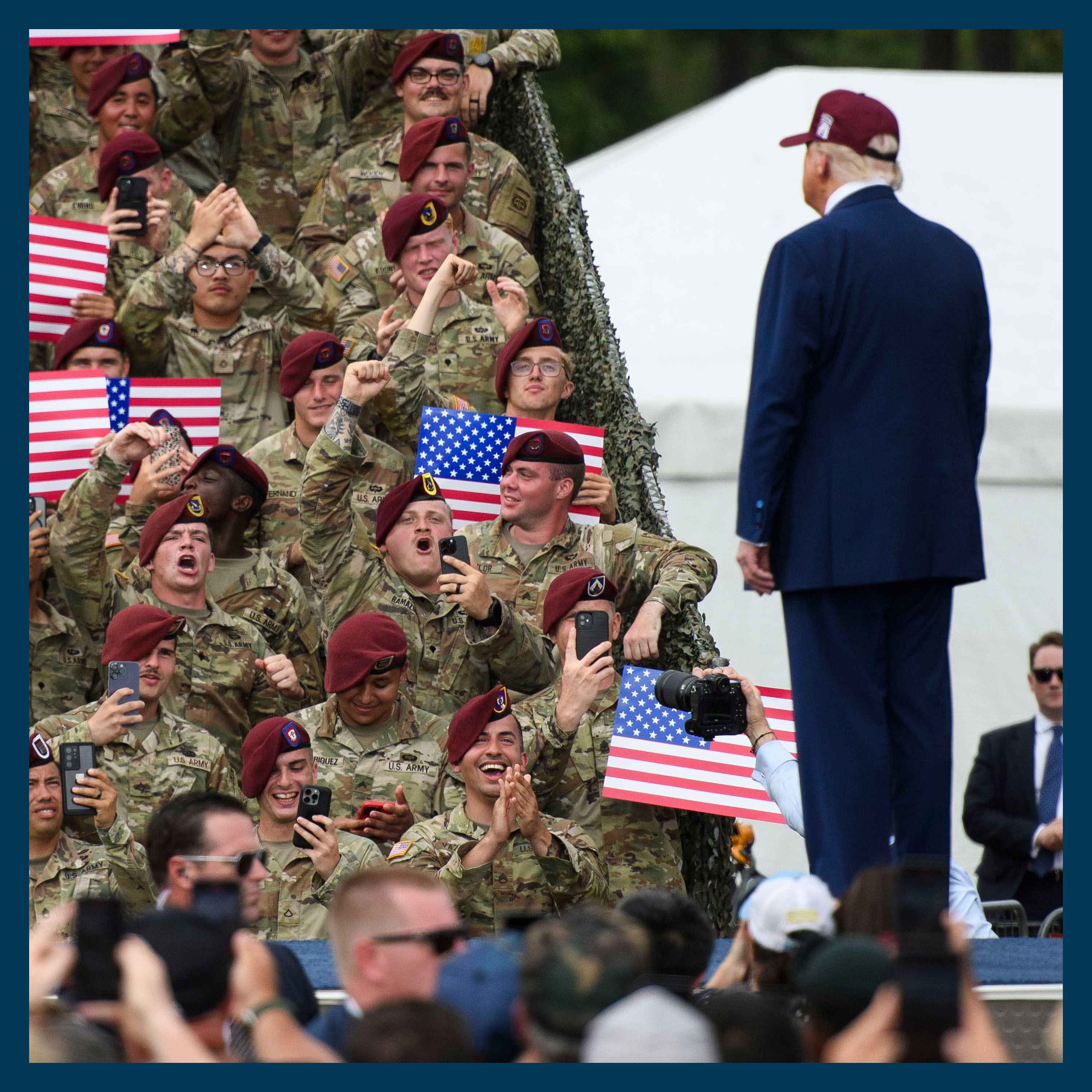
Well, the 82nd Airborne are really, you know, paratroopers. Always think they're the elite. I speak as a cavalryman. We're quite elite as well, but they are. I mean, they, you know, not only are they selected as soldiers, they then have to go through another selection process to be paratroopers. And they then, a bit like our own parachute regiment, do have an ethos, a really strong warrior combat ethos. So they are the spearhead, and you don't commit them lightly. But the 82nd would go in surrounded by an absolute umbrella of air assets as well. So all of these allow you to do simultaneity, as we call it. So you flood the zone. That's the American footballers who flood the zone with ways that have everybody just turning left and right. Is it behind me? Is it in front of me?
- [21:32]
Manveen Rana
Coming up, could an American invasion of Carg island backfire? What are the risks for President Trump? We'll have that and more in just a moment.
- [21:53]
Brookfield Advertiser
At Brookfield. We invest in the thing behind the thing. Behind the Next Big Thing. Our focus across infrastructure, energy, real estate, private equity and credit is helping to build the backbone of the global economy. We combine deep operational expertise with disciplined long term investing, uncovering value and partnering alongside clients to shape tomorrow's economy today. Brookfield Own what's Next? Learn more@brookfield.com this is not an offer to sell or investment advice. Investing involves risks, including loss of capital. Dreaming of getting the all new iPhone 17 Pro designed to be the most powerful iPhone ever?
- [22:28]
Manveen Rana
Then stay in bed and let a
- [22:29]
Lieutenant General Sir Simon Mail
Boost Mobile expert deliver and set it up for you. Oh actually they will have to get
- [22:33]
Brookfield Advertiser
up and open the door. Oh right. Delivery available for select devices purchased@boostmobile.com terms apply.
- [22:38]
Jerry App Advertiser
You know what's wild? Most people are still overpaying for car insurance just because it's a pain to switch. That's why there's Jerry. Jerry's the only app that compares rates from over 50 insurance in minutes and helps you switch fast with no spam calls or hidden fees. Drivers who save with Jerry could save over $1,300 a year. Before you renew your car insurance policy, do yourself a favor, download the Jerry app or head to Jerry AI Acast.
- [23:17]
Manveen Rana
Simon, you were talking through the options. If you want to launch an invasion of Carg Island. What are the alternatives? You said you know that the conjurer's trick of look over here, lots of talk about Carg island. You might go elsewhere. What else would be a potential target?
- [23:32]
Lieutenant General Sir Simon Mail
Well, Keshem Island, Larrak, which is basically the toll booth for the Iranians there.
- [23:40]
Manveen Rana
These are islands in the Strait of Hormuz.
- [23:42]
Lieutenant General Sir Simon Mail
They're in the Strait of Hormuz. Interesting. There are three islands which again your listeners and you may be very well aware of, were taken from the UAE on the formation of the UAE and they're known as Abu Musa, the Greater and Lesser Tunb. They're islands that the UAE would very much like to get back. They of course could be occupied and used as a base. From that point of view, you're saying, well, we're not actually occupying Iranian territory, we're just retaking some islands that should belong to the United Arab Emirates. But ultimately the use of Cog island will be leveraged to have a long term solution that doesn't allow a regime that behaves like this to constantly have a key to closing it. And that's what you ultimately want. Now we could widen it and look at Bab el Mandab as well. You know, the entry to the southern end of the Red Sea Both of them are critical and both of them have been threatened. And there's always this threat. But Khag island, either destroy it, environmental problem, destroy the tankers. You might want to do that, Give enough warning, get the crews off, make clear to the Chinese. I think quite a lot of the diplomatic pressure can come through Beijing, Islamabad, or occupy it. And if you occupy it, it's a game changer. But as we've discussed, Nanveen, occupying it does not come without huge risks.
- [25:10]
Manveen Rana
You mentioned that one of the targets might be one of the nuclear sites. We have heard that quite a lot. The idea of being able to go in and take uranium out of Isfahan or Fordo or wherever it's being held, how realistic is that? I mean, we know since the last operation last year, we know that they've been moving a lot of their sort of vital assets, including nuclear. Some of it's going underground. It's going all over the place. How easy would it be to send some troops in, Special Forces in a limited operation in order to take out uranium from Iran?
- [25:45]
Lieutenant General Sir Simon Mail
It would be extremely difficult, and it really depends. But the reality is we know where the uranium enrichment was. It was very heavily hit last year. It's been hit time and again now. I don't think it would be realistic unless you controlled the country or you had a regime that would allow you to, as it were, to go in, because this would be a major operation to defy. Now, at the moment, there's 247 surveillance over all the known sites. We assume Mossad have a very good handle, and the American intelligence agencies, they get a handle on where this is. If it suddenly sprung up, you could find it. It wasn't buried deep. You, you could do an opportunist raid on something. That sort of thing wouldn't surprise me at all. As you could do on a number of other strategic issues. Look, look what they did in Venezuela the other day. You know, major planning operation. But pinpoint in, out to go in and then try and bull those out and get in the tunnels and excavate it. I, I personally, I don't think, I don't think any military plan would say that that's, that's doable at the moment. But if they are moving it, once you start to move stuff, if you can track it, it's.
- [27:00]
Manveen Rana
It's vulnerable. George, we've been hearing how an invasion of Carg island might play out back in Washington, dc. How is the idea of it being met? You know, what happens the moment, you know, given all the Risks involved. What happens the moment body bags start being sent back from the Middle East? Would that be a red line for America?
- [27:30]
George Grylls
Well, body bags already have been going back from the Middle east, but they haven't been in a classic war way as Iraq or Afghanistan. You know, you had this KC plane that went down and all six Americans on board died. But an operation on Hog island or one of the other islands in the Persian Gulf is much more risky. And, yeah, I mean, there are midterms coming up in November. It would be likely to at least form part of the debate. I think more even the effect on voters is before all that, it would exacerbate the tensions within the MAGA movement over becoming embroiled in another forever war, which so many members of this Trump administration kind of came to Republican politics because they were disillusioned with Iraq and Afghanistan. So you're looking at J.D. vance, you're looking at Tulsi Gabbard, who was actually a Democrat, and she even sold T shirts that said no to war with Iran at one stage. That's how part of their political identity this is. And then you had Joe Kent resigning from the White House because of his disagreements with it.
- [28:39]
Unidentified Military Voice 1
I said, hey, I in good conscience can't do this, because that was a promise I made to myself probably 20 plus years ago when I was deployed to Iraq. Once I realized after my first couple deployments that we were. We weren't there for the reasons that our government told us we were there for. I said, if it's ever my turn, if I'm ever an adult in this situation, I ever have a position of responsibility, I will not in good conscience send young men and women off to die on foreign battlefields.
- [29:07]
George Grylls
So boots on the ground is such a kind of psychological threshold to cross. I think it would cause real anxiety within the MAGA world, which is already pretty on edge about how long this is lasting.
- [29:22]
Manveen Rana
And we've seen friends of JD Vance briefing about his anger over all of this. Some British generals here have told the Times that the US risks humiliation over Carg Island. I mean, is there a fear of that? Not only that you will end up in a forever war, you'll have boots on the ground and bodies bags being sent back, but also that this could, in a way, almost accelerate the US's decline as a global superpower if it's seen as having lost what they claim to be a very easy war?
- [29:56]
George Grylls
I think the pattern of the US military interventions is that they struggle against insurgencies. They are, without doubt the preeminent military superpower in the world and have been since the end of the Second World War. I think that the lessons of Vietnam and the lessons of Afghanistan are that it's very hard for even a country as powerful as the US to kind of deal with an adversary who can have outsized impact, but just by lobbying like, you know, a couple of drones at a tanker and causing immense economic harm. So, yeah, they could very well lose. But, but I, I think they lost in Afghanistan and they lost in Vietnam. And nevertheless, you know, you'd be a pretty bold country to go to war with the US Still. I just think that it would be another example of the kind of insurgency war that they could lose.
- [30:52]
Manveen Rana
And what would it mean politically for Donald Trump as somebody who's always rallied against these forever wars, these asymmetric battles that always come out quite badly for the US can be a source of humiliation. What would it mean for him?
- [31:07]
George Grylls
Well, Trump has learned the lesson throughout his political career that even if you lose, you declare victory. And we saw that in 2020. So I don't think it will let it affect him. I mean, whatever, whatever happens in Iran, he's going to say that the US has won. That is an absolute. So I don't think it will let it affect him. But I think that, you know, he is now polling really, really badly. He's most unpopular. He's been in either of his two terms. From the latest Fox News poll, the midterms are looking bad for the Republicans. And it looks, if you're a betting man, you'd say they probably lose the House of Representatives and they may even lose the Senate. So he looks like he's going to get a bloody nose regardless. And if the cost of petrol at the pump for American motorists just keep going up, that's going to cause a whole lot of pain for him.
- [32:21]
Manveen Rana
That was George Grylls, Washington correspondent for the Times, and Before that, retired Lt. Gen. Simon Mail. The producers today were Harry Stott and Olivia Case. The executive producer was Tim Walk Late. And sound design and theme composition were by Mar Lasetto. If you can do, leave us a review wherever you get your podcasts. Thanks for listening. We'll be back tomorrow.
- [33:20]
Farnoosh Tarabi
Hi, this is Farnoosh Tarabi from Sew Money with Farnoosh Tarabi. And today I want to talk to you about Boost Mobile. Quick Money, stop paying a carrier tax. If your phone bill feels trapped in a pricey plan, this is your sign to unlock savings. Boost Mobile helps you reset your spending with the $25 Unlimited Forever plan. You can bring your own phone, pay $25 and get unlimited wireless forever. And that simple switch can unlock up to $600 in savings a year. That's money you could put towards paying down debt, investing or something that actually brings you joy. Those savings are based on average annual single line payment of AT and T Verizon and T Mobile customers compared to 12 months on the Boost Mobile Unlimited plan as of January 2026. For full offer details visit boostmobile.com At
- [34:10]
Brookfield Advertiser
Brookfield we believe you can own wealth that's measured in generations. For 125 years. We've built long term wealth through expertise, discipline and a clear vision for the future, providing investors access to alternative strategies built for what's Next Brookfield Own what's Next learn more@brookfield.com this is not an offer to sell or investment advice. Investing involves risks including loss of capital. Past performance is not indicative nor a guarantee of future results. Please review performance and offering materials before investing.