Loading summary
Transcript56 lines
- [00:01]
Manveen Rahna
Shipping, billing, admin, payroll, marketing. You're managing all the things, so why waste time sending important documents the old fashioned way? Mail and ship when you want how you want with stamps.com print postage on demand 247 and schedule pickups from your office or home. Save up to 90% with automated rate shopping. That's why over 1 million small businesses trust stamps.com go to stamps.com and use code podcast to try stamps.com risk free for 60 days.
- [00:31]
Oliver Moody
From globalization to innovation sustainability to market volatility, there's always more than one side to a story. Explore different perspectives on today's most important business and economic issues with the Flipside podcast from Barclays Investment Bank.
- [00:46]
Manveen Rahna
Hear two research analysts in a lively
- [00:48]
Oliver Moody
debate and get insights from every angle. To further inform your view, listen to the Flipside on your favorite platform.
- [01:01]
Manveen Rahna
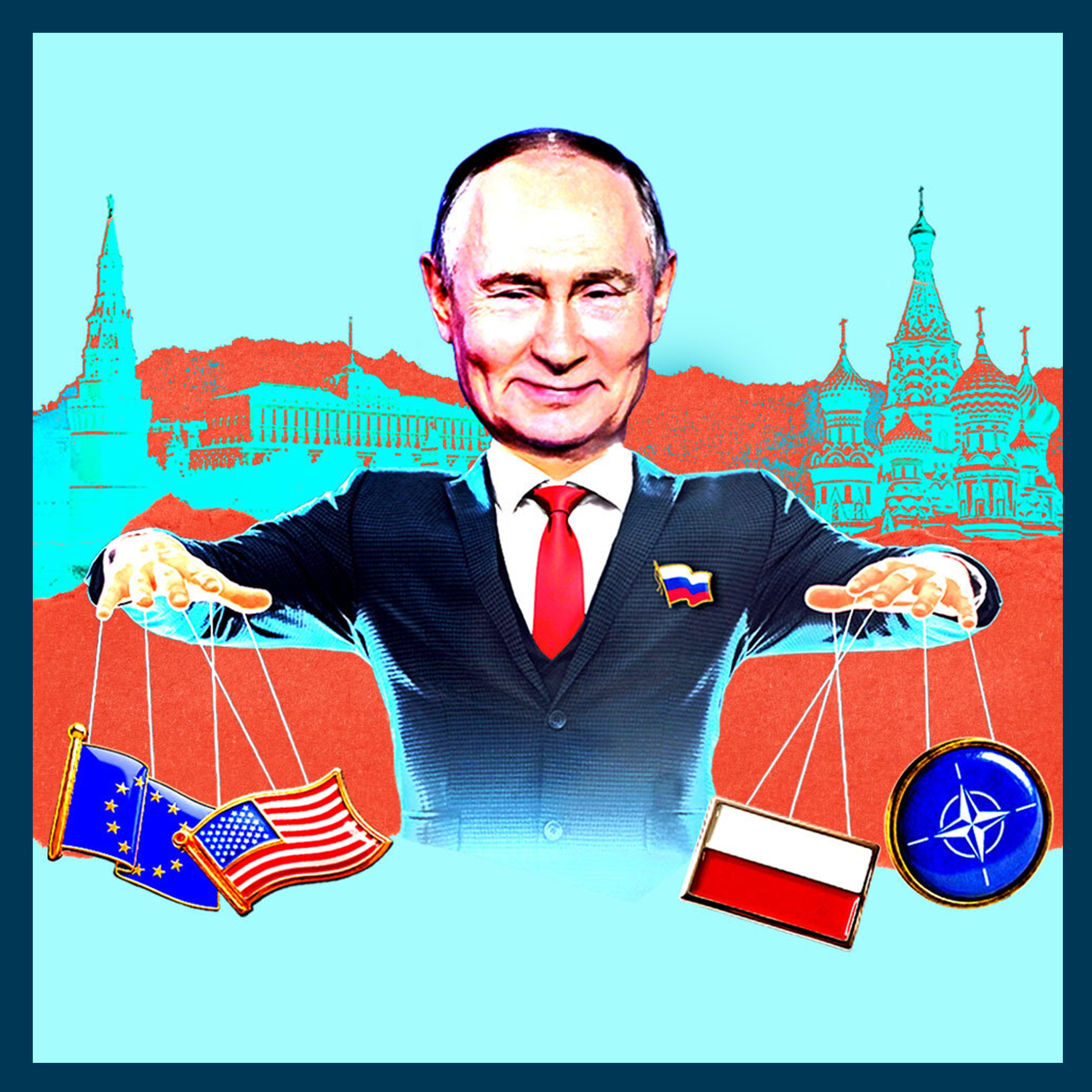
From the Times and the Sunday Times, this is the story. I'm Manveen Rahna. Countries across NATO have been warning for years about the looming threat that Russia poses, but it's not often that they go to such efforts to raise the alarm in public.
- [01:24]
Oliver Moody
I wouldn't exclude the Russians doing some kind of false flag operation against Russian territory in order to have a pretext for hitting one of the NATO countries.
- [01:35]
Manveen Rahna
In a series of interviews ahead of the NATO summit which begins today, the Polish foreign minister, Radislaw Sikorski, has been warning the public about what Russia might do next.
- [01:49]
Oliver Moody
He could put together some Ukrainian drones from bits found on the battlefield and send drones into Kaliningrad exclave, which is Russian territory, and then pretend that he's been attacked and therefore he has to return fire.
- [02:05]
Manveen Rahna
On Friday, he even issued a direct warning to the Kremlin. Our message to Vladimir Putin is this. We know what you're planning. Do not do it. As Russia's attempts at sabotage and cyber attacks grow bolder and more intense, some members of the security establishment in Europe are breaking cover to describe how Putin is trying to unleash chaos across the continent. But as the leaders of NATO countries, including one Donald Trump, gather in Ankara for fractious debates about defence spending, Iran, Iran and Ukraine. Could this be the most dangerous moment in the history of the alliance? The story today how putin is dividing NATO.
- [03:21]
Oliver Moody
NATO is holding its annual leaders summit on Tuesday and Wednesday. This year it's going to be in Ankara, the Turkish capital. The leaders of all 32 allies, including President Trump himself, will be there.
- [03:36]
Manveen Rahna
Oliver Moody, Berlin correspondent at the Times and the Sunday Times covers Germany, Scandinavia, Central Europe and the Baltics, and he keeps a keen eye on NATO.
- [03:48]
Oliver Moody
There will also be some of NATO's partners, including President Zelensky of Ukraine, President Lee Jaemyong of South Korea, and then we are also expecting Ursula von der Leyen and Antonio Kosta, respectively, the presidents of the European Commission, the European Council, to join the NATO leaders on Tuesday evening.
- [04:10]
Manveen Rahna
And this is all happening in Ankara. What sort of a role are we expecting Turkey to be playing?
- [04:15]
Oliver Moody
It's gone to Ankara because we often forget that Turkey is, by any metric, one of the most militarily capable NATO allies, possibly conventionally, the strongest armed forces in the alliance after the Americans. And for Turkey's president, Recep Tayyip Erdogan, this is an opportunity to try and bring the alliance's geopolitical sensitivities into line with his own. And what I mean by that is European NATO has up to now been very focused on the threat from Russia. But Turkey will consistently argue that we cannot neglect what is going on in the Eastern Mediterranean and the Middle East. And second to that, Turkey will want to show off its extremely robust and increasingly technologically sophisticated defence industry. It will want to try and get its NATO allies to sell it more weapons. And in particular, it's very keen that President Trump drop the blockade that has so far held Turkey out of the F35 combat jet program.
- [05:32]
Manveen Rahna
Obviously, they've got a lot to play for. They're not the only ones who are going to be very interested in what's happening in the Middle east, rather than just looking at Russia. Tell us about Donald Trump's approach to this NATO summit, because obviously it comes hot on the heels of Iran, and he hasn't necessarily been pleased with what the other NATO members have been doing with all of that.
- [05:51]
Oliver Moody
No, Donald Trump has a history of using these NATO summits as opportunities to beard his allies in their den and to tell them to cough up and to increase the pressure on them. So one very obvious point of friction is going to be the demand that every ally meet their commitment to spend 5% of GDP on defence and security sooner rather than later, which is going to be very problematic for some countries. But his second big beef with the European NATO allies is what he perceives as a feeble lack of solidarity in the us, Israeli strikes on Iran, and in particular, the restrictions that some of his allies put on access to military bases and airspace for the attacks.
- [06:47]
Manveen Rahna
One of the things that we've been talking about a lot here in Britain ahead of this NATO summit is defence spending, and there's real fear of what sort of a reception. Keir Starmer will get. Given where we are with the defence spending argument, how much is that going to be an issue at this summit?
- [07:03]
Oliver Moody
Keir Starmer is not the only leader who will be going in with some trepidation. There are a bunch of other European NATO allies that still haven't set out anything resembling a compelling pathway to get to that 5% target. And one of Donald Trump's favorite punchbacks in that regard has been Spain. Some listeners may recall that it was only a few months ago that he threatened a total trade embargo on the Spanish for refusing to accept the 5% target at all. As you know, they were the only country that in NATO would not agree to go up to 5%. So we're going to cut off all trade with Spain. We don't want anything to do with Spain. Keir Starmer is under particular pressure because Britain's status within NATO and its position as one of the two nuclear powers in Europe have meant that expectations of Britain are rather higher. And so it could be politically very uncomfortable for him. The big question is whether it is only uncomfortable. Does Trump confine himself to rhetoric and scathing remarks or are there some kind of punitive consequences? And so far, American officials have been suggesting that it will probably just be a slap on the wrist. But with Trump, you never know.
- [08:31]
Manveen Rahna
The other big topic we're expecting will be Ukraine. You mentioned that President Zelenskyy is attending. We know that in the run up over this weekend, Donald Trump has been on the phone to Vladimir Putin for about 90 minutes. I mean, what do we know about that call? And what do we think they'll be talking about in terms of Ukraine?
- [08:51]
Oliver Moody
So the occasion for this phone call on Saturday was the 250th birthday of America. And Trump also spoke with Zelenskyy on the same day. But it's clear that both calls were about more than pure pleasantries. And there is a sense that the situation on the battlefield, and in particular within Russia itself, has shifted quite significantly to Ukraine's advantage. And clearly there is a hope on the Ukrainian side that Trump might now be willing to bring some pressure to bear on Putin for a change.
- [09:31]
Manveen Rahna
At the same time, Ollie, this summit happens at a time where many people across NATO would argue the organization has never been more vital. We are seeing Russia stepping up threats across Europe. Just describe what's been happening.
- [09:48]
Oliver Moody
What has been happening is that Russia has been subjecting particularly its Western NATO neighbors, but also more or less every country in Europe over the last four years to a steadily intensifying Campaign of what is called hybrid warfare, using forms of attack that stop short of what you would classify as a kind of outright military assault, but are still very unsettling and violent and damaging in many cases. And those include GPS jamming and spoofing. They include colossal cyber attacks. They include assassinations, the sabotage of energy and railway infrastructure, and pretty much every tool that you can think of that can destabilize a country short of going over the threshold into outright warfare.
- [10:51]
Manveen Rahna
And you've been talking to people who are compiling studies, who are compiling the figures around all of this, and there's a fantastic piece in the Times. Anyone who's interested should have a look where. There's even a map of where these incidents are happening, which countries are most affected? I mean, just talk us through a few of those and the countries that they're mostly affecting.
- [11:09]
Oliver Moody
The first thing to say is that the vast majority of these incidents are not in the public domain. They're either thwarted by the security services, or they just simply don't get disclosed or attributed to Russia. So, for example, we know that last year Germany recorded 321 cases of sabotage, and only half a dozen of those have been publicly attributed to Russia. So there is a gigantic dark number hiding behind all of the numbers I'm about to present you with. But various studies have suggested that there have been something between 150 and 200 destructive hybrid attacks on European countries over the past four years since the full scale invasion of Ukraine. A finding from the International Institute for Strategic Studies claims Russia's shadow fleet is being used to launch drones over Europe. It includes airports and military assets across the UK and other NATO countries. We have recently uncovered a staggeringly reckless campaign of Russian sabotage in Europe. And on Monday in the Times, I published a piece about a new report for the Polish government that has analyzed 19 of these on the countries in northeastern Europe, those that are most directly geographically exposed to Russian aggression. They include things like putting metal clips on railway lines to try and derail trains carrying passengers or toxic chemicals. They derailed a chemical freight train near Essen in Germany. They very nearly derailed a full passenger train on the Warsaw to Lublin line in eastern Poland.
- [12:58]
Manveen Rahna
The first news of the damage to the train line came after a train driver noticed that part of the track had been broken. He raised the alarm, and authorities later confirmed it had been blown up.
- [13:11]
Oliver Moody
They obviously include the sabotage of things like water, sanitation, pumps, electrical grid facilities. And then there are the sabotage of critical underwater infrastructure, so particularly things like data cables and gas pipelines under the Baltic Sea. This operation involved a Russian Akula class attack submarine and a concurrent deployment of two specialist submarines from Gugi. That's Russia's main directorate for deep sea research. They're designed to survey underwater infrastructure during peacetime and sabotage it in conflict.
- [13:55]
Manveen Rahna
And Ollie, that's fascinating because as you say, we don't hear about these attacks most of the time. And they're not just attacks designed to make life difficult for the governments that they're hitting. You know, as you, as you said, those potential train derailments could have led to mass casualties. These are very serious potential incidents.
- [14:14]
Oliver Moody
That's right. And the big concern that the authors of this Polish report had is that the next logical escalation is in fact a mass casualty incident timed to influence a big European election. For example, France is holding presidential elections next year. Poland is holding parliamentary elections. Imagine a week before the vote, a train flips over or a bomb goes off at a stadium. It can't be clearly attributed to Russia within the kind of timeframe before election day. And as a result, a lot of voters go to the polls with the perception that the government is completely unable to guarantee their security. It's the kind of thing that could have a really significant impact on the outcome.
- [15:03]
Manveen Rahna
And do we know who's behind these attacks?
- [15:05]
Oliver Moody
We know quite a lot about them. And this is really interesting because Russia's tactics have changed a lot. A lot of its intelligence operatives who'd previously been under diplomatic cover at the embassies have been chucked out and as a result it's now using middlemen and so called disposable or single use agents.
- [15:26]
Manveen Rahna
Two men have been convicted of conspiring to carry out arson attacks that were targeting the property and a car that was connected to the UK's Prime Minister, Sir Keir Starmer.
- [15:36]
Oliver Moody
So these are individuals who are recruited from within our populations, very often from marginalized groups. So people like the Belarusian or Moldovan diaspora, very often it's members of the Ukrainian diaspora, which has the added advantage from Russia's perspective, of further alienating the host societies from them. These people will be typically recruited through telegram. They will be offered not life changingly large but significant sums of money between sort of 5 and 10,000 pounds to start by performing kind of basic acts of petty vandalism. And then that can scale up to things like arson or bombings.
- [16:23]
Manveen Rahna
And Ollie, we should point out it's not just this sort of hybrid version of warfare that people are worried about, that, you know, these attacks where you can't always draw a straight line back to the Russian government. But you know who's behind them. Just at the start of this week when we know there's a big NATO summit happening, we have seen the Russians following British ships and making it quite clear that they know exactly where you are and they could hit us militarily.
- [16:51]
Oliver Moody
Well, one really important thing to bear in mind here is that we use the term hybrid warfare. The Russians don't, they don't draw that distinction. In fact, they use the word hybrid to describe what we do, not what they do. And so from a kind of tactical, doctrinal standpoint, for the Russians, it's all just one spectrum. And what we are increasingly seeing is military manoeuvres being used for hybrid and inverted commerce purposes. So the helicopter buzzing the British warship is one example. The Ministry of Defence in the UK saying that this was unnecessary, dangerous and unprofessional activity. This Russian aircraft, a BX maritime patrol aircraft, flew repeatedly low in front of and over the aircraft carrier, dropping sonar boys very near the aircraft carrier. Another is a recent near incursion onto Swedish airspace by Russian fighter jets. But we're also seeing a marrying together of what people think of as kind of sub military tools of attack with the military itself. So a few days ago, my colleague Emma Yeomans published the first evidence that Russia has started putting guns on these so called shadow fleet oil tankers in the Baltic. And it's also started accompanying some of them with warships and warplanes. So this kind of gradual fusion of the Russian military with the hybrid sphere.
- [18:32]
Manveen Rahna
Coming up, is a Russian attack imminent and why is Putin on maneuvers now? That's in just a moment. Foreign.
- [18:49]
Advertisement/Commercial Voice
Still waiting in line again, that's time you will never get back. Save time and money with stamps.com over 4 million businesses have skipped the line with stamps.com. join them to save up to 90% off carrier rates from your computer or phone right now. Print postage for certified mail, registered mail and packages in seconds. Then schedule a pickup right from your home or office for a limited time. Go to stamps.com and use code podcast for a free welcome gift. Taxes and fees apply because you didn't
- [19:19]
Oliver Moody
just say how can I provide these investments? You'd be how do I holistically provide everything? How do I bring in the legal, the accounting, all this and do it at a price point no one else is doing it. Learn more about how we approach wealth management@creativeplanning.com integrated ready to experience something new.
- [19:36]
Manveen Rahna
Alltrails helps you find your next hike, whether you're looking for something nearby or planning a trip? Read reviews from real people like you to choose your trail and know what to expect. You can also download the map in case service gets spotty. Plan and experience your next hike with Alltrails, the app for exploring the outdoors. Download it today and find you outside. Oliver, you've been describing the backdrop of mounting tensions with Russian attacks, all sorts of forms of hybrid warfare that seem to be increasing across Europe before this summit even begins. And why do things seem to be worse now? Are we worried about Vladimir Putin being on manoeuvres?
- [20:33]
Oliver Moody
So it's important to say that these warnings that we have heard, particularly from Poland, do not, as far as I can tell, refer to specific intelligence of an imminent Russian attack. I've asked around in intelligence services and armed forces and no one has heard anything of the sort. This is an abstract danger, as far as we can tell, and what it is based on is partly the perception that Putin sees a window of opportunity here. Where Trump is very much at odds with his European allies over Iran and over defense spending. There's still a kind of lingering mistrust over the Greenland crisis. We are going to do something on Greenland whether they like it or not, because if we don't do it, Russia or China will take over Greenland. And that Putin might see this as the best chance he's going to get to try and drive a wedge between the two with a kind of provocation that would be recognized as a provocation very clearly by the eastern flank countries, but which the Americans might be able to feel that they could ignore or not blame on Russia.
- [21:51]
Manveen Rahna
So this is a moment where the tensions within NATO are so obvious that it might be a great opportunity for Russia. Are there also things happening at home that put pressure on Putin to act now rather than later?
- [22:03]
Oliver Moody
That's absolutely the case. There's been a whole string of circumstances that have put Putin with his back more against the wall than I think it has been at any point since February 2022. The first has been the development of the battlefield in Ukraine and in particular these mid range drone strikes around 100-200km, really pinning back the Russian advances, slowing down what they're able to do in terms of making ground in Donbass, but also crucially causing all kinds of havoc around Crimea, which is very symbolically and emotionally important for the Russian regime. Crimea now has blackouts, as Ukrainian forces in the past 48 hours targeted 16 different power substations. July 5, 2026 Russia's most advanced airbase in Crimea has Gotten hit. It's Home to the 38th Fighter Aviation Regiment of Russia. Then clearly you have the longer range drone strikes, which have been primarily targeting oil and gas infrastructure, often more than 500 miles away from Ukraine's borders, petrol stations across Russia are running low on fuel after a surge of Ukrainian strikes on oil refineries, substations and depots. Which is not just inflicting a lot of damage on Russia's petrochemical economy and its oil exports, but also exposing the complete lack of drone defenses over very wide expanses of Russian territory. And then at the same time, you have very obvious symptoms, not of an imminent collapse of the Russian economy, but of credit drying up, of it becoming harder to defend the rubles value, of the massive diversion of human resources into the war effort taking its toll on the labor market. And then finally, the repressive measures that Russian security services have taken to particularly shut down the Internet, have begun to bite in terms of the perception of everyday citizens in places like Moscow and St. Petersburg who'd previously been spared really having to wrestle with the impact of the war for the most part. And all of those things add up to a situation that is not, I really have to stress, this is not an emergency for Putin from a political perspective, but it does increase the pressure and it does weaken his position a lot, to the point where the reasoning is he might find it tempting to launch some kind of diversionary attack on NATO.
- [24:53]
Manveen Rahna
Ollie, if a distractionary attack was to happen, what might that look like? Because obviously a lot of these NATO countries now who are very worried about this being a potential scenario, are trying to work out how to prepare for it. So what are they envisioning?
- [25:09]
Oliver Moody
The one thing we can be sure of is what it would not look like, and that is a full scale Ukraine style invasion of the Baltic State, which is the one big scenario that we've all been talking about incessantly for the last 10 years. I mean, the real thing to underline here is the absolute breadth of the scenarios that we have to be considering. The Swedish armed forces, for example, have been pointing out that there are something like 20,000 islands in the Baltic Sea, many of them uninhabited, and it would be absolute child's play. And also following the playbook that China has established in the South China Sea, for Russia to occupy one of them and militarise it. Another really obvious flashpoint would be around the Shadow Fleet, for example, the Swedish Coast Guard has been very assertive in challenging aborting them. But we also know that a lot of those vessels are now carrying ex Wagner paramilitaries or other people with guns, that some of them actually have cannons on them, that some of them are being escorted by Russian warplanes. And the chances of some kind of exchange of gunfire there are very high. We've also seen a lot of very near misses in terms of military interactions on the Baltic Sea. And it's possible that one of those days the Russians might take it to more than a near miss and there would be some kind of hit.
- [26:36]
Manveen Rahna
One of the scenarios that the Poles have recently painted, and it's very unusual to have a foreign minister saying these things out loud, but was the idea of a false flag operation? How would that play out?
- [26:46]
Oliver Moody
Radisaw Prakorski, the Polish foreign minister, actually alluded to the Gliwice incident, which was at the end of August 1939. Many listeners will be familiar with the history where the Wehrmacht staged an attack on its own radio post on German soil, very close to the Polish border, blamed the Poles for it, and then used that as a casus belly to justify the invasion of Poland. And so what Sikorsky had in mind, there is a scenario along those lines where some kind of atrocity would be staged, possibly against the Russian minority or against members of the Orthodox faith that would furnish Putin with at least a very flimsy pretext for more significant military action.
- [27:40]
Manveen Rahna
Ollie, from all the people you're talking to, I know you're often in touch with the defence and security world across the NATO membership. How worried are they at this moment? How serious is this threat?
- [27:53]
Oliver Moody
It really varies a lot depending on where you're sitting. To be honest, there are people within NATO and within national militaries and defence ministries who, particularly around this summit in Ankara, find it very important to maintain the impression of calm and unity and feel that anything other than that is very much playing into Putin's hands. And then on the other end of the spectrum, you have people who are sincerely concerned that the abstract danger is very, very high over the next two to three years.
- [28:31]
Manveen Rahna
Is this almost a timeline debate? Because, you know, here in Britain, in talking about the Defence Investment Plan, we've been talking about a potential war with Russia after 2030. In other parts of NATO, they clearly think that's more urgent. Is this about how far it is on the horizon?
- [28:49]
Oliver Moody
It's absolutely a part of that. The assumption that a lot of northern and northeastern European planners make is that the real window of vulnerability is between now and 2029. That is partly because from 2030 they expect a lot more of European NATO's military capabilities to come online. So it just becomes conventionally a lot riskier for Putin to attack, even if he is fairly confident that the Americans won't show up. And it is partly because of of Trump's presidency being such a destabilizing factor and undermining the political dimension of deterrence to the degree that it does.
- [29:37]
Manveen Rahna
Wally is this actually one of the most dangerous moments for NATO, given that there is a lack of unity inside regardless of the attacks from the outside? The idea that America might not turn up?
- [29:47]
Oliver Moody
I'm biased. I live in Berlin. If things get really bad and we do end up in a full scale conventional war, then this city would be a very obvious target. And I talk to people in the German government and people in the militaries of northern and eastern and central Europe who all more or less share the same perception that this is an absolutely existentially dangerous time for NATO, and that's rubbed off on me. Maybe if I were in Madrid or Rome or Washington, I would see it differently, but based on all the conversations that I have and all the information that I see, I don't think it is histrionic to characterize this as the most dangerous moment for the Europeans since NATO's foundation.
- [30:58]
Manveen Rahna
That was Oliver Moody, Berlin correspondent at the Times and the Sunday Times. The producers today were Olivia Case and Shabnam Guruwal. The executive producer was Edward Drummond, and sound design and theme composition were by Mar Lessetto. If you can do leave us a review wherever you get your podcasts. Thanks for listening. We'll be back tomorrow.
- [31:50]
Advertisement/Commercial Voice
Still waiting in line Again, that's time you will never get back. Save time and money with stamps.com over 4 million businesses have skipped the line with stamps.com join them to save up to 90% off carrier rates from your computer or phone right now. Print postage for certified mail, registered mail and packages in seconds. Then schedule a pickup right from your home or office for a limited time. Go to stamps.com and use code podcast for a free welcome gift. Taxes and fees apply for investors at
- [32:20]
Oliver Moody
the highest level of sophistication, those with strong advisory support. The natural outcome is two distinct portfolios, one public, one private. Each plays a different role in the overall strategy. Uncover new investment opportunities for you at creativeplanning.
- [32:33]
Manveen Rahna
Com.
- [32:34]
Oliver Moody
New.