Loading summary
Transcript71 lines
- [00:00]
AT&T Business Wireless Advertiser
Before we had AT&T business wireless coverage, our delivery GPS wasn't the most reliable. Once our driver had to do a 14 point turn to get back on route. A 14 point turn. An influencer even livestreamed the whole thing. Not good for business. Now with AT&T business wireless routes are updating on the fly and deliveries are on time. And the influencer did get us 53 new followers though. AT&T business wireless connecting changes everything
- [00:31]
Barclays Investment Bank Podcast Host
from globalization to innovation sustainability to market volatility. There's always more than one side to a story. Explore different perspectives on today's most important business and economic issues with the Flipside podcast from Barclays Investment Bank. Hear two research analysts in a lively debate and get insights from every angle. To further inform your view, listen to the Flipside on your favorite platform.
- [01:00]
Manveen Rana
From the Times and the Sunday Times, this is the story. I'm Manveen Rana. On a long summer evening a few weeks ago in the center of Glasgow, something very peculiar was happening.
- [01:23]
David Lisk
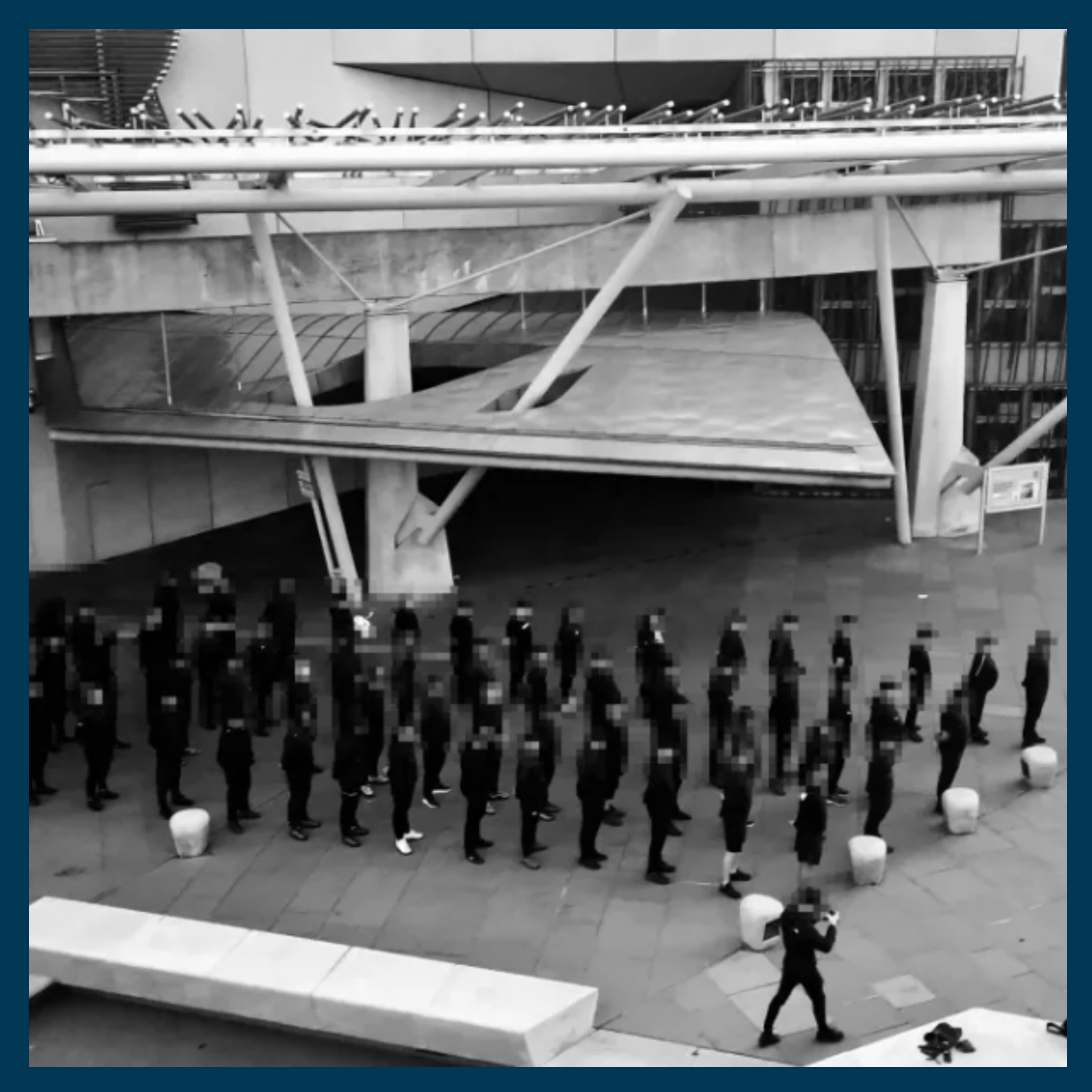
A group of men, scores of men, perhaps 50 or 60, lined up in files of four, all dressed in black in the precinct of Glasgow Cathedral.
- [01:35]
Manveen Rana
David Lisk has been reporting on Scotland for decades and he'd never seen anything
- [01:40]
David Lisk
like it insofar as they did anything. One other member, a woman, I think perhaps the only woman who was there, carried a wreath. And on this wreath there was this kind of strange messaging which was along the lines of we apologize.
- [01:58]
Manveen Rana
And that wasn't the only baffling message written on the wreath. There was more.
- [02:07]
David Lisk
You had this message, curiously, in Italian, saying basically, il fini justifica imi. The ends justify the means. And then this wreath gets laid at a monument to an entirely obscure 19th century Lord Provost of Glasgow, James Lumsden, somebody who, forgive me, if he was a household name in his day, he certainly isn't now.
- [02:34]
Manveen Rana
When the video of this protest emerged on social media, journalists were bewildered. What were those words supposed to mean? Why this obscure Victorian figure? But while the protest itself was shrouded in mystery, the grainy black and white footage was very familiar, rather like unusual,
- [02:59]
David Lisk
from some kind of fascist protest from the 1920s in Italy.
- [03:09]
Manveen Rana
This was only the beginning. In the weeks that followed, two more demonstrations of silent black clad men took to the streets of Scotland. So what is going on? Why are these groups aping fascist imagery? And why is it happening in a nation that has always prided itself on being welcoming to immigrants? The story today inside the Rise of Scotland's New Blackshirts. When did you first see that video emerging on the Internet. And what was your reaction?
- [04:09]
David Lisk
I first saw these, these videos when they're posted on social media and then reposted by significant far right actors in the uk, such as Tommy Robson. And what really struck me most of all about was first of all the fact that it was in black and white that I found that pretty evocative. I mean, I think we often think of the, of the far right as being people who have an ideology or maybe people who have behaviors that, you know, they say and do things, they think things and they act. But I think with the far right, and especially with the more fascistic end of the far right, they also have aesthetic values. If you think about how things were in the early part of the 20th century, especially in Italy, especially in Germany, but also in other countries, there is a distinctive way in which they present themselves and that will include the use of military style formations in their marching. It will include how they're dressed, which would be in Italy all in black, in Germany in brown. But there is a distinctive look. And what strikes me about it is that we recognize that when we see it. We've all. Haven't we been schooled for so long in the rise of fascism in Europe that we all know this. We know this from popular culture, we know this from our history lessons. It's instantly recognizable for what it is.
- [05:31]
Manveen Rana
You're right, it's imagery that projects power. It is instantly identifiable. I mean, there's so much I want to ask about the aesthetic and what's happened since. Before we get into that, though, I was just quite struck by how unusual this is. I mean, Scotland isn't known for protests full stop.
- [05:49]
David Lisk
No. So if you were to look, for example, at the times when there's been protests or violent protests elsewhere in the UK or Europe, we often haven't had them. So you think about those big riots in England in the 1980s. If you think about some of the disorder we saw in English cities later in the 21st century, and indeed most prominently in 2024, when after the Southport incident, you had all those awful scenes of people being burnt out of their homes and hotels, being kind of besieged.
- [06:15]
Barclays Investment Bank Podcast Host
I want to update you on the situation in Southport where violence has broken out tonight following that horrific knife attack yesterday morning. Merseyside police say that a large group of people who it says are believed to be supporters of the far right English Defence League, have been throwing items in the direction of a mosque in Southport. Police officers have been responding and have faced a barrage of bottles and wheelie bins being thrown at them.
- [06:47]
David Lisk
We tend not to have that. We have started seeing a degree of street politics from the far right in Scotland. This isn't completely new. We've had this in our history. But it is unusual for Scotland, which has traditionally been seen as a place where extremism of that particular kind does not thrive.
- [07:10]
Manveen Rana
I suppose that's why it's just so striking when this video emerges from Glasgow. Going back to that, you've described the sort of 1920s, 1930s fascist aesthetic. Just break down some more of the imagery you described, the scene where a woman lays a wreath. Tell us about that.
- [07:29]
David Lisk
This again is one of the fascinating things, I think, about these protests, and that is, of course, that they are not being explicit about what it is that they mean and they're allowing people to have to guess. There was this kind of strange messaging which was along the lines of, we apologize for what? That's not made entirely clear now. What I think most people, both of the left and of the right and of neutral observers thought when they saw that was that they were apologizing to the dead for the fact that immigrants had made their way to Scotland. I think the notion was, we are sorry, we've let you down. We've allowed these, forgive me for using these horrible terms, these invaders to come to our country and to settle down. That, I think, was what most people understood their message to be. And of course, this is not a clever new tactic. We know that back in the early days of fascism, and we've spoken to scholars of that period to get to the bottom of this, that quite often there was this kind of effort to employ the dead of World War I into the service of the new fascist movements of the 20th century. There was a cult of the fallen both in Nazi Germany and also in Fascist Italy. Sometimes these fallen were mostly men who lost their lives in the trenches, but sometimes also they were the other fascists who had been hurt or died in the course of their political action. And there's nothing new about assassins. Silent Vigil for DEAD Martyrs of the far right now, of course, what we don't have a lot of in Scotland at the moment or in the uk, are any actual or very many real martyrs for the far right. So in many ways, the fallen that they're apologizing to are imagined.
- [09:12]
Manveen Rana
And David, you mentioned that they lay this wreath at the foot of a memorial to a little known Victorian Lord Provost of Glasgow. What do we know about him and why was he the person they were venerating?
- [09:29]
David Lisk
So this was a monument to James Lumsden, who was one of our Lord Provosts or mayors of Glasgow, if you like, back in the 19th century. I wish I understood this for sure. I don't. What I'm told by people who don't particularly want their names banded around in the media is that there's something very significant about poor James Lumsden and that is that he was the last Lord Provost of Glasgow before the Irish famine. Lots of people from the Gaelic speaking parts of Scotland and from Ireland came to Glasgow and Glasgow, this huge population boost after this, if you like, one of the great waves of immigration into Glasgow. And many, many, many people suspect that when we talk about the far right in Glasgow, that there is a large element of what you might call Protestant supremacism in it. So in other words, people who may be on the very, very, very, very distant fringes of regular unionism or regular loyalism, who would see Irish immigration and immigration from Gaelic speaking Scotland as being kind of the beginning of their losing their place and their ownership of the city. To be fair, I think a lot of that, what I've just repeated there is somewhat speculative because. Because of course, we just don't know.
- [10:47]
Manveen Rana
So it's not just immigration from recent waves, it's going all the way back to the Irish famine. You mentioned the rather curious message that was written on the wreath and in Italian of all languages. Tell us about that.
- [11:05]
David Lisk
Well, this again is absolutely fascinating. Now, the actual phrase, which is one which people are familiar with, is usually attributed to Machiavelli. Il fini justifica imezzi. The ends justify the means. I don't think he actually ever exactly said that, but he certainly would have. I think it's probably fair to say that was a sentiment which he promoted in his work. So Machiavelli, of course, Renaissance thinker, very, very popular actually amongst extremists of all kinds. Now, I didn't know this until I started looking into this and was explained to me by, by scholars, and that is that this is a phrase that's been adopted by various far right organizations in Eastern Europe, so particularly around justifying their collaboration with the actual Nazi invaders of the 1940s. That's something that's new to me. But basically when you talk to experts, they're talking about how these events have taken a mishmash of different influences, including this Machiavellian idea that the ends justify the means. And I think why I find that particularly chilling. And this is again something that I noticed even from very, very conservative commentators when they saw these images is that this does sound like a way of justifying violence, disorder or other bad things.
- [12:27]
Richard Lucas
But then also there was the little board saying the ends justify the means. That's a pretty dangerous moral principle because it sounds like it's okay to do bad things if your aim is good.
- [12:42]
David Lisk
Richard Lucas, who is the leader of a conservative party in Scotland called the Family Party, which promotes, if you like, traditional values, Christian values, said he felt this, this sounded like giving people permission to do bad things.
- [12:56]
Richard Lucas
It seems that this group is trying to lay the groundwork to say we are going to do bad things. Doing bad things is necessary in order to achieve our ends. So that's quite concerning.
- [13:09]
David Lisk
And that's coming from somebody who would traditionally be seen as being on that right wing fringe of politics, but for whom obviously any suggestion of violence is beyond the pale.
- [13:20]
Manveen Rana
That really is very chilling. And there's also an odd irony about this because, you know, that message is written in Italian and Scotland has obviously over the years attracted waves of Italian immigration. A lot of the aesthetic too is of black shirts, you know, very much Italian fascism. Just describe that for us for a start. I mean, just describe how the imagery harks back to the era of Mussolini.
- [13:52]
David Lisk
It harks back theory of Mussolini in Italy, where of course, the squadristi wore these. His, if you like, his street thugs that he employed to really force Italy to bend its neighbor knee to him. So they obviously dressed all in black. It also harks back to another form of black shirts which is more perhaps immediately recognizable in Scotland and the United Kingdom, which is the black shirts of Oswald Mosley, who of course was the leader of the British Union of Fascists. And I think there is also a Scottish element here that might be overlooked by people listening to this podcast outside the country. And that is that while we often associate Oswald Mosley with that kind of British nationalistic, kind of fascistic movement of the 1930s, it did have a Scottish wing. Indeed, his security was provided by a Protestant gang from Brigton or Bridgeton in the East End of Glasgow, usually referred to as the Billy Boys. So the black shirt images are not just reminiscent of Italy in the 1930s, they're reminiscent of Scotland, United Kingdom too.
- [15:02]
Manveen Rana
This is obviously, you know, a century later. What do we know about the people who make up this set of Blackshirt protesters? Who. Who are they?
- [15:12]
David Lisk
Well, this is the fascinating thing. The whole way these videos of the these events were produced was done in such a way that you can't really clearly make up people's faces. Now they're not masked. But what's happened is that the grainy, blurry black and white images are so vague that it's hard to see who was there. So in the last week or so, and these events were taking place at the end of June, beginning of July, ever since then, obviously a lot of speculation about who was there and some of our colleagues in other newspapers have looked at it and come to conclusion. I think this has now been acknowledged by the organizers that at least some people who were there were members of Rangers ultras groups. Rangers traditionally seen as being the football club of the Protestant community. So we know that much, we may find out even more. And that's because there have been efforts by law enforcement to get access to these original footage of these videos. So we may actually find more people are identified in the fullness of time.
- [16:14]
Manveen Rana
You mentioned Ranger's ultras. I mean, just give us a sense of that. Is there a history of that? Is that a new thing and what constitutes an ultra in that sense?
- [16:23]
David Lisk
Well, ultras aren't necessarily baddies and Rangers ultras aren't necessarily baddies at all. They don't necessarily engage in disorder or bad behavior. And quite often these are just very, very vociferous football fans. Within that group there'll also be people who you might, to use old fashioned terminology, referred to as being football hooligans. And we have in fact seen fights between rival fan groups or hooligans between fans of Rangers, the supposedly partisan team, and Celtic, the supposedly Catholic team in Glasgow for decades and decades and decades. And there's predictable ways which people who are familiar with that fan culture will understand there are predictable ways in which those powers will fall. So one side will go, for example, towards Palestine, another towards Israel. That may sound very odd because these appear to be things that have nothing to do with Glasgow football. But nevertheless there is definitely a football factor in all of this.
- [17:15]
Manveen Rana
And what's the latest? Because I know the police have been looking into this.
- [17:19]
David Lisk
Yes, police are interested. Last week the gentleman who made the videos who claims not to have organized these events, this is a chap called Craig Houston, was detained at Edinburgh Airport and questioned about these events and he had his devices seized by anti terrorism police.
- [17:40]
Manveen Rana
And given that this does seem to be such a sea change for Scotland, it's not something we've seen before. What has the response been to this video of black shirts protesting? What has the response been sort of across the political spectrum?
- [17:53]
David Lisk
Well, we asked every single political party represented in Scotland for a response and you know, it has to Be said, I often think this may be unfair, but Scotland's a particularly polarized political culture. We have two huge tribes, if you like. Unionists and nationalists is usually the term. People who support in the bench and people who don't. And our politics is really tribal and quite unpleasant at times. I won't be perhaps praised for saying that, but I think that's a fair comment. Yet this is one example where if you were to look at the quotes from the mainstream parties, both Unionists and Nationalist parties, you wouldn't be able to tell which one was which, because our mainstream politicians, Conservatives, Liberals, Scottish Nationalists, Scottish Greens, they all said the same thing essentially, which is, this is terrible. Fascism is terrible. I mean, it's as simple as that. There was huge consensus around this. The only people that we asked and we didn't hear from were reform, which is obviously, if you like, a party which has campaigned strongly against violence, it has to be said, but also against what they see as the dangers of mass and uncontrolled immigration. And I'm afraid I can't tell you what they thought because they didn't tell us.
- [19:06]
Manveen Rana
That's interesting. And how about the group itself, the people who've put this video out? Craig Houston, what do they say about it and how do they feel about the label of it being, you know, a fascist? Flashback.
- [19:23]
David Lisk
The actual kind of the clever quote I'm going to give you now from Mr. Houston is that this is guff. G U F F. It's guff. It's nonsense. Basically. They don't accept these characterizations. But having said that, again, they have never quite articulated why that is. But I think we also have to acknowledge that words like far right and fascism have been abused and used over many generations to such an extent that many people don't even know what they mean anymore. But I do think in this case that the people who are using this word about these parades are identifying a specific aesthetic. We don't know whether these people themselves regard themselves as being fascists. I think probably they don't. But people even on their side know what it is that they're looking at.
- [20:19]
Manveen Rana
Coming up, that protest was soon followed by more. So is Scotland breeding a new form of fascism and why is it flaring up now? We'll have more in just a moment.
- [20:50]
AT&T Business Wireless Advertiser
When everything is moving all at once. Your workforce, your tech stack, your business. You don't need more tools, you need one solution. That's why Paylocity built a single platform to connect HR finance and IT with AI driven insights and automated Workflows that simplify the complex and power. What's next? Because when everything comes together in one place, growth comes easy experience. One place for all your HCM needs. Start now at Palocity.com one everyone treats
- [21:20]
Zoe Deutsch
summer like it owes you happiness. Long days, pool parties, your best life on a loop. So what does it mean when you feel worse? The summer blues are real. It's why summer is one of the busiest stretches of the year for people starting therapy. Grow Therapy is here for all the moments when you decide you want more. More support, more clarity, more tools. Grow connects you with thousands of high quality licensed therapists across the US offering both virtual and in person sessions, nights and weekends. The therapist you want takes your insurance on. Grow Grow accepts over 125 insurance plans. Sessions average $21 with insurance and some pay as little as $0 depending on their plan. Visit growththerapy.com acast today to get started. That's growththerapy.com acast growtherapy.com acast availability and coverage vary by state and insurance plan. Healthcare can feel complicated. That's why Optum uses technology to connect the people and processes that make healthcare easier, more affordable and more effective. We're making it clearer for you to know exactly what your benefits cover and to help you better manage your health. We're coordinating care between your doctors and your technology. We believe better, simpler healthcare is always possible. That's healthy optimism. That's Optum. Visit optum.com to learn more.
- [23:00]
Manveen Rana
David the video you've been describing appeared a few weeks ago. It caused quite a ripple of anxiety amongst the political classes. A real sort of moment of shock for a lot of people, I think in Scotland. That's not the end of it though. There have been other incidents since just remind us of what's been happening.
- [23:26]
David Lisk
So the, the first video was obviously in Glasgow at the cathedral. There was a second video taking another really emblematic location, which is just outside the Scottish Parliament. And this was another video when men lined up in fours, which just to remind people was of course how Italian squadristi lined up back in the 1920s. They were again dressed all in black. They were again taking part in the silent protest. This very location caused some concern, I think it's fair to say, right at the very gates of the seat of Scottish democracy. Now, again, we don't know exactly when this happened. It's probably on one of those long light evenings that we have at this time of year. The video caused a lot of worry even amongst, I think, politicians privately, people going into work. The Imagery has had an effect on people. They are frightened.
- [24:22]
Manveen Rana
And then there's more. There was another candlelight vigil. Tell me about that.
- [24:28]
David Lisk
This was another absolutely intoxicating video which showed men and women and children standing with candles, again, not so much in Milcher formation, but certainly lined up. And what they were doing was they were ghastly holding what they were calling a vigil for a young boy of 15 who died in 2004. His name was Chris Donald. Chris was just a poor boy who was picked on by some really ghastly gangs. In this case, the gang was Asian, Chris was white. All of the gang members were sent to prison for a very long time. Chris was kidnapped, he was burned, he was stabbed and he was murdered. And it was just an awful case. And the courts decided this was indeed a racially motivated murder. Chris's family, his mother, Angela Donald, was absolutely distinct that you cannot go around blaming all members of the Asian community in their part of Glasgow, which had a huge community of people of Pakistani and Indian origin. And There were concerns 22 years ago that the right wing, the far right, might use Chris Donald's death. And yet here we are two decades later and the same people who've been talking about the ends justifying means, who've been lining up in Blackshirts, are holding event to commemorate Chris Donald. And the question I guess people will be asking is, are they trying to turn this unfortunate, this absolutely tragic 15 year old boy who died 22 years ago into a martyr for their cause? Is that what this is all about? Well, again with all of these protests, they are never explicit about what it is they're saying. They're allowing the people watching their videos to come to their own conclusions.
- [26:09]
Manveen Rana
I mean, it does sound like an absolutely horrific case, you know, tragic killing, but interesting that the family didn't want it to be seen through the lens of race. And yet it's being dug up now and all of that will be brought up again. Have we had a sense of why these parades were happening? What was causing the protests? Is there a big fear of immigration in Scotland at the moment?
- [26:33]
David Lisk
See, Mangan, I think that's the most fascinating question of all and one which I don't really know how to answer. In many ways, nothing has changed in the last 12 to 24 months since gotten around immigration. We have in Glasgow, in particular, fairly large communities of people from South Asia, which has been essentially unproblematic now for decades. We have some new people who've come in most in the last 20, 25 years. Through basically the asylum system. And we've got lots of people who've moved from elsewhere in the UK who might be of color or of a different religion. So my question would be why now? Why suddenly in the last 12 to 24 months are we starting to see, if you like extreme anti immigration sentiment expressed, albeit by a small minority, what's happened that's caused that? I think that's a really interesting question, one I don't have an answer to. Would immigration on its own cause that? Well, it didn't for a very long time. So what changed? Are we talking about what's happening on social media where we are seeing this kind of thick soup of disinformation?
- [27:43]
Manveen Rana
And this isn't the only race related incident in Scotland recently or in Glasgow, in fact. I mean again, shocking headlines. Just tell us what's been happening.
- [27:55]
David Lisk
Well, you'll recall that there was that ghastly incident in Belfast when an asylum seeker I think is accused of having attacked and deal a Scottish man in the streets of Belfast with a knife. And that after that there were considerable scenes of violence and disorder in Northern Ireland, which again, we tend to perhaps forget that Scotland and Northern Ireland are actually extraordinarily close places where there's strong family connections between the two and strong cultural connections as well. And so that did have an impact in Scotland. There was a, if you like, a rally was held in the centre of Glasgow. During that rally we saw videos, including from the vlogger we mentioned earlier, Craig Houston, showing men all dressed in and black singing Rule Britannia as they marched into the city center. There was a rally right at the very heart on Buchanan street, which is the main shopping drag of Glasgow, with often masked individuals basically campaigning against immigration and using this ghastly incident in Northern Ireland. There's an excuse for that. During that event, a smaller number of people started to attack people, according to police, based entirely on the color of their skin, which, and I'd been a crime reporter based in Scotland for decades, I'd never heard of anything like this. It was truly, truly chilling.
- [29:26]
Zoe Deutsch
Three men have been arrested after violent
- [29:29]
Manveen Rana
scenes in Glasgow last night which left police officers and members of the public injured. The march in Glasgow city centre involved a group made up largely of men, many wearing masks, who appeared to be
- [29:40]
Zoe Deutsch
threatening people who weren't white.
- [29:41]
David Lisk
Where I spoke to one gentleman whose young daughter was spat at, for example, little girl. These are horrendous, horrendous incidents and while not completely unprecedented, still extremely unusual and alarming.
- [29:55]
Manveen Rana
I mean, I remember receiving texts from friends who were so shocked by what was happening, partly because it was in Glasgow, and that's the last place in the world where you would imagine something like that could happen. And it doesn't seem to be the end of it. I mean, I understand there are more protests that are being set up for later this month.
- [30:14]
David Lisk
Yeah. And the name of these protests, I find just completely intriguing is called Unite the Clans. Yeah. So for people who are listening from outside Scotland, obviously, you know, we don't actually have clans anymore. I know that in theory they exist, but we actually don't live, you know, in Highland glens and we don't all have the same name, but it's usually
- [30:34]
Manveen Rana
American tourists who are fascinated by the clans.
- [30:36]
David Lisk
Yes. I mean, it's all great fun and I'm not mocking them with the clans. It is a Highland thing, it's a wonderful thing. But this kind of idea of picking on what might be seen as Scottish national imagery, and I think that's part of a big trend that we've seen on the far right, not necessarily talking about these particular alleged Blackshirts, but just the general use of Scottish iconography in the far right, because the far right was traditionally in Scotland seen as being some kind of a fringe of British nationalism or unionism, but, you know, union, Jackie. Whereas now we're seeing the Saltire, the Scottish flag, the line rampant, the. The alternative Scottish flag is, like, used as part of this imagery. So I think you're talking here this an attempt not just to weaponize traditional British nationalism, but also Scottish nationalism with a small N. So we're not talking less about people who support independence or opposed independence, but that use of Scottish imagery is very powerful and very unusual, and that is a huge change on the far right within the last year or two.
- [31:39]
Manveen Rana
How much is this becoming a real problem in Scotland? I mean, how much is the far right growing? Is this something that's alarming people?
- [31:47]
David Lisk
I think it's alarming people, especially bluntly, people of colour who have, you know, often seen, rightly or wrongly, Scotland has been somehow a refuge from some of the extremism that we've seen elsewhere in the United Kingdom or Europe. We've kind of, like, cultivated this kind of national image of being this kind of nice, cuddly place. Obviously, that was never entirely true. No place is perfect. But clearly this has the potential to damage this kind of image of Scotland being this welcome place which our politicians actually, across the political spectrum, have cultivated in recent decades. There was huge consensus around the need for immigration in Scotland until quite recently, there's huge consensus with the need for integration for a long, long time. Is this going to be smashed now? Are we going to see the politics of immigration being contested and also having an extremist manifestation?
- [32:40]
Manveen Rana
Are there figures to show that this isn't just a one off, that this does feel like more of a movement? This is becoming a common thing, whether
- [32:47]
David Lisk
it's common or not. I would say probably still isn't common, but it is increasing. So a very clever academic called Judith Sistermans at Aberdeen University, poor woman, has been sitting there counting all of the far right events that take place in Scotland. For example, she counted all of the events that took place between the summer of 2024 and the summer of 2025, and she counted 189. But each month was escalating in the course of that year. It may still be uncommon, but you can see the rise. You can see the rise,
- [33:25]
Manveen Rana
David. It's so interesting that so many of the incidents that they're, they're marking are historic. You know, like the murder 20 years ago, when things might have flared up organically and yet they didn't. What is it about this moment that means it's rife for politicization in this way that these protests can kick off and can have an impact and people do feel scared?
- [33:49]
David Lisk
I think it's interesting contrast where we are in 2026 with where we were back in 2004, which is when poor Chris Donald lost his life in Glasgow. Now, of course, that was before the credit crunch, that was before the financial crash. That was perhaps seen as being a time when people maybe felt better about where the country was going. I don't know, I'm just speculating here.
- [34:09]
Manveen Rana
You had a parliament.
- [34:11]
David Lisk
Well, indeed, there's a new parliament. There was maybe a sense that things were going in the right direction. Those are the early years of the evolution. Now, we in Scotland, we talk about this thing, forgive me for using a Scots language word, but the Scunner defect, that people in Scotland are fed up with things, that everything's going wrong and there's a general sense of malaise or negativity. That's also the case in England and in many other countries. And I do think that that does mean things are different now than there were 20 years ago. Is there more immigration than there was 20 years ago? Yes, there has been more immigration in Glasgow in the last 20 years. In fact, Glasgow's population has been booming. So Glasgow in particular was a city which was shrinking from what's the 20th century, certainly from in the second half of it. Now it's growing again. Its population has risen about 40,000 in the last 20 years. And a large part of that is net in the migration, not necessarily of people that might be seen as being foreigners from outside the United Kingdom, but often from people from England. The city has been growing thanks to net immigration, and that has put a lot of pressure on things like housing, etc. That is all true. But is that enough to warrant or to spark the kind of violence that we saw on that day after the events in Belfast, or to excuse some kind of rise in far right activity, or indeed overtly fascistic activity? Something else must be causing this. There must be something else going on. It's not enough on its own. So what is that? Is it social media misinformation and disinformation? Certainly, if you ask local authorities, they will repeatedly say that there's a great deal of misinformation about who committed crimes, for example, who's to blame for housing shortages, that kind of thing. So you have to wonder about the role of social media and all of this. Now. I don't want to be over simplistic and just blame everything on social media. I'm not qualified to do that. I'm not saying sociologist, if I was one, I'd be wanting to find out whether the way in which some of these voices are amplified, including by people outside Scotland, is important.
- [36:30]
Manveen Rana
That was David Lisk, a reporter for the Times and the Sunday Times in Scotland. The producer today was Sophie McNulty. The executive producer was Taryn Siegel. The sound designer today was Dave Creasy. Theme composition was by Malicetto. If you'd like to get in touch with us, do drop us a line to the story@thetimes.com and if you can do, leave us a review wherever you get your podcasts. Thanks for listening. We'll be back tomorrow.
- [37:09]
Zoe Deutsch
Hi, this is Zoe Deutsch.
- [37:11]
David Lisk
And this is Nick Robinson.
- [37:12]
Zoe Deutsch
Check out our new movie Voicemails for
- [37:14]
AT&T Business Wireless Advertiser
Isabel, exclusively on Netflix.
- [37:16]
Zoe Deutsch
Sign up now to watch much. You're more than just one thing. Your vehicle should be too. More connectivity when you're the boss. Hey Google, when's my next meeting? And more space when you're the Mazda. Everyone in the all new Mazda CX5 more to move every side of you. Google is a trademark of Google llc. Sequences shortened and simulated.