Loading summary
Transcript79 lines
- [00:00]
Capella University Narrator
You've never been one to settle, stand down or stand still. You're a lifelong learner, energized by excellence. There's a fire inside you you can't ignore. You've got competition to outrun, momentum to build on, and your own high standards to meet. Stop now. Not a chance. At Capella University, we help you catch what you're chasing because you've always had the drive. Now go earn the degree. Capella University. What can't you do? Visit Capella. Edu to learn more.
- [00:30]
Thumbtack Advertiser
You know, recommendations can be great. Maybe someone recommended this podcast and here you are. But home projects are different. If a podcast isn't your thing, you lose a few minutes. If you hire your cousin's neighbor to mount your tv, you might end up with a lopsided screen and wall damage. Maybe I know a guy. Just isn't enough for your home. That's why thumbtack works. It matches you with top rated local pros with photos, reviews and credentials all in one place. For your next home project, try thumbtack. Hire the right pro today.
- [01:03]
Luke Jones
From the Times and the Sunday Times, this is the story. I'm Luke Jones. If you've got money to spare and a taste for luxury, there is one particular Frenchman with plenty to offer. The future is gold. J' Adore Dior.
- [01:23]
Capella University Narrator
We belong to something beautiful.
- [01:25]
Peter Conradi
Sephora.
- [01:26]
Thumbtack Advertiser
We got the new coconut flavor Luxe bomb by Fenty Skin.
- [01:30]
Luke Jones
I'll take all of it. Can always reinvent.
- [01:32]
Peter Conradi
When I think of Dom Perignon, I think of celebration.
- [01:35]
Luke Jones
Good times.
- [01:35]
Capella University Narrator
I think of adventure.
- [01:37]
Peter Conradi
Reinvention, reinvention. Changing all the time.
- [01:47]
Luke Jones
LVMH is an enormous luxury conglomerate. Recently, their bespoke Louis Vuitton trunks were carried onto World cup pictures. Dior's Maison de Couture ensured that Taylor Swift and Travis Kelce had something nice to wear for their wedding day. And Veuve Clicquot, Moet et Chandon, Belvedere and Glenn Moranji get all the ideas flowing. At mine and Manveen's weekly planning meeting.
- [02:19]
Manveen
In France, we have some brands that were created around more than 500 years ago and we are part of France's history. And very often when I travel to the world, I feel myself like a kind of ambassador.
- [02:38]
Luke Jones
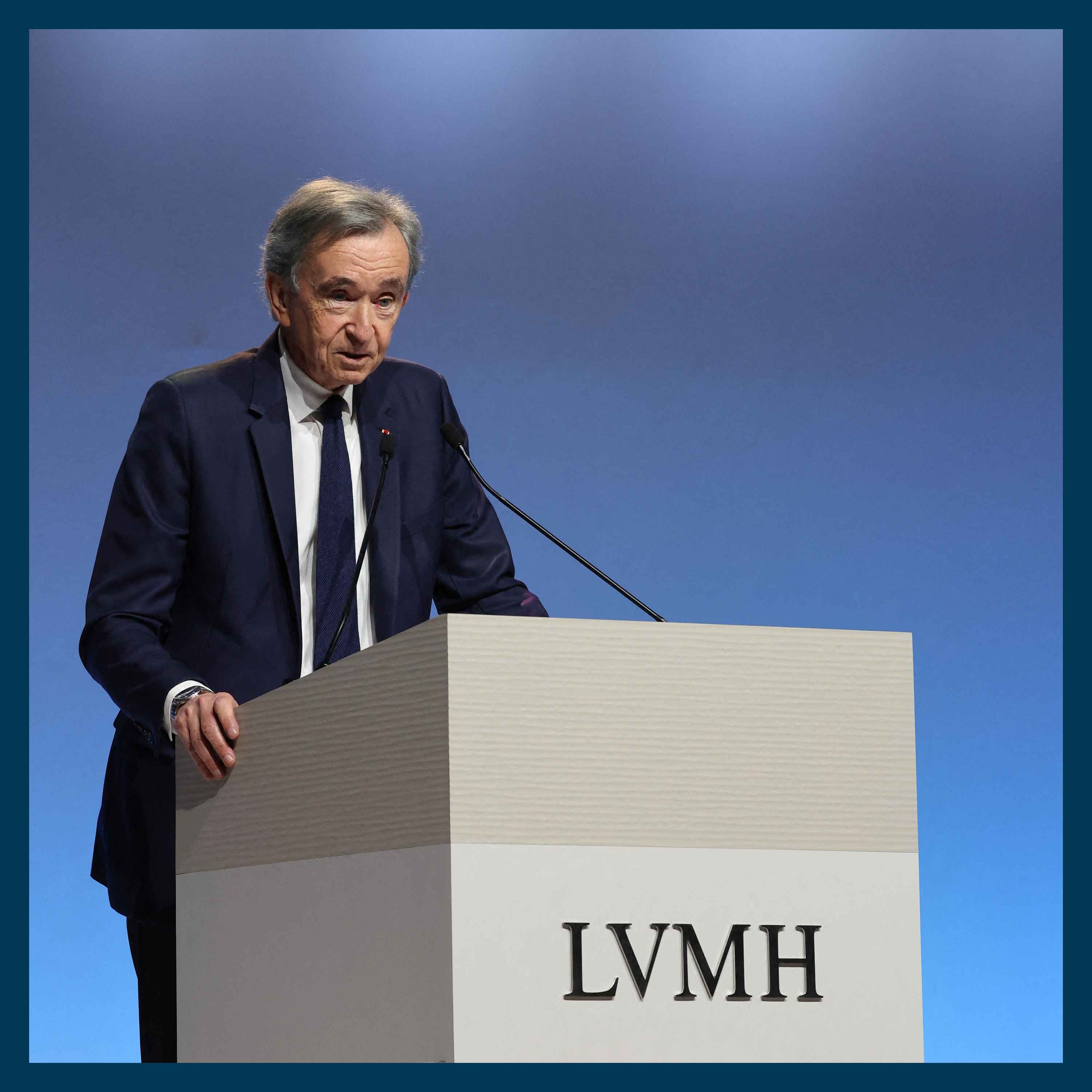
Sitting atop all of this is CEO Bernard Arnault. France and Europe's world richest man recently in the headlines in a big way. A French newspaper just did a huge reporting series on billionaire LVMH founder Bernard Arnault.
- [02:55]
Thumbtack Advertiser
And a profile on the billionaire businessman
- [02:57]
Peter Conradi
suggests he uses money and fear to
- [03:00]
Thumbtack Advertiser
hold it all together.
- [03:01]
Capella University Narrator
And then the last series was about succession, essentially was about follow the money.
- [03:08]
Peter Conradi
Arnold mocked the idea of a family feud, writing with the Arnaults. Apparently there is no discussion, only plotting, no deliberation, only rivalry. It's the stuff of novels.
- [03:25]
Luke Jones
In a six part investigation, newspaper Le Monde described Arnault as the head of the last French royal family, with the princes and princesses, Arnaud's five children vying for control in a succession style drama. Our man in Paris has been speaking with Arnault's unofficial controversial biographer to find out more. The story today, the succession drama at lvmh.
- [04:04]
Peter Conradi
My name's Peter Conradi, I'm based in Paris as the Europe editor of the Sunday Times.
- [04:09]
Luke Jones
Peter, before we get into this enormous hoo ha about LVMH for the simple, lowly puritan types amongst us, can you actually explain what LVMH is? Who they are, what they do?
- [04:21]
Peter Conradi
Yes. I mean, it's a massive conglomerate of 75 companies that includes, for example, starting from the top, the Louis Vuitton, you know, makers of those famous bags. There is Dion Fashion, there is Tiffany, the jewelers, Bulgari, the jewelers, Fendi, the fashion, Celine fashion, Le Valeva, Givenchy Fashion. I could go on and on and on.
- [04:50]
Luke Jones
And it's not just famous. I mean, they employ a lot of people, they make a lot of cash.
- [04:56]
Peter Conradi
They do indeed. I mean, the annual turnover is 81 billion euros. So that's something over, I think, probably about 70 billion pounds. That is, I think I looked it up. That's the equivalent of the GDP of Slovakia, I think, which gives you an idea of quite how big they are. And I don't know how many products they actually sell in Slovakia. And they employ 211,000 people across the world.
- [05:20]
Luke Jones
Wow. And if I'm an average French person, maybe even a Parisian, I mean, what's my view of lvmh? Am I quite proud of it? Is it how a sort of British person might think of Land Rover or something like that?
- [05:36]
Peter Conradi
I suppose so, yes. I mean, it's, you know, it's a huge company. You'll know the brands, you'll be proud of the brands. I suppose you will have seen them in a lot of places, including at the Paris Olympics in 2024, when they were everywhere. When it comes though, to Bernard Arnault, the bo, your view of him will probably depend on where you stand politically. So if you tend to be center to the right, you will probably see him as a pretty effective captain of Industry. If you are more on the left, you'll see him as a, you know, an oligarch and somebody doesn't really pay as many taxes as you think they should.
- [06:18]
Luke Jones
Which brings us to this investigation by the newspaper Le Monde, a big six part investigation. What jumped out at you from this big piece of work?
- [06:28]
Peter Conradi
This was an extraordinary piece of work because it was two of their kind of big name journalists who apparently spent six months working on it in conjunction with lvmh, which was in a sense quite surprising because Le Monde, leans to the left, is not known as being a fan of his or of any of these so called oligarchs. Anyway, so this investigation came out six days in a row, 20,000 words. I read every one of them. I suppose the main thing is perhaps there are no killer revelations in it. I think it just paints a very, very vivid picture of what it's like within LVMH and how sort of idiosyncratically it is run by Arnault, almost, you know, almost like a family business. I think one of the early pieces describes a visit to their headquarters, very flashy, swanky headquarters and near the Champs Elysees. And it sort of describes, you know, the executive suite, the top floor where Bernard Arnault holds court. And as they write, I quote, as you ascend the floors, spacious offices replace open plan spaces. The beige carpet grows thicker, lighting becomes softer, and murmurs give way to silence. On monsieur's floor. Now, Monsieur, apparently, is how everyone refers to Bernard Arnault. On monsieur's floor, you encounter only bucklers in formal dress and white gloves and burly security guards. Most of them are former police officers tasked with protecting the monarch. And they call it, they call him the head of France's last royal family. So, you know, it's rich in anecdotes like that and, you know, it just conveys the way he micromanages everything. I mean, one of my favorite elements in this investigation was the control that he apparently exerts over Radio Classique, which is, you know, a French classical music radio station which he bought in 1999. He loves classical music, he's an accomplished pianist, his wife is a professional pianist, but he likes the traditional stuff rather than modern classical. And so apparently he keeps telling them he wants it to be more like Classic FM in Britain. And they apparently have got the message and they know that he listens to the radio when he's in the car at about 9 o' clock when he's going to work and about 2 o' clock when he's coming back from lunch. And so they pay particular attention to programming at those times. So he doesn't get upset by any of the music he hears.
- [09:06]
Luke Jones
Amazing. Has that caused much of a ruckus? I know there's a new biography about Bernard Arnaud out at the moment. You've been speaking to the, to the writer behind that. What do they make of it?
- [09:20]
Peter Conradi
It's curious because there are a few things going on at the moment around Bernard Arnault, who has traditionally been very much in the shadows. His brands are all out there. They're everywhere. But he himself prefers to remain discreet in his dark suit, pulling the strings behind the scenes. And in the past couple of months, we've seen a critical, unauthorised biography of him by a lady called Audrey Millet which came out and which sort of looks forensically at his rise to industrial power, the way he's made use of all the sort of financial mechanisms, complicated financial mechanisms, tax rebates and so on to make more and more money. He also himself had a conversation with a podcaster, a fairly sort of soft, questioning podcast in which he talks again about his childhood, about his career and so on. There was a wonderful sense of love within the family, among the children, parents and grandparents. My grandparents ran a company near which my parents lived, and they instilled a strong work ethic and a sense of the value of hard work in the children and grandchildren. That went on for an hour and 40 minutes and viewed by 20 million people across the world. And then finally there's been this series of Le Monde articles. And most extraordinary of all is his response to these articles, which is having ignored Twitter for all the years of its existence, he then took to X, as it's now known, with a very smart, witty, three page kind of takedown, I think one could call it, of the Le Monde article, which was itself viewed by more than a million people, many of whom were surprisingly approving of him.
- [11:12]
Luke Jones
Okay, so he's out fighting. And has that altered the way people have seen him? You know, this insight into this gilded life that he leads, but him pushing back on it quite hard, it seems. How has France, how has La France Profond reacted? Peter?
- [11:29]
Peter Conradi
It's, it's difficult to say, actually. La France Profond has been a bit preoccupied with other things like the forest fires and, you know, the other, the other news that keeps on coming. I mean, I think what is striking is that, you know, he's often portrayed as a bit of a, a monster in the left of center press and in, you know, in the left wing press. But if you look at the comments, and I, I've hadn't, I certainly haven't read all, you know, tens of thousands of them, but look at some of the comments at random on his tweet and they're all pretty approving and saying, you know, good on you. You've built up something good, something big, something that employs a lot of people, that makes a lot of money. Contrasting his performance with that of some of the politicians who, you know, French people rather like their British counterparts, tend to be a bit disillusioned with these days. So, you know, I think it's been a good move on his part. And those around Arnaud say that, you know, we can expect further interventions from him in the coming weeks and months, which will be interesting because there is an election coming up here next April and Marine Le Pen of the far right National Rally is the favourite to win.
- [12:42]
Luke Jones
Interesting. Okay, so if we've got increasingly this image of lvmh, less of a sort of bland company and more kind of interesting royal court headed by this monarch, Bernard Arnault, tell us a bit more about him. You sort of mentioned some of his early days. I mean, how, where was he born and how did he build up this enormous luxury empire?
- [13:06]
Peter Conradi
Yeah, he was born in Roubaix, which is just over 100 miles or so north of Paris, near Lille. These days it's a pretty grim post industrial kind of place with a lot of social problems in those days. In 1949 when he was born, it was the heart of France's textile industry. There are a lot of very wealthy textile barons, I suppose, in the area. His maternal grandfather had set up a construction company back in 1926, which was then later taken over by Arnaud's father and which Arnaud himself came to work in. But that was only after he'd gone to Paris. He'd studied at one of the top schools, top universities could call them in British terms, in Paris. And while most of his classmates went off to work for the French state, which was widely expected, he went back to Roubaix and got stuck into the family firm and was essentially pretty soon telling his father how to run it.
- [14:13]
Manveen
And when I arrived in the business with him after three years, he told me, say, Guy, I think you are able to run the business, so let's do it. And he gave me the key. I was 25, telling him to shift
- [14:30]
Peter Conradi
from just buildings and flats and so on for other people into becoming a developer selling directly to the public, which he could See was where the money was.
- [14:41]
Luke Jones
And how did he end up with his hands on old Christian Dior?
- [14:44]
Manveen
I was hooking at several ideas and I hit a Christian Dior and immediately I thought, this brand has a lot of potential. It is under evaluated, it is small compared to what I thought the world was going to become. And so I moved to buy it.
- [15:07]
Peter Conradi
Well, that came in 1984, when there was a company called Boussac Sans Frere, which was a kind of a textile and retail conglomerate that owned a lot of largely worthless, I suppose, companies, but also a couple of very, very attractive ones. One was Christian Dior, the other was Le Bon Marche, the department stores. Now, it was in such deep trouble that the French state took it over and said, right, we're going to sell this for one franc. But obviously there were conditions attached to taking it over. So he persuaded his father that they should take over this company. They did. So they kind of built it up, started to realise the value of Christian Dior in particular. And, you know, that took him away from construction and real estate. And three years later, attempts were being made to set up a merger between Louis Vuitton and Hennessy, well known for its cognac. And the two owners were sort of fighting a little bit among themselves. Arnaud stepped in and at the end of rather a long and complicated process, he emerged as the boss of what became known as lvmh.
- [16:44]
Luke Jones
Amazing. And the. The value, I mean, particularly of Dior, amongst other things, I mean, obviously worth one franc at one point, but in terms of how France projects itself around the world, I mean, that. I mean, it is just an enormous brand.
- [16:59]
Peter Conradi
It is indeed. And, I mean, he spotted that, you know, I suppose that was an era when brands perhaps didn't have the cachet or the, you know, the financial power that they have now. And he was, you know, he was clever enough to spot that.
- [17:12]
Manveen
When I arrived in the US, the first time I went in the US in 71, it's when I understood that the power of the name. I arrived at the Kennedy Airport and I went in a cab and I was starting to talk with the driver and the driver told me, I like France. Say it's good. Do you know France? Do you know the French president? And he told me, no, I don't know French president, but I know Christian Dior.
- [17:46]
Peter Conradi
He's one of the very successful businessmen of his generation, I think, and there are various other ones in France. He kind of took advantage of a changing world, saw the way things were going and just Made a lot of money out of it.
- [17:58]
Luke Jones
How did he get to the point where, okay, he's piecing together that conglomeration of LV and MH to actually take it to new heights and become absolutely filthy rich in the process?
- [18:10]
Peter Conradi
It's largely been, you know, an organic process. Other companies have been added to it along the way, but, you know, it is just a very, very well run, successful company. He's understood very, very well the importance of image. Everything he does. I mean, if one looks at his incredible, incredibly generous, one would say donations to charity, like, for example, the creation of the Louis Vuitton foundation. Wonderful building designed by Frank Gehry, the architect, wonderful artworks there and so on. Huge, huge subsidies from the French state running to hundreds of millions of pounds. But also, you know, a perfect showcase for lvmh because people go there, they admire the art, they see the name Louis Vuitton and in their minds, Louis Vuitton becomes associated with art. You know, it's a perfect kind of synergy which he's, there's nothing wrong with it. It's perfectly legal, and it's also very smart.
- [19:26]
Luke Jones
Coming up, how this luxury conglomerate turned Bernard Arnault not into just an incredibly rich and powerful man, but also a friend of Donald Trump. More from Peter.
- [19:48]
Manveen
Then I thought, what if I've scaled businesses? What if I scaled my philanthropy? What if I did as much in
- [19:53]
Thumbtack Advertiser
one year as I've done in my whole life? See how your wealth could have even greater meaning@creativeplanning.com impact.
- [20:00]
Capella University Narrator
There's a fire inside you you can't ignore. Stand still. Not a chance. You're a lifelong learner who's come this far. Now we are here to help you keep going further. Capella University. What can't you do? Visit Capella. Edu to learn more.
- [20:15]
Thumbtack Advertiser
Avoiding your unfinished home projects because you're not sure where to start. Thumbtack knows homes, so you don't have to. Don't know the difference between matte, paint, finish and satin or what that clunking sound from your dryer is. With thumbtack, you don't have to be a home pro. You just have to hire one. You can hire top rated pros, see price estimates and read reviews, all on the app.
- [20:34]
Peter Conradi
Download today.
- [20:51]
Luke Jones
Peter, we've been discussing the luxury powerhouse LVMH and some of the dramas and intrigue that have been playing out in the pages of the French papers in the last few weeks, especially after an investigation by the Le Monde. You were telling us how Bernard Arnault Managed to build this enormous empire from this small building firm that his family owned. Just tell us, though, about the influence he's been able to wield as Francis Affleck, Europe's richest man. How far does his influence reach?
- [21:24]
Peter Conradi
His influence, or maybe one could say his tentacles stretch everywhere. You know, he's known every one of France's presidents since he went into business on a large scale and so on, and plenty of foreign leaders as well. I think the most extraordinary thing is his relationship with Donald Trump, because in 1981, Francois Mitterrand, the Socialist, was elected President of France on a very, very radical left wing program. Arnaud thought, this is going to be really bad for business. I'm going to get out of here. And he went to America, he went to Manhattan and started getting involved in construction or real estate deals there. And surprise, surprise, who did he come across but a young Donald Trump. And the two became friends, they became business partners, and they've continued to be friends and business partners ever since. And this appears to be a genuinely close relationship between them. He was, I think, the only Frenchman. Him, along with his wife and two of his children, were the only French representatives at Trump's inauguration in January last year in the Capitol. They were sitting in, I think, third or fourth row or so on. Frequently goes to dinner with Trump. He's also friends with the family of Jared Kushner, Trump's son in law. So, you know, the Kushners and the Arnault kind of hang out. The generation below also hang out. So he's just, you know, one can't really compare him with Trump. I mean, you know, Trump, I think we all know his personality and his image. Arno, by contrast, is very smooth, very sophisticated, extremely cultured, plays the piano very well. You know, he's a product of a sort of the elite French educational system. But, you know, when it comes to business, I think he works in a similar way to Trump and the two get on very, very well indeed.
- [23:35]
Luke Jones
And you mentioned obviously that the building of the Foundation Louis Vuitton in the Bois de Boulogne in Paris, but he's got involved in other aspects of the city and building things and projecting France's cultural heft.
- [23:49]
Peter Conradi
Yeah. Yes, indeed. I mean, one of his most notable actions, I think, was to give 200 million euros, probably about 180 million pounds or something, to the restoration of Notre Dame after it was very, very badly damaged by fire in 2019. And I was here in Paris covering the Summer Olympics a couple of years ago, and it was extraordinary. Just Quite how LVMH and its products were everywhere.
- [24:19]
Manveen
We wanted to find a way to show through the Olympics to the world that France as itself is a creative country, is a refined country, is a craftsmanship country.
- [24:34]
Peter Conradi
You know, I think the Olympic torch made some strategic stops outside LVMH stores.
- [24:41]
Manveen
You will see some of our creation, like the medals, like the trunk that bring the flame part of the deal.
- [24:52]
Peter Conradi
The IOC was beginning to think that this is going a little bit too far. And I think the Louis Vuitton logo had to be removed from the various backdrops and so on. But, you know, that checkered pattern is so familiar anyway that you don't really need the LV on it to know what it's all about. So it was a wonderful, wonderful showcase for him and for his products. And I suspect on large amount of it was very, very tax deductible.
- [25:25]
Luke Jones
Quite amazing. If it's the ioc, which is saying, hang on, this is all getting a bit commercial here.
- [25:30]
Manveen
Indeed.
- [25:31]
Luke Jones
What about actual hard politics, aside from all this sort of schmoozing and cultural stuff? I mean, does he actually get involved in sort of policy debates to kind of make things happen that he wants to see happen?
- [25:41]
Peter Conradi
There is one thing that Bernard Arnault feels very, very strongly about, and that is taxes, particularly corporate taxes. Well, funny that. Yes, corporate taxes and taxes on entrepreneurs who create businesses, create those companies. Now, you know, obviously self interest does pay. Must play an enormous part in this. But I think it's also part of a. A general kind of feeling on his part that France is already a very, very heavily taxed country and that it is holding back other budding Bernard Arnaults. And, you know, I had a personal experience of this, a slightly bizarre personal experience of this last autumn when there was a big debate going on in France centered on an economist called Gabriel Zucman, who made waves with a demand that there should be a 2% tax on anyone's fortunes ab 100 million euros. This was enthusiastically taken up by the left. There were some demonstrations going on at the time. People were waving banners with Zucman's name on it. I went along to interview him. Very nice, interesting, thoughtful young economist. In the course of the conversation, he started to complain about billionaires who didn't pay their fair share and cited Bernard Arnault. And I was thinking, that's a nice quote. And I was writing up my story for the newspaper and I suddenly, a little light bulb went off in my head and I thought, ah, we better give Bernard Arnault a Right of reply. But Big Bernie, I thought, is not going to bother to reply to a foreign newspaper. So I fired off an email on the Friday morning, I think to a rather anonymous email box at LVMH and was quite surprised that afternoon to get a call from his right hand man. Who said that Monsieur Arnault would indeed like to respond to the Sunday Times and indeed like to make clear for the first time his views on the wealth tax.
- [27:54]
Manveen
But.
- [27:55]
Peter Conradi
And he would do that through the form of a statement which he would only give us if we printed it in its entirety.
- [28:05]
Luke Jones
What'd you make of that?
- [28:07]
Peter Conradi
Well, I obviously consulted my bosses and thought, well, this is an odd kind of situation. There was a lot of toing and throwing with LVNH because they hadn't even shown me the statement at that point. And I thought, well, you know, it may go on for 25 pages and we can't fill the entire Sunday Times with it. In the end, they relented. They showed me the statement. It was about three or so paragraphs, but the content was absolutely explosive. Let me quote from it. He wrote, it is impossible to understand Mr. Zucman's positions if one forgets that he is first and foremost a far left activist. As such, he uses his pseudo academic expertise, which itself is the subject of widespread debate, to serve his ideology, which aims to destroy the liberal economy. The only one that works for the good of all this is why he presents the French tax situation in a biased way. And he continues, this is clearly not a technical or economic debate, but rather a clearly stated desire to destroy the French economy. Ouch.
- [29:11]
Luke Jones
Ouch indeed.
- [29:12]
Peter Conradi
And you know, within minutes of it going online on the Saturday evening, it was being picked up by every French media outlet. 30, 40 of them did it over that weekend, it dominated the news agenda. There was a whole discussion program on one of the rolling news channels with a big backdrop of a photograph of Zuckman on one side, confronting Bera Arno on the other side. And, you know, the row went on for several days. I actually ran into Zucman a few days later at a hearing he was giving at the French Parliament. Walked up to him, rather apprehensive of the likely reaction. And I said, I think you've probably had quite a busy weekend, haven't you? And, you know, but for him it was good. It certainly got the issue onto the agenda.
- [29:58]
Luke Jones
Amazing. What happens next though, with Elv Mage? Obviously, Bernard, Hanoi's not ancient, but he is getting on. Is there much of a struggle? Did we get any insight that from the Le Monde piece and beyond, about the race to succeed him amongst his kids.
- [30:25]
Peter Conradi
Well, whether or not there's a struggle depends on who you ask. Now, if you ask Bernard arnault, who is 77 going on 30, convinced that he's going to live for a long, long time, more plays tennis four hours a week, including sometimes with his quotes, best friend Roger Federer, the eight times, I think, Wimbledon champion. There is no discussion at all about succession. The five kids, who range in age from Delphine, who's 51, who's his eldest, and then she's followed by four boys, the last of whom, Jean is 27, they all run different parts of the business. Delphine runs Christian Dior Couture, Antoine, who is her next one down, they're both with his first wife. He sort of runs. He's basically the spokesman, I suppose, for the company. And then another three boys. Alexandre, who is the deputy chief executive of Moyer Hennessy, Frederic, who runs Loro Piana, sort of the Italian cashmere brand. And the youngest, Jean, is the director of watches for lvmh. But you know, is there a succession struggle going on? It's not clear because, you know, as it stands, they're all running their respective parts of the business. The reports of kind of clashes between them, particularly between the first group, the first two and the latter three, how much is in that is not entirely clear. When I spoke to his biographer, she said the idea that he's trying to set them up for some kind of squid game style battle to see who is ultimately going to succeed him, you know, is not true because he has seen various other dynasties, particularly the Agnellis in Italy, and he's seen how after the, you know, the patriarch's death, the whole thing got ripped apart and ended in lawsuits and acrimony and whatever. And, you know, I think he likes to think that somehow they will find a way of sorting things between themselves. I mean, whether that actually turns out to be the case, we just have to wait and see.
- [32:46]
Luke Jones
Why does any of this matter, Peter, do you think? I mean, it's important for business, it's important for column inches, but why should any of us care, would you say?
- [32:55]
Peter Conradi
Well, this is a very, very big company, it's France's biggest company. So ultimately who runs it is going to be important, whichever of the five children ultimately takes over. And I think it's pretty clear it will be one of these five children will probably have a different way of proceeding, will have a different idea of what the priorities should be. And so on. But I think, you know, most of all, it is just a wonderful business soap opera with very, very colorful personalities and with such an enormous creation, sort of very, very kind of French creation, headed by a very, very French man, well rounded, cultured, you know, the French businessman from central casting. And, you know, it just is an endless source of fascination, I think, not just for people in France, but for other people that are across the world. I suppose that look to business.
- [34:07]
Luke Jones
That was Peter Conrady, Europe editor for the Times and the Sunday Times. The story@thetimes.com is our email address. Should you like to get in touch at any point with questions, points, queries, praise. Perhaps that is it from us today. Today's producers were Taryn Siegel and Olivia Case. The executive producer was Edward Drummond. Sound design was by Dave Creasy, and theme composition was by Malasato. I'm Luke Jones. See you.
- [34:44]
Peter Conradi
Try Angel Soft for your tushy.
- [34:47]
Capella University Narrator
It's made by Angels Soft and strong. Budget friendly.
- [34:52]
Peter Conradi
The choice is simple.
- [34:55]
Capella University Narrator
Pick up a pack today. Angel Soft. Soft and strong. Simple. You've never been one to settle. Stand down or stand still. You're a lifelong learner, energized by excellence. There's a fire inside you you can't ignore. You've got competition to outrun, momentum to build on, and your own high standards to meet. Stop now. Not a chance. At Capella University, we help you catch what you're chasing because you've always had the drive. Now go earn the degree. Capella University. What can't you do? Visit Capella. Edu to learn more.