Loading summary
Transcript131 lines
- [00:00]
SoFi Advertiser
High interest debt is one of the toughest opponents you'll face unless you power up with a SOFI personal loan. A SoFi personal loan could repackage your bad debt into one low fixed rate monthly payment. It's even got superspeed, since you could get the funds as soon as the same day you sign. Visit sofi.compower to learn more. That's s o f I.com P-O-W-E r loans originated by SoFi bank and a member FDIC. Terms and conditions apply. NMLS 696891
- [00:33]
PwC Sponsor Announcer
this episode of the Story is sponsored by PwC.
- [00:36]
Luke Jones
Technology doesn't wait and neither should you. Staying competitive means getting ahead, not just keeping up. PwC takes you further with tech. From optimizing the systems that put your data to work to scaling AI from proof of concept to competitive edge, PwC
- [00:53]
PwC Sponsor Announcer
helps you meet tomorrow's tech demands so you can compete at a speed that rewrites the rules.
- [00:59]
Luke Jones
Discover more at pwc.co.uk. from the Times and the Sunday Times, this is the story and I'm Luke Jones.
- [01:11]
Oliver Wright
Well, at 20 minutes to 5, we can now say the decision taken in 1975 by this country to join the Common Market has been reversed by this referendum to leave the EU.
- [01:26]
Luke Jones
It's 10 years since BBC favourite David Dimbleby called it. Brexit was on.
- [01:33]
Oliver Wright
The British people have spoken and the answer is we're out.
- [01:39]
Luke Jones
It was a rough and tough campaign which got us to that point.
- [01:43]
Oliver Wright
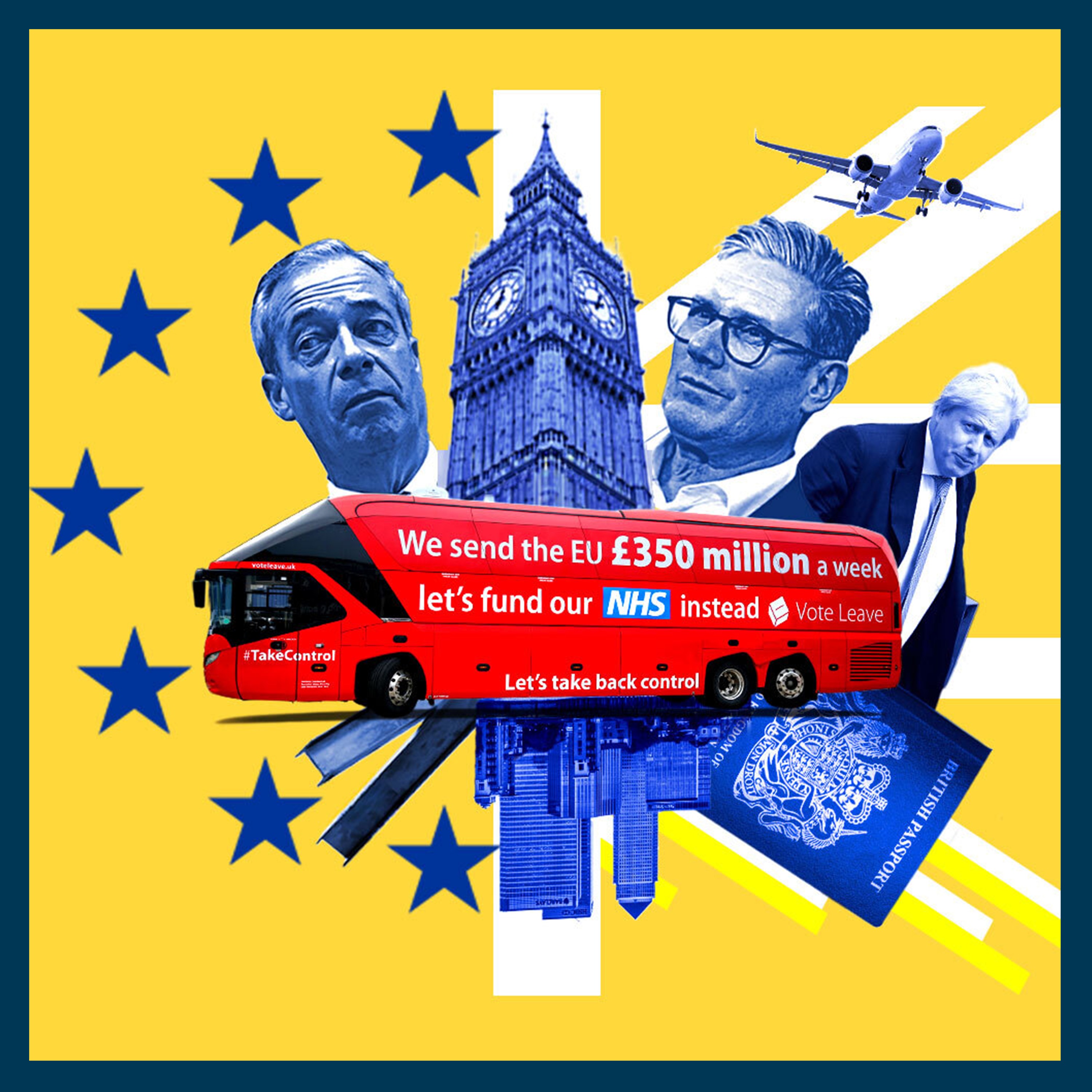
We should take the chance now as a country to take back control, take back control of huge sums of money, £350 million a week. We cannot stop criminals coming into this country if they've got an EU passport. Simple as the British people have the
- [02:01]
Luke Jones
ability to not just govern themselves well, but to be a progressive beacon to the world. Ten years, six prime ministers and one pandemic later, have the promises of Brexit been realised? And are those who voted Leave satisfied with how things went? We have asked some.
- [02:21]
PwC Sponsor Announcer
It's a disaster and I get really fed up of whichever government's in making all these promises, promising you the world, changing the mind and giving you nothing at the end of the day.
- [02:49]
Luke Jones
The story today did we take back control?
- [03:03]
Oliver Wright
We were looking for people who had voted to leave during the 2016 referendum. So we went to Long Eaton because it's a place which has voted for the government of the day in every election since 1983. Of all the seats in the country, it is the bellwether seat and obviously it also Voted for Brexit.
- [03:26]
Luke Jones
Oliver Wright is policy editor for the Times.
- [03:29]
Oliver Wright
It's sort of halfway between Nottingham and Derby, so in South Derbyshire. It's quite leafy, it's a small town. It is what you would think of as Middle England.
- [03:41]
Luke Jones
And you weren't there just to take in the delights of Long Eaton. You were there for a focus group. Explain for someone who's not had the pleasure of sitting through one of those, what it's like and how it's set up and who's there.
- [03:51]
Oliver Wright
So what you try and do is get, in this case, not an entirely representative section of voters. And we wanted to find out not so much why they voted to leave, because that sort of territory's been endlessly gone over, but sort of to talk to them about 10 years on, had it in any extent lived up to their expectations? What were the good bits, what were the bad bits? Did they really think that the sort of promises of that referendum ten years ago had come to pass and what needed to happen in the future?
- [04:24]
Luke Jones
And what kind of mix of people did you have? As you looked around the table, we
- [04:27]
Oliver Wright
had a mixture of ages and sexes. I'm Lee.
- [04:31]
PwC Sponsor Announcer
Terrence. Karen. Sharon. Colleen.
- [04:34]
Oliver Wright
Hi, I'm Brian.
- [04:35]
PwC Sponsor Announcer
Elizabeth. Sam.
- [04:37]
Oliver Wright
Most of them were what you would describe as kind of normal working people. Some of them of course, were retired. But it was with all these things, you're never gonna get an entirely representative picture of Britain cause it's such a diverse place. But just being able to sit down and talk to people does give you a sense of what people who aren't involved in the sort of day to day running of politics, where we follow every twist and turn, what are people actually hearing? And it's worth remembering in all this, if you go back to before the referendum, Dominic Cummings, who was the guy who in some ways arguably masterminded the vote Leave referendum for that, he came up with this slogan which was Take back control. And where did that slogan come from? That slogan came from doing focus groups in very similar places to Long Eaton. And Cummings was really representing what he was being told. That's what people said to him. They said they wanted to take back control. They didn't feel that the laws, the rules that they had to follow were really made in Britain and so that focus groups could be quite powerful in terms of sort of just what people are thinking independently.
- [05:51]
Luke Jones
Well, let's get into what they said to you. How did these people view the country back in 2016? How do they describe it?
- [05:58]
Oliver Wright
With the benefit of hindsight, it's interesting. And I wasn't really expecting this. They were quite nostalgic. I do think it was slightly better.
- [06:08]
Luke Jones
I can't put my finger on anything, really, but it didn't seem quite so
- [06:13]
Oliver Wright
bad all that time ago. One lady said it was all very glamorous. Yeah, it was all very glamorous with
- [06:19]
PwC Sponsor Announcer
Boris there and everything. And, yeah, they were all saying the right things.
- [06:24]
Oliver Wright
They felt that the sort of, you know, it was a moment of hope when that referendum result came through.
- [06:30]
PwC Sponsor Announcer
It was quite exciting when we came out, like, the thought of what. What could be achieved.
- [06:35]
Oliver Wright
But as you might imagine, they don't see it quite that way now.
- [06:39]
Luke Jones
And what made them vote for Brexit? What were the reasons that they were giving you?
- [06:43]
Oliver Wright
Now, it's fair to say that probably primarily immigration back then was a driver of Brexit. As it is an issue now.
- [06:51]
PwC Sponsor Announcer
I could just see the identity of the country changing, especially if I compare it to when I was little. And for me, one of the main reasons I voted was immigration. Where I work, I see people coming in and taking advantage of our services and facilities, but they've not got the respect because it's not their country and they're not bothered. They're just here for what they can get.
- [07:16]
Oliver Wright
This idea that you couldn't control who came and worked here. One gentleman talked about people coming from Eastern Europe and undercutting the wages of people that he knew and the jobs that he and his friends were doing. I work in construction and most of my time I spent in London or Birmingham. And I was sick of seeing European nationals getting jobs being exploited and taking away training of our young people, not giving them an opportunity for others. It was more a sort of, you know, a sense that Europe was telling us what to do and they shouldn't tell us what to do and we should take control of our own destiny. There was a sort of, you know, there was a real kind of optimism that Britain Independent could do things that it couldn't do as part of the European Union.
- [08:06]
SoFi Advertiser
Yeah.
- [08:07]
Oliver Wright
And we wouldn't be answerable to Brussels or anything.
- [08:11]
Luke Jones
I mean, we've paid him millions, billions. And as I say, I just thought it'd give us more freedom.
- [08:17]
Oliver Wright
Interestingly, we had. One of our participants was a guy called Terence, who had actually, at the time of the referendum, was working in the agency that processed payments from the EU to farmers all over the block. And I could privy to the amount of money that we were paying to the EU for European subsidies and then how little compared to that, our Farmers got back. And that was just one aspect of it. And obviously, there's a whole range of different things that we were paying into the EU for and not getting our
- [08:46]
PwC Sponsor Announcer
value for money back.
- [08:46]
Oliver Wright
And I thought that we'd have more autonomy to spend that extra cash.
- [08:54]
Luke Jones
And so did they think all of these years later that Brexit had been a success, it had done what they wanted?
- [09:01]
Oliver Wright
In a word, no. Would you say Brexit's been a success, a failure, or somewhere in the middle? Scale of 1 to 10? I'd say about 4.
- [09:07]
SoFi Advertiser
4.
- [09:08]
PwC Sponsor Announcer
I'd say somewhere in the middle.
- [09:09]
Oliver Wright
Somewhere in the middle, yeah.
- [09:10]
Luke Jones
I'd go, yeah, I'd go, everyone about 4 to 6.
- [09:13]
Oliver Wright
A bit lower. A bit lower. There was a lot of discontentment about the way in which they saw Brexit having worked out. Karen again said, it's heartbreaking. And she remembers, as most of them did, the pledge on the bus, the money that was gonna go into the nhs, and they see what's happened to the NHS since, and they don't think they got what they were promised.
- [09:37]
Luke Jones
I thought immigration would change and they'd sort the borders out more and, like
- [09:43]
Oliver Wright
Colleen said, more money for hospitals so
- [09:46]
Luke Jones
that the waiting time in AE wouldn't look so atrocious.
- [09:51]
Oliver Wright
You know, you see these old people on the trolleys waiting to be seen.
- [09:55]
PwC Sponsor Announcer
It's heartbreaking.
- [09:58]
Luke Jones
And did they give any reason for why they thought it had failed?
- [10:02]
Oliver Wright
It was mixed. Some people thought that the forces of Remain would never let us do Brexit properly.
- [10:10]
PwC Sponsor Announcer
I think the Conservatives tried to point it in the right direction, but I think their hands were tied a lot of the time.
- [10:17]
Oliver Wright
Other people thought, in part, it was the sort of EU punishing people for Brexit? It's almost like, let's make Brexit such a huge mistake. Let's get it back and let's make it. Let's take away all the good stuff. But interestingly, what there wasn't a sense of was that this was inevitably going to be a failure. I don't think we had strong enough characters to deliver on what they promised. I think what was promised was achievable, or somewhere close to being achievable.
- [10:47]
Luke Jones
It wasn't a problem with Brexit, it was just how it was implemented.
- [10:50]
Oliver Wright
It was a problem with how it was implemented and the failure of both politicians in Britain and Europe to sort of implement Brexit properly.
- [10:59]
Luke Jones
Did any of them blame the sort of Leave campaigners, your Boris Johnsons, your Michael goes for not having thought this through?
- [11:05]
Oliver Wright
No, they didn't. And actually, I mean, not from this particular focus group, but with a bit of hindsight, people are actually quite nostalgic about Boris Johnson. And equally, I mean, they don't really appear to blame Nigel Farage. You know, he was alongside Johnson, alongside Gove, one of the principal voices of the Leave campaign. Yet, you know, you talk to that group and quite a few of them are considering voting for Farage if there was a general election held, because, you know, they think he is going to get on top of this issue of immigration. That is still right up there.
- [11:39]
PwC Sponsor Announcer
I did vote reform and I'll be voting reform again. I'm not saying that it's going to be any better. I'm going to give the man a chance because I like what he says.
- [11:53]
Luke Jones
What about COVID Because, of course, that disrupted a lot of government policy.
- [11:57]
Oliver Wright
Yeah. And people do, I think, accept that there has been a sort of series of events that have taken place since Brexit that, you know, has had an impact. Covid, you know, the war in Ukraine and the sort of political instability that that has caused. But what you don't get really, is a sense that people have a huge amount of sympath for their politicians, that, you know, these people were trying to govern in really difficult times, that we borrowed a huge amount of money to get through Covid and then we spent a huge amount of money during the economic bailout as a result of the war in Ukraine and rising energy costs. There isn't a sense that, yeah, any politician would find it harder. They just feel that, you know, they haven't had the right politicians.
- [12:41]
PwC Sponsor Announcer
I would like to think they'd stick to by what they tell us they're going to do instead of changing the mind all the time. They've got to speak the truth. It's no use telling us one thing and then changing the mind the next week and going on to something different because we just lose confidence in them.
- [13:04]
Luke Jones
Coming up, to what extent can Brexit be blamed for Britain's many challenges today? Would we be better off back inside the eu? More from Oli in a moment. This episode of the Story is sponsored by PwC.
- [13:24]
PwC Sponsor Announcer
AI is everywhere. Return on investment, not so much. So how do you move past the hype and make AI actually deliver? PwC takes you further with tech, strengthening the data quality processes and workflows that shape how well AI performs.
- [13:42]
Luke Jones
PwC turns innovation into implementation so you can accelerate from experiment to scale.
- [13:49]
PwC Sponsor Announcer
Discover more@pwc.co.uk
- [13:55]
Oliver Wright
because you didn't just Say, how can I provide these investments? You'd be, how do I holistically provide everything? How do I bring in the legal, the accounting, all this, and do it at a price point no one else is doing it.
- [14:03]
Luke Jones
Learn more about how we approach wealth
- [14:05]
Oliver Wright
management@creativeplanning.com integrated today, we'll attempt a feat once thought impossible. Overcoming high interest credit card debt. It requires merely one thing a SOFI personal loan. With it, you could save big on interest charges by consolidating into one low fixed rate monthly payment. Defy high interest debt with a SOFI personal loan. Visit sofi.com stunt to learn more. Loans originated by Sofi Bank NA member FDIC terms and conditions apply. NMLS 696891.
- [14:51]
Luke Jones
Ollie despite the advice of doctors, we are back talking about Brexit. You've been sitting through one of these focus groups looking back 10 years since we had the referendum result, telling us to get out of the eu. We've heard about how they were quite nostalgic. Even some of these Leave voters you heard from in long Eaton about 2016, how do they feel about the state of Britain now?
- [15:12]
Oliver Wright
They're not happy. There is a huge amount of discontentment out there.
- [15:17]
PwC Sponsor Announcer
It's a disaster.
- [15:19]
Oliver Wright
It's cracking ice, isn't it, on every front? Yeah.
- [15:22]
PwC Sponsor Announcer
I don't think we're any better off, sir.
- [15:25]
Oliver Wright
Keir Starmer was never popular, not even when he entered Downing street with that huge landslide. And you look at it, the actual percentage of the vote that Labour got during that election was only just over 30%. It did extraordinarily well in terms of winning seats, but it was quite a shallow win.
- [15:44]
Luke Jones
Even people like Jess Phillips, formula saying that she won her seat despite Keir Starmer.
- [15:48]
Oliver Wright
She said, no, absolutely. And, you know, you talk to them more broadly about the sort of state of politics that we're in now. And, you know, there was a sense of depression, of things not quite working, of, you know, people talk about their high street and the state of their high street and the shops and the fact that there are vape shops everywhere, that it's depressing.
- [16:12]
PwC Sponsor Announcer
A lot of the nice shops have gone out of Long Eaton. There's nothing really to go down there for now, or coffee shops, but that's about it. But now I think it's gone downhill quite massively.
- [16:22]
Oliver Wright
People don't want to come into the high street. They talk about the nhs.
- [16:26]
PwC Sponsor Announcer
The NHS is just in a dreadful state. We're just waiting so long for appointments and for everything else because of the state of the country and the mass amount of people that are here.
- [16:39]
Oliver Wright
There isn't at the moment any sense, particularly certainly from this focus group, that things have been turned around in the NHS now, you know, statistics suggest that they are better, but that is yet to filter through to voters. And obviously, you know, the big issue of migration, there's a point during the focus group where they talked about a local hotel for migrants in the area and the protests and the problems that's caused.
- [17:03]
PwC Sponsor Announcer
Are they still in there?
- [17:04]
Oliver Wright
They're still in there over the road, still being processed at every Saturday lunchtime was the same here. They've managed to move them on now, but we still have got the hotel over the road and it must be costing an absolute fortune.
- [17:17]
PwC Sponsor Announcer
And there was problems when they were here. I'm not saying they're all like it, but there was incidents where they, you know, girls were being harassed and things like that. And it's not on for anyone to do that. Even if they live in this country and they're born and bred in this country, it's not on.
- [17:30]
Oliver Wright
And that, and I really hate this phrase, but I can't think of a better one, is, you know, the lived experience of people in those areas and it doesn't get national headlines. But if you've got a hotel with 50 or 70 refugees in that hotel, who were kicked out of that hotel in the morning, who are sort of standing around in parks, usually groups of young men, that has an impact. And I think also the thing that was interesting, and we've seen it, particularly in the Makerfield by election, is the importance of social media in terms of people getting their news, particularly on the right. There was huge name recognition for Rupert Lowe, the leader of Restore Britain. I've got an opinion who I think would make a great Prime Minister, but it's not Nigel Farage at the minute.
- [18:19]
PwC Sponsor Announcer
Who would that be?
- [18:20]
Oliver Wright
Rupert Low.
- [18:21]
PwC Sponsor Announcer
Restore.
- [18:21]
Oliver Wright
Restore. And at one stage, one of the focus groups, people in the focus group said, you know, I like Rupert Lowe. I mean, I really. I don't really know anything about Andy, what's his last name? I've seen a lot of Rupert Lowe on social media, although not Andy, whatever his name is. That's how little scene I've heard of him. But Rupert I've seen quite a bit of. So you get the sense of some people, and this was a person who said that they didn't have a television license. They're getting their muse, their information, from social media. And that is a sort of dynamic that some of us in the Sort of old media find hard to get. Congress legacy media find hard to get regrets with.
- [19:02]
Luke Jones
And what about in terms of some of those grievances that they laid out now, in terms of the state of the country you mentioned not much improvement in the nhs concerns about immigration, to what extent do you think those have not been helped by Brexit or have been affected by Brexit?
- [19:19]
Oliver Wright
It's a really good question. You have to separate out what people term irregular or illegal migration, small boats and migration more broadly. And migration more broadly does impact on jobs. And that has had an economic impact. People have probably forgotten now in the sort of aftermath of there was a huge shortage of labor. And one of the things that Boris Johnson did was allow people to come into this country much more easily to fill those shortages of labor because they were worried about the economy. But that has carried on and has had a knock on effect. And then you've got the issue of irregular migration and small boats and a sense that the government hasn't done anything about it, maybe almost. I do think some people realize that the government is slightly powerless to do anything about it, but they don't feel like they should be. And they sort of felt that Brexit would give us control over our borders and they don't feel that it has. And at least one person said, well, maybe we should just can get the job done by pulling out of the European Convention on Human Rights, which people often sort of slightly mischaracterize as being part of the eu. And of course it's a sort of separate thing, but people are talking about finishing the job of Brexit by pulling out of the echrn.
- [20:40]
PwC Sponsor Announcer
Obviously the ECHR is a big thing that stops that happening. So, yeah, our hands are tied in certain ways.
- [20:52]
Luke Jones
And stepping out of the focus group room and just into your mind, as policy editor of the Times, what do you think the impact of Brexit has been on some of those big policy challenges, not just the NHS and issues like controlling employees, but also just the ever extending chase for growth.
- [21:10]
Oliver Wright
It is really hard to disaggregate the impact of Brexit on other world events. Boris Johnson gave a big speech over in Greenwich hailing this brand new world that we were coming into. We will engage with Japan and other Trans Pacific agreements, countries with old friends and partners, Australia, New Zealand, Canada, on whom we deliberately turned our backs in the early 1970s. We will get going with our friends in America. And, you know, it was literally a matter of weeks before COVID reared its head.
- [21:53]
Luke Jones
Yeah.
- [21:54]
Oliver Wright
And you know, the entire conversation about Brett, it got switched off as everyone dealt with a far more pressing problem. And then, you know, Covid receded. Then very shortly after you had Russia's invasion of Ukraine, you had spiking energy prices. And you look at the polling over a period of time, what's sort of fascinating is just how much Brexit, as a issue at the forefront of people's minds, just dropped off the cliff.
- [22:21]
Luke Jones
But are you saying that it's had sort of little impact on things like foreign investment into the UK and our GDP being sluggish, or are you saying it's just lost in the mix?
- [22:30]
Oliver Wright
I'm saying it's lost in the mix of public perception. I think it is widely accepted as indeed, to be fair, it was predicted before the referendum that growth in the UK has been slower than it would have been if we had remained inside the eu. Now, that's not the same thing as saying, well, Brexit's always inevitably going to be a failure. It is perfectly possible that in the longer term, you do have control over your laws which suit you, as opposed to having to compromise and follow laws that suit a block of countries and possibly allows you to be more agile. There is some evidence that in areas of policy, for example, the regulation of artificial intelligence, intelligence, genetic modification in plants, the UK has taken a much more sort of practical, agile approach. And you talk to people and they say, if you've been part of the European Union, you couldn't have done any of this stuff. I don't think one should say that there is no possible alternative to being part of the European Union. But I think equally, it's naive to. To say that there hasn't been an economic hit.
- [23:47]
Luke Jones
Back in that focus group room, had any of them toyed with the idea of, well, maybe we shouldn't have left, or I would like to rejoin now.
- [23:56]
Oliver Wright
That's the really interesting bit, because I thought maybe a few of them would, but actually only one person out of the group said that they would reconsider. Who would vote differently today if they go back in 2016? Brian, you would? I'd vote definitely. If we were given the right information. And with hindsight, then, yes, I'd go back and I would try and persuade other people to don't do this.
- [24:23]
Luke Jones
How did that go down in the room?
- [24:24]
Oliver Wright
It was fine, actually, to be fair. Everyone was sort of quite respectful of each other's positions and were quite interested to hear what other people had said. There wasn't any sort of, oh, how could you possibly That's a betrayal. But most of them just, you know, they felt that Brexit had been a failure, but they didn't think that going back into the EU would make everything fine again.
- [24:42]
PwC Sponsor Announcer
I'm still glad I voted for Brexit, and I would today. You know, I think it's actually got worse, maybe because of the recent government. We've got now just hope for change and can't wait to vote again, to be honest.
- [24:57]
Oliver Wright
And that is interesting because it explains that discrepancy, as it were, in the polling, that if you ask people whether they think Brexit's been a good thing or not, by a very large margin, people think that it hasn't, that it's been a failure. But then if you ask the question, if there was a referendum tomorrow, would you vote Leave or remain? It narrows. There are some Leavers who would vote remain absolutely now, but it isn't the same margin. Not all those people that think Brexit's been a failure want to rejoin.
- [25:32]
Luke Jones
What were they saying about their hopes for the future and what they think might turn things around? If they are so gloomy about the current state of things, there's not a
- [25:42]
Oliver Wright
huge deal of sort of, if only they did this, it would all be fine. I think, again, come back to the point about immigration.
- [25:49]
PwC Sponsor Announcer
Immigration.
- [25:50]
Oliver Wright
Immigration, I'm going to say immigration, yeah,
- [25:53]
Luke Jones
I agree with Colleen.
- [25:54]
Oliver Wright
Sort the borders out there is a huge prize for if this government or a future government can demonstrate to people that particularly irregular migration has been brought under control, an end to the boats, there is a dividend to be had from that, but it is horribly, horribly difficult to do. I mean, there is some evidence in the polling that shows that when the small boats issue is prominent in the news, that gives a small electoral boost to reform. And Nigel Farage, yet when you have a period of time when you don't talk about it as much, reforms sort of dip in the polls. So there's a rough correlation there, and you could see that if the new labor administration is able, and it's a big if to make a difference to that, then maybe some of those voters, particularly Labour voters, who are now saying, I think I'm voting for a formal restore, could come back to the fold,
- [26:57]
Luke Jones
but they're not necessarily talking about that this could be achieved with a recess in relations with the eu, or actually a more decisive pivot away from the EU and towards America.
- [27:06]
Oliver Wright
Even so, the absolutely unexpected and fascinating bit to this, given we've been talking a lot about immigration, is we asked them what they thought about this idea of freedom of movement. Certainly if you're traveling abroad at the moment, trying to. The non Schengen sort of arrangements they've got, trying to get into other countries and then trying to get out again is unfortunate. You know, freedom of movement was a big issue during the 2016 campaign. The ability of people in Europe to come and freely work and live in the UK and vice versa. And this group were broadly in favor of a return to freedom of movement. Now, why? One of those in the focus group said they had direct experience, they worked in Spain. They said it was a total nightmare trying to work out getting working visas and trying to organize it all. When we work in certain cities in Spain, there's red tape around, like getting working visas and stuff like that. The red tape is mad.
- [28:05]
Luke Jones
Yes.
- [28:06]
Oliver Wright
A couple had had experiences of the new electronic visa system and had been stuck in queues.
- [28:12]
SoFi Advertiser
Yes.
- [28:13]
Oliver Wright
They got four machines on to do the fingerprints, etc. There were 24 machines around the area not being used. And you're thinking, well, they've got the machines, their system is there, but they're not using it. Yeah, that was like in. Cos it was the same in a way, because the sort of illegal migration issue has become so big, the sort of legal side of it is slightly less prominent than it might be and they don't really seem to have a problem of people from France, Italy or Eastern Europe coming to work now. I don't know, it's interesting that's their gut reaction because no one's really had this conversation about freedom of movement for 10 years. But also, I mean, we tested that with the polling and by a large margin, people are in favor of a return to freedom of movement. There are more League voters who are in favor of return to freedom of movement than are against it.
- [29:12]
Luke Jones
Amazing.
- [29:12]
Oliver Wright
Yeah. There's an opportunity there, potentially for the government now. It's dangerous because they say that now if a future Andy Burnham government or anyone else decided that that was going to become their policy, it would be exposed to the sort of harsh light of political debate and people pointing out what that might mean. And you can see those polling numbers changes, but the instinctive reaction of people at the moment is that they would like to see that return. And I suspect it does have something to do with holidays. But, you know, it's fascinating.
- [29:47]
Luke Jones
Once you've been in a two hour queue at Heathrow trying to get out to Faliraki, you sort of concentrates the mind. But just finally, I mean, you mentioned, you know, A possible incoming Andy Burnham government. We are obviously talking about Brexit by way of anniversary celebrations, but do you think that actually this will be a feature of government discussion and debates and even public debates in the next few months as a new administration is assembled, or do you think actually people are a bit beyond it?
- [30:14]
Oliver Wright
So I think it's inevitably going to be a bit of a subject of discussion because we've got now scheduled in this summit between Britain and the EU towards the end of July. Now there's a question mark over who will be leading that summit, whether it's, you know, Keir Starmer still or whether actually you've got a new leader in place by that time that will look at the issue of youth mobility scheme. It will also look at the sort of end of checks on food crossing across the Channel and the Irish Sea and also areas of future cooperation. So there'll be a deal on some of these things and then they'll talk about what they want to do in future. And you know, Burnham in particular has said in the past that he would like to see Britain rejoin the EU in his lifetime. He's recanted on that a bit, but I think he will be be Larry to open the Pandora's box in one of his first acts. He will want to stick with where the government is at the moment, but, you know, providing he can survive in number 10, whether he is writing the next labor manifesto, he'll have to think where they want to go from there.
- [31:40]
Luke Jones
Oliver Wright Times Policy editor the story thetimes.com is how to email us with your your views, your thoughts. Brickbats and bouquets are all welcome. Today's producers were Mikaela Arneson and Harry Bly. The executive producer was Harry Stott and sound design and theme composition was by Malisetto. I'm Luke Jones. See you.
- [32:24]
Oliver Wright
Foreign.
- [32:39]
PwC Sponsor Announcer
This episode of the story is sponsored by PwC.
- [32:42]
Luke Jones
What does an AI ready workforce actually look like? Breakthrough performance comes from combining human intelligence with machine capability. PwC brings it all together and takes you further with tech, empowering you to move faster, solve more complex challenges and unlock new value.
- [33:00]
PwC Sponsor Announcer
PwC combines talent strength with tech strategy so you can unite human potential with AI power.
- [33:07]
Luke Jones
Discover more at pwc.co.uk.
- [33:13]
SoFi Advertiser
high interest debt is one of the toughest opponents you'll face unless you power up with a Sofi personal loan. A Sofi personal loan could repackage your bad debt into one low fixed rate monthly payment. It's even got super speed since you could get the funds as soon as the same day you sign. Visit sofi.compower to learn more. That's S-O-F I.com p o w E R Loans originated By SoFi Bank NA Member FDIC Terms and Conditions apply. NMLS 696891.