Loading summary
Transcript64 lines
- [00:01]
A
From globalization to innovation sustainability to market volatility, there's always more than one side to a story. Explore different perspectives on today's most important business and economic issues with the Flipside podcast from Barclays Investment Bank. Hear two research analysts in a lively debate and get insights from every angle. To further inform your view, listen to the Flipside on your favorite platform. Okay, Caller one wins courtside seats to tonight's game. What? I won floor seats. You did? I've been calling for 13 months. Wait. Chris.
- [00:37]
B
Yes.
- [00:37]
C
I finally did it.
- [00:39]
A
What are you gonna wear? Men's Wearhouse. They've got today's looks for any occasion and I need to look like a celebrity. Don't wanna stick out. Exactly. They've got Chill Flex by Kenneth Cole, Joseph Abboud, and a tailor at every store for the perfect fit. Congrats. You can stop calling now.
- [00:52]
D
Not a chance.
- [00:53]
A
Hit any look for every occasion at Men's Wearhouse. Love the way you look.
- [01:01]
E
From the Times and the Sunday Times, this is the story. I'm Manveen rana.
- [01:09]
C
Well, at 20 minutes to five, we can now say the decision taken in 1975 by this country to join the Common Market has been reversed by this referendum to leave the eu.
- [01:23]
E
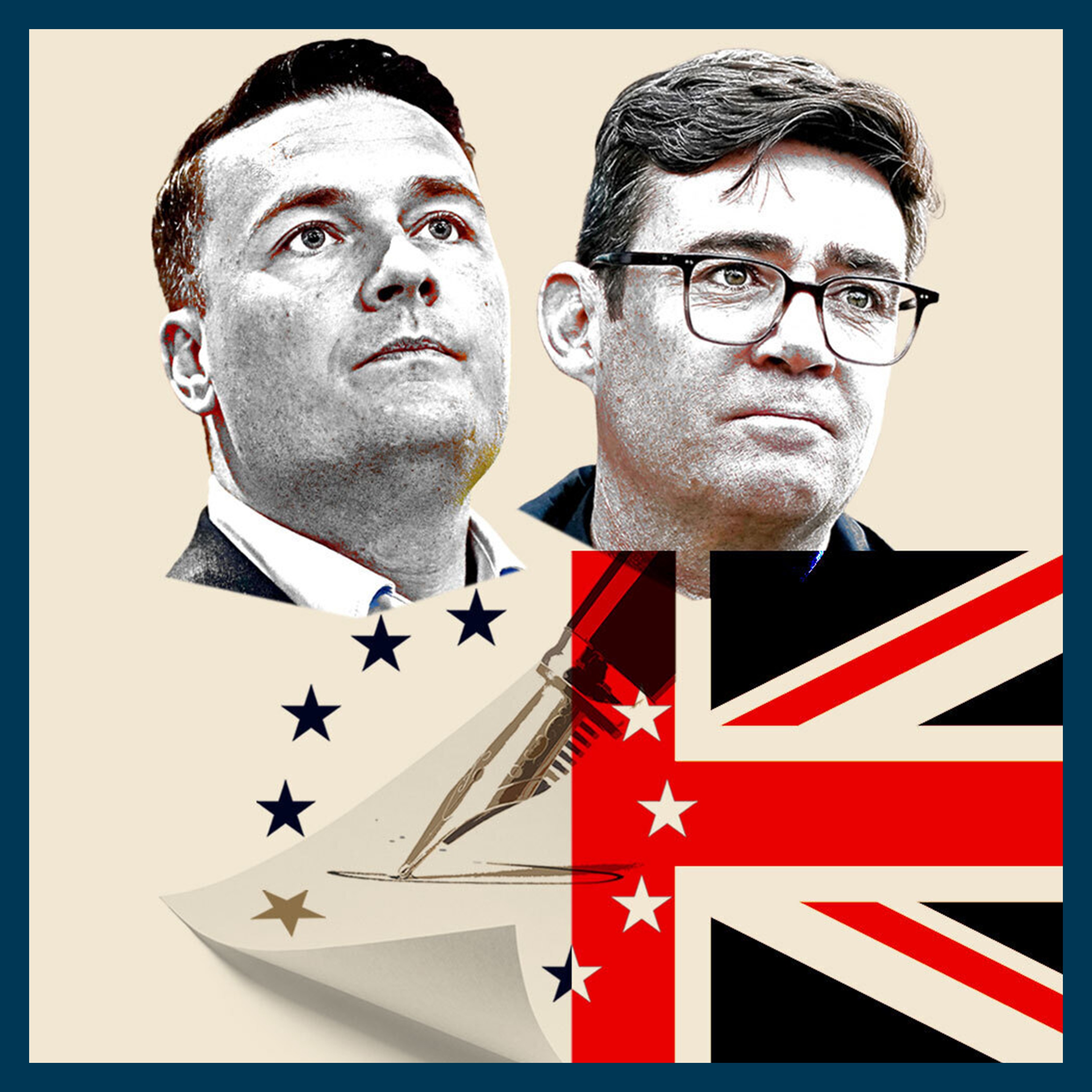
Almost a decade on from that moment when the UK chose to leave the European Union, the battle lines are being drawn in the Labour leadership contest and Brexit is firmly back on the agenda.
- [01:38]
C
Leaving the European Union was a catastrophic mistake.
- [01:45]
E
Wes Streeting set out his stall at the weekend weekend matching the pro Europe rhetoric his main rival, Andy Burnham has become known for.
- [01:55]
C
Long term. I'm going to be honest, I'm going to say it. I hope in my lifetime I see this country rejoin the European Union. I'm absolutely clear about that.
- [02:04]
E
But was Wes Streeting trying to appeal to the pro EU wing of the party or was he queering the pitch for Andy Burnham, who now faces a make or break bar election in May Makerfield, which voted for Brexit and where reform swept ahead in the local elections, suddenly the question of Europe is looming large over the campaign in Greater Manchester.
- [02:30]
C
My view is that Brexit has been damaging. But I also believe the last thing we should do right now is rerun those arguments. I am not proposing that the UK considers rejoining the eu.
- [02:43]
D
I respect the decision that was made
- [02:45]
C
at the referendum and it's going to undermine everything I've said about strengthening democracy
- [02:51]
E
if we don't respect that vote for some Labour MPs. The reopening of this debate is just another reason to Despair.
- [03:00]
C
We are just over a week after we took a real beating in our working class heartlands. We're talking about the Hartlepools, the Grimsbys, Barnsley, places like Wigan, where this by election is going to be. And we were losing to a party which until recently was called the Brexit party. For us to reopen that debate is just staggering. And the Labour Party is in an existential crisis, it really is.
- [03:28]
E
So will Brexit determine the vote in Makerfield? Could it prove to be Burnham's downfall as he plots his route to number 10? And what will it mean for Labour at the next election? The story today, the Brexit walls inside Labor.
- [04:03]
C
It's funny, about 51 of the 52 weeks of the year are dominated by Washington, but I've seem to have found the one week where it's swapped around. Ye, I thought the politics here was getting a bit dull. So. And popping across the pond.
- [04:15]
E
That's Max Kendix, political correspondent for the Times. He's about to swap Westminster for Washington, but in the meantime he's covering the Labour Party psychodrama up close. Anne, what is the mood like in Westminster this morning? I know you've just hurried over from there to speak to us.
- [04:35]
C
Yeah, I mean I was just walking around the lobby this morning. Them peas. I mean it is, it is a bit calmer than last week week which was absolute chaos and things changing by the minute. We are now in a holding pattern before the by election in Makerfield in about a month's time. It's quite curious because there are people who are being recruited. I bumped into someone this morning saying, you know, I've joined Streeting's campaign even though of course there is no formal campaign and that campaign hasn't been launched and won't be until after the by election and at that point we don't know if it will be properly either. But clearly there is a lot of organization going on behind the scenes, various people trying to join various campaigns. But really we are all waiting for the result of this huge moment. The sort of most significant by election in British political history, I think.
- [05:26]
E
Well, tell us about that. How have we got here after last week when we were doing emergency podcasts with a breathless regularity? Just remind us, how have we ended up with Andy Burnham now looking at a political comeback in Westminster?
- [05:42]
C
Well, he was always looking for a political comeback in Westminster and we went through this cycle earlier this year when he applied to be the Labour candidate in Gorton and Denton and he was rejected at that point and so he went back to being mayor. But since then, Keir Starmer's position has only become a lot more precarious. And for months, Andy Burnham and his team, especially Lucy Powell, who's his closest parliamentary ally, who's the deputy leader of the Labour Party, she said they've been looking for a seat for him. They've been looking all around Greater Manchester. The various MPs who were approached, various people said no. And then eventually, in the last moments, Josh Simons, the MP for Makerfield, an old once upon a time a big Starmer it or considered such, who's grown to loathe Keir Starmer and his leadership of the Labour Party, and who has appreciated Andy Burnham's mayoralty in Greater Manchester. He turned around and said, I'll give up my seat. We don't know what the quid pro quo was there, if anything, but that was announced on Thursday afternoon.
- [06:50]
E
Bit of a surprise when the news broke.
- [06:52]
C
Yeah, well, I'd been hearing it for the previous probably 12, 16 hours. It's always very difficult with these things, you know, from a reporting perspective, because so many names were going around. And it's particularly funny with him because we knew as a fact that he had said no at some point earlier on in the week. Something changed after that point. We're not sure exactly what, but he decided that he will go ahead and give up his seat for Andy, and very explicitly so.
- [07:21]
E
And Josh Simons, as you say, had turned against Keir Starmer after being called out, really, having lost his position as a junior minister because of his involvement with Labour. Together, a great scandal that broke that does leave a seat open a by election. In the offing. Towards the end of last week, we did have Wes Streeting stepping down from Cabinet, stepping down from his role as Health Secretary and becoming the first to sort of kind of throw his hat in the ring about a potential leadership contest. He did say at the time he wanted it to be a big contest, which seemed to be a hint at Andy Burnham being allowed to stand. How does he feel about that now?
- [08:03]
C
He's been very explicit about wanting Andy Burnham to be allowed to stand in Maker Field and he is going to campaign there and he says he wants Andy Burnham to win in Makefield as well. It was clear at the point that Wes Treating resigned as Health Secretary, that he wasn't going to immediately launch a leadership contest. There are various theories for this. His team will explicitly say, and his allies, that they did have the numbers by which they mean the 81 Labour MPs you need to trigger a leadership contest. Others close to number 10 argue that he never did have those 81 and that is why he has decided not to launch a bid.
- [08:41]
D
Because.
- [08:42]
C
But I mean, there is a truth in the Streeting ally camp when they say that any contest which would have been triggered by Streeting that didn't involve Andy Burnham in some form or that didn't allow Andy Burnham the opportunity to come back into Parliament would be seen as illegitimate by a big chunk of the Labour membership, among whom Andy Burnham is one of the most popular politicians, the most popular Labour politician in the country. So not having him in a contest would be seen as sort of wrong. It would cause more instability. If Prime Minister Streeting came into number 10, he would have the same problem of the King of the north trying to come back and take over eventually.
- [09:24]
E
So Max, on the one hand, that will seem very magnanimous. This is Wes Streeting wanting Andy Burnham to be part of the contest, even saying he'll go and campaign for him in Makerfield. On the other hand, there are many people in Westminster on Monday morning who are seeing Wes treating as almost scuppering Andy Burnham's chances by talking about Brexit. Tell us about that.
- [09:49]
C
There's a certain irony here. So Andy Burnham spent several Labour conferences talking in fringe events disrupting the news agenda being set by Keir Starmer by saying that he wanted to rejoin the European Union and saying it explicitly. And everyone was thrown into a frenzy by Andy Burnham saying something like that. And that's certainly what happened just in September. And now at the point that Andy Burnham is standing in a seat which voted overwhelmingly to leave the European Union 10 years ago. that point West Streeting does a sort of reverse UNO card and he says, well, I want to rejoin the eu. And he says that very explicitly in pre prepared remarks that he made on Saturday at the Progress Conference. We need a new special relationship with the EU because Britain's future allies with Europe and one day, one day back in the European Union. Clearly this has been interpreted by some of those very close to Andy Burnham who I've spoken to who say this is being done as a move of desperation by West Streeting to try and shift the debate onto Europe so that Andy Burnham has to talk about it. And clearly he doesn't want to talk about it because the constituents of Makerfield don't very much like talking about rejoining the EU either. Of course, West Treatings people come back and say, hang on, you've always thought this, what's the problem? With us saying it now.
- [11:19]
E
And Andy Burnham has talked about rejoining in the past, but he is being more circumspect now, saying he would respect the results of the last referendum. Starmer, meanwhile, keeps trying to relaunch his leadership with a Brexit reset plan, a sort of third way. Not in, not out, just resetting relations. And Wes Streeting has explicitly said he'd like to rejoin. In a way, this is the big debate facing Labour at the next election. So just remind us, where exactly does Labour currently stand on Europe?
- [11:56]
C
Yeah, so it said in the Labour manifesto very explicitly there were red lines about Labour in Europe. They wouldn't be in the customs union, they wouldn't be in the single market, but they wanted closer alignment to the European Union. And that's something that Keir Starmer's been leaning more and more on in the last year or so, as he tries to unsuccessfully, it must be said, to rally progressive voters around him and the Labour Party. But obviously when you have those red lines, the movement is quite limited. The European Union will only accept so much. If you're saying that you will not enter into any kind of customs union or single market arrangement. And it's been an argument within Cabinet about how do you move on this debate around Europe. Do you put into the next labor manifesto Maybe not rejoining, but do you put the single market in the next Labour manifest? You do put the customs union in there. It's seen by some and Wes Streeting has always been in this camp. David Lammy is someone else. That much closer relationship with Europe, closer than the current Labour manifesto allows, is the way forward for Labor. They see this as a huge, biggest trading partner and this is the way to get the economy growing. But of course, within the constraints of the Labour manifesto of 2024, that won't be possible. These are the battle lines of the next general election. And it looks like the two most likely candidates to become the next Prime Minister, who will probably lead Labour into the next general election, are both in the position that eventually they want Britain to rejoin the European Union. So we could end up with quite an extraordinary debate around the EU just 10 years after leaving.
- [13:36]
E
Some Labour backed benches have been pointing out that's a tough manifesto pledge in some parts of the north where they did vote leave and where reform are making huge inroads. You know, formerly the Brexit party. If Brexit does cost Andy Burnham this by election, if he doesn't win, Talk us through what happens next. Are there other candidates lining up to throw their Hats in the ring. If Andy Burnham doesn't come in, are the camps already forming around different people?
- [14:05]
C
I would just say on Brexit costing Burnham the by election, it's slightly more nuanced than that. So if you ask a lot of people in Makefield, there might even be a majority who say that actually nothing good has come of Britain leaving the European Union. They're upset with how the elites have managed Brexit. What they. I don't like is some politicians saying that they want to rejoin the eu. Not necessarily because they're saying that, but because it shows something about politics. They think, clearly Westminster hasn't listened to the last sort of 15 years of political debate and they're trying to bring back these wars and clearly they just need to move on, which was a successful argument that Boris Johnson made a few years ago. And if it does cost him the by election, it's more likely to be on the point that Farage is going to Hammerholm and every doorstep in Makerfield, which is he's calling him Open Borders Burnham. This is a new kind of Trumpesque nickname that he's developed for the Greater Manchester mayor. He will tie it very much not to Brexit, but to freedom of movement and the idea of 500 million people coming into the country because the single market has been opened up and Schengen has been opened up, because that's what Burnham wants. Now, if he does lose, all bets are off. Who stands at that point is up in the air. Obviously, one of the big points to know at that point is, has Starmus already set out a timetable for his departure? I think it's likely that he won't do that before that by election, but he is considering doing it later on, possibly at the Labour conference in September, if he lasts that long. So the contest at that point will depend on what Starmer has said about his future position.
- [15:44]
E
And that's what he's sort of hinted to the Times now. But is there a world where, if Andy Burnham doesn't win that by election, Starmer is running in the leadership contest as well? He is a candidate.
- [15:54]
C
Yeah, absolutely. And you could get this almighty mess where you have. So Andy Burnham isn't in Parliament, but say he loses narrowly, you have an argument from the soft left that actually you can tell that the arguments that Andy Burnham was making cut through. So we need to carry on with that argument, even if he didn't quite get across the line. And you'd see people like Angela Rayner, possibly Ed Miliband, Lucy Powell, one of those candidates will come through and be the kind of soft left candidate in the party. On the other side of the party you'd have Wes treating very clearly. He's now said that he wants to stand in leadership contest. You'd have those two, you might have other candidates. Al Khan says he wants to stand if there's a leadership contest and obviously Keir Starmer and he may well fight a leadership election. Most of the cabinet don't want him to and they will tell him that. But there are a group of people around him, a very small group of people, you know, known within government as the bitter enders, who will stay there.
- [17:02]
E
Coming up. That's the politics. But what about the numbers? We crunch through the electoral calculus of Makerfield, the Labour leadership and relitigating Brexit with a polling expert, Joe Twyman. That's in just a moment.
- [17:24]
A
At Brookfield we believe you can own wealth that's measured in generations. For 125 years. We've built long term wealth through expertise, discipline and a clear vision for the future, providing investors access to alternative strategies built for what's Next Brookfield Own what's Next learn more@brookfield.com this is not an offer to sell or investment advice. Investing involves risks, including loss of capital. Past performance is not indicative nor a guarantee of future results. Please review performance and offering materials before investing.
- [17:56]
F
School's almost out and at Abercrombie Kids new warm weather staples are in. It's a one stop shop for everything on their checklist like tees, shorts and swim. So planning what they'll wear is a breeze. For outfits that keep up with them and easier mornings for you, stop by Abercrombie Kids Shop in the app, online and in stores.
- [18:24]
B
We've all heard those scary IRS radio ads that try to frighten you into calling. But Tax Relief Advocates is different. If you owe the IRS 5,000 50,000 or even $500,000 10,000, TRA has a solution for your tax problem. It doesn't matter if you're in your car or at work or with your kids. No matter where you are, visit tra.com don't lose hope. TRA could reduce or even eliminate what you owe. Their passion is taxes and helping people and businesses fix IRS problems. They have over a thousand five star Google reviews and an A rating with the Better Business Bureau. You no longer need to fear the irs. Generous tax relief programs are available now to give you a fresh start. So don't wait. Simply visit tra.com that's tra.com or call 800-583-6428. Once again, that's 800-583-6428. Tax relief advocates real solutions for real people.
- [19:38]
D
I guess the best way to describe Makerfield would be a safe Labour seat. Is it the safest Labour seat? No, but it is a strong Labour performer. It has been in its various incarnations with Labour since 1906.
- [19:52]
E
That's Joe Twyman, co founder and director of the public opinion consultancy Delta Poll.
- [19:59]
D
At the last general election, 45% of people voted for Labour compared to 30% who voted for Reform. So a strong Labour performance, but also quite strong for Reform as well. And that's reflective of the fact that the constituency leans Leave around about it's estimated 2/3 of people voted Leave in the Brexit referendum of 2016.
- [20:23]
E
And Jo, in the recent local elections, we did see a lot of seats that had voted Labour for more than a century suddenly turn. How did Makerfield do?
- [20:31]
D
Makerfield was another place where Reform did extremely well. And so going into the by election, you have a situation where if this were a general election, you would probably be pretty certain it would go to Labour. But by elections are unusual and weird and wonderful in many different ways. And the specifics, the I should say unprecedented specifics of this by election mean that, yes, it is perhaps one for Andy Burnham to win, but that is by no means guaranteed.
- [21:01]
E
So what are his chances?
- [21:03]
D
It's very difficult to say because what we don't have is specific polling in Makerfield, at least not yet. And any polling that is done is extremely difficult to do at a constituency level. So there's always going to be a big margin of error around that. What we do know is that Reform did perform very well in the local elections and that Andy Burnham will inevitably have to act outperform Labour if he is to win. But given his personal profile in that specific area, that is certainly possible. What will be particularly interesting is the strategy that it has adopted for the by election. Because of course, in Denton and Gorton, the recent by election that Greens won and Reform campaigned very hard for their campaign was get Starmer out. Those were the three words that were repeated time and again throughout the campaign. You could argue, even if Andy Burnham perhaps does not do this explicitly, that if you want to get Starmer out sooner, a vote for Andy Burnham in Makerfield may be the thing to deliver that.
- [22:04]
E
And Jo, you mentioned that when it came to the Brexit referendum, this was an area that voted overwhelmingly for Leave. How much Is that still a factor in decision making when it comes to votes?
- [22:16]
D
Well, it's been nearly 10 years since the Brexit referendum and the country remains extremely divided over the issue. Not so much with regards to Britain's European relations and the relationship that the United Kingdom has with the European Union. Instead, it's about what Brexit represents. Dissatisfaction, distrust and disapproval of the political class, of the political system, of the political parties, a dissatisfaction with the change that was promised that hasn't arrived, the benefits that haven't been delivered, et cetera, et cetera. And so it does.
- [22:51]
E
It's a continued feeling of being left
- [22:53]
D
behind and it does still play an important role for many people. People are likely to identify with either a leave or remain position than they are with a particular political party.
- [23:05]
E
So that is still a bonus for reform in the area. How much is talking about a relationship with the EU a good strategy for Labour at large? And for Wes Streeting, who's obviously mentioned it over the weekend, For Wes Streeting,
- [23:20]
D
I think bringing it to the fore, shall we say, is a strategically interesting position, certainly. But it was inevitable that Andy Burnham would be asked at some stage during the campaign what his position was. And so it just so, just so happened to have been. Now, Labour has tried for a long time to be very quiet on the issue of Brexit, and in a sense, Brexit is a reflection of the wider story that we saw in the local elections last couple of weeks. We have seen Labour lose to reform on the right, to Greens on the left, but also to the Conservatives and to the Liberal Democrats and other parties as well. They have a very difficult position to find any kind of ideological stance or policy platform that will appeal to all of these sides. So instead they have to focus on delivery. But part of the problem they have is that, as they would say, that delivery is scuppered by Brexit. But they don't want to talk about Brexit. I think if a new leader is to come in, then it would be inevitable that that will have to come back to part of the discussion, because simply adopting the position that Keir Starmer's government has adopted of we want closer ties, but not that close ties, we want some of the rules, we want some of the Customs Unions, etc. Etc. That is a position that attempts to strike an easy balance between the two, but in actual fact ends pleasing nobody, because it's not nearly enough for those people who want to rejoin, and it's too much for those people who want to leave and want to stay left. And so exactly how Labour approaches Brexit is still very, very unclear. But it wouldn't surprise me, given that 75% of people who voted Labour at the last election favor rejoining, at least in principle. It wouldn't surprise me if the leadership, candid, actually make that an element of their campaigns, not just, again, because of Britain's relationship with the European Union, but because of what that says about the type of country and the type of person they wish to project.
- [25:41]
E
And if the candidate does pitch this, and if they do win, I mean, is that a winning strategy for Labour at the next election? You know, as you pointed out, for Keir Starmer, it was one of the things that often stunted his ability to deliver, and not wanting to talk about it didn't help. People also accused him of not having a vision, you know, that fill a bit of the vision gap. You know, is that a winning ticket?
- [26:04]
D
I think it's a really good way of setting out your stall. It firstly gives a defined goal, it sends a message about the type of person that you are and the type of country you want Britain to be. Now, people may disagree with that or they may agree, but at least you are saying something and it gives you something to be associated with. As for what success it will have, that's very, very difficult to say because. Because we don't know, of course, what rejoining would look like, how that would go about. Would you hold another referendum? Would you say, oh, we're just going to negotiate a return, or whatever? It's very, very unclear. And we also don't know the degree to which reform will be able to capitalise on this, because although people, when asked in surveys and in discussions, etc, etc, will say I'm leave or I'm remain, doesn't necessarily mean it's the most important argument or issue for them. Increasingly, we see that people are more concerned by a whole host of other issues. Now, people in labor and people in reform would argue that a lot of these issues, be it immigration, the economy, the cost of living, education, NHS crime, et cetera, et cetera, many people on both sides would argue they are intrinsically linked to Britain's status with Europe and Britain's relationship with Europe, you can't just just remove it entirely. But I do wonder whether a new Labour leader who's able to turn things around on perceptions of delivery, could then sell the idea of a positive change in terms of some form of rejoining. But it would be an enormous gamble to make.
- [27:49]
E
And in terms of the leadership, all of this is assuming there is a new Labour leader, where are Keir Starmers poll ratings at the moment?
- [27:58]
D
Well, for some pollsters, Keir Starmer has the lowest rating of any Prime Minister historically, and given the many Prime Ministers we've had of late and how some of those have performed, it really is an interesting. Less than Liz Truss, if that is possible to imagine. Yes, lower in the ratings than Liz Truss, but a lot of that is Liz Truss lasting such a short period of time, whereas Keir Starmer has more time for his unpopularity to bed in. But more seriously, Keir Starmer is doing extreme, extremely badly in the polls and has been for some time. In terms of the leadership challenges. However, it's far more complicated because you can, and we do ask questions about who you think would be the best person to lead the Labour Party. How would you vote if this person were leading the Labour Party? Is this particular person good or bad? Be you positive or negative towards them? Lots of different questions you can ask, but actually, the only logical conclusion to draw at the moment at least, is that the average person in the street and the 50% of people less engaged than the average person in the street simply do not know very much about any of those candidates. And in a sense, that's a good thing. You can view that as an opportunity, a blank piece of paper onto which you can project your thoughts, your ideas, your policy positions, et cetera, et cetera. We know what Wes Streeting's position is on Brexit, but what's Wes Streeting's position on the economy, on crime, on immigration, bringing down inflation, et cetera, et cetera? We don't know that for any of the candidates. As time goes on, we may find these things out, but it may very well be that the more people learn about these candidates, the less they actually like them. In the end, what they don't have is particularly strong views from people either way. The only exception to that is Andy Burnham in Manchester and the surrounding area, where he is well known, where he does have a personal brand.
- [29:53]
E
Yeah. Does he have wider recognition? You know, does he have enough of a profile nationally? Out of the leadership hopefuls, who has the best chance of winning over the country?
- [30:06]
D
Well, there's two separate questions there. Out of the leadership hopefuls, I would say that Andy Burnham is the best known and also the best liked. But a lot of that is a factor of him simply having more people who know about him and having this geographical base in Manchester. So he's in prime position. And as I say, you can interpret these results in different ways, but if you're Andy Burnham, you'd rather be ahead on these figures than behind. And so regardless of exactly how more there is to learn about him, he is in a good position. But whether he can actually turn the country around or not, that's very difficult. As I said, the ideological challenge that Labour faces, they're losing people on the left, on the right and in all sorts of different directions. And there is no obvious policy platform that would suddenly appeal to all of these sides. Instead, I think the focus has to be on perceptions of delivery. In other words, you have to work on the assumption that people out there will be less concerned about how we achieve economic growth, how we bring down the cost of living, how we improve the nhs, how we improve our skills. Unless you hope that people are less concerned about how we do it and simply perceive the fact that it is done. If a new leader can do a better job of changing people's perceptions that things are being done correctly and that the country is moving in the right direction, that things are improving, I think that could place Labour in a much better position than they are in at the moment. Simply adopting a particular series of policies is no guarantee of success at all. Ultimately, a policy platform, be it for Labour leadership or the general election, is a lot like a set menu in a restaurant. You. You look at the individual dishes. You might like some, you might not like others, but you have to either accept it or not. But ultimately, if the restaurant is on fire, you're probably going to eat elsewhere.
- [32:32]
E
That was Joe Twyman, founder and director of Delta Pole. And before that, you heard from Max Kendix, political correspondent at the Times. The episode today was produced by Julia Webster and Harry Stock. The executive producer was Tim Walklade. Sound design and theme composition were by Malicetto. If you have any thoughts on this or any other episode, do drop us a line to the story@thetimes.com thanks for listening. We'll be back tomorrow.
- [33:32]
A
At Brookfield, we believe you can own wealth that's measured in generations. For 125 years, we've built long term wealth through expertise, discipline and a clear vision for the future, providing investors access to alternative strategies built for what's Next Brookfield Own what's next. Learn more@brookfield.com this is not an offer to sell or investment advice. Investing involves risks, including loss of capital. Past performance is not indicative nor a guarantee of future results. Please review performance and offering materials before investing.
- [34:03]
F
School's almost out and at Abercrombie Kids New warm weather staples are in. It's a one stop shop for everything on their checklist like tees, shorts and swim, so planning what they'll wear is a breeze. For outfits that keep up with them and easier mornings for you, stop by Abercrombie Kids shop in the app, online and in stores.