Loading summary
Transcript26 lines
- [00:00]
A
Hi, I'm Katie Prescott from the Times Tech Podcast. For two weeks each summer, Wimbledon becomes one of the biggest sporting events in the world. But behind every match is a vast operation of data, digital tools and live fan updates. In a special episode recorded the week before the championships, in paid partnership with IBM, I look at the technology behind the championships and how AI and data are helping fans follow the action and real time. Listen to the Times Tech Podcast wherever you get your podcasts. This episode of the story is sponsored by PwC.
- [00:38]
B
Technology doesn't wait, and neither should you. Staying competitive means getting ahead, not just keeping up. PwC takes you further with tech. From optimizing the systems that put your data to work to scaling AI from proof of concept to a competitive edge,
- [00:54]
A
PwC helps you meet tomorrow's tech demands so you can compete at a speed
- [00:59]
B
that rewrites the rules. Discover more at pwc.co.uk.
- [01:15]
C
Hello, I'm Harry Stott, a senior producer on the story. The Reform UK donation saga is rumbling on with yet more revelations from the Sunday Times Insight team coming out today after our podcast series Posh George broke the story that convicted fraudster George Cottrell secretly bankrolled Nigel Farage. The team have now revealed that Cottrell's mother, the aristocrat Fiona Cottrell, is being investigated by the Met over at least £500,000 of donations. For all the latest on that, we're handing over to our colleague Aisha Hazarika on Times Radio.
- [01:59]
B
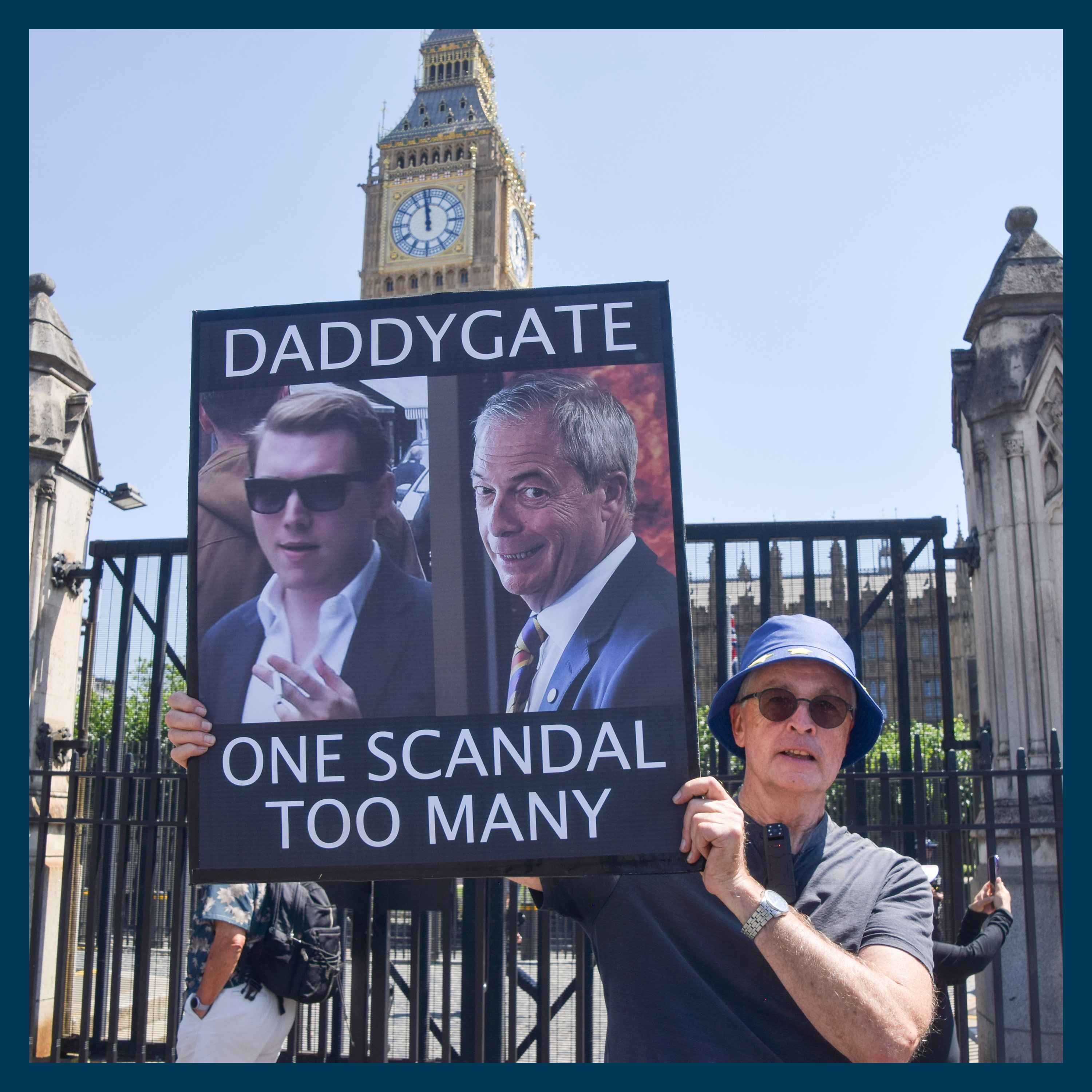
Well, let's start with that story about donations and the finances of Reform UK continue to be under the spotlight today and the Times newspaper reveals that police are investigating a 500,000 pound donation made by a woman called Fiona Cottrell. She is the mother of George Cotre and he is the convicted fraudster and person very close to Nigel Farage. He is the person who's so close to Natural Fares, it's alleged that he would call Nigel Farage daddy. Yep. And the Times reports allegations that Fiona Cottrell made two separate donations to the party before the general election in 2024. Now, the investigation was led by Gabriel Pogrand, brilliant journalist, insight editor for the Times.
- [02:47]
D
We understand that the Electoral Commission examined the SU that seems in particular two installments of £250,000 received before that 2024 election in which Farage, on the eighth time of asking, was finally elected to the House of Commons. And the particular piece of the statute that they're examining relates to situations where the ultimate source of a donation has been disguised in order to permit an impermissible donor from depositing funds into the coffers of the political party or where false statements have been made about a donation to a.
- [03:24]
B
Now, the deputy leader of Reform uk, Richard Tice, spoke with Times Radio this morning. He told Callum that he believed it was a politically motivated smear campaign and that people will see it for what it is.
- [03:36]
D
It was donated to the company by Fiona Cottrell and that is. That is that she's a permissible donor and that's the end of it. A very successful aristocratic family, and this is a politically. This is a politically motivated smear campaign. We've heard that point people who wish us ill and that's the beginning and end of it and people can see it for what it is.
- [04:00]
B
I suppose my question to you guys at home listening is, what do you think about it? And I mean, do you buy that this is just all a politically motivated smear? Given that the Sunday Times and Gabriel Pogrand and other journalists have been pretty vociferous going after the Labour Party in terms of the Keir Starmer freebies. Gabriel Pogrund also was looking into Tulip Siddiq as well in terms of her housing arrangements, Looking into other Labour figures as well, of course, did a lot of, you know, the Times and the Sunday Times team, along with many other journalists, did lots of work into Peter Mandelson. Do you think this is the media unfairly singling out reform and that reform are victims of the press? And also, do you think that Nigel Farage will actually go ahead with this by election? Should he go ahead with this by election? He said that he wants this by election to present the opportunity to have a serious debate about serious issues. But if it is just him with Count Benface, and as much as we love John Harvey, he's a regular on my show, as you well know, and he's a regular sort of presenter in Times Radio. You know, he's a brilliant satirist. Is that. Is that going to work out for. For Nigel Farage? I mean, this investigation will still continue after this by election that we now hear is going to be, I think it's the 12th or 13th August. Do you think he'll actually go through with it and do you think he should go through with it? Would it be less embarrassing for him to just pull out now, or should he see it through and will he have the last laugh? Because if he wins significantly in Clacton and there's another by election after that, he may well win that. And also Is he gonna have a hustings with like Count Binface? Is it going to be like a Question Time Clacton special with just him and Count Bin face? I mean, is that going to serve him well? And do you think this is all just making our British politics look even more ludicrous than. I mean, we're already on, we're about to have our seventh prime minister in 10 years and now we've got a by election with basically a man who doesn't need to call a by election now and a man dressed up as a bin. I mean, honestly, I know it's funny and I. It's all very haha. But isn't it also just like, isn't our politics just all becoming a bit ridiculous? Now let's have a look at the link between politics and money. And we've got a great guest, Peter Geoghegan, who's an investigative journalist. He's the author of the Sunday Times best selling book Democracy for Dark Money and Dirty Politics. And he also writes the substack called Democracy for Sale. Peter, welcome to the show. Thanks for joining us.
- [06:39]
D
Thank you very much for having me.
- [06:40]
B
So look, what do you make of where this story is going? I mean there's quite a few different strands to it, but what's your take on it?
- [06:48]
D
Yeah, I think, and I think you did a good job there is of picking some of them apart. You know, what we are seeing is effectively more and more details coming about about reforms, funding and about funding that we didn't know about. The first bit is this 5 million pound gift from Christopher Harborne which Nigel Farage says was a personal gift and nothing to do with politics. But you're bearing in mind this came from someone who'd given over £10 million to Nigel Farage's Brexit party previously and then went on to fund reforms. I think that's quite a tricky line for reform to stand on. But secondly, I think almost in some ways more concerning the stories coming out of Sunday Times, as you mentioned, about these donations from George Cottrell's mother. George Cattrell, the convicted, convicted fraudster, his mother has given quite a bit of money to reform. Questions have been asked about the progeny of some of those fundings. But what we're now seeing is money going to Richard Tice's company that then went to reform. Richard Tice says nothing was done here is no problem, she's a permissible donor. If that's the case, why does she not donate directly to the political party? Because we did not know this money had come from George Cattrell's mother because it went to Richard Tice's company and then was basically used as a pass through. That's not how transparency is supposed to work. And it does beg, I think, a lot of big questions about the funding of reform. Like I've reported on just how dependent reform is on a very small number of donors. These figures might have changed recently, but I did a story on Democracy for Sale a few months ago about how three quarters of all the money, reform and the Brexit Party ever got to come from just three people, including Tyson Harborne. So this, this is a party that's got a handful of donors and these are serious questions about these donors. We've also seen, Andrew, you know, the other question of underscores all of this is have these donors changed party policy? It's very striking that one of the things that reform, it's not a political party, but a huge number of detailed policies. One of the few areas that they have detailed policies in is cryptocurrency. A huge chunk of reform's money has come from crypto donors. Andrew Bailey, the governor of the bank of England, this week actually, basically Casey came out and said how Nigel Farage had lobbied him around cryptocurrency. He said it didn't change his mind. But that begs a big question. If you're going to go to meet the head of the bank of England and your leader, the Reform Party, why aren't you asking about inflation, the cost of living, trade policies? Why are you asking about cryptocurrency?
- [09:01]
B
And look, in terms of money and politics, it is always a contentious issue and the transparency is really important, isn't it? Do you think that the idea of transparency is going to survive in, in British politics? Because it does feel like people are finding ways of circumventing it?
- [09:22]
D
Well, this is a big problem, I think, and you're completely right, you're hitting the nail on the head. Like this idea, we have conflicts of interest and frankly, so long as we have run a politics that runs on private money, whether that's from trade unions or individual donors, we will have conflicts of interest because parties have to raise money. So they go to these people to try and raise money. And the people with the deepest pockets are the ones who get the most access because they're the ones who have the most money. What you're seeing with this is basically the transparency measures that we have, which I've reported on this issue for almost a decade. You know, I report constantly on transparency failures. And so what we are seeing is almost the epitome of this. This is just showing just the gaping holes that we can have in our, in transparency. It's kind of, it's, it's kind of incredible timing. This is happening right now. So there is an elections bill through Parliament. The government under Keira Starmer brought up, brought together elections bill. It's going to have, it's going back to Parliament next week as it happens. And I think the original elections bill is fair to say a lot of people. Transparency experts say this doesn't go far enough. We're not really doing anything about, you know, fundamentally in Britain you can give unlimited amounts of money. Political donors can give as much money as they want, which actually isn't the case in the us. Political donors here in the UK can give as much as they want. As long as we have that system, I think we're going to see issues like this. And so there's a kind of timing here in the government I think as well to say, okay, if you think this is a big problem and clearly they do. Listening to what ministers, senior ministers saying about this, well, why don't we, is there not kind of come time to act on this? We need more transparency. But also arguably does, you know, there's a problem if people can give, you know, 5, 10, 15, 20 million pounds to politics.
- [10:58]
B
And so I think what you've got there is you've got sort of, you've got two issues, you've got the transparency and then you've got the principle about should people be able to give those amounts of money. And I think both are legitimate questions, I suppose why the transparency is so important is that in the absence of being able to reduce the amount of big money that people can give into politics and we have a cost of living crisis. We know the public finances are very tight and actually I'm going to throw this out to people at home. Would you be happy to take out the big money from politics and have you as the taxpayer fund politics so it's state funded politics rather than people trying to raise. But I suppose, Peter, I suppose my kind of challenge question to myself and to you and having these debates is you've got to be realistic. I think it's hard in a public, in a cost of living crisis to say, right, the taxpayer is going to fund all politics and we just sort of stop big donations. I think that is, I mean, I'd quite like to see that, but I think it's quite difficult to sort of do. But the transparency becomes ever more important because then people at least can decide. Look, if. Right. Take for example the Labour Party. The Labour Party, as I said earlier, has got a close association with the trade union movement. When there is a Labour government, there is always legislation in terms of strengthening workers rights and things like that. That's kind of always been the case. And people put it in their manifesto. They can see that the trade unions have donated and that is for people to make their decision. With the Conservative Party they often get a lot of money historically from, you know, developers and the, the construction industry and the building industry. The Conservatives always been quite kind of predisposed to that, that form of business and business in general. Conservatives traditionally have had more money in from. From business. Isn't the reality. You are always going to get some kind of lobbying and some feeling from the leadership of a political party that they do have to give something back to their donors. But if the public can see it, then it is up to the public to decide whether they're comfortable with that.
- [13:01]
D
Yeah, and I think before we answer that, I think it's worth saying as well, I think there's a halfway house as well between fully state funded and the current free for all. You know, you could. One of the reasons we have so much money sloshing around our politics at the moment is that the spending limits in elections were massively increased by the last Conservative government. They're now very, very high. So you can actually spend way more money. So if you can spend more money, you're going to raise more money. There was no real need to do it. No one's gone near hitting these spending limits now, but they've become a stretch target. So political parties are now trying to raise more money to hit these spending limits. And frankly, five years ago we had elections without those spending limits and they were totally fin. So I don't think I'm the only person that's going do we need to have huge spending limits? You know, could we bring that down? Similarly, we only have transparency of spending during the year of a general election. So for four to five years of a general part of a parliamentary term, normally we do transparency spending.
- [13:52]
B
I didn't know that money goes.
- [13:53]
D
No, most people don't. It's pretty crazy. And you and I know we are living in a constant politics now. It's 24 7. The idea that campaigning only happens during a general election is, is for the birds. But we can't see where that money is spent unless there's a general election happening. So there's a lot of things, you know, short of state funding that are going on that I think are, you know, are a real problem when it comes to this. And we've seen, you know, I've tracked this and others have as well, just the extent to which the increase in money is just, is really, really pronounced over the last 15 years. So we've seen this big increase and one of the reasons it's increased so much is because you can give unlimited donations. So again, you know, we had elections 20 years ago, 30 years ago, with just a lot less money and they still run. So there's, you know, I would probably, I could see how you could create a halfway house between that if you didn't want a state fund and because you will end up with this problem of conflicts of interest and because they are inherent if you have, you know, if you have a small number of big donors. We've never done. There's, there's also creative ways to encourage small donors. We just don't really do it in this country like you or I probably, you know, I don't know people who donate to politics who aren't sources of mine. You know, it's not something everyday people do. But there is, there is ways and means to, to encourage small donations, et cetera, et cetera. We've just really, we've. In politics, there's a thing called the 80, 20 rule. 80% of your money are for political fundraisers. 80% of your money comes from 20% of your donors. Reform, I think, is the 99, 1% rule. When it comes to big donors, it's 99% from, from, from 1%. But in general, that's been the direction of travel is more and more big money. And you know, it seems to me that it's not going to be a panacea and we will. Conflicts of interest. That's why transparency is important. That's why the work, I would argue to people, and I do, people like the Sunday Times do, is so important. But you would start to see, you know, where if you took £5 million from a donor, that's just not okay. You know, that becomes a, you know, that becomes a serious red line. Not something that we're having this discussion about. Should you declare it? Should you not declare it?
- [15:48]
B
Well, look, Peter, what an interesting conversation and, you know, I think this is something that we are all going to have to sort of think about a lot more and is this sort of transparency is really important. But thanks so much for your time.
- [16:05]
C
The Sunday Times approached Fiona Cottrell about her donation last month. She refused to comment. George Cottrell's lawyers said his mother's donations were a matter for her. Nigel Farage has denied breaking any parliamentary rules and Christopher Harbin, for his part, has insisted his 5 million pound gift was a purely private gift given out of admiration for Farage's Brexit campaigning. That was the investigative journalist Peter Geoghegan speaking to Ayesha Hazarika. And before that we heard the Reform UK MP Richard Tice and the Sunday Times Insight editor Gabriel Pogrund. You can hear Ayesha every Friday from 1 to 4 on Times Radio. And for more in depth reporting on this story, do listen to our podcast series. Just search for Posh George wherever you get your podcasts. The next episode is out on Monday. The story returns as normal over the weekend where we'll have a two parter looking at the shocking Murdoch murders which rocked a small town in South Carolina, but where big questions remain over who really committed them. We'll see you then.
- [17:14]
A
This episode of the Story is sponsored by PwC.
- [17:17]
B
What does an AI ready workforce actually look like? Breakthrough performance comes from combining human intelligence with machine capability. PwC brings it all together and takes you further with tech, empowering you to move faster, solve more complex challenges and unlock new value.
- [17:35]
A
PwC combines talent strength with tech strategy so you can unite human potential with AI power.
- [17:42]
B
Discover more@pwc.co.uk
- [17:48]
A
hi, I'm Katie Prescott from the Times Tech Podcast. For two weeks each summer, Wimbledon becomes one of the biggest sporting events in the world. But behind every match is a vast operation of data, digital tools and live fan updates. In a special episode recorded the week before the championships in paid partnership with IBM, I look at the technology behind the championships and how AI and data are helping fans follow the action in real time. Listen to the Times Tech Podcast wherever you get your podcasts.