Loading summary
Transcript54 lines
- [00:00]
Luke Jones
Par le tu francais hablas espanol?
- [00:03]
Advertisement Voice
Par le italiano. If you've used Babbel, you would Babbel's conversation based technique teaches you useful words and phrases to get you speaking quickly about the things you actually talk about in the real world. With lessons handcrafted by over 200 language experts and voiced by real native speakers, Babbel is like having a private tutor in your pocket. Start speaking with Babbel today. Get up to 55% off your Babbel subscription right now at babbel.com acast spelled B A B B E L.com acast rules and restrictions may apply.
- [00:40]
Your team just added its 67th AI tool and also your 67th security blind spot. The good news? The Vanta agent works like a GRC engineer in the background, finding every app your team uses, scoring the risk and drafting fixes for you. Vanta is the platform used by over 16,000 fast moving companies like Ramp, Cursor and Harvey, who are shaping the future with AI and staying ahead of AI risk. Get started@vanta.com.
- [01:10]
Luke Jones
From the Times and the Sunday Times, this is the story. I'm Luke Jones. The G7, the world's richest economies, yes, that still includes us, are gathering in France.
- [01:28]
Katherine Philp
The G7 summits, they're not going to win any awards for viewing figures or anything. They're usually they're meant to be quite stiff.
- [01:37]
Luke Jones
Katherine Philp is Times World Affairs Editor.
- [01:40]
Katherine Philp
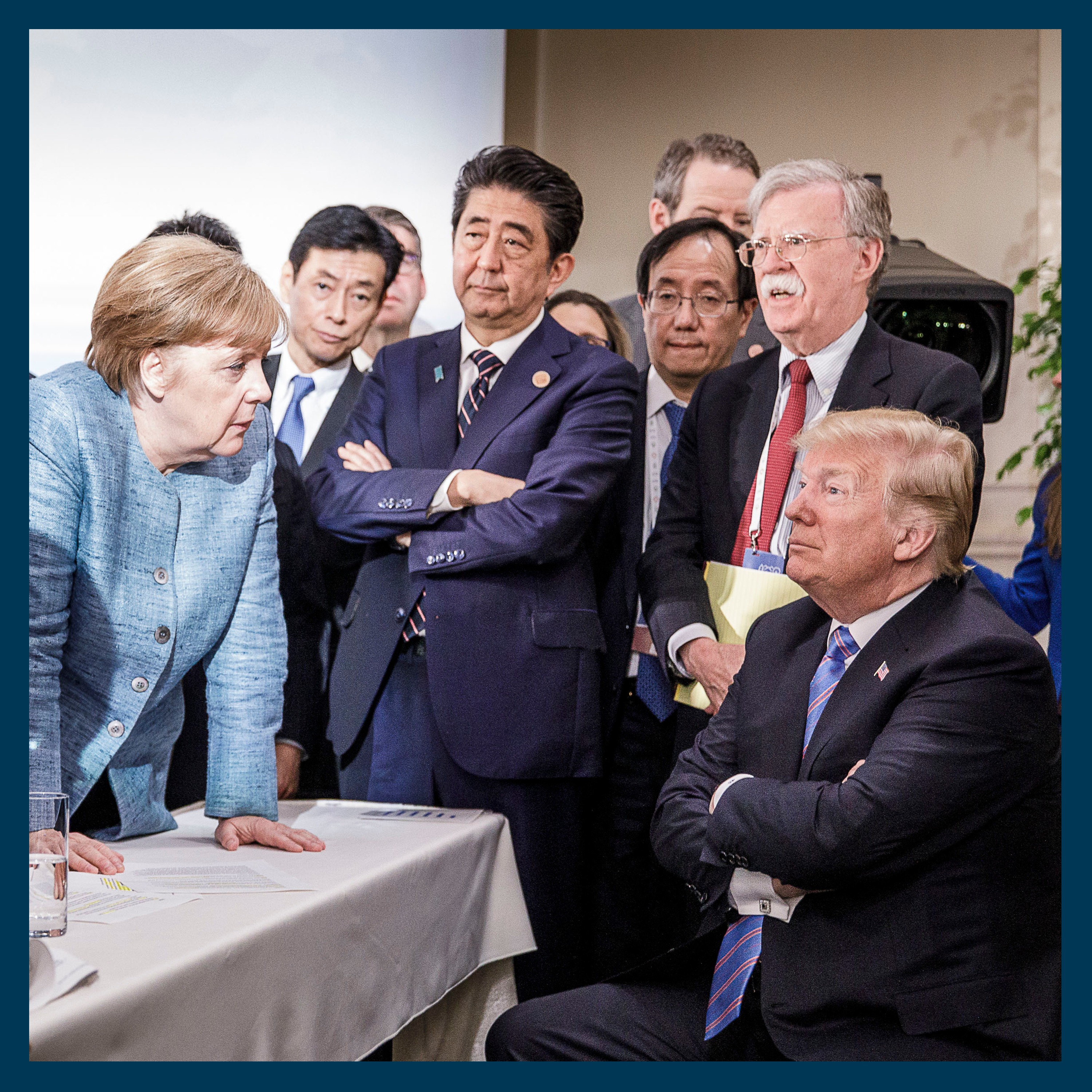
They started to get a bit interesting for all the wrong reasons when Donald Trump showed up to them. And I think people will remember quite a famous picture of him being confronted by Angela Merkel at the 2018 summit. He later walked out of that summit and refused to sign a final communique and he did that again last year. So yeah, certainly unexpected, interesting things have started to happen at this very formal event that only really started when Donald Trump came into the picture.
- [02:10]
Luke Jones
What used to be a group of broadly like minded countries joining this declaration or that communique has in the recent past turned into open argument.
- [02:21]
Advertisement Voice
President Trump has decided the United States will not sign onto a joint communique from the G7 summit, reversing his earlier endorsement.
- [02:29]
Luke Jones
The G7 also tried and failed to get Trump to back down on his opposition to the Paris climate change accord, despite what the German chancellor said were the best efforts of everyone else. Ahead of this latest summit in the town of Evian, Trump has already called the G7's help on the war in Iran irrelevant, with Russia's war in Ukraine and the rise of China also Causing lots of disagreement. It won't just be the spring water that's icy. The story today, the G7 versus Donald Trump. Catherine, remind us exactly what a G7 is and why on earth we have them.
- [04:01]
Katherine Philp
So what we call the G7, what we usually think about when we say the G7 is this summit that happens every year. And the first One happened in 1970 and it was actually a G6. There were only six countries in it. Canada joined a year later and made it the G7, but it was a group of essentially industrialized countries with free markets who had worked together since the end of the Second World War to establish what we kind of think of as the international rules based order, but with particular attention to the economy. The reason this started up in 1975 was that you'd seen a collapse of the Bretton woods system when the US had pegged the dollar to gold before and currencies traded against the dollar, and when the US decoupled the dollar, that happened around the same time as linked to the current, current state of affairs, the oil crisis of 1973. So essentially all these things put the global economy into a massive spirit. And the G7 was supposed to be a forum where they could get together and discuss these things and try and impose some order on a disordered world.
- [05:23]
Luke Jones
Okay. Which I guess is very much the hope for now. Now we've got a different energy shock, if you can call it that, for this G7.
- [05:29]
Katherine Philp
Exactly. Yeah. It's very reminiscent of the original.
- [05:33]
Luke Jones
How exactly does this summit work? Who is involved? What actually can be decided, like with a lot of these kind of summits is a lot of the work just really in the preparation. And this is something of a. Of a public signing.
- [05:47]
Katherine Philp
Yes, that's right. I mean, we'll come to whether it's even a signing in a second. It's a get together for a bunch of pals. And there's a lot who all know each other and those relationships are important. And, you know, I mean, look, Donald Trump is very much about the personalities and his relationships with people in the world. But yeah, it is a club where they all get together. It's meant to foster dialogue on these big issues, obviously, starting with the economy as a springboard, but going into things like security, climate war, pandemics. When we had Covid, that was one of them. This year they'll be talking about artificial intelligence and the challenges that presents to the world now. So it's a place for political discussion and coordination. But it has in the past, certain leaders have attempted to make it more of a power block in the sense that it has imposed sanctions in the past. But the decisions it makes are not legally binding. And as we will discuss, it is harder and harder to get all the countries together to sign up to the same things even without any legal obligation.
- [07:03]
Luke Jones
Well, quite so in terms of this latest annual meeting, it's 52nd, I read. What is the biggest issue facing them, would you say?
- [07:17]
Katherine Philp
So the G7 has a presidency every year one country takes the presidency on a rotating basis and this year is France. And when France issued its agenda for this year's G7 summit, it was in January. And so the, the issue that's really hanging over it most dominantly now hadn't even started the war in the Middle east and with the US on Iran. And the implications that's had for obviously the global economy with the Strait of Hormuz closed. So that has foisted itself to the top of the agenda. It was meant to be essentially about economic imbalances and trade imbalances and global equality. And so, you know, as is often the case, some of the leading countries in what we call the Global south were invited and that was sort of meant to be the agenda. And now of course it has shifted somewhat. And I think that, yeah, that we're going to see the war in Iran on the Strait of Hormuz and the impact that's having on economies with soaring fuel prices and all the knock on effects that is going to be very much part of it. And indeed there is going to be a breakout session on the Middle east conflict because Egypt, Saudi Arabia, Qatar and the United Arab Emirates have been invited to a specific session on that. There will also be a one on Ukraine that's become a sort of annual issue of concern. And the French have said that is to rebuild consensus on support for Ukraine. And I think really what that means is essentially the split that we see between the US and its European allies and Canada on one side, who have perhaps been more strenuous in their continued support of Ukraine.
- [09:26]
Luke Jones
And we see a similar split over Iran as you mentioned. So what is there for this G7 to do, do you think, in actually trying to sort that out or does Donald Trump, with the way he sees the world and where power sits, actually not put a lot of store in these kind of meetings?
- [09:42]
Katherine Philp
No, that's right. And he's actually said that quite explicitly, almost as we are speaking. He's told an Italian journalist that he doesn't need the G7's support for his war in Iran because they've already won it, which I think is a questionable claim, but I don't think the G7 was really going to get behind him in this war anyway. It's not really its role in, in this. And he has actually taken quite a few swipes at allies in general, NATO in particular, about its lack of material support, so not getting involved in the war. So I think what Trump is signaling there is, you know, his irritation that none of the allies have got involved, but also that he doesn't care about such forum anyway. So it is, as he says, irrelevant to what he chooses to do. And in fact, last year he left the G7 summit early. It was in Canada, and he left it because of the then Israel Iran war, which was the 12 day war of last summer. White House Press Secretary Caroline Levitt made the announcement Monday evening saying President Trump is returning to Washington so that he can attend to many important matters. We didn't know at the time that actually one of the reasons for him returning to Washington was that the US Was going to get directly involved itself and bomb the nuclear sites in Iran. But the fact that he did sort of sack it off early, I think, you know, does tell us something about his attitudes to these things. So there was no joint communique at the end of that because he was literally wasn't there to sign it. Now in the past, in 2018, I think he just, just fully refused to sign it.
- [11:32]
Advertisement Voice
President Trump left the summit in Canada on Saturday to head to Singapore, tweeting that he would tell his officials not to endorse the communique because of what he called false statements by Canadian Prime Minister Justin Trudeau and because he said of Canada's massive tariffs on the US
- [11:49]
Katherine Philp
So last year the final communique was put out by Canada in the name of the Canadian presidency. And it appears the French are planning to do something similar this year just to simply avoid the difficulty and the optics of not being united behind one statement.
- [12:06]
Luke Jones
And do you think this is just, you know, as lots of people debate, an aberration in the period of Trump, or do you think this really is signaling an enormous fissure in the Western alliance which might last well beyond Trump, well beyond this G7 meeting, into future, future ones?
- [12:25]
Katherine Philp
I think we just don't know yet what's going to happen with the US Post Trump, like whether it's going to continue in this trajectory because it does seem very bound up with him and his personality. You know, kind of, you can retro engineer an ideology and call it MAGA or something and look at how that's affected the political discourse in the us. But, you know, even the Republican Party are very split over this. You've got people who have broken with Trump over the fact that he's gone to war with Iran. And it's not about America first and it's not isolationist and they're angry about that. So I think it's really too soon to say. For example, in 2021, when Biden came into office, he arrived in the UK for the G7 summit. That was in Cornwall, and his catchphrase was, america's back. The United States is going to do our part. America is back at the table. America is back at the table. And he was there to sort of say, we're getting back in to these alliances and they do mean something to us. And then, of course, the election cycle came around again and Trump came back and promptly pulled back. So it remains to be seen, is this permanent change or is it an operation?
- [13:46]
Luke Jones
But it's interesting, though, isn't it, that even the other Western powers, who are maybe trying to resist Donald Trump's bulldozing of alliances like the G7, don't seem to have their coherent act together necessarily. Are they pulling in different directions still? I mean, at time of recording in the uk, there's this whole argument over whether we're putting enough money into defence when other European nations seem to have got the message on that front. There's not unity even amongst them in opposition to Trump, is there really?
- [14:16]
Katherine Philp
Yeah. I mean, that's an interesting question. I think that one thing that makes this whole defense issue in the UK so, so difficult in some ways to place into that international context is it's really a conversation here about national priorities, and it's very much impacted by the larger. The macroeconomics are the frame for it. So if we don't have this money, you know, how do we spend it? Or do we have this money and we're just not choosing to spend spend it there? I mean, they're just of different orders. If you think about what John Healey resigned over, it's four days worth of the war in Iran. So we are just batting on a completely different scale to the us. I think that there is sort of ideological coherence in the other allies, but it's what we do with what we have. And I think that's the question about what our priorities are nationally and what we bring to the table. For example, you saw in a different forum in Davos earlier this year, you know, Mark Carney gave a very well received speech about what middle powers like ours might do in the world and how we should play on the same field with outsized beasts like the US and China.
- [15:33]
Advertisement Voice
We know the old order is not coming back. We shouldn't mourn it. Nostalgia is not a strategy. But we believe that from the fracture we can build something bigger, better, stronger, more, just. This is the task of the middle powers, the countries that have the most
- [15:53]
Katherine Philp
to lose from a world of fortresses
- [15:55]
Advertisement Voice
and most to gain from genuine cooperation.
- [15:59]
Katherine Philp
So I don't think there's such a division of values amongst the other allies as there seems to be with the US and its other G7 allies. But it doesn't mean that we are all pulling our weight in the ways that we probably need to. And the problem is that the Western alliance is under enormous strain with disagreements like the war in Iran. At the same time you have the growing strength of the a China led bloc and the alliances that it's trying to forge in a kind of rivalry with the Western alliance.
- [16:39]
Luke Jones
What of China then as they make their own alliances and build their own power bases? Are the shifting global tectonic plates making groups like the G7 just irrelevant? We'll have more from Catherine coming up.
- [17:03]
Advertisement Voice
Seeking, Pushing, Optimizing, Creating, Learning, Discovering At Aramco, we believe in harnessing the power of data to push the limits of what's possible. That's how we deliver reliable energy to millions across the world. Aramco, an integrated energy and chemicals company. Learn more about us@aramco.com
- [17:33]
your team just added its 67th AI tool and also your 67th security blind spot. The good news? The Vanta agent works like a GRC engineer in the background finding every app your team uses, scoring the risk and drafting fixes for you. Vanta is the platform used by over 16,000 fast moving companies like Ramp, Cursor and Harvey who are shaping the future with AI and staying ahead of AI risk. Get started@vanta.com High interest debt is one
- [18:01]
of the toughest opponents you'll face unless you power up with a SOFI personal loan. A SOFI personal loan could repackage your bad debt into one low fix rate monthly payment. It's even got super speed since you could get the funds as soon as the same day you sign. Visit sofi.compower to learn more. That's sofi.com p o w E R Loans originated by SOFI bank and a member FDIC. Terms and conditions apply. NMLS 696891. Foreign.
- [18:46]
Luke Jones
We're Talking about, well, the state of the world as the G7 has its summit in Evian in France. You mentioned just a moment ago actually what is happening outside of the G7 and some of the pressures and challenges that those countries are facing, namely China going around and building alliances, bolstering itself as it tries to in the future, hopefully dwarf the United States even on the world stage. What exactly have they been up to which G7 countries might be wary of?
- [19:17]
Katherine Philp
So firstly, let's go back to the origins of the G7 for a second because I think it helps kind of tee things up for where China is now. China was never invited to join, even at a point where it essentially got rich enough to be in the club. Russia was invited to join in 1997. And I mean, that was obviously in a time when Russia was in transition. And I think we all had naive beliefs that it was transitioning towards a European democracy. And then its membership was suspended after the annexation of Crimea. And that was in 2014 when really I think we saw the true nature of the regime in Moscow.
- [20:01]
Advertisement Voice
As I told President Putin yesterday, the referendum in Crimea was a clear violation of Ukrainian constitutions and international law and it will not be recognized by the international community.
- [20:16]
Katherine Philp
China was never invited at any stage to join simply because it didn't really sign up ever to the original principles. Firstly, it kind of directly competes against the world order. So on the same reasons that Russia was kicked out, it wouldn't be invited. Also, it's never been a fully free market economy and it's never shown any transition towards democratic principles. That's where you have the key difference. It is obviously now the second largest economy in the world and it's an economic rival certainly to the US but essentially what it's been doing in that place where it keeps kind of butting up against the US and they have their trade rivalries, is that it's been grow, essentially growing its own block, its own alliances, and reaching out in a much less formal way to countries around the world and essentially getting them on side and getting them essentially in a state of certainly some economic dependence or trading dependence on China so that it isn't kind of blocked out of the global Systems that the G7 is sitting atop of. It's got its own relationships and doesn't need to worry perhaps quite so much about someone else setting the rules, I
- [21:39]
Luke Jones
guess, because it would be in a variety of their friends, economic interests to continue to support China if, say, you owe China a lot of money or, you know, they have helped pay for Some fabulous new piece of infrastructure where you are.
- [21:54]
Katherine Philp
That's correct. And that's. That has been the Chinese modus operandi. With lots of less developed countries. They've either given or loaned money or. Or started a project that is then built by Chinese engineers. And then those countries are enmeshed in their economic systems and trading. And indeed, in some cases, they owe Beijing a lot of money. And so they're really kind of locked into that relationship.
- [22:19]
Luke Jones
Are these alliances or whatever they are that China is striking, are they more economic and what are they doing on the military side?
- [22:32]
Katherine Philp
Yeah, they're both of those things. I mean, what they don't do is China doesn't sign a military alliance. There's no document quite like NATO or even a mutual defense pact, as some countries have with each other. It's sort of how shaping this coalition of countries through security and military cooperation. So, for example, they'll do joint military exercises, so their militaries are au fait with one another, and they'll sell weapons to those countries. And then this is. Obviously, the west does exactly the same. We have American weapons systems that tie us into that system. China does the same on its side.
- [23:20]
Luke Jones
And what does China see as its goal in all of this in terms of if it does increasingly get its hands on a steering wheel of the world, how does their view of how the world should be operating and how international cooperation might work differ from what the G7 is pushing for?
- [23:38]
Katherine Philp
Well, China would like to operate by its own rules, not by rules that have been written for it by a group of other countries that are governed by very different principles, such as democracy. It doesn't mean that they can't essentially try and get their way through institutions that already exist. I mean, you'll have heard Trump fulminating about how China should never have been allowed into the World Trade Organization and that that gave it too much influence in the world and, you know, made it a competitor. China has also has a kind of strategy where it systematically goes around getting the support of small nations because everyone's vote is equal in the UN General Assembly. If everyone's voting to appoint the head of a particular agency in the un, Fiji's vote is the same as the US Vote. And so if you, for example, if you do some kind of deal with the Solomon Islands or Fiji, then that's just as valuable in that particular forum as anyone else's vote. So you see China making a lot of those relationships. It's partly about legitimacy. So, for example, there's the one China policy under which most countries don't recognize Taiwan as an independent country. And they say there's only one Chinese government and that is the one in Beijing. Most countries do adhere to that. Certain countries who hadn't essentially made that leap or that decision or indeed were already backing Taiwan, China has peeled them away. And so it's sort of got their vote in its box.
- [25:22]
Luke Jones
And do you think that the G7 is on top of this problem as they would see it and are working effectively to try and counter that and protect their own values that they're trying to protect around the world, their own control, as they would hope, of the world?
- [25:38]
Katherine Philp
I think it's very difficult because of this fact that it is a forum. I mean, it sort of attempts to function like steering committee, but there's nothing that binds anyone to these rules. I mean, we're talking in a time where we feel like the existing international law is under assault and people are simply acting the way that they want. So for something that has even less force behind it, the G7, a policy making machine, no, it is very vulnerable to the kind of shocks that come about with something like the Trump presidency. But there's also, let's not forget, the world is changed a lot since 1975 when this first came into being. And the G7 then accounted for about 70% of GDP. It's much less now. It's well under 50%, just in pure dollar terms. And I think if you take it down to purchasing power parity, it's under 30%. It's also got less people because we're aging in our part of the world. So it's gone from 15% of the world's population to under 10% now. So in that sense, you know, you can argue that whether it's our shrinking or the growth of the rest of the world, we're simply less wealthy, dominant and important, a bloc as before.
- [26:58]
Luke Jones
And if I was listening to this in Argentina or in India or in, you know, other parts of maybe the global south, you'd say, well, that's a good thing.
- [27:08]
Katherine Philp
Absolutely you would, because it would mean that your economy had grown and it would mean that you were a bigger player on the stage because, you know, it's the same side stage. It's everyone's relative strength to one another. So one of the, I think, most interesting players within this is India, which is coming to the G7 and often does. I think it's been coming every year for over maybe 12 or 15 summits. India is part of a loose alliance called the BRICs which are emerging economies. The acronym stands for Brazil, Russia, India, China and South Africa. And it's not a formal alliance, the same way that the G7 is, but it's certainly a way for those countries to put their stamp on the world. You know, India is one of those. It calls it strategic autonomy. It kind of keeps all these relationships up in the air in the name of strategic autonomy. So it essentially wants to be everyone's friend and is having relationships with all sides. So there's a few countries like that, but I think it's the most interesting and significant of them.
- [28:16]
Luke Jones
And just finally, I guess, Catherine, stepping into all of this, is our own embattled Prime Minister. With his plans for investing in defence still not announced, but being criticised, not least by his outgoing Defence Secretary and one of his defence ministers who resign in protest to all of this, are we again turning up on the world stage even more diminished than this broader downward trend would suggest we should be?
- [28:46]
Katherine Philp
Yes, I think this is very bad timing that this be happening now, that it's not. I don't think it's that the world cares who the British Defence Minister is, but allies care about whether we're pulling our weight on the global stage. And if we're not investing in defence at a such a perilous moment, it's very bad timing that this shines a spotlight on it and that we have to have to show up. But this has been a trajectory for some time because, of course, we're also not part of the European Union and we're not in the necessarily vaunted position of the special relationship that we might have hoped we would be, because Trump is such an unpredictable ally. So we're sort of neither in one place nor the other. We're somewhere in between. And that's not a comfortable place for the UK and hasn't been since we found ourselves in it.
- [29:44]
Luke Jones
The hope is we'll have our act together by the time there's the NATO summit. Speaking of summits at the beginning of July in Turkey, do you think that's the case?
- [29:51]
Katherine Philp
Well, that will certainly be a much more significant. The defence issue and spending will be much more significant then. Yes. And if we don't have our act together by then, that will be much worse.
- [30:17]
Luke Jones
That was Katherine Philp, World Affairs Editor for the Times. That is it from us. If you've got anything you'd like to add, the storyatthetimes.com is our email address. We always like to hear from you. Do subscribe to this feed and if you enjoyed the episode. Why not send a link onto a friend so they can enjoy it as well? That's it from us. Today's producer was Michaela Arneson, the executive producer was Edward Drummond, sound design was by Dave Creasy and theme composition was by Malisetto. I'm Luke Jones. See you soon.
- [31:12]
Advertisement Voice
Your team just added its 67th AI tool and also your 67 security blind spot. The good news? The Vanta agent works like a GRC engineer in the background, finding every app your team uses, scoring the risk and drafting fixes for you. Vanta is the platform used by over 16,000 fast moving companies like Ramp, Cursor and Harvey who are shaping the future with AI and staying ahead of AI risk. Get started@vanta.com high interest debt is one
- [31:39]
of the toughest opponents you'll face unless you power up with a SOFI personal loan. A SOFI personal loan could repackage your bad debt into one low fixed rate monthly payment. It's even got super speed since you could get the funds as soon as the same day you sign. Visit sofi.compower to learn more. That's S-O-Fi.com p o w E R Loans originated by SOFI bank and a member FDIC. Terms and conditions apply. MLS 696891.