Loading summary
Transcript60 lines
- [00:00]
Felix Salmon
This message is a paid partnership with Apple Card. This is Felix Salmon from Slate Money and I'm here to tell you about Apple Card. Even as a seasoned traveler, things can still get stressful, which is why I use Apple Card on my international Trips and with 2% daily cash back on every purchase with Apple Pay, I'm actually earning daily cash as I travel. Instead of coming home feeling like I've drained my bank account, I I come back with cash back I can put toward my next trip. Applying the Wallet app on iPhone subject to credit approval. Apple Card issued by Goldman Sachs bank usa Salt Lake City Branch terms and more at Apple Co AppleCardBenefits what if a marginal gain unlocked greater performance? What if an insight in data could change everything? At Aramco, our focus on detail helps us deliver reliable energy to millions across the world. Because margins aren't marginal, they're where we can truly push the limits of what's possible. Aramco, an integrated energy and chemicals company. Learn more@aramco.com.
- [01:19]
Manveen Rana
From the Times and the Sunday Times. This is the story. I'm Manveen Rana. For Donald Trump, it's long been an obsession.
- [01:30]
Donald Trump
China, president of China, China, the Chinese virus.
- [01:35]
Manveen Rana
And when he returned to the White House in 2025, it was clear the obsession with China hadn't gone away.
- [01:42]
Donald Trump
We import from China massive amounts and maybe we'll have to stop doing that. We have to charge them 200% tariff or something.
- [01:50]
Manveen Rana
But what seemed to be the start of an apocalyptic trade war quickly ended in emergency talks and surprisingly warm words.
- [01:59]
Donald Trump
I thought it was an amazing meeting. He's a great leader, great leader of a very powerful, very strong country, China.
- [02:08]
Manveen Rana
Although the ping pong between the two great powers isn't over, it recently came to a head again over the war in Iran.
- [02:18]
Donald Trump
I hear news reports about China giving the shoulder missiles. If we catch them doing that, they get a 50% tariff.
- [02:25]
Manveen Rana
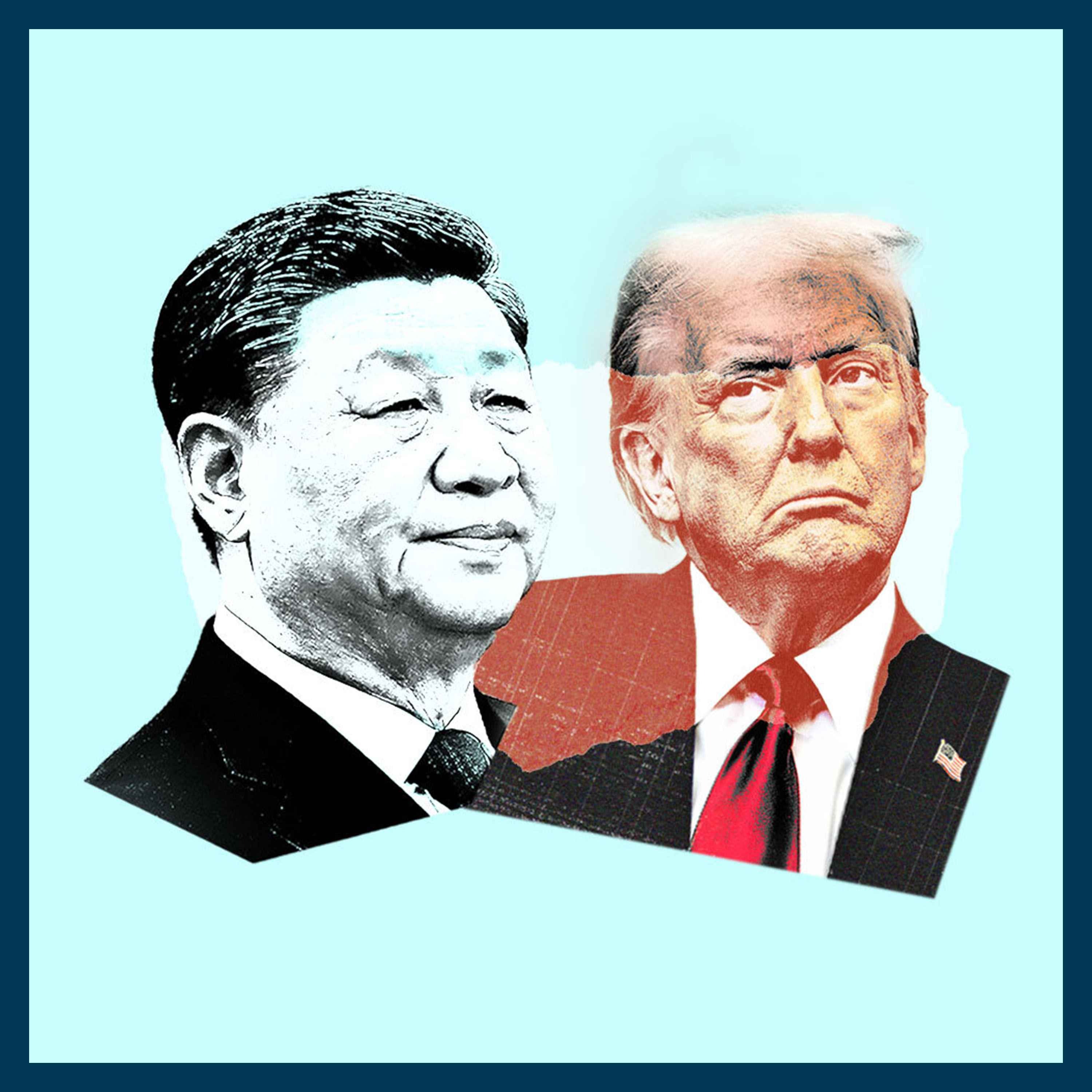
As Donald Trump and Xi Jinping prepare to meet in a much anticipated summit. With the war in Iran still paralyzing the Middle east, global energy markets on the brink, and Taiwan still casting a shadow across the negotiating table, Donald Trump sounded remarkably chipper about the meeting.
- [02:45]
Donald Trump
We're going to have a very good meeting. I spoke with President Xi. We look forward, we both look forward to the meeting. It's going to be great.
- [02:52]
Manveen Rana
To make sense of it all, we've assembled our own summit of two big beasts of the China watching world. What can we expect to see on trade, Taiwan and the war in Iran when Xi and Trump come face to face. The story today, Trump's China visit, what's at stake?
- [03:32]
Rana Mitter
I think that the answer to the question of what success looks like comes in one word that has a very 1970s ring, and that word is detente. In other words, a relaxing of tensions between the US And China that even if it doesn't last forever, at least lasts for a few years.
- [03:53]
Manveen Rana
That's Professor Rana Mitter, St Lee, Chair in US Asia Relations at the Harvard Kennedy School and an expert on China.
- [04:03]
Rana Mitter
In other words, the US Has a whole variety of issues on its plate in the Middle east and elsewhere. China is still trying to get in. Not exactly flatlining, but certainly not very lively economy to start to grow again. Both of them have problems that they want to deal with aside from each other. So a detente, a calming of the relations between the two sides that I think will be an outcome that they will both want.
- [04:27]
Manveen Rana
In our podcast version of a grand summit, we also invited Richard Spencer, the Times China correspondent who's covering the trip, to join us.
- [04:36]
Richard Spencer
I think it depends who in their entourages you're really talking to. I agree that success in the sort of broader context, looked at from the position of God, if you like, is exactly that detente. I think there's a lot of nervousness, particularly amongst the more hawkish China people in Trump's administration. And there are quite a lot of them, of course, that he might give something away that they don't like. And so if there's kind of silence on that front, it's a good thing for them. If there's a general sort of, yeah, let's carry on talking about trade without any sort of new sort of sweeping tariffs or threats or anything. That's a good thing for a lot of people, particularly on the Chinese side. You know, I think both leaders, on the other hand, would like to get a little bit of positive coverage. If you like something that says, look what a great game they've played, but whatever. And on both sides, they do to try and bring that about brings risks.
- [05:35]
Manveen Rana
Rana, what do you make of the list of people accompanying President Trump on this trip?
- [05:40]
Rana Mitter
I think it's a very interesting mixture of different constituencies. So we have people who are there from the business community, and Elon Musk is obviously quite prominent in all sorts of ways. He's someone with a long history in China, actually very well respected in China. If you go on Chinese social media websites for a long time, there are a lot of chats about Tesla, about Elon Musk himself as a polarizing but prominent figure The Chinese love entrepreneurs. And so someone like that, I think, will be seen as a sign of, of a perhaps renewed conversation between the two sides. But then we have a whole variety of people who maybe are more nervous about the relationship between China and the U.S. there's been a line that's been going around in Washington that Trump may be the biggest dove, the biggest China dove in the administration. Now, that may be a bit of an exaggeration, but on the other hand, there will be other people who perhaps feel that it's important for the US to push back against China, particularly in terms of there being a major competition between the two in areas like the fate of Taiwan, the future of technology, whether it be restricted or whether or not the two sides will cooperate. And of course, some of these issues around trade and tariffs. So I think we'll see people who are essentially pushing all points of view. The thing about Donald Trump is that in the end, once he's decided what the policy is going to be, he's probably going to make his choice and make it very much a one to one conversation with Xi Jinping.
- [07:04]
Manveen Rana
Richard, given that the optics seem to be so important in this summit, what do we know about the preparations for it and the protocol?
- [07:11]
Richard Spencer
All state visits and prime ministerial visits and so on are always associated with huge amounts of protocol and nowhere more so in China, where the optics even of how people stand of, you know, who's walking up to meet who is very important. And on the American side, you may have seen pictures of the beast, you know, the presidential car and the presidential motorcade. I mean, they all have to be shipped to China in advance, not using local taxi service by any means. Extraordinary goings on. There's also the question of, you know, how much time the two leaders spend alone, or at least just with their translators. I mean, there's always this question with when President Xi meets other world leaders, is he trying to show that he's the big man and they're the supplicant? With Trump and Xi, the importance of displaying them as equals is very high, probably for both.
- [08:09]
Rana Mitter
I mean, I think I agree with Richard, absolutely. But personalities are important. One of the things that's very notable about Xi Jinping, and this is truer of him than it was of some previous Chinese leaders, such as Jiang Zemin, who was president in the 1990s and early 2000s, is that Xi is very choreographed, and it's very rare to see him either domestically or internationally, make a speech, make a move, make even a comment that isn't fairly well thought through and rehearsed. He's not, in that sense, a spontaneous guy. He's not stiff. I mean, he's generally, from those who've met him, people say that he has. He's comfortable in his own skin, is one phrase I heard from a Western leader who met him. But at the same time, Trump is freewheeling. Trump is uninhibited, and he will may want to kind of riff off the meeting in a way that probably will make Xi feel slightly uncomfortable, since he never quite knows what it is that those Western leaders want to say. Macron was a bit the same sort of way, and Trump is that, but maybe Macron squared in terms of coming out with unexpected comments.
- [09:08]
Manveen Rana
So with Trump freewheeling chaos aside, Richard, just talk us through the itinerary and what we know of it.
- [09:14]
Richard Spencer
President Trump landed in Beijing on Wednesday evening. No events other than the sort of formal welcome. The main events are for Thursday and Friday, when he will be meeting President Xi in the morning at the Great hall of the People in Beijing on Thursday morning. I think there's a bit of tourism. I haven't seen it confirmed by the White House itself, but I've seen reports he's going to go to the Temple of Heaven, which is an amazingly beautiful city, circular temple in the south of Beijing. He went to the Forbidden City when he went in his first term of office, so he probably didn't want to go and see that again. There's a state banquet in the evening quite early. The Chinese eat quite early. I think it's at 6pm Beijing time on Thursday evening. And then there's another bilateral meeting on the Friday. And then the two men take tea together, and then he heads for the airport back to Alaska.
- [10:04]
Manveen Rana
And presumably every moment of that trip will have been worked out beforehand and hopefully a little more smoothly than last time. I think there was famously a moment where a Chinese official tried to prevent the briefcase containing the US nuclear launch codes from following the President into the Great hall of the People. Rana, there is almost a mythology about American presidents going to China. Just talk us through a bit of the history. And how does this moment compare?
- [10:32]
Rana Mitter
Pretty much every president since Richard Nixon has been to China at least once during the time that they were in fact sitting as President Joe Biden actually did go. But as vice president now, the Richard Nixon visit in 1972, just over half a century ago, still stands as not only the most important of those visits, but perhaps one of the most transformative events of the 20th century.
- [10:56]
Donald Trump
We seek an open world A world in which no people, great or small, will live in anger, isolation.
- [11:05]
Rana Mitter
Richard Nixon, who was always prone to giving himself plenty of credit, that's probably fair enough in this case, talked about it as the week that changed the world when he went in February 1972 to China.
- [11:17]
Donald Trump
The Chinese people are a great people. The American people are a great people. We have at times in the past been enemies. We have great differences today. What brings us together is that we have common interests which transcend those differences.
- [11:43]
Rana Mitter
And that was actually the first time that any US President had visited China as president. We have to remember that back in 1972, the United States did not recognize the People's Republic of China at the UN or internationally and diplomatically, Taiwan, which was where the exiled Nationalist government of Chiang Kai Shek was still in charge, was still the official voice of China even as late as the 1970s. So essentially, by going and making that visit, which was done, you know, with lots of skullduggery, Henry Kissinger famously was smuggled out of Pakistan and taken on a secret flight to China to kind of lay the ground in 1971. It was all very skullduggerous in a way that Nixon and Kissinger, I think, rather enjoyed and, you know, enjoyed telling stories about in later, later years. But it set the stage for what has become, I would say, the world's most significant bilateral relationship. Because although 1972 and Nixon's visit didn't mark the opening of full diplomatic relations, it set the stage for what we would see over the next five, 10, 20, 30 years, which was the entwining of the Chinese and American economies.
- [12:48]
Donald Trump
That communique will make headlines around the world tomorrow. But what we have said in that communique is not nearly as important as what we will do in the years ahead. We have been here a week. This was the week that changed the world.
- [13:09]
Rana Mitter
In other words, the idea of what we call today globalization. That China produces huge numbers of goods and also buys large amounts of American debt. That America provides a huge market and its consumers benefit from cheap goods. And as I'm sure you know, Manveen, it was such an important event that a few years later, John Adams actually wrote an opera about it called Nixon in China. I'm not sure anyone will write any operas about the visit that's coming up this week, but I suppose at least we should hope they don't have to write a sitcom. That will be rather unfortunate.
- [13:37]
Manveen Rana
Who knows? Still time, in a way, that historic moment with Nixon in China starts the process of globalization. And the intertwining of trade between America and China. And it has felt since Donald Trump first came to power as if that's exactly the process he's trying to reverse. Richard, talk us through where relations between the two countries stand at the moment.
- [14:00]
Richard Spencer
Yeah, it's fascinating. And I don't think we pay quite enough attention to the sort of the recent history since that extraordinary visit that Ron has just described of how American presidents have viewed China. But that was such a success for Nixon that that aspect of American policies never wasn't really challenged for three or four decades. And you had very pro what we would now regard as very pro Chinese presidents thereafter who really played a big role in the rise of China. And China doesn't really want to acknowledge that a huge amount and nor now does America. But if you think of George H.W. bush, the first President Bush, he'd been ambassador to China. He really resisted after Tiananmen Square massacre, he. He resisted heavy sanctions against China over that or cutting off China. Diplomatic relations stayed. There was an arms embargo, but not on other aspects. So globalization and the intertwining of the American and Chinese markets continued, took huge strides thereafter. Bill Clinton also came to China. He negotiated China's access to the World Trade Organization. Then George Bush II continued his father's policies towards China. It was really only Obama who came along and said he was going to pivot American policy away from the Middle east towards the Asia Pacific. Reason, I don't really think he thought through the consequences, particularly for the Middle east or indeed for China, because China saw America saying we're going to pivot away, that America was going to pivot towards Asia Pacific. And they'd seen America destroy Afghanistan and destroy Iraq and they got pretty worried. So I think that was the big shift in modern history between China and America. And since then it's been much more uncertain. And then Trump 1 came along and said he really took on China and he was even sort of mimicking China. He called it China and was pretty insulting about China, particularly over Covid. And that's really set in tune a much more scratchy, edgy relationship between the two, which carried on through Biden, who put in lots of trade tariffs himself against China. And of course, with Trump too, you had those massive tariffs last year. So if Trump is now deciding let's take a more dovish and engaged policy again, it could be a really major, a major sort of swing back towards that sort of Nixon era.
- [16:46]
Manveen Rana
Rana. It does feel like a lot of those sort of tariff policies were about trying to reverse some of that process of globalization. They saw the relationship with China as being one sided. They were buying a lot of Chinese good, but not selling very much out there. And yet President Trump is flying in with a raft of businessmen. What is he hoping to achieve? We keep hearing about a Board of Investment and Board of Trade. What is he hoping that relationship will look like in the future?
- [17:11]
Rana Mitter
Sure. Well, I think it's fair to say that on the American side and the Chinese side, when it comes to what specific policy goals they'd like to achieve from the summit, they have quite different ideas. So on the American side, it's to do with trade, and on the Chinese side, it's to do with Taiwan. So on the American side, I think that as you put it just now, there isn't a whole bunch of stuff that the Americans can really sell the Chinese that they want to buy. Of course, the Chinese would love to buy large amounts of American high tech equipment, but that, of course, as Richard pointed out, is part of the restricted sorts of goods that are simply not going to be sold by the US To China. So that means that basically there are only two or three major highly profitable areas that they can look to sell into China. One is Boeing aircraft. And if Chinese airlines, which of course are huge, would buy 100 Boeing jets, that would obviously do quite a lot to rebalance trade deficit, which worries Donald Trump so much. Donald Trump is also looking to the midterm elections in the United States, just less than six months away now. And he's very aware that in the United States, very Republican voting agricultural states in the Midwest, farmers are finding that the tariffs that were imposed on China and other countries, which are then leading to kind of reverse tariffs in the other direction, are really hurting their agricultural exports. So when it comes to products like soybeans, China is now buying a lot more of those from Latin America, from places like Brazil, less from the United States. So essentially, the Americans will hope there'll be a deal on that front as well. And the Chinese side, I think, will be happy to sign off some deals. They did that the first Trump term. It was called the phase one deal. They never actually got to phase two. But I think that it will be some issues that are more important to the Chinese, including the question of the status of Taiwan, that they will try and put really front and center on the agenda. And I think the Americans will try and avoid talking about Taiwan as much as possible.
- [19:07]
Manveen Rana
So, Richard, can we expect to see any movement in terms of tariffs as a result of all of This, I
- [19:13]
Richard Spencer
think that tariff war last year was so explosive and so chaotic. I think even President Trump thought it was chaotic. And I think he doesn't want to reopen that again. There is, however, this sort of linked aspect of sanctions over Iran. So America is still putting sanctions on Chinese companies that deal with Iran, particularly over oil, which China is of course, by far and away the biggest purchaser of Iranian oil. So there is a question of whether China is putting sort of retaliatory sanctions on American companies. But I think both sides are keen to keep that apart. My sense is that nobody wants to reopen that tariffs issue. I think the difficulty for America is that America, if it wants to gradually decouple from China, America is going to have to find new markets for its exports. And so it hasn't really thought about how it's going to negotiate that new world.
- [20:10]
Rana Mitter
I think it's just worth noting actually on the tariffs that essentially both sides have a bazooka pointed at each other because of rare earths and critical minerals. Back in October of last year, the two sides came to a deal in which essentially the Chinese agreed that they would not prevent the United States and companies and countries in its supply chains from getting those rare earths and minerals that really are only mined and refined in China. And the United States would not put the tariffs up to those three figure numbers that we were seeing in the middle of last year, you know, 100, 110, 120%, but put them on the not great, but still much lower level, about 25 or 30%. That agreement runs out in October. But my expectation would be that essentially this discussion and ones that will follow between the US And Chinese sides will extend that truce, essentially because the Chinese still really need the US Market and the US really needs those rare earths and critical minerals from China.
- [21:05]
Manveen Rana
And in terms of trade, it's interesting to see who President Trump is taking with him in this delegation. The head of the chipmaker Nvidia was a last minute addition. And we know that Elon Musk is going, of course. How much do we think AI will be on the table? We know that President Biden got some concessions from China on the name AI deal. Will there be more movement on that?
- [21:29]
Rana Mitter
I think there will. I think that there is going to be certainly discussion of AI which is being driven on both sides by the extraordinary speed at which AI is developing. I think actually a big wake up, I mean, a wake up call, you know, a year or so ago, year and a half ago for the American side was China's development of Deep Seek, their AI LLM that basically did a great deal of what Chat, GPT and the other American models have done, but essentially at much lower cost. But most recently within the last few weeks, it's the mythosman from Anthropic that I think has really got both sides with their ears pricked up. This announcement by Anthropic that they've developed an iteration of AI that's so powerful that it could undo the world's finance systems, for instance, by spotting all the flaws. The problem, though, is a very central one that can't be easily solved, which is that at some level the talk between the US and Chinese sides, particularly amongst tech figures like Elon Musk and people within the big companies like ByteDance and so forth in China, is that there has to be some sort of overall agreement that, for instance, AI cannot be used in ways that might endanger humanity. And one small agreement that was achieved just at the end of the Biden term was the agreement between Xi and Biden at Lima in Peru that AI would not be allowed to launch nuclear weapons, that there would have to be a human involved somewhere in the process if in fact nuclear weapons were ever to be used. Or that might sound like predominantly pretty. Pretty cold comfort in that sense. But beyond that, indeed, but beyond that one agreement, it's proved fantastically hard to find any other areas of agreement, because in the end, the bottom line is that the United States tech establishment and the Chinese tech establishment are in competition when it comes to AI. The other major difference, of course, compared to nuclear controls in the Cold War, is in those days it was governments containing, controlling a contained number of nuclear weapons that governments knew where they were. This is about private companies, particularly in the us, you know, very kind of freewheeling private companies. And even in the. On the Chinese side, they're more controlled by the state, but they do their own research. Getting governments to check what private sector actors are up to is fantastically different, difficult in any circumstances. And for AI, it may end up proving near impossible. So they'll talk about it, but whether they'll get to a solution, I think is really hard to see.
- [24:02]
Manveen Rana
Coming up. That's trade. But what about the geopolitics? This summit takes place in the shadow of the Iran war. So will China be persuaded to help the US out of a hole in the Middle East? And what does it all mean for Taiwan? That's in just a moment.
- [24:29]
Optum Advertiser
Healthcare can feel complicated. That's why Optum uses technology to connect the people and processes that make healthcare easier, more affordable and more effective. We're making it clearer for you to know exactly what you your benefits cover and to help you better manage your health. We're coordinating care between your doctors and your technology. We believe better, simpler healthcare is always possible. That's healthy optimism. That's Optum. Visit optum.com to learn more.
- [24:59]
Felix Salmon
This message is a paid partnership with Apple Card this is Felix Salmon from Slate Money and I'm here to tell you about Apple Card. Even as a seasoned traveler, things can still get stressful, which is why I use Apple Card on my international Trips and with 2% daily cash back on every purchase with Apple Pay, I'm actually earning daily cash as I travel. Instead of coming home feeling like I've drained my bank account, I come back with cash back I can put toward my next trip. Apply in the Wallet app on iPhone subject to credit approval Apple Card issued by Goldman Sachs Bank USA Salt Lake City Branch Terms and more at Apple Co Slash Apple Card benefits.
- [25:43]
LifeLock Advertiser
You're great at protecting your data, but lots of places could still expose you to identity theft.
- [25:48]
Optum Advertiser
I thought it was safe.
- [25:49]
LifeLock Advertiser
If that happens, LifeLock gives you a US based restoration agent who will stick by your side from start to finish. Phone calls, filing documentation, preparing insurance claims. Your agent handles it all. In fact, we're so confident restoration is guaranteed for your money back. Isn't it nice to have someone like that on your side? Save up to 40% your first year at lifelock.com Pandora terms apply.
- [26:25]
Manveen Rana
Rana and Richard, we've talked about trade, which is obviously going to be very high up on the agenda. President Trump seems to see this almost as a trade delegation visit. It's impossible to ignore that this summit will be taking place with the Iran war as a backdrop. Richard, what is China's role in all of that and what would America like China to be doing about it?
- [26:48]
Richard Spencer
Yes, I think there's a very ambiguous question for America about China's relationship with Iran. China is the only country that would have substantial leverage over Iran. China has a big interest in bringing this war to an end. It wants low oil prices. It doesn't like to see global trade disrupted. It is by far the biggest purchaser of oil, not just from Iran, but also from the Gulf in general. So the question is whether Trump says to Xi, you know, come and use your leverage to get Iran to do a deal. You know, you also China, you're a member of the, you're a permanent member of the Security Council, you're an official member of the nuclear Club, the five countries that are both signatories of their non Proliferation Proliferation Agreement and permanent members of the Security Council. You don't want to see nuclear proliferation. Tell them to give up their nuclear arsenal, their stores of enriched uranium, get them to hand it over to the iaea, close down their enrichment facilities. The trouble with that is a China doesn't want to do that. China keeps saying we are not the sort of country that gets involved in the Middle east and so we're not going to get involved. Sorry. We will call for peace and harmony on all sides like we always do. And we will. Occasionally we will meet the Iranian foreign minister to discuss the broad outlines of what we think should happen. I think there's also a danger for Trump here to be looking like a supplicant to try and sort of do a trade off. You know, I'll give you something on Taiwan if you put pressure on Iran. And I think there will be people traveling with Trump saying, don't make it look as if you're begging China to bail you out here.
- [28:32]
Manveen Rana
And Richard, David, when Taiwan is discussed, what is it that you think Xi will want? What sort of concessions would he want America to sign up to?
- [28:41]
Richard Spencer
So there's two things that China wants out of America. One is a very, very subtle point. China says, of course, that Taiwan is part of China will eventually be reunified. And the American position is odd sounding, but quite carefully thought out. It acknowledges China's claim that, that there is but one China and Taiwan is part of it. And it does not support, stressing the active verb there, does not support any Taiwan claim to independence. Now, China would ideally like America. I mean, it knows that America is not going to stop its military support for Taiwan or its friendship with Taiwan. But it would ideally like to say that it actively opposes Taiwan's independence because that gives them a little bit more. It's all very incremental, but it gives a little more sway when they create this narrative, particularly with the audience in Taiwan itself, who, of course, you know, speak and read Chinese, they are nearly all ethnic Chinese, that reunification is inevitable. At some point, they're just going to have to give up this pretense of being a separate entity. So that's one ask that China makes. I think it's unlikely to get that the more practical thing that Xi wants is a limit to US Arms sales to Taiwan. There have been some big announcements on American arms sales packages to Taiwan, and Trump has said he will discuss this with Xi, which is rather alarming to Taiwan. So that's making it rather nervous and somewhere where you might see Trump give something away.
- [30:19]
Manveen Rana
Rana, is there a sense in Taiwan that actually given the last year or two, watching the second Trump administration and its changes, changing foreign policy, that perhaps China is starting to look like a slightly more reliable partner?
- [30:33]
Rana Mitter
I don't think that most of the public in Taiwan think that China is a more reliable partner. But I do think you can see straws in the wind that suggest that an awful lot of people are suddenly thinking very hard about whether or not they might have to engage with China in a way that would have been unthinkable just a few years ago. The best indication of that is something that happened just a few weeks ago ago, which was the visit to mainland China of the leader of the main opposition party in Taiwan, the Komidang or Kuomintang, as it's often written, the Nationalist Party and its leader or its president, a woman named Zheng Liwen, visited the mainland. It's not unprecedented. One of her predecessors did that, you know, about 10 years ago, but it's been a while. And she even did a photo opportunity with Xi Jinping. Now for the leader of Taiwan's opposition, which, you know, is is China friendly, I think it's fair to say. But a democratically elected party to feel comfortable about doing that is an indication, I think, of a wider sort of deep rumbling within Taiwan politics that maybe, just maybe the United States is no longer reliable, that those assurances that come, you know, they are set in law in the United States. The 1979 Taiwan Relations act signed during the presidency of Jimmy Carter, in fact, does say that the US Is obligated to provide support for Taiwan to defend itself. So that's not the same thing as the American troops coming to actually fight for Taiwan, but it's a sign that there is actually indication that Taiwan's status and need to defend itself is recognized. The real crunch moment, I should just add, would be the Taiwan presidential election of January 2028, just a few months before the US presidential election. If a more China curious candidate is elected to the presidency instead of the current president, President Lai, that may also change calculations.
- [32:20]
Manveen Rana
And just finally, Ronnie, you spend a lot of time in America now. It does feel like President Trump was elected on the promise of making America great again. Is there a chance, looking at the impact he's had on places like Taiwan and Asia and the Gulf, is there a chance that he's actually made China great again?
- [32:37]
Rana Mitter
I think that what the message that not only Donald Trump, but also actually JD Vance's vice president are pushing hard is that that in a sense, attention should be taken away from the idea that there's an existential battle between China and the United States, and instead the real battle is at home. In other words, changing the United States into a country that has more economic prosperity but is pushing back against the kind of wider trends of political change when it comes to identity diversity and so forth. There's a sense in which for the Trump administration at the top, that China is just one of a series of problems. In other words, really, America at home and how it changes is becoming the focus and something that I think, you know, Joe Biden and Donald Trump in his first term. I've said that the big battles with China, that message really seems to have changed and I suspect that we'll see that expressed in whatever happens in Beijing changing in the next couple of days.
- [33:56]
Manveen Rana
That was Professor Rana Mitter, historian, author and St Lee Chair in US Asia Relations at the Hospital Harvard Kennedy School, and with him Richard Spencer, China Correspondent at the Times. The producer today was Olivia Case, the executive producer was Tim Walklate, and sound design and theme composition were by Malicetto. If you can do, leave us a review wherever you get your podcasts. Thanks for listening. We'll be back tomorrow. Sa.
- [34:59]
Optum Advertiser
Healthcare can feel complicated. That's why Optum uses technology to connect the people and processes that make healthcare easier, more affordable and more effective. We're making it clearer for you to know exactly what your benefits cover and to help you better manage your health. We're coordinating care between your doctors and your technology. We believe better, better, simpler healthcare is always possible. That's healthy optimism. That's Optum. Visit optum.com to learn more.
- [35:29]
LifeLock Advertiser
You're great at protecting your data, but lots of places could still expose you to identity theft.
- [35:33]
Optum Advertiser
I thought it was safe.
- [35:35]
LifeLock Advertiser
If that happens, LifeLock gives you a US based restoration agent who will stick by your side from start to finish. Phone calls, filing documentation, preparing insurance claims. Your agent handles it all. In fact, we're so confident restoration is guaranteed for your money back. Isn't it nice to have someone like that on your side? Save up to 40% your first year at lifelock.com Pandora terms apply.