Loading summary
Transcript57 lines
- [00:04]
A
From the Times and the Sunday Times, this is the story. I'm Luke Jones.
- [00:18]
B
Protecting our right to our self determination. It's absolutely key and you know, just like it should be for any country in the world. We're not special, we're the same. We've been living here peacefully for a very long time and we should be allowed to continue to do so.
- [00:32]
A
So in recent history, at least, life on the Falklands, the South Atlantic British overseas territory, has been pretty quiet, peaceful even. But will that last?
- [00:46]
B
There are games at play in the world and we are a useful pawn for some.
- [00:54]
A
Could the United States be about to breathe life into an old spatula?
- [00:58]
C
A leaked Pentagon email seems to outline potential punishments for those NATO countries who have not supported the United States or Israel in their war against Iran. One possibility, that the United States might withdraw its support for Britain's sovereignty of the Falkland Islands.
- [01:20]
A
Argentina has long claimed the Falklands, Los Malvinas. To them, I want to reaffirm our right to the full exercise of sovereignty over the Malvinas Islands. We famously went to war with them when they invaded the islands 40 years ago. So is the US really going to inflame this long running, one time deadly row, and what does that mean for the Brits who live on the Falklands? Now, The story today, unrest in the Falklands.
- [02:11]
C
It's a very desolate place, very windy.
- [02:15]
A
Matthew Campbell is a foreign features editor at the Sunday Times. He's been in the Falklands recently, getting a sense of what life is like.
- [02:21]
C
There's the weather, changes every five minutes. I think I experienced in the course of one week, hail, snow, rain, and also a fair amount of glorious sunshine.
- [02:32]
A
And actually ideal that it's you who went, because you're a Brit who grew up, at least in part, in Buenos Aires.
- [02:38]
C
Well, I spent a year in Buenos Aires, my year out, when I was at university, because I was doing French and Spanish. And so I decided to go to Argentina and I got a job teaching. Well, being an assistant teacher at a school in Buenos Aires, was it sort
- [02:52]
A
of magical and romantic and colorful and wild?
- [02:55]
C
Yeah, it was wonderful. I loved it. I had a particular fondness for the. The writings of Jorge Luis Borges. And so the first thing I did when I got there was to look him up in the phone book. I gave him a call and he invited me round. So I ended up reading to him, reading poems to him, because he was completely blind since the age of 14.
- [03:14]
A
Amazing. Take us to the Falklands. You were there in the wake of, I guess, quite a Sort of tense time in terms of these leaks out of the us, the US Pentagon, about how they might use the falcons as a sort of bargaining chip. I mean, did that come up in conversations when you met people, when you were walking around?
- [03:38]
C
Yes, indeed. So last month, this leaked memo from the Pentagon suggested that the United States might be ready to, quote, unquote, review their view of our sovereignty over the Falkland Islands. And this seemed to be as a way of punishing us for our stance on the war in Iran and our lack of support, basically. And so, yes, when I got to Port Stanley, the capital of the Falkland Islands, people were talking about this. The response I got when asked them, when I asked them, though, was that they're kind of used to rhetoric from Buenos Aires, from America. It was a bit different. And so they weren't too sure what to think about it. Some of them just put it down to the, quote, unquote, madness of the Trump administration. Other people were slightly more worried at the prospect of Britain's sovereignty being challenged in this way. I spoke to some local Legislative assembly members who said that they had been showered with messages of support from, as they put it, their colleagues in Britain, fellow MPs, and also from some politicians in America. These are emails and tweets and messages supporting the Falkland Islands. And that made them feel a lot better. They kept on saying how grateful they were for all of the support.
- [05:07]
A
And has it, do you think, raised serious questions, I mean, in the Falklands and elsewhere, about this could actually happen? We should do something about it?
- [05:16]
C
Well, I think it put the Falkland Islands back under the spotlight in a way, which is why I went there to find out what people were thinking and to find out exactly what the Falklands are today, because I think they've been slightly neglected for a while. We haven't seen much news from there. And so that was the purpose of my visit. On a Sunday morning, I went to a service in the Christchurch Cathedral. It's the southernmost Anglican church in the world. And I met the former rector after the service, standing in the back of the church. Kathy Byles.
- [05:50]
B
We are a relatively safe community.
- [05:53]
C
People with tarties.
- [05:54]
B
Yes, yes.
- [05:55]
C
Charming.
- [05:56]
B
Yeah.
- [05:56]
C
The front.
- [05:57]
B
Back door open? Yeah, my door's always open. You completely much walk into my house anytime, which is, you know, on a main road. You know, as a Falkland dialecter, I feel reassured and I feel well, well defended. And, you know, I'm very grateful to the British government for their continued support and allowing us, you know, to, I guess, have the life that we would like in Our.
- [06:32]
A
And when you got there, what is it actually like? Because you hear that they are more British than the British. It's a lot of rock and penguins. But how did you actually find it?
- [06:43]
C
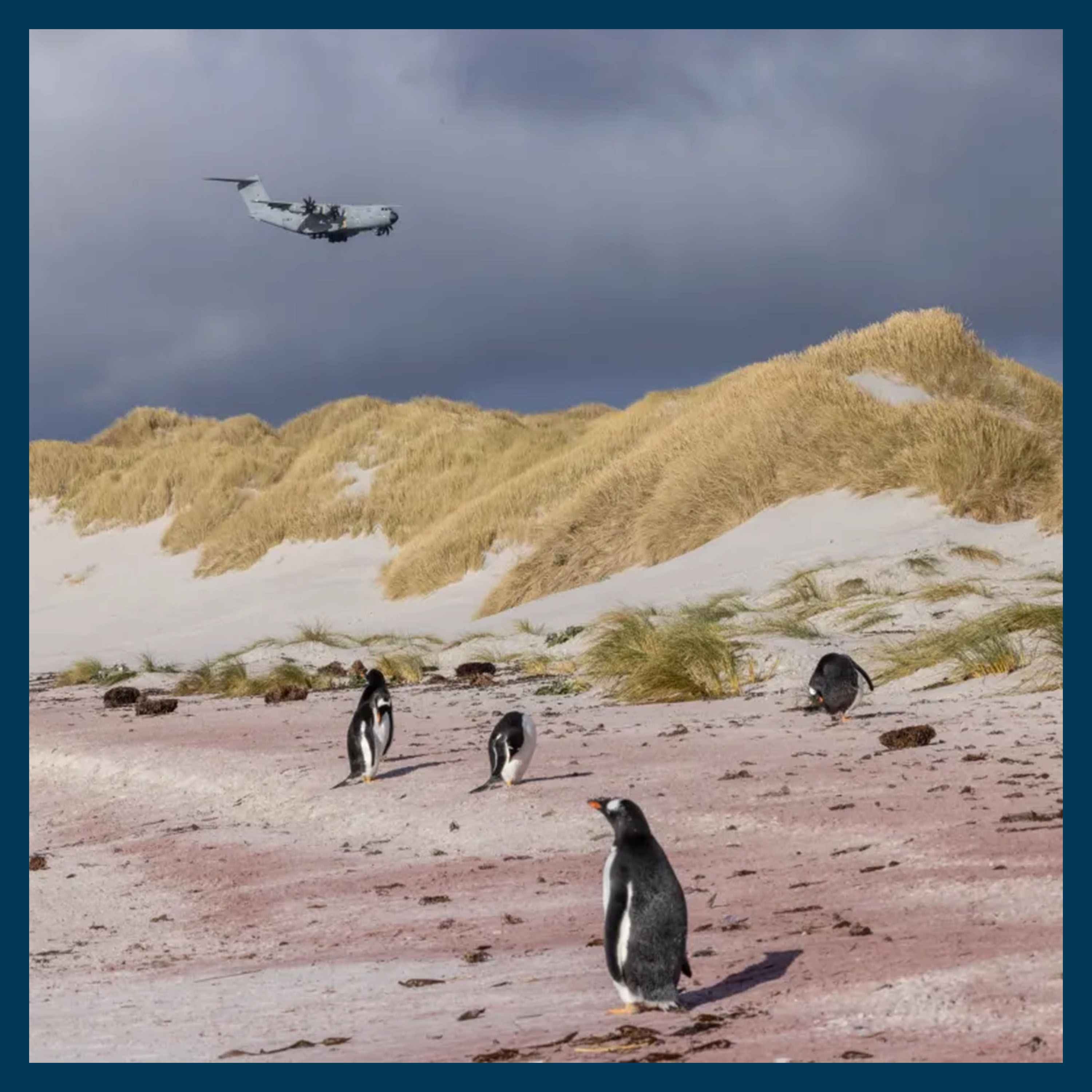
When I arrived, it was pouring with rain, actually, and it was late in the evening, and we got on a bus to go into the couplets about an hour's drive from Mount Pleasant, which is where you land. That's actually a British military base. And it was very super. You couldn't see anything except the vague outline of hills. And tantalizingly, there's glimpses of bays and inlets. But the next day we went for a drive and I was struck by the sheer sort of haunting beauty of the landscape. It's very empty, desolate and windy, but strikingly beautiful. One day I went out to a place called York Bay. Until recently, it was closed to the public because they were still finding landmines. The land mining clearance has been going on for years and years, and only recently did they declare it mine free. Everybody ran down onto the beach to celebrate. And then just a few days ago, in fact, another landmine detonated and killed a cow. So they're still cropping up. But what surprised me was that the penguins didn't set off any of these landmines. Apparently they're not heavy enough because that whole area is filled with penguins, and I've never seen a penguin outside captivity. And I was thrilled when I emerged around a sand dune to find a whole colony of gentlemen to penguins, walked across some sand dunes at York Bay, come out onto a promontory where a colony of penguins are basking on the tussocks of grass and sand. They're Gentoo penguins, and this is where they live. Quite amazing. I think they were just resting after their fishing spree and sunning themselves. And it was. It was magic. And I think Falkland Islanders are used to this, but they still appreciate these scenes of great natural beauty.
- [08:42]
A
What did the community seem like? Is it largely people working for the military, or are there, you know, people there doing a variety of things?
- [08:49]
C
Well, at Mount Pleasant, they've got a large community of people, several hundred of them, I think, are British military personnel. In Stanley, the community senses of, you know, it's a bit like being in a village in the uk, actually. Everyone speaks English, but I have to say, with a slightly strange accent. Some people have said it sounds like there's a twang from New Zealand in there, for whatever reason, or that it's kind of West Country. Some of them were newcomers, relatively. People had Moved say from Britain two decades ago or from other parts, other countries around the world. The thing about the Falklands today is that it's rapidly becoming a multinational community with apparently some 60 nationalities represented. These are people who have been attracted to the Falkland Islands because of new opportunities emerging. The point about the Falkland Islands today is that they're booming.
- [09:43]
A
Yes. With what industry?
- [09:45]
C
Well, after the war in 1986, Britain established a 200 mile sort of exclusion zone around the islands, allowing the Falkland Islands complete rights to all of the fishing. They then started selling these rights to other countries and in the process made a fortune. Your income from fishing, and this is for squid mainly, and this is bringing in big bucks. The other thing is that to add to this bonanza, there's the prospect of oil in the future. It's said that in 2028 they'll start exploiting this oil find off the coast of the Falklands, the so called sea lion field. This is expected to bring great wealth, even more wealth to the islands.
- [10:33]
A
And when you said that there's big bucks from the fishing or the selling of licenses for people to fish squid, how big big is that big box? I mean, is it more money than they'd know to do with?
- [10:44]
C
Well, in a sense, I think certainly more than they've ever had before. Before the war when there was nothing, you know, people barely had education, they lived, if they lived in the countryside, they, they barely saw their neighbors because there were no paved roads. This is Andrew Newman, a toothfish tycoon. Nobody had anything. You know, you all wore the siblings clothes and boots and stuff as it all came down. Your mother knitted sweaters, gloves, socks, you know, hats, all of that stuff. We didn't have 24 hour power, we didn't have television, you had certain amounts of radio, you communicated by old wind up phones and CB radios. You lived off what there was on farms or dried or tinned. There was no keeping up with the Joneses after the war and after the advent of the big fishing industry, they built paved roads, they have free education, schooling, even university if they want it. Free dental care too and free healthcare. And so things have changed much for the better. The standard of living has improved enormously.
- [11:49]
A
And in terms of you people that you met, I take your point that now obviously there are lots of different nationalities represented on the island, but what flavour of Britishness do you think that exists still there? Do they still feel that kind of strong attachment that we're told quite often that they do have?
- [12:04]
C
Well, it varies. Some people are very attached to the idea of being a British overseas territory. Indeed, in 2013, they held a referendum on this subject and the question was, do you want to continue being a British overseas territory? And I think that all but three of the 3,660 Islanders said that indeed they did, because it's a small place. Everyone knows who the other three were who voted against. But it wasn't because they wanted to be part of Argentina. They wanted to be independent,
- [12:40]
A
which actually, I guess, you know, unlike other British overseas territories, they're not necessarily in hock to the United Kingdom for granting aid. So, you know, that might be possible,
- [12:48]
C
but, well, increasingly so I think the question maybe will arise because of the new prosperity. They basically govern themselves. Britain is responsible for defense and as these planes and air missiles, air defences at Mount Pleasant. But Britain doesn't fund the government, as it were. And this is Kathy Biles again.
- [13:12]
B
We matured and continued to mature and build a really open and professional relationship with British government. And now we're, I would say, a very independently minded and independent in means overseas territory of the uk, safe for the cost of defense. We pay for absolutely everything ourselves and we're very, very proud about that. We've been living here peacefully for a very long time and we should be allowed to continue to do so. But we're also fundamentally British.
- [13:48]
A
Coming up, what does the history of the islands tell us about the tensions that are still looming over and around the islands? And remember, if you've got a question about this or any other story we've been talking about on the podcast, drop us an email. Our address is thestoryatthetimes.com and we will maybe discuss it in our Q and A on Thursday. We'll have more for Matthew coming up. Matthew, we're talking about the Falklands, obviously, in the wake of the islands being back in the headlines after that leaked memo from the US Pentagon, there are some people listening, I'm sure, who actually might not necessarily know that much about the Falklands, its history, the war and all the rest of the. Can you take us back to actually why there are British citizens on there in the first place? Has it always been British?
- [14:58]
C
The first settlers arrived, I think, in the early 16th century, some of them from Britain, also from France and other European countries. There was a lot of whaling going on later. I think the first British colony there was set up round about 1760 or so. And then the French also had a settlement there. Eventually the British withdrew. The history slightly murky. The French gave their settlement, I think, to the Spanish and Then of course, they were governing much of South America and a confederation basically of what are now Argentine states, but in those days were called the Confederation. They made a claim, but then Britain returned in 1830 or so to recapture the islands, as it were, and by that time the largely English speaking population of the islands had grown. Argentina, though, continued to claim, this is the country of Argentina, continued to claim the islands right up until today, and still does. As the president, Javier Milei, said in response to the leaked Pentagon memo, the islands have been, are and always will be Argentine.
- [16:15]
A
And of course, most memorably, that they staked a claim to that in the 1980s with the outbreak of war there. So explain what happened.
- [16:20]
C
That's right. Well, when I was living in Buenos Aires in 1981, I distinctly remember turning on the television one evening and there was this general ranting to his troops. It turned out to be Leopoldo Galtieri. He was head of the army in those days. And he said, if ever I had the great honor and responsibility of leading this country, the first thing I would do is reclaim our sovereignty over the islands. And everybody was cheering. I thought, oh my, this is interesting. And I was fascinated by the whole idea of the dictatorship in Argentina. It was a dictatorship in those days. So every evening on TV you'd see generals covered in medals, festooned with medals, basically opening factories or talking to workers. And it was clear that at the same time there was an appalling episode of repression, the so called dirty war. A lot of students were disappearing. Left wing students were, we now know, being locked up and tortured and terrorized and ultimately dropped out of airplanes over the river plaza, over the estuary. This incredibly fierce repression was going on. There was an atmosphere of fear in Buenos Aires. So anyway, a few months later, when Galceri actually came to power, I think the British government was, was caught unaware and by surprise and should have realized that, you know, this is what would happen.
- [17:43]
A
The Foreign Office in London say a group of Argentines landed on an island in the disputed Falkland group at the weekend and established a camp. Argentina claims sovereignty over the islands in the South Atlantic. And according to the Foreign Office, the group landed on the island of South Georgia and hoisted the Argentinian flag before leaving again.
- [18:01]
C
And of course, very soon they did muster a force. They sent a commando force to capture the island of South Georgia, which is a few hundred miles away from the Falklands. But they figured that this was how they would stake their claim. These commandos were masquerading as scrap metal merchants. There's a lot of old whaling gear lying around on South Georgia.
- [18:22]
A
Interesting.
- [18:23]
C
The British sent in the SAS to kick them out, and ultimately we gathered together, famously, the task force, which was all the ships we could find, basically, to send them full speed across the Atlantic to try and take the islands back. By the time the task force arrived, the Argentines were very well dug in various places around Stanley, and the fighting began and lasted until June 14, from April, May and June. May and June is the season for commemoration in the Falkland Lines, because that's when all the battles occurred. There were great losses on both sides.
- [19:10]
A
And actually, when you were there, you met somebody who was a veteran of the war, who lost friends and was there to what, to pay homage?
- [19:19]
C
That's right. On the flight over, I met Tony Scales, a former Welsh Guardsman, and he was returning to the islands for the first time since being severely injured after the Sir Galahad. His ship was hit by Argentine aircraft, and he wanted to go back to where it had all happened. Tony Scales told me that he'd been playing a game of cards with his mates, three friends, below decks, when they'd heard an announcement. He hardly had time to do anything before they were hit. He said it was like being inside a flame, you know, he was very lucky to get out. I think 40 or so guardsmen were killed on the ship. He was winched by helicopter to the shore and miraculously survived after being in hospital for a long time. And he was subjected to long months of painful treatment and skin grafts.
- [20:17]
A
And is that something that he regularly does, going out there, visiting, or was this his first time?
- [20:20]
C
It was the first time he'd been back. There are other veterans who go often, and I met some of those, too, and they go on tours around the battle sites, especially at this time of year. The commemorations culminate in Liberation Day, June 14, which is when the Argentine forces surrendered in Port Stanley.
- [20:44]
A
And is that something that is ever present as you go around the island, do you get the sense that it is a place sort of consumed by that history?
- [20:52]
C
Yes. There are memorials dotting the countryside, this very stark and hauntingly beautiful empty countryside, populated mainly by sheep. You find these stone crosses commemorating the spot where servicemen were killed or aircraft pilots were shot down. A lot of our other servicemen were left in the ships that went down when it was decided not to bring them back and to turn the ships into war graves, basically.
- [21:36]
A
Thinking about the commemorations that happen every year and at different parts of the year on the Falklands, commemorating what happened in the conflict, how do the Argentines respond to that. And is that a source of tension?
- [21:46]
C
Yes. Argentina has long proclaimed the islands as Argentine territory. This is something that every Argentine child grows up convinced of, that these should be part of Argentina and that they've been stolen from Argentina by the British. And so it's a very sort of heartfelt thing. Often at football matches, big games for Argentina, the fans will suddenly start chanting, you know, las Malvinas son nuestras. The Malvinas is their name for the Falkland Island. And so you have Argentine visitors as well to the islands who come not only on the cruise ships in the summer, but also on one flight a month that comes from Chile, but lands once a month in the Argentine town of Rio Gallegos on the coast, and then flies onto the Falklands. Sometimes there are tensions. You get lots of Argentines roaming around town. And some of the islands can be upset by their behavior, particularly if they bear Argentine flags. There have been stories this summer, this commemoration season, I should say, of Argentines putting up their own plaques on British memorials. They've been taken down very quickly, but it fuels tensions. One islander I met, actually, I was chatting to him in the museum in Goose Green, and he was explaining that some of them come in, you know, waving their flags and sometimes with T shirts of Maradona on them. And he said, literally said, I want to shoot them. So you can imagine how the incidents like this could flare into something more serious. I was lucky enough to meet one Argentine visitor who'd come back for the first time to see where he had fought. He was with his daughter and his son and agreed to talk to me, and I had a long conversation with them. Fernando is a lawyer from Buenos Aires. When he was a young man, he played rugby. A year before the war, he went on a tour of Britain, playing British schools. He said he had a great time meeting young British men and drinking with them. He. He made good friends. The next year, he found himself doing his military service, compulsory military service, and suddenly they're being sent to the Falkland Islands. And there he was in the Falkland Islands. He was defending a hill near Port Stanley called Wireless Ridge. He was in charge of a mortar, and he said it was terrifying, the bombardment that they came under. And he remembers some of his friends who were killed in the fighting. But the most interesting aspect of it all was the way he described how it had tormented him in the years since. He suffered intensely from post traumatic stress, I think, and said that he was concerned for his children because he felt he'd been a terrible father. He was always on edge, he says the children were saying, no, dad, it's fine, it's not that bad. It wasn't awful. But he was very emotional. And he eventually recited a poem by Jorge Luis Borges. Jorge Luis Borges is a famous Argentine writer, a former professor of Anglo Saxon Literature in the States who had an intense love of Britain. He was an Anglophile, and he wrote a poem, a beautiful poem, actually, about the Falklands after the war, in which he imagined two combatants, one British, one Argentine. He said that the Englishman, John Ward, learned Spanish because he wanted to read Cervantes, and the Argentine had a fondness for Conrad, as he put it. Ultimately, they both ended up buried together in the Falkland Islands, this insignificant outcrop of rocks. That's obviously not the wording of the poem. It's much more elegant and beautiful in his own words. But he read this poem, it was very moving because I think he identified with this in the sense that he'd been to the UK the year before. He'd met young British men just like himself there and realized that they could have been friends in a different world. And this was the point of the poem, that in a different world, these children, two protagonists in the war, could have been friends.
- [26:38]
A
And if all of this is coming in the wake of, as we've already said, this leak from the Pentagon hinting at maybe some change in position, do you sense from anybody and do you think there is a genuine worry that things might get difficult again, not necessarily in a sort of hot war kind of way for the Falklands, but that they will be even more of a political football than their used to already being?
- [27:02]
C
I think that for the time being, the Falkland Islands are secure. I spoke to General Sir Richard Barons, former commander of the British army, while he was in that role, you know, he was commander of the forces in the Falklands. He knows the Falklands well. He's been there a few times. He told me that it is inconceivable that what happened in 1982 could happen again, in the sense that we could never be caught off guard in the way that we were back then. We have better military technology, we have better ways of detecting movement of Argentine forces. They wouldn't be out of the harbor before we knew it. We have long range missiles that we didn't have before. We have all sorts of clever technology that we didn't have before. We have a new class of submarines, the Astute, that we didn't have. All this stuff adds up to a very strong deterrent, and it's extremely unlikely that Argentina could try to mount a military threat to the islands. And so the question is, you know, how else could they do it? Well, their hope is that ultimately they can persuade or convince the islanders in their next referendum to vote to be part of Argentina. That also is highly unlikely, although some people I spoke to on the island were afraid that the population is changing. There are a lot of newcomers on the islands who aren't necessarily people with British ancestry. And ultimately they might change the vote. But that seems like a long way off. And why would they, if they could be a successful independent South Atlantic mini state, an Abu Dhabi of the South Atlantic producing oil and squid?
- [28:52]
A
That was Matthew Campbell, foreign features editor for the Sunday Times. Remember our monthly Q and A? Manveen and I together again is dropping this Thursday. If you have a question for us, anyone on the team here about any of the stories that are kicking around, thestoryatthetimes.com is how to reach us. That's it for us. To today. Today's producers were Julia Webster and Sophie McNulty. The executive producers were Edward Drummond and Harry Stott. Sound design was by Ross Burns and theme composition was by Malicetto. I'm Luke Jones. See.