Loading summary
Transcript93 lines
- [00:00]
Boost Mobile Advertiser
You're locked into a lot of things you can't change weather, traffic. Hey, stay in your lane. Your wireless carrier's latest price hike. But you can unlock a better way. Unlock the savings at Boost Mobile and save up to $600 a year. Switch to the $25 a month unlimited wireless plan. No contracts, no price hikes, and you keep your phone. Stop being locked into their games. Unlock the savings@boostmobile.com unlock based on average annual single line of payment of AT and T, Verizon and T Mobile customers, compared to 12 months on the Boost Mobile Unlimited Wireless plan as of January 2026. For full offer details, visit boostmobile.com
- [00:33]
Commentator
Back
- [00:33]
Wayfair Advertiser
to School is busy enough. The last thing you need is shopping. That makes it harder. Whether you're moving into a dorm, your first apartment or just getting organized for the semester, Wayfair makes it easy to get everything you need in one place. Furniture, bedding, storage, decor, study essentials all at prices you'll love with fast shipping. Before move in day, get everything you need for back to school season. Shop Wayfair.com today Wayfair Every Style, every
- [01:00]
BetterHelp Advertiser
home
- [01:05]
Manveen Rana
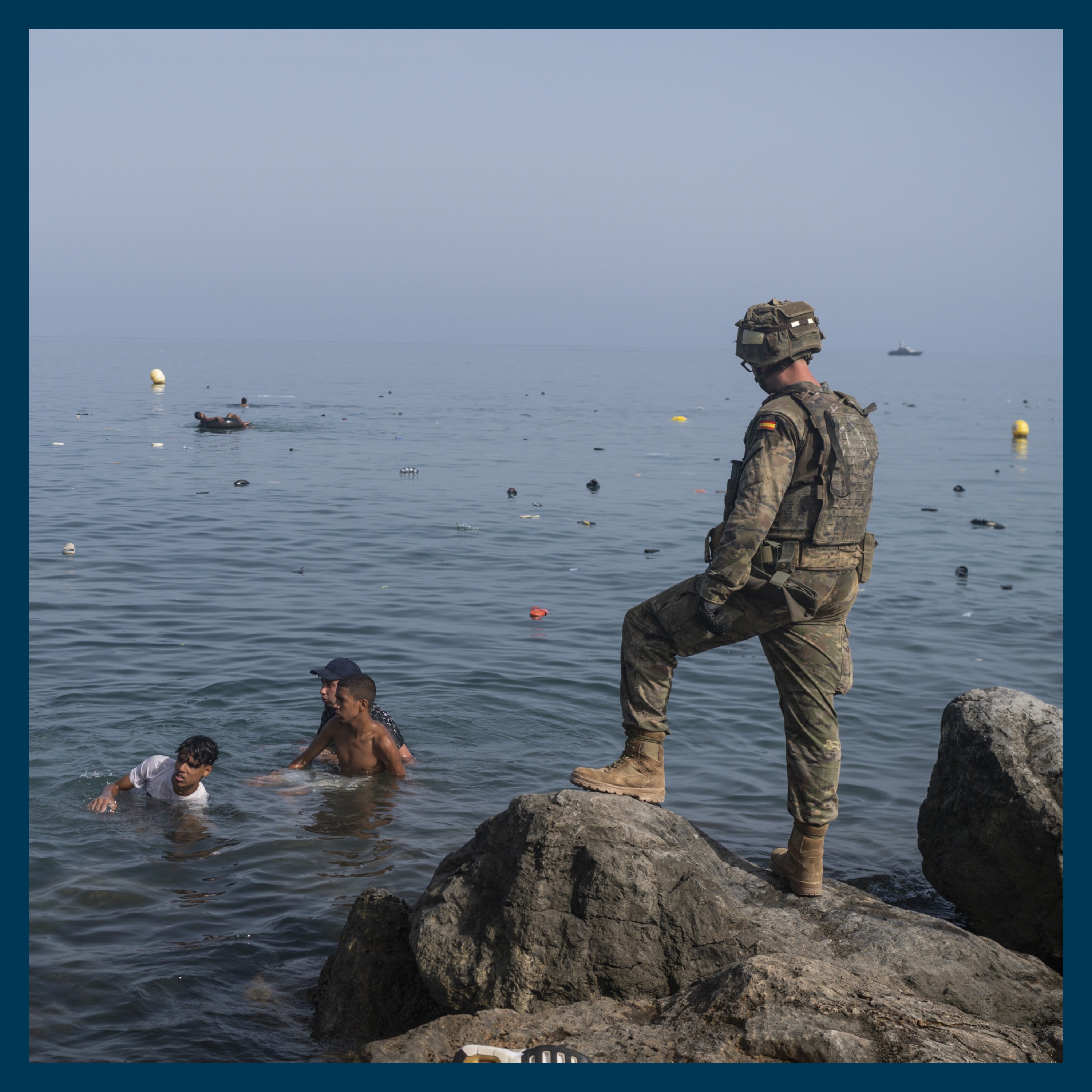
from the Times and the Sunday Times, this is the story. I'm Manveen Rana. They came by land and sea. Tens of thousands of people en masse surged into the Spanish enclave of Ceuta last week.
- [01:33]
Peter Frankopan
About 60,000 migrants have crossed into Spain's North African territory of Ceuta from Morocco in the last 24 hours.
- [01:41]
Political Commentator
Migrants trying to get around the border fence. Some try to skirt around it, others take to the sea and swim around the fence. Dozens of migrants have died trying since Thursday morning.
- [01:57]
Manveen Rana
It was the largest single illegal border crossing in the history of the European Union. The astonishing scene sent shockwaves around the world.
- [02:08]
Peter Frankopan
Italy has said that it has suspended the EU's Schengen free travel regime, with Spain authorities now deploying tear gas water cannons and firing warning shots in an effort to stop tens of thousands of migrants coming in from Morocco.
- [02:26]
Commentator
You know, I saw Spain yesterday and I watched the catastrophe that took place. It looks like an invasion of a country.
- [02:34]
Manveen Rana
And yet within 48 hours, as suddenly as they had come, the majority returned to Morocco voluntarily. Of those Left, more than 70 people are dead. And a humanitarian crisis is unfolding. But how did we get here? Was it coordinated by political actors? And what impact has it had on the hotly contested immigration debate across Europe?
- [03:12]
Peter Frankopan
A nation that cannot control its borders is not a sovereign nation, and Britain is being invaded. I think what happened in Ceta over the weekend shows you just how Serious this situation is.
- [03:25]
Manveen Rana
We'll hear from our reporter who has been in Ceuta and the author, historian and Oxford professor Peter Frankapan. The story today, what really happened in Ceuta?
- [03:45]
Katie Gatens
I was quite nervous turning up, actually. I got the ferry there for from the mainland Spain.
- [03:51]
Manveen Rana
Katie Gatens is Europe correspondent for the Sunday Times and she's just got back from Ceuta, the scene of those recent crossings.
- [04:00]
Katie Gatens
As soon as I got out of the port, really, there were young men, boys actually, carrying flippers that they had used to swim across, queuing at petrol stations, sort of begging to be sold food. Hundreds of army officers with tanks and jeeps and guns, you know, looking incredibly intimidating and directing people away from the main town. And I went to the border and there were still hundreds of people in the sea, wading across, swimming across, some people crawling out onto the sand, exhausted. Those people were being stretchered off. People had swam for miles. And one thing that was really apparent as well is that not a lot of these people can swim. So a lot of them were clutching inflatables. There was women and children, but it was mainly young men. I spoke to one man who I met him, dripping, running out onto the sand, and he just said, viva Espana.
- [05:13]
Interviewer
Katie, we'll get into what's happened to those people who. Who've been arriving in just a moment. Before we do, though, just take us back. Where exactly is Ceuta? Just explain a bit of the history.
- [05:27]
Katie Gatens
So it's on the very, very tip of North Africa, and it's actually been a Spanish territory since 1580. One of the things that really struck me as quite interesting about it is the food. It's a real mixture of North African and Spanish. So you go out for tapas and you get meat skewers that you would expect. I've eaten those in Marrakech. But people there are incredibly proud of being Spanish, I would say, and very protective over that. Along with Melilla, it's another Spanish territory. It's the EU's only land borders with Africa. But Morocco, crucially, has never formally accepted their sovereignty, their Spanish sovereignty. And as you might expect, they're on the tip of North Africa, so they have become a flashpoint for illegal migration.
- [06:15]
Interviewer
That's so interesting. So there is a history of this. This isn't the first time it's emerged, but just describe the scenes that occurred at the end of last week and over the last few days.
- [06:26]
Katie Gatens
As you said, Ceuta has always had seasonally, mainly in the summer, just like ours, illegal border crossings. And instead of small boats, it's people swimming across, or actually jet skis is a big mode of immigration. So there's always been a few dozen people are used to seeing migrants crossing the border, milling around town. But obviously what happened last week was the floodgates opened for a multitude of reasons, and an estimated 60,000 migrants crossed in just a few days. It's the largest single illegal border crossing in the EU's history.
- [07:13]
Manveen Rana
You were there meeting some of the
- [07:15]
Interviewer
people who had managed to get over the border, had managed to swim to Ceuta. What were they telling you? Tell us about some of the people you met.
- [07:26]
Katie Gatens
Yeah, so the next day I actually traveled to the temporary immigration centre, which is on the other side of the territory, up in the hills. I tried to get in to try and speak to some people about what was going on. It was a flat. No, it was surrounded by police, military, but outside of the immigration center, there was hundreds and hundreds. I would say more than 500 people. People who were hungry, thirsty, sleeping rough in the dirt. I met people from Sudan and Syria and Yemen.
- [08:04]
Interviewer
So they're not just coming from Morocco?
- [08:06]
Katie Gatens
No, absolutely not. So I met one man, Quasi al Mahayni, who's 23. He said that he spent 10 hours swimming and thought he was going to die. He said that he had spent about a month traveling through North Africa from Yemen and he was in Marrakech when he saw viral videos on social media. The border is open. Come to Ceuta. All in Arabic. Apparently there are some videos showing exactly how to cross, where to buy inflatables from, even the Google Maps routes up to North Africa, up to the border, almost influencers giving tips and advice. And, you know, it was a painting, a very happy scene about how easy it was. So he thought he'd give it a go.
- [08:57]
Interviewer
So many others had exactly the same thought. And we, you know, we're told around 60,000 people made it into Ceuta, which is, you know, dwarfs the normal population. Give us a sense of how this little city was affected by this huge influx of people.
- [09:15]
Katie Gatens
People described to me, residents of Ceuta described the scene on Thursday and Friday of an invasion of people. And it must have really felt like it. And one young girl I spoke to had been trapped in her home, or felt like she was trapped in her home for two days. She wouldn't have felt safe on the street. And when I arrived on Friday, there was barely any restaurants open. There were small corner shops with groups of migrants asking people who were going in if they could buy them food because they wouldn't be served Is there
- [09:50]
Interviewer
any sense of how so many people managed to get in? Because, I mean, there is a border with Morocco there. Why did so many people manage to get around that?
- [10:01]
Katie Gatens
I think there's a lot of speculation that is ongoing at the moment. And last night, Morocco's Interior Ministry put out a statement that they had acted at the earliest opportunity to this surge. And, you know, I think that a lot of people think that this is not a migration issue. This is a diplomatic issue. I spoke to Pablo Simon, who's professor of political science at the University of Madrid, and he said it's a controversial opinion, but Morocco has used border controls as a diplomatic bargaining chip. And when Morocco disagrees with a specific policy of Spain, they reduce border control in order to be sure that they create an internal problem for the government.
- [10:50]
Interviewer
So, Katie, is the implication that because this was a diplomatic spat, effectively, that the Moroccan authorities turned a blind eye or that the guards there let people through? What happened to the normal policing of that border?
- [11:04]
Katie Gatens
I don't think that Morocco would ever admit to that. Back in 2021, when this happened, there was a very similar diplomatic spat. Morocco relaxed policing at the border, and 8,000 migrants came to Ceuta. You know, my opinion is they tried to do it again, but social media, the algorithm, TikTok, Instagram, just added rocket fuel to this in a way that we have not seen before. And I think it just snowballed. And I think when Morocco potentially tried to get a grasp on the situation, they were just simply overwhelmed.
- [11:50]
Interviewer
Katie, as suddenly as that surge of people had arrived within 48 hours, it felt like it was just as quickly receding. How many of those 60,000 are still in Ceuta?
- [12:04]
Katie Gatens
So there are estimates that there are a few thousand, about 2 to 3,000 migrants who have stayed in Ceuta. The reality is, is that with bars, shops, and restaurants all closed, many just returned home.
- [12:22]
Interviewer
And, Katie, we know that this is a bit of a humanitarian disaster because
- [12:26]
Manveen Rana
of the people who came over.
- [12:28]
Interviewer
Many actually died. More than 70 at current.
- [12:32]
Manveen Rana
the current count.
- [12:33]
Interviewer
Just tell us a bit about.
- [12:40]
Katie Gatens
So the death toll as it stands is currently in the 70s. But as you said, there is a serious humanitarian crisis going on. When I visited the beaches yesterday, there are people in desperate situation. They claim that they have not eaten for three or four days. And organizations like the Red Cross have put out stations saying that they're at crisis point and completely overwhelmed and unable to, you know, relieve staff or provide basic care. I think we're at a point where the focus is still on getting people back across the border. And to do that, they're sort of disincentivized to stay because they're not being provided with food and water and shelter. But there's going to be more casualties and deaths if they are not provided with basic aid.
- [13:41]
Interviewer
Katie, you've been describing the humanitarian crisis in Ceuta and just the events of the past few days. What does Pedro Sanchez, the Prime Minister of Spain, what does he say is behind this sudden influx of people?
- [13:59]
Katie Gatens
Pedro Sanchez, interestingly, blamed trafficking gangs in Morocco so as not to blame the Moroccan authorities. He's found himself, I think, in an impossible situation because he has to work closely with Rabat in order to police the border. In return, Morocco receives hundreds of millions of euros in European funding for border management. So he said the gangs had circulated false information about a Spanish Supreme Court ruling. So, in late June, there was a landmark ruling that defined the border powers in Ceuta. In 2024, a migrant was returned to Morocco after swimming around the breakwaters. And the court ruled that while this return was legal for fences and land borders, it crucially, it did not apply to sea rivals. So Sanchez's saying that trafficking gangs jumped upon this opportunity to kind of accelerate arrivals by the sea.
- [15:07]
Interviewer
That's so interesting. So.
- [15:08]
Manveen Rana
So that ruling does make it legal for people to arrive by sea. Were the gangs, right, Spain, they can't
- [15:14]
Katie Gatens
forcibly return people, but they're saying that, you know, it doesn't count. This last week is you sort of had a, you know, a mass arrival, and we can. And we can circumvent EU law.
- [15:27]
Interviewer
Did the Spanish or the Moroccan authorities, did they know it was coming? Were they prepared?
- [15:32]
Katie Gatens
That's a good question. And I think that now that the crisis has subsided, a lot of people will be looking back and thinking, could this have been preempted? But I think at the same time, there's only so much you can do on the Spanish side if there is a lack of border control in Morocco. There are reports out there of migrants saying that they were waved through and actively encouraged by border police who were saying Spain is this way or directing them to cross. I'm. I'm no idea if that's true, but it's interesting if it is, and just
- [16:15]
Interviewer
explain why the Moroccans would have potentially have been willing to wave people through. Now, if they are using this as diplomatic leverage, what is it they want?
- [16:26]
Katie Gatens
Well, it's created a complete headache, more than a headache, a crisis, really, for Pedro Sanchez. I mean, he's been ostracized from other EU leaders a Spanish minister saying
- [16:39]
Political Commentator
there
- [16:39]
Katie Gatens
are countries that have really shown an absolutely selfish, unsupportive and irresponsible attitude. Italy has revoked the Schengen Zone and is introducing passport checks for third party nationals from Spain. There was a letter to the European Commission and European Union signed by 22 EU member states.
- [17:02]
Political Commentator
France said it would implement tighter border controls with Spain. Italy's Prime Minister, Giorgio Meloni, is suspending free movement of people between Spain and Italy. And Germany's Chancellor demanded that Morocco take back what he called illegal migrants.
- [17:18]
Katie Gatens
There's a crisis meeting being held today and this has all been caused arguably by Sanchez's actions. He's an outlier in Europe. He's one of the very few socialist leaders, socialist heads of state. The leader of the opposition party in Spain said it was very much the Prime Minister's fault and he blamed Sanchez's immigration policy, which allows the regularization of undocumented migrants.
- [17:49]
Spanish Opposition Politician
What we are suffering in Ceuta is a story of a triple failure, the failure of migration policy, security policy and foreign policy. This shouldn't have happened and it cannot happen again. Spain must maintain a relationship with Morocco that is based on mutual respect, cooperation and good neighbourliness.
- [18:10]
Katie Gatens
And as we've seen over the past sort of six months, Sanchez's response to Trump and migration, it's been completely at odds with what Meloni and the rest of Europe is doing. So I think it's a very hot topic, migration at the moment. And I think that if you look at the news and what's happening in the uk, it's really played into the hands of right wing populist political parties. And that is not good news for Sanchez, especially with the general election coming up next year.
- [18:45]
Interviewer
Katie, for you, you are back now in Spain. Obviously, the whole country has, has been shocked by what happened. Having actually been to Ceuta and seen it firsthand, what are you left thinking about it?
- [19:03]
Katie Gatens
Oh, that's a good question. I think I need some sleep. I think that for me personally, and I've visited a few migrant camps now, these people are demonised. People are scared of migrants in the uk, people think that they're criminals and rapists, but when you actually meet these people and speak to these people, they're electricians, they're builders and they were unfortunate enough to be born in Sudan and Syria and they just want a better life. A lot of them want to work. So I think I just have a lot of empathy for the people who are being used as pawns by governments.
- [20:01]
Manveen Rana
Coming up, the historian Peter Frankopan explains a bit more about why this might have happened and how it fanned the flames of the immigration debate across Europe. That's in just a moment.
- [20:27]
Boost Mobile Advertiser (Repeat)
The Scouting reports end Unlock the savings at Boost Mobile get Unlimited Wireless for $25 a month forever and keep your phone. It's a veteran move. Unlock the savings@boostmobile.com Unlock $25 forever requires customers to remain active on Boost Mobile Unlimited Wireless plan. For full offer details, visit boost mobile.com
- [20:43]
Creative Planning Advertiser
for investors at the highest level of sophistication, those with strong advisory support, the natural outcome is two distinct portfolios, one public, one private. Each plays a different role in the overall strategy. Uncover new investment opportunities for you@creativeplanning.com New
- [20:58]
BetterHelp Advertiser
a better help ad after my session and talking to my therapist and really feeling seen and heard for the first time, I just felt like a weight just was lifted off of my shoulders and I felt like it was a good match. From the first time we talked, I could tell people from lived experience that they should try therapy. I could really be myself again and I have this continued support with better help wherever you are.
- [21:22]
Boost Mobile Advertiser
That's where BetterHelp begins. Visit betterhelp.comrandompodcast to get started.
- [21:28]
Katie Gatens
Paid testimonials Results may vary.
- [21:50]
Peter Frankopan
I'm a historian, so the thing that's always interesting is, is why now? And also it's very unusual for tens of thousands of of people to all react the same way.
- [21:59]
Manveen Rana
While those images coming out of SUTA
- [22:01]
Interviewer
were seen by people around the world,
- [22:04]
Manveen Rana
for the author and professor of global history at Oxford University, Peter Frankapan, they raised more questions than answers.
- [22:13]
Peter Frankopan
So the coordination, or I guess suspected coordination is one thing, but also trying to work out what was it that triggered this?
- [22:22]
Manveen Rana
What do you think contributed? I mean, a lot of people have talked about the way Morocco often uses that border as sort of diplomatic leverage. Do you think that was happening here?
- [22:33]
Peter Frankopan
I think states often use borders as diplomatic leverage. I think that that's what Russia has done. That's why the border with Finland, with the Baltic states has been closed, because you can destabilize governments and countries by putting them under all sorts of different kinds of pressure. Lots of this hangs on the relationship between Morocco, its neighbour Algeria, and Western Sahara. Western Sahara is a giant part of West Africa, whose sovereignty has been long disputed. Morocco claims sovereignty, and in the end of Trump's first presidency, the United States recognized Morocco's claim over Western Sahara, essentially in return for normalization of relations with Israel. Algeria sees things very differently. It supports something called the polisaria Front, which seeks independence for Western Sahara for the people who live there. And those relationships between Rabat in Morocco and Algiers have been pretty fractious because of this. But there is a wider geopolitical picture. I mentioned Israel, I mentioned the United States. These 3D chess games are going on not just in Ceuta, in Spain, but in lots of other parts of the world, too. So it looks a recognizable pattern where applying pressure through migration or through economics is a way of a new form of hybrid activity.
- [23:49]
Manveen Rana
And what exactly had happened recently to have triggered a response like this from Morocco in terms of that relationship with Algeria? Why might they be feeling rather miffed?
- [23:59]
Peter Frankopan
Well, in 2021, the Spanish government allowed the Polisario leader Brahim Ghali to receive medical treatment after he got severe Covid and probably some other underlying health conditions, and that in retaliation, something like 10,000 people were essentially waved through the border to show Spain that Morocco has got a set of tools that it's willing to use. In this particular instance, Pedro Sanchez, the leader of Spain, has been quite vocal in a couple of things that you can see why they might antagonize. In the first instance, he visited Algiers about 10 days beforehand. So that would have set some feathers flying. In Morocco, he's been very vocal about Gaza and about recognizing an independent state of Palestine that has raised hackles in Israel. He's been very outspoken. He's also been outspoken in not only not meeting NATO defence budgets, that's antagonized Trump. Trump has used some pretty colorful language to describe Sanchez over the course of the last couple of months, but also not allowing the United States to use Spanish bases for its bombing of Iran or even airspace. So Trump, for example, has called Sanchez a terrible partner. And in fact, at the Ankara meeting of NATO in June, he turned to his treasury secretaries, got, and said, I don't want anything to do with Spain.
- [25:12]
Commentator
Spain is a wasted cause. We don't want to do any trade business with Spain anymore. By the way, I'd like you to cut it off. Spain is a terrible partner in NATO.
- [25:23]
Peter Frankopan
It was not hard to put two and two together and say, well, releasing 50,000 people across the border is a way of showing Spain that, look, you should mind your step.
- [25:41]
Interviewer
That's so interesting.
- [25:42]
Manveen Rana
So for Morocco, it's a way of showing Spain they shouldn't be extending such warm relations with. With Algeria right now. That's. That's not going to go down well
- [25:52]
Peter Frankopan
with Algeria, with Israel, with the US that there's a way, I think, in which the old Fashioned historians like me call this foreign policy. You, you find ways of conducting war through peaceful means and you find ways of applying pressure to people's windpipes to show them that they should think twice before they pick sides.
- [26:10]
Manveen Rana
And you mentioned both Israel and the United States there. I mean, in Israel we have seen over the past year or so, while Spain has been objecting to what's been happening in Gaza and has supported the idea of a Palestinian state, the Israeli Foreign Ministry will put out tweets sometimes saying Spain can't make that argument until they're willing to give up their territories in Morocco. Similarly, in America, we understand that there was a bill passed just two weeks ago which most Republicans signed up to, which again seem to recognize Ceuta as Moroccan territory. Do you think this is, is this sort of a coordinated push by all three countries to try and show Spain they're not happy? How do these things happen? As an expert in how foreign policy is, is applied.
- [26:54]
Peter Frankopan
Well, it's always very lovely to be described as an expert. I think there's a, there's quite a bit of crystal ball gazing in all of this because we don't have the tools, the data, the materials that we would be able to do anything beyond conjecture. I mean, I guess as a starting point, the new social media tools that we've got, the way that people are hyper connected through WhatsApp groups, through other social media platforms means that news can be telegraphed very quickly to mobilize. And as it happens in Morocco, North Morocco is home to lots of informal net settlements called Al Kalyan, which is a play on the French word caviar. The sort of cantons or the slums, I guess, are where Moroccan workers used to live. And you can mobilise people to say, look, there's some news, the ball is going to be opened for you. These things, they can happen naturally, but they can also be galvanized and catalyzed by actors that are incentivized. And usually with things like this, you think, who stands to gain? So you mentioned United States and suites and its status, but there are also a lot of right leaning political parties and far right in Europe that for whom migration is the single most important and effective way of getting people to come and vote. And so those scenes that were televised all around the world would have petrified anybody who thinks that migration is a challenge or is difficult because you think this is the southern flank of Europe being overwhelmed. If you're a far right politician, I don't want to say it's a Godsend for you, but it gives you a lot of material to play with to say, this is why we need to have a firm line against sealing the borders and not allowing anybody into Europe.
- [28:24]
Manveen Rana
And we've seen the issue come into sharp focus here in Britain again just yesterday. Off the back of those images going out all over the world last week, we've had Nigel Farage and Reform putting forward more policies on small boats. Does the case of Souter just go to show how important and how powerful a political issue this has become?
- [28:46]
Peter Frankopan
Absolutely. I mean, I think it's the single one, it's the number one rated issue in every country in Europe today is the question of migration. And I don't think there's a single solution or a single simple explanation about what the right sort of policy is. But yeah, we saw reform politicians turn up in Ceuta to be photographed at the borders to show, look, this is what's coming towards us. And those questions are perfectly valid ones. These things, they do put pressure on local communities where jobs are at risk. They're going through a technological revolution where those are obviously going to be more sensitive at the moment. So migration has become the most important issue in which governments get elected or they rise and fall.
- [29:25]
Manveen Rana
Just finally, Peter, this is the year that you sort of feel like geography is being weaponized. We've watched choke points like the Strait of Hormuz become an incredibly powerful weapon, as strong as a sort of a nuclear deterrent. You know, it's an ability to wage war without having to go to war. Is the same thing happening with border?
- [29:42]
Interviewer
Borders?
- [29:43]
Peter Frankopan
You're probably asking the wrong person because historians tend to be quite good on thinking about choke points, about mountain ranges, about borders, and about the ways in which geography is an important way of thinking about national security. So I think it's been ever thus. It's no surprise that frontiers, walls, borders have been some of the greatest things that have shaped the 20th century. So I think that we, over the last 30, 40 years, particularly here in Europe, have fallen asleep thinking that the world is a very happy, gentle place where people just want to trade with each other. It turns out that it's much more complicated than that. So I think it's just a cold dose of water that reminds us that fundamentals matter and that sort of fairyland of all of us getting on okay, can town that can be exploited quite effectively, whether it's by organized groups, whether it's by sudden pieces of information that are suddenly jumped on by tens of thousands of people or by politicians who want to exploit it either domestically or abroad. And again, we should probably add that a lot of this stuff about migration is funneled by bad actor groups outside Europe from Russia, for example. So we are a long way behind, I think, in thinking about how do we regulate, how do we understand these networks and how do we learn how to shut these things down?
- [30:53]
Manveen Rana
As somebody who has looked at these
- [30:55]
Interviewer
things happening over thousands of years, are there any simple solutions?
- [30:58]
Manveen Rana
How do you shut those, those problems down?
- [31:01]
Peter Frankopan
I think it's very easy when you are growing economically to be tolerant. That's one of the great lessons of great trade networks like silk roads or maritime connections. When things are going well, your ability to understand other people's point of view and to actually search them out and to learn from it, benefit from it, revel in it, you've got a much higher capacity and tolerance to be able to absorb new ideas. When things look tough economically, then everything else starts to close around with you. And so I think it's also a reflection of the fact that life is quite tough for us here in Europe and in fact in many parts of the world. And that's why some of these conversations about what really presses our buttons and antagonizes and scares us are so vivid at the moment.
- [31:59]
Manveen Rana
That was Peter Frankepan, professor of Global history at Oxford University. And before him you heard from Katie Gatens, Europe correspondent for the Sunday Times. The producers today were Olivia Case and Jennifer Kennedy. The executive producer was Harry Stott. Sound design was by Dave Creasy and theme composition was by Malaceto. If you can do leave us a review.
- [32:20]
Interviewer
It'll help others to find us.
- [32:22]
Manveen Rana
And if you'd like to get in touch, do drop us a line to the story@thetimes.com thanks for listening.
- [32:29]
Interviewer
See you again soon.
- [32:43]
Boost Mobile Advertiser (Repeat)
The scouting reports end Unlock the savings at Boost Mobile. Get unlimited wireless for $25 a month forever. And keep your phone. It's a veteran move. Unlock the savings@boostmobile.com Unlock $25 forever requires customers to remain active on Boost Mobile Unlimited wireless plan.
- [32:57]
Optum Advertiser
For full offer details, visit boostmobile.com Healthcare can feel complicated. That's why Optum uses technology to connect the people and processes that make healthcare easier, more affordable and more effective. We're making it clearer for you to know exactly what your benefits cover and to help you better manage your health. We're coordinating care between your doctors and your technology. We believe better, simpler healthcare is always possible. That's healthy optimism. That's Optum. Visit optum.com to learn more.