Loading summary
Transcript79 lines
- [00:00]
Grow Therapy Advertiser
Everyone treats summer like it owes you happiness. Long days, pool parties, your best life on a loop. So what does it mean when you feel worse? The summer blues are real. It's why summer is one of the busiest stretches of the year for people starting therapy. Grow Therapy is here for all the moments when you decide you want more. More support, more clarity, more tools. GROW connects you with thousands of high quality licensed therapists across the US Offering both virtual and in person sessions, nights and weekend. The therapist you want takes your insurance on Grow grow accepts over 125 insurance plans. Sessions average $21 with insurance and some pay as little as $0 depending on their plan. Visit growtherapy.com acast today to get started. That's growththerapy.com acast growth acast availability and coverage vary by state and insurance plan.
- [01:02]
Manveen Rana
This episode of the story is sponsored by PwC.
- [01:06]
PwC Advertiser
Technology doesn't wait, and neither should you. Staying competitive means getting ahead, not just keeping up. PwC takes you further with tech. From optimizing the systems that put your data to work to scaling AI from proof of concept to competitive edge, PwC
- [01:22]
Manveen Rana
helps you meet tomorrow's tech demands so you can compete at a speed that rewrites the rules.
- [01:28]
PwC Advertiser
Discover more@pwc.co.uk
- [01:33]
Manveen Rana
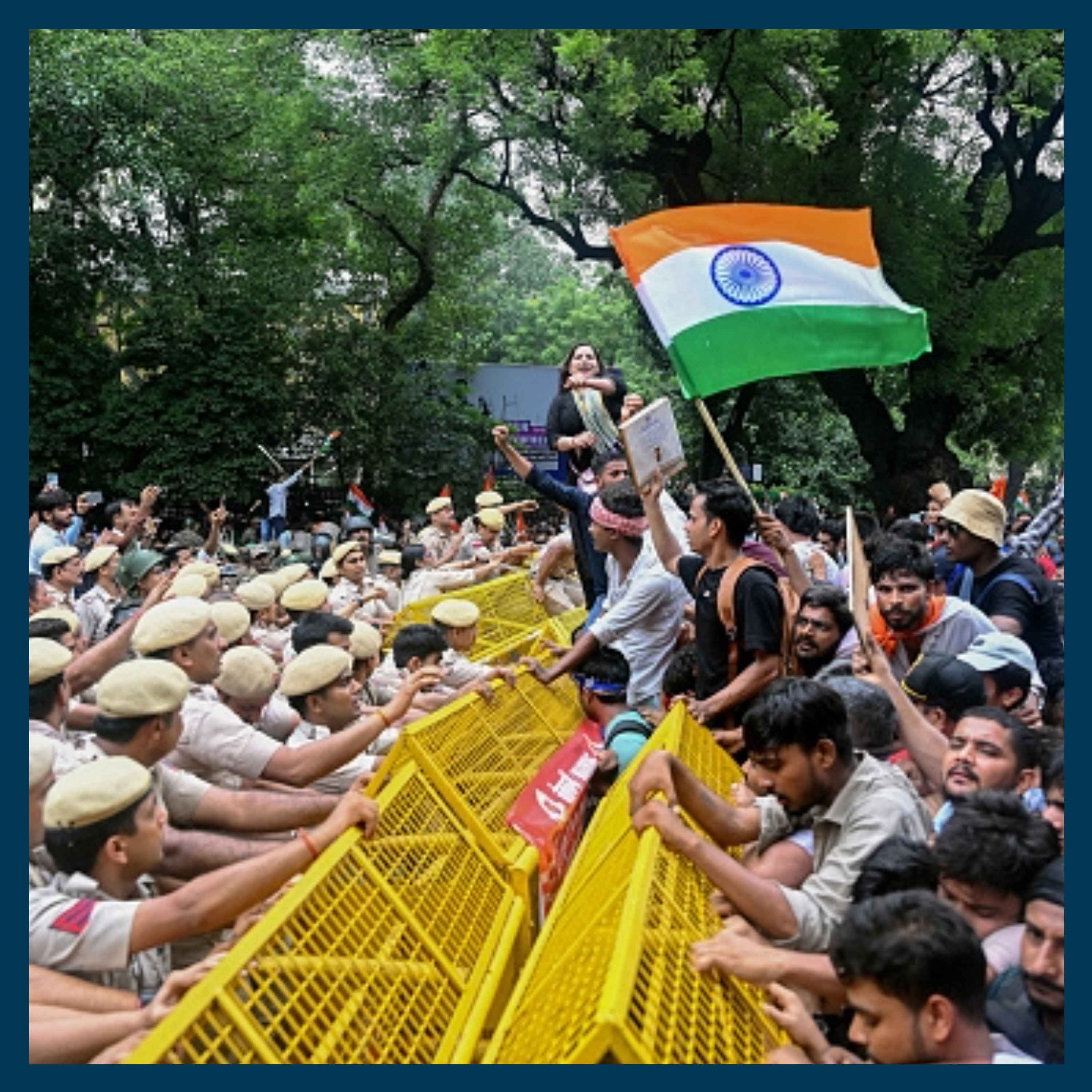
from the Times and the Sunday Times, this is the story. I'm Manveen Rana. In Delhi, India's busy bustling capital and the seat of its sprawling government, it's anything but business as usual. Police unleashed tear gas and used batons to fight off fire thousands of protesters who'd gathered to march on Parliament seeking answers from the Modi government.
- [02:07]
Alexander Balakrishnan
The police are now firing tear gas into the protesters who had breached the barriers and rushed towards Parliament and they had almost reached the compounds of Parliament and now we are seeing them charging the protesters. It was bigger than anything I've ever seen before. Way bigger. Like it was like easy. I can say with absolute surety it was the biggest protest Delhi has seen.
- [02:31]
Amrit Dhillon
The scenes have been quite astonishing judging by the numbers alone. This easily seems like a significant challenge to the Prime Minister Narendra Modi.
- [02:45]
Manveen Rana
So what's caused these protests? Why is it being called the cockroach movement? And how serious a threat is it to India's strongman, Prime Minister Narendra Modi? The story today Modi's cockroach problem.
- [03:36]
Amrit Dhillon
A group of young students have been on protest at a populous site which is designated for protest called Jantar mantar since, well, June 20.
- [03:45]
Manveen Rana
Amrit Dhilan is a reporter for the Times based In Delhi.
- [03:50]
Amrit Dhillon
Now they've been sitting there saying that they will not move until the education minister is told to have assigned. But there's been no response from the government. So in the end they said let's march on parliament to make sure that the government listens to us and to our demand. Now the organizers expected about maybe 10,000, 20,000 people, but the turnout was tremendous. Young Indian men and women turned out from all over north India and from South India. They came by, you know, by plane, by train, by bus, on the metro. And the city was full of people. So by around lunchtime an estimated 50,000 people were there. So suddenly the streets around Jantar Mantar became full of a surging crowd of students who were angry, who wanted to continue this march.
- [04:43]
Alexander Balakrishnan
New Delhi witnessed large scale protests on Monday. The protesters attempted to march to the
- [04:49]
Manveen Rana
parliament announced by the Cockroachanta Party, but
- [04:51]
Alexander Balakrishnan
was stopped at security barricades outside the complex.
- [05:03]
Amrit Dhillon
The police stopped them because there was no permission that had been given for the rally. And in that there was a huge confrontation between the two sides. The police attacked. The crowds attract the students and the protesters with batons and they used tear gas. The students were determined to jump over the metal barricades and reach parliament. And there were pitched battles all over the city radiating out about 2km or more from the central focal site of Jantar Mant.
- [05:37]
Alexander Balakrishnan
Police are now firing tear gas into the protesters who had breaths the barriers out there and rushed towards Parliament. And they had almost streets, the compounds of Parliament,
- [05:50]
Amrit Dhillon
the end of it. About one hundred and twenty young people were injured. One young woman is on a ventilator. Many policemen were injured too. And by the evening the whole city, the streets around Jantamanta looked like a complete mess with wrecked buildings and vehicles and debris and bricks and stones all over the place. But things did calm down by the evening and the protest continues.
- [06:20]
Manveen Rana
And just some of the video clips coming out of Delhi at the moment sort of showed just quite a violent set of encounters, particularly with the police in a way that I think is quite surprising in the West. Just describe how bad it's got.
- [06:33]
Amrit Dhillon
It was quite surprising for Indians too to see this level of violence. I think the problem was the peace. Were unprepared, they expected to turn out, but not so many people. And then on the other hand you had the organizers of the youth protest who also had no idea that so many people would turn out. And you know, they are not organized. This is not an organized group. It's not a political party, it's a group of young people who are trying to reform the education system and get the education minister to resign. And so it was very difficult for them too to figure out what to do when you had so many people on the streets. So they struggled. They had no control of the crowd.
- [07:09]
Manveen Rana
And as you say, the protests continue. Just talk us through what's happened since then.
- [07:14]
Amrit Dhillon
Well, since then the group has reformed at the same spot to Chantamanta. They did meet one minister in the government, the health minister, who asked them what their demands were. So they gave him a letter stating their demands and they've heard nothing back from the minister. And so they feel they've been shortchanged. They're back to square one. And there are more people there now than ever before, despite a scorching sun that's come out right after rains this morning. The rains have made it very, very humid. It was bad weather to begin with, now it's even worse. And don't forget, many of them, certainly the leaders have been there since June 20, day in, day out in this kind of scorching sun in awful weather.
- [08:04]
Manveen Rana
So Emma, to understand how we've ended up having these chaotic scenes of protests and violence on the streets of Delhi, I guess we have to take a step back. So firstly, just remind us a bit about the government that they're protesting against and the Prime Minister Modi, who has been in power for some time now.
- [08:25]
Amrit Dhillon
Yes, he's been in power for 12 years now and has proved to be a very, very popular leader. His party's agenda is that of Hindu nationalism, which is an assertion of Hindu culture and Hindu pride. And many people, critics say that this acts against the minorities. It's harmful for the minorities who are ignored. And over the past 12 years there's also been a lot of criticism from people on the left, from liberals, from academics, from the minorities, that the government simply does not tolerate any criticism or any dissent. So the main criticism of his government over the past 12 years has been that democracy has been undermined, that freedom of speech and freedom of movement have been stifled by Mr. Modin. But nevertheless, he remains hugely popular with his base.
- [09:22]
Manveen Rana
So that's the government of Narendra Modi, a man with a reputation for being a strong man. Now let's turn to the protesters. Tell us a bit about them. How did what's being called the cockroach Janata Party, how did this emerge? How did the cockroach movement come about?
- [09:40]
Amrit Dhillon
It came about because of fury over yet another exam paper leak. This happens in India once in a while. You have A few insanely competitive nationwide exams. Some are for the civil service, some are for government jobs, and some are for a place at medical college to become a doctor. Now for the medical college exams which took place In May, about 2 million to 2.3 million people sit those exams and they have studied to a point which I think people outside India would struggle to understand. Studying 10 hours, 14 hours a day, going to coaching institutes, the families scrimping and saving to pay for those coaching fees. It's a whole industry, it really is soul destroying the way they have to study. But they know they have to study because out of the 2,2 million or so students who will sit the exam to get a place at medical college, there are only about 120,000 places. It's nothing.
- [10:41]
Manveen Rana
I mean those are extraordinary figures, extraordinary figures.
- [10:44]
Amrit Dhillon
But such is the prestige and the possible income that you get as a doctor in India that so many students, young people, do put themselves through this grueling ordeal. But the problem is that in May the exam paper was leaked and the questions came out. So what happens is there are criminal gangs who are working around the exams and it's all to do with corruption and bribery. And so they will do anything. They'll move heaven and earth to get their hands on the questions in the exam paper and then they will sell it to the highest predator, however many people who are prepared to bind. And of course people will pay vast sums because as I said, to get a place at medical college means your career and your income for life are assured. So that it was leaked and so the exam had to be cancelled. So can you imagine, you've worked your guts out for maybe months or maybe a couple of years to sit the exam. You think maybe you've done reasonably well and the whole thing is canceled because it was leaked. And so you have to reset the exam. And the problem is that, I mean, if you were to work like a dog and study like crazy in the way that young Indians do, and you got a job with a good income at the end of it, that wouldn't be so bad. But unemployment is chronic and people, young people feel they have no future. So this is what triggered a lot of fury in India amongst young men and women that why can't they fix the system? Why is this happening?
- [12:10]
Manveen Rana
And Amrit, just as a sign of how serious this is for many of those students, is it true that people have actually committed suicide over this?
- [12:19]
Amrit Dhillon
Well, after the exam was cancelled in mid May, at least a dozen students committed suicide. They simply couldn't face Sitting the exam again. There were two fathers who were there at the protest yesterday, and it was heartrending to hear what they said. One father said that, you know, when he heard that the exam had been cancelled, he said, my son was just absolutely distraught. And then he went quiet. He wouldn't talk to me, he wouldn't talk to his mother. He would just kind of mope in a corner. But he said, I had no idea of the storm that was raging inside him or what he was thinking. And this poor man was a farmer, so you can imagine how he must have scrimped and saved to pay the fees for school, for college and for the coaching. And he said, I'm here because my son took his life. I have to do something to make sure that young Indians don't kill themselves in future over this crazy, examined education system.
- [13:21]
Manveen Rana
So the protesters are calling themselves the Cockroach Janada Party. Where does the term cockroach in this case come from?
- [13:28]
Amrit Dhillon
Soon after the exam was cancelled, there was a young Indian living in Boston. When he heard about the exam being cancelled and so many young Indians committing suicide over it, he was pretty furious. Then what really enraged him was a chance comment made by the Chief justice of India, who happened to say in a random remark that some unemployed youth were like cockroaches. And when this young man, Abhijit Dipke in Boston, heard this, he was outraged and said, well, if you're gonna treat us like that, if you're gonna call us cockroaches, well, okay, we'll embrace the name, let us be cockroaches. But you know what? We're going to fight to reform the system. He got 22 million followers on Instagram in the space of about a few days. So initially this was an online satirical movement and there were memes and videos of people dressing up with a kind of, you know, cockroach mask on.
- [14:21]
Alexander Balakrishnan
Their finally awakened in this country. They have finally woken up and they're coming out in huge numbers. And I'm really grateful for them. Mentally, I'm very motivated and very charged up given the support, the kind of support that I have been receiving from the people.
- [14:36]
Amrit Dhillon
But he touched a chord, clearly, amongst young Indians who felt that their kind of frustrations and their anxieties were simply not being listened to by the government. Because after the exam was cancelled, there was, I mean, hardly any expression of regret and there was no accountability by the education Mr. Dharmendrapadan, who students say should resign if you don't do your job properly and under your watch. And the exam paper is leaked then you should obviously resign. So he tapped into this fury amongst young Indians and so he came back. And since then the corporation movement has held rallies in various cities all over India. The government has for some reason been absolutely steadfast in not even talking to them. They've said just come and talk to us, listen to our grievances. That's all we're asking for. But if, if anything, ministers had been mocking them, calling them propagandists, agitators, you know, people who are just doing what the opposition parties want them to do. And so this young man and other people who felt like him decided to camp at Jantamantar and hold a protest until the government was would listen to them. But actually now it's going to be very difficult for this movement. They really galvanized and mobilized boys and girls all over India. But the problem is what do you do the next day? What will they do for example, tomorrow? They have no sort of ideological direction as such. Obviously they came together spontaneously, first online and then physically. There's no coherent leadership. So how do you now keep up this momentum?
- [16:20]
Manveen Rana
Coming up.
- [16:21]
Alexander Balakrishnan
That's when they started throwing tear gas. They started hitting us with sticks and we basically kept being pushed back into Jantar Mantar.
- [16:30]
Manveen Rana
We hear from a protester about what exactly has been happening on the streets of Delhi.
- [16:42]
PwC Advertiser
This episode of the Story is sponsored by PwC.
- [16:45]
Manveen Rana
AI is everywhere. Return on investment, not so much. So how do you move past the hype and make AI actually deliver? PwC takes you further with tech, strengthening the data quality processes and workflows that shape how well AI performs.
- [17:03]
PwC Advertiser
PwC turns innovation into implementation so you can accelerate from experiment to to scale.
- [17:10]
Manveen Rana
Discover more at pwc.co.uk.
- [17:16]
Grow Therapy Advertiser
everyone treats summer like it owes you happiness. Long days, pool parties, your best life on a loop. So what does it mean when you feel worse? The summer blues are real. It's why summer is one of the busiest stretches of the year for people starting therapy. Grow Therapy is here for all the moments when you decide you want more. More support, more clarity, more tools. Grow connects you with thousands of high quality licensed therapists across the US offering both virtual and in person sessions, nights and weekends. The therapist you want takes your insurance on. Grow Grow accepts over 125 insurance plans. Sessions average $21 with insurance and some pay as little as $0 depending on their plan. Visit growtherapy.com acast today to get started. That's growtherapy.com acast growtherapy.com acast availability and coverage vary by state and insurance plan.
- [18:16]
PwC Advertiser
What's going on?
- [18:16]
Arch Manning
I'm Arch Manning, biore athlete and college quarterback. Whether I'm running, training, traveling or just unwinding at home, I love doing it in my core shorts from Vuori. With a breathable box of brief liner, they're quick to dry, super versatile and stand up to even my most intense training sessions. Plus they come in three inseams and a ton of colors. Ready to try a pair? Go to vuori.com arch and get 20% off at checkout. I think you're going to love them as much as I do. That's V U O R I.com arch and get 20% off your first order. Exclusions apply. Visit the website for full terms and conditions. Not only will you receive 20% off your first purchase, but enjoy free shipping on any US orders over $75 and free returns. Have a great.
- [19:05]
Alexander Balakrishnan
My name is Alexander Balakrishnan and I have been kind of covering protests for the last seven years.
- [19:12]
Manveen Rana
Alexander is a student and content creator based in Delhi. He's been on the ground throughout these protests, which he says are some of the biggest he's ever seen in his home city.
- [19:32]
Alexander Balakrishnan
Around May, I started seeing posts on Instagram about it and they started off slow and then suddenly it was everywhere. Like it was just immediate. So they have 24 million followers and their entirety of their messaging is via Instagram. But they've managed to do it on a very grassroots level without too much funding, and it's been directly up.
- [20:00]
Manveen Rana
What do you think is behind that popularity, that surge in interest?
- [20:04]
Alexander Balakrishnan
I think what happened is that they've been silently shutting down voices here, there, everywhere, and anytime people say something, do something, we get the sense that we're not actually allowed to say it. On a personal level. I felt very stifled. I'm a very political person and I get this sense that I can't say this, I can't say that I can't say this. It's like an unofficial dictatorship. It's obviously not a dictatorship. It's a thriving, officially democratic country. But there's this sense that we can't say stuff. And finally this cockroach Janta party came up and they were saying things which all of us had thought and we would say in our living rooms or in our WhatsApp chats, but we weren't saying out loud. And suddenly we had an outlet to say it out loud, to go to a protest, to be part of a youth movement.
- [20:50]
Manveen Rana
And when this movement came along, was there a Sense that there's almost safety in numbers.
- [20:54]
Alexander Balakrishnan
Exactly. We suddenly saw this Instagram page with 20 million 21, 22 just going up, up, up. And we were like, wait, there's not just me, there's so many other people who feel the same way. And so while right now this movement is concentrated on a very singular objective about this exam paper leak, but there's a sense that it's not just about the exam paper leak. It's a kind of anti incumbency protest.
- [21:17]
Manveen Rana
And now it's turned into something that is is real on the streets as well. You've been there. What has it been like in.
- [21:25]
Alexander Balakrishnan
So over the last week, before the 20th of July, that is Monday, there had been posts about come on Monday, come on Monday, be there, be on the 20th. And they'd been all over Instagram. And slowly there was a kind of a crescendo where you were like, you have to be there on the 20th if you want to be there for this protest. And so we all went very scared on Monday because we heard reports that they were going to arrest us, they were going to throw stones at us, and it was absolutely massive. I've seen protests before in India and they usually, usually been concentrated on Jantar Mantar, this kind of little enclave right around central Delhi. It's a large area, but it's not huge. Usually all the protests have been there, but this was the entirety of central Delhi. I can say with absolute surety it was the biggest protest Delhi has seen.
- [22:07]
Manveen Rana
Wow. And what was it like to be there and be part of that, Especially when the police turned up and it became quite violent.
- [22:18]
Alexander Balakrishnan
The morning started off totally peacefully around 2 to 3pm as we started moving towards Parliament. The basic premise of this protest was that we would move from Jantraman, which is the actual protest site, towards Parliament Street. We did not have permission for it was kind of unofficially moving there. That's when they started throwing tear gas. They started hitting us with sticks and we basically kept being pushed back into Jantar Mantar. Suddenly I would see smoke coming up from the sky, like, ta ta. It was like these loud sounds where you could hear, you could see it go right up into the sky. And they were in quick unison every minute. Then suddenly everyone started running towards me and I realized, obviously they must be actually hitting us. So I also ran away. Then behind me, on another side of the protest, lots of people came out bleeding because they had been hit by latis. Latis are the Indian words with sticks, which the Indian police people are allowed to Carry essentially like batons. And there were reports of the lattes had nails inserted into them. So when they hit people, they were hitting them not just with the wood, but actually with nail as well. There's one girl in hospital on a ventilator right now in one of the hospitals in central Denhi. And there were quite a few injuries, serious injuries. The state machinery is actively working to suppress voices. You know, right now, I was on Instagram and they've kind of deleted so many videos. They've shadow banned them, they put on reports on them. They've shut down 16 metro stations today in Delhi. Think of central Delhi as completely blocked off by Metro today. It's really impossible to get to the protest site right now unless you book an Uber, which is going to cost money for people. You know, it's not going to be cheap.
- [23:54]
Manveen Rana
What are you most hopeful about? If there is a message they take on board, what do you want that to be?
- [24:00]
Alexander Balakrishnan
Stop using state machinery to suppress our voices. Whatever the issue is, one month, there'll be one issue in a country like India, there'll be different, different serious issues every month. But we should be allowed to raise our voices. If they would just allow us an outlet to protest and to actually ask for our demands, we might not actually react so angrily.
- [24:18]
Manveen Rana
So it's really about being more democratic?
- [24:21]
Alexander Balakrishnan
Yeah, completely. Completely. It's all about it. It really feels like a quasi democracy right now, unfortunately.
- [24:37]
Manveen Rana
And Amrit, you described that this is a movement really without a leader. There are, however, some well known activists who are associated with the movement now, including one who's been on hunger strike. Tell us a bit about him.
- [24:49]
Amrit Dhillon
Yes, he's a climate activist who comes from the remote Himalayan region called Ladakh in the north of India. His name is Sonam Wangchuk. He's also known for pioneering education reforms and he's won many awards, both Indian and International. He's 59 years old and he was so moved by these young men and women sitting there under a scorching sun, you know, day in, day out, trying to get their voices heard by the government, that he turned up at the site and said that, listen, I'm with you. I support your demands. And so I'm going to go on a hunger strike until the government agrees to your demands. So he began that strike about now. I think it's been about an astonishing 24 days or so. He's had only water, nothing else. He's lost nine kilos, obviously, in that time. He's had no food and he's very weak. And frail now,
- [25:52]
PwC Advertiser
Yes, indeed, I am still alive. About 20% of my body mass is gone. After the fat, the muscles went. And next the organs will go. Finally, the brain. That stage hasn't been reached yet. Today marks the end of the 20th day.
- [26:16]
Amrit Dhillon
And so his hunker strike did help to give some fresh momentum to the whole movement. But the problem is that I think the government realized that if he were to die at Jantamanta, there would be a price to pay. And so on Saturday, they sent the police in to pick him up. When I said pick him up, they didn't pick him up. They dragged him from the stage like a corpse, corpse, and against his will, and took him to a local government hospital. He is still refusing to have any food or any other sustenance apart from water. And he is saying that, no, I'm going to continue this fast until the government agrees to the movement's demands.
- [26:59]
Manveen Rana
And at this stage, what exactly are the movement's demands?
- [27:03]
Amrit Dhillon
At the moment, there are three. One is, of course, that the education minister should. The second is that, as I mentioned, about a dozen students committed suicide after the Zion was cancelled. The movement says that number is actually 20. They want the government to pay compensation of about 1 million rupees to the families of the children who died. And the third demand is for Mr. Wanchuk to be released because he's been detained against his will by the government. They want him to be released.
- [27:34]
Manveen Rana
And Amrit, lest we forget, India is supposed to be the biggest democracy in the world. None of this sounds very democratic.
- [27:40]
Amrit Dhillon
No, that's what been so mystifying for the young men and women out there, that in a democracy, the government is meant to listen to people, listen to their grievances and to respond in some way and come to some kind of resolution. The problem is Mr. Modi has not held a single press conference in the 12 years that he has been in power. And so there's never a chance for the media or for other people to put questions to him, to, you know, to hold his feet to the fire. So these are some of the things that clearly this movement wants to change, really wants to make this government more accountable, more democratic in its functioning and more responsive.
- [28:26]
Manveen Rana
I mean, to understand how big a moment this is for Modi's government. I suppose we have to look at how much protest and how much resistance there has been to his actions in the past. This isn't the first time there have been big protests in the streets. Just talk us through what he's faced previously over the past Few years, there
- [28:46]
Amrit Dhillon
have been two major protests against Mr. Modi. One was by Muslims who felt that they were going to be affected by a Citizenship Amendment Act. I won't go into the details of that, but they felt that they were being targeted. And there was a very long protest held in Delhi, largely by women, as it turned out, which was very successful. And it drew a lot of support from a lot of non Muslims as well as Muslims, of course. But then, of course, Covid put paid to that and they had to disperse. The other one was the farmers in north India in 2020 and 2021. They were opposed to Mr. Modi's proposed reforms of agriculture. Mr. Modi wanted to overhaul the entire system. They disagreed. In the end, the government did have to relent and those reforms were cancelled. What's different this time is that, and this is interesting to note, is that those were two specific groups, you could say specific interest groups this time. What's different is that the challenge comes from a broader movement. These are young Indians from all over the country from different kind of social backgrounds. So it's a broader challenge to him.
- [30:04]
Manveen Rana
And Amrit, as you mentioned, with the farmers protest, eventually there were concessions. Is there any sign that any member of the government now is willing to engage with this movement?
- [30:15]
Amrit Dhillon
I don't see anything happening yet. Stay on, mate. Could continue. But things keep changing from day to day. So, for example, the opposition parties are now really on board. Earlier, I think they kept their distance. They didn't want to be seen to be usurping at this youth movement, you know, piling on and taking over in any way. And so they really gave them a wide berth and let them be and let them do their protest. But yesterday, the opposition party, the Congress Party, its leader Rahul Gandhi, staged a protest outside Mr. Modi's residence, and he was hauled away by the police and taken to the neighbor's police station. And so in that sense, if the opposition parties make a huge ruckus noise about the youth movement, maybe there could be some response from the government. It's really impossible to say.
- [31:05]
Manveen Rana
I mean, is there any chance that this will actually turn into a political movement in its own right? Could it become a party?
- [31:11]
Amrit Dhillon
I really don't know about that. These are people who have left their homes, their studies or whatever jobs. They had to come and park themselves there. Here in Delhi, they will want to get back to their own lives at some point. I haven't seen anyone in the party say that they want to become a permanent political party with an agenda. And an ideology. And I think they've also made it clear that they want to keep a distance from the established political parties because they know how that will be used by the government. They'll be called the tools of vested interest and all sorts of other terms of abuse. So I think they want to keep their distance.
- [31:45]
Manveen Rana
Is this the biggest threat that Narendra Modi has faced?
- [31:49]
Amrit Dhillon
I would say that yes. In the past 12 years, if we look at the other protests that have happened and there have been many both lagged and support, this seems to be the most significant because it's not just the young men and women you see out there who are protesting. What's surprising is that their parents are on board. Too many came to the protest with their parents who come from very, very ordinary backgrounds. These are not people who are politically active, but they feel angry that these men and women are being ignored. For example, in the neighborhood where I live, most of the people here are absolutely hardcore supporters of the bjp. Yet I was shocked when a cleaning lady came in the other day and she said in the homes where she works, a lot of their families are sending food and water to the protesters, which completely took me by surprise because as I said, they love Mr. Modi. They're full of adulation for him and the party and everything the government has done. So this came as a real surprise to me because they do feel that this is no way to treat young Indians and they feel that, okay, they want to be heard. So listen to them watch the, the big deal. What's the big issue? And just calling them and saying, okay, let's sit down and talk this out. So that struck me as being fairly significant. So yes, I think it does mark some, some erosion in support for him even among his earlier supporters.
- [33:36]
Manveen Rana
That was Amrit Tillon who reports for the Times from Delhi. And before that you heard from Alexander Balakrishnan, one of the protesters who's been out on the streets of Delhi. You can find all the latests on those protests and the Indian government's response to them online@thetimes.com the producers today were Elle Scott and Shabnam Garawal. The executive producer was Harry Stott. Sound design was by Dave Creasy and theme composition was by Maliceto. Thanks for listening. We'll be back tomorrow. This episode of the Story is sponsored by PwC.
- [34:26]
PwC Advertiser
What does an AI ready workforce actually look like? Breakthrough performance comes from combining human intelligence with machine capability. PwC brings it all together and takes you further with tech, empowering you to move faster, solve more complex challenges and unlock new value.
- [34:44]
Manveen Rana
PwC combines talent strength with tech strategy so you can unite human potential with AI power.
- [34:51]
PwC Advertiser
Discover more at pwc.co.uk. now is your time to get into a new Dr. Horton home by taking advantage of its national Red Tag sales event going on right now through Sunday, August 2nd. Stop by any of its participating communities and find select red tag homes at Incredible Pricing. So whether you're buying your first home or looking for an upgrade, you don't want to miss the red tag sales event going on right right now. Discover the Dr. Horton difference at Dr. Horton. Com Dr. Horton America's Builder and Equal Housing Opportunity Builder.