Loading summary
Transcript85 lines
- [00:00]
Paige Desorbo
Hey, I'm Paige Desorbo from Giggly Squad and I want to talk to you about Arm and Hammer Hardball cat litter. Because when it comes to fighting cat odor, they are the champs. Like what? Smell the litter box was my biggest fear when I got my kitty, Daphne. But since I started using arm and Hammer cat litter, I don't notice any cat smell. I always feel confident about anyone stopping by, whether it's my friends or my family or even people in my building. So for my fellow cat parents, be guest ready with Arm and Hammer Hardball cat litter. Find it now at Walmart or Amazon.
- [00:32]
Monday.com Advertiser
This is a Monday.com ad, the same Monday.com helping people worldwide getting work done faster and better. The same Monday.com designed for every team and every industry. The same Monday.com with built in AI scaling your work from day one. The same Monday.com that your team will actually love using the same Monday.com with an easy and intuitive setup. Go to Monday.com and try it for free. Yes, the same Monday.com.
- [01:06]
Luke Jones
From the Times and the Sunday Times. This is the story. I'm Luke Jones.
- [01:17]
Donald Trump
My whole life is all about deals. That's all I ever did is make deals.
- [01:20]
Luke Jones
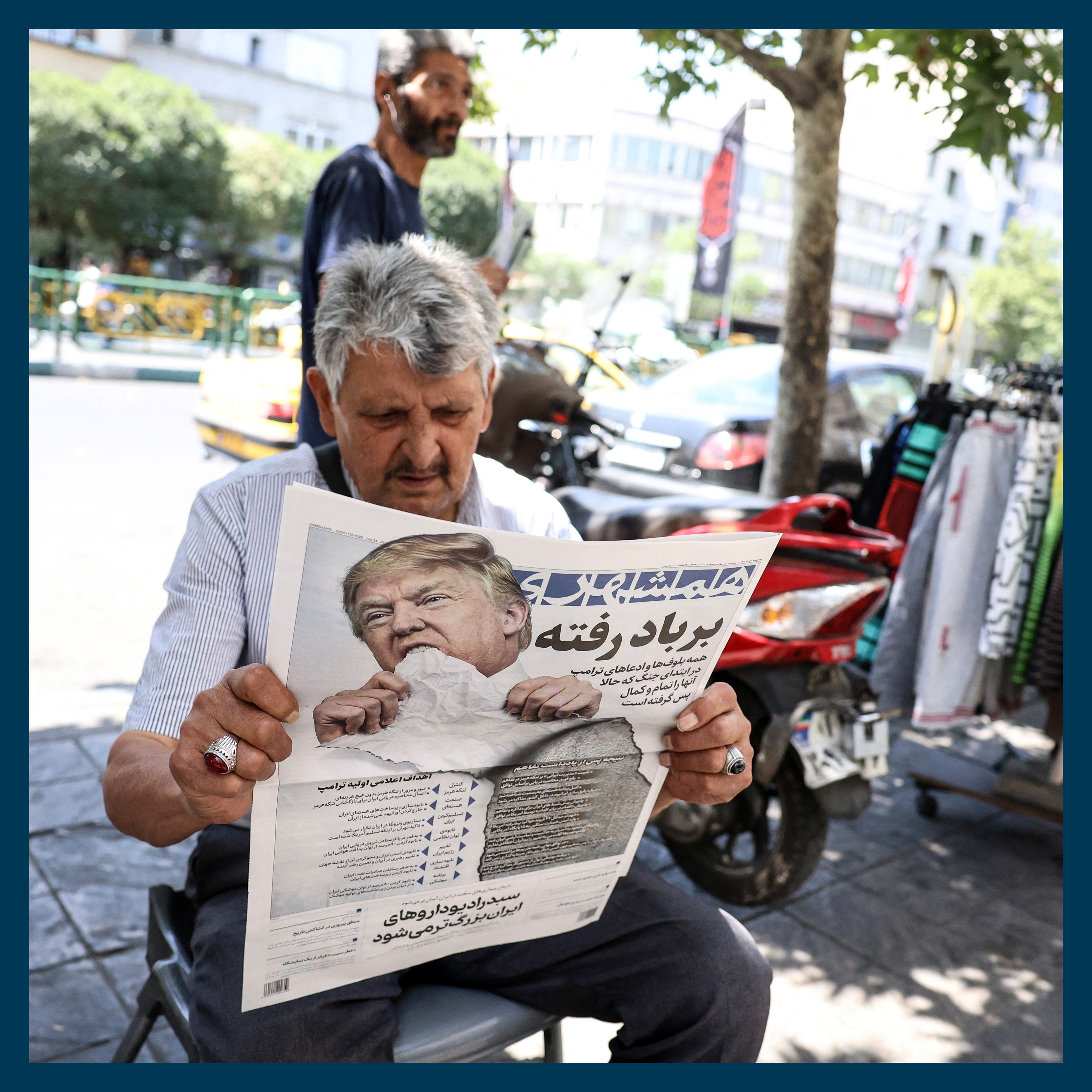
Deal artist, war ender and war starter Donald Trump is calling his agreement with Iran a win.
- [01:28]
Donald Trump
The Obama deal was a road to a nuclear weapon. And let's call it the Trump deal was a wall for a nuclear weapon that the nuclear weapon could not get through. Nobody's going to get through it. And it says very clearly close number whatever, 5, 8 is a very strong statement that they will never have a nuclear weapon.
- [01:53]
Luke Jones
It's paragraph 8 of 14. Iran, quote, reaffirms that it shall not procure or develop nuclear weapons. That's all right then. Some Iranians are pleased with this deal.
- [02:08]
Monday.com Advertiser
Iran's chief negotiator called the deal a quote, record of America's failure. Now that's Iran right now dancing on the table. But the truth is the agreement appears to have a lot for Iran to celebrate.
- [02:22]
Luke Jones
A $300 billion fund for reconstruction and development is promised. The US has agreed to lift sanctions and release an estimated $2 billion in frozen Iranian assets. A countdown has also begun. Both sides have 60 days to agree a final comprehensive deal. As negotiators meet in Geneva today, we are asking, what does this deal look like from inside Iran? What has changed since those Internet blackouts in January and how are ordinary Iranians responding to this moment? The story today, Tehran reacts.
- [03:25]
Fatima Jamalpour
It's so hard because of the Internet blackout. And you Know, people who talk to foreign media could be arrested and sentenced to the jail or even, you know, sentenced to being a spy. So it's dangerous.
- [03:40]
Luke Jones
Fatima Jamalpour is an Iranian journalist living in exile in the US because of
- [03:45]
Fatima Jamalpour
my reporting about Women Life Freedom Movement, I had to leave.
- [03:49]
Luke Jones
You may remember it started after the death of 22 year old Mahsa Amini, who was arrested for not wearing her headscarf and died in custody. Now Fatima faces an uphill battle when reporting on what is happening in her home country.
- [04:04]
Fatima Jamalpour
People are risking their life to talk to me and I, I'm trying also to protect their identity and protect them. It's not easy and it's getting harder and harder because of the Internet blackout that has been there since the January protest.
- [04:23]
Interviewer
And just explain that because that was when we started to see these uprisings of ordinary people in Iran. And what that Internet blackout quite swiftly came because the regime was worried about how people might be using it to organize or get news out of Iran.
- [04:40]
Fatima Jamalpour
Yes. So by the last days of December of last year, there was economic protest in Iran. It spread across the country so fast. And in January 8 and 9 we had a huge demonstration against the entire regime. Millions of the people were in the street, street protesting and the regime shut down the Internet within the first hours of the protest in January 8th across the country. For me as Iranian journalists, it means that there is something happening there because we saw this Internet blackout before. Like in November 2019, they shut down the Internet for the first time for five days and according to Reuters, they kill 1,500 protesters or again in Women Life Freedom Movement. In September 22, they did Internet shutdown and they killed 500 people. So whenever there is a protest and the regime blackout, the Internet for me as Iranian journalists means they are suppressing and they don't want war to watch, to see what's going on there.
- [05:54]
Interviewer
We then, not too long after that latest blackout, after those protests had of course the, this American and Israeli offensive on Iran. And Trump famously said at the time, you know, help is on the way. If you're Iranian and you don't like the regime, we are here to go and help you. This might be your last chance in a generation to help topple your regime.
- [06:14]
Donald Trump
To the great proud people of Iran, I say tonight that the hour of your freedom is at hand. When we are finished, take over your government. It will be yours to take. This will be probably your only chance for generations.
- [06:31]
Interviewer
But as far as you could tell, how are the Iranians who you knew reacting to that American and Israeli bombs falling on their cities.
- [06:41]
Fatima Jamalpour
It makes protesters to think that they really have the support of, you know, the most powerful country in the world. And he's really mean to help them. But it was the empty promise, you know. And his rhetoric changed during the wartime like before the war they sold it as, you know, we want the regime change, we want Iranian people to be free. But during the war his rhetoric changed. They realized that no, these foreign countries doesn't have any good will for them. You know, what we are seeing nowadays after reaching to this memo random, is that no, this war and this foreign countries have nothing to do with the protesters in Iran.
- [07:29]
Interviewer
Yeah. And can you sense from where you are what the split has been like throughout this conflict of people welcoming the firepower of the United States and Israel in trying to topple the regime and those who have been trying to defend the regime and have been out on the streets supporting it.
- [07:49]
Fatima Jamalpour
According to Cameroon Institute survey that was hold two years ago, 70% of Iranians are against this regime. So people were optimistic that this war ended the regime in the first days. But soon they realized that no, it has nothing to do with regime change. And then school children got killed by the US bomberment.
- [08:14]
Narrator
Few attacks have left a deeper mark than the strike on a school in southern Iran on the war's opening day. More than 150 people were killed when airstrikes hit the school in Minab, most of them children. And there is little dispute that the missiles were American made and they started
- [08:31]
Fatima Jamalpour
to heating the infrastructure.
- [08:33]
Narrator
Different places, including infrastructural facilities have been impacted. Some of them even directly hit, including Sharif University of Technology which is known as Iran's mit.
- [08:45]
Fatima Jamalpour
So people then wanted to end the war. But regime supporters have been on the street since the first day. They are against deal. They wanted war to continue. They nowadays chanting in their demonstration rallies, I mean pro regime people that the Iraqi, the foreign minister should be executed. So I should say both war and deal got received in different way. You know, within the conflict depends on if people were against the regime or were pro regiments.
- [09:21]
Interviewer
And we now have this deal. Well as you say, a sort of memorandum of understanding between the Iranians and the Americans. A kind of precursor to a 60 day ceasefire where they need to properly negotiate some of the outstanding issues. And that will end the fighting. It will end the fighting, including in Lebanon. The US naval blockade will end. The Strait of Hormuz will open and will be toll free. There's talk of a $300 billion development and reconstruction fund for Iran and the lifting of all sanctions, but with a schedule to be agreed. And that obviously all hinges on Iran agreeing that Iran will never have a nuclear weapon and they will work together on trying to remove their enriched nuclear material. From your vantage point and from the people that you're speaking to, how will this be received, do you think?
- [10:12]
Fatima Jamalpour
So in general, I should say Trump are reaching to a deal that doesn't have that much difference from the Obama deal from 2015. Yeah, what's changing is adding Hezbollah and Lebanon into the deal. But from the people, ordinary people point of view, what the millions of Iranians realized after the nuclear deal in 2015 was that they didn't benefit from it. Regime received billions of dollars and spent it in its proxy group and in adding to its suppression tools to suppress protesters. And people know that these new deals has nothing to do with their life, their country, economy. But the only things that this deal has is this pause in the war. So the people that I was talking were like, at least we are happy to not hearing, you know, the sounds of jet and bomberment at any moment.
- [11:16]
Interviewer
But still comparing that to Trump's rhetoric towards the start of the war when he talked about help being on the way and this is your chance to help topple your regime to maybe now arguably helping to prop it up with no sanctions and economic redevelopment fund. I don't know, people must be feeling quite betrayed.
- [11:36]
Fatima Jamalpour
Maybe people do. And also the other part of this ongoing wall and this deal was that the regime did the most execution. You know, the execution rate getting to highest level in Iran because regime using this situation to suppress people. And also people are saying that human rights and execution and the fate of the imprisoned protester has nothing to do with this deal. They never put the human rights situation in Iran on the table of the deal. You know, since the war started, the regime executed innocent teenager who were in the protest during January.
- [12:18]
Grow Therapy Advertiser
While the world has been watching the war between Washington and Tehran, Iran has been quietly carrying out the fastest wave of political executions in its recent history.
- [12:30]
Fatima Jamalpour
They have been executed about 50 protesters of January protests. Why Taran was talking about he, you know, posed the execution in Iran before start the war. But nowadays they don't talk about it anymore. Yeah, people feel they are betrayed.
- [12:51]
Interviewer
If you were the the new Ayatollah, how would you be feeling about this deal?
- [12:56]
Fatima Jamalpour
I don't think he would be happy about it. You know, hardliner in the estuary demanding for the revenge for his father. And I think his situation is Shak. And we know that there is a huge difference within the regime about this deal. Like the Kalibov, he's a technocrat and he was a spokesperson of parliament and who won the sign aid and the reformist president administration wanted it. But hardliner like Saeeda Jarieli who was the head of negotiation and close to supreme leader and many people within the irgc, Iranian Revolutionary Gold clubs, they don't want this deal and I think we will see much more indifference within their regime in the next months.
- [13:48]
Interviewer
So when Trump says, as he did on Wednesday, that he thinks that actually the new set of leaders that are in place in Iran because of all this conflict and all the people that they have taken out are, are less radicalized, is he right or wrong on that front?
- [14:04]
Fatima Jamalpour
There is not any sign for that. As I mentioned about the execution rate and how the regime suppress people, there are thousands of checkpoints by IRGC across the cities who stop the cars, who search people phone, you know.
- [14:31]
Luke Jones
Coming up, what are Iranians telling Fatima about what life is like for them in Iran and what peace might mean for them too?
- [14:38]
Sarah
I don't think people can tolerate this economic situation for more than the next two to three months. It's getting worse day by day.
- [14:46]
Luke Jones
That's in a moment.
- [14:56]
Paige Desorbo
Hey, I'm Paige Desorbo from Giggly Squad and I want to talk to you about Arm and Hammer Hardball cat litter. Because when it comes to fighting cat odor, they are the champs. Like what? Smell the litter box was my biggest fear when I got my kitty, Daphne. But since I started using Arm and Hammer cat litter, I don't notice any cat smell. I always feel confident about anyone stopping by, whether it's my friends or my family or even people in my building. So for my fellow cat parents, be guest ready with Arm and Hammer Hardball cat litter for find it now at Walmart or Amazon.
- [15:27]
Grow Therapy Advertiser
The pressure to have a summer worth posting about is real. So is financial stress, social exhaustion, and the anxiety that sneaks in right when things are supposed to feel good. Grow Therapy can help with that. Whether it's your first time in therapy or your 50th. Grow makes it easier to find a therapist who fits you, not the other way around. They connect you with thousands of independent licensed therapists across the US offering both virtual and in person sessions, nights and weekends. Whatever challenges you're facing. Grow Therapy is here to help. Grow accepts over 100 insurance plans. Sessions average about $21 with insurance and some pay as little as $0 depending on their plan. Visit growtherapy.com acast today to get started. That's growththerapy.com acast growththerapy.com acast availability and coverage vary by state and insurance plan.
- [16:27]
Wealth Management Advisor
Because you didn't just say how can I provide these investments? You'd be how do I holistically provide everything? How do I bring in the legal, the accounting, all this and do it at a price point no one else is doing it.
- [16:36]
Paige Desorbo
Learn more about how we approach wealth management@creativeplanning.com integrated.
- [16:53]
Interviewer
Fatima we're talking about this memorandum of understanding between the United States and Iran which has paved the way for this 60 day ceasefire cessation in fighting. As some of the thornier details are worked out, Iran has partially returned the Internet. How has that happened? And have you got any sense that life is improving or at the very least calming down for ordinary people?
- [17:19]
Fatima Jamalpour
So I should say the Internet didn't return back to what it was before January protest. The last statistic from Zoomit Media said that 70% of Instagram user never return back to Instagram. Many limitations is there. So like social media are filtered, messenger app are filtered. People need to buy VPN to have access to this kind of Internet. The difference is that they only like reopen the Google and Gmail and some really basic Internet part, not the whole of it. It's really costly for people because we know that the inflation is high there. The economic situation is like a disaster. More than 40 million of people nowadays are living under poverty line and the cost of VPN has added to people and I think this kind of just opening a bit of Internet after that longest Internet blackout in the modern history. According to Netblocks they reopen it after 88 days is not a free Internet. It's like just a narrow window because it was so costly for business. According to regime official, it cost about 80, 80 billion dollars daily. And many businesses, you know, got broken. Many people got unemployed. They had to do that of course
- [18:56]
Interviewer
because I guess so much business is done using the Internet.
- [18:59]
Fatima Jamalpour
Yeah, exactly.
- [19:00]
Interviewer
If it is now just a small window, then that has opened. Who have you been able to speak to recently through that about what life is like now in Iran?
- [19:09]
Fatima Jamalpour
Because I used to be a journalist there, you know, I have still my connection since reporting of years in Iran. And whenever they are connected I'm in contact with many sources. Recently I talked to an injured protester from the January protest who got shot in the feet and is disabled. Or like I talked to a teacher, I talked to a student, 16 years old about how they feel One of the People that I talked to was Sarah. She used to be a journalist, political journalist in Iran. She's in her 40s and she's working another job as she wasn't able to continue her work as a journalist after she was in prison after Killeen movement in 2009 in Iran.
- [19:56]
Interviewer
And how did, how did you speak to her and what does she have to say about how she sees things at the moment?
- [20:02]
Fatima Jamalpour
Yeah, so we spoke through Telegram. So she used a vpn, pay for VPN to get connected to the telegram and we talk through it. She's one of the few people that I found inside Iran who is optimistic.
- [20:20]
Sarah
I generally have a positive outlook on everything that will happen in the future.
- [20:24]
Fatima Jamalpour
Because she thinks this deal with the US would weaken the Islamic Republic regime.
- [20:33]
Sarah
The Islamic Republic will be forced to submit to major changes. And those major changes, in my opinion, will bring its demise.
- [20:41]
Fatima Jamalpour
Because through her eyes, the regime has had two pillars all of these years. One was implementing like duress code Islamic rules in the society, like mandatory hijab. The other one was hostility with the US and Israel. And nowadays they have lost both of that.
- [21:04]
Sarah
Now only its political pillar remains. And that in fact is anti marriage. And with this agreement, that pillar will also fall apart.
- [21:14]
Interviewer
How do you mean?
- [21:16]
Fatima Jamalpour
So they are not able to control the hijab anymore. You know, since the war started, there have been many public parties in Tehran. When people dance, listen to music, and these are forbidden in Iran public spaces since a few years ago and even before this war. So it seems that the regime cannot control hijab anymore. They don't have tools, they don't have people, you know, they don't have budget to implement hijab rules anymore. And also nowadays they are dealing with the US whom killed the former supreme leader, you know, and they have not even been able to, to hold a funeral for him. They are, we can now, in the eyes of their hardliner, support her even.
- [22:15]
Luke Jones
Yeah.
- [22:16]
Interviewer
Do you think the way that it currently is for ordinary people in Iran? You mentioned that some women can go out currently and you know, not wear the hijab because things aren't being enforced. Do you think all of that will last or is that just temporary?
- [22:31]
Fatima Jamalpour
Yeah, I think the freedom in the history, all of these public parties that is holding, I don't think that it would be permanent. I think the regime, they are going to suppress people again and trying to impose Islamic rule. But regarding the women hijab, I don't think that they could impose hijab rule anymore because they cannot arrest millions of Iranian women. And nowadays I see people, young women are working in a top, in a short, in a sports bra, you know. Yeah. And the level of the determination and the resistance of Iranian women is much more than the regime potential to suppress them. Yeah.
- [23:22]
Interviewer
What does Sarah, the woman you, you've been speaking to, what does she make of the memorandum of understanding?
- [23:29]
Fatima Jamalpour
So she thinks that this is a loss for the regime, but she didn't see it as something permanent. And also she said it's too soon to think about it as something that is finalized.
- [23:46]
Sarah
Look, I think it's a little early for us to have a feel for this agreement. The reality is that there are so many strange things happening and everything has become so unpredictable.
- [23:58]
Interviewer
And what about the strength of the regime going forward? Of course, there are still lots of economic pressures. There are still lots of angry people who would like to see the regime go. Could she or could you foresee a future where they do fall?
- [24:12]
Fatima Jamalpour
Yeah. She thinks that there would be another huge protest in Iran and the regime is weakened to suppress that in other way.
- [24:24]
Sarah
It's getting worse day by day. I think people will come to the streets with much more anger and we will see the collapse of the force of repression.
- [24:32]
Fatima Jamalpour
And also she thinks that we will see that many people within the regime will stop supporting because regime cannot support them economically. You know, this economic situation affected their lives and their family lives as well.
- [24:49]
Sarah
I don't think people can tolerate this economic situation for more than the next two to three months.
- [24:54]
Fatima Jamalpour
We don't see any will to do reform within the regime, you know, or to fix economic problem. They have been dealing with this inflation for a year since Trump withdrew the sanctions. So it's not something that the regime can work on and solve it, surely, unfortunately.
- [25:14]
Interviewer
And what have other people been telling you within Iran about the economic situation is.
- [25:23]
Fatima Jamalpour
It's so bad, bad. You know, millions of people cannot afford buying meat or chicken anymore. They are struggling to buy eggs, basic bread. You know, the medication is so expensive. Many people could not have access to their medication because of the price. And day by day they just drop in the poverty. For me, it's really painful because I'm witnessing my people, you know, all of them dropping in poverty. And day by day the currency lose its value. The inflation of the Goods has reached 180% in the last month. You know, the prices changing day by day. People are struggling to buy basic, I mean, like milk, like eggs. You know, I talked to people like Hossein was a 50. He said more people are relying on Buses now as car prices have increased. Education has also stalled. He's hoping for a return to a normalcy with peace or art means. She's 16, she's a student and she's happy with the deal as long as it helps to economic situation. Because she wants to immigrate, she don't want to stay in Iran. She doesn't see any future future for herself or like Mahru. She's an English teacher. She lives in Karaj near to Tehran. And she said in my view the economic pressure are so severe that this agreement no longer have much effect on people's lives. She said, I've become numb. Like many people have told this to me.
- [27:17]
Interviewer
Have you sensed any optimism from people about if there is peace and it is sorted out that the economic situation in Iran will massively improve and they
- [27:28]
Fatima Jamalpour
will feel that honestly no, people are not optimistic that this deal will help them. The only optimism about the deal for them as I mentioned was that there will not be a war for at least 60 days and they will not see bombing, they will not hear the fighter jets voices. The only optimism that they have is that.
- [27:54]
Interviewer
And what about you Fatima? Are you optimistic at the end of this 60 days there will be some kind of a negotiated peace that will, that will last and maybe make a difference to people and our lives.
- [28:05]
Fatima Jamalpour
I really wish that the economic situation get a bit better, you know, like my whole family are living there, there. My brother is so young, he's 24 and he don't see any future for himself. Even before this far he told me I calculated and for buying a home I need to work 100 years. You know, they don't see any future and there is not any future there. I really hope that the regime, you know, would get a lesson from all of these years and trying to just establish economy. All these people want is a normal life. They don't want to chant this to this, this to that, you know, they don't want this ideological regime and they just want some social freedom and economy stability.
- [29:02]
Interviewer
People just want a normal life.
- [29:04]
Fatima Jamalpour
Yeah, only, only a simple normal life that have been, you know, given away from them for 47 years.
- [29:28]
Luke Jones
That was Fatima Jamalpour, an Iranian journalist and author of for the Sun After Long Nights about Iran's women led uprising in 2022. The story at the times.com is our email address. Should you wish to get in touch with us, give us your thoughts or your questions on this or any of the other stories we've been talking about
- [29:46]
Interviewer
on the podcast, today's producers were Sophie
- [29:49]
Luke Jones
McNulty and Elle Scott. The executive producer was Edward Drummond, and sound design and theme composition was by Mala Sato. I'm Luke Jones.
- [29:59]
Interviewer
See you soon.
- [30:35]
Wealth Management Advisor
Because you didn't just say, how can I provide these investments? You'd be how do I holistically provide everything? How do I bring in the legal, the accounting, all this, and do it at a price point no one else is doing it.
- [30:44]
Fatima Jamalpour
Learn more about how we approach wealth management@creativeplanning.com integrated hey, I'm Paige Desorbo from
- [30:50]
Paige Desorbo
Giggly Squad and I want to talk to you about Arm and Hammer Hardball cat litter. Because when it comes to fighting cat odor, they are the champs. Like what? Smell the litter box was my biggest fear when I got my kitty, Daphne. But since I started using Arm and Hammer cat litter, I don't notice any cat smell. I always feel confident about anyone stopping by, whether it's my friends or my family or even people in my building. So for my fellow cat parents, be guest ready with Arm and Hammer Hardball cat litter. Find it now at Walmart or Amazon.