Loading summary
Transcript84 lines
- [00:01]
Manveen Rana
From globalization to innovation sustainability to market volatility, there's always more than one side to a story. Explore different perspectives on today's most important
- [00:11]
Tom Whipple
business and economic issues with the Flipside podcast from Barclays Investment Bank. Hear two research analysts in a lively debate and get insights from every angle. To further inform your view. Listen to the Flipside on your favorite platform.
- [00:29]
Manveen Rana
This episode of the story is sponsored by PwC.
- [00:32]
Tom Whipple
Technology doesn't wait, and neither should you. Staying competitive means getting ahead, not just keeping up. PwC takes you further with tech. From optimizing the systems that put your data to work to scaling AI from proof of concept to competitive edge, PwC
- [00:49]
Manveen Rana
helps you meet tomorrow's tech demands so you can compete at a speed that rewrites the rules.
- [00:55]
Tom Whipple
Discover more at pwc.co.uk.
- [01:00]
Manveen Rana
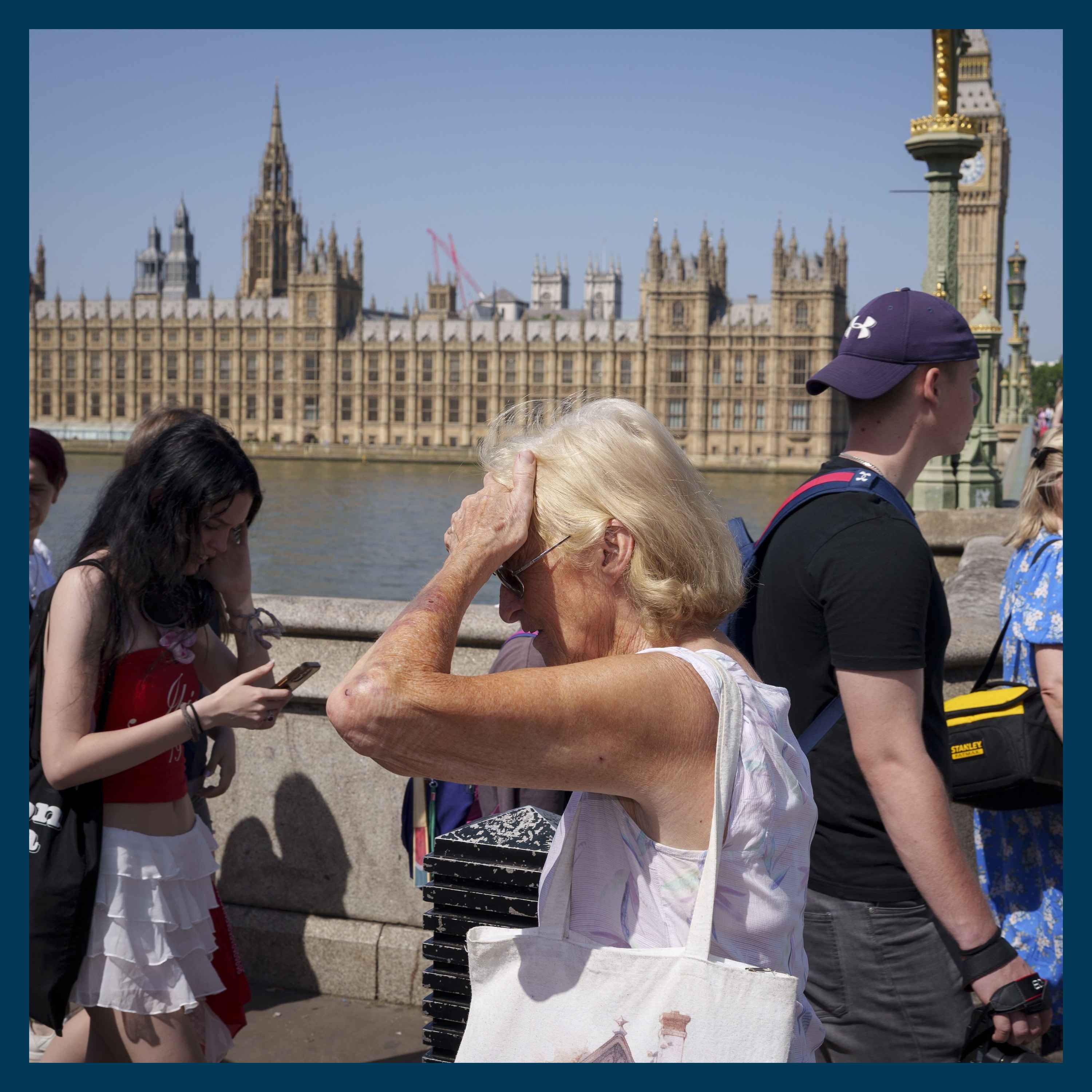
from the Times and the Sunday Times, this is the story. I'm Manveen Rana. Another week, another heat wave in this scorcher of a British summer, the heat wave is back.
- [01:17]
Tom Whipple
Temperatures predicted to Soar through the 30s. It's been the hottest June day on
- [01:22]
Manveen Rana
record in the UK so temperatures peaked at 36.1 Celsius. And it continues to the extent that we have another red weather warning. Scorchio. In the past, a heat wave would have been a source of national glee and Mr. Whippy's all round. But in 2026, it's not so cheery. As the reality of climate change begins to bite, extreme heat starts to feel like the new normal. The UN Climate chief said the savage heat wave across Europe showed what climate crisis looks like in practice.
- [01:59]
Tom Whipple
Extreme heat we're going to see over the next 48 hours or so could affect your eye, could affect perfectly healthy people.
- [02:05]
Manveen Rana
People in Britain and on the continent are sweltering.
- [02:08]
Tom Whipple
Wildfires in southwest France, eastern Spain and
- [02:12]
Manveen Rana
Thessaloniki, Greece, and our national infrastructure is struggling to keep up.
- [02:18]
Tom Whipple
There is a danger to life. It's led to hundreds of schools closing and train companies warning of potential disruption.
- [02:27]
Manveen Rana
So why does it feel like Europe is worse affected than the rest of the world? Should we all be installing aircon now? Or will some James Bond like solutions involving spraying the stratosphere or pumping seawater onto the Arctic fix our summers? As with all big scientific conundrums, we've asked the Times science writer Tom Whipple to find out. The story today. Why can't Britain handle the heat? Tom, you're looking very cool and unflustered. Are you sleeping? How are you coping with the new normal?
- [03:20]
Tom Whipple
I probably come into the office more because we have air Conditioning. It's interesting. I love the heat, but something feels amiss in Britain at the moment. It just doesn't feel quite right.
- [03:29]
Manveen Rana
It doesn't feel right. And you're right, people are coming into the office more for the aircon, but the commute is another form of torture.
- [03:35]
Tom Whipple
Yes. Yeah. When I'm. I have some air conditioned trains sometimes not air conditioned trains. And I actually cycled from the station today because I thought I don't want to do the Tube and I want to feel the breeze.
- [03:48]
Manveen Rana
Create a breeze.
- [03:49]
Tom Whipple
Yeah.
- [03:52]
Manveen Rana
I do feel like I'm having a lot of these conversations at the moment. Most conversations are about how you coping. Why is that? I mean, obviously for all of us, it feels like the world is on fire, everything's much, much hotter than normal and then I get into a cab and everyone will sort of say, you don't know what it was like in 1976. So just quantitatively, is it actually hotter than we've been used to before? Cause it does feel like in the past, 30 degrees was a heat wave, a miracle, and now it's kind of become almost Norma.
- [04:22]
Tom Whipple
Yeah. So there were years when you wouldn't get a 30 degree day in Britain. Probably this year we will exceed 1976. I mean, we've exceeded it already in terms of absolute temperatures, but we probably will. When we look back at it, say this was a warmer summer than that great summer of 1976. Heath and forest fires suddenly became almost commonplace in August. From the New Forest to the Wiltshire Downs, from the farms of Gloucestershire to
- [04:48]
Manveen Rana
the Quantock Hills, the story was the same. Got any special tips for keeping cool in this weather?
- [04:53]
Tom Whipple
Yes. Keep your mind cool. If you keep on telling yourself over and over again how hot it is and how terrible it is, you get hotter and hotter and hotter. I would say that if you have a summer which is talked about for two generations, then it's probably not your best comparator for what a British summer can do. The other thing about 1976 was it was a really weird concatenation of events. If you look at a global heat map for 1976, you see a big red blob on Britain. If you look at a global heat map for 2026, you see a big red blob on the world. Britain is not anomalous. In 1976, Britain was anomalous. This year we're not at all anomalous. And if we got a comparable anomaly, well, I mean, you know, we were below 1976 ounce of water. It was a very strange Year specifically
- [05:47]
Manveen Rana
for Britain, as you say, it now does feel like there is a red blob on the world and in particular Europe. You know, we're not the only ones who are sweltering. I was in Paris a couple of weeks ago, they were hitting 40 degrees, which just seems bonkers. Where is it happening? Where is this heating happening and why?
- [06:06]
Tom Whipple
So we have to be slightly careful because what, you know, global warming skeptics, what they, the less sort of scrupulous of them would do is find a cold period, find, you know, when it's a bit under the temperature, when it's very cold in winter and say where's your global warming now? And then what, what people will say is, well that's weather, not climate. And of course we are experiencing now weather, not climate. Weather is the variation from the trend. It's the ups and downs and all of the things. But the weather is worse because the trend that it is varying from is one that is continually up. So I'll get that out of the way. We are talking about this because we're humans and we notice when it's really hot.
- [06:50]
Manveen Rana
Yeah.
- [06:51]
Tom Whipple
And the fact it's really hot is a combination of weather and climate. And we're seeing weather, but the underlying trend is unambiguous. And in Europe what we're seeing is more of it. So globally temperatures have increased by 1.2 to 1.5 degrees. In Europe it's about 2.5 degrees. Europe is the fastest warming continent and that's because warming doesn't happen universally across the world. And there are several reasons why Europe is the fastest warming continent. But you're not imagining it. This is very, I'm going to tell
- [07:30]
Manveen Rana
every cab driver who cites 1976 exactly that. But you know, you said it's happening more in Europe than in other places. It's happening faster here. Why?
- [07:41]
Tom Whipple
So there's a combination of reasons, some of them actually quite positive. We know that air pollution reflects more of the sun. So if you have a lot of air pollution then you will be a little bit colder because there's more of the sun's energy going into space rather than going into your house. The smogs protects you, the smogs. And Europe has been very good at reducing things like sulfur dioxide pollution. And the knock on effect of that is, you know, ironically we think of environmental policies as combating climate change. Well that's made climate change worse, but that's a one off step change. So that's, you know, whatever that gives us. That's one and Done. That's a constant now. Yeah. The other thing that is big is the Arctic is warming the fastest. And partly this is because of loss of ice. And ice reflects the sun again for the same reason. It's white. What is white? White is light being fully reflected. If things get warmer and you have less ice, then you have a feedback loop where you then end up reflecting less of the sun, so you get warmer still. And so we're seeing that, we're seeing with the warming of the Arctic, changing air patterns, which is bringing more warm air in any way. And the third reason connected to the Arctic further south is snow cover for exactly the same reason. Snow reflects the sun. We are seeing France sized less snow cover in Europe at the peak of winter, really. So less of the sun is being reflected back, which is making our winters warmer as a continent. So you're seeing all these feedback loops and the net result of that is that Europe is the fastest warming continent.
- [09:29]
Manveen Rana
I mean, that doesn't sound great. How is it also playing out in terms of weather patterns?
- [09:34]
Tom Whipple
Well, so the jet stream is the thing that really determines so much of our weather in Britain and in Europe. The jet stream, that fast moving ribbon of air five miles above our heads that circles around the planet travelling from west to east at speeds of up to 200 miles an hour. It's the jet stream up there that determines the weather that we experience down here. I looked obviously before this conversation at the weather forecast and it was just this sort of continual sameness. Days and days and days and days of 30 degrees sun, no clouds in the southeast of England. And that sameness is unusual. The stickiness of the weather, particularly in Britain. And part of that seems to be down to this double jet stream. The jet stream which blows in colder sort of maritime air, seems to be splitting more often into two branches over Europe, which between them it sort of traps the heat that's almost stuck between these colder pincers of the jet stream. And that can create these kind of blocking systems where it's not only hot, but it stays it for these longer periods of time. It lingers, but it's hard. I mean, modeling the upper atmosphere is extremely difficult. And this itself could be a temporary thing for sure, another change as we get slightly hotter. But for now that seems to be one of the factors in Europe.
- [11:04]
Manveen Rana
I do want to talk to you about what this change in climate and weather means for us, because, you know, looking across Europe, these are temperatures nobody's used to. What are the knock on effects of this extreme heat for Our long term
- [11:18]
Tom Whipple
climate, well, let's say that yeah, Britain can't on its own do much, although it's been one of the countries that's gone the furthest in trying to deal with climate change and seen a rise in energy prices as a consequence. So maybe adaptation is the key. And the truth is our entire infrastructure in Britain is not made for extended periods above 30 degrees. And we can see that. I have young kids and it felt suddenly covidy. We got an email from one of the schools and our kids were not going into school. Now it's one thing to close schools for a once in a generation pandemic event that hadn't been predicted, but if our climate is such that for a few weeks every year our schools have to close, that is clearly not sustainable. So we have solutions to this. The solutions are called air conditioning. And I think we're increasingly realizing we need that air conditioning because the economic cost of not having it is higher. So we're going to have to look at things like that. There are other things as well. Our railways were not built for this temperature. Railways involve rail tracks. People ask, you know, why is it that Britain can't cope with these temperatures when other countries can? Well, quite simply because we didn't think to build them. The same reason we don't have a massive stock of snow plows in the southeast of England. Rails expand in the heat and you build them for a set of thermal tolerances and if you it goes beyond that, they're going to get kinks. And that means you have to run trains slower just in case. So we're going to have to look at that. I was speaking last week to someone who's head of the Cold Chain Federation. You don't think about cold chains, but that's how half of our food gets into supermarket shelves and stays fresh, is by having a whole bunch of very big refrigerated warehouses. And he was saying, well, during the heat, when it got up to 37 degrees, these refrigerated warehouses were trying to be at minus 20 degrees and the top of them was hitting 50 degrees. That's a massive thermal differential. They were trying to get more energy from the grid above what they were contracted to get. And the grid was saying we can't give you that extra electricity because we've got a lot of people who want electricity at this time. So all of these systems, a lot of them are old and they were designed for different temperatures. They're going to have to be changed at the really fundamental stage. The infrastructural stage where this is how we keep Britain fed. You know, they made it work, but they were saying if we had had four, five days of stuff pushing 40 degrees, well, we might have started to see collapses.
- [14:10]
Manveen Rana
If we are now learning to adapt. And one of those things, as you mentioned earlier, is air con. Is that almost like a political debate here? Is there sort of a sense of you're worried about climate change and so you get aircon, which actually just makes everything around you hotter, makes the cities hotter. Is that a terrible doom loop?
- [14:28]
Tom Whipple
Look, this is where I get into my opinions. It has become a political debate in some areas. I think that's slightly preposterous. If we were saying people shouldn't heat their houses, then I think a lot of the same people who'd be against aircon would be saying, so you want to freeze granny? Well, I don't want to freeze or boil granny. It is a human health thing, we need to do it. But I think, think making it a puritanical, you're making climate change worse thing is only going to be counterproductive.
- [15:02]
Manveen Rana
And talking about the green agenda, I mean, is this an argument that actually solar panels would do better in this country than we ever thought if we keep having these sustained long summers?
- [15:11]
Tom Whipple
Well, I'm about to have solar panels installed in my house. They will produce excess energy when it's warm and then that's exactly when I'd need a air conditioning unit. So there's a very. Yeah, well, there's a very obvious way in which to make these work. But yes, look, solar is doing really well. I would have never thought that Britain would be a place in which it would be economical to install solar. And I've been looking at the numbers and it's massively economical. I would say part of the reason for that is that our electricity prices are a multiple of other countries. And part of the reason for that is that we've gone so far, far in on net zero.
- [15:51]
Manveen Rana
Coming up, time for a bit of blue sky thinking. What are the cutting edge solutions that the tech world is looking at to try and end our extreme summers? We'll have more from Tom in just a moment.
- [16:06]
Tom Whipple
This episode of the story is sponsored by PwC.
- [16:09]
Manveen Rana
AI is everywhere. Return on investment, not so much. So how do you move past the hype and make AI actually deliver? PwC takes you further with tech, strengthening the data quality processes and workflows that shape how well AI performs.
- [16:27]
Tom Whipple
PwC turns innovation into implementation so you
- [16:31]
Manveen Rana
can accelerate from experiment to scale, discover more at pwc.co.uk. shipping, billing, admin, payroll, marketing. You're managing all the things. So why waste time sending important documents the old fashioned way? Mail and ship when you want, how you want with stamps.com print postage on demand 247 and schedule pickups from your office or home. Save up to 90% with automated rate shopping. That's why over 1 million small businesses trust stamps.com go to stamps.com and use code podcast to try stamps.com risk free for 60 days.
- [17:10]
Tom Whipple
I'm Kiana and I leveled up my business with Shopify. Once I figured out that Shopify was a thing, I never turned back. I can create a site with my eyes closed. Shopify thinks ahead of us, you know, and it thinks about the customer more than anything. Every day I'm thinking about some other new business, but Shopify is doing it to me because it's so easy to use. It's like I can't stop. I'm addicted. Start your free trial@shopify.com.
- [17:52]
Manveen Rana
Tom We've been talking about extreme heat and some of the solutions to it. You've talked about air conditioning certainly as a way of adapting some of the things that we can do to make life more bearable. For the bigger solutions though, what are they? Has has the world of tech come up with anything that might save us?
- [18:09]
Tom Whipple
Well, so there's one thing which I find fascinating and scary and I've known about and you know, it's been talked about but slightly sotto voce for quite a while and this is geoengineering or as several sort of newspapers have put it, you know, boffins trying to dim the sun.
- [18:28]
Manveen Rana
How does that work?
- [18:30]
Tom Whipple
Well, we mentioned earlier air pollution in Europe and how it removing the air pollution made us hotter. One of the techniques, and there are several proposed, but one of the most advanced is the reverse. Essentially create air pollution but do it higher up and you wouldn't need anything like as much air pollution. Sulfur dioxide. If you inject it into the stratosphere, we know that it will make us colder. We know that because we've had volcanoes in the past. If you go to 1815, the year without a summer, as it was known, there was a massive volcano. I think it was Tambora. That was the summer that was so grim. They invented the velocipede because horses didn't have enough oats. So there had to be another way to get around. Also, the Shelleys were on Grand Tour of Europe with several of their sort of mooning poet friends.
- [19:23]
Manveen Rana
This is what they saw of Europe. This wasn't a great introduction.
- [19:27]
Tom Whipple
Well, I think they were always going there to die of consumption or whatever it was they did. But they sat in the rain in Geneva and they decided to write gothic novels, one of which became. Became Frankenstein.
- [19:38]
Manveen Rana
How ironic.
- [19:39]
Tom Whipple
So, yeah, so it was a cold, miserable summer, I should say. It was 0.7 to 1 degrees colder. So it was less of a difference than we are currently in. But it was enough to really change things. So when we talk about these tiny changes, they can feel big. But that was as a result of stratospheric aerosol injection, which is what the volcano did. Now we could do that relatively quickly
- [20:06]
Manveen Rana
without having to have a volcano erupt.
- [20:08]
Tom Whipple
Without volcanoes. Send up planes, distribute your sulphur dioxide or whatever, whatever particles you choose, and then you do it. A few tens of billions of pounds, you could lower temperatures by a degree around the world.
- [20:22]
Manveen Rana
How long does it just sort of hang there suspended?
- [20:24]
Tom Whipple
You would have to keep on doing it.
- [20:26]
Manveen Rana
Right.
- [20:26]
Tom Whipple
There would be a little bit more acid rain, but not actually that much. I'm making this sound positive and easy. This isn't actually something that I would particularly advocate really. And scientists haven't spoken about it for terribly loudly for a while, partly because they talk about this thing called moral hazard. The idea if we could do this, then people would say why the hell am I bothering dealing with climate change at all? Partly because it is boffins dimming the sun. We don't know what would happen. Let's say we went ahead with it. It would certainly change weather patterns. There would certainly be losers. You know what happens if the monsoon moves? Well, we don't really know at a localized level.
- [21:10]
Manveen Rana
What if we end up with a sort of summers that make us write gothic novels?
- [21:14]
Tom Whipple
Well, exactly. Far too many poets mooning around beside lakes.
- [21:18]
Manveen Rana
No, that would be catastrophic.
- [21:20]
Tom Whipple
Yeah. So that could be awful. But obviously there could be all sorts of knock on consequences which even if it was broadly positive in inverted commas, you're still dealing with entire countries that might be very cross because actually all you're doing is buying time. This is not a solution. This is a. Can we buy time to do something? Because temperatures would keep on rising. You'd have just done a step change where you'd have made them a degree colder. But let's say that this happened and for whatever reason you then stopped doing it. You would then end up being a degree warmer very rapidly. So if we brought temperatures down to merely a half degree rise and then kept doing what we're doing and found ourselves again in one and a half degrees rise in 30 years time. And then there was, I don't know, an apocalypse and we stopped putting up planes. Well, then it would go to 2 1/2 degrees rise in almost three years. So there are lots of reasons why this is a bad idea.
- [22:19]
Manveen Rana
So when you talked about moral hazard, basically it would almost be hiding the problem from us and we'd be doing less to solve the greater climate crisis.
- [22:25]
Tom Whipple
Yeah, it would be a definite sticking plaster. But what one scientist said to me is, look, if you're driving in your car towards a brick wall and your brakes don't work, maybe you pull on the handbrake. Even if you know that it's not the best brake to use in these circumstances, you still give it a go.
- [22:45]
Manveen Rana
I mean, desperate times.
- [22:47]
Tom Whipple
Desperate times, exactly.
- [22:50]
Manveen Rana
So definite dangers, temporary sticking plaster, but at least it's something potentially. Are there other potential solutions?
- [22:58]
Tom Whipple
Aria, which is the UK's blue skies thinking Research Agency, is looking at projects involving thickening Arctic ice during the winter. If you spray up seawater onto the top of the Arctic ice, you can make the ice thicker and then it's less likely to melt.
- [23:17]
Manveen Rana
Wow.
- [23:18]
Tom Whipple
And then you don't get this feedback mechanism that we talked about. So it's looking at those. But that, you know, that's a vast project. You're talking about finding ways to do that across an area the size of Western Europe. There's other things, marine cloud brightening, spraying up, you know, salt, things like this that could reflect more. There are ideas about seeding the ocean, things like putting little iron particles in there, which means that you encourage more of the sort of life that then photosynthesizes, takes in that sunlight dies, drops to the above bottom of the ocean and turns the CO2 into rock. And that might be a way of taking, directly taking CO2 out of the atmosphere. There are all of these wonderful ideas and I'd imagine there will be scientists who know about this, who are listening to this and who are shouting now at the radio because your inbox is going to be sight. Yeah, this is something. So people talk about scientific consensus in climate change and there is, sorry, climate skeptics, there is scientific consensus that that climate change is man made, is caused by CO2. You know, the physics of this is really basic and if you argue with it, you're sort of arguing with the laws of thermodynamics, which is not an argument you're going to win. But there is not scientific consensus on geoengineering. There really isn't. And this is something where you get people who, you know, hate each other in only the way that academics can hate each other. These really long nurtured hatreds and vociferous arguments that have been going on around hind table for quite a while.
- [24:52]
Manveen Rana
How close are we to seeing any of this happen? And you know, how expensive is this? You know, and I'm not just talking about sort of once you've got over all the arguments within the scientific community, you've got to sell it to the politicians and to the populace. Is any of it likely to happen soon?
- [25:07]
Tom Whipple
There have been attempts to have experiments with injection of atmospheric particles. They have failed in the face of strong objections and, you know, lots of other things. There's also the argument that you can't necessarily have experiments when the thing you're trying to look for is whether this has a global effect. Just doing some sort of localized experiment isn't actually going to answer many of your questions. One possibility though is that the way we see it is that one country, China, say, just says we're just going
- [25:43]
Manveen Rana
to do it, no debate.
- [25:45]
Tom Whipple
If things get bad, no debate. And amid frustration at the world, maybe you do that, maybe you start looking at other things and just do it for your country. But then the weather system does not exist over one country. There will be knock on consequences everywhere.
- [25:59]
Manveen Rana
And there is always such a fear of messing with this ecosystem because every time we do, we do tend to get it wrong.
- [26:04]
Tom Whipple
Yeah, I mean the counter argument again in these furious debates will be we're already conducting an experiment in our atmosphere at a massive scale. Not like we're not doing that. So you know, what's another one we've got? It's like with invasive species, you got this one, let's bring in the bullfrog to eat it. And what's worse that can happen?
- [26:22]
Manveen Rana
Are you broadly optimistic that we will be able to fix this or do you think hotter summer's here to stay?
- [26:28]
Tom Whipple
Climate change? Well, in my lifetime I don't think we're going to get colder. You can oscillate between optimism and pessimism. The optimistic case is that everything is getting better, technology wise. In much of the world, solar and battery really is the cheapest way to make electricity. The downsides, the case for pessimism is look somewhere like the UK has really tried, we've really gone fast to try to decarbonize our grid. Rather than being seen as a global exemplar, we're seen as a global cautionary tale. Rightly or wrongly, how much of this can be attributed to net zero. The fact is our electricity is now the basically the priciest in the world. The plan is you make electricity green, then electrify everything and we've done it in that order. The electrifying everything is really hard, things like heating, but also it's harder if the electricity is then really expensive. So the counterargument at the moment is maybe we should think about electrify everything, then make electricity green if we're serious about net zero, but that's not what we're doing. But this is really hard and there's so much cause for optimism. China quite possibly will be plateauing now. It will have reached its peak output and it looks likely it's going to start reducing it from a very high level. And it's still building coal, but it's building it as at least we understand as backup for the massive renewables investments that it's doing. So there's all of these reasons for optimism, but it is the case that globally, and this is a global problem because we share the same atmosphere globally, that CO2 concentration just keeps going up.
- [28:19]
Manveen Rana
That was Tom Whipple, science writer and special correspondent at the Times. You can find more of his writing on science, climate and the myriad other subjects he takes on@thetimes.com the producer today was Harry Stott, the executive producer was Edward Drummond. Sound design was by Ivan Eastleigh and theme composition was by Maliceto. Do send us any of your tips on how to avoid the heat or if you have any questions you'd like answered, do drop us a line to the story@thetimes.com thanks for listening. We'll be back tomorrow. This episode of the story is sponsored by PwC.
- [29:15]
Tom Whipple
What does an AI ready workforce actually look like? Breakthrough performance comes from combining human intelligence with machine capability. PwC brings it all together and takes you further with tech, empowering you to move faster, solve more complex challenges and unlock new value.
- [29:33]
Manveen Rana
PwC combines talent strength with tech strategy so you can unite human potential with AI power.
- [29:40]
Tom Whipple
Discover more at pwc.co.uk. you didn't just say how can I provide these investments? You'd be how do I holistically provide everything? How do I bring in the legal, the accounting, all this and do it at a price point no one else is doing it.
- [29:54]
Manveen Rana
It.
- [29:54]
Tom Whipple
Learn more about how we approach wealth management at creativeplanning. Com Integrated.