Loading summary
Transcript62 lines
- [00:01]
Richard Ashton
From globalization to innovation sustainability to market volatility, there's always more than one side to a story. Explore different perspectives on today's most important business and economic issues with the Flipside podcast from Barclays Investment Bank. Hear two research analysts in a lively debate and get insights from every angle. To further inform your view. Listen to the Flipside on your favorite platform.
- [00:29]
Manveen Rana
This episode of the story is sponsored by PwC.
- [00:32]
PwC Sponsor Voice
Technology doesn't wait, and neither should you. Staying competitive means getting ahead, not just keeping up. PwC takes you further with tech. From optimizing the systems that put your data to work to scaling AI from proof of concept to competitive edge, PwC
- [00:49]
Manveen Rana
helps you meet tomorrow's tech demands so you can compete at a speed that rewrites the rules.
- [00:55]
PwC Sponsor Voice
Discover more@pwc.co.uk
- [00:59]
Manveen Rana
from the Times and the Sunday Times, this is the story on Sunday. I'm Manveen Rana.
- [01:10]
Richard Ashton
The diamond quarter of Antwerp is a strange place. It's a kind of warren, or in fact two streets of grey 60s office buildings. Quite a shabby place in which Orthodox, Jewish and increasingly Indian diamond traders shuffle around dragging armored suitcases and greeting their acquaintances.
- [01:33]
Manveen Rana
The Times writer Richard Ashton has been lifting the lid on the normally rather secretive diamond industry. Where better to start than Antwerp in Belgium, where diamonds from around the world are brought to be cut and sold?
- [01:50]
Richard Ashton
You walk around and you see discounts of up to minus 50% on the windows of jewellery shops all over the place. The price of a natural diamond is about 2/3 what it was three years ago. The talk on the streets is of crisis In Antwerp.
- [02:11]
Manveen Rana
It's clear that all is not well.
- [02:14]
Richard Ashton
I met one guy, Michael Golan, who who works in his father's jewelry shop in the quarter, and he was sitting there looking at his phone, no customers to be seen, and he told me that they basically make half what they used to. Four year old diamond was a diamond. It was a dream of every woman. Today it's like let's buy her mess bag.
- [02:44]
Manveen Rana
But it's not just demand for Hermes bags that has got the industry in a tailspin. The sharp decline in demand that's hitting Antwerp's dealers and jewellers is also having an impact far beyond Europe. What does it mean for a country like Botswana, whose whole economy relies on diamond mining? The story today why Diamonds may not be forever.
- [03:25]
Richard Ashton
I am in the office of a man called Oded Mansouri, who is a master diamond in a Kashmir jumper who has spent his life selling diamonds and particularly large diamonds, and his office overlooks the diamond Quarter of Antwerp as a starting point.
- [03:46]
Manveen Rana
Into this journey, Richard was determined to see the biggest and brightest of the diamond world, which is how he found himself in the office of the man who currently holds the second largest diamond ever mined, the Motwady.
- [04:03]
Richard Ashton
We've been talking for about an hour and sitting in front of us on a coffee table is an embossed box. After about an hour, he flips open the lid of this box in passing during conversation and says, this is it. That was a glimpse, I thought, of this extraordinary diamond that could be worth tens of millions of pounds, even hundreds of millions of pounds. After we've finished talking, he takes this rock out of its box and lets me and the photographer I'm visiting with play with it for about five minutes. And it's after about five minutes of this that he just stops us suddenly and says, I must stop you, I won't sleep at night. And he then dances over to his desk and from a wrapped up piece of white paper he gets out another rock, identical to the first one. When we do touch that one, it is cool to touch. It's quite heavy in the hand and it doesn't, on reflection, have this slightly plasticky look to it. He's fobbed us off with a fake to start with, but then decided that he must show us the real thing. But anyway, after that we spent 20 minutes, half an hour, playing with the real Matsuoedi.
- [05:27]
Manveen Rana
Just describe what it's like to hold what is in effect the largest existing
- [05:32]
Richard Ashton
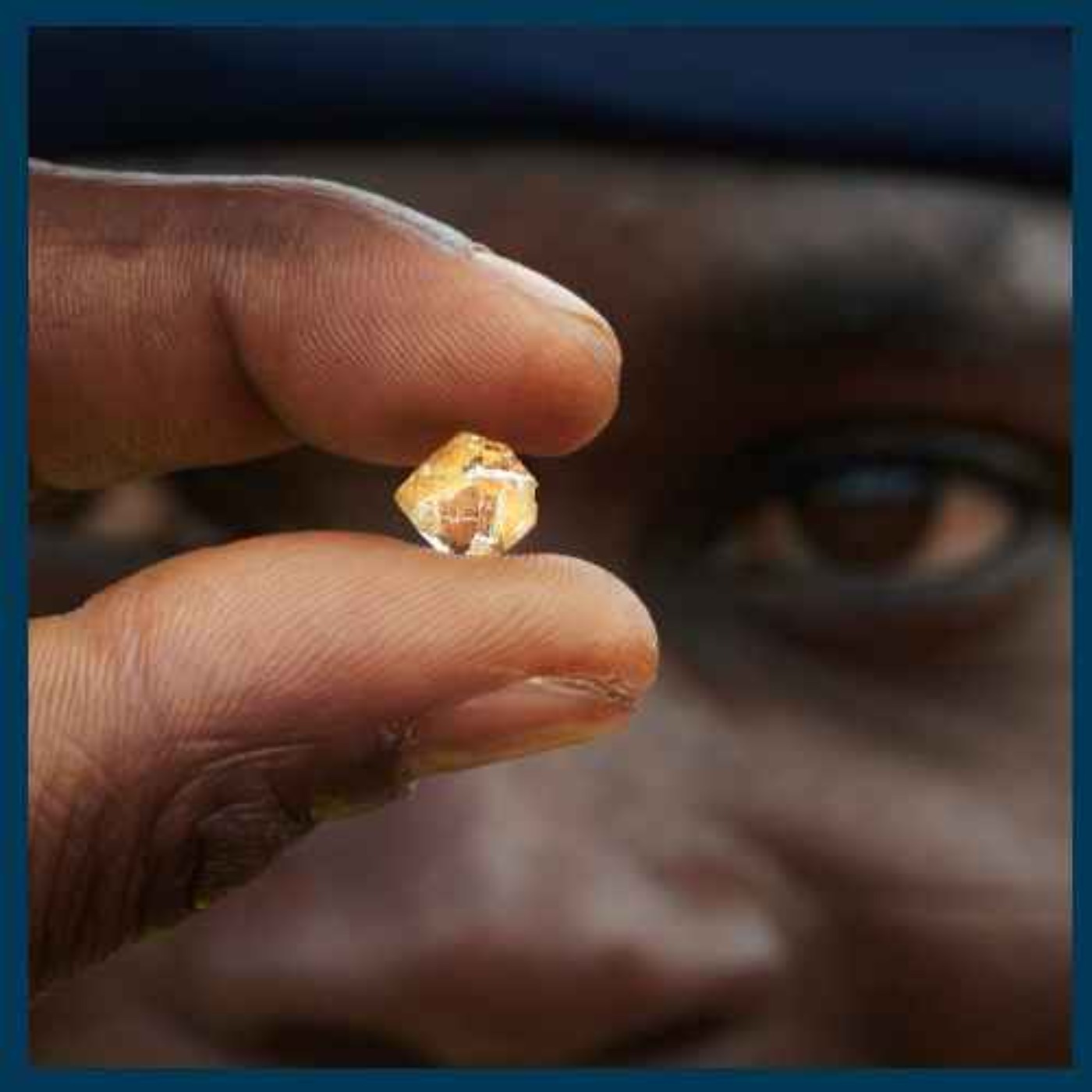
diamond in the world before diamonds are polished and cut. They don't glisten, they're not brilliant in the way that we know them. So you're touching this rough rock, there are some kind of colorings, yellowish brownish colorings on it and it is, you can see partway through the stone. So, yeah, it was a bizarre moment to be standing in this office holding this thing. I came away from the experience with a bit of the sense of the mystique that is built around diamonds and has persuaded so many of us for so long to part with our money.
- [06:10]
Manveen Rana
And Richard, this man you're meeting, the one who's allowing you to hold the real thing, the cashmere wearing diamond expert, what does he tell you about the state of the industry at the moment? How is he finding things? What does he say about its future?
- [06:28]
Richard Ashton
So he says there is a problem in the diamond industry which is that it's not transparent. You or I, the consumer who goes into a jewelry shop and wants to buy a diamond engagement ring does not know how that diamond came to that shop. There are dozens, sometimes hundreds of middlemen that are between the jewelry shop and the mine where that diamond came from. And Oded Mansouri, he has made it his task to try and transform the diamond industry so that diamonds are a traceable commodity, even so that they can be traded like gold. He thinks a huge part of the reason why the price of diamonds has fallen is this lack of trust. You go on a pair and you sit next to someone, you, you don't really want to say that you're in diamonds. I always say I'm implementing tech solutions into supply chains because God forbid, if they think that I'm in diamonds, then I'm part of the dirt that is the conceptual good. Diamond dealers have a terrible reputation as kind of grubby backroom dealers passing envelopes between themselves. And blood diamonds are still a huge issue in people's consciousness. We're all worried about buying a diamond that has come from a conflict situation that has caused the exploitation of people. And Oded Mansoori, he wants to use blockchain technology and a very close form of tracing so that consumers know what they're getting, so that dealers cannot lie, and so that everyone in his industry benefits. He's created these very advanced boxes that all the rough diamonds that his company treat, because it's a dealership, but also a cutting workshop, they're all in specific boxes. Each worker in the workshop has to put their thumb on a box in order to open that box. He knows where all his diamonds are and that's why he, he liked to make a big show about his lack of anxiety about us touching the mots weddy and playing with it because he's trying to show that the technology is backing all of this up.
- [08:57]
Manveen Rana
I mean, it is really interesting to think about blockchain and technologies like that because, I mean, I spent a bit of time investigating diamond mines and some of those dangers of blood diamonds. And once a diamond is cut, it's almost impossible to know where it's come from. Now it's even more confusing because not only do you have those natural diamonds that are being cut in places like Antwerp, you have what many in the industry would call fake diamonds. You have lab grown diamonds. How is that changing the industry? Just tell us a bit about them. I mean, how real are they?
- [09:33]
Richard Ashton
They are real in every way. The only way you can distinguish a lab grown diamond from a natural diamond is by spectroscopy. It's called. In one technique, you shine a laser on a rock, it comes out the other side with particular wavelengths and whose signatures you can use to detect imperfections in the diamond. Natural diamonds have different imperfections to lab grown diamonds. Lab grown diamonds may have pieces of silicon and other materials that come from the machines they're made in, whereas natural diamonds can have nitrogen and other elements in them. So if someone's wearing a lab grown diamond, to the naked eye, even an expert could never tell the difference. They last just as long, they are just as brilliant and they open up the possibility for manufacturers of making very clear, very perfect, as it were, diamonds. The natural diamond industry has always tried to sell to us this idea that the more you spend, the more perfect, the clearer, more colorless your diamond can be. You can do that in a few days.
- [10:57]
Manveen Rana
That's the attraction for the manufacturers. Effectively they can make the perfect diamond. Suddenly, none of that is down to chance or nature anymore for the consumer. What's the great draw towards lab grown diamonds?
- [11:11]
Richard Ashton
It's the price. And the price is falling all the time of lab grown diamonds. You can now get a a lab grown diamond for about an 80 to 90% discount compared to a natural diamond. One Dutch clothing chain, Siemen, which is a bit like Primark in the Netherlands, released a lab grown diamond pendant last September and they put it on sale at €29.99. Sold out very quickly. Shows that if they want to, manufacturers and retailers of these diamonds can basically make them worthless. And that's what natural diamond dealers and miners want to tell us, is that over time, if you buy a lab grown diamond, it will lose its value and in another five years they won't be worth anything at all. Effectively.
- [12:05]
Manveen Rana
Does that have an impact on the cost of natural diamonds too? If suddenly you can buy a diamond which is almost identical for almost nothing, do you still fork out for the real thing?
- [12:15]
Richard Ashton
This is exactly what's happening. Price of natural diamonds is about two thirds what it was three years ago. The industry believes that the main reason for this is lab grown diamonds. They've been made for a number of decades, but they only became competitive and they were only mass produced from about 10 years ago. And absolutely that means friends and family, acquaintances, when they're making that decision, they want, for whatever moment in their life, whatever occasion, they want a diamond. It's very hard for the natural diamond industry to persuade consumers that they should spend more to have something that they can have for cheaper and no one's going to tell the difference. That's a very difficult argument to make. And that is where they are now. They're Trying to make new arguments and come up with new stories to tell about diamonds to try and change the conversation. Because at the moment it doesn't look good at all for the natural diamond industry. De Beers, the world's leading diamond mining company, has cut its production. It is currently for sale. De Beers, no one has bought it in over two years. It is absolutely an unprecedented crisis for this industry.
- [13:30]
Manveen Rana
You've spoken to many people across the industry, from the people who cut the diamonds and sell them in Antwerp to the people at the heart of mining, including De Beers. How worried are they?
- [13:43]
Richard Ashton
I think they'll try and put a brave face on it and they do to me, but they are seriously worried. And I think you can detect that in how they're doing things they never did before. De Beers itself launched a range of lab grown diamonds, which it removed after a couple of years. David Johnson, who's the head of strategic communications at De Beers, told me, we're not anti lab grown diamonds, we're anti, anti natural diamonds.
- [14:14]
David Johnson
I'd say De Beers is anti anti natural diamond messaging. So it's frustrating. In De Beers, when you do a lot of work, you, you see the value that the business generates in diamond producing countries. But the received wisdom is that natural diamonds are blood diamonds, they're nasty, they're not doing anything. There's probably forced labor, bonded labor, child labor, torture. And it's. Yeah, frankly, it's frustrating that a number of lab grown diamond companies would push promotional messages that seem at best misguided or sort of not well informed and at worst kind of just extremely deleterious to the sort of, the genuinely beneficial work that a lot of diamond producing countries do and a lot of diamond governments are really, really focused on.
- [15:01]
Richard Ashton
De Beers is also making a huge thing of selling the notion that if you buy a natural diamond, you have something that was formed in the earth millions, sometimes billions of years ago. A unique thing. So as I was saying, they've spent decades trying to persuade us to buy the most perfect, the most almost artificial looking diamond. And now they're saying each one is unique, they have character. This is a special thing that you can pass down generations and has come to you from millions of years of, of the Earth's history. And they're also trying to promote what they're calling desert diamonds, so yellowish brown ones previously, the more color in a diamond, the less value it was perceived to have. And you know, those brownish diamonds down the scale because there's a scale of color that diamond dealers and jewelers use right down the Bottom of the scale. Those brownish ones were almost an afterthought who would buy them, and now they're promoting them as desert diamonds. These things with this beautiful, you know, sandy color. They're also spending a huge amount of money. They've. They're spending about 1% of their, I think it's revenues supporting an organization set up by the industry called the Natural Diamond Council, which has hired actors like Lupita Nyong' o and Lily James to promote natural diamonds. Lily James has been to Botswana, the world's biggest producer, to go and look at the industry and look what it does for a country like Botswana. Everyone you talk to agrees that this is a crisis this industry hasn't seen before.
- [16:53]
Manveen Rana
With an existential crisis looming over the industry, the impact is being felt far beyond the world of luxury diamonds. For the people of Botswana, it's a matter of national survival. In a country where half of government revenue comes from mining diamonds, what happens when the world stops buying? Coming up, Richard travels to Botswana to meet the people whose future depends on the answer.
- [17:33]
David Johnson
Foreign.
- [17:39]
PwC Sponsor Voice
This episode of the Story is sponsored by PwC.
- [17:42]
Manveen Rana
AI is everywhere. Return on investment, not so much. So how do you move past the hype and make AI actually deliver? PwC takes you further with tech, strengthening the data quality, processes and workflows that shape how well AI performs.
- [18:00]
PwC Sponsor Voice
PwC turns innovation into implementation so you can accelerate from experiment to scale.
- [18:07]
Manveen Rana
Discover more at pwc.co.uk.
- [18:12]
Richard Ashton
a better help Ad matching with my therapist was very quick and easy. I just filled out a couple of questions. Before you know it, I was matched with a therapist. I just felt like a weight just was lifted off of my shoulders and I felt like it was a good match. From the first time we talked about BetterHelp is there to meet people at their needs, giving them a space to feel safe. There is a stigma about therapy, but with BetterHelp, I meet people where they are. Wherever you are, that's where BetterHelp begins.
- [18:38]
Stamps.com Sponsor Voice
Visit betterhelp.comrandompodcast to get started.
- [18:42]
Richard Ashton
Paid testimonials Results may vary.
- [18:45]
Stamps.com Sponsor Voice
Still waiting in line. Again, that's time you'll never get back. Save time and money with stamps.com over 4 million businesses have stamps. Skipped the line with stamps.com join them to save up to 90% off carrier rates from your computer or phone right now. Print postage for certified mail, registered mail and packages in seconds. Then schedule a pickup right from your home or office for a limited time. Go to stamps.com and use code podcast for a free welcome Gift taxes and fees apply.
- [19:26]
Manveen Rana
Richard, you've been describing the decline in the natural diamond market. One of the reasons for that, I suppose, is because people think lab grown diamonds are ethically easier to buy. You don't have to worry about blood diamonds or exactly how the diamonds were extracted or where, whether they were from Russia or whether they've passed through the hands of people you may not want to be associated with. So in some ways you can see why there's a market for that. But you went to Botswana to see a part of the diamond industry where it really does do a lot for the people of Botswana. It does a lot for the people around the mine. Tell us about that. Where did you go and what was it like?
- [20:15]
Richard Ashton
I went to Orapa, which is the. The world's biggest diamond mine by land mass. It's 1.8km by 1.2km and it's on the edge of the Kalahari Desert in northern Botswana. Botswana is the world's biggest diamond producer by value, has historically been the biggest diamond producer in the world. Its entire economy is built on the back of diamonds. It's been an extraordinary success story in Africa since independence. Independence government managed to negotiate deals with diamond mining companies, De Beers foremost, and it owns 15% of De Beers. Most people in Botswana are supported in some way by the diamond industry. Even though it only employs about 10,000 people in the country, the population is about 2.6 million. But in a good year, half of the government's revenue comes from its diamond income. The government spends more of its GDP on education than Sweden. There is a universal public health service. Lots of Botswana people go to university at western elite universities like Trinity College Dublin on government scholarships. And this is all on the back of diamonds.
- [21:51]
Manveen Rana
And a lot of that success comes down to that negotiation the government did with De Beers when diamonds were found. And what came out of that? I mean, just tell us a bit about Debzwana.
- [22:02]
Richard Ashton
Debzwana is a joint venture between De Beers and the government of Botswana. So it's a 50, 50 joint venture. And Debtswana is the company that operates the mines like Orapa. And it has been absolutely central to Botswana's economic development. It's one of the country's biggest employers. But as I say, not that many people work in diamonds. But it has done a lot to, to fund schools, hospitals. The political elite of Botswana like to call themselves diamond babies because in some way they've all grown up as part of. Part of this system.
- [22:45]
Manveen Rana
Benefited.
- [22:46]
Richard Ashton
Yeah, benefited. And if you grow up in Botswana, one of the main companies you want to work for is Debswana. There's no doubt.
- [22:55]
Manveen Rana
That's incredible. While you're at the Arapa mine, you actually spoke to some of the people who do work for Debswana. Tell us about that.
- [23:04]
Richard Ashton
I met one woman called Kesekoffetsi Bumo Motzuaiso, who is a mining engineer at Orapa. As she put it to me, my job is to translate long term plans into short term plans, which basically means decide which bit of that bit big hole to blow up next and cart away and look for diamonds in. She lives in Orapa with her husband and her two year old boy. Her husband works in the pharmacy of the mine hospital. Her sense of pride in her career was palpable. Absolutely the sense that she believes she's doing something important for her country, for her people. I mean, she was in a sense the prime example of what diamonds have done to a country like Botswana. When she went to university, the government paid her tuition fees and her living expenses by grants. She gave a plea, in fact, to people who will be listening to this podcast and people who will be reading the article that we've done and saying, look, if you know what diamonds have done for Botswana, we will be right back on track. As in, please buy natural diamonds because this is what they do. They create lives for people like me, my husband and my son. She said her son, when he grows up, he may not be able to work in the diamond sector. She doesn't know. She hopes that that will be a possibility. But she said she wants him to use all the education that diamonds have given Botswana and use it to diversify the economy, do other things. She said maybe he'll work in AI. It's hard to over exaggerate how much. Diamonds are the lifeblood of Botswana, people in Botswana and like a symbol of Botswana's national identity. We met some primary school girls and their school uniform, the emblem of their school was a diamond in the airport. There are diamond jewelry shops in the airport. Everyone in some way is connected to diamonds. I mean, it was one of the poorest countries in Africa. On independence. The whole country is wondering, were the last 60 years a blip? Are we going to go back to being poor?
- [25:59]
Manveen Rana
How much is it having an impact that you can see on the economy of Botswana? Is it something that's already being felt nationally?
- [26:07]
Richard Ashton
Absolutely. The same party had run Botswana since independence until 2024. When voters kicked them out, they surprised even themselves. I don't think many people in Botswana saw that, that coming and the new president du he quite quickly afterwards declared a public health emergency amid medicine shortages which threatened to undermine what had been one of the most successful campaigns against HIV in Africa. Public debt has grown. Inflation is on the up. Going around Gaborone, which is the capital city, there are lots of empty office premises. Botswana people, as they're called, love to talk about how good the roads are in the country. Yet potholes have started appearing. In one quite grim sign of the times, the managers of the restaurant on the rooftop of the tallest building in Gaboroni have erected a glass barrier after a series of apparent suicides. There is a feeling, yeah, there is a feeling in the country of kind of fear, a kind of end of days feeling. It is strange. And that is why people are so desperate to make sure that the diamond industry doesn't collapse.
- [27:33]
Manveen Rana
Botswana has done so well out of the diamond industry. But I mean, is there a plan B for the government? Is there another source of revenue if it does keep plummeting?
- [27:43]
Richard Ashton
Lots of people there will tell you the government has talked and the previous government, and now this government has talked a lot about diversifying the economy, about growing other sectors for a long time without doing much. It does seem that now push has come to shove. This new government, Duma Boko's government has realized that this is absolutely a must do. Now he announced plans to mine other minerals in Botswana. That's interesting because it's, you know, something they could do with all their expertise that they have. He wants to develop the technology sectors and he's also talked a lot about developing tourism. Botswana has wildlife tourism, luxury lodges. They want more of those. And he's talked about developing the tech industries.
- [28:35]
Manveen Rana
All of that will take time and will need investment. So you can see why they're up against a moment of real crisis. Richard, for you, you've spent so long now tracking the journey of the entire diamond industry from mine to Antwerp and the place where they're cut and sold. From everything that you've seen and everyone you've spoken to, what will be your lasting impression? What's really stayed with you?
- [29:01]
Richard Ashton
Where is the diamond market going? Will we still buy natural diamonds? Will we all buy lab grown diamonds? Will we buy no shiny diamond looking stones at all? Taylor Swift received from her fiance, Travis kelce, a roughly 8 carat repurposed diamond. So an antique mined diamond. As for her engagement ring last year that actually pushed up the stock price of Signet, the American jewelry giant. Even though Signet doesn't sell antique diamonds. There are so many different trends going on in the diamond world. So many of our consumer industries are fragmenting. It was fascinating to learn that analysts are saying the diamond market is becoming K shaped. And what that means is the price of the largest natural diamonds is increasing and the price of the smaller natural diamonds and lab grown diamonds is decreasing. At the same time, as Oded Mansouri put it to me, there are more and more new rich people in the world and supplies stays the same. I think it says so much about our world that this is yet another industry in which the gap between luxury and the rest is growing.
- [30:25]
Manveen Rana
And for you, having seen all of that, if you were going out tomorrow to buy an engagement ring, what would you go for?
- [30:34]
Richard Ashton
Well, it's funny you say that because I did actually come back from Botswana with a diamond in my, in my bag or in fact three little ones on a ring, natural ones, which my fiance is now, is now proudly wearing.
- [30:53]
Manveen Rana
And congratulations.
- [30:55]
Richard Ashton
Thank you. Thank you. Yeah, and I think I was persuaded, I have to say I was persuaded by that time in Botswana and the time in Antwerp learning about these things. If I was doing it again with everything I've since learned and all my reflections. I think the antique ones are cool. I think it's, I think it's silly that antique diamonds, we have basically said they don't have as much value as ones that have just been mined. Even if there's nothing different about them, why not enjoy old ones rather than always looking for the new?
- [31:36]
Manveen Rana
That was Richard Ashton, foreign features writer for the Times and the Sunday Times. You can read his amazing piece in the Times magazine this weekend or online@thetimes.com just search for between a Rock and a Hard Place. That's it for today. The producer and sound designer was Dave Creasy and the executive producer was Sophie McNulty. And we'll be back as usual tomorrow. This episode of the story is sponsored by PwC.
- [32:27]
PwC Sponsor Voice
What does an AI ready workforce actually look like? Breakthrough performance comes from combining human intelligence with machine capability. PwC brings it all together and takes you further with tech, empowering you to move faster, solve more complex challenges and unlock new value.
- [32:45]
Manveen Rana
PwC combines talent strength with tech strategy so you can unite human potential with AI power.
- [32:52]
PwC Sponsor Voice
Discover more at pwc.co.uk.
- [32:58]
Stamps.com Sponsor Voice
shipping, billing, admin, payroll, marketing. You're managing all the things, so why waste time sending important documents the old fashioned way? Mail and ship when you want, how you want with stamps.com, print, postage on demand 247 and schedule pickups from your office or home. Save up to 90 print with automated rate shopping. That's why over 1 million small businesses trust stamps.com go to stamps.com and use code podcast to try stamps.com risk free for 60 days.