← The Table with Anthony ONeal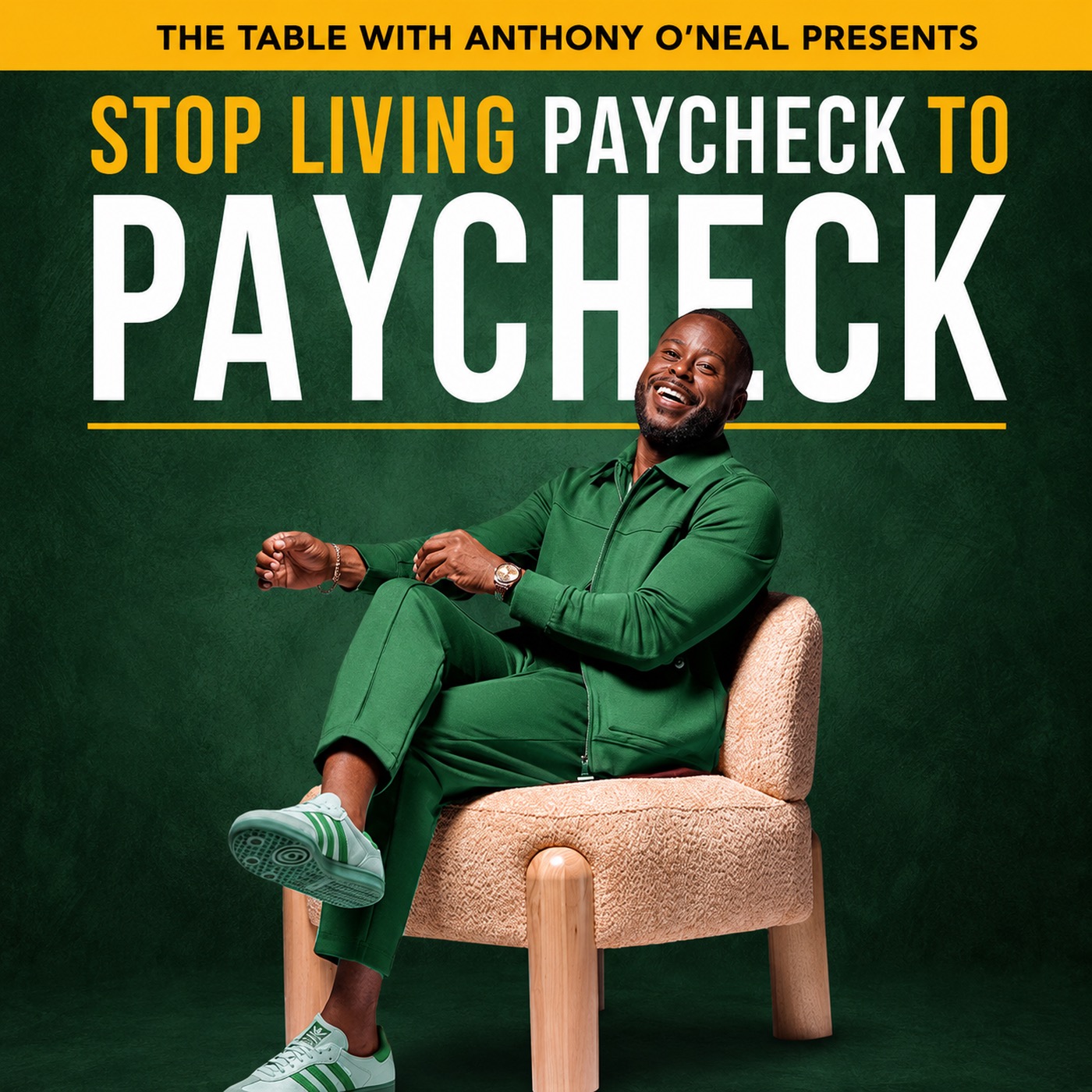
The Table with Anthony ONeal
How To Pay Off $25,000 in Debt on a $45K Salary In 9 Months (Real Plan)
00:30:04
Loading summary
Transcript17 lines
- [00:03]
A
When others hear noise. Tieroprice interprets market signals to find investment opportunities. That's the power of active ETFs from T Rowe Price. Their portfolio managers approach data from multiple perspectives, analyzing trends and conducting deep research to give you their curiosity backed active management expertise. Learn more about their active ETFs@troprice.com Explore ETFs Exchange Traded Funds ETFs are bought and sold at market prices, not NAV. Investors generally incur the cost of the spread between the prices at which shares are bought and sold. Buying and selling shares may result in brokerage commissions which will reduce returns. T. Rowe Price Investment Services Inc.
- [00:45]
B
I cashed out my entire 401k thinking someone stole my identity. A fake email cost me my dream home. After I sent my personal information to a scammer, my AI agent wired thousands to an account I'd never seen.
- [00:57]
A
When billions of people feel unsafe, that's no longer a security problem, it's an economic one. At jen, we're building the trust layer for a more fearless planet with products and technologies from our global brands Norton, Lifelock, Avast and Money Lion. See it in action@gendigital.com what's going on family?
- [01:16]
B
Today's show is going to be a little different and before we get into it, I want you to watch this video, this quick clip because this is going to be the foundation of what we talk about today. Check it out.
- [01:28]
C
I say something respectfully and you know what, actually also a little bit disrespectfully if you were not born after like 1990, I am not going to take financial advice from you. Like I am not going to listen to you when you talk to me about how to be financially successful. And I feel like that's going to trigger a lot of older people. The economy that you experience. No one is saying that you did not struggle underneath a terrible economy. But what I am saying is that the current economy that people who were born in like 1994 onward are living under is 20 completely different than anything we have navigated before and the rules are not the same. And sometimes when people from older generations try to give me financial advice I just look at them and I'm like that literally doesn't matter anymore. Or advice that I'd be like, well yeah, that would be an amazing piece of advice 25 years ago.
- [02:13]
B
Now here's what I want to tell you before I go any further. And a lot of, a lot of you all within my community sent me this video hoping that I would just go after her and just check her. And I'm not going to do that because that's not what my platform is for. And I've never used my platform to attack people. But I do believe that there are some things that she said inside this video that are true that I'm going to cover before I talk about some things where I think she is or she was wrong at. This is not a reaction video. This is going to be a conversation. So let's have a conversation inside of the chat. And if you're watching this live, hey, let's talk back and forth. But here's why I specifically wanted to respond to this, and here's why I care about this specific conversation. Because right now, in the background of all this noise, something massive is happening. Somewhere in between, I would say now and 2048, roughly $124 trillion is going to be changing hands, moving from the boomer generation to my generation to millennials and Gen Z. That's not, that's. That's. I don't want to sound like I'm hyping this up. No, literally trillion with a T. And here's my concern. If an entire generation grows up believing that the system is so rigged that nothing they do matters, they are going to be perfectly positioned. Watch this. To receive the wealth and completely unprepared to keep it and steward it. History has already told us what happens next. Most inherited wealth doesn't survive to the third generation. And it's not because the money wasn't real. It's because nobody built the habits and the systems to hold it and to multiply it. So this conversation today, it's not going to be about her. It's going to be about you. Do you believe the system is stacked against you? Let's be real. Probably at least a little do. But. But do you also believe you still have control over what happens next? And I need you to sit with both, both of those questions because by the end of today's episode, I want you holding both truths at the exact same time. Now, we didn't have the opportunity to play the whole video, so I really want to break down what she said throughout her entire video because I want to make sure I honor her where I believe she's right, but also give some constructive wisdom to where I believe she is wrong. She said she's not going to take financial advice from anyone not born after 1990. She was careful and I totally respect this. To say she's not claiming the older generation, my generation, because I was born in 84 never struggled. She specifically named the 2008 crisis and said older millennials got crushed by that. Right. Her point was narrow than I think what people were giving her credit for because hardship does exist and it did exist, but the mechanics of building financial stability and have changed so much that the specific tactical advice doesn't map out onto today's reality anymore. Huh? Okay. She also talked about childcare costing anywhere between 2,000 and $3,000 a month for just one child. She talked about applying to hundreds and hundreds of jobs and getting zero interviews. She also talked about what I would say a third of people under 30 having to move back in with their parents. And the last thing she said was listen, me choosing not to have kids right now is not selfishness. It's honestly the most responsible decision that she could make. Her ask wasn't never talk to me again. Here's what I heard from me listening to it. Verify advice older generation against current data before you hand it to me like it's gospel and lead with empathy instead of judgment. And if I gotta be honest with you all, I want you to notice something that's not an unreasonable ask. I truly do believe that is a mature ask. That is a wise ask. And my generation up we should be leading like that. Check this out family. Did you know that nearly 4 in 10Americans still have zero money invested? The stock market. That's a gap where wealth is built or missed. If you're just saving, you're falling behind because the markets average close to about a 10% a year for a century while your savings account is barely keeping up with inflation. I want to make this plain. If you wait just five years to start investing, you could lose out on hundreds of thousands of dollars in future wealth. That's not hype, that's real math. The wealthiest 10% of Americans now own over 90% of all stocks because they started and they stayed consistent. But here's the thing. You don't need to be rich to honestly get inside of the investing game. With platforms like SoFi, Invest Public and Moomoo, you can open an account today, start with as little as a dollar, literally, and buy fractional shares of the same assets that have built generational wealth for millions. No commissions, 100%. No excuses on your end. Listen, I need you to hear me clearly. Stop sitting on the sidelines. Go to anthonyoneal.com invest right now to compare the top investing platforms and open your first investing account today. Your future self and your children's children will thank you for taking action right now we have to start building wealth, not just watching others get rich. Do not let another year go by. As a matter of fact, don't let another day go by. Take the first step, family. Visit anthonyonil.com forward/invest. Let's get to work. Let's start investing ASAP. Let's get back to the show. So let's start here. Where do I start? Yeah, I'm gonna start here. Because I think this is where a lot of the Internet got it backwards. They jump straight to outrage and skip right past the part she got completely, completely, completely, completely right. Number one, the cost of raising a child today is not the cost it was 20 years ago. It wasn't the cost to raise me. Listen, I look more into it. Depending on where you live, a full time infant care really can run between 2,000, $3,000 extra a month. That's not an exaggeration, right? That's a real documented and brutal number. Number two, the entry level job market right now is genuinely harder to break into than it's been in a very long time. Applying to 2 and 300 jobs and getting silenced back, that is honestly happening. And I know this as a professor because my students are constantly coming to me and saying, hey, I'm not getting a response. So I can relate with that one. Now, number three, and this is the one I want to slow down on a little bit, right? Choosing not to have the child you cannot afford to raise well is not selfish. It is honestly wise stewardship. Proverbs talks about the wise storing up what they have for the right season instead of consuming everything now with no plan. So that's not a modern idea, that's an ancient one. And she landed on a biblical principle without even quoting scripture. She's wise. I would say number four is when older generations mock or dismiss the younger people's financial struggle without listening first, that does real damage. I've had grown men tell me 20 somethings today are just lazy, entitled and soft. I don't believe that. I've talked to many of them on this show. I've been impressed by a lot of them. They're not lazy. Heck, I got some of them on my team. But let me tell you something about me because I need you to know I'm not talking from a distant perspective here. I get it. Yes, I'm 42 years old, but 20, 21 years ago, I pulled my car into a gas station on fumes because I was too scared to check my balance until I had to. I called the automated line and Told me I had $6.32 to my name. It was Wednesday. I didn't get paid until Friday. I was about to be broke for two straight days. So I filled my tank up, knowing the gas station would only authorize it for about a dollar. Then I drove to McDonald's, got me two large sweet teas, two double cheeseburgers. Cut those up in half when I got home. And those that two cheeseburgers and those two large sweet teas helped me survive until Friday, y'. All. I had to water down a sweet tea just so I can have a little bit of flavor over a couple of days. So when somebody tells me I don't understand the struggle because of when I was born, I honestly don't take offense to it. I take it as an invitation to say I remember exactly what that feels like. Yes, it was during a different time, but I understand the feeling. And that's exactly why I refuse to let anybody, young or old, stay stuck there believing that there's no way out. Now, we talked about what she got right. I want to talk about what I believe I need to push back on in a respectful and loving way. And y' all tell me if I'm wrong, because I think the way this got framed opens the doors that I believe is more dangerous than the original complaint. Here's the distinction I need you to hold onto for the rest of today's episode. There is a difference between financial principle and financial tactics. You see, a tactic is the specific move you make in a specific decade. Buy or start a home at 25, work one job for 30 years, save $1,000 for emergencies. Those are tactics and taxes. And tactics absolutely change with the economy. So she is right about that. But a principle is different. Spend less than what you earn. Avoid consumer debt. Build margin before you multiply your money. Save before you Invest. Those aren't 1990 ideas. Those are not even 2020 ideas because they're not about the economy. They're about. They're about human behavior. So when somebody says, I would not listen to a Dave Ramsey or Anthony O' Neill because they were born before 1990, what they're really saying is, even if they don't mean it this way, watch this. That the principle themselves must be outdated, not just the tactics. And that's where it gets dangerous. Because once you convince yourself the principles don't apply to you anymore, you stop applying any of them. And that's not liberation that. That you are paralyzing yourself wearing a costume of a valid complaint. And I want to Bring somebody most of us respect, regardless of the generation, into this conversation. Warren Buffett. The man is in his 90s. His core investing principles were formed decades before either of us were born. And they still outperform almost everybody trying to, I would say, be a millionaire. He is a living principle. Buy value, be patient, let compound interest. Work. Age has nothing to do with whether that's true. Nothing to do with whether that's true. What happens to your family if something happened to you? I'm gonna ask that again. What happens to your family when something happens to you? You see, life insurance feels scary. It feels complicated and even expensive. But here's the thing. It doesn't have to be anymore. Most of us are walking around with no life insurance policy, but we have a name brand item thinking, I'm young, I'm healthy, I got time, family. I want to be honest with you. I'm so sorry. That's not faith. That is pure foolishness. Here's what I love about my friends over at Ethos. They've made getting term life insurance 100% simple. No medical exams, no waiting weeks for approval. You can get a quote online in literally 10 minutes like myself and get approved the exact same day. We're talking coverage from $100,000 up to 2 million dol billion with absolutely no blood work for way less than what you actually think. Term life insurance is pure protection at a fraction of the cost of whole life insurance. Look, a healthy 30 year old can get a 500, 000 policy for about 25amonth. That's less than your Netflix and Spotify combined. Listen, your family deserves to be protected. Don't leave them struggling to pay bills and funeral costs because you kept putting this off while you're in heaven smiling. Your family's down here stressed because of your poor decisions. Listen, stop playing games with your family's future. Get your free quote today in 10 minutes by going to anthonyonil.com forward/ethos. Again, go to Anthony O' Neill.com forward slash ethos and I promise you, you will feel way better and sleep better at night. All right, let's get back to today's show. Here is a another principle or another way to see it. Every single generation in American history has believed their economy was the hardest one that's ever existed. The generation before 2008 lived through stagflation.
- [16:20]
A
When others hear noise, Tieroprice interprets market signals to find investment opportunities. That's the power of active ETFs from TieroPrice. Their portfolio managers approach data from multiple perspectives, analyzing trends and conducting deep research to give you their curiosity backed active management expertise. Learn more about their active ETFs@troprice.com Excel Explore ETFs Exchange Traded Funds ETFs are bought and sold at market prices, not NAV. Investors generally incur the cost of the spread between the prices at which shares are bought and sold. Buying and selling shares may result in brokerage commissions which will reduce returns. T. Rowe Price Investment Services, Inc. Yeah,
- [17:03]
B
Maxing is so maxing right now bro. Get ready for spicy chicken maxing because Carl's Jr. Is saving you big with a 5.99 maxed out double stack double stack Double stacked Spicy Chicken sandwich seriously. Just $5.99 double stack spicy chicken.
- [17:18]
A
This is unreal value in the bromosphere.
- [17:22]
B
The new Spicy Chicken Max Wallet Friendly Max Tasty only at Carl's Jr available for a limited time at participating restaurants.
- [17:29]
A
Tax unincluded.
- [17:30]
B
Not valid for use within a combo or in combination with any other offered discount hey, it's Ryan Reynolds here for Mint Mobile. Now I was looking for fun ways to tell you that Mint's offer of unlimited Premium Wireless for $15 a month is back. So I thought it would be fun if we made $15 bills, but it turns out that's very illegal, so there goes my big idea for the commercial. Give it a try@mintmobile.com switch upfront payment
- [17:54]
A
of $45 for three months, $90 for six months or $180 for a 12 month plan required $15 per month equivalent to taxes and fees. Extra initial plan term only greater than 50 gigabytes. Me slow when network is busy.
- [18:02]
B
See terms in the 70s, I want to say the 80s. Double digit inflation, right? Double digit interest rates. Farmers closing land. I mean loads closing. I'm sorry, farmers losing land that they held for generations. The generation before that lived through the Great Depression. Every generation is going to say, you do not understand. The times are different and every generation that actually built something did it despite believing that not because the world got easier for them. I want to tell you all about a young man I worked with named Marcus. He's a single dad, has two boys, worked as a warehouse supervisor in, I want to say, North Carolina. He had just finished paying off his last credit card and had built about a $1,300 buffer when his boss called him in and said the word nobody wants to hear we're downsizing. It wasn't his fault, it wasn't performance. He was just unfortunately let go his first thought was, how am I going to feed my boys? But that $1,300 covered him. He picked up food delivery work, applied around within a few weeks, and he landed another distribution center job. He called my show after and said, that little bit of savings literally saved me from going back into debt or worse. You see, Marcus didn't have an easy economy, but Marcus did have a plan and strategy. Those aren't the same things, but people confuse them all the time. I want to go a little bit deeper and I want to bring this all the way home for all of us. You can hold both of these at the same time. The economy is genuinely harder for people entering into adulthood in the 20, 26 and beyond, let's be honest. And you still have more control over your outcome than you've ever been told. It's not a contradiction, honestly. I would say that's. That's maturity. Remember that number that I gave you at the beginning? 124 trillion. Moving hands over the next couple of decades. That transfer is coming whether you're ready for it or not. So the question isn't whether the money shows up. The question is whether you'll be in position to receive it and actually keep it and grow it or whether, I don't know, you'll be so buried in debt and so convinced nothing works, that money passes right through your hands the way it does for most families that inherit wealth without ever building the habits to hold it. When I think about this, this is why I wrote my brand new book, Stop Living Paycheck to paycheck the Way I did. Not as five steps to get rich, but as five phases to build an actual financial house. Lay the foundation, clear the debt, built the frame with real savings, then scale it with investing and then cement and secure your legacy. I want you to notice something there. None of those phases require a perfect economy. They just require a decision from you. Not from the economy, but from you. There's a young lady. I'm sorry, there's a young couple. I want to say inside my book. John and Jasmine, 25 years old, living in a small two bedroom home in Atlanta. Credit card debt is climbing and Jasmine just found out that she's pregnant. In that same conversation where they should have been celebrating, Jasmine breaks down because she's always pictured owning a home like the one she grew up in. And right now they can't even keep their savings account above zero and they're expecting a baby. John doesn't have, her husband doesn't have a solution. In that moment, what he has is. It is a decision. I don't know how, but there's gotta be a better way and I'm going to find it. To me, that's it. That's the whole turning point. Not a perfect economy, not an older person fixing it for the, for the people. It is literally a decision followed by a plan and a strategy. It is a decision followed by a plan and a strategy. Not a better economy, not a better, not an easier job economy. It is a plan because the Bible says it plainly. He who is faithful in what is least is faithful also in much. I think that's over in what Luke, Luke 16:10. Nobody gets trusted with big wealth transfers. Who hasn't first proven faithful with the small stuff first, the budget, the debt snowball, the emergency fund. The verse doesn't check your birth certificate before it applies to you. It checks to see have you been faithful? Can we call you a good and faithful servant? So if you're watching this and you're under 30 or you're 40 and you've been feeling exactly what she described, here's what I need you to do. Starting today, not next month, but today. The very first thing, we're going to have these up on the screen screen. Somehow write down your financial vision. Three to five sentences about where you actually want to be and what you'll need to do this year to progress and move forward towards it. Second, build a one month buffer in a high yield savings account. Not a thousand dollars sitting in a bank paying you basically nothing. An actual month of your net pay sitting somewhere earning 4 to 5% instead of, I would say 2, 10 of a percent. If you can go to anthonyonil.comsavings to open up that high yield savings account today. The number three if you're carrying consumer debt, listen to me, I need you to start the debt snowball today. I've done so many videos, videos on this and I really, really break this down inside of my book, Stop living paycheck to paycheck. So make sure you get a copy of that. But the debt snowball is simple. You pay the smallest balance first. List it, list out all of it, all of your debt. Attack the smallest one first and you're going to build momentum because you can go from the smallest one to the next one to the next one to the next one. That's called the debt snowball. But again, maybe I'll link some other shows really breaking down the debt snowball for you all. But honestly, I think the best description I've ever done about the Debt snowball and why I believe it is the best method out there. I really break it down inside of my book. So listen, go inside my show notes, get a copy of my book. You can pre order it today. It's not going to cost you nothing. And I'm going to send you about two $300 worth of freebies today to help you get started on your financial journey. Fourth, and this one matters more now than ever. We gotta get to a point, how do I say this? We gotta get to a point to where we are no longer exchanging our time for money and money is buying back our time. I hear you. You're saying, Anthony, how do we do that though? I'm busting my butt right now. Okay, do you have a job or do you have a skill? And specifically do you have a skill that you can utilize to where you have ownership in it? Not just a job. Show up to work, work for them, do your thing, go back home. No, no, no, no, no, no. Have you invested into a skill that pays you back within the next 12 months for an example. Right now AI is changing the job market fast. It's not going to be AI that takes your job. It's going to be someone who knows how to work AI better than you do. And I need you to get ahead of that right now. What kind of business can you launch with new technology? With AI? Invest into a skill that can position you to make a lot of money. Then that money positions you to invest it to where you can buy back your time. And here's the fifth thing, and I've really been big on this, even specifically for myself. Get around the people who will tell you the truth in love the way I'm trying to do with you right now, for this young lady, not. Not people who just validate everything you feel and validate all of your excuses and not people who let you watch this without you listening. Both of those are an extreme and they're going to keep you stuck. And I want to make sure that you're around people that when you tell them your goals, when you tell them, hey, I got applied to 100 jobs today, they're going to hold you accountable to that. But then also when you're venting about your experience in life today, they are mature enough to understand. Watch this. They are mature enough to listen, to learn, not to respond. And oftentimes and, and I, I believe that my generation and older real guilty of that. I think, I think, no, I think that's a human thing. We want to listen to Respond rather than ask more questions, to really learn the depth of how you really feel, the depth of what's going on, and then respond with love. And that's something I've really been working on. When people come to me and complain, I'm like, okay, why do you feel this way? Okay, how did it make you feel? Okay? And sometimes I've learned a response is not needed. Then sometimes I just need to be a good friend, a good mentor, a good brother, a good son and just listen. And then sometimes what I've learned, my thought that I really want, what I really want to say. Then when I go back and I just listen and not listen and go back and think about it for like a day or two, my perspective changes. And I'm so happy that I did not respond when I felt it. And here's what I want you to walk away with today. The economy is harder. That part is real. And I'm not going to pretend it isn't just to make a point because, heck, I'm going through it with my own self, with my own company. But hard is not the same. I would say it's not the same as hopeless. And the moment you let this harder than it used to be turned into, so nothing I do matters, that's the moment you actually lose. Regardless of what you decide or what decade you were born in. You don't need someone born in 1994 to tell you the truth about money. And you don't need someone before 1994 either. You need principles that have never failed anybody who actually applied them, no matter what decade. And I'm trying to be. I'm trying to watch my words if you can tell. I'm really trying to watch my words if you can really tell, because this is the main reason why I wrote the book. Because things are different. And I think we need a message that is more loving. We need a message that's not all motivational. We need a message that. That are just principle. We need a plan. And I think a lot of people don't have a plan. And if you want the full plan, the exact five phases I'm talking about written for exactly this moment in this economy. I want to encourage you to get the book, stop living paycheck to paycheck. The link is going to be inside the description. You can go to anthonyoneal.com book and get this book. As a matter of fact, if you are a, if you're in a relationship, if you love someone, I would get two books and read it with the partner. Read it with your spouse. Read it with your accountability friend. Read it with someone to where you two can get this together because I firmly do believe, I firmly do believe that this book, it's going to change lives. And here's what I can guarantee you. If you get this book, you read it, highlight it, apply the phases within the next 12 to 18 months, your financial situation is going to look so much better, it's going to flip. Listen, if you made it to the end of this episode, thank you. Hit that like button because the more likes and ensures that we can get the algorithm is activated and we can activate people and commission them and help them to get out of debt and to build true wealth. Man, I'm really excited. These next 30 days gonna be real good, you know, real, real, real, real good. I'm excited. I'll be speaking at Invest Fest in Atlanta and I'm going to be talking about this on stage. So if you're in Atlanta area during the best, best time, come see me. All right? It's your boy, Anthony o'. Neal. Love you. God bless you and I'll see you on the next show. Peace out.
- [33:08]
A
When others hear noise, tieroprice interprets market signals to find investment opportunities. That's the power of active ETFs from T. Rowe Price. Their portfolio managers approach data from multiple perspectives, analyzing trends and conducting deep research to give you their curiosity backed active management expertise. Learn more about their active ETFs@t rowprice.com Explore ETFs Exchange Traded Funds. ETFs are bought and sold at market prices, not NAV. Investors generally incur the cost of the spread between the prices at which shares are bought and sold. Buying and selling shares may result in brokerage commissions which will reduce returns. T. Rowe Price Investment Services Inc.
- [33:49]
B
I cashed out my entire 401 thinking someone stole my identity. A fake email cost me my dream home. After I sent my personal information to a scammer, my AI agent wired thousands to an account I'd never seen.
- [34:02]
A
When billions of people feel unsafe, that's no longer a security problem. It's an economic one. At Jenn, we're building the trust layer for a more fearless planet. With products and technologies from our global brands, Norton, Lifelock, Avast and Money Lion. See it in action@genndigital.com.