← The Team House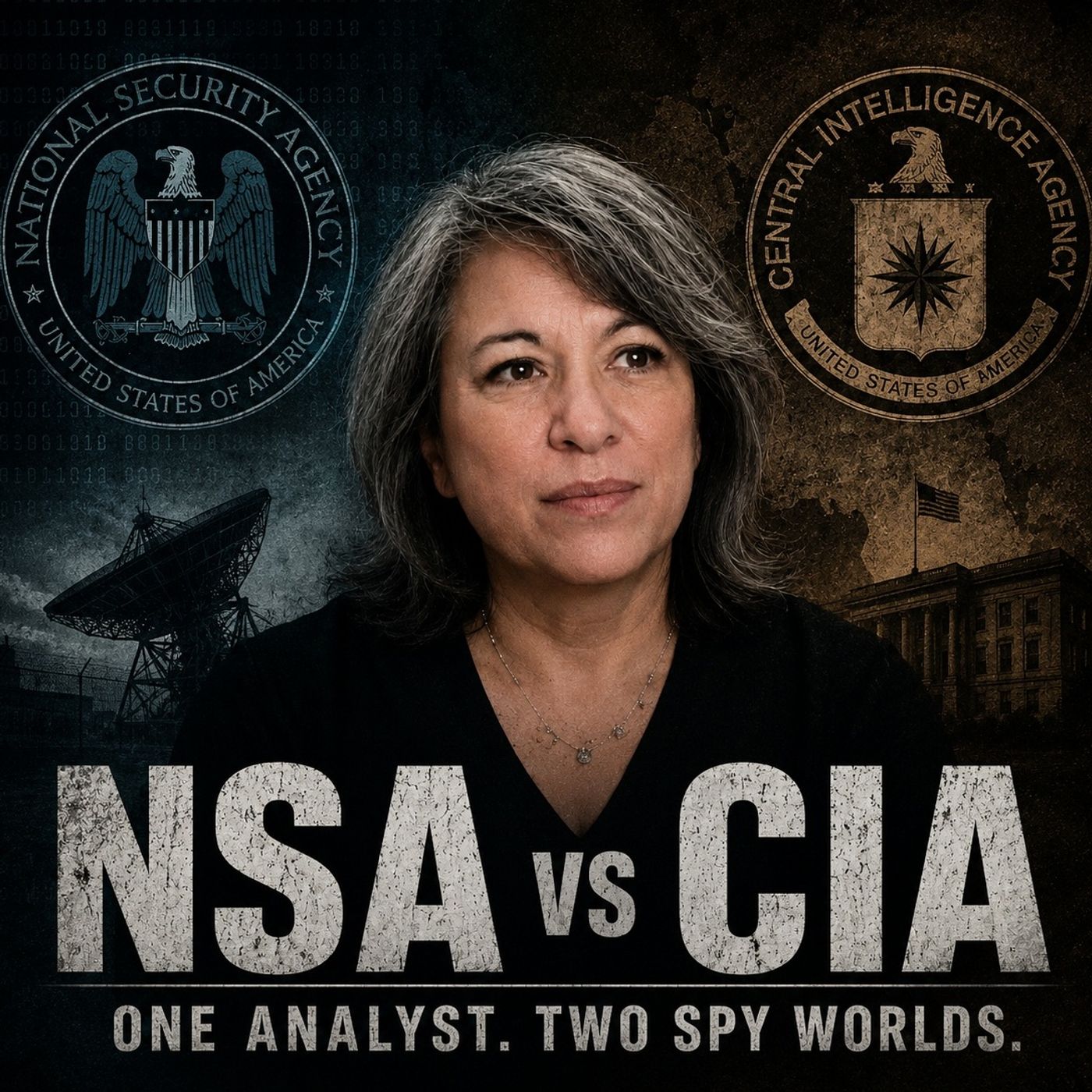
The Team House
NSA vs CIA: A Former Analyst Explains the Difference | Alma Katsu
01:46:48
Former NSA and CIA analyst Alma Katsu joins us to discuss her career in intelligence, from the analog era of NSA and early hacking programs to CIA work on social media, disinformation, and emerging technology. She also breaks down how real...
Loading summary
Transcript264 lines
- [00:00]
Sarah Spain
This is Ashlyn Harris from Wide Open with Ashlyn Harris. And now, a vital break from our sponsors, Vital Proteins. And it is Vital Collagen Peptides is
- [00:10]
Alma Katsu
a wellness supplement that supports healthy hair, skin, nails, bones and joints.
- [00:16]
Sarah Spain
When we hit 30, our body's collagen
- [00:18]
Alma Katsu
production starts to drop. And that's when Vital Proteins steps in. Their iconic blue tub is everywhere. People love Vital Proteins in part because it's so easy.
- [00:30]
Sarah Spain
Just mix it into your coffee, tea or a smoothie and you're good to go. And now you can get 20% off the next order at vitalproteins.com by using promo code wide open 20 at checkout. These statements have not been evaluated by the Food and Drug Administration.
- [00:46]
Alma Katsu
This product is not intended to diagnose, treat, cure or prevent any disease.
- [00:51]
Spinquest Advertiser
Whether it's slots or live dealers, Spinquest.com has the fun and action you're looking for with Spin Quest exclusives. Blackjack, roulette, baccarat, and even live dice with craps and bubble craps. The games never stop so you don't have to. And right now, new users get $30 coin packs for just 10 bucks. Play now@Spinquest.com SpinQuest is a free to
- [01:16]
Jack Murphy
play social casino void where prohibited. Visit spinquest.com for more details. Hey, everyone. Welcome to episode 411 of the Teamhouse. I'm Jack Murphy here with tonight's guest, Alma Katsu. She served as an analyst at NSA and CIA, also delving into the technical side as well, some of the technological development work that they do. She is the author of 10 books, including some spy novels, the bigger one being Black Vault, which is being made into a television show, and an upcoming novel about Havana Syndrome. So, Alma, thank you for joining us on the show tonight. Your name has been circulating around for a while. I think I've had you on our list for a while, actually. I'm glad this is finally happening.
- [02:06]
Alma Katsu
Yeah. Thanks for having me here. I'm really looking forward to this. I know it's kind of confusing because I'm not really known for my spies stories, but then when people find out my background, they're like really surprised. That's not all I write.
- [02:20]
Jack Murphy
Yeah. I mean, I think it's always enjoyable when somebody kind of brings their personal experience into the novel, whatever kind of novel, you know, if you were a police officer or a CIA officer or whatever the case may be and kind of lend that sort of like that insider baseball is what I think. Kind of like, at least for me, kind of makes the book what it Is
- [02:42]
Alma Katsu
it was really interesting. I never thought that I would actually write a script spy novel. I tried early on when I was, you know, my very first book was. It came out in 2011, and it took me 10 years to write that book. And while I was writing it, I would jump in and try to write, you know, like a spy thriller. And I was terrible at it, so I just figured I'd never write one. And then after the first three books came out and I was retiring from NSA, actually it was 2017, and my editor at Putnam and I'd done a couple books with her, and she said, you know, I know you've always wanted to write a spy novel. Why don't you give it a try? Because she knew I wanted to write one about the, the female experience in the spy business and in CIA. So, you know, I was really lucky. I was kind of gifted that experience and I knew what I was going to write about because when I was there, there was a really horrible thing that happened that if I told you, you would recognize it because it was in the news for years, but it was never publicly associated with CIA. And I always knew I'd write a story and incorporate a version of, of what happened there in it. So I got the chance to do it. But it, you know, it was really an eye opener. I don't know what your experience has been, but, you know, you go into this thinking, just like you said, I'm going to tell. I'm going to be a truth teller. I'm going to give the inside baseball, you know, and it feels like it's going to be cathartic for you. And then once you get into it, you realize that that's not necessarily what the public wants. Yeah, you know, they're kind of conditioned more for, you know, Jason Bourne and Jack Reacher and, you know, James Bond. And that's not what the job is really like. And so as a writer, you're sort of torn between these two things. You, you want to be true to your, to the profession and the wonderful people that you work with, who you want to honor, you know, and not make them into characters or, you know, that sort of thing. But, but you're also an entertainer and you have this obligation to try to entertain your readers. So it's. That's made it not what I thought
- [04:55]
Jack Murphy
it would be in, in my mind, you know, when, when I'm writing, like, mostly like special ops stuff, I kind of picture that this guy is having like, such a singular career, like every amazing thing that could possibly happen is happening to this one person. It's like no one has a career like that. Just to be clear, nobody has something out of a video game. So, yeah, it becomes like this combination of all these other experiences packed into one protagonist.
- [05:26]
Alma Katsu
Yeah, but, you know, in your business, though, at least it's full of action in real life for most, even case officers. Right. It's not like they're running down the streets waving guns, which is unfortunately kind of the expectation of a lot of the public, especially if they don't really read spy novels, if really their understanding of the profession is based on movies and TV shows, which is a visual medium. There's certainly a lot of great spy novels that are more realistic. I'm thinking Jean Lecrae and, you know, Charles Cummings and those kind of guys. But. But, you know, it's really hard. You know, even McCarron, for instance, you know, I got to be on a panel with MC Heron, and I asked him, I said, how did you know that there actually are offices like the Slow Horses? And he looked at me and he said, I didn't, but there are. And I accidentally got to be the boss of one of them once. When I was at nsa, one of my last jobs was I was made the director of one of the research labs. And I only got the job because the person who had been the director for six years was horrible and had run it into the ground. And what they had done was they put all these dead wood, all the people they didn't want to deal with in the S and t back at NSA, they sent them down to my lab 20 miles away so they wouldn't have to deal with them. So I just felt like Jackson Lamb. I just had this team of, you know, useless, argumentative, you know, people. Unfortunately, I could not get the work out of him that Jackson Lamb gets out of his people.
- [07:03]
Jack Murphy
Yeah. I mean, no disrespect at all to anybody, any of the case officers out there. But, like. And it's not just like an aberration, but I think it's, like, almost intentional. A lot of these guys look like insurance claims adjusters. They don't look like James Bond. And they shouldn't. Right. Because they got to blend in in different places. They shouldn't look like a CrossFit athlete.
- [07:28]
Alma Katsu
Right. I mean, that's what. What's his name? Colby said. Right? The little gray man. The man that can just blend into the background. And that's the most successful case officers. But I'll tell you a funny thing on the analytics side, you do get some very attractive people there was.
- [07:44]
Jack Murphy
Yeah, we noticed, Alma. Thank you.
- [07:49]
Alma Katsu
Not me. Not me. Some of the people I worked with were like. One of them looked just like Gwyneth Paltrow. I am not kidding. And we were thinking this particular office chief kind of went out of his way to hire really leggy, attractive blondes.
- [08:05]
Jack Murphy
Yeah, yeah. Well. Well, that's. We'll get into that when we start talking about the female experience at the CIA and some of the dubious characters that you cross paths with. But let's. Before we. We get too deep into the. Into the writing, I want to kind of start at the beginning with you and ask a little bit about kind of your upbringing and how that took you towards governmental service, you know, Was your first stop at the nsa, or did you have something in between there? Just walk us through it.
- [08:37]
Alma Katsu
Sure. Well, when I started out when I was a kid, I wanted to be a writer. I mean, I think, like with most writers, I was a little introvert, you know, was more comfortable with a book than with people, and pretty much spent all my time in the library, so much so that the librarians gave me a job as a page when I was 15. So kind, you know, and so I thought I would be a writer. And I actually started out as a reporter while I was still in high school and while I was in college. And, you know, back then, this was pre Internet years, most people didn't know any, you know, like, a novelist. I had no idea how you would become a novelist. The only thing I could see was newspaper work, where people were really making a living at writing. So I sort of figured I'd go into newspaper work. But then, you know, the job market crashed. This was in the late 70s, early 80s. And my dad, who'd been in the military, you know, he was really after me to get a government job that soon, Security, that sort of thing. And so just. Just on a whim, I applied to nsa. My sister, who was a wild child, she went to Woodstock and she hitchhiked across the country during the Summer of Love, right? She told me all these crazy stories she'd heard about the place, that it was. You know, it just made it sound insane. And so I thought, well, you know, even the application process was an experience. You know, go down to the corner, knock three times kind of thing, right? So I applied, and I never thought I would get a job with them, and I never thought I would go, but they offered me a job. And at the time, my job where I was working, which had only been for About a year I was working at a college, was looking pretty shaky, so I went ahead and took the job. And when I went, I told them, look, I have no interest in national security. You know, this is not my thing. I'm just coming here for the experience. I'll stay a few years and I'm gonna leave. That's what I told them. And they were like, sure, sure, come on down, you know, reel me in. And I stayed. You know, I had a 35 year career and then some. So I stayed because, as you know, right. It's such a singular profession and you get opportunities. I got opportunities that if I had stayed in Boston and followed what I thought was my, you know, path, I never would have gotten. And when we talk about the career a little bit more, you'll see. So, you know, while it wasn't perfect and there were a lot of things that, you know, were disappointments, everyone has disappointments in their career. You know, I have to say, it made me into a person that, you know, I never, never dreamed I would be. And that includes the science and technology part. Because when I was a little kid growing up, even though I grew up in a town that was home to one of the first computer companies, so all of us were exposed to computers way before most people were. They still kind of treated girls like, you don't know math and you're not going to be good at science. So I thought I wasn't good at math and science. And it wasn't until I got to NSA and they know how to train you for what you need to know, I found out that I was actually good at it. So, yeah, I mean, it, it really opened up a lot of doors for me.
- [12:01]
Jack Murphy
What was the position they hired you for?
- [12:04]
Alma Katsu
So I got hired into what was then their intern program, which was a little bit like the PMI program. But I was hired as what they called a reporter, which is a kind of analyst at nsa. I think it's changed now, but when I started, and this was decades ago, reporting, and I mean analysis, I should say was sort of a hybrid. It was, you were working with linguists, but a lot of times the linguists were not so good at stepping away from the content of what they were translating and really understanding the so what of it? So a lot of times a reporter, someone who was better at writing, would then step in and kind of take it to the final, you know, take it to a finished product. That changed for me, of course, when I went to CIA. They have a very different view on what an analyst is and what an analyst should be able to produce. So. But that's how I started out. I started out as a reporter. Did that for about. I can't remember how long, 15 years or so. Made it all the way up to a sigint National Intelligence Officer in my field. So very fulfilling job that got to look kind of my nio. So when you're a national intelligence officer, generally that's associated with CIA, the nic, the National Intelligence Council, but other intelligence agencies often have their equivalent to sort of lead in that particular area. And for me, it was multilateral affairs. I ended up becoming a specialist in, like, three phase four operations and operations other than combat in the 90s. There was a lot of that going on, especially genocides and atrocities. That's kind of what I'm famous for. Not the thing you want to be famous for, but because my nio, who was wonderful, David Gordon, brilliant man, but he came from outside the intelligence community, so he didn't really understand how intelligence supported his work. So I ended up working very closely with him. And, yeah, it was an amazing time, but it all ended when 911 happened, and I ended up going down to do two policy years to try to support the Bush administration and their objectives.
- [14:25]
Jack Murphy
Well, let's take a second to talk about those first 15 years at NSA. I think the people that listen to this podcast generally understand what NSA does, that they're sort of the big ears listening to the interceptions and everything else. But it sounds like you got there probably in the 1980s and worked there into the 1990s. What was it like at that time? I mean, technology is kind of analog transitioning to digital. What was it like working at NSA at that time frame? And what were the kind of technological constraints?
- [14:59]
Alma Katsu
You know, so it was interesting. I came to NSA like a lot of my peers. You know, we came from all over the country. I had come from a very sort of protected, unworldly family. Right. So getting there, just trying to sort of get my feet on the ground was about all I could wrap my head around. And trying to learn the job because it was so different from anything I'd been exposed to, as you can imagine, because you're not only having to, say, learn a target, you're also having to absorb the culture. When you work in intelligence, you have to learn a lot of stuff, like how to handle classification. There's just all these components that are more than what your average job is asking of you. The technology was incredibly analog. We did not even have computers. There was one computer A delta data at the end of the aisle and you kind of sorted through your papers and looked at things and tried to draw your little conclusions and then you would run down to the computer to try to access the data. It was just insane. When I look back on it, a lot of analysts did their work on index cards, kept notes on everything, right. If you try to tell the kids about it today, they won't believe you. But I was there. I was starting to get in the upper echelons by the time the transition, what they called the transition at nsa and that was the transition, the world's transition from analog to digital. And that was huge. That, that was so eye opening and it really made an impression on me for the rest of my career. So later when I went into technology forecasting, I drew a lot on that experience. What the agency went through to, you know, you hear the expression, you're building the plane as, you're flying it. They were building the plane as. Because we knew if we did not change in five years, we were going to go blind. We would not be. The communications were going to move on. How you process them, how you make sense of them, everything is completely different from analog. And so it was a huge investment. They had to stop working on certain targets that were bringing, that were our bread and butter that, you know, were answering policymakers needs today. But the management had to make this very difficult and very brave decision to do that and put up with a lot of flack. I mean, you can imagine people were so upset, right? This is, it's rice bolism. This is their job. What are they going to do if they can't make that transition, if they can't understand how to deal with this new technology, especially as analysts, it was frightening. And we'll talk about that more because we're going through that right now. The intelligence community continues to go through a second digital age. Right now.
- [17:59]
Podcast Host/Interviewer
A lot of people put off buying a new mattress because it feels like a hassle. Too many options, too many claims and no real way to tell what's actually going to hold up. Ghostbed makes that decision easier. Ghostbed is a family run company with more than 20 years of mattress making experience. Backed by deep manufacturing expertise. Their approach is straightforward, focused on quality materials, smart construction and a consistency over time. Not flashy features or complicated sales tactics. Every Ghostbed mattress is built for long term comfort, using durable foam and proven cooling technology to help regulate temperature while you sleep. It's designed to feel reliable night after night, not just when it's brand new. And if you're not sure which mattress is right for you, Ghostbed's online mattress quiz helps narrow it down quickly. Whether you're a side sleeper who needs a little plushness or someone who prefers a firmer feel, the quiz matches you with the right option based on how you actually sleep. They also keep pricing grounded. Ghostbed mattresses cost up to 50% less in comparable brands. You could rest easy knowing you're getting one of the best values at this quality level. Every mattress comes with a 101 night sleep trial, an industry leading warranty and fast free shipping. And as a team house listener, you can get an extra 10% off your order. Just go to ghostbed.com house and use the promo code HOUSE at checkout. That's ghostbed.com house code house for an additional 10% off site wide, upgrade your sleep with Ghostbed, makers of the coolest beds in the world. Some exclusions apply. See cipher details. Thank you Ghostbed for sponsoring the show. Thank you guys for helping support the show. Bye.
- [19:38]
Sarah Spain
This is Sarah Spain from Good Game with Sarah Spain, brought to you in part by Vital Farms. Let's talk eggs. Vital Farms Pasture raised eggs to be exact. My favorites. The only kind I've got in my fridge. No joke. And here's why. These aren't your average eggs. The hens live on open pastures with fresh air and sunshine all year long. They forage on local grasses and stretch their wings. They're living their best life. That care really shows in the taste. I love mine scrambled with a little butter or whipped up into a fancy frittata. And here's something most people don't know. You could trace your eggs back to the farm they came from. Seriously. Side of the carton, you'll find the farm name. Type it in@vitalfarms.com farm and you'll get a 360 degree peek at the pasture. Plus, Vital Farms is a certified B corporation, which means they're committed to improving the lives of people, animals and the planet through food. Eggs you could feel good about. So next time you're in the store, look for the black carton in the egg aisle and visit vitalpharms.com to learn more. Vital Farms Good eggs, no shortcuts it
- [20:38]
Reese's Advertiser
said everything happens for a reason, but maybe everything happens for a Reese's Take Noise canceling headphones? Do they block hearing to heighten taste? That sound seems to show everything happens for a Reeses.
- [20:52]
Spinquest Advertiser
Whether it's slots or live dealers, Spinquest.com has the fun and action you're looking for with Spinquest extension exclusives, blackjack, roulette, baccarat, and even live dice. With craps and bubble craps. The games never stop, so you don't have to. And right now, new users get $30 coin packs for just 10 bucks. Play now@spinquest.com Spin Quest is a free
- [21:17]
Jack Murphy
to play social casino void where prohibited. Visit spinquest.com for more details.
- [21:23]
Alma Katsu
But yeah, so that was very interesting I'd mentioned to you before the show, and I guess I need to shove this in there somewhere. Early on in my analytic career, I got to be on a team that was the first hackers at nsa.
- [21:36]
Jack Murphy
Yeah, tell us about that.
- [21:37]
Alma Katsu
Yeah, that was, well crazy because the technology then is not the technology now. So we were chasing entities around the Internet in a method that does not exist now. And the funniest thing, well, the weirdest thing is I'm still friends with one of the, you know, I was one of the analysts. So we supported the programmers trying to find, we were, it was, it was entirely a research endeavor. Right. It was not operational. We were the team that had to prove that you could do this.
- [22:15]
Jack Murphy
Got.
- [22:15]
Alma Katsu
We had to figure out how to do the backend processing, all that kind of stuff. So we had programmers who were just, I mean, excellent hackers. Right? They were the best of the best, really, these kids. And then they had a team of, of reporters like me, analysts who supported them and would shift through a lot of data and look for patterns and say, okay, I think there's something here, let's reverse engineer whatever. So, you know, got to sit in the room with them while they were doing the very first intrusions and things like that. It was, it was something, I mean, made a big impression on me. So much so that years later, for now, I was asked to write what we call design fiction for CIA. It's fiction. It's like science fiction, right. But it shows a particular outcome or objective. And in it, I had to do something that was very much akin to hacking, but I haven't done it in 20 years. So I'm like, I'll just write what I think might be going on. And I got a friend of mine who had been one of the programmers and he stayed in the career field. He stayed in computer security information operations his whole career. And I asked him to read it before I handed it in to CIA. And he said, yep, that's pretty much what we're still doing. He made a couple suggestions. So that was pretty eye opening.
- [23:42]
Jack Murphy
Yeah, I mean, so this is again, the kids May not understand what we're talking about, but this was the days of dial up modems. The Internet was in a nascent sort of form, to say the least. It wasn't exactly what people see on the, on the Internet today. What was kind of, I understand this was sort of a proof of concept at the time, but sort of what was going on in NSA's head at this time, like, because mostly it was just like universities really that were on the Internet. Was it sort of like trying to project forward, like governmental institutions are going to be on this platform eventually, so we need to be there?
- [24:22]
Alma Katsu
Well, I mean, I was just a little peon on the team. I, they, you know, I didn't hear what was happening at the higher levels, the direction that was being given to our management. And it was a very small office and this was quite a few years before the transformation. So I think at that point they were probably, knowing what I know now for technology forecasting, there was probably a lot of naysayers who were like, this is never going to change, you're wasting our time, blah, blah, blah. What you were saying is so true. It was so unlike the Internet today. For instance, back then you got what was known as a dni, a dialed number indicator. It was like a telephone number that you use on the Internet. So you had to know the person's telephone number. There was no, you know, it was, it was just so completely different. Yeah. And you could, I can understand why it, it didn't take off. Yeah.
- [25:22]
Jack Murphy
Oh. So the, at the time the NSA was kind of like, we don't really know what to do with this, I
- [25:28]
Alma Katsu
would say, because when I started out, I was an intern for three years and then I was pulled into an office that ended up being the beginning of something that ended up being really big for nsa. And it was their interface really with the commercial sector in technologies of interest. And so I was exposed. I was actually on standards committees for. I'm actually one of the drafters of an old American national standard for encryption, for key encryption. And I'm sure it's been superseded many times by now, but so I was exposed to that world. And then I had the opportunity to go work on this in this hacking cell just because I'd already had that sort of technical exposure. So I'm sure there were people who were skeptical of it. That's just the nature of emerging technologies and it's a little, I'm sorry, any,
- [26:30]
Jack Murphy
anything new, there's always going to be some skepticism.
- [26:34]
Alma Katsu
Yeah, there's always a ton of naysayers, I'd say, like, 80, 20, 80% are people who just think things are going to continue the way they are. And, you know, so, you know, I really kind of made my name in this area with social media. I was at CIA at the time, and the center they have that is the lead on open source was supposed to be taking the lead and developing an approach to social media. But the question at the time, I mean, this was 2007. You know, none of the platforms are anywhere near what they are today. And, you know, people were just saying, this is for kids. This is not gonna. This is not a serious thing. Um, and this is. And they needed somebody who had a technical background, because they were kind of looking at it in what I call the hunt and peck method. You know, they were just looking, but they had no plan. Like how you systematically figure out what's out there. And. And then there are a lot of associated intelligence questions with that, like, how do we know this person is who they say they are? You know, how do we know when information is authentic? Just all of these sort of validation issues that, as an analyst, you have to be able to answer. So they hired me to be the first senior analyst for social media, and I spent three years in that program. And I approached it like I would as an nio, right? I reached out to, like, the best researchers in the country, you know, working with them to try to develop methodologies. I took NSA's approach, where you have systematic, sort of a systematic look at the environment, the communications environment. NSA does it through frequencies. We had to figure out a way to replicate that in an environment without frequencies, which we made some headway towards. So, anyway, a fair amount of people ended up knowing me for that work, and when I went to Rand, it was based on that work, but, oh, I kind of lost the track. What was the original?
- [28:34]
Jack Murphy
Yeah, you jumped right onto the social media thing, But, I mean, we can dwell on that for a minute. So 2007, Facebook came around 2004, I believe, and MySpace was around back in those days also.
- [28:52]
Alma Katsu
Yep. A few years before Facebook took off Twitter. I can't remember the exact year. 2006 was Miracle on the Hudson, which was, you know, when Sully landed the plane, you know, outside of New York. And it was the first time that we had seen the news break on Twitter faster than we were seeing it break in the news media, you know, so. And
- [29:21]
Jack Murphy
hadn't you already seen that phenomena take place once already in your career? With the advent of satellite live news from cnn and so on starting to come online.
- [29:33]
Alma Katsu
Well, so that I wasn't in a technical position during that time. I was working, you know, operations other than combat. And so I was running a lot of war rooms. And we were having to deal with that because you'd have your policymakers, you know, listening to CNN and you're trying to do your keep on top of the intelligence. And at the same time you've got to constantly bounce it against this never ending stream of open source information to try to, you know, not cross wires. If you have something that is contradicting what the media says, you've got to deal with that. So I had to deal with it more on that in that regard rather than trying to figure out the intelligence value, what its role was. When I took over as the senior analyst, it really was the question that was posed to me is, is there intelligence value in social media? So that's what we had to answer. And to do that, we had to have a good sense of what was out there, who's talking, you know, what are the conversations. I could go on for hours about how this is done. But it's what folks who aren't exposed to it don't understand is it's all that measurement is done with highly sophisticated physics models. It's highly technical. It's not just, oh, I looked at Twitter today and I saw these things, or these are the top 10 trending topics on whatever. You know, when you're answering the president, you know, you have a very high bar. You really need to know what you're talking about. And in order to do that, you have to run all these complex analytics so that you understand you can validate what you're seeing out there on social media, which is pretty much an invisible platform to most people.
- [31:30]
Jack Murphy
Yeah. And I mean, well, nowadays our policymakers are definitely taking cues off of Twitter on a daily basis, for better or worse. What was the question I wanted to ask? Oh, I'm surprised that the intelligence community didn't jump on social media sooner for targeting. That all of these people, just the very nature that somebody is uploading their profile onto a social media platform must be a bonanza for targeters.
- [32:04]
Alma Katsu
I think targeting was probably one of the first fields that actually did take advantage of social media. The early years though for me at least, it was just so much pushback against, you know, the rank and file. And I'll just talk about this one organization, for instance, that was supposed to have the lead and that was the open source center. I don't think it's called the Open Source center anymore. It might be called the Open Source Enterprise, but you know, there were just like it at CIA in the D.A. you know, you have all these offices that have a regional focus or they have a topical focus. Right? The Office of Transnational Issues or Counterterrorism or the Office of Russia, the Office of South America. And those people at the Open Source center, it was really run like a wire service. They were responsible for understanding what the foreign media was talking about in their area. It was very language based. There was a lot of translation of traditional media. What they didn't appreciate at the time is that this was all going to be challenged and eventually done away with, that the digital revolution was going to come and it was going to make all those sources that were so important to them less meaningful, in some cases meaningless. And so they fought us tooth and nail for the three, every day, three years that I was there. It was just a battle. And the management did not want to side with us because what happens is it was the same thing as, as with NSA during the transition. As a manager, you have responsibility to look forward and to put your agency in the best position to deal with what's coming over the horizon. But knowing what's coming over the horizon is very hard. And at the same time, you still got to deliver the mail every day. And the stuff that's coming in on your legacy systems is your bread and butter. And you don't want to upset the people who are making your bread and buttering it by telling them, I'm going to take 20 or 25% of your resources and turn it towards this new source, which may or may not, you know, come to fruition. And so they, at NSA, they made the tough decision to take that 20% of the workforce and give it over to the transition so we could figure out how to do the processing and we could see where we were going and we made a successful transition. At the Open Source center, they did not do that. And I kind of got off the social media wagon. I mean, I was working as a consultant for companies for a while on this, but I stopped a while ago. When I did, I estimated that the intelligence community was almost 10 years behind what the commercial sector can do in evaluating social media. That was, that was the upshot of that. You know, I understand the attitude of my peers not wanting to give up what they were doing, but it, you know, came at a great cost.
- [35:13]
Jack Murphy
Yeah, I mean, it's another tangent, but I think a lot of intelligence professionals have had sort of this criticism that there are these open source investigators that are able to put things together and connect things that even the intelligence community hasn't been able to do, or at least not able to do very well. But then there's also some thought now that because of AI, that the golden era of open source intelligence is basically over, that the information environment's becoming so polluted with artificial intelligence content and so on, that even those types of. That type of intelligence isn't going to be as fruitful as maybe it used to be.
- [35:56]
Alma Katsu
Yeah, I can't imagine it would be. We are seeing the insidification of the Internet, as Corey Doctorow says, he's absolutely true. AI is already messing up and plowing it back into the, you know, like the septic field that is our Internet. Yeah, I don't know what's going to happen in the future. I did a lot of work recently before I finally gave up consulting work on generative AI and artificial intelligence. So. But I jumped off it about a year and a half ago. So I'm not up to speed on the. On what's happening now in the last year and a half is orders of magnitude and sophistication. Yeah, I don't know what's going to happen.
- [36:42]
Jack Murphy
Okay. So we've been jumping around a little bit, which is totally fine. I just don't want to blow over a few things. One of them was your work on phase four operations. And it sounds like you were kind of knee deep, maybe in like the West Africa stuff, the Balkans and things like that back in those days. Yeah, yeah. Could you explain to the listeners what phase four operations are and sort of what your role was there?
- [37:09]
Alma Katsu
So the 90s, which we sometimes call the golden age of genocides, there were many, many civil conflicts, internal conflicts in countries, a lot of them in Africa, but not solely in Africa. And at that time it was less American boots on the ground than multinational forces. So the US was being called to put forces on the ground. Sometimes it was NATO, sometimes it would be combination of things. And so whenever that happens, the intelligence community has to support those. You know, NSA is the Defense Department institution. You are supporting the war fighter in addition to supporting policymakers. So we would have to spin up these war rooms to try to help support these things. Also just sort of the approach that intelligence agencies have, which I sort of mentioned a little bit, it tends to be sort of split up between the offices get divided up geographically. So, you know, regions you'll have. So you'll have the right resources to support whatever you're doing in that particular area, language, etc. Etc. And at that time, there weren't a lot of people that were used to dealing with these kinds of operations. It wasn't strictly combat. There would be other components to it. Usually had a humanitarian component. That's why they were called operations other than combat. It wasn't just war fighting. And so it became useful to have people like me to go from one to the next because we carried this knowledge of what you could expect, how. How the multinational forces were going to work, how they were going to interact with international organizations, what was going to be called upon in the event of humanitarian relief. That ended up being a huge part of my job, was following humanitarian operations. And that's what I did for Rumsfeld's office when I ended up going down to OSD after 9, 11. So, yeah, it was sort of a hybrid thing. And it was always, always, always, always a war room component. Whenever there were US Forces there, when something happened, often you had to be 24 hours with a small staff. So, yeah, there was a lot of watch standing, for instance. Yeah, it was a lot of fun. Two and a half years on the Balkans. I had Somalia, Sierra Leone. They're all fading in the midst of time. I think it started with Rwanda. Drock. Yeah.
- [39:48]
Jack Murphy
East Germany, Liberia.
- [39:50]
Alma Katsu
Liberia. How could I forget Liberia?
- [39:53]
Jack Murphy
Did you do North Iraq also with the Kurds?
- [39:58]
Alma Katsu
Not so much prior to the Iraq War.
- [40:03]
Jack Murphy
Okay.
- [40:04]
Alma Katsu
Trying to think there was something else.
- [40:06]
Jack Murphy
They had a. There's a. The military did a big humanitarian operation to head off a famine in the Kurdish areas of Iraq after the Gulf War. I believe. So maybe like 94 or 93 or something like that.
- [40:22]
Alma Katsu
Yeah, I, I was doing Africa then. We did have a team that looked at Iraq, but they were focused on wmd.
- [40:37]
Jack Murphy
So you had a pretty broad, you know, experience doing that in these different theaters. I'd be interested to ask you what kind of grade would you give the United States? Did we do better in some areas than others? What made the difference between success and failure? I mean, just from your, like, unique perspective, I'm really interested, like, what kind of, like, lessons learned you may have pulled out of that experience.
- [41:03]
Alma Katsu
Well, you know, I mean, just for my. My little corner of it is the intelligence community. And it was sort of the same experience as what I was finding, what I would later find in the technical area. And that is, you know, when you're doing something that is not the standard, it's rough because you're not going to get the resources you need. So for instance, and I laugh at myself today, but I remember when I was going through this in the 90s and we were watching Russia implode and they were complaining because there was a lot of call to draw down the incredible amount of resources we threw. Russia was target number one. And then with the Cold War seemingly dissolving, did we really need 600 Russian linguists now? Could I have a few of them to work? I'll give you an example. When I worked on the Balkans, for instance, the team I had, which was the multilateral team, we had maybe 20 people and that's to do round the clock operations. Whereas the Balkans Office itself had 150 people and NATO had blown up their communications. So they weren't even as busy right as we were. And yet I could not convince them to hive off a handful of people and give them to us. So, you know, it was hard to keep the wheels on the train and to meet the high demand from customers when you were not being given the resources, which from my perspective, you know, I thought that was bad management. Then after I became a manager, I realized how hard it is to make people do something against their will. You know, they studied in Russia and got their advanced degree in it. They're really not going to want you to tell them to just go over there for a year and do this other job.
- [43:01]
Jack Murphy
And what year was it that you made the jump from NSA to CIA?
- [43:06]
Alma Katsu
Well, it was 2003, after 9, 11. I went downtown for two years and I was still an NSAer at that time, but I was sent to State Department and I worked on policy there in the multinational arena because of my background in multinationalism. And it was to work on the team that helped prevent the people that we thought were responsible from fleeing to other countries, mostly North Africa. So we worked on the National Security Council trying to get them, you know, member states to support us in preventing this. It was the, what did we call it? I forget, you know, the flee states. So I did that for a year and then I ended up going to the, what used to be called the Office of Humanitarian Assistance until Bush's people decided, decided we didn't do that. And then it became the Office of Reconstruction and something else I forget now. So I worked on the Iraq war planning for a year. That was the most eye opening experience.
- [44:20]
Jack Murphy
Tell us about that.
- [44:23]
Alma Katsu
So I was one of the few people in there who actually had ever worked phase four combat operations. And I was brought in to help advise on what would happen in phase four, which is what happens after Combat as your troops are moving through a country and you're trying to secure the back area and make sure that the humanitarian stuff is in place and all that kind of stuff. Work with the civil affairs officers. And it became quickly apparent that they had no interest in that. Really. I'm not telling any secrets.
- [44:55]
Jack Murphy
Nation building was a bad word at the time.
- [44:58]
Alma Katsu
Very much so. But also just their whole concept going into that war was wrong. Was wrong. I was at the Iraq rock drill, which is where you get together before operations and everybody goes around the room. So we are all on the same page. And it became very apparent listening to all the different components that were there, that no one was on the same page. Some of the offices were told we are there for wmd. And other offices were being told we were there for other purposes. And I remember General. What is his name? The first guy we sent in? General Franks. I want to say I'm sorry.
- [45:37]
Jack Murphy
Was it Franks?
- [45:39]
Alma Katsu
No, I'm sorry. For humanitarian assistance. He was a retired general. I can picture his face. And he realized at that moment he was screwed, that he was being sent in there and he was going to take the blame. And I told him, I said, you're going to be twisted in the wind. And, you know, he was sent back within six months because as soon as he got there, he realized that this was a setup. So. Yeah, and so at a certain point, you know, I. I was telling people, I was telling their generals, this is not how it's going to work. You're not going to go in and they're going to welcome you as saviors and everything's going to be great. I didn't see them ripping copper out of the walls by day three, but, you know, that was what happened. Destroying buildings and all this stuff. I. I mean, I knew from everything I had seen, we were going to have a humanitarian crisis on our hands. And they'd but put things in place, which of course they did not.
- [46:33]
Jack Murphy
Why do you think there was such a disinterest in planning for this? When for starters, it's a part of military doctrine, the demobilization or transition process. But also there's this sort of real politic, just bureaucratic incentive. If you're the Bush administration, you don't want to preside over a failed war. And if you don't have some sort of legitimate reconstruction plan, you know, then you're condemning our forces to just like kind of camp out there forever, I guess, which is sort of what happened.
- [47:04]
Alma Katsu
Yeah, you know, I wish I knew the answer. I just know what I felt from the meetings I was in and talking to various officials. You know, I was at the ASD level, not the, you know, under secretary level. So God only knows what went on in those meetings. But partly there was just a feel, feel, I think, that we had the most powerful war machine on earth. There was no way we were going to fail. Sure, we were going to be able to take the country pretty easily. And I don't know why they didn't think that it was going to be as hard as it was afterwards. But also going into it, there was a big fight between the agencies. There were departments like State Department that did not agree with what Bush wanted to. Well, Bush. What Cheney and Rumsfeld wanted to do. And they actually started their planning process first, and they held conferences and they brought in as many Iraq experts as they could. And the Defense Department really wanted to get a hold on their strategy, but State Department wouldn't give it to them. And I was one person who really knew the guy at State Department who was running that really well. And so I was kind of caught in the middle for a little while. And we tried to hold our own conferences, but when the experts told the defense officials the same thing, this is a horrible mistake, and you're not looking at this correctly. They basically just told us to pound sand. I mean, I was called a traitor to my face, really. After 20. Yes, after 20 years working in intelligence, being a national intelligence, like that, you,
- [48:48]
Jack Murphy
like, lacked sufficient patriotism to support the war, that kind of thing.
- [48:52]
Alma Katsu
Right, Right. So we tried our best to advise, and they didn't want to listen to us. We tried our best to try to manage the chaos afterwards, but it just could not be helped. I mean, it, it's, I'm, you know, it's a crime, really, what they did.
- [49:15]
Jack Murphy
It's the, the saddest thing for me is that we have learned basically, or we have learned absolutely nothing from the experience. If you look at what we're doing in Iran right now, there's no plan. There's no plan for this. You know, the plan is, hey, we're going to drop some bombs, and if that doesn't work, we're going to drop some more bombs. And no one's thought beyond that.
- [49:39]
Alma Katsu
It's absolutely ludicrous. But the only way, of course, that this administration can get away with this is that they have people with absolutely zero experience leading these departments. And it's such a disservice to the professional people who have run this government and the people in the military and, you know, the government workforce who worked so hard to develop this expertise so we understand how to do these things, it's like it all over again, but worse. Like having a clown tell you, you know, to shut up and sit in the corner. And you're absolutely right. There's no plan. I have been through war planning for something like this. There's nothing even remotely like it. So the American people. I don't. I don't understand. I just don't understand what they want.
- [50:25]
Jack Murphy
Well, the American people have this weird thing, and, you know, they've been conditioned also for 25 years, at least now, maybe more, that airstrikes and special ops is not war in their mind. I don't know why that is. They think that, like, if we're blowing the. Out of, like, a girl's school in a foreign country, in their mind, that's not war. I. I don't get it. But they've been conditioned to believe that.
- [50:51]
Alma Katsu
That's true. That's true. And, yeah, I don't understand either. Is it the movies? Is it because they see it on a movie and they think, well, that's different. It's not real to them? I don't think that's.
- [51:02]
Jack Murphy
I think that's a big part of it. And I think also there is a such thing as the fortress America and just the distance we have from it, that politics doesn't have the immediacy for us that it has for people who live in contentious parts of the world where the politics go haywire and your country's being invaded. We don't really have that sort of experience here.
- [51:25]
Alma Katsu
That's true. But even in the 90s, where I was closer to this, there were other things that. That the American people cared about and that registered with them. Right? So. And yet none of that seems to have the same impact anymore on Americans where what is important to us. And, you know, I actually blame technology for a lot of this. I do feel that, you know, especially social media. Social media is how people around the world communicate now, Right? Used to be telephones and letters. Not anymore. It's all through social media. And it's different, right? It's asynchronous. And it's also all propaganda. That was a big part of my work. My first teams, we are the ones who started looking at, how do you measure disinformation? How can you, you know, authenticate information? How can you authenticate users? What the hell's going on out there? And we are just totally in an age of propaganda now. You really can't believe anything you hear from people. And, you know, when I say that to people, especially kids, they're like, yeah, yeah, we know. And yet they don't.
- [52:31]
Jack Murphy
Right, right. But they go along believing it anyway.
- [52:35]
Alma Katsu
Right, right. What's the answer? I don't know. I've been yelling for years that really what we need in this country is strong regulation of technology, especially social media, and we need it for AI, too. It's from what I saw working with these companies when we first started doing the disinformation work, and I had ended up retiring and was working with one of these companies, helping them in their outreach, especially to government. So we did a lot of case studies and that sort of thing, and at that time, Congress got it. But unfortunately, Trump was on the horizon, and they knew he did not want any policies looking into. He did not want, you know, regulation of the technology industry and didn't believe. Said he didn't believe it, that disinformation. So, you know, that kind of closed the door. Then there was a time when Congress kind of looked at whether or not we should do this. So a lot of the people I knew and I still worked with on the outside, researchers, they were working on projects for the big platforms. They worked with Google, they worked with Facebook, they worked with Twitter, and, you know, and then they told me and we would just. What we needed was like a quasi governmental organization, because the platforms won't talk to each other. They see each other as competitors. And you can't shut down disinformation platform by platform, because the actors jump around, they move, they're very fluid. There has to be coordination. And the only way that we could see that working was through a quasi government governmental organization. We actually came close to having some of Congress support that, but it passed because, you know, went away because of Trump, and we're in this mess we're in today.
- [54:27]
Jack Murphy
Yeah. It does seem that our government has been so captured by these companies at this point that they're. They're. The possibility of regulation just seems so far away, it's almost inconceivable. Even though I think everyone knows exactly what you said, that kind of. We desperately need some type of regulation that also protects people's right to express themselves and so on.
- [54:55]
Alma Katsu
It can be done, but it would shut down this open season on lying. Right. But obviously there are some, especially politicians, who have a vested interest that this. Yeah, you remain well.
- [55:11]
Jack Murphy
And also the. The companies themselves bounce around, too. They're very nimble in how they're able to court the government, you know, whether it's Democrats or Republicans, they'll go and tell them what they want to hear and, you know, walk away with goodies from the government. It seems that it's not a big deal for them.
- [55:29]
Alma Katsu
It's not. I mean, and early on though, I will say that they were, it wasn't even handed. They were courting conservatives because the conservatives were so critical of the social platforms. Right around the time I retired and I was looking for my next job, I was looking at what was available at places like Google or whatever in the policy areas. And they were looking for policy people, government, to be liaisons with the government. But they only wanted them for right wing organizations. They weren't doing anything for the left leaning organizations.
- [56:03]
Jack Murphy
Yeah, yeah. I mean, definitely there's this sort of like bouncing back and forth and you know, I think we can all remember like the rhetoric about big tech and they wanted to get big tech under control. And then, you know, after the election, Zuckerberg and Elon are there at the inauguration. It's like all that just went away apparently.
- [56:23]
Alma Katsu
Yeah, yeah, it's, yeah, that is, that, that's a big tragedy really for this country and maybe it'll swing back. I mean, there was the finding against Meta recently that they, they did contribute
- [56:39]
Jack Murphy
to mental health, addictive behaviors.
- [56:42]
Alma Katsu
Yeah. Which they certainly did. You know, it's, it's just insane that you can see these behaviors out there. You know, they're doing it, they're lying about doing it. You know, it's gaslighting, to use a popular word. I guess maybe that'll make a difference. I don't know.
- [56:59]
Jack Murphy
Yeah, yeah, no, it's, it's really depressing, you know, how our government has sort of abdicated its responsibility to protect the public. Even like the FBI saying recently that you should use Signal or another encrypted app to protect your communications because we can't and won't protect them. How does that work? I don't.
- [57:23]
Alma Katsu
Hopefully the people at Signal are overjoyed. Of course they started because they didn't trust the government. So. Yeah, that's kind of interesting. Well, you know, we did put ourselves in this fix. One of the technologies that we have that I've watched my whole career is computer security. And the companies know, everybody knows we need more computer security baked into our products. But companies have said we're not going to put it in there unless consumers want it. And consumers don't want it enough to make it worth the investment for them. We do this to ourselves.
- [58:02]
Jack Murphy
So to get US back on the timeline a bit after the Iraq war planning, what was sort of the next step in your career?
- [58:14]
Alma Katsu
Well, I was at the Pentagon when. Who was it? Hayden. Now I love Hayden, General Hayden. He was the chief of NSA for the transformation. And like I said, he did a tremendous job. But I was there when he came to talk to the workforce about the Patriot act because of course it had a big impact for nsa. Right. And it really ran against the policies that SIGAN analysts are trained to go by. And I was, it just shocked me how much he was in Rumsfeld's pocket and you know, that there was no pushback on this. So I was complaining to David Gordon, my friend who was the NIO and at the time he was a office manager at CIA and I said, I really don't want to go back to the Defense Department. He said, come work for me. So I went to CIA at that point they hired me and I went and I was the senior humanitarian analyst for five years.
- [59:13]
Jack Murphy
Cool.
- [59:15]
Alma Katsu
So I had to become an all source analyst, had to learn how to do that. It was a really eye opening experience because I was coming in as a mid careerist as, you know, probably most agencies, government agencies like you to come in as a young person. And so you come up through the ranks and you really are just, you know, immersed in the culture and all those things that I talked about, you know, like learning classification and all that, you learn their ways and it just seeps into your pores. Right. So everyone has the same experiences. And so it's hard when you come in mid career. It's very hard bringing in people from industry, from outside the government. You bring them in for their expertise in a particular domain, but they didn't come up through the ranks. And so they don't have the same experiences and the same understanding and all that. It was very hard. And David brought several folks in from other agencies as mid careerists and it was hard for all of us. Yeah. So at the end of five years, he ended up becoming assistant secretary for Condoleezza Rice. He left, left me high and dry. And then I had to fight off the wolves because, you know, I was an outsider. But after five years, that's when I got the gig. Basically. I did a year of recruiting and during that time Open Source center came to me and said, we need someone who has a technical background to work on social media. So.
- [60:46]
Jack Murphy
And what was this horrible story that got turned into a novel?
- [60:53]
Alma Katsu
I can't tell you. It happened in, when I was in the office of Transnational issues. The new office director, who had been my friend David's deputy, did a really stupid, stupid thing. And he. He basically dabbled in operations without telling the directorate of operations he was doing this. And it was a disaster. I mean, like a really bad disaster. And they frog. Marched all the analysts into the bubble and said, you're never going to do this again. And they put down all these new coordination rules so no one would ever make this horrible mistake again. That's the most I can tell you about it. Sorry. Because if I say anything more, you'll know what the incident was.
- [61:53]
Jack Murphy
Well, how did that get fictionalized in the book?
- [61:58]
Alma Katsu
Well, so somebody died during this operation that this guy authorized and in a denied territory. And so I just. How to put this? I thought it was interesting that a manager could. Well, he didn't survive. He got thrown out, but he should have gone to jail. Somebody died. But, you know, that's not what happens in the intelligence community, especially CIA. Right. Their mandate is to. To do these impossible things, you know, for a policy objective, basically. And, you know, he wanted the right outcome. He just went about it the wrong way. And so his punishment was to be banished from the kingdom. But I just thought that was so weird. And I'll tell you, in publishing, when I talked to my editors and agents and I told them the story as much as I could, they were flabbergasted that all he got was fired, that he didn't go to jail. I think it. It kind of showed that the public doesn't really understand what intelligence does, what, you know, the rules that apply to it and that sort of thing. I can't. I really can't tell you more. Even though it's been quite a while, the
- [63:24]
Jack Murphy
was. I mean, that's like one of those kind of like hard lines, right, that analysts aren't supposed to be running operations.
- [63:31]
Alma Katsu
Oh, absolutely, absolutely. But this guy you knew, dealing with him, that he thought too much of himself, and he was always. He prided himself on thinking outside the box. And you had to be prepared to tell him, no, I won't do that, Amy. You'll do that. You have to find another person to do that for you. And a couple people didn't tell him that.
- [64:00]
Jack Murphy
It reminds me, as you're telling me this story, it reminds me about what's been said about Oliver north in the 1980s, that he was going to these embassies and saying, hey, I'm a direct representative from the White House. I have this letter from President Reagan saying this to the station Chiefs, you're going to do parallel unilateral operations for me. And all the station chiefs reported back to the CIA, even though Oliver north said not to tell anyone. All of them reported back. I believe the one that didn't was the station chief in Honduras. And he was the one that got canned.
- [64:35]
Alma Katsu
Yeah, see, they were smart. They were smart. Now, the Havana Syndrome story has something in it that was another thing that happened in my career, happened when I was at nsa. And it has to do with an official on the policy side getting caught making a secret deal with the enemy. So that was fun. I got to go back and I mean, it wasn't fun. At the time, we felt very bad for this person. This person, person. His heart was actually in the right place. He was trying to do the right thing. It's just that he believed the adversary when the adversary puffed up his ego and told him, you know, you're the only one and you're going to be
- [65:18]
Jack Murphy
our man and all peace is going to break out if you work with us.
- [65:24]
Alma Katsu
Right, yeah, something like that. And he couldn't see that. He was, he was being. Doing a treasonous thing.
- [65:32]
Spinquest Advertiser
Right.
- [65:33]
Alma Katsu
But we caught him on intercept and we had to tell his secretary. And that was not a pleasant thing. Yeah. But I was another one of those instances that I thought, if I ever write a story, I'm going to stick this in there.
- [65:49]
Jack Murphy
Yeah. I, I mean, so while we're talking about that, this is the, the. Well, first off, tell us what, what's the title of the novel about the analysts that was, you know, that you fictionalize the analysts dabbling in operations. What was the name of that book?
- [66:07]
Alma Katsu
That was my first spy novel. It is called Red Widow, came out five years ago, I think. And there was a second book in the series. Red London came out three years ago. And unfortunately those are the only two books in the series. We will not be getting any more red books. I'm very proud of the books. They did well critically like Red Widow was a New York. The New York Times book editors picked it as an editor's choice and it was nominated by international thriller writers for best novel of the year. And it got optioned a couple times, but it ended up not being picked up. And then I did a couple like novella length pieces for Amazon Original stories. So one is Black Vault and that is actually a UFO story because you probably maybe had the same idea when the 60 Minutes piece came out about the Navy, you know, and everybody was talking about it and I was like, oh, there's going to be a congressional directive which means every agency is going to be told to do a report on, you know, what your experiences. And I know exactly how the CIA one's going to go. So I wrote a story about that. And it's basically this case officer 15 years ago. He has what seems to be like a close encounter with the ufo and like an idiot, he insists on writing a cable about it. And he's told by his chief of station, don't do that. You're going to destroy your career. You're going to make us look like idiots. They're going to think we're smoking something out here. But it falls through the cracks and it gets released and it ruins his career. Fast forward 15 years. The Navy 60 Minutes piece comes out. The congressional directive comes through. So what does CIA do? It sets up a task force to write the report. And he is assigned to the task force. He is six months away from retirement. He thinks somebody is yanking his chain and trying to get him to quit by putting them on this task force. And you know what these task force like, it's dead wood. That's where you send the people who are not doing a liquor work anyway. You just don't want to look at them for a year. So it just gets filled up with all these useless, you know, slow horses characters. And he goes down there and he's just furious and he ends up mouthing off to somebody, somebody who's high up, who used to be a friend of his. And he says you can't put people who know that the last thing you can do at CIA is fail. They're not going to write a truthful report. You've got to put young people on it who don't know to be afraid to fail yet. And so the guy does and they end up finding out what actually happened 15 years ago and they uncover this massive. There was a massive mole problem and it blows the doors open that maybe there are aliens out there. So that's the story that it got picked up by for TV by amc. And the producers of Breaking Bad and the producers of the Walking Dead are my producers on it. And right now we're looking for a star to attach to was such a fun story to write and the reaction from Hollywood has been very gratifying.
- [69:36]
Jack Murphy
That's cool.
- [69:37]
Alma Katsu
I really like the story. So fingers crossed we'll see something before. Before too long.
- [69:42]
Jack Murphy
Yeah, no, I'm glad to hear that that you know, it got the attention after the the two spy novels. It sounded like they really resonated with people, but it, for whatever reason, didn't get, you know, maybe the traction that you'd hoped for.
- [69:55]
Alma Katsu
Well, you know, my experience with Hollywood has been interesting. Hollywood versus the books. Sorry, I'm looking at myself here. My hair looks terrible. Readers seem to like books that follow sort of a predictive, a familiar pattern. Right. Whereas Hollywood likes stories that are grounded, very truthful. So there's some of that, but it takes you beyond that. So unfortunately with the Red Books, because they're women protagonists and even the antagonist is usually a woman, it really is written from the that point of view. But the readership of spy novels tends to be male. It's one of the few categories in literature, in fiction that is more male readers.
- [70:44]
Jack Murphy
Maybe science fiction is the only other one.
- [70:47]
Alma Katsu
Maybe. Yeah. And. And you know, they find that men tend to not want to read a story from a woman's point of view. So the main character, you know, like putting themselves in the head of a woman and seeing how she sees the world, and they tend not to want to read books by women too. So that, that has been sort of a double whammy for, for the Red Books. But oddly enough, Hollywood loved the idea. Unfortunately, the movies from a woman's perspective don't tend to do as well either. So that's the lesson I took away from all that.
- [71:22]
Jack Murphy
So I'm surprised, for one. I mean, I would rather watch a movie with Charlize Theron than Gerard Butler or somebody. Just my opinion. Take it for what it's worth.
- [71:33]
Alma Katsu
I agree. I loved Atomic Blonde.
- [71:36]
Jack Murphy
Yeah. And so the Havana book, you have
- [71:40]
Alma Katsu
a working title for that, The Invisible Enemy.
- [71:44]
Jack Murphy
And so I've done a lot of, like, journalistic work on Havana Syndrome. And I've had folks tell me this has been reported publicly now too, that it's suspected that the first Havana Syndrome victim was actually an NSA employee in the 1990s. I was wondering if you ever crossed paths with any of that back in those days.
- [72:05]
Alma Katsu
So here's a crazy story and it'll lead to the book, I swear. In 2000, I was a. A national intelligence officer at the time. I was supposed to go do participate in a war game for a friend of mine. I woke up and I had complete vertigo, spin, spin, spin. And the worst head pain of my life. I. I thought my skull was splitting open. This went on for nine months Now. It didn't come out of the blue. There had been. I'd had a couple years of continuous problems with my head and pressures and ear and all that kind of Stuff. But of course, NSA didn't want to talk to me about it. If you had been in the building at the time, you would have thought, there's got to be environmental issues here, because the building was not kept up well. But the main thing was the roof. And this was. I was always in the main headquarters building. The roof was completely covered with microwave antennas. The walls were riddled with cabling where transmissions are going around you and underfoot you were just. And occasionally you would get somebody else complaining of the same issues, that their heads felt funny and whatever, but they would do nothing for you. So, long story short, I thought I was going to have to retire. We didn't know what it was. It took nine months to get to Hopkins. They have a special program, and they gave me a diagnosis, and I stayed under their care for six years. To this day, I still take daily medicine to try to suppress a migraine. That's how it is, right?
- [73:59]
Jack Murphy
What was the diagnosis that Hopkins gave you for that?
- [74:03]
Alma Katsu
So 25 years ago, the diagnosis is this rare form of migraine called vestibular migraine.
- [74:10]
Jack Murphy
Okay.
- [74:10]
Alma Katsu
Where exit Vestibular system.
- [74:12]
Jack Murphy
Yes.
- [74:13]
Alma Katsu
So it was 2021, I think, that I ran into. Oh, I should explain a few things. One is they got it under control enough so that by the time 911 came around, I could just go from the frying pan into the fire. You know, I was in the office of the Secretary of Defense for the Iraq War. Right. If pressure was going to make my head erupt, that would have been it. I was literally working, like 16 hours, days and commuting three. So it didn't come back. I went back to NSA in 2014, and it wasn't until that day I thought, oh, I haven't had those problems since I left that building. I wonder if I'm going to have those problems if I have to go back to that building. Luckily, I did not have to go back to that building. I ended up being in the outbuildings. But also, they cleaned up their act. There's not an army of microwave antennas on the roof anymore. So didn't have any problems. 2021, I think I was at a speaker at a conference, one of Valerie Plains conferences, and she had Mark Polygroff. I screw up his name. Poly. Thank you. He talked about his experiences with Havana Syndrome. And you could have knocked me over with the feather. It was exactly the same what he went through. The feelings, the headaches, the. Just crazy. When he finished, I sat down with him and I said, look, I'm not saying I had what you had. I'm not saying you had what I have, but this is weird. And he agreed it was weird. That's actually how the book that I worked on, the Invisible Enemy, came about. Because when CIA came out a little while after that with their, they said, we don't believe it's a directed energy weapon. He contacted me and he said, you know, he was doing a lot of interviews at the time and telling them his experience and how he felt betrayed and that the agency, you know, was doing a disservice to his fellow officers who'd also been struck. And he said, we need to write a story about it. And he said, a story is not going to get you what you want. You know, it's not going to do any better than your nonfiction. He said, I don't care. I want a story. So that's why I ended up writing the story. At the time, I was doing a lot with Amazon, and I thought for sure they would publish it. And so I wrote it to a novella length and long story short, it took a year and a half to actually get them to give me a contract on it. And they wanted it a novel length by then. So I had to take extra time to write it. And in that time, some of the more recent developments came out. But a couple of years ago, I had a relapse. It was the first time. And Hopkins took me back, and I was talking to one of the doctors in the special program, and they said, you know, we've learned a lot about brains and heads since you were here before. And they were telling me that they think this condition is. You have to. It's like congenital. You have like a malformation or deformity in your head that makes you more susceptible to these kinds of vestibular disturbances. And it just all clicked into place when they told me that, because like I said, there were other people at NSA who had some of the same physical symptoms that I did. But NSA would always push back and say, well, why aren't the other people next to you having the same problems? It can't be real. I think it's a combination of the effect of the emanations and whether or not you have these congenital problems, whether or not you have malformations that predispose you to this.
- [78:03]
Jack Murphy
Here's an interesting parallel. So most of the people out there have probably heard of Gulf War Syndrome, which was also something that our government denied, you know, like Agent Orange. And then it was Gulf War Syndrome that we had Gulf War veterans coming back and they were kind of like bedridden, depressive, like they were experiencing strange symptoms. No one could really explain why they were having them. And the government said it doesn't exist. There's actually some science out now, like credible science, showing that what happened was Saddam Hussein did not deploy chemical or biological weapons. But we did blow up some bunkers during the Gulf War where those weapons were. So there were very low levels of some of that stuff in the air in certain places. And again, why did some people have Gulf War Syndrome and some don't? Well, they saw that it has to do with a genetic receptor that certain people have. Not everyone has it. So some people are uniquely susceptible to those low levels of, like, sarin gas that gives them these symptoms. So I think that, you know, what you're describing, exposure to microwaves. Why does it affect some people and not others? I think it makes a lot of sense. But then when we talk about actual Havana Syndrome now, we're talking about a system that is weaponized and designed to hurt you. So I don't know if that would hold true when you start talking about people who are specifically targeted with a weapon. Probably at that point, it doesn't matter what the genetic receptor is or the shape of your brain. Probably you're gonna get microwaved regardless.
- [79:45]
Alma Katsu
Possibly. But let me ask you about this, because you've probably looked into this part more than I have. If you think back to the 50s and 60s when the Russians were bombarding the US embassy. Yeah. It wasn't. It was a collection attempt. Right. They were trying to collect information. And it was just pulsed microwave. That's just a band of the radio spectrum, radio frequency spectrum. And. And that's used for a lot of different technologies, not ones that most people run into every day, like radar systems or something like that, but it's there. And I. I know of. God, it must have been 30 years ago, seeing NSA knew about these types of collection systems, right. Where you collected the emanations and you could pull information out of them. So I do think in a lot of these cases, it's not that they're trying to intentionally hurt an individual, but they're aiming a collection device against them. And this comes up in my story. But now, of course, we are seeing the age of using these kind of disruptive technologies that the, the prohibition, the moral prohibition is off. And we're seeing more development of these kind of pulsed weapon systems.
- [81:06]
Jack Murphy
Yeah, you know, the. Some of the doctors I've spoken to, they think that. And apparently the. The military is testing some captured device. So may they'll have better information. But to the best of my knowledge, the theory is that it is pulsed microwaves. But when I say pulsed, I mean like hundreds of pulses a second. And that's creating some sort of like cumulative effect inside the human cranium. That's the prevailing theory about how it works right now. And I mean, I certainly would not preclude that. There are people, you know, the Moscow signal and others, you know, people who are harmed by, you know, attempts at collecting intelligence.
- [81:49]
Sarah Spain
This is Sarah Spain from Good Game with Sarah Spain, brought to you in part by Vital Farms. Let's talk eggs. Vital Farms pasture raised eggs to be exact. My favorites. The only kind I've got in my fridge. No joke. And here's why. These aren't your average eggs. The hens live on open pastures with fresh air and sunshine all year long. They forage on local grasses and stretch their wings. They're living their best life. That care really shows in the taste. I. I love mine scrambled with a little butter or whipped up into a fancy frittata. And here's something most people don't know. You can trace your eggs back to the farm they came from. Seriously. Side of the carton, you'll find the farm name. Type it in@vitalfarms.com farm and you'll get a 360 degree peek at the pasture. Plus, Vital Farms is a certified B corporation, which means they're committed to improving the lives of people, animals and the planet through food. Eggs you could feel good about. So next time you're in the store, look for the black carton in the egg aisle and visit vitalfarms.com to learn more. Vital Farms Good eggs, no shortcuts.
- [82:49]
Reese's Advertiser
It said everything happens for a reason. But maybe everything happens for a Reeses. Take noise canceling headphones. Do they block hearing to heighten taste? That sound seems to show Everything happens for a Reeses.
- [83:03]
Spinquest Advertiser
Whether it's slots or live dealers. Spinquest.com has the fun and action you're looking for with Spin Quest exclusives. Blackjack, roulette, baccarat and even live dice with craps and bubble craps. The games never stop so you don't have to. And right now, new users get $30 coin packs for just 10 bucks. Play now@spinquest.com Spin Quest is a free
- [83:28]
Jack Murphy
to play social casino void where prohibited. Visit spinquest.com for more details. But I would, I would assert that there are quite a few people who are deliberately targeted with a weaponized version of this.
- [83:44]
Alma Katsu
Yeah, I Mean, there's research programs now even in the United States.
- [83:48]
Jack Murphy
Yeah.
- [83:48]
Alma Katsu
That are looking at, you know, what's his name? What's his name? The President when they did the Venezuela hit. Right. He was talking about his disruptors.
- [83:58]
Jack Murphy
Yeah, I think that's BS myself. The discombobulator ray. And then more recently in Iran, we got the ghost murmur. You know, we could read a heartbeat from 10 kilometers. Like they're kind of like inflating themselves up, I think a little bit here.
- [84:16]
Alma Katsu
I do think some of that technology, the descriptions are overblown, but that is some of the applications, at least in the research stage for these types of weapons that you can use them to disrupt, you know, a computer system or something like that or take down. You know, in movies they always make EMPs as like this world ending thing. But actually in, in real life you can design EMP attacks, you know, that can be very localized, like against a room or against a campus. You know, it'll be less effective, of course, across the campus, but I think, you know, that's the class of the next generation non kinetic weapons we're talking about.
- [84:56]
Jack Murphy
Yeah, no, it's, it's fascinating stuff. And your book is about a. Is it a CIA officer that gets hit in Central Asia?
- [85:06]
Alma Katsu
Yes, he's, he's in Baku. He's there meeting an asset. He runs into just by chance, an old adversary. Who, A Russian who happens to be there. He does the best SDR of his life. He feels like he can go ahead and meet his asset. He comes back to the hotel, he knows there's a watcher on him downstairs, and then he's hit that night and doesn't know what hit him and it ruins his life.
- [85:34]
Jack Murphy
Yeah, yeah, that part is not fictional.
- [85:39]
Alma Katsu
Yep, sadly true. But then a White House staffer is hit in the parking garage near the White House and it just incenses him. And the President at the time of course, is talking about how the Russians are going to be our new best buddies. And so nothing is being done about this. And you know, everything at the Agency about for Havana syndrome is being smothered and he just is furious and so he decides he's going to conduct his own investigation.
- [86:13]
Jack Murphy
Okay. Yeah. So they're going off book.
- [86:16]
Alma Katsu
Yes.
- [86:17]
Jack Murphy
Cool.
- [86:18]
Alma Katsu
So there's a lot of Mark in it. It's not all Mark.
- [86:22]
Jack Murphy
When is the book due out?
- [86:24]
Alma Katsu
It's going to be spring of next year. Looking like March at this point.
- [86:31]
Jack Murphy
As we get back to your story, where did we leave off? Going to work with S and T.
- [86:40]
Alma Katsu
Let's See what happened. I, I was the lead analyst for social media. I sold my first book in 2010. And in 2011 when the book was coming out, CIA started giving me a lot of hassle. They were hassling me and the book has nothing to do with intelligence. It was like a fantasy book. Right. And I told them there's no reason why you should need to review it or anything like that. And they didn't believe me. But then it came down to press being able to interact with the press. And my publisher at the time, Simon and Schuster decided it was going to be a big book. So they were sending me on tour. And you go to a festival and you sit in a tent so any press person can come up to you and ask you questions. And CIA said no, you have to give us four days to approve any contact with the press. You don't get the golden ticket in publishing every day. So I quit and I went to work for RAND for a few years and then NSA hired me back and I was working in science and technology at that point. Did the office director thing, Helped them set up an office to do technology forecasting, which I had done at RAND and done for CIA as a contractor.
- [87:58]
Jack Murphy
It's unfortunate sometimes the way the CIA makes it difficult for employees to, you know, be a human being. You know, I've heard all kinds of stories over the years about somebody who works at the CIA, falls in love with a British citizen, they want to get married. And the CIA, even though it's a Brit and there's not an intelligence threat there, they're like, no, you can't marry this person. Like they can actually put the kibosh on it. Like that's wild.
- [88:28]
Alma Katsu
It is crazy. And I want to feel like they're getting better over time. I put NSA in a separate box because it has incredible management issues and always has. Now my experience at CIA is, was different. Right. Like I said, I came in as a mid careerist, so maybe I didn't see the things that people who came up through the ranks would see, or maybe it's just the comparison to nsa. But CIA didn't seem as bad. You just had to remember that it was, you know, they could, they could sometimes come up with the right answer. You just had to figure out a way to get them there. Whereas at nsa, a lot of times it was like a bad parent. There was just no way to get them to be reasonable. Yeah. So I don't doubt that some people have had very unreasonable experiences with CIA. I mean, the Ford I Don't think they would probably do that now to people. You got to remember too, this was right around the time that Mike, what's his name, he wrote Imperial uas. And he really pissed off.
- [89:34]
Jack Murphy
Sure, yeah.
- [89:35]
Alma Katsu
Yeah. The Bush administration and Cheney was furious and he didn't want any more CIA people to get publishing contracts after that. And so they were really clamping down on everyone. And they couldn't really clamped on me because it was a fantasy book. Right. So they needed some other way to control me. So.
- [89:53]
Jack Murphy
That's funny. Yeah. I heard a gentleman speak. I don't want to speak out of turn, but he was former CIA case officer and he was talking about. He wrote a nonfiction book about his experiences early in the Afghanistan war working with Special Forces and fighting Al Qaeda. And this story, or other people's similar stories has been written many times from the CIA perspective, the Special Forces perspective. And the CIA came back to him like, no, you can't publish this because we won't let you publish anything about CIA and Special Forces working together. And it's like they made a movie about, I mean, what are we doing here? And this, you know, it's probably about the current administration and the current political appointees at the agency are just like, we're not doing books.
- [90:46]
Alma Katsu
Yeah. I mean, it was very much in my experience, like a pendulum swing. Right.
- [90:51]
Jack Murphy
Yeah.
- [90:51]
Alma Katsu
So when they were getting political pressure, they would really clamp down on things. Other times they could be very reasonable. I mean, when I started vetting books through them, which was in the mid-2000s, you know, they would not let you use the expression chief of station in a book, even though of course it had been published and was in movies and all this stuff. And their argument back to you was, well, you're, you know, you work here, so you're validating this. You know, now they'll let you use chief of station. You know, it's. It. I think they do.
- [91:24]
Jack Murphy
I'm trying to think.
- [91:25]
Alma Katsu
I mean, they can't say no to me, but I imagine if you're in. In the building, they would.
- [91:29]
Jack Murphy
Some of my favorites, oddly enough, they would let guys use the term Special Forces, but not the term special operations. One of my favorites. I spoke to this gentleman many years ago now. I should try to go and find him. He wrote a book, put it through the prb, and there's a scene, I believe it's a memoir. He goes and meets with his source at night in a field, and he says the field has a bunch of rocks, football sized rocks in the Field where he meets his asset. And the CIA is like, nah, you can't say that because it could identify what field that you met the person in. And he had to have his lawyer go back and forth with the CIA people and they confabulated with themselves and came back and they're like, okay, we'll give you rocks. You can have rocks.
- [92:24]
Alma Katsu
Yeah. You hear those kinds of stories and you think it's run by crazy people. But part of it sometimes depends on the situation. Just the threat of the legal, you know, problems they think might deter you or deter your public.
- [92:41]
Jack Murphy
That's exactly what it is. It's the same with the family members and everything else. The CIA is not going to press charges. Can you imagine the discovery on some of these cases? Like, it's never, ever going to happen.
- [92:53]
Alma Katsu
I have a friend who's a talking head on the news and stuff a lot. We were both interns together at NSA many, many years ago, and we've stayed friends. As a matter of fact, I fictionalized him for a character in Red Widow. And, you know, so I was asking him at one point, what do you do? You know, sometimes I'll get these questions and I don't feel comfortable just, you know, do I need to go and tell NSA in advance or CIA in advance I'm going to be talking about this. And he said, you know, I used to worry about that, but I don't anymore. They can just catch me and they never have got back to them. Can you imagine? They can't keep an eye on all of us.
- [93:36]
Jack Murphy
The only thing, and this is reasonable, I understand they get pissy when you start naming names, people who are still under a cover. Certainly you don't want to be talking about sources and assets and that kind of stuff. And I get that. I understand that. But there's a lot of other stuff, anecdotal stories that can be told in more vague terms. And sometimes it's funny what they won't let you say.
- [94:02]
Alma Katsu
Yeah, well, maybe I shouldn't have admitted this. Maybe somebody will be watching, but I generally don't go back to them for anything. But mostly what I'm asking you also
- [94:11]
Jack Murphy
learned over time, like what you would need to and whatnot. Yeah, right.
- [94:16]
Alma Katsu
And I'll tell you what was really helpful in that is working in recruiting, because you would be going out and you're speaking at constantly and you really have a sense of what's allowable to and what people need to hear.
- [94:28]
Jack Murphy
And the kids are asking you questions all the time.
- [94:31]
Alma Katsu
You stay away from sources and methods. And mostly because the last part of my career was in technology. I ended up talking a lot about, you know, how technology is used in intelligence, et cetera, et cetera. And you know, it's all. It's all open source information.
- [94:49]
Jack Murphy
And so, I mean, that's really interesting. I didn't know that you retired from the government so that you could become a writer. That's awesome.
- [94:59]
Alma Katsu
Yeah. That was not maybe the best decision of my life, but I was so mad.
- [95:04]
Jack Murphy
I know. Well, you did your 35 years. I think that's great. And you were ready to transition into something new. And, you know, it sounds like the time was right. So you started off in fantasy novels and there's. And then later the spy novels. I mean, what are the other ones? I mean, is it, you know, you do some saucy romances?
- [95:27]
Alma Katsu
No, I'm not good at saucy romances. But the. So the fantasy novels came at a time when those kinds of books were very popular.
- [95:36]
Jack Murphy
Very popular.
- [95:38]
Alma Katsu
Well, no, not Harry Potter, more like. I hate to say it, but like Twilight. Okay. Like, so these dark, you know, kind of tempestuous romances. But I did not write YA and I did not write romances. They were very dark. And also it took me 10 years to write it. So by the time I got it to the point where it was saleable, that genre was kind of on the downhill slide. So by the time the third book came out, the market had really fallen away. And so at that time, my agent came to me. He had actually been approached by these people who needed a writer. Now normally this is what we call work for hire. If you're a writer and you're hired to do an idea, companies called book packagers will come up with the idea. They'll put the deal together, they'll hire a writer. And this company was very successful with their film rights. They hadn't been around very long, but like 90% of their books got the film rights option. And I was having a really hard time making that jump. So I said, I tell you what, all this was going to be their first adult book. They only had done young adult up till then. I said, we'll be partners. I am not work for hire, but if we go partners on this, I'll give it a shot. So that first book was the Hunger, which is considered horror, but really it's more mainstream fiction. It's a reimagining of the story of the Donner Party with just this little twist. What if there was something following the Donner Party. That is my most successful book ever. It has sold hundreds of thousands of copies. It was translated in 20 languages. Ridley Scott optioned the film rights. He's about to option them again. It was very, very lucky with that book. So then I wrote three, two more historical horror novels and got the opportunity to do the spy novels. They kind of inner interwove like that. And now I'm probably known for the horror novels more. Yeah. The next one that's coming out is a horror novel. It's incarnate, but it's also actually sort of based on how I view technology now. It's about technology. It's about social media and deep faith. Yeah. And it's going to be interesting promoting that one.
- [98:09]
Jack Murphy
Yeah, yeah. No, I mean that is like. That's definitely the modern horror novel, right? It kind of has to be about that almost.
- [98:16]
Alma Katsu
Yeah. I went to Hollywood to talk to some of the producers I deal with and asked them, I said, I can't imagine that you're really interested in like artificial intelligence horror. And they said no. We're really getting slammed with kind of the same pitch over and over again. So we're just about to go out with this book to pitch it to studios incarnate. I'll let you know. It's not quite what you think the book's going to be about, but it is about influencers and what we used to call fake Personas. Avatars.
- [98:51]
Jack Murphy
Cool.
- [98:51]
Alma Katsu
You know how you can now. Now it's, you know, in the news constantly. As a matter of fact, I just did a substack newsletter on this. But you know, fake influencers and how it's. That's going to be the norm pretty soon.
- [99:06]
Jack Murphy
Yeah. Okay. No, that's a very topical subject.
- [99:11]
Alma Katsu
Let's hope.
- [99:13]
Jack Murphy
And so is this what you do full time now? You're full time writer?
- [99:17]
Alma Katsu
Full time writer and trying to get the media side of things up. So we have about four or five projects in development right now.
- [99:29]
Jack Murphy
You mean like screenplay.
- [99:30]
Alma Katsu
I knew nothing.
- [99:31]
Jack Murphy
Screenplays or like.
- [99:33]
Alma Katsu
I'm sorry, what? Like screenplays and yeah, I don't write, I don't write screenplays. They don't like novelists to be anywhere near a script. Apparently you really have to convince them that you can do it. So I'm going to be working on a script but usually we try to get me in as a producer of some kind. So I'm trying to learn the business. It's tough. It's really tough to get something made these days.
- [99:57]
Jack Murphy
Yeah, well, I mean this is been super cool Is there anything else that I haven't asked or anything else you'd like to talk about?
- [100:08]
Alma Katsu
Not really. I guess I could, but. Go ahead, but.
- [100:13]
Jack Murphy
Airing of the grievances.
- [100:15]
Alma Katsu
The airing of the grievances. I guess the one thing, you know, you've heard me talk and maybe some people just don't believe I did all these crazy things that I did over my career. I did, Believe me, no one's more amazed than me. Especially the technical stuff, which was so rewarding. But it's very frustrating trying to get people to pay attention to you when you're a woman and you're old. You know, I've also been a critic. I was a book reviewer for the Washington Post. I have a master's degree in fiction. I'm an analyst. So I'm highly analytical when it comes to evaluating things. And I know my writing's good. I mean, I won a bunch of awards too. I end up, you know, it comes down to our society especially, but many societies around the world do not value women and they especially do not value older women. But I do think I have interesting things to say and that I could say them in very interesting ways. And Hollywood agrees. I just like to get more readers to give me a try.
- [101:22]
Jack Murphy
You know, if you need a pen name, you know, you feel free to use Jack Murphy and see if that gets you some traction. It hasn't worked out so great for me at all times. But, you know, maybe you'll have better luck. You never know.
- [101:35]
Alma Katsu
I'll keep that in mind. Thank you.
- [101:40]
Jack Murphy
Yeah, no, I can see that for sure. That's got to be very frustrating that I don't know it's a novel. It's like, why would I necessarily even care if it's a. It's a man or a woman writing it? I mean, I think the only time that it would make a difference is there's certain types of, like literary genres where, you know, if it's the female author talking about, you know, how she has her hair highlighted and her nails done, like, I only have so much patience for that. But a woman writing a spy novel or a political thriller, it's kind of, who cares, you know?
- [102:17]
Alma Katsu
Well, I mean, I'm glad to hear that. I know there are men like you out there that are more open minded or maybe don't even give it a thought. But you'd be surprised how many times I'll be doing a book event or something and some white haired man will come up to me and kind of imply that I should be writing Romance novels are children's books. You know that. What makes me think I can write an adult book? And it's all I can do to not just slap the shit
- [102:48]
Jack Murphy
a little. Missy, let me tell you something, really.
- [102:51]
Alma Katsu
It's just like,
- [102:56]
Jack Murphy
where can people go to find you? Do you have a website? I think you mentioned a substack.
- [103:01]
Alma Katsu
Yes, the substack took over my newsletter because it just is such a great platform for that sort of thing. So you can find me at Almakatsu, my name and books, almakatsubooks.com or just look for me on Substack. I would love it if your listeners would subscribe. I kind of rotate between writing about writing, like the craft of writing or talking about the business of writing. For those who want to break into writing, I write occasionally about technology. I have a whole series on Gen AI. Hey, I spoke at mit. I know what I'm talking about. And then I also just kind of give personal things because some people like to hear about my crazy life.
- [103:48]
Jack Murphy
And we'll have some links down in the description for folks and go subscribe to the substack, check all of that out. And I believe we have a viewer question for you, Alma.
- [103:59]
Podcast Host/Interviewer
Yeah, we have multiple, actually.
- [104:00]
Jack Murphy
Okay.
- [104:01]
Podcast Host/Interviewer
From Alexander. He asks what's the best slash, worst part of working for the NSA and CIA, respectively?
- [104:10]
Alma Katsu
Well, the worst part of working at nsa, which you got to understand, you know, I grew up there, right? So as a matter of fact, when I left the first time and I did my exit interview, the woman who interviewed me had also been a SIGIT national television officer. And she said to me, alma, why do you think it's going to be any better at CIA? And I said, maureen, it's like this. This is like my first marriage. And NSA broke my heart. I'm going into my second marriage a little wiser. So NSA is. It's really, really misogynistic even to this day. I mean, the stories I could tell you from my last three years, and I was fairly senior at that point, and still the way I saw them, the way they treat women and how it's baked into the culture, which is terrible because especially as you move more and more into emerging technologies, new technologies, you need every brain you can get your hands on. You cannot afford to put a whole class of people off to the side and not value your. Their input. You need them. So that was the worst thing, the best thing. I don't know. They had good cookies at one point. I don't think they have those cookies anymore. CIA. Oh, My God, there's so much there. So much. I saw that as a recruiter that you could go into that database and you could hire a lock Smith, someone who was in prison for being able to, you know, break and enter. You needed those skills as much as you needed, you know, the postdoc in artificial intelligence. Just the range of things you needed was mind boggling. And you could end up working in any of those areas. You know, it, it was really something. It's very elitist though, that, that is the bad part.
- [106:15]
Podcast Host/Interviewer
All right, we got one from V. Kind of answer this slightly. What could CIA, NSA do to improve working conditions for women?
- [106:23]
Alma Katsu
Oh, oh my goodness. So much. You know, I can't even imagine it at nsa. It would be like, you know, like a fantasy. Just one, you know, how to tell you. It's like it's baked into the culture that they're just not going to see women as whole human beings. It's insane. CIA. So my perspective is different. I mean, I do think that operations is still tough for women to crack. I would imagine some of it comes down to the types of characteristics and skills that they value that maybe is hard for a woman to embody without not being a woman anymore. On the analytics side and science and technology, I think it was a little fairer, believe it or not. It's, it's more just dog eat dog. On the analytic side, it's incredibly combative. You, you have to be able, but it's all, you know, brain power. You're, you have to brainstorm constantly. And so like the thing I described with the open Source center where you would have the senior analysts of say, the Russia shop argue with me about the value of social media in the Russian population. You were doing that every time you turned around, but that was so that you were coming to the right conclusions. You had to sort of fight it out to make sure that the best thought raised to the top, no one's going to want to work for CIA or especially nsa. After this interview,
- [108:07]
Podcast Host/Interviewer
we have one more from Joe. What are your thoughts on media consolidation in the Paramount Warner Brothers Discovery deal in particular?
- [108:15]
Alma Katsu
Well, I haven't watched that super closely. So one thing, and you've probably experienced this with other analysts on the show, is we don't really like to talk about things unless we really know what we're talking about. We tend not to be bullshitters. So I don't really have much to say on that. Also, you know, people, intelligence, I don't know about now, but when I was coming up, we really tend not to focus on domestic things. We really focus on foreign intelligence. So I just have this bad habit of not following domestic situations very well. All I know is for me, as now someone who's trying to break into that side of media, it's probably a really bad thing.
- [108:58]
Jack Murphy
Well, Alma, thank you for taking some time out of your evening to do this interview. Really appreciate it. Any final thoughts before we go tonight?
- [109:07]
Alma Katsu
Well, thank you. I hope I didn't sound like too much of a jerk.
- [109:11]
Jack Murphy
No.
- [109:11]
Alma Katsu
And it's not often where you just get to pontificate about yourself for way too long. So thank you very much for putting up with me. This was so much fun. You are so sweet and really appreciate it.
- [109:24]
Jack Murphy
Yeah. Thank you. And everyone else out there. Thank you for joining us tonight and we'll see you guys next time. Hey guys, I want to take a moment to tell you about the Teamhouse podcast newsletter. If you go and subscribe, it's totally free and what it will do is aggregate all of our data, all of our content that we put out. The things that are on the team house on our Geopolitics podcast, eyes on things that I write journalistically with Sean Naylor. On the high side, anything else that we have going on, books. We recommend upcoming guests that we have coming on the show and also, you know, filtering in some fun stuff in there as well. If you'll go and check it out. We send it out just once a week.
- [110:13]
Spinquest Advertiser
Week.
- [110:14]
Jack Murphy
We don't want to spam you guys. It's just a kind of roll up of all of our content on a weekly basis. You can find our newsletter@teamhousepodcast kit.com join again the website for that is teamhousepodcast.kit.com
- [110:31]
Sarah Spain
join this is Sarah Spain from Good Game with Sarah Spain, brought to you in part by Vital Farms. Let's talk eggs. Vital Farms pasture raised eggs to be exact. My favorites. The only kind I've got in my fridge. No joke. And here's why. These aren't your average eggs. The hens live on open pastures with fresh air and sunshine. All year long. They forage on local grasses and stretch their wings. They're living their best life. That care really shows in the taste. I love mine scrambled with a little butter or whipped up into a fancy frittata. And here's something most people don't know. You could trace your eggs back to the farm they came from. Seriously. Side of the carton. You'll find the farm name. Type it in@vitalfarms.com farm and you'll get a 360 degree peek at the Plus Vital Farms is a certified B corporation, which means they're committed to improving the lives of people, animals and the planet through food. Eggs you could feel good about. So next time you're in the store, look for the black carton in the egg aisle and visit vitalfarms.com to learn more. Vital Farms Good Eggs no Shortcuts they
- [111:31]
Reese's Advertiser
say everything happens for a reason, but I suspect everything happens for a Reese's. Like this commercial. Commercial break did you need 15 seconds away from music or 15 seconds to eat a Reese's? Perhaps it's true. Everything happens for a Reese's.
- [111:47]
Spinquest Advertiser
Forget everything you had planned for this weekend because you are sitting on your couch and winning from the comfort of your own home. I'm here with Spinquest where you can play hundreds of slot games, all the table games you love, and you could even win real cash prize Prizes. New users 30 coin packs are on sale for 10@Spinquest.com SpinQuest is a free
- [112:10]
Jack Murphy
to play social casino void where prohibited. Visit spinquest.com for more details. So we hope to see you there. The link will be down in the description.
- [112:23]
Sarah Spain
This is Sarah Spain from Good Game with Sarah Spain, brought to you in part by Vital Farms. Let's talk eggs. Vital Farms pasture raised eggs to be exact. My favorites. The only kind I've got in my fridge. No joke. And here's why. These aren't your average eggs. The hens live on open pastures with fresh air and sunshine all year long. They forage on local grasses and stretch their wings. They're living their best life. That care really shows in the taste. I love mine scrambled with a little butter or whipped up into a fancy frittata. And here's something most people don't know. You could trace your eggs back to the farm they came from. Seriously. Side of the carton. You'll find the farm name. Type it in@vitalfarms.com farm and you'll get a 360 degree peek at the pasture. Plus Vital Farms is a certified B corporation, which means they're committed to improving the lives of people, animals and the planet through food. Eggs you could feel good about. So next time you're in the store, look for the black carton in the egg aisle and visit vitalfarms.com to learn more. Vital Good Eggs no Shortcuts it said
- [113:24]
Reese's Advertiser
everything happens for a reason, but maybe everything happens for a Reese's Take. Noise Canceling headphones Do they block hearing to heighten taste? That sound seems to show everything happens for a Reese's.
- [113:39]
Spinquest Advertiser
I'm here with Spinquest where you can play and win from the comfort of your own home with hundreds of slot games and all of the table games you love with real cash prizes. Right now, $30 coin packs are on sale for $10. For new users, it's all@spinquest.com that's s p I n q u e-t.com SpinQuest
- [114:01]
Jack Murphy
is a free to play social casino void where prohibited. Visit spinquest.com for more details.
- [114:16]
Sarah Spain
This is Sarah Spain from Good Game with Sarah Spain, brought to you in part by Vital Farms. Let's talk eggs. Vital Farms pasture raised eggs to be exact. My favorites. The only kind I've got in my fridge. No joke. And here's why. These aren't your average eggs. The hens live on open pastures with fresh air and sunshine all year long. They forage on local grasses and stretch their wings. They're living their best life. That care really shows in the taste I I love mine scrambled with a little butter or whipped up into a fancy frittata. And here's something most people don't know. You could trace your eggs back to the farm they came from. Seriously. Side of the carton you'll find the farm name. Type it in@vitalfarms.com farm and you'll get a 360 degree peek at the pasture. Plus Vital Farms is a certified B corporation, which means they're committed to improving the lives of people, animals and the planet through food eggs you could feel good about. So next time you're in the store, look for the black carton in the egg aisle and visit vitalfarms.com to learn more. Vital Good Eggs no shortcuts they say
- [115:16]
Reese's Advertiser
everything happens for a reason, but I suspect everything happens for a Reese's like this. Commercial break did you need 15 seconds away from music or 15 seconds to eat a Reese's? Perhaps it's true. Everything happens for a Reese's.
- [115:30]
Alma Katsu
What's up baby?
- [115:31]
Jack Murphy
It's Bretzky. And I'm here to tell you that spinquest.com is giving out free sweeps coins. All you gotta do is purchase a ten dollar coin pack and guess what? They're gonna give you the coins from
- [115:43]
Alma Katsu
a $30 coin pack that lets you
- [115:46]
Jack Murphy
play all your favorite games like Blackjack, Wanted, Dead or Wild. And we're talking real cash prizes, baby. Spin Quest.com Spin Quest is a free to play social casino void where prohibited. Visit spinquest.com for more details.
- [116:06]
Sarah Spain
This is Sarah Spain from Good Game with Sarah Spain brought to you in part by Vital Farms. Let's talk eggs. Vital Farms pasture raised eggs to be exact. My favorites. The only kind I've got in my fridge. No joke. And here's why. These aren't your average eggs. The hens live on open pastures with fresh air and sunshine all year long. They forage on local grasses and stretch their wings. They're living their best life. That care really shows in the taste of. I love mine scrambled with a little butter or whipped up into a fancy frittata. And here's something most people don't know. You could trace your eggs back to the farm they came from. Seriously. Side of the carton you'll find the farm name. Type it in@vitalfarms.com farm and you'll get a 360 degree peek at the pasture. Plus, Vital Farms is a certified B corporation, which means they're committed to improving the lives of people, animals and the planet through food. Eggs you could feel good about. So next time you're in the store, look for the black carton in the egg aisle and visit vitalfarms.com to learn more. Vital Good Eggs no shortcuts they say
- [117:06]
Reese's Advertiser
everything happens for a reason, but I suspect everything happens for a Reese's. Like this commercial break. Did you need 15 seconds away from music or 15 seconds to eat a Reese's? Perhaps it's true. Everything happens for a Reese's.
- [117:22]
Spinquest Advertiser
Forget everything you had planned for this weekend because you are sitting on your couch and winning from the comfort of your own home. I'm here with Spinquest where you can play hundreds of slot games, all the table games you love, and you could even win real cash prizes. New users $30 coin packs are on sale for 10@Spinquest.com SpinQuest is a free
- [117:44]
Jack Murphy
to play social casino void where prohibited. Visit spinquest.com for more detail.
- [118:00]
Sarah Spain
This is Sarah Spain from Good Game with Sarah Spain, brought to you in part by Vital Farms. Let's talk eggs. Vital Farms pasture raised eggs to be exact. My favorites. The only kind I've got in my fridge. No joke. And here's why. These aren't your average eggs. The hens live on open pastures with fresh air and sunshine all year long. They forage on local grasses and stretch their wings. They're living their best life. That care really shows in the taste. I love mine scrambled with a little butter or whipped up into a fancy frittata. And here's something most people don't know. You could trace your eggs back to the farm they came from. Seriously side of the carton you'll find the farm name. Type it in@vitalfarms.com farm and you'll get a 360 degree peek at the pasture. Plus, Vital Farms is a certified B corporation, which means they're committed to improving the lives of people, animals and the planet through food. Eggs you could feel good about. So next time you're in the store, look for the black carton in the egg aisle and visit vitalfarms.com to learn more. Vital Farms Good Eggs no Shortcuts it's
- [119:00]
Reese's Advertiser
said everything happens for a reason, but maybe everything happens for a Reese's take Noise canceling headphones? Do they block hearing to heighten taste? That sound seems to show everything happens for Reese's.
- [119:15]
Spinquest Advertiser
I'm here with Spinquest where you can play and win from the comfort of your own home with hundreds of slot games and all of the table games you love with real cash prizes. Right now, $30 coin packs are on sale for $10. For new users, it's all@spinquest.com that's S P I N Q U-E-S-T.com Spin Quest
- [119:37]
Jack Murphy
is a free to play social casino void where prohibited. Visit spinquest.com for more details.
- [119:51]
Sarah Spain
This is Sarah Spain from Good Game with Sarah Spain, brought to you in part by Vital Farms. Let's talk eggs. Vital Farms Pasture raised eggs to be exact. My favorites. The only kind I've got in my fridge. No joke. And here's why. These aren't your average eggs. The hens live on open pastures with fresh air and sunshine all year long. They forage on local grasses and stretch their wings. They're living their best life. That care really shows in the taste. I love mine scrambled with a little butter or whipped up into a fancy frittata. And here's something most people don't know. You could trace your eggs back to the farm they came from. Seriously. Side of the carton you'll find the farm name. Type it in@vitalfarms.com farm and you'll get a 360 degree peek at the pasture. Plus Vital Farms is a certified B corporation, which means they're committed to improving the lives of people, animals and the planet through food. Eggs you could feel good about. So next time you're in the store, look for the black carton in the egg aisle and visit vitalfarms.com to learn more. Vital Farms Good Eggs no Shortcuts they
- [120:50]
Reese's Advertiser
say everything happens for a reason, but I suspect everything happens for Reese's. Like this commercial. Did you need 15 seconds away from music or 15 seconds to eat a Reese's. Perhaps it's true. Everything happens for a Reese's.
- [121:05]
Spinquest Advertiser
Whether it's slots or live dealers. Spinquest.com has the fun and action you're looking for with Spinquest exclusives. Blackjack, roulette, baccarat and even live dice. With craps and bubble craps, the games never stop so you don't have to and and right now, new users get $30 coin packs for just 10 bucks. Play now@Spinquest.com SpinQuest is a free to
- [121:30]
Jack Murphy
play social casino void where prohibited. Visit spinquest.com for more details.
- [121:41]
Sarah Spain
This is Sarah Spain from Good Game with Sarah Spain, brought to you in part by Vital Farms. Let's talk eggs. Vital Farms pasture raised eggs to be exact. My favorites. The only kind I've got in my fridge. No joke. And here's why. These aren't your average eggs. The hens live on open pastures with fresh air and sunshine all year long. They forage on local grasses and stretch their wings. They're living their best life. That care really shows in the taste. I love mine scrambled with a little butter or whipped up into a fancy frittata. And here's something most people don't know. You could trace your eggs back to the farm they came from. Seriously. Side of the carton you'll find the farm name. Type it in@vitalfarms.com farm and you'll get a 360 degree peek at the Plus Vital Farms is a certified B corporation, which means they're committed to improving the lives of people, animals and the planet through food eggs you could feel good about. So next time you're in the store, look for the black carton in the egg aisle and visit vitalfarms.com to learn more. Vital Farms Good Eggs no Shortcuts they
- [122:41]
Reese's Advertiser
say everything happens for a reason, but I suspect everything happens for a Reese's. Like this commercial break. Did you need 15 seconds away from music or 15 seconds to eat a Reese's? Perhaps it's true. Everything happens for a Reese's.
- [122:57]
Spinquest Advertiser
I'm here with Spinquest where you can play and win from the comfort of your own home with hundreds of slot games and all of the table games you love with real cash prizes. Right now, thirty dollar coin packs are on sale for ten dollars. For new users, it's all at stake. Spinquest.com that's S P I N Q U S T.com Spin Quest is a
- [123:19]
Jack Murphy
free to play social casino void where prohibited. Visit spinquest.com for more details.
- [123:33]
Sarah Spain
This is Sarah Spain from Good Game with Sarah Spain, brought to you in part by Vital Farms. Let's talk eggs. Vital Farms pasture raised eggs to be exact. My favorites. The only kind I've got in my fridge. No joke. And here's why. These aren't your average eggs. The hens live on open pastures with fresh air and sunshine. All year long. They forage on local grasses and stretch their wings. They're living their best life. That care really shows in the taste. I love mine scrambled with a little butter or whipped up into a fancy frittata. And here's something most people don't know. You can trace your eggs back to the farm they came from. Seriously. Side of the carton you'll find the farm name. Type it in@vitalfarms.com farm and you'll get a 360 degree peek at the pasture. Plus, Vital Farms is a certified B corporation, which means they're committed to improving the lives of people, animals and the planet through food. Eggs you could feel good about. So next time you're in the store, look for the black carton in the egg aisle and visit vitalfarms.com to learn more. Vital Good Eggs no shortcuts.
- [124:33]
Reese's Advertiser
It said everything happens for a reason. But maybe everything happens for a Reese's. Take noise canceling headphones. Do they block hearing to heighten taste? That sound seems to show everything happens for a Reese's.
- [124:48]
Spinquest Advertiser
Forget whatever plans you have this weekend because you're staying at home and playing on spinquest and there's never been a better time to sign up than right now. New users get $30 coin packs for just $10. All the table games you love with hundreds of slot games and real cash prizes. That's at spinquest.com S P-I-N Q U-E
- [125:09]
Jack Murphy
S-T.com Spin Quest is a free to play social casino void where prohibited. Visit spinquest.com for more details.
- [125:25]
Sarah Spain
This is Sarah Spain from Good Game with Sarah Spain, brought to you in part by Vital Farms. Let's talk eggs. Vital Farms pasture raised eggs to be exact. My favorites. The only kind I've got in my fridge. No joke. And here's why. These aren't your average eggs. The hens live on open pastures with fresh air and sunshine all year long. They forage on local grasses and stretch their wings. They're living their best life. That care really shows in the taste. I I love mine scrambled with a little butter or whipped up into a fancy frittata. And here's something most people don't know you could trace your eggs back to the farm they came from. Seriously? Inside of the carton you'll find the farm name. Type it in@vitalfarms.com farm and you'll get a 360 degree peek at the pasture. Plus Vital Farms is a certified B corporation, which means they're committed to improving the lives of people, animals and the planet through food. Eggs you could feel good about. So next time you're in the store, look for the black carton in the egg aisle and visit vitalfarms.com to learn more. Vital Good Eggs no shortcuts it's said
- [126:25]
Reese's Advertiser
everything happens for a reason, but maybe everything happens for a Reese's. Take noise canceling headphones? Do they block hearing to heighten taste? That sound seems to show everything happens for a Reese's.
- [126:40]
Spinquest Advertiser
I'm here with Spinquest where you can play and win from the comfort of your own home with hundreds of slot games and all of the table games you love with real cash prizes. Right now, $30 coin packs are on sale for $10. For new users, it's all@spinquest.com that's s p I n q U-E-T.com SpinQuest is
- [127:03]
Jack Murphy
a free to play social casino void where prohibited. Visit spinquest.com for more.
- [127:16]
Sarah Spain
This is Sarah Spain from Good Game with Sarah Spain, brought to you in part by Vital Farms. Let's talk eggs. Vital Farms pasture raised eggs to be exact. My favorites. The only kind I've got in my fridge. No joke. And here's why. These aren't your average eggs. The hens live on open pastures with fresh air and sunshine all year long. They forage on local grasses and stretch their wings. They're living their best life. That care really shows in the taste. And I love mine scrambled with a little butter or whipped up into a fancy frittata. And here's something most people don't know. You can trace your eggs back to the farm they came from. Seriously, inside of the carton you'll find the farm name. Type it in@vitalfarms.com farm and you'll get a 360 degree peek at the pasture. Plus Vital Farms is a certified bee corporation, which means they're committed to improving the lives of people, animals and the planet through food. Eggs you could feel good about. So next time you're in the store, look for the black carton in the egg aisle and visit vitalfarms.com to learn more. Vital Good Eggs no shortcuts it said
- [128:16]
Reese's Advertiser
everything happens for a reason, but maybe everything happens for a Reese's Take Noise canceling headphones? Do they block hearing to heighten taste? That sound seems to show everything happens for a Reese's.
- [128:30]
Spinquest Advertiser
You know what? It sucks to be bored. But when I get on my phone and play real casino games on spinquest.com the time flies by. That two hour wait at the DMV seems like 10 minutes. Play your favorite slots, live blackjack, live craps with a live dealer. New players $30 coin packs are on sale for 10 bucks. Play spinquest.com and you'll never be bored again.
- [128:54]
Jack Murphy
Spin Quest is a free to play social casino void where prohibited. Visit spinquest.com for more details.
- [129:03]
Spinquest Advertiser
I'm here with Spinquest where you can play and win from the comfort of your own home with hundreds of slot games and all of the table games you love with real cash prizes. Right now, $30 coin packs are on sale for $10. For new users, it's all@spinquest.com that's S-P-I-N Q U-E-T.com Spinquest is a free to
- [129:26]
Jack Murphy
play social casino void where prohibited. Visit spendquest.com for more details. Save on Family essentials at Safeway and Albertsons this week at Safeway and Albertsons, Fresh cut cantaloupe, watermelon, pineapple or Melon Medley Bowls 24 ounces are $5 each and Wild Caught Lobster Tails are $4.99 each. Limit eight member price plus selected sizes and varieties of Doritos, Lays, Cheetos, sun chips and Kettle cook chips are one $1.99 each limit for member price. Hurry in, these deals won't last. Visit Safeway or albertsons.com for more deals and ways to save. Well I was down on my last dollar Then I started saving because the bank said fiscal restraint is what you're craving. So I put my earnings in a
- [130:12]
Alma Katsu
high yield account Let the savings compound
- [130:14]
Jack Murphy
and the interest mount I'm optimizing cash flow putting debt in check now time
- [130:19]
Alma Katsu
is my flight A pain in the neck and we've got a little cash
- [130:22]
Podcast Host/Interviewer
to rebuild the old deck Boring money
- [130:25]
Alma Katsu
moves make kinda lame songs but they sound pretty sweet to your wallet brilliantly boring since 1865.