← The Team House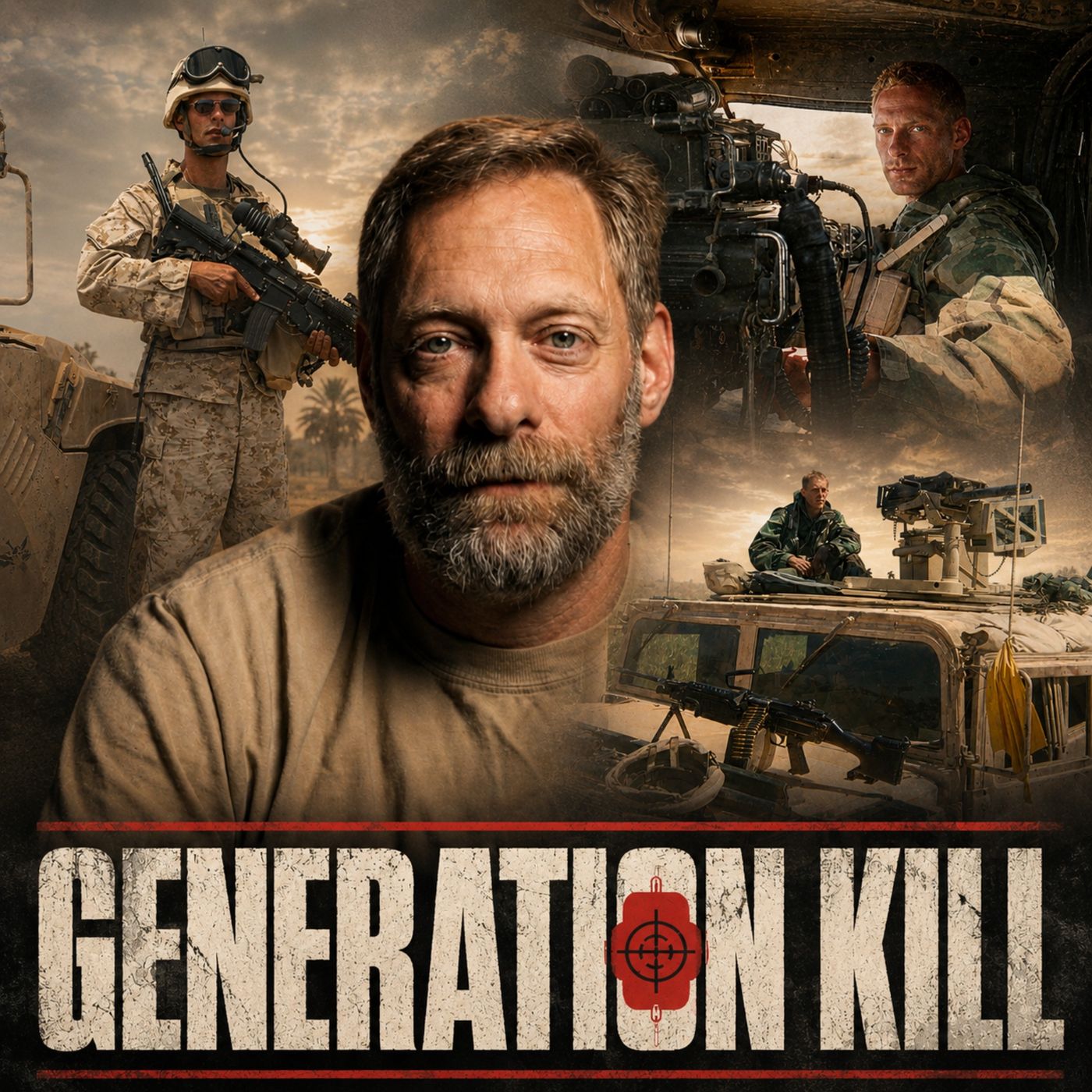
The Team House
The Real Marine Behind Generation Kill | Brad Colbert
02:20:57
Brad Colbert, retired Marine Force Recon veteran and one of the real Marines behind Generation Kill, joins us to talk about his path into the Corps, recon selection, 9/11 while forward deployed, Camp Rhino, and the early days of the war in...
Loading summary
Transcript601 lines
- [00:00]
Commercial Announcer
What's up, y'?
- [00:01]
Jack Murphy
All?
- [00:01]
Brad Colbert
Summer's got a different tempo.
- [00:03]
Commercial Announcer 2
Everything's a little looser, brighter.
- [00:05]
Brad Colbert
One plan turns into another. You hear something, you stay a little longer. Next thing you know, you're somewhere you didn't plan to be. It's those in between moments.
- [00:14]
Commercial Announcer 3
That's where the ideas hit.
- [00:16]
Brad Colbert
Conversations stretch out. Little memories sneak up on you. Sometimes it's just about what's in your hand. That color, that chill. The new Tropical Butterfly Refresher from Starbucks. Guava and passion fruit flavors with mango pineapple flavored pearl. Yeah, that feels like summer before you even taste it. Funny how one small stop becomes the best part of the day. Start your summer rhythm with Starbucks. Try the new Tropical Butterfly Refresher from Starbucks.
- [00:49]
Shannon Maldonado
My name is Shannon Maldonado. I'm the founder of Yaoi, a gift shop. From the lens of artists and handmade objects, I chose Shopify because when I was testing other platforms, it was definitely one of the most user friendly. It was important to me to think about where we would be in the future. All of the tools for reaching your sales, like planning inventory, they're just right there on your dashboard. For anyone starting a small business, the biggest thing I can tell you, it doesn't have to be perfect. Shopify can help you build upon it. Start your free trial on shopify.com guys,
- [01:18]
Jack Murphy
if your lady or your fella or that person that sends you an eggplant emoji at 2am is ready for better sex, then you should be too. That's where Bluechew comes in. They have been on a mission for years to help get you bricked up, build your confidence and help you actually perform in the bedroom. Their new arousal boosting formula, Bluechew Gold, is helping millions of men have better sex in 2026. While most ED meds focus only on blood flow, Bluechew Gold goes further by combining two ingredients for blood flow with two ingredients for mental arousal and connection. So you're not just physically ready, you're actually in the mood. This type of innovation is why bluechew Gold is the number one brand in erectile function. Don't let your mind get in the way of a good time. Discover your options@bluechew.com and we've got a special deal for our listeners right now. When you buy two months of BlueChew Gold, you get a third for free with the promo code Housecall. That's promo code housecall. Visit bluechew.com for more details and important safety information. And we thank BlueChew for sponsoring this podcast. Hey, everyone. Welcome to the Teamhouse. I'm Jack Murphy here with our guest in studio today, Brad Colbert. Brad is a retired Marine, served in Force Recon. You did a stint with the Royal Marines.
- [02:45]
Brad Colbert
Did.
- [02:46]
Jack Murphy
And numerous other things. We'll talk about. Your platoon, of course, was the inspiration for the book and subsequent television show Generation Kill. And you have a podcast called the Carry On Podcast.
- [02:59]
Brad Colbert
I do, yeah.
- [03:00]
Jack Murphy
Yeah. Well, just right off the bat, you want to tell people what that podcast is, where they can find it.
- [03:06]
Brad Colbert
Yeah. Carry On Podcast is available either video through YouTube or whatever platform they use to consume audio podcasts, Spotify or Apple or iHeart. And, you know, we do a couple things on the show. We talk to guests, authors, policymakers, discussing current events, treatments for veterans health. We talk about some fun equipment things. And we also look for reconnections with Generation Kill cast members to sort of give people where they now look and maybe some stories that weren't originally portrayed in the book or the TV series.
- [03:45]
Jack Murphy
So you try to interview the Marines you served with in the platoon, and do you try to interview the actors also that portrayed them?
- [03:51]
Brad Colbert
We haven't actually had any of the actors yet, but I certainly wouldn't put it past them. I do keep in somewhat contact with the individual that portrayed me, Alex Skarsgard. So maybe I can ask him if he wants to come on the show.
- [04:04]
Jack Murphy
All right, cool.
- [04:05]
Brad Colbert
Pretty cool.
- [04:06]
Jack Murphy
We'll get deeper into all that in a bit, but if we're to start at the top, you know, I always ask people about their origin story. Tell us a little bit about, like, how you grew up and what was that path that took you towards military service.
- [04:19]
Brad Colbert
Well, I had a pretty rough childhood. Not because of my parents. I was just. I was a pretty shitty kid, so. And I think my parents would probably agree with that if I was to ask them. They may. They may couch it a little differently, but I was a difficult child. I was fiercely independent. I was probably smarter than my own good, for my own good. And I got in trouble a lot. In fact, I was expelled from every school that I ever went to. I was expelled from elementary school, which is pretty hard to do, by the way. Junior high. I was expelled from high school. I ended up finishing school at a military academy that was in Missouri. All that to say that I was very rebellious and I did not handle groups well. And I wanted to give myself a challenge. I wanted to find a place where I could fit in. I wanted to. I originally wanted to be. And I've told this story before, but I wanted to be an astronaut. And in order to be an astronaut, I'll short circuit the story. Most astronauts were pilots. Pilots come from the military. Okay, So I have to be an aviator. Well, what do I want to fly? I want to fly F18. So that's Navy or Marine Corps? The Navy has shitty uniforms. Sorry, guys. They do Marines. Like, that's. That's it. And this is, you know, 10, 11 years old. That's my path. And I just didn't. I didn't have the personal discipline to stay in college. I tried it for a little while after high school and just said, effort. I'm just gonna enlist. So I was gonna say, this isn't
- [05:50]
Jack Murphy
one of those scenarios where, like, the parents brought the Marine Corps recruiter to the home. Was like, no sign. No.
- [05:56]
Brad Colbert
In fact, it was the other way around. And again, I had a rough go of it. You know, I got in trouble with the law. I was on unofficial probation, so I got in trouble, and I had to sort of, like, keep my nose clean for a little while. So I went to the recruiter, and the recruiter says, I can't take you. You've got this thing. And I'm like, okay, cool. Well, what do we have to do to get this thing? You have to go in front of a judge. And so I did, and I got it cleared up. But I was a recruiter's wet dream because I marched right in and said, I want to be, you know, 0311 infantry. That's one of those things where the recruiter's like, I don't know. I'll try to pull a few strings. We'll see what we can do, you know? You know, meanwhile, it's like, that's the hardest thing they have to get people to do. I did really well in the asvab. And he's like, there's a lot of other jobs. So I did. I enlisted. I wanted to be a recon Marine. I knew it. If I wasn't going to fly, that was the only other option. It is to this day, I think, one of the better decisions I've ever made in my life. And it has served me well, not just in character development and personal growth and interpersonal, but, you know, I think it's good for the soul. People who have done what we've done and worn the uniform, service, the sacrifice that comes with it. There is nothing else that you get anywhere in our life.
- [07:20]
Jack Murphy
Sure.
- [07:21]
Brad Colbert
From that experience. And, I mean, it was beautiful for me, and I did it for a long Time. And it was, it was amazing.
- [07:29]
Jack Murphy
So what year did you enlist?
- [07:31]
Brad Colbert
I enlisted in 95.
- [07:33]
Jack Murphy
Okay.
- [07:34]
Brad Colbert
October of 95. And I left in October of 16. Yeah.
- [07:40]
Jack Murphy
So 1990s Marine Corps.
- [07:43]
Bluff
Yeah.
- [07:44]
Jack Murphy
What was that like?
- [07:46]
Brad Colbert
You know, that was still where a lot of us expected it to be, like Full Metal Jacket or, you know, and that is not what it was like at all, or platoon or a lot of the movies that Hollywood dramaticizes. Marine Corps boot camp. I had come from doing several years in at military school, and that was hard, believe me. You, you know, kids can be very cruel to one another, and when you give them implied authority over each other, you talk about hazing. The Marine Corps was, was a walk in the park. Like, I, I was hung upside down by my ankles the very first day I was at military school. I was 15 years old. Like boot camp was, you want me to stand in these yellow footprints and you're going to scream at me for a little while? So it was fine. And I mean, I found it actually to be easy. And I was also older. I was 21 when I enlisted. The average age, 17 and a half, 18 years old. So I had life experience. I had a little maturity. I had some experiences that a lot of the other recruits didn't. And I found it really fairly easy. To be. To be perfectly honest, I think Marine Corps boot camp, out of all the services, is still the most challenging. It is the longest. It has the greatest amount of attrition. Yeah. And I left knowing that this is what I wanted to do. I had no regrets. A lot of people may leave their initial entry training and say, ah, this was a mistake. No, I didn't have that. So it's good.
- [09:23]
Jack Murphy
And you shot iron sights?
- [09:25]
Brad Colbert
Yes, we did. Yes, we did. In fact. Really, the Marine Corps, I want to say, recently, within the last couple of years, transitioned away from the iron sights to using an optic. But all the way back from the 60s, Marine Corps shot the M16 with iron sights at basic training. And then every year, to recall, I
- [09:47]
Jack Murphy
always bring that up, I can get Marines really wound up about the iron sights. That was pretty good. But I mean, to speak to the Marine Corps, I mean, jokes aside, they do train. What do you shoot out the 500 yards in basic in boot camp. And that's really good.
- [10:03]
Brad Colbert
It is, yeah. So it's different positions. You know, you start from 100 and then 200 and 300. Each yard line is a different body position. So, you know, at the shorter distances, you're standing and then you're doing kneeling and then prone at 500. But make no mistake, shooting a high score on iron sights in the prone, it's still. It's. It's not easy.
- [10:25]
Commercial Announcer 2
Yeah.
- [10:26]
Jack Murphy
At 500, you're struggling to see the target.
- [10:27]
Brad Colbert
You are struggling to see the target. Yeah.
- [10:30]
Jack Murphy
But I mean, shooting iron sights, again, jokes aside, like, it is really good. Yeah. To learn all the fundamentals like that.
- [10:37]
Brad Colbert
And the Marine Corps is huge into that. That adage of every Marine is a rifleman or rifle person. Whatever the adage is today. I mean, it holds true. And I think that is something that some of the other services are struggling with when it comes to identity. You know, every Marine is a rifleman, so. But what about the Air Force? What do you say? Is every person a pilot? They're not, Right?
- [10:58]
Jack Murphy
Yeah.
- [10:58]
Brad Colbert
Yeah. So the Marine Corps, I think, nailed it pretty early and has kept consistent all this time.
- [11:04]
Commercial Announcer 3
Yeah.
- [11:05]
Jack Murphy
So after you graduate from boot camp, what unit do you get assigned to?
- [11:09]
Brad Colbert
So after boot camp, you. You. I. I went to infantry school because I did enlist as an O3.11. At that time, the reconnaissance community was what we would call a secondary mos.
- [11:20]
Jack Murphy
Right, right.
- [11:21]
Brad Colbert
You couldn't get into recon at the point of enlistment. There was a pathway, so you had to be in a. In the combat arms, preferably 03.11. And then you had to try out and go to selection and pass selection, which I did. I did that at the School of Infantry, which was another three months of training at Camp Pendleton. And then from there, my first unit was third reconnaissance Company in Okinawa, Japan.
- [11:45]
Jack Murphy
Oh, cool. I didn't realize that back then you could go kind of like straight into the recon community.
- [11:51]
Brad Colbert
You could. Provided that you passed assessment and selection. Yep.
- [11:55]
Jack Murphy
Out there at Parris Island.
- [11:56]
Brad Colbert
Well, this would have been Camp Pendleton, but they had it both.
- [11:59]
Jack Murphy
Gotcha.
- [12:00]
Brad Colbert
Gotcha. Yeah. They had screening teams that would go around and screen people. They try to get them as early as possible before the unit scoops them up. Because once they get embedded into an infantry unit, those units are very reluctant. You want to take our best, our highest PTEs, our smartest people. There was a GT requirement, so there's a general technical score that the ASVAB will kick out. So when you go to the recruiting office, you have to take a test and it assess you on all these different things. Part of that test is a general technical score, which rates your aptitude for, you know, cognition and a whole bunch of other factors. It's a number. Recon needs that number to be, you know, 115 or above. And you need to have a high PFT, your physical fitness test. So if you go to an infantry unit, they're going to probably hide you like, no, you're not leaving. So they go to the school of infantry, where you're not yet assigned to a unit, and they screen you there.
- [13:05]
Jack Murphy
So you get to the recon community and do you want to talk a little bit about, like, what the difference was at that time between recon and force?
- [13:13]
Brad Colbert
Yeah, it was really. There was a huge cultural difference and one that was rigid. It's a lot of people at that time would say, you know, the reconnaissance community is the JV team and the force reconnaissance community is the varsity team. And I would say that's really childish to categorize it like that. Guys, we both go through the same schools. It really comes down to mission sets. The force reconnaissance unit typically operates outside of the artillery fan. So we're talking, you know, close air support range. They support a mef, which is a higher echelon of table of organization. The reconnaissance community works within the artillery fan, so up to 30 km in most cases, and works for the division. I mean, that doctrinally, that's your difference. Now, culturally, night and day. They didn't like us. We didn't like them. We wanted to go over to Force Recon. Force Recon felt that they were, you know, we're up here. Figure it out. And there was another vetting process. You know, you have to screen again. And they usually took you when you were a little senior. You know, now you're an E5, maybe an E4, and they wanted you to have a little experience under your belt. And I, looking back, I understand the need for that type of progression, but there was a huge difference in culture. Now it's a little more homogenous. Both of those units are now organized pretty much under the same house because of MARSOC's creation. But, you know, in the 90s, it was a different Marine Corps. They also had better equipment in many cases because they had access to a little bit more money. And we were still coming off of the heels of not really understanding what would be over the horizon. Right, right. Like, you know, we always trained for the last war, so we still did a lot of jungle tactics, patrol base activities. Yeah, we did a lot of things that we did in Southeast Asia that we would not be doing in oif, oef. But the forest reconnaissance community still had, you know, the Chenoweth dune buggies. They had a lot of the equipment that you just. We don't use anymore. And A mission set to go along with it. Not that it's still not pertinent, but it's not as pertinent, you know, especially modern warfare with drones and.
- [15:49]
Jack Murphy
Yeah, so what did they have you doing in recon at that time? Did you end up going to Thailand? Anything cool like that?
- [15:56]
Brad Colbert
Yep, did a lot of Cobra Golds, did some Marine Expeditionary Units. If that's when you go on ship. A lot of people don't realize that the Marine Corps has an infantry battalion, up to three at any given time, patrolling the waters of the ocean, available for immediate dispersion anywhere that the President deems they're needed. And Okinawa has a mu. And I did that twice. I did a special purpose magtaf, a Marine air ground task force to China. So we went into China for about a week and a half into the port of Qingdao and this was the first time that Marines had been to China since World War II.
- [16:33]
Jack Murphy
I was going to say the Boxer Rebellion.
- [16:36]
Brad Colbert
Absolutely.
- [16:36]
Shannon Maldonado
Yep.
- [16:37]
Brad Colbert
The China Marines were the last Marines to be there. And it was surreal. We could. We went on liberty, we worked. It was a working port call, but we were allowed to leave the ship in groups and we went out into the city. And I remember I'm wearing my. Well, we would call them Charlies. Your class C uniform. So khaki, long sleeve shirt. No, I tell a lie. Sorry. Short sleeve shirts, no tie, green trousers, piss cutter hat. Oh, I couldn't say that. It doesn't matter. We're walking around and the Chinese had not in many cases seen Americans before. They certainly hadn't seen Marines. And I'm walking and people would come up to me and they would stroke my arm because of the body hair because they're just not used to seeing. They would fascinate them. Strangers were calling us into their homes. They just wanted to talk, they wanted to practice their English, they wanted to offer us food. And so we, we wanted to go on liberty. But you couldn't because you're just getting mobbed.
- [17:43]
Jack Murphy
Right, Right.
- [17:43]
Brad Colbert
But it was amazing and it was fascinating. And this was 97. And I remember we pulled into the port and I'm looking around at their ships and their subs are just rusted at the water lines. Their surface fleet was not in great shape. I was young, but I was pretty into military hardware. Tables of organization. So I'm looking around and I'm like, these guys are not in great shape. Now fast forward. They are arguably ahead of us in many of those same categories. So they have incredible growth in their military Industrial complex. But back then, we toured their ships, we did some exchange, and they were not a concern.
- [18:30]
Jack Murphy
I was gonna. Yeah, I was gonna say, I mean, first off, that's something that would never happen today. There's no way they'd have Marines going on liberty in China by then. I mean, just, what, a couple years after this, we had that surveillance bird.
- [18:45]
Brad Colbert
Yep.
- [18:46]
Jack Murphy
Go down Hanan Island, I think.
- [18:47]
Commercial Announcer 3
Yeah.
- [18:48]
Brad Colbert
Yeah. If I'm not, I'm pretty sure that's the name of it. It was a bit of an embarrassment. We did get it cleared up diplomatically, but, you know, there was also. There were some other instances as well. There were some missile tests that they had done against Taiwan that covered the Strait. We did some GPS jamming that caused those missiles to splash into the water. They were horribly angry about that. They knew that it was us. But, you know, neither side publicly admitted it because they didn't want to save. They didn't want egg on their face. So there were a couple of things. Yeah, you're right. It wouldn't get done today, but what an amazing experience for me out of the uniform. We got to go see the Great Wall of China. Got to go to the National Art Gallery, Tiananmen Square, the Forbidden City. It was.
- [19:36]
Jack Murphy
That's so awesome. Yeah.
- [19:37]
Brad Colbert
I mean, like, that's one of the great things about the military is that those. Those intangibles, those travel opportunities, you can't get that anywhere else.
- [19:45]
Jack Murphy
Yeah, yeah. It's kind of sad that something like that wouldn't happen today.
- [19:50]
Brad Colbert
It is. It is. Because I. I get that there are adversary. But there's a lot of opportunity there as well.
- [19:58]
Jack Murphy
Yeah. I mean, it's a culture that's been more or less intact for like a thousand years.
- [20:02]
Brad Colbert
Right.
- [20:03]
Jack Murphy
Yeah. I. I wouldn't. Unfortunately, I wouldn't go as a private citizen. I'm afraid of, you know, it's like going to Russia.
- [20:08]
Commercial Announcer
Yeah.
- [20:10]
Jack Murphy
What's gonna happen?
- [20:11]
Brad Colbert
Not gonna do that. Not gonna do that.
- [20:13]
Jack Murphy
But I'm fascinated by the history and the question culture. I think it's super cool.
- [20:16]
Brad Colbert
It is. It's incredible. I mean, they. They do have. And it's. There's very similar parallels with Japan as well. You know, it's a very rich culture with a long history. And, you know, China for many centuries was the cultural epicenter of the world. They created a lot of. And as did those in the Middle east, you know, and then somewhere along the way, things just. Oh, we're going to do communism. Okay, Cool, cool.
- [20:48]
Jack Murphy
So you're in recon when did kind of you get the opportunity to start thinking and taking action about going to force.
- [21:00]
Brad Colbert
It was actually kind of an accident really. And I didn't spend, to be perfectly honest with you, I really didn't spend that much time in the force community. I dipped my toe into it because when I left the British World Marine exchange program in 07. 06, 07. Yeah. I was assigned to First Force, but only for about six months before MARSOC stood up.
- [21:28]
Jack Murphy
Ah, gotcha.
- [21:29]
Brad Colbert
Okay. And then I found myself back with 1st Reconnaissance Battalion. And then they stood up the force company in 1st Reconnaissance Battalion because, you know, there was MARSOC, so they took what was 1st Force. You're now MARSOC, but we need a group of you to be force. That job, we don't know what we're going to call it yet. And that's what I did. So was I still force, was I not? I guess it's. I don't know. It's a matter of semantics. But in very short time, I found myself as a platoon sergeant going back over to Iraq in 07. So my stint in force was fairly short just because of the circumstances. You know, three years in England with the commandos right on the heels of the invasion of Iraq. And then MARSOC changing in 06. So maybe seven months with force. Okay, okay. Maybe another three at the reconnaissance battalion in a force platoon. And that was it.
- [22:32]
Commercial Announcer 3
A lot of people put off buying a new mattress because it feels like a hassle. Too many options, too many claims, and no real way to tell what's actually going to hold up. Ghostbed makes that decision easier. Ghostbed is a family run company with more than 20 years of mattress making experience backed by deep manufacturing expertise. Their approach is straightforward focus on quality materials, smart construction and a consistency over time, not flashy features or complicated sales tactics. Every Ghostbed mattress is built for long term comfort, using durable foam and proven cooling technology to help regulate temperature while you sleep. It's designed to feel reliable night after night, not just when it's brand new. And if you're not sure which mattress is right for you, Ghostbed's online mattress quiz helps narrow it down quickly. Whether you're a side sleeper who needs a little plushness or someone who prefers a firmer feel, the quiz matches you with the right option based on how you actually sleep. They also keep pricing grounded. Ghostbed mattresses cost up to 50% less in comparable brands. You can rest easy knowing you're getting one of the best values at this quality level. Every mattress comes with a 101 night sleep trial, an industry leading warranty and fast free shipping. And as a teamhouse listener, you can get an extra 10% off your order. Just go to ghostbed.com house and use the promo code HOUSE at checkout. That's ghostbed.com house codehouse for an additional 10% off site wide. Okay, upgrade your sleep with Ghostbed, makers of the coolest beds in the world. Some exclusions apply. See cipher details. Thank you Ghostbed for sponsoring the show. Thank you guys for helping support the show. Bye.
- [24:12]
Jack Murphy
Hey guys, this is Jack Murphy. I want to tell you about tonight's sponsor which is Quints. They are a company that makes a thoughtfully built wardrobe that comes down to pieces that mix well and last. That's where Quince really shines. They use premium fabrics, considered designs and everyday essentials that feel effortless to wear and dependable even when the seasons change. What I'm wearing today is their 100% Mongolian cashmere sweater. The same stuff that luxury brands use. It is a staple in the industry and it stays soft and doesn't pull. It keeps you nice and warm throughout the year. I've been wearing this for a couple months now. New York City winters get pretty cold and also the linen shorts have become a go to for me. They don't wrinkle like cheap linen does and they work with everything and they don't cost a fortune either. Right now you can go to quints.com house for free shipping and 365 day returns. That's a full year to build your wardrobe and love it and you will now available in Canada too. Don't keep settling for clothes that don't last. Go to Q U I n c e.com House for free shipping and 365 day returns. Quince.com House thanks for supporting the show everyone.
- [25:38]
Bluff
Hanging out at the pool is great. Relaxing and playing Vegas style games on my phone at the same time. Drink in one hand and a blackjack in the other. It's all at Spinquest. Over a thousand games including your favorite slots and table games. Be cool with this summer special. New players get $30 coin packs for
- [25:59]
Commercial Announcer
10@Spinquest.com SpinQuest is a free to play social casino void where prohibited. Visit spinquest.com for more details.
- [26:09]
Commercial Announcer 2
This July 4th at Lowe's get up to 45 off select major appliances plus save $80 on a select Char Broil Performance series gas Grill. Now $299. Our best lineup is here at Lowe's Lowe's. We help you Save valid through 78 while supplies. Last selection varies by location. See lowe's.com for more details.
- [26:33]
Lady Luck
Visit your nearby Lowe's.
- [26:38]
Shannon Maldonado
My name is Shannon Maldonado. I'm the founder of Yaoi, a gift shop from the lens of artists and handmade objects. I chose Shopify because when I was testing other platforms, it was definitely one of the most user friendly. It was important to me to think about where we would be in the future. All of the tools for reading your sales, like planning inventory, they're just right there on your dashboard. For anyone starting a small business, the biggest thing I can tell you is it doesn't have to be perfect. Shopify can help you build upon it. Start your free trial on shopify.com to back up then.
- [27:08]
Jack Murphy
Sure, let's. You're in Recon. What was sort of like the experience like being in recon when 911 happened?
- [27:17]
Brad Colbert
That was. That was. Everyone has their where were you when 911 happened story, right? That is the where were you when Kennedy was assassinated version of our generation for me. I was on a Marine deployment. I was on a Marine expeditionary unit. So we were in the coast of. Sorry, we were in Darwin, Australia when 911 happened. And as one of the platoons, I'm trying to think if the seals. I don't remember if the seals. I'm sure they were back then. Yeah, they were. So we had a force platoon, we had a reconnaissance platoon. I'm pretty confident we had a SEAL platoon as well. So I think those three groups were pretty confident that we were going to do something. And we were right. We all did separate things. But I don't think any of us were privy to any more intelligence than anyone else was privy to.
- [28:18]
Jack Murphy
I mean, the world was on cnn. Yeah.
- [28:21]
Brad Colbert
Yeah, it was pretty much open source. And then whatever, you know, the captain of the ship was being told and whatever the battalion commander was being told. It was surreal though. Being Forward deployed when 911 happened was surreal.
- [28:38]
Jack Murphy
And what did you guys end up doing? How. What was the Marine Corps response to it in those, you know, weeks and months after?
- [28:45]
Brad Colbert
Well, we immediately pulled. We sailed out of port. It was late when it happened in Darwin, so It was probably 20, I want to say 2300. Liberty expired at midnight. They were dragging people back to the boat half drunk. Nobody would see, say, what was taking place. They're seeing some things in the news on the bars. From what I gathered, bringing the ship's complement back was a nightmare. I was already on the boat the next day. We left, we weighed anchor. We basically went. No one knew what had taken place. Was this the opening shot of a war? Is this some kind of asymmetrical attack that is going to repeat itself? So we left and went into the open waters 50, 60, 100 miles off the coast and just cut squares for a couple of weeks. Then we went into East Timor, did a humanitarian mission, and then it was in very short order apparent that we were going to go into Afghanistan, that they were the ones responsible. So we made an amphibious landing into. Well, we hung out in Pakistan for a while at an air base and then we did an amphibious assault into Afghanistan.
- [30:04]
Jack Murphy
And it was amphibious assault into Afghanistan.
- [30:08]
Brad Colbert
Right. The technical amphibious assault was because we departed from ship and we landed in Afghanistan. And that by definition is amphibious. And it's the longest amphibious assault salt that's ever been made in the history of American.
- [30:23]
Jack Murphy
Right, right. So you had to refuel a few times in the air on the way.
- [30:26]
Brad Colbert
Yeah, yeah. Also one of the scariest flights I've ever had. We landed at Camp Rhino, which was a compound in the middle of the desert. It was a hunting preserve for some very rich individuals. But it had a private Runway, unimproved Runway. It had a big hangar, it had a little mosque, it had all these ancillary buildings and it was surrounded by this wall. And we're like, that's it. So C130, I mean, we are packed in. No doubt. You've been on a C130 before. I don't know if you've done a mass tack. Yeah, but it's that kind of cramped. And I mean, you got your gear, your pack is on your legs and you can't move. And we flew high threat tactics, which means you're assuming you're going to get a lot of ground fire. There's also going to be surface to air missile threats. You got to fly basically nap of the earth. So C130, we did receive some ground fire. We don't know where, but the plane did get shot a little bit. But that wasn't the problem. It's. You're going from this really high altitude and then it goes screaming down to like a thousand four feet. And you're just sardined in, you can't move. And then the Runway is made of this, like moon dust.
- [31:47]
Jack Murphy
Yeah.
- [31:48]
Brad Colbert
You know what I'm talking about. Because you've walked that. You sink into it. It's up to your ankles. But here's a C130, fully loaded, full bag of gas, and it's coming in on this Runway and it's not getting purchased. And it's just sliding and yawing. And I'm like, oh, this is it. This is how it's going to end. The plane is going to clip the ground, it's going to cartwheel, and I'm wedged in between, you know, 60 other fuckers. I'm. I'm done. This is. This is it. This is my story. It didn't turn out that way.
- [32:16]
Jack Murphy
I mean, spoiler alert. This is basically kind of what happened to the C130s in Iran.
- [32:22]
Commercial Announcer
Yeah.
- [32:22]
Jack Murphy
A few months ago. They got stuck in the dust. Essentially sunk in because of that. Whatever. It's that certain type of soil.
- [32:30]
Brad Colbert
It's unique. And then, you know, so fast forward, I had a. A guest on the show, Alexander Lemons, and he did some research to find that the soil in Iraq is unique from all of the soil in the world. I know that we're talking about Afghanistan, but there's some property about this particular type of sand where it just recirculates due to the, you know, the. The dust storms and stuff. It does something. It grows, Grind it down. But yeah, so Iran, Afghanistan, Iraq, it's all that same type of dirt. Yeah. I thought it was over. It didn't turn out that way.
- [33:07]
Jack Murphy
And so you guys kind of spearheaded into Camp Rhino.
- [33:12]
Brad Colbert
We did, yes. There was us, and then it turned into, like, the who's who of Special Operations Forces because it became the beachhead for everyone to flow in. So there was, you know, British, sas, there was Australian, there were French, there was German. Clearly the Marines, Navy, Special Forces. There was, I think, for a very brief time, I want to say there was an ODA team. But it all kind of blends in. At this point, we're talking 01, and we ran operations out of there. The infantry was dug around the perimeter. It was just weird, you know, it was weird because nobody enlists in the military under any illusion that you are not going to potentially go to war. But I enlisted in 95. There was no war taking place. I mean, we had some people that were concerned, but it was like, oh, that's, you know, Nicaragua or that's, you know, know Somalia or. That's right. The United States getting attacked on its home turf and then retaliating was unheard of. Yeah.
- [34:23]
Jack Murphy
And then finding yourself in, like, such a third world country, what's going on here?
- [34:30]
Brad Colbert
It was so weird. And we didn't have any of the equipment to really do this type of thing. You know, you're still wearing. We had just transitioned. We didn't have them yet. But the Marine Corps had just transitioned to that new digital pattern. Yeah, we still had the old classic tricolor woodland pattern or chocolate chip, like 91 chocolate chip desert Storm. So that's what we had. And that was our desert uniform. And we didn't have vehicles that were really tailored towards what we were doing, which was, you know, some long range desert patrol. We didn't have the, we didn't have the equipment for it. So we made it work. But it was very weird.
- [35:12]
Jack Murphy
I remember working with Marines in this was a little later on, this would have been 2004 Marine infantry. And I mean they had like one pair of nods per squad. They didn't have any sort of organic intelligence attached to their battalion. And there's again, not trying to throw shade on them. It's just they didn't have a lot.
- [35:34]
Brad Colbert
The infantry off broadcast operates under very austere conditions. They always have so much so that it's really a point of pride to them at this point.
- [35:41]
Jack Murphy
Yeah, I know, yeah.
- [35:42]
Brad Colbert
Like, like we can do everything with nothing. And the Marine reconnaissance community had a lot more. It did. But now when you compare Marine recon or even the Force platoon to say a Ranger battalion or an ODA team or you know, cag. Oh yeah, like night and day, like don't even get it started. But we did have more equipment. You know, we had some, some laser range finders, laser designators. Everybody had NVGs, we had M4s, we had suppressors. We had a lot more hardware than your run of the mill and we had reach back. And that was one of the things that reconnaissance is able to do in the Marine Corps is you're in all of the other services put an officer in charge of their smaller SF units. Marine Corps doesn't run that way. Now MARSOC does, but there was no MARSOC in 01. So this was six enlisted Marines with an E5 in charge. You will go out to 20km and get eyes on a target and then we want you to talk to that aircraft overhead and lays ordinance on it. Can you do that? Yes, I can do that. The Marine Corps is the only one that does business that way. And it's a tremendous responsibility and one we took seriously.
- [37:03]
Jack Murphy
They were sending you out on those kinds of missions.
- [37:05]
Brad Colbert
Yeah.
- [37:06]
Jack Murphy
What was that like going out there and like, now it's for real?
- [37:09]
Brad Colbert
Yeah, now it's for real. And it was, it was fun because you're finally getting to play the game you have practiced for.
- [37:16]
Commercial Announcer 2
Right.
- [37:17]
Brad Colbert
You know, it is that pro athlete who never gets Old off the bench. And now finally I'm off the bench. Let's see what it's about. But it's also incredibly naive because you hadn't been shot at yet. You didn't understand any of the fog of war. It was very sterile in many cases because the desert was the only opposition that we had. We did drive into a minefield at one point that was interesting. We did call in some, some, some ordinance on occasion. That was fun. But a lot of it was just spent doing what reconnaissance Marines do, which is quietly getting eyes on and just reporting. But it was fun. It was really a relief to be able to finally do what we had always practiced.
- [38:05]
Jack Murphy
And were you guys inserting on Humvees, like walking, setting up a observation post and that sort of stuff?
- [38:11]
Brad Colbert
Humvee. We had a single Humvee for the six of us and we would drive it out there, leave it, camouflage it, make the rest of the movement on foot, establish an observation post, and then monitor. And it was a lot of monitoring MSRs. You know, we understood Taliban at that point. We understood who our enemy was. I'm talking strategically. And the infantry battalion had a CIA case officer assigned to them when we went in. So we were getting intelligence, you know, the larger we, from a couple of different sources, military intelligence as well as the intelligence community at large. And it was early on in 01, so the sky was just filled. I mean, they were dropping 2,000 pounders off. You could, you could see the light flashes. Right. So there was a massive air campaign, but overhead you had all kinds of enablers, all kinds. I mean, we would see the planes overhead and then you could just, you could pick up the radio and talk to the AWACS or, you know, talk to the command and control bird. If there was fixed wing aircraft checking in, they would push it to you. And it was, that was pretty cool. Yeah, that was pretty cool.
- [39:25]
Jack Murphy
Any of those operations that kind of got a little dicey?
- [39:29]
Brad Colbert
I don't think so. There was a firefight with the force platoon. They were out and they got into a bit of a scrape. Should they have is a matter of some disagreement. I know the guys that were there at that time, they, they did exchange, they did get into a firefight, but nothing. I don't remember anything that was like dicey other than our own, our own dangerousness. We were, I've told this story before. We modified the Humvee with a pintle mount to hold the belt fed. Okay, when I say we modified it, we took a piece of tubular steel, we Welded a flat plate on the bottom. And then we took the caster off of a refrigerator and welded it to the top. That allowed for a swivel, which the gun sat on with a pin through it. You now have a pintle mount. Once it's ratchet strapped to the Humvee, any machine gunner knows that you have a device under the barrel or attached to the weapon in such a way called a traverse in elevation. It's a fixed piece of metal that keeps the barrel from free flowing. We didn't have that. So there's a gun in the bed of the Humvee which could pivot to shoot the floor of the Humvee or between the driver and the A driver. And there was a moment where the gun was used and it was like, oh, my God, you just riddled the hood of the Humvee. And it was between me and the a driver of the Humvee. And I'm like, oh, God, this is so fucking stupid. That was the worst thing, I think, that took place as far as the enemy contact and anything. No, no. There were some other very surreal moments, like getting into Kandahar Airport and we did watch one of the Marine infantry step on a mine and get blown up. There was a couple of other instances as well.
- [41:30]
Jack Murphy
Yeah. It was a period of time, I guess a brief period of time when the Taliban was essentially defeated. There may be some holdouts we were still looking for, and there really wasn't an IED threat.
- [41:44]
Brad Colbert
Yeah.
- [41:44]
Jack Murphy
Yet
- [41:47]
Brad Colbert
it was nice because that changed, and it changed relatively quick. I mean, any. Any adversary that is going to survive will learn asymmetric warfare against the United States. I mean, that is the only way that you are going to survive. And it's not just unique to the American culture. Ukraine's doing it against Russia right now. And yeah, it was a matter of time, but in 01, there was no. There was no such animal. That was great. Yeah.
- [42:20]
Jack Murphy
And tell us about rotating back home from that trip.
- [42:24]
Brad Colbert
That was great. It was so weird too, because I compare my retrograde from 01 and my retrograde from, like the Iraq war in, oh, three. Three complete night and day. I mean, when we went into Afghanistan, we went in with a full combat load. I mean, freaking. You name it. It was like shopping cart. I want one of those. And I'll take two claymores and I'll take that law rocket. I need seven fragmentation grenades. Nope, not enough ammo. More ammo. We never downloaded that stuff. Like, we got out of Afghanistan on a helicopter and then leapfrog back to Pakistan, and from Pakistan back to the ship. And we've just got. Our pack is filled with stuff. Like, I mean, just stuff, man. And our deuce gear filled with ammo and fragmentation grenades. And I've got two or three rounds. I mean, I just. And it just all gets dumped into a quadcon. And that quadcon gets closed up. Not locked, not secured, not like, sign here, just, hey, go put your gear in your team quadcon. And then it gets back to Pendleton and it's like, you know, that's all full of ammo.
- [43:40]
Bluff
Right.
- [43:40]
Brad Colbert
And explosives and C4 and claymores and rocket launchers. We should probably turn that into the armory. Yeah, yeah, we'll do that. We were the only platoon to see any kind of combat. Any kind. And make no illusions. I'm not saying that we, you know, were six months constantly getting shot at. It was. It was a very short period of time and for all intents and purposes, pretty innocuous, but we were the first platoon to see combat.
- [44:09]
Shannon Maldonado
Yeah.
- [44:10]
Jace Medical Announcer
Yeah.
- [44:10]
Brad Colbert
So you walk back to a unit who is operating at a very high level and is itching to get some from 9 11, and you're treated like, I don't want to say heroes, because that's not what I'm saying, but you are definitely like, you're the cock of the walk right now.
- [44:26]
Jack Murphy
Right. Right.
- [44:26]
Brad Colbert
Yeah. We want to hear what happened. We want to hear your lessons learned. We want a pme. You're going to talk to everybody. What did you do? How did you do it? What worked? What didn't work? And in the process of articulating all that, I started absorbing all of those lessons because I'm now, you know, it's an oral story. This is what worked. This is what works in the planning process. Yeah. That technique right there, screw that. That doesn't work. So now I have this great database of things that we. Fast forward to, oh, three. And I'm like, okay, this is what needs to change. We are going into Iraq. We can't do this, but we are going to keep this. This needs to change. And that made all the difference in the world.
- [45:06]
Jack Murphy
When you got back home, were you already hearing stuff about Iraq? A little bit, yeah.
- [45:11]
Brad Colbert
Yep. There was discussions about Iran while we were still in Afghanistan. There was a lot of talk on the. On the high side about possibly remaining and just crossing the border into Iran.
- [45:28]
Jack Murphy
We're going to do the rest of the Middle East. Yeah.
- [45:30]
Brad Colbert
Like, let's just. It. Let's just get it taken care of. And I think my God, how different would the world be today if that had actually come come true?
- [45:37]
Jack Murphy
The Iranians were scared shitless after 9 11. Not because they were involved, but they were afraid we're going to catch some of the retaliation from this.
- [45:45]
Brad Colbert
Yeah, there was a lot of blowback and a lot of people were, like you said, running scared because we were not messing around. The United States was on a war footing and we don't get on war footings very often. I mean, we will get into engagements, but as a country, we were galvanized. Everybody, I mean, especially this city.
- [46:04]
Jack Murphy
Yeah. I mean, it's something about like the, the American character. And I mean, when you get the entire country pissed off, like, we'll do scary stuff, we'll do stupid stuff too.
- [46:17]
Commercial Announcer
I mean,
- [46:19]
Jack Murphy
and yeah, I, it's like I have this conversation with people sometimes that, about Taiwan that people are like, well, we're not going to go and fight over like some rock, rocks that you can barely see at low tide and the South China Sea. And it's like, yeah, no, I get that. You're right, we wouldn't. But if an American aircraft carrier gets sunk in the South China Sea.
- [46:37]
Brad Colbert
Yes.
- [46:38]
Jack Murphy
This entire country will go batshit.
- [46:40]
Brad Colbert
It's 5,000 people. That's more than we lost in 9 11.
- [46:43]
Jack Murphy
Yeah, people will lose it.
- [46:44]
Brad Colbert
Yes, they will. They absolutely will. And it's a conversation that I've had on my show as well with some policy experts who are, who. That's their job to talk about that subject and not to get you off track. But the most likely scenario is China blockades Taiwan and we are forced to somehow try to break that blockade. What does that look like in a Berlin style airlift service? But their response, they're most likely KOA is probably going to be just that. And God help them if they sink one of our aircraft carriers. Yeah, that's, that's, that is a red line that you don't come back from. And I talk more about, you can theorize what the battle is going to look like. That is great. And that's academic. I don't care about that. I want to know what is the world gonna look like after? What does this do to the globe?
- [47:40]
Commercial Announcer 2
Right.
- [47:41]
Brad Colbert
How does it piece out different countries? What is the alignments gonna look like? You know, what is six months, nine months a year after Taiwan do? That's what I think is interesting.
- [47:52]
Jack Murphy
Yeah, well, I mean, the same question for Iran right now.
- [47:55]
Brad Colbert
Yeah, yeah. Watching that.
- [47:58]
Jack Murphy
So talk us through a little bit. The ramp up for Iraq.
- [48:02]
Brad Colbert
Yeah. We had a period of Time after Afghanistan, we get back, we, we, you know, we do all of the post, post deployment things like put all your gear away, go talk to the shrink, take all your welcome back classes, and then you need to take some leave. You go on leave and you do all the things and then it's business as usual. We went back into a training cycle. I went to a couple of schools. But we knew that there was something coming and it was definitely on the front of everyone's minds. And we formed, you know, people rotate in, people rotate out. We formed a new platoon with new leadership and we start preparing for ground operations. We start preparing for Iraq. It was, it was known that we would be, that that was the target. It wasn't matriculated down, like this is the line of departure and this is where we're going to stay. But it was like, that's the X that is the target. So we started practicing a lot more vehicle ops. We started modifying the vehicles. I got my vehicle prepared to do what I knew based off Iraq or Afghanistan it would be needed to do. And we practice. I mean, that's what you do, right? You train vehicle operations and contact drills and down driver and all of the other things. And then medicine, I mean, lots of medicine.
- [49:34]
Commercial Announcer
And
- [49:37]
Brad Colbert
once we had a date for deployment that really, I think solidified everybody's resolve because that's like, okay, it's real. Yeah. This is not some buzzword. It's not something to rally the truth. Like we're going and this is the date that we're leaving. And I think because it's not just a platoon now and it's not just a potential, it's real. And we're taking everybody, the whole battalion is going, you know, a couple of hundred very well trained men are going into, with the rest of the US military into this little country and we're gonna, we're gonna take it over. And I, I remember and I don't know how your experience was, but I just remember the sheer number of body bags they ordered.
- [50:24]
Jack Murphy
Oh, shit.
- [50:25]
Brad Colbert
Because they expected massive casualties. I mean, massive casualties was expected, anticipated, not. I mean, I'm not talking about for the Marine Corps or 1st Reconnaissance Battalion. I just mean the US military, they were expecting a lot of casualties. There was anticipation of anthrax. Yeah, Chemical. Right. So we got before 2003, the full anthrax regime, which was an 18 month shot sequence.
- [50:54]
Jack Murphy
Yeah, it was like six or seven.
- [50:56]
Brad Colbert
Yeah, it was a lot. And I think we had two people in the unit that refused and were, they were out. They were gone because it was non negotiable. This isn't Covid. Like you're going to be taking anthrax. It's so weird. I mean, just to go down a rabbit hole how different everybody's attitudes were towards anthrax compared to Covid.
- [51:16]
Jack Murphy
Covid, yeah.
- [51:17]
Commercial Announcer 2
Yeah.
- [51:17]
Jack Murphy
No one gave. No one gave a second thought.
- [51:19]
Commercial Announcer 3
No.
- [51:20]
Brad Colbert
Like completely untested, untried experimental anthrax. And you compare it to Covid, which had rigid. Anyways, it's not important.
- [51:30]
Jack Murphy
It was. I. I was so fortunate that I got the anthrax series and. But it wasn't recorded in my records, so I got it like 1.5 times. You know, I probably got like 12 instead of 7.
- [51:42]
Brad Colbert
Yeah, you're extra inoculated or extra. Your DNA is screwed up. I don't know.
- [51:48]
Jack Murphy
Probably. I'm pretty screwed up. You know, it's a good thing I'm registered with va. I'm going to get something weird down the line.
- [51:54]
Brad Colbert
Like I seem to remember something about you couldn't donate blood for a period of time after the anthrax vaccine.
- [51:59]
Jack Murphy
That was also depending on certain parts of the world that they sent us to. If you were like, probably Afghanistan was one of them. But I remember, I've heard that story also.
- [52:09]
Jace Medical Announcer
Yeah.
- [52:09]
Jack Murphy
Oh, you've been hanging out and so Central Africa for six months. Like, nah, we're not taking your blood.
- [52:15]
Brad Colbert
I had so many inoculations though, like from all of the different places that I had been to. And that's one of the things that blows my mind because again, tangential. I worked in my last job with all former military guys, you know, and when the COVID kerfuffle came, everybody starts complaining about it. I'm like, really? I know where you guys all served. I know what your shot records look like. You've had like 25 vaccinations for stuff that is a one in a billion chance you're ever gonna get it. Like Japanese encephalitis. And God knows it's.
- [52:50]
Jack Murphy
I mean, it really is dependent on the person's media diet and what they're consuming and what they're hearing. Because yeah, we went through basic training or boot camp, we lined up and they had the gun and they injected us with all kinds of. I don't know what the hell.
- [53:03]
Brad Colbert
No idea. Yeah, yeah.
- [53:05]
Jack Murphy
You remember the shot that they put in your ass cheek where it's like they inject like it feels like there's a golf ball.
- [53:10]
Brad Colbert
Peanut butter. It feels like, like somebody is injecting peanut butter into It. Yeah, I don't.
- [53:14]
Jack Murphy
I don't remember what that shot is for.
- [53:16]
Bluff
We don't.
- [53:17]
Jack Murphy
We got smallpox, too, which Americans don't get, except for military.
- [53:21]
Brad Colbert
Yep. I remember my smallpox vaccination. Still have the scar from it. I'm sure we all do. And so, like, all of that stuff. Right. It was all part of the workup to that O3 invasion. And because we expected the royal. We. So many casualties from Kim, a lot of people didn't know any better. I don't want to say didn't know any better because they were ignorant. But I think the assumption is. Is like, this is not Afghanistan 01. This is not 2001. Or, sorry, 1991, first Gulf War. Like, we are going to get in a fight. And we were prepared for that. And we weren't reticent. We weren't afraid. It was just this very pragmatic resolve, like, some of you guys aren't going to come home.
- [54:11]
Jack Murphy
Right.
- [54:13]
Brad Colbert
And that's not the way it worked out, at least not in 03. That is not the military's experience during the duration of the conflict over there. But for my battalion, we lost no one. With only, you know, one. One real casualty.
- [54:32]
Jack Murphy
When you deployed to, I'm assuming Kuwait first, what was sort of like your concept of what your unit's mission was?
- [54:40]
Brad Colbert
It was really weird.
- [54:44]
Jace Medical Announcer
We.
- [54:45]
Brad Colbert
We were supposed to drive through and find a route through a very specific. Trying to think how to describe it. There was a sort of like this dam network of levees. My job was I was going to be the lead platoon, lead team, lead platoon for the entire battalion that would then lead the division through. Gotcha. So I had to. And I was looking at U2 photographs, you know, with a magnifying glass, and just like. And I'm charting it and rehearsing and rehearsing. And that was supposed to be what my team's job was. You're going to go through the line of departure, engineers are going to blow the berm, and then you are going to navigate this route, proof it, and then everyone's coming in behind you. None of that happened. No, no. And that. That was what we were supposed to do. We worked at the time, General Mattis was the division commanding general for 1st Marine Division, of which 1st Recon fell under. Brilliant strategist. I still think he's one of the brightest minds of our generation as far as a warrior goes. And it ended up that that's not how things played out, but that's what we were supposed to have been trained to do we must have been to Kuwait. I mean, it was over a month. I'm sure it goes by very quick. I can't remember.
- [56:16]
Jack Murphy
And so what did they have your team doing in actuality?
- [56:21]
Brad Colbert
In actuality, the battalion still spearheaded movements, but we did not have a lot of infantry, or in many cases, any infantry behind us. We acted as shock troops. We did more of what a Ranger battalion would do in many ways. That is not what we were trained to do. Not. Not to suggest that we weren't capable, but I think that's a lot of what the friction was for the unit and. And really for the lower ranking, the rank and file, you know, men like myself who were in E5 at the time, because I'm like, this is not what Recon Marines are supposed to be doing. You know, our job is recon.
- [57:01]
Shannon Maldonado
Pull.
- [57:02]
Brad Colbert
We're going to go over here, we're going to locate the target, and then you do whatever you want to do. If that's infantry, if that's rockets, if that's an airstrike, you are using us as shock troops. We're flowing en masse. We're making contact with the enemy. We are destroying the enemy, and we. We are continuing to move. And if that's what the general wanted to use us for, that's great. Like, in retrospect, who the f. Was I to sit there and be like, I'm sorry, I don't do windows? You don't say that, but you complain about it. And we did. And that did not go over well at the end of events.
- [57:42]
Jack Murphy
But was the idea that they wanted you to sort of be like a block blocking force, like, go out there, see what's going on, and kind of like, guard the flank of the movement?
- [57:54]
Brad Colbert
In many ways, yeah, we were. And we were way out front. I mean, way out front in many cases. And it's not just us. I mean, the military to a whole, but the Marine Corps specifically, moved so fast, there were several times where they just had to say, you guys have to stop. You've outstripped your supply line. Yeah, yeah, yeah, yeah. I don't know where you were.
- [58:19]
Jack Murphy
I wasn't within the invasion.
- [58:21]
Brad Colbert
Okay.
- [58:21]
Jack Murphy
I joined the army in O2.
- [58:23]
Brad Colbert
Got it. Okay, fair enough. Fair enough.
- [58:25]
Jack Murphy
I was in. I was actually in Ranger selection when the invasion happened. God. Yeah. Well, when the guys came home with, like, a bunch of broken ankles and stuff from that jump, they're like, maybe, yes.
- [58:41]
Brad Colbert
I never jumped a combat jump. And I'm really kind of glad. You know, I have a lot of Parachute jumps to my name.
- [58:49]
Jack Murphy
We'll get one of those guys in here. I mean, they told me the static line was at waist height because they were so weighed down.
- [58:55]
Brad Colbert
Yeah, yeah, no thanks. Yeah, I'm good.
- [58:58]
Jack Murphy
Kind of, kind of my thought about it.
- [59:00]
Brad Colbert
Yeah, yeah, yeah. You know, even, even jumping a square with combat load is not, it's not a fun ride. I don't know how it was for you. We jump front mounted rocks. We don't typically jump back mounted rocks.
- [59:12]
Jack Murphy
We in free fall. We did front mounted front.
- [59:15]
Brad Colbert
Yeah. And it's like that beach ball until that is lowered and it's just such a pain in the ass. We trained for it. I'm just really glad that I never did it. I'd much rather just walk.
- [59:28]
Jack Murphy
I'd do a free fall jump but like a static line jump into combat. I mean, sounds pretty, pretty cool, you know, band of brothers and all that. But in reality that's scary as hell.
- [59:38]
Brad Colbert
You've got. I did a JRTC at Fort Polk years ago. And I say years ago because the C141 was still flying. So, you know, it's years ago and they did a mass tack with like 16 or 17 C141s over Fort Polk. You could walk across the sky from one canopy to the next. So many Joes in the sky and they assume a 10% combat injury rate. And that was legit. And this was a training jump. I mean, broken ankles. They had a couple of casualties and I'm not celebrating that. But combat now. So let's take that template and now you've got guys on the ground potentially shooting at you. No thanks. Good.
- [60:26]
Jack Murphy
Tell us about, you know, the D day, the day of the invasion.
- [60:29]
Brad Colbert
Pushing across the berm. So cool. I mean it was. They did all of these preparatory fires, surface fires and aircraft. They did tomahawks, I mean all kinds of sof. And they did, you know, some diversions and try to draw the Iraqis to confuse them where we were going. And the engineers blew the Bermuda very shortly before we crossed the ld. And it was at night, so everyone's on nods. We did so much driver's training on nods. And it still sucks because these are the old single tubes. Seven bravos, seven PVs, seven zero depth perception because there's one tube. And that takes a lot of practice in order to get good at. But it was surreal. It's just like you're with your friends and you have trained with these guys for a long time. You trust them, you know how they're going to react, but it's still not been proven. So there was a lot of that anxiety, like, what's going to happen? Not fog of war, because you don't know what the enemy is going to do. But you're. There's this little, like, Jiminy Cricket on your shoulder, like, don't fuck up. Hope you go really well.
- [61:43]
Jack Murphy
Hope you don't die.
- [61:44]
Brad Colbert
Yeah, don't suck. You just don't know how you're going to react. So I think there's a lot of not at the forefront of your mind, but there's that little voice like, what if I screw up? What if I panic? What if I freeze? What if I'm not as competent as I hope I am? But it was just weird. Bombs are going off. There's explosions way off in the distance. You can hear. Hear gunfire. Is it ours? Is it theirs? Is it a firefight? Is it misdirection? Like, what is all that? And you don't know. And you're just. You're just driving. And that's what we did. I mean, we left it. Oh, dark 30. And we drove and we did not stop driving for a couple of days, but, like, all through the night, we just drove. And it was very, like, staccato. You know, you drive for, like, 20 minutes, and then for some reason, you had to stop. Sometimes our vehicles were in front, sometimes we were in the back of the convoy, sometimes we spread out. Sometimes you'd have to come together, but it was clunky for all night. And it's got to be the accordion effect.
- [62:53]
Jack Murphy
Yeah.
- [62:54]
Brad Colbert
And then it's just anticlimactic, and you're
- [62:56]
Bluff
like,
- [63:00]
Brad Colbert
nothing going on. There's nothing to see. It's all just, like, just desert. Right. And it was that way for. Until the next day. And then suddenly it's daytime and the nods are off, and you're, you know, wiping the crust out of your eyes, and you're like, oh, this is Iraq, huh? Well, this is cool. Oh, look, there's a goat herder. And then there's more people. And then you come to this little mud hut town and village, and people are just kind of looking at you and, like, there's a war on. Do you get. It's. It was just. It was weird.
- [63:33]
Jack Murphy
Yeah, yeah, yeah. Unexpected.
- [63:35]
Brad Colbert
I've never invaded a country. That was my first time. So there was a lot of firsts.
- [63:39]
Jack Murphy
Yeah. And you guys had an embedded journalist, right?
- [63:44]
Brad Colbert
We did, yes.
- [63:46]
Jack Murphy
What was that like? When was he specifically with you?
- [63:49]
Brad Colbert
He was specifically with my. Well, he was assigned to 1st Reconnaissance Battalion.
- [63:54]
Jack Murphy
Okay.
- [63:54]
Brad Colbert
And just through this weird twist of fate. Well, I consider it to be a twist of fate. I have talked to some other people that say, actually, no, you were specifically chosen because they wanted him to be with your team or you specifically because they felt you would be a good fit, that you could handle it and all this stuff. But I felt. And I am still. That is my position. It was just dumb luck. I had an empty seat. We had four Humvees. We had three teams. So that means one team of six is going to have to be split into two groups. Humvee has four seats. So if you take six people and you have eight seats, you're going to end up with an empty seat somewhere. I had an empty seat in my Humvee. Reporter, you're riding with him again. There is another side to that strike story, but that is my version of events. I wouldn't say that I wasn't crazy about having him, but I was not super enthused. He grew on me because he's very personable and he's very likable, but I'm
- [65:04]
Commercial Announcer
like,
- [65:06]
Brad Colbert
I'm not going to be responsible for this guy. You can't give me a civilian. And, like, if we get into a firefight, I'm not dealing with this person. You know that, right? And all of that was explained, like, nope, you do you. He'll look after himself. If he gets hurt, that's. That's on him. But then, of course, you have this. You have this implied responsibility.
- [65:31]
Commercial Announcer 2
Yeah, yeah.
- [65:32]
Brad Colbert
Like, I'm not just going to leave you helpless. So, all right, let's talk about it. Where's your gas mask? Where's your mop suit? Let's talk about two PAM chloride and atropine. Let's talk about, you know, speed drills. Where's your weapon? He had no weapon, but we would give him access to one from time to time if we felt like, hey, I think we're probably going to be in a firefight if one of us gets shot. You need to pick up his M4. Let's just make sure you understand how to use it. And he was keen across the board on all of this. He came with his own mop suit. He had his own body armor. He had his own gas mask. I have no idea where he got any of this stuff. The corpsman hooked them up with some of the stuff that he basically needs, you know, tourniquets. In those days, they were all homemade tourniquets. It was a crevasse and Popsicle sticks to make the windless. And they gave him the atropine and the 2 PAM chloride for chem attacks. And just like, all the stuff. And he did well. And he was a big dude. I don't mean, like, he was a little, but not a lot. He was just tall. It's like six, four. So he was not small.
- [66:39]
Jack Murphy
It's interesting that, you know, at the time, he probably didn't even think about this, but, like, someone had once told me that Magellan was not the first person to circumvent the world, but he was the first person to do it with a historian on the ship that wrote about it. Yeah, that's why everyone remembers Magellan in, you know, your. Your team, your platoon had a historian along for the ride.
- [67:03]
Brad Colbert
We did, yeah. And another interesting footnote about this is that he was the only print journalist in the entire Marine division. He was. I want to say he was only one of two in the entire theater. Everyone else was news or TV or, you know, film. They were all film. He was the only person that was there as part of a printed publication, which meant that he wasn't in and out. And that changed things, too. It would have been very different if it was like an embed from CNN or BBC or Al Jazeera or, you know, whatever, because he was going to be there for the duration. He was. He was there for three months and just hundreds. Hundreds of notebooks.
- [67:51]
Jack Murphy
And he got to know all the guys and.
- [67:53]
Brad Colbert
Yeah. Intimately. Heard the stories, was witness to everything. And we didn't censor ourselves, which bit a lot of people in the ass later. Right. A lot. But, you know, early on, and I've said this before in some other interviews, but I made a decision very, very early on. I could take one or two approaches. I could bring the platoon or the team together, and I say, all right, listen, guys, we've got a reporter with us. Everyone's just going to have to shut your mouth and not say anything. Or I could just say, don't change a thing and just be yourself.
- [68:32]
Jack Murphy
Let history be the judge.
- [68:33]
Brad Colbert
Let history be the judge. Because what I didn't want to happen was I knew what we were getting into, right? I didn't know if somebody was going to die or if we were going to get shot. I didn't know if we were going to get blown up or witness whatever. But the last thing that I wanted to do was to tell them not to process it. And a lot of people, when they are nervous or when they are scared or when they are whatever, you know, they're going to verbalize.
- [69:02]
Jack Murphy
Right.
- [69:03]
Brad Colbert
That's just how we process.
- [69:04]
Jack Murphy
And there are probably some things that they could talk to a reporter about that maybe they wouldn't say to, like, a teammate, you know, like, you wouldn't tell your teammate. Like, man, I was scared shitless, you
- [69:12]
Brad Colbert
know, So I just felt that the easier thing to do between those two linear choices would just be like, just treat him like one of the guys. Whatever's going to happen is going to happen, and I stand by it. Yeah.
- [69:27]
Jack Murphy
And so in those subsequent days, what. What was the story that he was capturing? What was it that you guys went out and did?
- [69:37]
Brad Colbert
I think everything that, you know, the Generation Kill the book and Generation Kill the series talks about is, you know, it's out there. It's the story. It's pretty self evident.
- [69:47]
Jace Medical Announcer
But
- [69:50]
Brad Colbert
it was all of the, you know, the day to day, it was driving from one position to the next. It was interacting with people. It was helping sometimes. It was treating wounded, it was collecting POWs, it was uncovering weapons caches. It was sometimes getting in firefights, sometimes being ambushed or calling in helicopter strikes. It was war. It was all of it. It was the good, the bad, the ugly. And he was there for its entirety. And I think it was really
- [70:28]
Commercial Announcer
great
- [70:29]
Brad Colbert
to have somebody narrate that history, I think.
- [70:32]
Jack Murphy
Yeah, yeah, yeah, yeah, absolutely. Somebody's got to capture those stories and capture that history.
- [70:39]
Brad Colbert
Yeah. You know, we've had so much published on Vietnam. There were so many journalists. It was a long campaign and it was a bloody campaign. And it was. You know, somebody said to me the other day that one of the generals made a comment recently that the United States has been in combat for the last 20 years, but we have not been in war for decades.
- [71:01]
Jack Murphy
Sure.
- [71:02]
Brad Colbert
I said, that's. That's brilliant, because he's right. We haven't been in war. And I mean, I would argue Southeast Asia, I would say Vietnam was our last American war.
- [71:12]
Commercial Announcer 2
Yeah.
- [71:12]
Brad Colbert
Where you had an entire generation baptized in combat. We've had hundreds of thousands of men and women over the last 20 years be in combat, but it's different. It's different. And so you had all of these stories come out about Vietnam on the air side or the Navy side or the ground side from every walk of life, from men and women, old and young. You didn't have that in OIF and oef, not to the same level. You certainly didn't have anyone writing the type of story that Evan Wright did at that time and place.
- [71:53]
Jack Murphy
Yeah, there's my opinion is that there's very little coverage of that, like, lance corporal perspective. Boots on the ground. And it sounds like he did that very well.
- [72:05]
Brad Colbert
He did it. And that is one of the reasons why I think so many people identify with the story, because it is the every man's story. It doesn't matter if you are a, you know, an army 11 Bravo, if you are a coasty, you know, National Guard reservist. It doesn't matter if you were an E5 and below in Iraq in 2003. That's your story.
- [72:26]
Commercial Announcer 2
Yeah.
- [72:27]
Jack Murphy
Resonates.
- [72:27]
Brad Colbert
Yeah. We all get it. The same food, the same conditions, the same fog of war, the ambiguity that can. Like, all of it. Yeah. It's like, everybody gets it. If you want to know what it's like, like to be in the military, that's a pretty good way to do it.
- [72:44]
Commercial Announcer
Yeah.
- [72:45]
Jack Murphy
So it sounds like they kept you incredibly busy. Like, you were kind of, like, doing it all.
- [72:49]
Brad Colbert
We were doing it all. I wouldn't say that I was bored, but combat, for anyone who's been in it, is long periods of boredom interrupted by intense periods of violence. That's combat. And that was 2003. There were long stretches of. Just like,
- [73:09]
Jack Murphy
it's very flat out here.
- [73:10]
Brad Colbert
Yeah, it's very flat. Or like, this is boring. We have to wait and, you know, you don't know where the goal post is. It's just like, well, what are we gonna do today? Well, today we're, you know, we're gonna drive five miles or five kilometers or whatever the case may be. We're gonna go check out this thing over here, and then we're just gonna wait around, and there's just a lot of it.
- [73:30]
Commercial Announcer
Right.
- [73:30]
Brad Colbert
And it's just day after day of that. Of kind. Kind of unknown goal post, unknown objective, and. But it's busy. Yeah.
- [73:42]
Jack Murphy
And you guys ran into some, like, Iraqi military holdouts.
- [73:46]
Brad Colbert
We ran into a lot of different people. The Iraq war was kind of this bellwether to anyone who wanted to fight Americans.
- [73:55]
Jack Murphy
Sure.
- [73:55]
Brad Colbert
You know, it was. We got into some. Okay. A firefight in particular. And then when we did the post firefight analysis, and we find passports from, like, Syria and other countries, fighters who had crossed.
- [74:08]
Jack Murphy
I didn't know that was happening already. I thought that came a few years down the line.
- [74:12]
Brad Colbert
Now, that was right then and there.
- [74:13]
Jack Murphy
Right in the big. Right in the beginning.
- [74:15]
Brad Colbert
Right in the beginning, we got into a pretty good ambush trying to cross a bridge one time. And then that's. That's where I fired a 203 that didn't blow up because it was too short of an army distance and just went right through the chestal cavity. Yeah, it was.
- [74:30]
Jack Murphy
I'm like, wow.
- [74:30]
Brad Colbert
I didn't. Didn't know it could do that. But then again, why didn't I know it could do that? Why haven't I done that before? But yeah, they had Syrian passports and a couple of other foreign fighter passports, and it was all over. That was Iraq. Anybody who wanted to come in and get their jihad on right, that was the place to do it at that time and place. But we did. We. We came into contact with a few Iraqi regulars, but most of it were militia fighters.
- [75:00]
Jack Murphy
That's so weird.
- [75:01]
Brad Colbert
Yeah, yeah, it was. And you know, tactically now, or I should say not now, but like 040506, that would have. We would have stopped and we would have been like, okay, let's. Let's prosecute that whole. Right back then. It's like, not our problem. Just keep moving. We're going to shoot as many as you can. Mitigate the threat. If it's not a threat or it's a mitigated threat or I should say reduced, we're just going to keep pushing. Yeah, yeah, it was weird.
- [75:36]
Jack Murphy
So when was it that you did find that goal post? I mean, that your unit must have stopped you at point.
- [75:41]
Shannon Maldonado
Some.
- [75:42]
Brad Colbert
Some point we stopped at bakuba. Bakuba. I'm probably saying it wrong. I cannot pronounce a lot of these words the right.
- [75:49]
Jack Murphy
I think bakuba is.
- [75:50]
Brad Colbert
Yeah, yeah, that's as far north as we made it. It's on the other side of Baghdad. And then we kind of declared it was game over, like, not 1st Reconnaissance Battalion, but mission accomplished, mission accomplishment. I think that's when America said, okay, the Saddam regime is toppled. They are unseated. Saddam was in hiding. We'd captured the palaces, we'd captured some of the family members. They have no functioning system of government. They can provide no real opposition. And truly, when you're fighting war, that's the measure of success, is when opposition ceases to happen. And at least at that time and place, it was declared. That's it. That was the goalpost. So then it was just a matter of, well, fuck, I guess we had to drive all the way back south. We didn't drive all the way back to Kuwait. We drove basically back to Baghdad. We kind of made an assembly area there and later slowly retrograded back to Kuwait and then back to America. Should that have been the goalpost? Wow, this is a great conversation. The Way that we fought that entire war, I think was probably myopic.
- [77:13]
Commercial Announcer
Yeah.
- [77:14]
Brad Colbert
Many people would agree back then in 2003, we probably did the best that we could. But yeah, I think no one would disagree. If we were to do it again, we would do it differently.
- [77:28]
Jack Murphy
Well, I would hope. It seems sometimes like we're the United States of amnesia and we just do these things over and over again.
- [77:36]
Brad Colbert
American suffers. I mean, that's just our culture. We are so short sighted.
- [77:41]
Jack Murphy
Yeah. To say the least.
- [77:42]
Brad Colbert
Yeah, yeah.
- [77:44]
Jack Murphy
And tell us about the reception back home this time. As you said, it was different then.
- [77:49]
Brad Colbert
Very different. It was an amazing. So America still had a lot of jingoism. You come back and there's parades and America, you know, you could not be more patriotic. We had vindicated, you know, supposedly 9, 11.
- [78:05]
Jack Murphy
Like we got chicks. Fuck them.
- [78:07]
Brad Colbert
Yes, yes. But Camp Pendleton is right outside of Oceanside, California. And you've never seen a more patriotic little town than that. And I'm sure it was the case whether it was, you know, Fayetteville or anywhere. Yeah, yeah. America was grateful we could not get a better, A better reception. But then the magazine article came out. Evan writes home. He was a freelance reporter for Rolling Stone. He was originally commissioned to do one article in one issue of Rolling Stones. They end up loving it so much they make it a three part series into three articles. So the first issue comes out and then it's like, oh, yeah, yeah. They don't like that. The Marine Corps doesn't like it. General Mattis doesn't like it. 1st Reconnaissance Battalion leadership doesn't like it because it openly criticized a lot of the decisions that the officers made. It openly criticized the decisions that the Marine Corps as a whole was making. Whoever wanted to be the face of the Marine Corps, it was critical because again, you are talking about a E5 and belows version of events. And look, if you don't know anything about the military, let me tell you one thing. Members of the military, especially at that rank, do nothing all day long other than complain. That's what people do. You will sit around and you will find something to complain about. It does not matter if you have lobster and steak and caviar and all the free booze you want. And that's what we did. And now you're not just doing it in peacetime Garrison, you're doing it in combat. And that's, you know, where everyone is hypervigilant and you are stressed, you are scared, in some cases, you're hungry. You are a whole host of emotions. Yeah, you're going to complain. And there's a guy documenting everything. Oh, this person said that Lieutenant. So. And so is a. The Marine Corps didn't like that. It has since been re. Looked at. But at that time, you know, you're talking, what, winter of 2003, they didn't want to hear that shit.
- [80:30]
Commercial Announcer 2
Well, yeah.
- [80:30]
Jack Murphy
And what it is, too, is, I mean, they're worried about their own career progression. And this makes, you know, our command look bad. And this.
- [80:36]
Brad Colbert
And that command is, what is this going to do to the Marine Corps public relations? And is potentially any of this actionable? Did you violate anything in the ucmj?
- [80:46]
Commercial Announcer 2
Yeah.
- [80:46]
Brad Colbert
Yeah.
- [80:46]
Jack Murphy
I was going to ask what did they. Did they try to retaliate against any of you?
- [80:51]
Brad Colbert
So I had. While in Iraq, I was nominated for a meritorious promotion, a combat meritorious promotion to Staff Sergeant to E6 for the entire division. So it wasn't in the battalion. They had one meritorious combat slot for E6, one for E7, one for E8. I competed against I don't know how many people for E6, and I won. I was the first meritorious combat promotion since Vietnam.
- [81:24]
Jack Murphy
Wow.
- [81:25]
Brad Colbert
Yep. So my warrant is date of rank on the second of the month instead of the first. And it says in combat. Should have said that it got taken away. General Mattis rescinded the promotion warrant in light of what had taken place in the article. Now I ended up getting it, but I was gone for about six weeks. Yeah. And it wasn't just me. There were other people in the platoon as well. And the prevailing attitude of the leadership at the time was, well, you should have kept your mouth shut. You didn't have to say anything. I'm like, okay, hold on a minute. You put this person in our group.
- [82:02]
Jack Murphy
You put a Rolling Stone reporter in the midst of a recon team.
- [82:07]
Brad Colbert
Freelance reporter. Be that as it may. May. Former publisher for Penthouse Letters, New Flint. Personally, like, he's got a great street reputation. He was not the liberal, Ivy League, ax to grind Democrat. No, he was cool as fuck, but come on, man, he was still a reporter. What did you think was going to happen? That was the first thing that I had sort of stood on as. And the secondly, I'm like, what was really so bad, Right? I mean, really? I. I had known and had conversations with General Mattis Prior. I spoke to him many times in Afghanistan when I was reporting directly to him in Kandahar. I'd had a couple of other conversations on other times through a weird set of circumstances. It's not important. He Knew me. General Mattis has a great memory, by the way. He will meet somebody one time and he will always remember you, which is incredible because I was a nobody. He knew me. I had a very, very unpleasant one sided conversation with the general. And this was the conversation that was going to determine whether or not I was allowed to be promoted to that next one rank under the circumstances that I was. It worked out, but it was painful.
- [83:35]
Jack Murphy
He was pissed.
- [83:36]
Brad Colbert
He was furious. He was furious. And again, it was a one sided conversation. He didn't give a shit what I had to say. He was not asking for my version of events. And honestly, it was interesting because the general didn't keep care what the officers looked like. He didn't care that they were questioned or slandered or ridiculed. He's like, I don't. I don't want it affecting the enlisted men. I don't want your. I don't remember the exact words that he said, but, you know, I'm paraphrasing. I don't want your cancer affecting the enlisted ranks.
- [84:14]
Bluff
And
- [84:18]
Brad Colbert
it worked out well. But really the only reason it worked out well is because he had a sergeant major and his sergeant major liked me, and his sergeant major listened to me and he heard my story and he listened to my argument. But he was one of several. I had to go in front of every single sergeant major in the entire mef. Okay, that's a lot. Because remember, a division is below a method. First recon battalion is below the division. So there's a lot of sergeant majors. There's like eight of these dudes. The artillery, the infantry, like, they're all in a room. And there's Sergeant Colbert. And I'm having to explain myself to senior enlisted people who don't like Recon Marines anyways because we're all a bunch of cowboys. And now here's an uppity little sergeant who thinks that he can just say whatever he wants about. Yeah, it was. It was rough. But I won the day. I won the day. And I got to keep my rank. I got to pick up my next rank and my next one. And, you know, the story has aged well. I think people realize that, like one, there were a lot worse things to come for sure. Yeah, yeah, yeah. Like, in the grand scheme of our adventure in Iraq, Sergeant Colbert's mouth is not the thing that we are going to blemish.
- [85:46]
Jack Murphy
Yeah.
- [85:46]
Brad Colbert
So, yeah,
- [85:48]
Jack Murphy
in. Does this have anything to do with your stint with the Royal Marines that they're kind of like, we need to get this guy out of here for a little while.
- [85:56]
Brad Colbert
No, in fact, quite, quite the opposite. That is a, that is a coveted billet, I would think.
- [86:02]
Jack Murphy
Yeah.
- [86:02]
Brad Colbert
Highly sought after. You are completely alone. You have no higher headquarters. You are isolated. Like when I say you're embedded, it's like that's it, it's you. I have no American chain of command in the country. Not marine. The only marine in the country are the, the embassy folks up in London's embassy. And they have no association with me. My reach back was a officer, a major in Quantico. And so it was highly sought after. And I was selected and screened and found to be. Yep, it was good. It was not universal. The, the angst over the generation kill magazine articles was not universal. There were a lot of people that were like, yeah, dude, I, I get it. What could you do, right? You were in a tough spot. I don't think you did anything that was that egregious. It was really just the upper, upper echelons. Yeah.
- [86:57]
Jack Murphy
You know what I mean? And it all rolls downhill.
- [86:58]
Brad Colbert
And it all rolls downhill. So to be selected for the British exchange program, I mean it was great. Phenomenal opportunity, really. Personally and professionally, it was great.
- [87:10]
Jack Murphy
Did you have to go through their training course?
- [87:13]
Brad Colbert
I had the option to go through their training course. I started to go through their training course. There were some circumstances that prevented me from finishing the all arms commando course. One of the unique things about the British commandos is the individual Royal Marine goes through their eight. I think it's eight months, eight enough positive things about their fighting spirit, their morale, their attitudes are. You just, you cannot demoralize this group of people. I've never seen anything like it. They can't be miserable enough. They're just really good dudes. And I think it has a lot to do with the fact that their training pipeline is incredibly long. Yeah, eight months is a long time to be in basic. And they go through some very arduous physical courses. They go through a lot of schooling and there's not that many, you know, 3,500, 4,000 at any given time. That's small. And I mean I found them to just be an incredible group of guys. And I've said this before, I think they could do so much better if they would unass more funding for them if they had access to more money to pay for some really top tier equipment and get access to some really good training. And their training is good. I don't mean to insinuate that it's not, but I compare it to us right Right. Like my platoon of 24 recon marines would typically have a range day where the ammo allotment was 9,10,000 rounds. That's pretty average really. I mean flat range.
- [88:53]
Bluff
What's going on everyone? It's bluff here and we're driving through the states in the bluff mobile and the best thing that we can do is play our favorite casino style games on Spinquest. They have over a thousand games including live dealer blackjack and craps. With tons of slots and unlimited options, you can get a 30 coin pack for just $10. For new users sign up today. Go to spinquest.com right now Spinquest is
- [89:16]
Commercial Announcer
a free to play social casino void where prohibited. Visit spinquest.com for more details.
- [89:24]
Commercial Announcer 2
This July 4th at Lowe's get up to 45% off select major appliances plus save $80 on a select char broil price performance series gas Grill now $299. Our best lineup is here at Lowe's Lowe's. We help you save valid through 7, 8 while supplies last selection varies by location. See lowe's.com for more details.
- [89:47]
Lady Luck
Visit your nearby Lowe's.
- [89:53]
Bluff
I'm Kiana and I leveled up my business with Shopify. Once I figured out that Shopify was a thing, I never turned back. I can create a site with my eyes closed. Shopify thinks ahead of us, you know, and it thinks about the customer more than anything. Every day I'm thinking about some other new business, but Shopify is doing it to me because it's so easy to use.
- [90:15]
Brad Colbert
It's like I can't stop. I'm addicted. Start your free trial@shopify.com maybe a shoot house, you know, maybe you do some live firing maneuver, some immediate action drill drills, 10,000 rounds of 5, 5, 6 and then some other associated belt fed and smoke like that's nothing. That's a lot of ammo for those guys. That's a lot. So that's the kind of stuff that I'm talking about. Not, not that they're not doing anything wrong but like bro, if you had, you know, the latest cutting edge communications equipment and absolute top tier, like amazing,
- [90:50]
Jack Murphy
what did you think are the similarities and the differences between them and the American Marine Corps?
- [90:59]
Brad Colbert
Well, they're still very much embedded into the Navy. One of the really weird things about the the British military on a whole is that their pay system is not the same across the board like in the, in the American military. If you are an Army E1 or a Marine Corps E1 or an Air Force E1, you are getting the same amount of money. That's not the case over there. It's different. Their Navy pay is different than their army pay. That's different than their Marine Corps pay. So that's the first thing that's weird. They also don't have an up or out policy like we do.
- [91:34]
Bluff
Right.
- [91:35]
Brad Colbert
So you could potentially. So they sign up for. And I could be getting this wrong because my memory is a little fuzzy these days, but you basically sign up for a 22 year enlistment and you can leave after a certain period. Period. But it's. That's it. And you don't have to be promoted to stay in like you do in the American military system. So you could be a corporal of 20 years. You just don't want the responsibility of leading and you're quite happy to be at that rank. That's a big difference. And I think that is very impactful on their leadership because just because you're upwardly mobile doesn't mean that you are necessarily ready for that next. Right. So I don't think that you're promoting the right way when you do it like that. I'm sure there's reasons beyond what I can see on the surface level, but those are some pretty big, glaring differences between our military, or at least our Marine Corps and theirs. We want everybody to have the mantle of leadership and you are going to do it. You're probably going to suck at it, but somebody will teach you. They're still in the Department of the Navy in almost always. Their Navy controls their budget and their manpower and a lot of their other things. Whereas in US Marine Corps, yeah, we say Department of the Navy, but that's really just something that's still on the figurehead and the walls and it's not the case. I would love to see the British commanders or, you know, the Royal Marines sort of separate themselves in more ways from their parent service.
- [93:29]
Jack Murphy
Did you end up deploying with them?
- [93:30]
Brad Colbert
No, I was at a training command. So the way that the exchange program works is it's one of theirs and one of ours and we swap. So my counterpart went to a unit that was deployable and he did get a chance to deploy.
- [93:45]
Jack Murphy
Oh, interesting.
- [93:46]
Brad Colbert
I would have loved to have to have gone over to Iraq with those folks. But no, it was a training and education command. So I spent a decent amount of time teaching asymmetric warfare, amphibious, you know, operations, boat driving, VBSs, that kind of stuff.
- [94:04]
Jack Murphy
Yeah, that's pretty cool.
- [94:05]
Brad Colbert
Yeah. Yeah.
- [94:07]
Jack Murphy
In three years almost in the uk.
- [94:10]
Brad Colbert
Yeah.
- [94:11]
Jack Murphy
That must have been fun.
- [94:12]
Brad Colbert
Yeah, it was, I had a great place to live. I had a, a two bedroom flat right on the water. Like you could jump off of my balcony into the ocean if you wanted to. I don't recommend it, it's cold as. But you could do it. And then it was right next to work. So I got up in the morning and I walked next door to the training compound and it was great. I would, I had two of my motorcycles went with me. I TMO'd them over there. So I would regularly put a motorcycle on the ferry and go over to France, you know, and drive through the coast of Normandy, or I would go over to Ireland, you know, and ride the motorcycle through the countryside of Ireland or go up to Scotland and tour the distilleries. So a lot of personal takeaways. Yeah, yeah, yeah, it was, it was, it was great. I had a good time, learned a lot.
- [95:05]
Jack Murphy
And after that, wrapped up and you got sent back to the mother Marine Corps, what was the next assignment for you?
- [95:14]
Brad Colbert
Well, so that's when I went to First Force. I was there for, you know, about six months. And there was unfortunately a cabal of people who were like, yeah, that whole generation kill thing, you're not going to be a good fit. I'm like, you know, I went to school with a lot of you guys. Like, we all went through the same pipeline, we all treaded the same grounds. Again, don't be a dick. But okay, if that's your attitude, then that's fine. Yeah, so, I mean, I just came back to the mothership, I reintegrated myself, tried to do whatever was asked, whatever was needed, and then in short order found myself back at 1st Reconnaissance Battalion, getting ready to go back to Iraq again.
- [96:09]
Jack Murphy
How'd that go?
- [96:14]
Brad Colbert
It was a little rough. Yeah, it was a little rough. I mean, when I went to Iraq in 03, it was the Wild West. I mean, we were in combat, you know, now it's like we have forward operating bases and there's gate cards.
- [96:28]
Jack Murphy
What year? Okay, gotcha.
- [96:30]
Brad Colbert
So I'm in Fallujah in 07. And you know, this is 07. So none of the really horrible fighting that was taking place in 04, 05, 06 was there it was. We did combat operations and we got into some scrapes, but for the most part it was like, it's kind of what I call peacetime combat, garrison combat. It's bureaucratic, it's administrative, it's your hands are tied. You, you know, you can't do this and you can't do that. And we still went out and we did a lot of. Really, what I think is to be, you know, good work. A lot of cordon and clearing a lot of IED stuff. Schwacked a lot of dudes putting in roadside bombs and, you know, found weapons caches and all the stuff that we all did. But it was also horribly bureaucratic. It was, you can't do this, you can't do that, and we got to ask permission to this. And this is. This is where we had a zero injury mentality. You know, we started loading these vehicles up that were never designed for all of this armor.
- [97:40]
Jack Murphy
Yeah.
- [97:41]
Brad Colbert
With all this stuff and like, oh, you can't go out. You need. You need full ppe. Like, I can't run with this, by the way. Okay. You put 80 pounds of armor on me. If I get into a firefight, how am I supposed to maneuver or grab my friend who shot, and I have to maneuver him. This is stupid. But somewhere along the line, we as a country decided we will not allow casualties. Like, we're not having it. You can't.
- [98:11]
Jack Murphy
It was looking pretty bad in the press. Yeah.
- [98:13]
Commercial Announcer 2
Yeah.
- [98:14]
Brad Colbert
Can't fight a war that way. Did anyone not read A Soldier's Load and the Mobility of a Nation? Because I did. And you haven't, clearly.
- [98:24]
Jack Murphy
I have that manual here somewhere, actually.
- [98:27]
Brad Colbert
It's a good book.
- [98:28]
Jack Murphy
Yeah.
- [98:28]
Brad Colbert
Yeah. So the 2007 deployment was very different for me. I was also not a team leader. I was now a platoon sergeant. So Senior enlisted for 24 individuals. And. And I had a pretty shitty platoon commander. Yeah, yeah, yeah, pretty shitty. He was a last minute substitution. The original one rotated back to the United States because his significant other had cancer. And he's like, I'm out. Okay, thanks. And they substituted somebody else in. And this guy was a douche. A total douche.
- [99:08]
Jack Murphy
Did he come out of the recon community or no?
- [99:11]
Brad Colbert
No, he was. He was there, but he had no reconnaissance. And the officers typically don't. Usually they're ground intelligence or aviation intelligence officers.
- [99:23]
Jack Murphy
Oh, I can see that being an issue.
- [99:24]
Brad Colbert
Yeah. This, which for the most part is not a big deal because they understand the significance of the mission and the reconnaissance, and they are mature enough for the most part to be like, this is your expert area of expertise. I'll just sort of help mold you and point you in the direction. Now, this guy was straight from the infantry, and he had some very didactic and rigid ideas about, you know, the way things should be done. I'm like, okay, okay.
- [99:55]
Jack Murphy
So how did that relationship End up working out. Not good.
- [99:59]
Brad Colbert
Not good, not good. I also got into it with our first sergeant at the time a lot. You know, like I said, we. It's not that I forgot I was in the Marine Corps. It was just that the reconnaissance community had always been a little to the right of center. You know, you have the Marine Corps rank and file, rigid like, this is a Marine. And then over here you have recon, who I'm not saying shouldn't adhere to the norm, but by virtue of its mission set, doesn't they have to adapt a little bit? And I had a couple of individuals in the chain of command that were like, nope, this is the way we do business. That's not how we do it. I'll do it that way because all of you outrank me. But you. This is not how we do it. So, yeah, there was some contention. We did not get along. We made it through. I made it through the deployment, clearly. But it wasn't fun, wasn't enjoyable. Yeah.
- [101:11]
Jack Murphy
Felt hamstrung, it sounds like.
- [101:13]
Brad Colbert
Yeah, I was. I was hamstrung. I was really just ready for it to be over.
- [101:20]
Jack Murphy
Yeah.
- [101:20]
Brad Colbert
Yep.
- [101:21]
Jack Murphy
How long, how long was that deployment?
- [101:24]
Brad Colbert
Seven, eight months.
- [101:26]
Jack Murphy
Yeah, it's a long time.
- [101:27]
Brad Colbert
It is. Yeah, it is. And again, it's. It's Camp Fallujah. And everything had just been like, all of the fun of war was stripped away because, you know, you're living in a pod and there's a dining facility
- [101:43]
Shannon Maldonado
and
- [101:46]
Brad Colbert
there's all these rules about, well, this has to be done and this
- [101:49]
Jack Murphy
has to be how you can use the shower, what you have to have with you when you go to the chow hall and all this weird stuff,
- [101:54]
Brad Colbert
I'm like, this is not what I remember of 03. And for me to go from that period and really be away from the Marine Corps in England while all of this other stuff was going on and now reintegrated with it. I have got a platoon commander that I can't stand and I've got some other people in, in the chain of command that are difficult and prickly to work with. It was just not a good experience.
- [102:17]
Jack Murphy
Yeah, I recall that. It kind of being difficult because you're like, maybe it's a sense of entitlement, but also it's just culture shock that you're doing these like, combat operations and then you come back to the FOB and there's like a whole one page printout of the rules of how you're allowed to use the coffee maker. And it's like, this is. Feels weird, you know, it does.
- [102:38]
Brad Colbert
And I think somewhere along the way, we just industrialized the whole process of fighting.
- [102:45]
Jack Murphy
Yeah.
- [102:47]
Brad Colbert
The Marine Corps does not do peacekeeping very well. The army doesn't either. In fact, I'll go so far as to say America.
- [102:53]
Jack Murphy
No, we don't.
- [102:54]
Brad Colbert
We just don't. And that's what we were trying to do. You know, you're fighting this asymmetric warfare at the same time, we're trying to help the transitional government of Iran, Iraq. And it was just.
- [103:05]
Jack Murphy
Yeah.
- [103:06]
Lady Luck
When.
- [103:06]
Jack Murphy
When the MPS are handing out speeding tickets on the FOBs, it's kind of like, what are we doing here, guys? What are we doing?
- [103:14]
Brad Colbert
Oh, and the road guard vests. I don't even want to talk about. Yeah, yeah, road guard vests.
- [103:19]
Jack Murphy
That was like a huge preoccupation.
- [103:22]
Brad Colbert
What?
- [103:22]
Jack Murphy
So. Yeah, I mean, that's. I know exactly what you're talking about. And so what. Where did you land after that Iraq deployment?
- [103:35]
Brad Colbert
Back at first Recon, I took over as the headquarters and service company gunny. So I was the company gunny for H and S. I did that for a little while and then got another platoon, and this time we were going to go on ship. So I was a platoon sergeant for a mew, which, coincidentally, would be my last. Would be my last.
- [104:00]
Jack Murphy
That's pretty cool. I mean, that's pretty rare to get multiple platoons, right?
- [104:04]
Brad Colbert
Yeah, it is. At least multiple deploying platoons. So I've had, I think, total five muse, five Marine Expeditionary unit deployments, which are all, you know, on ship. And I, during that five, held every position that you could have. So I bookended it very, very nicely.
- [104:21]
Shannon Maldonado
Yeah.
- [104:22]
Jack Murphy
You guys were back in the Pacific.
- [104:24]
Brad Colbert
Yep.
- [104:25]
Commercial Announcer 2
Yeah.
- [104:25]
Brad Colbert
Yeah, it was. That was a great deployment. And I did some things on that deployment that I'd never been able to do before. Didn't even know we could. We went to. Went to Malaysia. I spent, like a week in the jungle with their Malaysian recon. Just. Just living on the land and. And eating monkey and squatting over rice and it was. It was fucking cool. Yeah, it was really cool. Kuwait and did a bunch of other stuff. Yeah, it was fun. We had a lot of fun.
- [105:01]
Commercial Announcer 2
Yeah.
- [105:03]
Jack Murphy
And eventually they sent you to airborne school.
- [105:07]
Brad Colbert
Yes, Fort Benning. So. Okay. That decision was made while I was on the way home from ship on that meal. At that time, Fort Benning was where you sent the, like, your shitbirds, your. The people.
- [105:33]
Jack Murphy
I was on that. Nowhere else to go, like, four years, man.
- [105:38]
Brad Colbert
As a Marine, especially as a recon Marine. Like, oh, wow. So I called up the monitor. The monitor is the person in the Marine Corps who sends people to their jobs. Like, they have the big chessboard, and they're like, this person's up for reassignment. Where do I need this person? And I'm an E7, so I'm not cannon fodder. I'm going to pick up E8. So the monitor. I had a good relationship with the individual, and I see the orders come across the computer. I'm on ship, and I'm like, oh, no. So the first chance I got, I picked up the phone and I call him. It was a very short conversation, but I basically said right off the bat, like, I know that I have ruffled feathers, but I had no idea I was this much of a shipbird. And he said, slow down. I am not sending you to Fort Benning because you have done anything wrong, because you have not had a good career, because you are not. I need the opposite. He said, we have been sending the worst of our worst to Fort Benning. We cannot do it anymore because it's given the Corps. It's giving the Corps a bad name. And we have not had good mentorship and leadership at Fort Benning. So if you don't know, the Marine Corps has had a presence on Fort Benning since World War II. It is an agreement we made with the army way back in World War II, which basically says we will allow the Marine Corps to go through our parachute school, but in return, we want one or two of your Marines to help teach. So the reconnaissance community is really the only people that are airborne, that are airborne qualified. So it inevitably stands to reason that the instructors would be from that community.
- [107:24]
Jack Murphy
One of my rises on Benning was a staff sergeant in the Marine Corps.
- [107:28]
Brad Colbert
And it's not just the airborne school. So we have infantry Mortar leaders course there. We have Pathfinder. We have Jumpmaster. We have Ranger school. There are Air assault schools there. Fort Benning has a lot of schools. Each one of those schools has a Marine on the staff. All of those individuals have to be shepherded by somebody. That's what he was asking me to do do. And I'm like, okay, I hate you, but I will go do this. And I did. Fort Benning was an interesting tour, you know, from having worked there. I was part of the Marine detachment. I was the. The infantry operations chief for the Marine detachment. And it was very small. There was only 12 of us. It grew later. There was a time where the tank school that used to be at Knox was Bracked closed. They put all of that structure at Fort Benning. Fort Benning changes from the maneuver center of our infantry center of Excellence to the Maneuver center of Excellence. Doesn't matter. So now Marine Corps tanks are there. And we went from a 12 individual mom and pop detachment to, oh, we have 90 people here now. And that was interesting.
- [108:46]
Bluff
Yeah.
- [108:48]
Jack Murphy
And how was it providing that coaching, teaching and mentoring to young Marines. Marines coming through Airborne school.
- [108:55]
Brad Colbert
So I spent a year as a static line jump master instructor. That was the first thing that I did.
- [109:01]
Jack Murphy
Okay, that's cool.
- [109:02]
Brad Colbert
Yeah. After that, I went into the office and was just, you know, permanently in the office as the operations chief, essentially. So part of the duties and responsibilities would be to talk to the Marines when they showed up for the Basic Airborne School or Marines that were showing up for Ranger School or it didn't matter what. Like, I would be the guy that come by. Right. I was a master sergeant. I picked up master sergeant, so E8 halfway through that tour. And I would just be, you know, let's talk a little bit there, young sergeant. So welcome to the Army. You are going to be called Sergeant whether you're an E5 or an E8.
- [109:40]
Jack Murphy
They all get. They all get called Gunny.
- [109:42]
Brad Colbert
Yep.
- [109:42]
Jack Murphy
Yeah.
- [109:42]
Bluff
Yeah.
- [109:42]
Brad Colbert
Either Gunny or Sergeant.
- [109:44]
Commercial Announcer
I'd make.
- [109:45]
Brad Colbert
I'd make one correction a day. That was my quota as an E8 or an E7. At that time, a lot of the soldiers would refer to me as Sergeant. I'm like, not a fucking sergeant. I'm a gunnery sergeant or a master. But one correction a day, after that, I reach my quota and I would just look like. Help manage expectations. There were a lot of Marines that would come through the schools and as Marines, for example, we don't wear PT gear in the mess hall. We just don't. It's horribly forbidden. Nobody would ever think to do that. But in the army, after whatever, you're going to go eat in PT gear. And so sometimes you'd have an overzealous staff sergeant like, everyone's going back to change and have to be, listen, dude, they can't do that. There's a schedule. They don't have time for that. Just leave the little guys alone. Things like that. Or, you know, there was. I don't even know if I should say this. There was a senior enlisted Marine who failed the physical fitness test for the basic Airborne course.
- [110:46]
Jack Murphy
Yikes.
- [110:47]
Brad Colbert
Yeah, it was good. He then lied to his parent unit and said that he didn't fail, that there was an administrative error that he Was being recycled to the next class. So I had the unpleasant conversation with his unit to say, yeah, that's, that's not what happened. He didn't come back.
- [111:07]
Jack Murphy
Oddly enough, I, I always found the marines going through those schools to be pretty squared away. I think it might have been the seals that needed adult supervision.
- [111:16]
Brad Colbert
They did, and, and they stopped going through that.
- [111:18]
Jack Murphy
Yeah, I know.
- [111:19]
Brad Colbert
Back in the day, you remember, I
- [111:24]
Jack Murphy
don't know if this was still going on. And it sounds so bizarre to say this out loud. People watching this are probably like, what the hell? When we went through airborne school, they would like check to make sure that you weren't wearing underwear under your pts, because they're like, we have to monitor how hot or over heat exhaustion or something like that. And so they would do these like random underwear spot checks on guys. And one of the seals decided to wear lingerie underneath his pts one day. They check, and he's wearing like a thong from Victoria's Secret or something.
- [112:03]
Brad Colbert
I went through the basic airborne course as a student, I want to say, in 2002. It was one of the first things I did after Afghanistan. And then free fall school the next year and we went through and there were still seals there. And it was like. I look back now and I think to myself, what a freaking joke it must have been for those guys.
- [112:25]
Jack Murphy
Yeah, it was absolutely.
- [112:26]
Brad Colbert
To finish Buzz, you'd be like, really? This. And they've proven clearly, because their, their parachute school is one week now, that it doesn't take three weeks.
- [112:37]
Jack Murphy
Yeah.
- [112:37]
Brad Colbert
To jump out of a plane.
- [112:38]
Jack Murphy
Yeah. That really feels like a relic of like the World War II.
- [112:41]
Brad Colbert
It so does.
- [112:43]
Jack Murphy
And, and there were complaints too. As I remember, as we were getting out of the army, they were trying to change things because you remember to do a jump, a training jump. That's an all day event.
- [112:52]
Brad Colbert
Yeah.
- [112:53]
Jack Murphy
To come in and do your sustained airborne training. Drop parachutes.
- [112:57]
Brad Colbert
JMPIs.
- [112:58]
Jack Murphy
JMPIs. Go down to the hangar, rig up. Yeah. It's like a full day event. It's like, does it really need to be.
- [113:04]
Brad Colbert
It's a lot of work. And I gotta say, I still think tactically, well, strategically, does an airborne unit have worth? Yes, but less and less. I mean, if you think about what the need for the 82nd Airborne IS, and I say that with all due respect to those individuals, but can you envision a battlefield where we would need to parachute and hold ground and hold and seize an airfield for follow on forces in 2026 with what we know about taking place in Ukraine and the Drone threat that has permeated warfare? I don't know. I don't know. Maybe.
- [113:49]
Jack Murphy
Yeah. Well, I mean, this is sacrilegious. But you also have to ask, like, do we really need all of these guys who are free fall and dive qualified? Yeah, like, you know, the amount of people that we qualify on it versus how many combat jumps we've done during the war. How many combat dives have we done during the war?
- [114:07]
Brad Colbert
I mean, and I spent the bulk of my time in recon on the dive team, you know, so I went to dive school in 97 and I spent the next God knows how many years diving with all manner of equipment. And like, the same thing that you trained me to do. There's now an autonomous system that can do better without any risk. So you're right. I don't know if it's really required anymore. I think the Marine Corps sees it because they're drastically changing what their units are going to look like.
- [114:42]
Jack Murphy
And somewhere around this time frame, when is the. The Generation Kill was turned into like a HBO series?
- [114:48]
Brad Colbert
2008. Yeah.
- [114:49]
Jack Murphy
So it's around this time frame. Did you get kind of hit a second time by the.
- [114:54]
Brad Colbert
I did, I did. This time it is not as pejorative as it was in 03, because he wrote those three articles and then it was turned into a book. That book was optioned by hbo. Now HBO is producing it. So I'm in Fallujah in 07 and the series is in production and then comes out in 08. So I come back from that 07 deployment almost to the first episode being released almost. I helped a little bit in post production, did some technical advising on the show, you know, made some trips to Hollywood and Burbank actually, and did some work. Met David Simon, Met who at that time was very, very well. Or, sorry, was unknown. Alexander. Right. Like, hung out with him for a while, did some press stuff. But I didn't really get hit with the negative side.
- [115:46]
Jack Murphy
That's cool.
- [115:47]
Brad Colbert
I did get hit with a lot of just the other side. The love the show or love the book or, you know, did this happen? Did that happen? Did he really say this? What did you think of Captain America? And a lot of these guys at that time were still in. They were still around and they were like, I'm not gonna slander or badmouth or say one thing or another. He's over there, you can go ask him. I learned my lesson. You know, there was a bulk of time between 03 and 08 for me to be like, yeah, I'm wiser, I'm older. I am going to handle this one differently this time. So, I mean, discretion was definitely the better part of Valor.
- [116:31]
Jack Murphy
Was it a little surreal seeing those experiences on the screen?
- [116:35]
Brad Colbert
Yes, yes. I read the scripts early on. The technical advisor on that series was a good friend of mine. He had access to the scripts. Well, the first technical advisor, he bowed out and another friend of mine ended up taking over. But point is, I read the scripts and I saw what they were trying to do and I thought it was pretty good, right? But you don't know what it's going to look like, right? And so I see it and I thought, oh, okay, well, I look good. The rest of you guys, I don't know about, but they got this one. They nailed me. Clearly. It was very, very surreal. One of the things those, like even before Generation Kill was even a thought. I don't know how it was for your experiences, but there were times where when you're just bored and sitting around as a platoon or a team or just a couple, you would sort of, what if, like, if this was a movie, who would play you? Never in a million years did I actually think that that would come to light. And it did. And so, you know, there I am. I'm actually at Evan Wright's house in California. I'm there. My girlfriend at the time is there and Alexander Skarsgard is there. And we're watching it in Evan's living room. We're watching a pre, like a pre release DVD of the first episode, you know, and it's still got the editing code scrolling through. And it was like, yeah, all right, this is not bad. This is not bad. I think this will play well. I think it'll do it justice and I think it did.
- [118:19]
Jack Murphy
What do you think has been like the kind of legacy of the series? Because people talk about it to this day. I mean, I think it resonated with a lot of folks.
- [118:28]
Brad Colbert
You know, I think we kind of hit on it earlier. There has not been a chronology or capturing an oral history or written history about what was it like for the American soldier, and I'm using that term universally, to go to war. We just didn't have anything because we hadn't had a war. You could argue 91, but if anyone says jarhead, I'm just gonna punch him in the face. That book sucks. I'm sorry. The book sucks. The movie was horrible.
- [119:01]
Jack Murphy
Three Kings was good.
- [119:02]
Brad Colbert
Three Kings was actually three. Three Kings is pretty good. Yeah, yeah, yeah. I like that movie. But there Wasn't anything. We just. And this was it. Now, there has been numerous things since then, but, you know, maybe I'm a little biased. I don't think anything captures just the raw grit, the absolute truth of what is it like for a young man to go to war.
- [119:29]
Jack Murphy
Yeah, yeah.
- [119:30]
Brad Colbert
In this generation or in that generation, nothing else captures it. And I think it's still to this day, fairly representative of what it is like for that generation.
- [119:40]
Jack Murphy
Yeah. And it's important to communicate that to the public.
- [119:43]
Brad Colbert
Yes.
- [119:44]
Jack Murphy
Who largely don't serve in the military.
- [119:47]
Brad Colbert
That is another interesting demographic. Less than point, I want to say 0.1.01% of our population wears the uniform at any time. The lowest it's been in the history of the United States. And even less of that is actually in theater exchanging gunfire.
- [120:04]
Jack Murphy
Right.
- [120:05]
Brad Colbert
So I do feel like your point is valid. This is transparency, this is empathy. This is understanding. I have never been one of these people to say, you know, the veteran needs a handout. No, but just understand what it's like. Put yourself in the shoes of somebody who is 18, 19 years old, 20 years old, away from home maybe for the first time, and in a foreign land, and they are picking up arms against an unknown aggressor and seen. So I think it's interesting. Yeah.
- [120:41]
Jack Murphy
And for you, what came after your glorious stint at Fort Benning, Georgia?
- [120:47]
Brad Colbert
I got another call from the monitor. This time the last call that I would get from him. Now, we talked all the time. I mean, I just talked to him a couple of months ago, and he's long since retired. He basically said, what do you want to do? Do you want to stay in the Marine Corps or do you want to get out? Now, I had never intended to serve longer than 20 years. That was always my goal. 20 years to the day, and I'm done. Nothing against the Marine Corps. I just wanted to do something else. Yeah, but you got to do your 20. If once you're past 14, you're committed, that's sort of that fork in the road. And he says, do you want to stay in? And I said, no. He says, okay, I need you to do one more thing then. Then I would like you to go to Quantico. I want you to work at Raids and Recon, and if you're not going to get promoted, that's where you're going to go. I said, okay, I'll do that. And I did. And also, very interesting career ender. Never expected to end up there. Raids and Recon is the group that is in charge of acquisitions for the reconnaissance community and in some cases the Marine Corps as a whole. So if you don't know, the army has a version, the Navy has a version, the Air Force has a version. There is a group of people, and it is a mix of civilian and active duty whose job it is to buy you things. That uniform that you're wearing, that pack that you're carrying, that rifle you're shooting, all of those things had to go through some kind of a purchase process where there is a need identified. We need a new gun. Okay, tell me about this new gun. What are the capabilities? Describe it, what do you want it to do? Or maybe there's a training gap. There's. Who knows? Well, you've got to have a group of smart people, engineers, logisticians, subject matter experts who say, oh, well, they need a new gun and it has to fit this criteria.
- [122:53]
Commercial Announcer 2
Well.
- [122:53]
Brad Colbert
Well, then that means it must be. You get the idea? So that's what I did. I was a project officer for raids and recon. I had a portfolio I was in charge of, which were boats and engines, breaching equipment and hearst equipment. Hearst helicopter rope suspension training. So all of the army's air assault equipment.
- [123:12]
Jack Murphy
Gotcha. Gotcha.
- [123:13]
Brad Colbert
Right. The Marine Corps, we call it hearse. So if you're doing fast roping, if you're doing rappelling, if you're doing anything like that, that suite of equipment we would label as Hurst. I was in charge of it breaching. So if you're doing explosive, mechanical, thermal, or ballistic breaching, all of the tools, techniques, tactics and procedures I would be in charge of. So, for example, it's all about battery powered these days. The quicky saw, I'm sure you're familiar with it. It was gas powered. Those are great. But when you're using it in confined spaces, like on a ship, that engine.
- [123:46]
Jack Murphy
Right, right.
- [123:46]
Brad Colbert
That'll fill up a space pretty quick. What about an electric saw? Oh, interesting. How do we recharge it? What is the battery life? Does it have enough horsepower to get through a bulkhead of a ship? All that stuff. But predominantly it was boats. The marine corps uses an inflatable craft called a zodiac. You guys do too. Everybody uses it. It's kind of old technology. There's new stuff out there there. So I worked on trying to bring that to market. And then a lot of parachute testing. Go out to Yuma and, you know, get new data for new glide data, release data for the parachutes or a lot of underwater propulsion testing, a lot of diving, stuff like that. And Then just going out to industry and talking to people and going to trade shows and finding new things.
- [124:33]
Jack Murphy
And that must have been actually a pretty good gig to help you transition into the civilian world. I don't know what you did in
- [124:40]
Brad Colbert
retirement, but I worked after the Marine Corps. Do you want to jump ahead?
- [124:45]
Commercial Announcer 2
Yeah.
- [124:46]
Jack Murphy
I mean, unless there's something in between the two that.
- [124:49]
Brad Colbert
Not really. I got out of the Marine Corps on a Friday, and on a Saturday, I was flying to my new job. Yeah. So I spent the last about 10 years in the intelligence community after the Marine Corps. A good friend of mine was already doing the job. And it's kind of one of those jobs where it's word of mouth. There's no website you can go to. There's no resume you can send. There's no application process. It's just like, hey, you interested in doing some work? Yeah, sure. What's the job? Can't tell you. Okay. Would I like it? Yeah. Well, can you tell me anything about it? No. You want to do it? Okay, let's try it. And it was like that. My name was dropped, phone call was made, interview was done, and then assessment and selection, which is no joke. There's been two schools in my life where I thought, I am not going to graduate. Dive school was one of them. I never unpacked my bag from dive school. I went from okinawa, Japan, in 97 to Panama City, Florida, to the naval dive itself and training unit for Marine combatant dive. I loved that school. And I could swim like a fish, but I could not run to save my life. And they had extremely rigid PT standards. And I'm like, I am not going to pass this course. So I never unpacked my bag and I graduated and I loved it, and it was great. But the other thing that I thought, there's no effing way I was going to pass was the assessment and selection for my last job.
- [126:27]
Jack Murphy
How come?
- [126:27]
Brad Colbert
The shooting standards are incredible. I mean, there were guys from Pick a unit, doesn't matter. All the letters that you could think of. They had guys there from all of those. You have a 78% attrition rate. It's hard. And I'm not a shooter. Not like I can shoot the long gun, but my pistol skills are just average. And they couldn't be average. And so I was really worried about it. And I had about three months to prepare. And I spent a lot of time doing a lot of shooting and a lot of things wrong. And the organization sent me to a school in.
- [127:09]
Jack Murphy
It doesn't matter like a Mid south or something like that.
- [127:13]
Brad Colbert
You said it, not me. That changed my entire pistol approach.
- [127:19]
Jack Murphy
That's cool.
- [127:20]
Brad Colbert
If not for Mid south, probably wouldn't have passed because I learned a way of shooting that I wasn't aware of and it completely changed.
- [127:31]
Jack Murphy
What, what was that thing that changed?
- [127:34]
Brad Colbert
I have a tendency to muzzle. I always have.
- [127:38]
Commercial Announcer
Because.
- [127:38]
Brad Colbert
Because I learned how to shoot with very, very large caliber guns. It was. I never really had a proper pistol education. The long guns are different. So I learned how to shoot on some guns that were just like. Nobody learns how to shoot with a.454 Casull. I'm quoting a movie that was Harley Davidson and the Marlboro man, but big guns. And so I have a tendency to muzzle a little bit. They taught me a way to press that support hand palm into the grip swell. And it helped. So much so that I suddenly started bringing my groups in Nice. And I just, I naturally offset a little bit. I know I shoot low and left, so I offset a little bit right. And I was consistently making A boxes. It's all ipsic target for scoring. So so suddenly I'm getting A's where before I was getting Bs. And yeah, it worked. It was. Yeah, it was great. And then the speeds, like you draw from the holster and you're talking about two rounds in less than two seconds from the draw and they have to be in the A ball. I mean, that's fast. And I just didn't do anything like that before. It wasn't that I couldn't and obviously I did because I passed. But there was a learning curve there. Needless to say. It was incredibly, it was incredibly hard. And I watched a lot of people wash out dudes that come from communities that we would, we always would emulate. Like, wow, you're, you know, you're from that group. I thought for sure you. Nope.
- [129:16]
Jack Murphy
Was there any like additional training you had to go through after that?
- [129:20]
Brad Colbert
There wasn't anything that I had to go through, but I was afforded the opportunity to and some of the best training. I mean, amazing. And the people that you work with are really fantastic individuals. And you talked about transition. And while Quantico, that last bookended tour in the Marine Corps was fantastic for helping me transition into the private sector. I promise you what really, really did it is I found myself in an organization of all prior military and in a semi military environment. So no, there wasn't a rank structure, but it was like, oh, you served here and you served there. And I remember that part and you remember this and you know all of the services from all. I mean, pick an SF unit and that's who you're all now with. But you're wearing plain clothes and there's no rank and you're all doing the same job and it's fun. So there's a little bit of measuring still, but not much. And that's what really made the transition so seamless. Yeah.
- [130:18]
Jack Murphy
And you said you did that for 10 years. Like, what was. How did you like the job?
- [130:21]
Brad Colbert
Oh, it was fantastic. Not only were the travel opportunities incredible, but you're working with some people who are absolutely at the tip of the spear and you're helping accomplish a mission that is really important to, to national security. You're helping support real world operations. And so there's relevancy. A lot of the things that we do in the Marine Corps or the Navy or the Air Force, it doesn't matter. You're not going to see the effects of for years to come. Like, I have no idea in my heart of hearts if Iraq is a better country today because of 2003. I'd like to think that it is, but I can't prove it. It's hard to prove a negative. Right. But I can emphatically say that I have helped. Helped been a part of. I'm not taking ownership of it, but I have helped support operations that I know had immediate impact to national security. And that's very, very gratifying.
- [131:23]
Jack Murphy
Was it, speaking of transitions, was it difficult for you to transition from being a Recon Marine to, I'm guessing in this case, more of like a clandestine, low visibility sort of framework?
- [131:39]
Brad Colbert
It was very easy because it was a lot of the stuff that I did wearing a uniform or sometimes plain clothes, but in the military under Title 10, and now it's a different title, but it's a lot of the same MO more so in many respects. One of the things that I think it really solidified for me is just how much more vulnerable or less safe you are. The more that you try to make yourself safe. Right, right, right.
- [132:05]
Jack Murphy
The more armor you're sticking on the side of the vehicles.
- [132:08]
Brad Colbert
Yeah, all of it. The convoy operations, the, you know, the SOPs.
- [132:12]
Jack Murphy
Raising your profile.
- [132:13]
Brad Colbert
You're just raising your profile. And while it wasn't a foreign concept to me, I don't think I saw it illustrated as much when I left the Marine Corps and worked in the government sector and went, oh, wow, the State Department's rolling around in five level sevens, all in a convoy with toe straps Hanging out. Yeah, you guys are fucking targets. That kind of highlighted it for me. And so there were a lot of takeaways, a lot of things that I think the reconnaissance training and all of those years in uniform helped me along the way in that next walk of life.
- [132:49]
Commercial Announcer 2
Yeah.
- [132:50]
Brad Colbert
And honestly, it was really, really easy to go from being a Master Sergeant in E8 in the Marine Corps with all of the courtesies and customs, and now I'm just. I'm a private again. Like, no problem. You. I. I'll clean that for you. I will absolutely. Get you another cup of coffee. Dry cleaning need picked up. I'm on it. It was, like, it was kind of cool again, to have nothing to worry about and just individual efforts.
- [133:21]
Jack Murphy
And you did that for 10 years. What. What kind of convinced you to move on to the next thing?
- [133:26]
Brad Colbert
Nothing convinced me. Somebody took that away from me. So I. I had been working on the training side of the house, and I loved it, and it was incredible. Probably the best job I have ever had. I like. And I. That is not hyperbole. I worked in a very small group with some amazing dudes, and we had some great freedoms, and we designed some fantastic training. I just happened to have the misfortune of telling the emperor he had no clothes. There was an individual at my last job. Let's see. I want to protect the name. So we will call this person Skyler. Skyler is a piece of shit. There was. Yeah. So I had a personality conflict, and I was. It wasn't egregious, but when the individual transitioned from the position in which I met him to a position of authority, he decided, like, your services were. Are no longer required. I said, okay, no problem. I get it. And in hindsight, it's probably good because it afforded me the opportunity to do this, to do the Carry on podcast, to have conversations with individuals such as yourself about my story, about what comes next, and then all of the projects and things that carry on allow for. Because I couldn't do it in my last job.
- [134:56]
Jack Murphy
Yeah, right. They didn't want you being, like, public.
- [134:58]
Brad Colbert
No, no.
- [134:59]
Jace Medical Announcer
You.
- [134:59]
Brad Colbert
You would have had to have asked permission for each and every, you know, podcast ahead of time. For each and every. All of it.
- [135:07]
Jack Murphy
But that's actually interesting because I. I also got to see how. How to phrase this. There's a guy that once worked for me and wrote for me, and I think he did the same job you did.
- [135:18]
Brad Colbert
Yeah.
- [135:19]
Jack Murphy
But the client did not give a shit. As long as he wasn't writing about the client. You're writing about the Marine Corps, they're cool. No problem.
- [135:28]
Brad Colbert
Yeah. I think it's part and parcel due to my systems access. There's rules for individuals that have access to the system and those that don't. So if you have a TSSCI and you have the ability to log into these classified systems, you're under much greater restrictions than if you don't. And I think that's.
- [135:51]
Jack Murphy
That could make sense.
- [135:52]
Brad Colbert
That's why. Yeah. Just by virtue of doing the job, you are still restricted, but not to the degree that somebody who is doing the job. Oh, and you can log into the system. Yeah. They want to make sure that you're, you know, not talking about things that you shouldn't, sharing locations that you shouldn't. And I get it. I get it, man. There's a lot of people that currently hold TSSCI's. The. That shouldn't. I think.
- [136:16]
Jack Murphy
Yeah.
- [136:16]
Brad Colbert
1.2 million. We've seen through the news. Yeah. Some of you guys don't need it.
- [136:23]
Jack Murphy
Yeah. The military, especially, hands them out like candy.
- [136:26]
Brad Colbert
They do. And it's funny because when I left the Marine Corps, I had a. I had a ts, and then I went to the new job and they're like, have you ever held a TS4? I said, yes. Like, who have you had it with? I said, you know, the Marine Corps. Like, oh, that's so cute.
- [136:40]
Shannon Maldonado
Huge.
- [136:41]
Brad Colbert
Yeah. We don't care that. We don't recognize that. Like, they don't care at all. Like, we're starting from scratch. And then I guess I kind of realized, like, oh, there's different degrees of, like, wow. Okay, I get it now. Yeah.
- [136:56]
Jack Murphy
Well, yeah, they don't put military guys through a lifestyle. Poly is one of the big differences.
- [137:01]
Brad Colbert
Yeah. Huge. So, yeah, when you go through that, it. You're definitely, like, put through the wringer. Yeah.
- [137:07]
Jack Murphy
I don't know how most military guys can even pass that.
- [137:11]
Brad Colbert
Yeah, I. Yeah, absolutely. I don't.
- [137:14]
Commercial Announcer 3
I don't.
- [137:16]
Brad Colbert
I. I pass mine, so it can be done. But. Yeah. Interesting.
- [137:21]
Jack Murphy
So since you've, you know, left that position behind or helped out of that position, what's been consuming your time since then?
- [137:30]
Brad Colbert
Well, I have some side businesses. I have a distillery.
- [137:33]
Shannon Maldonado
Cool.
- [137:34]
Jack Murphy
Yep.
- [137:34]
Brad Colbert
Yep. Single malt and a bourbon. I do have a small gun business, manufacturing, and I can do modifications and then from whole metal AR15s AKs. So I do that and I always. I've had this fabrication.
- [137:49]
Bluff
Yeah.
- [137:49]
Brad Colbert
Yep.
- [137:50]
Bluff
Oh, wow.
- [137:50]
Brad Colbert
Yep. And then I'm back in school for my master's degree, and that's Taking up a lot of my time. I do have children. They take up a lot of people my time. And then the podcast and the story and the conversation. I'm very motivated and passionate to shepherd that and grow and continue to. Yeah. See where it goes, have conversations with
- [138:18]
Jack Murphy
folks, tell us where people can go to find the distillery and the gun business.
- [138:23]
Brad Colbert
They both have websites. The distillery is called Raider Distilling. It is an homage to the Marine Raiders of World War II. I was not creating that title because of MARSOC, but I certainly don't mean any disrespect to the MARSOC folks. This, the bottle, the website, the. The. The history of the distillery, if you will. It's all goes back to World War II and those Marine Raiders. So that's why I named it what I named it the gun business. Very innocuous. It's Bravo 21 Tactical. And it's named so because of my platoon in Iraq in 03. It was, you know, Bravo Company, 2nd Platoon, Team 1. So Bravo 21 Tactical is the website so folks can go if they want.
- [139:14]
Bluff
Yeah.
- [139:15]
Jack Murphy
And we spoke about it a little bit early on in the podcast, but the Carry on podcast. Yes. Tell people again where they can go
- [139:25]
Brad Colbert
to find that they can go to Brad Colbert us.
- [139:29]
Jack Murphy
Okay.
- [139:30]
Brad Colbert
Really easy to remember. BradColbert us is the splash page for the website. And then from there it talks about all of the different styles of interviews or videos that we do. And there's a variety of things that people may identify with, but our bread and butter is our weekly sit rep, we call it. So we talk about some current events, about an hour, hour and a half of discussion with news and stories that are relevant to the day.
- [139:56]
Jack Murphy
You got anything coming up that you're particularly excited about that you tease a little bit?
- [140:01]
Brad Colbert
Well, we. We're working our way through the Generation Kill Platoon. We've had several individuals come on. We are going to have Rudy Reyes next month. People seem to be very excited about Rudy. He is a individual that was portrayed in the book. He actually portrays himself in the show. He is on television now. He does one of those special forces shows.
- [140:27]
Shannon Maldonado
Cool.
- [140:28]
Brad Colbert
So he seems to be very popular. We're going to have him on next month in July. I think people will probably be excited about that. And we're just going to continue to work. Nate Fick is going to come on the show. He was the platoon commander for that time and we have a few others, all of which are forthcoming. And we also have authors, too. Regularly have authors. We've had a couple and they're coming up soon. Jody Fletcher has a book out. Andy Priddy has a book out, all of which are available in future episodes coming up. Super cool. Yeah.
- [141:01]
Jack Murphy
And we'll have links down in the description for people who are watching this on YouTube or podcast or whatever. We'll have links to all these places before we get going today. Brad, is there anything that, you know, you wish I had asked, anything I failed to cover here that you'd like to put out there?
- [141:19]
Brad Colbert
I liked the opportunity to come on the show and talk about some of the, the, you know, the history that I have been witness to and some of the stories that have brought me where that I am. But honestly, the one thing that I feel I've always tried to let people know is I'm standing on the shoulders of giants. I love the fact that people identify with the Generation Kill story. They may have been inspired by myself or others that are depicted in that story. But I still look back to the men from, you know, Vietnam or World War II and there's not that many left. Less and less every day and the things that they did. I've been to Normandy. I've seen the sand. I've touched those pillboxes that the American Rangers had to cliff assault to get to.
- [142:11]
Jack Murphy
I didn't do anything through the shores of Tripoli. Marine Corps has been around for a while.
- [142:16]
Brad Colbert
Yeah, I've been to what was the Beirut barracks in Lebanon. I have. It's now an airport. But like I've seen that soil. I've been to the beaches in Tripoli. I have touched that sand. All of these places. I stand on the shoulders of giants. I am so humbled to have been a part of the Marine Corps story, but also just the story of all of us who have sacrificed. And my hat's off to them.
- [142:44]
Jack Murphy
Yeah, that's great. Well, best of luck with the podcast, the businesses. It sounds like you're doing good stuff.
- [142:52]
Brad Colbert
I appreciate it, my friend. Thank you for having me on your show.
- [142:54]
Jack Murphy
Yeah, thanks for making the trip out here to New York.
- [142:56]
Brad Colbert
It's my pleasure.
- [142:58]
Jack Murphy
So thank you everyone who joined us today. And we'll see you guys next time.
- [143:06]
Bluff
Hey guys, what's going on, everyone? It's bluff here. And you know what's more American than America's 250th birthday birthday? Supporting American owned companies like Spinquest, America's number one social casino with over a thousand games like live dealer blackjack and craps. They're offering new users a 30 coin package for just $10. Go to spinquest.com and sign up.
- [143:29]
Commercial Announcer
Today Spin Quest is a free to play social casino void where prohibited. Visit spinquest.com for more details.
- [143:38]
Lady Luck
Picture this the power goes out, your phone's at 50% and suddenly your home is cold, dark and you can't cook a thing. Oh, and it's the middle of winter. It's freezing cold air creeping in and you wrapped in blankets, hoping the heat kicks back on. Well, not anymore. Meet the new patriot power generator 2200x from 4patriots, our biggest solar generator ever built to keep your essentials running through winter storms, rolling blackouts, ice outages, whatever hits next, it turns on automatically when the power goes out. Can run a full size fridge for up to three days and arrives fully charged. So you're ready the moment the lights go out. And right now, for the first time ever, you'll get a free 200 watt solar panel. And once this batch is gone, it's gone. Visit fourpatriots.com that's the number four patriots.com and claim your 2200x solar generator and free 200 watt solar panel. While this holiday offer lasts
- [144:39]
Commercial Announcer 2
this July 4th at Lowe's, get up to 45% off select major appliances plus save $80 on a select Char Broil Performance Series gas Grill. Now $299. Our best lineup is here at Lowe's. Lowe's we help you save validor78 while supplies last selection varies by location. See lowe's.com for more details.
- [145:02]
Lady Luck
Visit your nearby Lowe's
- [145:08]
Jack Murphy
I want to take a moment to tell you about the Team House Podcast newsletter. If you go and subscribe, it's totally free and what it will do is aggregate all of our data, all of our content that we put out, the things that are on the Team House on our Geopolitics podcast. Eyes on things that I write journalistically with Sean Naylor. On the high side, anything else that we have going on, books we recommend upcoming guests that we have coming on the show and also you know, filtering in some fun stuff in there as well. If you go and check it out. We send it out just once a week. We don't want to spam you guys. It's just a kind of roll up of all of our content on a weekly basis. You can find our newsletter@teamhousepodcast.kit.com join again. The website for that is teamhousepodcast kit.com join so we hope to see you there. The link will be down in the description.
- [146:07]
Bluff
What's going on everyone? It's bluff here and we're driving through the states in the Bluff Mobile and the best thing that we can do is play our favorite casino style games or on Spin Quest. They have over a thousand games including live dealer blackjack and craps. With tons of slots and unlimited options, you can get a $30 coin pack for just $10 for new users. Sign up today. Go to spinquest.com right now Spin Quest
- [146:30]
Commercial Announcer
is a free to play social casino void where prohibited. Visit spinquest.com for more details.
- [146:37]
Jace Medical Announcer
A Warning from Jace Medical Even if the war stops, the real shortages won't because of how slow ships move. For most of this war, the US Was still receiving oil that set sail months ago. But other parts of the world are already feeling it. Asia, Europe, Africa. That's why prices are rising now, because demand is increasing as supply tightens. But the US is just beginning to experience the real shortage and even if things stabilize, the ripple effects will last for much, much longer. Oil doesn't just power your car, it powers the systems that make and deliver your medications. And when supply slows, access becomes less predictable. The difference between panic and peace is preparedness. With Jace, the Jase Case is a doctor prescribed emergency supply of essential medications and prescription antibiotics delivered right to your door so you're already ready when you need it. Get your Jace case today@jace.com your child wakes up in the middle of the night with a high fever and the pharmacy is closed. You could wait agonizing hours just to try and get a doctor's appointment. Or you could prepare ahead of time with Jayce Medical. Jayce makes it simple for families to stay ready with kits like the Jace Case. These are ready to go supplies of prescription antibiotics and essential medications for travel, emergencies or everyday life. With Jace, you're investing in more than health. You're investing in true peace of mind that you are prepared for the unexpected. It's fast, it's affordable and it could be life saving. Just head to Jace.com, answer a few quick questions and a licensed doctor reviews your info in minutes. After that, your meds are shipped directly to your door. Keep yourself and your loved ones prepared with the right medications on hand no matter what comes next@jace.com.
- [148:45]
Brad Colbert
Hey everybody.
- [148:46]
Lady Luck
Lady Luck here and we're celebrating America's 250th birthday. Now all summer long I'm going to be celebrating by playing on finquest.com which is an American owned social casino. It obviously features over a thousand slot games and and live blackjack, live craps, live bubble craps. Head on over to spinquest.com get yourself a $30 coin pack for just 10 bucks.
- [149:10]
Commercial Announcer
Spinquest is a free to play social casino void where prohibited. Visit spinquest.com for more details.
- [149:15]
Jace Medical Announcer
This is the story of the One as a maintenance engineer at a beverage manufacturing plant, he starts his day knowing every line is ready to run because Grainger delivers the industrial grade products he needs to keep mixers, conveyors and packaging equipment moving. With Grainger's vast selection of bearings, belts and motors, he keeps operations running smoothly so nothing grinds to a halt. Call 1-800-GRAINGER Click grainger.com or just stop by Grainger for the ones who get it done, shop the Sherwin Williams 4th of July sale and get 30% off paints and stains. June 26 through July 6 whether you're refreshing your interior or exterior, we've got the colors to bring your vision to life. And with delivery, getting everything to your door is easier than ever. Shop online to have it delivered or visit your neighborhood Sherwin Williams store. Click the banner to learn more. Retail sales only some exclusions apply. See Store for details. Delivery available on qualifying orders.
- [150:18]
Commercial Announcer 3
Foreign.
- [150:23]
Lady Luck
Lady Luck here and we're celebrating America's 250th birthday. Now all summer long I'm going to be celebrating by playing on spinquest.com which is an American owned social casino. It obviously features over a thousand slot games and live blackjack, live craps, live bubble craps. Head on over to spinquest.com get yourself yourself a $30 coin pack for just 10 bucks.
- [150:47]
Commercial Announcer
Spinquest is a free to play social casino void where prohibited. Visit spinquest.com for more details.
- [150:53]
Brad Colbert
I'm Jake Stauch, co founder and CEO of Cervel. We built Serval to automate the IT work that slows companies down. Onboarding password resets, access to applications. My laptop stopped working.
- [151:06]
Commercial Announcer
While employees wait for help, their real
- [151:08]
Brad Colbert
work is put on hold. IT desperately wants to automate this work, and that's why they need Serval. You just tell Serval what you want to automate in plain English and it's built. No drag and drop workflows, no expensive consultants. Employees get unblocked and IT teams go
- [151:24]
Commercial Announcer
from drowning in tickets to building what actually matters.
- [151:27]
Brad Colbert
With Cerval, it becomes the AI engine powering the entire company.
- [151:32]
Commercial Announcer
This is a new way to run it.
- [151:35]
Brad Colbert
We guarantee you'll automate 50% of all
- [151:37]
Commercial Announcer
tickets and we'll prove it to you in a free four week pilot.
- [151:41]
Brad Colbert
Go to serval.com tickets that's S-E-R-V-A-L.com tickets.
- [151:53]
Jace Medical Announcer
You never know where your next unforgettable experience will pop up. That's why bringing along an American Express card opens the door to rewards wherever you go. Morning coffee run with an old friend. Earn cash back. Weekend getaway. Earn miles. Dinner at the hottest restaurant in town. You get the idea. No matter the place or the plan. AMEX rewards your inner explorer. Learn about card options@americanexpress.com terms apply.
- [152:30]
Bluff
Hanging out at the pool is great. Relaxing and playing Vegas style games on my phone at the same time. Drink in one hand and a blackjack in the other. It's all at Spinquest. Over a thousand games including your favorite slots and table games. Be cool with this summer special. New players get 30 coin packs for
- [152:50]
Commercial Announcer
10@Spinquest.com Spin Quest is a free to play social casino void. Where prohibited. Visit spinquest.com for more details.
- [152:59]
Brad Colbert
I actually drive better when I'm high.
- [153:02]
Bluff
If anything I'm more careful.
- [153:04]
Brad Colbert
That's probably what the driver who killed a four year old told himself and now he's in prison. If you feel different, you drive different. Don't drive high. Brought to you by NHTSA and the Ad Council.
- [153:20]
Commercial Announcer 2
What's up everybody? It's Bretzky and America is turning 250 and I can't think of a better way to celebrate that than playing on an American owned social casino. Spinquest.com with all of your favorite games. Live crafts, bubble craps, live blackjack. There's no better place to play for free and win real cash prizes.
- [153:42]
Commercial Announcer
Spinquest.com Spin Quest is a free to play social casino void where prohibited. Visit spinquest.com for more details.
- [153:57]
Commercial Announcer 2
What's up everybody? It's Bretzky and America is turning 250 and I can't think of a better way to celebrate that than playing on an American owned social casino. Spinquest.com with all of your favorite games, live crafts bubble craps, live blackjack. There's no better place to play for free and win real cash prizes.
- [154:19]
Commercial Announcer
Spinquest.com Spin Quest is a free to play social casino void. Where prohibited. Visit spin quest.com for more details.
- [154:37]
Bluff
Forget whatever plans you have this weekend because you're staying at home and playing on Spin Quest and there's never been a better time to sign up than right now. New users get $30 coin packs for just $10. All the table games you love with hundreds of slot games and real cash Prizes. That's at spinquest.com S P I N
- [154:56]
Commercial Announcer
Q U-E-S-T.com Spin Quest is a free to play social casino void. Where prohibited. Visits spinquest.com for more details.
- [155:12]
Brad Colbert
Hey everybody.
- [155:13]
Lady Luck
Lady luck here and we're celebrating America's 250th birthday. Now all summer long I'm going to be celebrating by playing on finquest.com which is an American owned social casino. It obviously features over a thousand slot games and live blackjack, live craps, live bubble craps. Head on over to spinquest.com get yourself a $30 coin pack for just 10 bucks.
- [155:36]
Commercial Announcer
Spin Quest is a free to play social casino Boyd. Where prohibited. Visit spinquest.com for more details.
- [155:48]
Bluff
Happy birthday America. It's time to celebrate and play your favorite Las Vegas casino games by American owned. Spin quest.com what's better than fireworks and American pie? Hitting a black deck in the palm of your hand and you won't lose your fingers. Over a thousand games including slots and live dealers and $30 coin packs are on sale for 10. Spin quest.com buy American players.
- [156:10]
Commercial Announcer
For American players, Spin Quest is a free to play social casino boy. Where prohibited. Visit spin quest.com for more detail.
- [156:20]
Commercial Announcer 3
Foreign.
- [156:26]
Commercial Announcer 2
What's up everybody? It's bretzky and America is turning 250. And I can't think of a better way to celebrate that than playing on an American owned social casino. Spinquest.com with all of your favorite games. Live craps, bubble craps, live blackjack, there's no better place to play or free and win real cash prizes.
- [156:47]
Brad Colbert
Spinquest.com Spin Quest is a free to
- [156:51]
Commercial Announcer
play social casino void. Where prohibited. Visit spinquest.com for more details.
- [157:03]
Bluff
What's going on everyone? It's bluff here. And you know what's more American than America's 250th birthday? Supporting American owned companies like Spin Quest, America's number one social casino. With over a thousand games like live dealer blackjack and craps, they're offering new users a $30 coin package for just $10. Go to spinquest.com and sign up today.
- [157:26]
Commercial Announcer
Spin Quest is a free to play social casino void. Where prohibited. Visit spinquest.com for more details.
- [157:33]
Lady Luck
Hey guys, lady luck here. Are you going on any road trips this summer? I know I'm going to be going on a bunch of road trips and and being that I'm going to be passenger princess, I Love playing on Spinquest.com Spinquest has all of my favorite slot games. Live blackjack, live craps. Head on over to Spinquest right now and get yourself a $30 coin pack for just 10 bucks.
- [157:57]
Commercial Announcer
Spinquest is a free to play social casino. Void where prohibited. Visit spinquest.com for more details.
- [158:03]
Brad Colbert
Identity theft can cost more than you think. Drained investment accounts, stolen tax returns, lost wages, expenses for lawyers.
- [158:10]
Commercial Announcer 2
It's a lot.
- [158:11]
Brad Colbert
That's why Lifelock is backed by the Million dollar Protection package, which covers up to $1 million each for stolen funds, fees for experts and lawyers, and out of pocket expenses. Don't face the burden of identity theft alone. Protect your future and finances with Lifelock. Join now and save up to 30% your first year@lifelock.com iheart terms apply.
- [158:34]
Commercial Announcer
It's called soccer. It's called football.
- [158:37]
Brad Colbert
Soccer, football.
- [158:40]
Bluff
Domino's Best deal ever.
- [158:41]
Commercial Announcer
Lets you get any pizza, including stuffed crust with any toppings for 9.99. Okay, we can agree on that.
- [158:49]
Brad Colbert
Yeah, fully.
- [158:50]
Commercial Announcer
So pineapple? Don't ruin it. Get any pizza, including stuffed crust with any toppings for 9.99.
- [158:57]
Brad Colbert
Finally, something everyone can get behind. And if the refs disagree, that's between them and Domino's. Which means the only thing left to fight over is who's ordering. Dom Mino Prices higher for some locations. Excludes XL and specialty pizzas. Select this offer from 6:15 to 7:26 online only. Size availability varies by crust type. Max 7 toppings, 6 for pan and New York style crust. Minimum purchase required for delivery prices, participation, delivery area and charges may vary.