← The Team House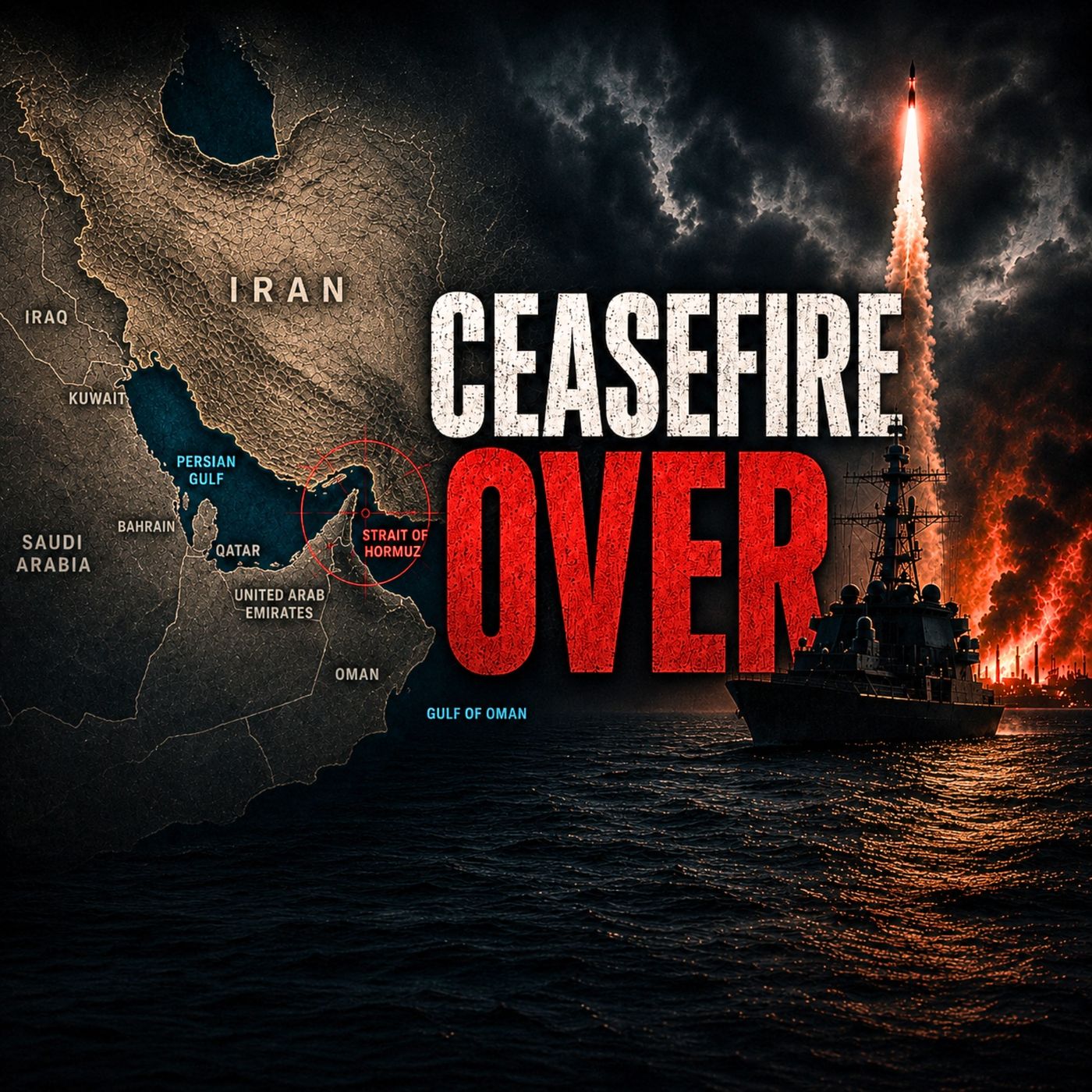
The Team House
This is What Losing Looks Like (Iran War Update) | EYES ON GEOPOLITICS
01:13:23
This week we break down the collapsed ceasefire and week two of American strikes on Iran, from the deaths of US service members in Jordan to the Chinese navigation system suddenly making Iranian missiles far more accurate. We get into why the air...
Loading summary
Transcript140 lines
- [00:00]
Andy Milburn
What's up everybody?
- [00:01]
Bretzky
It's Bretzky. And America is turning 250 and I can't think of a better way to celebrate that than playing on an American owned social casino. Spinquest.com with all of your favorite games, live crabs, bubble craps, live blackjack, there's no better place to play for free and win real cash prizes.
- [00:21]
Spinquest Announcer
Spinquest.com Spinquest is a free to play social casino void where prohibited. Visit spinquest.com for more details.
- [00:31]
Grainger Announcer
This is the story of the 1. As a maintenance engineer at a beverage manufacturing plant, he starts his day knowing every line is ready to run because Grainger delivers the industrial grade products he needs to keep mixers, conveyors and packaging equipment moving. With Grainger's vast selection of bearings, belts and motors, he keeps operations running smoothly so nothing grinds to a halt. Call 1-800-GRAINGER Click ranger.com or just stop by Granger for the ones who get it done.
- [01:01]
Jonathan Hackett
Hey, everybody. Welcome to another episode of Eyes on Geopolitics. I'm here today with Jonathan Hackett and Andy Milburn. Mick Moroi may possibly will likely be joining us in a little bit. You guys are seeing the same stuff I'm seeing. Ceasefire seems to have completely collapsed. We're on like day eight of American strikes, you know, on whether it's Iranian shipping or Iranian, you know, islands. Different, different targets. Iran has responded with shooting cruise missiles, ballistic missiles and drones at all of our bases in the region, which means. And, you know, shooting missiles against all of their neighbors. Two service members died in Jordan from that attack, from one of the attacks. One is missing. So, you know, this is like a real this, you know, for people who think this is, you know, obviously this is so far away, but this is like real people's lives that are being lost on the Iranian side as well. Like, let's be frank, right? I'm sure we're not 100 accurate where we're shooting.
- [02:11]
Grainger Announcer
So,
- [02:14]
Jonathan Hackett
yeah, some bits, like the one quote that really like, like stuck to my crawl a little bit was Caitlin Collins of cnn, who I think is probably one of the better White House reporters. Ask Trump. What did she ask Trump? What the hell did I have it? Hold on. This is a pretty glaring fucking quote, frankly. She asked, you know, the United States is bombing Iran again. You've been bombing Iran for months now. Is this just a new normal for the American people? Which I feel is a completely fair question. And the President replied, we were in Vietnam for 19 years. We're here for four months. So I think we've done a lot. That kind of shit coming from the President is one of the. I know obviously it's Trump, so, like, we're desensitized to the crazy he says. But he's talking about, like, actual war. And the way he just so blase about it, to me, frankly, is offensive. And I'm being as generous as I can because I have other words that I could totally use. Yeah, it's a fucking joke, frankly, that this guy's the president and he's leading us into this fucking abyss. The escalation ladder seems to be getting longer and longer every day. That doesn't seem to be at no end in sight. So. Yeah. What are you guys tracking? Milliburn.
- [03:44]
Bluff
Let's.
- [03:45]
Grainger Announcer
Let's.
- [03:45]
Jonathan Hackett
I want you to go first. I've missed you.
- [03:48]
Andy Milburn
I miss you too, Dee.
- [03:49]
Jonathan Hackett
Thank you.
- [03:50]
Spinquest Promoter
Yeah.
- [03:50]
Andy Milburn
So, you know, I. I think not. I think, you know, when we've talked about the. The strategy or lack thereof before on this program, it isn't simply us throwing rocks, you know, in fact, I know at least a couple of us were involved in planning for war with Iran before, so. And are wondering why some of the assumptions and some of the risks identified in almost a decade of planning have been thrown out of the window. Namely, the anticipation that Iran would close the Straits of Hormuz, but also understanding the limits of an air campaign and through no one's fault, it's just very difficult to track down the assets. We're trying to track down rocket launchers and now small boats, drone places where drones are being stored specifically to leap ahead. What has changed about this phase of the war? To answer the question that's been asked, the administration, what do you hope to gain at these strikes? The list of targets are specifically focused on Iranian assets that could interfere with shipping in the Straits of Hormuz, at least until last night. So those were specifically radar sites, acquisition radar in the southern part of the country, and again, missile launches. Places where intelligence was suggesting the Iranians were storing drones. And although I haven't seen this specifically, I assume also small boats. But all those assets are easy to move around and hide and decoy and disperse. And especially in a country like Iran. And the longer the war goes on, the easier it is for them to disperse the remaining assets. And so, you know, the strike against Jordan last night, the strikes against Kuwait are not a surprise. What is perhaps surprising in this phase, and John can perhaps jump in to add some more amplification on this, is the increased accuracy of Iranian missiles. Right. And that is, I understand Mostly attributed to the fact that the Chinese are providing navigation system. It's no longer a gps. John, what's, do you remember the term? And it's B, it's Baidu free or something.
- [06:49]
John
It's the, it's the GPS alternative.
- [06:52]
Andy Milburn
Yeah, it's a Chinese frequency hopping version of the gps. I know I should probably Google that. And we have various student members of our audience who will be able to jump in. But anyway, B3A is what we call it and the network is called the Baidu 3, it's military grade signal we call B3A. And so very quickly my understanding is that civilian GPS is obviously, it's a fixed known frequency, it's very jammable. In the 12 Day War in June 2025, both Israel and the US were jamming Iranian GPS guided munitions very hard. And it worked. GPS guided systems reportedly failing at a rates of over 70% early in the conflict. Now 98% of them are getting through. So that's a concern. So although we're in a new phase of the war, although we've narrowed our targeting options, the targets themselves are easy to disperse and on the Iranian side they're getting more accurate. So, so that is, that's certainly a concern. And you know, the last thing I'll say is that piling on more strikes again might give us a feeling of satisfaction. But as we've seen, we've also amped up the risk and the Iranians are going after, and I haven't got confirmation of this on the strike on the base in Jordan yesterday. I forget the name of the base, it's about 60 clicks from Amman. But the Iranians are going after specific assets that we have. Not strike aircraft on the ground, but they're going after the, the AWACS, the EC2 sentries, they're going after the KC135 tankers just like they did in Saudi Arabia. So for those of you who like center of gravity analysis, these are the critical requirements, right? The high value, low density assets that we have, and we've got about 75% of these assets in the region right now, so they're all vulnerable and we only have a limited number of them. So the Iranians know what they're doing, they're going after these assets and increased accuracy. And I'm not being Chicken Little here, I'm just saying that all of this suggests that this last round of the war isn't going to be quite as easy as perhaps some people think to simply shut down Iranians by piling on more Munitions. And at the end of the day, what's our first priority? Our first priority is Hormuz. We're not even talking about enriched uranium anymore. We're not even talking about the proxies. Even though, by the way, the Iraqi, Iranian backed proxies have only grown stronger during this war. And if anyone who's observed the aftermath of Khomeini's funeral, we'll see that a lot of the traffic control in Iraq was these militias. We're not even talking about those things. We're talking specifically about Hormuz. And the thing is, even if we manage through all our naval assets in the region, two carriers, over 20 surface vessels, untold number of aircraft, et cetera, et cetera, even if we managed to force an opening in the straits of Hormuz, the effect on the global economy remains because commercial, we're talking about commercial ships, it's still high risk. Until the Iranians agree not to strike ships and there's some kind of a negotiated settlement, the problem continues. And that is the issue I think we're facing right now. So again, the tactics don't fit in any coherent overarching policy. And that's the bottom line. Any, any overarching policy that can be achieved through the tactics that we're using.
- [11:08]
John
Yeah, And I would also add on to that, in addition to the center of gravity component of this targeting that we're seeing, people are asking, why are there these tip for tat strikes going on? Why are they hitting bridges in Iran? Why is Iran hitting US Bases in Jordan like this? This questions from the public, trying to understand, you know, why are these targets the targets? One part of it is what you mentioned, Andy, that they're doing operational level analysis of target packages and deciding both the U.S. and Iran, both deciding about if I strike a bridge that links this base to this base, that has a stronger impact than if I just hit an aircraft at that base. And at the same time, if you look back to Operation allied force in 1999 in Kosovo and in the Balkans, generally Bosnia and so on, we had a multi discipline intelligence approach to targeting in that conflict. We had not only air assets, which was a massive air campaign in Kosovo, we also had a very extensive human intelligence network inside of Kosovo that was helping us to identify and validate targets. So there were some targets that we already knew about, like military bases, which are fixed and pretty, you know, slow to change on a spreadsheet. But we also had new locations, like point of origin sites, when the enemy would be launching mortars or Artillery, which they can move around very easily in relation to bases. We'd have human sources on the ground who would say, hey, that truck, although it was at X location today, now it's at Y location right now. So we'd be able to tell the pilots in the air, hey, adjust fire dynamically and go strike this point of origin site that we've noticed with our imagery intelligence and with our signals intelligence. We also have human intelligence telling us that that's actually where they are and that's actually what it is that we think it is. In Iran we don't have this. So we're relying very heavily on signals intelligence and imagery intelligence to say that looks like a transporter erector launcher. It looks like it's there right now and it looks like it has a weapon on it. We strike it and then we don't really know what that strike did to it because we can't go validate with battle damage assessment. And we can't also say how many more they have left and other things like that that human intelligence can tell us, but that the other two disciplines alone have a hard time being really forceful on. The reason I mention that is because you look at why did Jordan hit Muafak Salty Air Base, or Msab, which is in Jordan. This base is well known. When I was in Jordan, we used to joke that this was the largest land based aircraft carrier that the United States has in the Middle east because most of our air assets were at Muafak Salti Air Base separately from Qatar, which is where Air Force's central command is at. And there's a lot of air assets in Qatar. Qatar has been hit multiple times during this conflict. But Msab, that base has been there a very long time. That's a well known target. There's plenty of open source satellite imagery of Muafa Salty Air Base. You can look it up on Google and see it, the huge airfield there, lots of military, US military infrastructure there. So from an Iranian perspective, it's kind of a low cost strike in terms of intelligence because they don't really need to validate much to know that if they lob an intermediate range ballistic missile at it, they're going to hit something that's American. Now the problem here is they don't know what exactly they're going to hit. And my suspicion is they did not intend to kill Americans in the strike. They probably meant to hit American assets, fixed assets, and that was not the goal because they know that by killing Americans, American military forces are highly sensitive to casualties When Americans die, we tend to respond with overwhelming force. They know this firsthand. Because the reason Qasem Soleimani is dead is because two months before that, Americans were killed in Syria. A contractor and active duty members were killed, and we launched and assassinated their most important military commander in response. And we have typically done that not just against Iran, but against many other examples, including in Vietnam, where most of our overwhelming responses that were dynamic in nature, not. Not planned ahead, but by dynamic in nature were in response to US Casualties like this. So I would expect to see a larger US Response than we expect. Over the evening. We saw a strike on a couple of facilities, an IRGC facility. I don't think that's the end of the story. I think there will probably be increases in retaliation from this that the US Is probably trying to put together right now to consider. Okay, how do we respond to this proportionally, based on how we understand proportional, not how the adversary understands it, but how does the US Military understand that? So I wouldn't think this is over yet. And on the tit for tat part of it, those intel limitations are real. So the US can only hit what it understands. So if the US doesn't understand, let's say, a underground facility, we can't just bomb it. We have to know what we're hitting. Like when you're putting a weaponeering package together and you're having the air officer actually sit there with you and talk through the targeting, as far as the intel side, you're actually picking strike points. You're saying, what are the locations on this facility that are the best, the weakest to hit, or the locations that if we hit it will cause damage in a particular direction?
- [15:59]
Mick Mulroy
There.
- [15:59]
John
There are lots of considerations. It's not just dropping a bomb. So a lot of these facilities, we might not be able to strike now because we lack knowledge of what's going on inside that facility and around that facility. So we won't hit everything that's as valuable as we want to hit yet without that human intelligence on the ground. So that's going to be a limitation where you're going to see probably a lot of infrastructure strikes, bridges, water purification barracks, fixed military assets, because those are things we understand with limited information. You're not going to see strikes on, let's say a G2 intelligence headquarters in Tehran, because even though we are striking a lot, we are still trying to limit civilian casualties as much as we can. And when you're looking at that G2 headquarters, you don't really know what. What's in the buildings around it. So you don't know which kind of weapon to use to destroy that building, to make a blow up, to make it implode versus explode and things like that. So you're going to probably see those larger headquarters entities left off the target list for now, until we understand more about those targets so that we can ensure that we're hitting them the right way with what our doctrine says. And next to that, the GPS issue that you mentioned, Andy. So there's actually three different major GPS like networks in the world. There's the Free World gps, which is gps, Global Positioning System. There's the Russian version, which is the gnss, which is just like our gps, but it's a Russian controlled satellite array that the Russians can use. Even if our GPS goes down, the Russians will still have GPS and vice versa. This is a Cold War development. As we were developing our space program, which was a cover for our nuclear program, our intercontinental ballistic missile nuclear delivery program, the Russians are doing the same thing. You need GPS for that. So the Russians had GNSS for that. China was late to the game. But China also had bds, which is the Baidu that you were talking about, Andy. So these are three different independent arrays of GPS controlled networks. Iran is relying on China's network, not on Russia's but on China's network to get a lot of accurate information. So even if we try to jam Iran using our gps, which sometimes they do, depending on what they're, what the equipment is that they're using, there are areas that we can't jam as easily because it would require, whenever you jam something, there's a diplomatic component to that. If we jam a Chinese system, we are technically in an act of war with China by blocking their communication system. So there's going to be a calculation made, is it worth blocking China's GPS for us to harm Iran? And if we could harm Iran somehow without blocking the gps, maybe we choose the somehow option even though it's less because we don't want to implicate China into this consideration. So there will be some calculation there going on with, you know, what's the cost and benefit of using this now? And also some of these technologies we have to work with GPS in particular, we don't want to use it in a conflict like this because we're saving it for later in a bigger conflict because some of these things are very, very technical and sophisticated and depend on the enemy not knowing we have it. And if we use it now, we can never really use it effectively again, we could still use it, but just wouldn't be as surprising and overwhelming and important as it would be if we waited, say, in a nuclear war with Russia, for example. So there's also that calculation being made. Just like Winston Churchill decided not to announce that we had broken Enigma as early as we had. And British civilians died because of this. Because the importance of just having that as a secret was way more powerful than just telling the world that we had done so. And so there are still things like that in the world, including zero day vulnerabilities. We haven't seen very much talk about cyber attacks against Iran right now. And there's probably a degree of keeping those zero day vulnerabilities secret until a future time when we actually need to use these more powerful tools. And we've just calculated this is not the time, which at the operational level is a very wise move, I think, because it's always about measuring risk. You can never eliminate it and you can never, you know, use everything you've got right now because the value of it goes away the moment you use it. Just like nuclear weapons, a nuclear weapon is powerful because it's not used. The moment you use it, the threat is completely understood and completely on the table and it changes the game. And the game is only good in your favor if you don't use your nukes.
- [20:09]
Author John
Hey, guys, I want to tell you tonight about my new novel, the Most Dangerous man, coming out June 9th. I think like a lot of you, I read in high school the short story the Greatest Game, which is almost a century old at this point, but it's the classic premise of man hunting man for this book is based off of that a little bit, but also on stories that I have heard over the years about safari guides that have actually taken hunting parties, wealthy people hunting poachers in West Africa. That idea kind of cooked off in my mind when I was asked to write a novel and get back into writing fiction again. And this book is about a ranger with the Ranger Reconnaissance Company who's on a mission in West Africa and gets kidnapped and hunted for sport by a group of wealthy tech billionaires. I had a lot of fun writing this book and I think you'll have a good time reading it. It's a quick, fast and furious, fast paced action action novel. And I hope you all check it out. It's up there. You can find it wherever books are sold. The hard copy, the hardback, the soft cover, and also the Kindle ebook edition. We'll have some links down in the description for you. The book comes out June 9, and I hope you all let me know what you think of it.
- [21:36]
Spinquest Promoter
Happy birthday, America. It's time to celebrate and play your favorite Las Vegas casino games by American owned spinquest.com what's better than fireworks? An American pie. Hitting a blackjack in the palm of your hand and you won't lose your fingers. Over a thousand games, including slots and live dealers and $30 coin packs are on sale for 10 spinquest.com buy American players.
- [21:58]
Spinquest Announcer
For American players, Spin Quest is a free to play social casino boy where prohibited. Visit spinquest.com for more details.
- [22:07]
Grainger Announcer
The Sherwin Williams summer sale is here. Get 30% off select paints and stains or 35% off our newest product and Emerald Symmetry. July 17th through the 27th. Whether you're refreshing your interior or exterior, we've got the colors to bring your vision to life. And with delivery, getting everything to your door is easier than ever. Shop online to have it delivered or visit your neighborhood Sherwin Williams store. Click the banner to learn more. Retail sales, only some exclusions apply. See store for details. Delivery available on qualifying orders.
- [22:44]
Andy Milburn
That's a great, great point about cyber. You know, the one assumes that that is something that we would be integrating at this level. You know, John, I mean, to your point, though, about not using cyber because we're worried about exposing methods. I mean, I'm not sure, you know, explain that one to me. I'm not sure I buy that. You know, surely we would integrate cyber regardless. We've already conducted cyber operations against Iran in conjunction with Israel.
- [23:22]
Mick Mulroy
Right.
- [23:22]
Andy Milburn
In the past.
- [23:23]
Jonathan Hackett
Why.
- [23:24]
Andy Milburn
Why would we not do so now? Especially, especially now that we know that the Chinese have given them that, you know, Baidu systems when we're trying to.
- [23:36]
Spinquest Promoter
Right.
- [23:36]
Andy Milburn
We're trying to sidestep. We realize jamming is no longer as effective. I think. I assume that's one of the reasons why we've changed our targeting. I say we collectively in the United States to kind of node by node targeting. Going after the surveillance towers. Like the other day they hit the Chabaha surveillance tower and southern Iran. So we're, you know, we, we realize obviously what is happening. I just can't. I mean, I just don't. I'm not sure I buy that. We, we're waiting on. We're reluctant to use cyber at some level. Surely we can use cyber operationally without perhaps exposing our. Our methods.
- [24:25]
John
I think the more normal, let's say cyber operations are probably going on. What I'm talking about are the more exquisite one Time use things like we saw in Venezuela when the president was taken. There was a massive cyber attack that night that blacked out the city. That's the kind of thing that you can only use one time, because the way that it's used, the way that it's implanted, once it's used now, it's known. And I'm not. I would not be surprised if there were things in Iran that. That could be switched on and off in a way that would spectacularly turn the country off in a way that'd be advantageous for us in various ways. But the moment that we use it, we can't use it against Russia and we can't use it against China anymore, because it will be understood, analyzed, exploited, turned around. We had the same problem with Stuxnet when we attacked Natanz, the cyber attack in 2007. The reason Iran developed an offensive cyber capability that is very formidable is because they reverse engineered the Stuxnet virus that we used in 2007, and they used it against Saudi Aramco in the Shamoon attack, which brought down. It was the largest cyber attack in Saudi history and destroyed huge amounts of infrastructure and oil output. On the night of power during Ramadan, when they used some other cyber tools to analyze pattern of life and identify that that was the best time to attack. That tool was a child tool of Stuxnet. Later, they also reverse engineered something called Flame, which was a cyber tool that the NSA independently developed that was very, very capable of doing a lot of things. Let's say they reverse engineered that and they've been using it ever since. And we can't defeat it because the way it was designed, it was designed to be undefeatable. It could be reverse engineered, but it can't be stopped. But the way that it actually works. So there's that idea of once it's in the wild, what happens next? What if North Korea gets their hands on this technology and uses it against us or against Australia, for example? So there's this concern of the effects beyond the battle space, of using the more exquisite. Let's say that the 1% tools that we have, the other tools are out there. For sure. They're being used right now. Absolutely. But then there's the cost of what happens once we fire this shot. Will it be fired at us, too?
- [26:31]
Andy Milburn
So, I mean, the media's reporting that Trump's being briefed on. Well, obviously is being briefed on military options in response to the US Deaths. I mean, something has to be seen to be done right. And I suppose another aspect of cyber which may seem counterintuitive but nevertheless is true, is it doesn't have that kinetic political effect. Right. If you're playing to a global and domestic audience, often the effects of cyber are not clearly evident and purposefully not publicized. Which in a sense, if you're looking for, especially with a war that's less than popular and you wanted to show that you're in charge, it's perhaps not as satisfying an instrument to use as kinetic targeting, but. I know so, but talking about tit for tat. So we, you know, undoubtedly the options available and there aren't a wide range of options. I mean, going after Iranian infrastructure, Right. Certainly energy infrastructure, another round against Iran's nuclear sites, or perhaps targeting one of the underground facilities like the one at what's it called, Pickaxe Mountain, perhaps going in again with bunker busters, something that's going to really make the news. It does appear as though obviously the military is preparing for those options. There's reportedly, I mean, it's all over Twitter, 33 aerial refueling tankers, KC135s crowding the tarmac and Ben Gurion Airport in preparation for something. But at the same time, the problem is, again, I don't want to appear to be Chicken Little, but the problem is that the Iranians too appear to be telling the Houthis, hey, stand by. And Houthis moving assets into position, being directed to move assets into position to give the bam the band Al Mandeb a good shellacking should the US Take targeting to the next step. So now we would have both waterways threatened and effectively closed off. And meanwhile, Iranian strikes on Kuwaiti border posts oil platform reportedly a desalination plant too, although that didn't make the news, but I saw it on X. Kuwaiti consulate in Basra. Two Emirati tankers, notably Saudi Arabia, has not been hit in this round, but they did. They've been issuing, they issued another condemnation today against all of these attacks. And I likely may well consider, if the Houthis get involved, this as a direct attack on Saudi Arabia.
- [29:50]
Mick Mulroy
So.
- [29:50]
Jonathan Hackett
Yeah, so I wanted to mention. Sorry, John. Yeah, I did see a little bit of chatter talking about, like, us letting Saudi Arabia off the, off the chain for, against the, the Houthis. I don't know if that's plausible or actually, you know, in the cards. I just wanted to get your thoughts on that. Sorry, John.
- [30:10]
John
Well, with Saudi Arabia and Qatar in particular, Qatar obviously has been negotiating and helping to negotiate between various parties in this conflict, but Saudi Arabia Foreign ministry officials, high level officials attended the funeral for Khamenei, which is significant if you look at who attended the funeral and at what rank were they. This is a very interesting analytical exercise if listeners want to look it up. It's very fascinating actually to look through, like who sent who and who are they? The Saudis did send some significant folks. And if you remember, before the war started, Saudi Arabia had been increasing its steps toward, let's say, a detente with Iran that Mohammed bin Salman had been working toward and trying to do to basically calm tensions in the region after especially Nimr Nimmer was assassinated a few years previously or killed, executed a few years previously. That was a major problem for Iran and Saudi relations. And since then, both countries have been trying to kind of fix that damage. And I think seeing the Saudis at the funeral signals that hope is still there because Saudi Arabia seeks to benefit by regional stability, whatever that means. And the Saudis have their own interests. In fact, there's something called a 1, 2, 3 agreement, which is a special nuclear agreement between the US and a foreign partner about how nuclear research and development should go. The U.S. is negotiating a 1, 2, 3 agreement with Saudi Arabia right now which will allow the Saudis to enrich uranium and plutonium. And interestingly, there are no restrictions on weaponization on this particular agreement. Every 1, 2, 3 agreement is different between countries. When I was in Jordan, we were negotiating a 1, 2, 3 agreement with Jordan. Theirs had a weaponization cap on it or restriction on it. The Saudis negotiated one without it, which is a pretty big deal and also shows that's Saudi Arabia trying to fix itself in the region as a power. And they have said, Mohammed bin Salman himself said, if Iran gets a nuclear weapon, Saudi Arabia is getting one too. And I mentioned all that context because Saudi Arabia cares about Saudi it's integrity, sovereignty and stability, price stability for their country. And so they're looking at this like, how do we balance against all these competing interests. We have this very powerful neighbor, Iran. We also have Iran controlling some elements inside of Yemen, but we also have shared interests in OPEC and oil prices and economics in the region. So Saudi Arabia Arabia is playing a diplomatic, not necessarily a game, but they're being careful about how exactly do they commit to either side and, and what kind of side do they take and how do they fit into this, just like Qatar is doing, but for different reasons. And I think the attendance at the funeral kind of indicates that. And with the Houthis, maybe Saudi Arabia is allowed to be unrestrained but does that mean they will be unrestrained? That's a question for the Saudi government to make the decision on, not the US to tell them, hey, go fight the Houthis. Instead, it's going to be a Saudi decision about how much do we actually do here, because we do care about the day after the war. After the war ends. We still need to find some common ground with whatever Iranian government remains after this war. So we can't go too far and too hard because there could be repercussions. And it's a similar concept to what happened with UAE in Saudi Arabia and Yemen, where there were divisions on how those two states decided to prosecute the war in Yemen, with the Saudis deciding one way and the Emiratis deciding to remain. And that's a very interesting thing to think about because those states do care about the day after the war much more than the west and the United States cares about it, I think.
- [33:31]
Andy Milburn
Yeah. And, and, you know, from a Saudi perspective, it makes perfect sense, of course, because I think. And it'll be interesting. I, you know, John, I don't know how you feel about this, but I mean, I don't. We, we're not going to stop Iran from getting the bomb. I mean, we, we aren't. Eventually, Iran will get the bomb. The, the, the prize is too evident. The, to be a member of the club brings such prestige, but it brings invulnerability. Right. Look at North Korea. And, and it's just too difficult to actually prevent Iran from doing so. I mean, we've done our best at this stage. It's not as though we, we did those strikes back in June as a warning to the nuclear program. I mean, it was a wholehearted attempt to eliminate Iran's nuclear program. But for all the reasons we've talked about on this program, we've. Probably by launching Midnight Hammer, again, not a criticism necessarily, but by launching Midnight Hammer, the fact that it failed turned a near impossible task, probably into an impossible one. Undoubtedly, the Iranians have learned from that strike. They learned very quickly. Right. They've learned how to better conceal. They've learned to do their centrifuges. The enriched uranium gets dispersed, and even the technology we have cannot, cannot put a halt to the program. I think my feeling is, without being an expert in that field, that we're just not going to prevent Iran from doing so diplomatically, publicly. We always say that it's unacceptable. But what do we really focus on? Probably what we focus on are the problems that are most imminent to US Interests. Hormuz is number one. Number two, the proxies, but specifically, I mean, not Hezbollah, not even the Houthis, although they are a second. The number one proxy that we should be concerned about are the Iranian backed militias in Iraq who've launched something like 180 attacks on US forces in the last three years. I mean, significant amount. I mean, and are only gaining traction in Iraq. That's a big, you know, after Hormuz, that's the biggest issue. Again, I'm not saying that we tell Iran, hey, don't worry about it, but this looks to me perhaps as a way of at least hedging our bets. All right, so there are those who would argue even if Iran gets the bomb, it's not an existential threat, not even to Israel, even though we hear Israel say all the time, it's an existential threat, Israel's got the bomb too. But if you can enable or turn a blind eye to other regional partners in enriching uranium and developing their own program, then arguably you help a little bit balance the nuclear balance of power right in the region. I mean, I'm not suggesting that's our work here, but undoubtedly that's in everyone's mind. So this agreement is on Trump's desk. My understanding, he hasn't signed it yet. As John pointed out, it's significant because until this point, the 2009 deal with UAE was considered the gold standard. And for that, UAE got the civil nuclear cooperation, but explicitly gave up the right to enrich uranium or reprocess plutonium. Under this protocol, Saudi Arabia would not agree to do either of those things. So the US Is currently fighting a war against Iran. Trump himself has framed, at least partly as being about stopping Iran from using enriched uranium to build a weapon. At the same time, there's perhaps the realization that this isn't really going to be possible. So now sitting on his desk is a deal that would let Saudi Arabia, Iran's principal regional rival, enriched uranium domestically with weaker safeguards than the standard Washington itself set for uae. So you could credibly say this is only a deliberate decision and an acceptance of the fact that we can't stop Iran from crossing that red line. So perhaps we've moved the red line for other partners in the region.
- [38:17]
John
Yeah, and I think if Saudi Arabia began enriching uranium, it would be crazy to think that Iran would not try to do so. Again, just from a purely realist, we in the west, we love political realism and the realist theory of international relations. It's like a textbook example of okay, step one, Saudi Arabia enriches uranium. Step two, Iran enriches uranium. This is exactly how states think and work. As states, as black boxes. Forget the emotional issues within the regime and ideology and religion, just pure political action. Like, why would you not do it? It would not make sense. Especially when Israel already has over 100 nuclear weapons and has not signed the nuclear Non Proliferation Treaty or the biological weapons controls or any of these other treaties and controls that other states have signed and have not followed perfectly, but have still signed them. And those are still real. Israel just refuses to sign them at all. Which kind of signals? Like what Israel is going to do. If they want to use these, they will use them. And, and if now Saudi Arabia has it again, the principal rival besides Israel, now you have these two states that have both interests in keeping you out of the game. You're going to want to play the game and you're going to do it clandestinely because you don't want it to be stopped. So instead of stopping them and scaring them into not enriching uranium, we're going to actually be forcing them deeper and harder to find. And they will be doing it in a way that will be more difficult for us to stop. They'll also build alliances that may be surprising to us so that they can gain access to materiel and information that they might not already have or has been eliminated or destroyed since 2012. After Israel started assassinating Iran's nuclear scientists, we may see them make alliances with countries we wouldn't expect. China is a great example of that. China is an atheistic communist country. Iran is a Shia ideological religious state and their closest ally is China. That's not because they agree with Chinese atheist communism. It's because China is willing to be on their side and help them in this world where they're isolated, just like in Sudan. Iran. The IRGC built a navy base in Sudan. Sudan was their greatest regional partner. In the late 1990s and early 2000s, the IRGC Navy trained all of Sudan's navy. After Omar Al Bashir was removed, the Emirates went into Sudan and started co opting the Sudanese government toward the Emirati side. And Iran lost a toehold there in Northeast Africa. So that's just something to think about. Regional politics are very real here. It's not about ideology, it's about how do I keep my state strong vis a vis your state? And the nuclear issue is the ultimate pinnacle issue for these states, jockeying for what power means to them. And if, if my adversary has a nuclear weapon you better believe I'll try to get one, too. And that's how they're going to look at it. I mean, it would be kind of crazy to think otherwise.
- [41:03]
Jonathan Hackett
Would Israel be okay with Saudi Arabia, you know, having the door open essentially to getting a bomb?
- [41:11]
John
Certainly not. I think there's going to be lobbying from the Israeli side to go against that. But ultimately it's US decisions about what do we want power structures to look like in the Middle East. We have a lot of basing access and overflight with Saudi Arabia, the Emirates, Qatar, Kuwait, Bahrain. Those states all have a seat at the table. They get a voice and they get a vote. It may not be as strong as Israel's sometimes, but. But it is something and it's meaningful. And those states can band together and say, hey, we want X. Israel might say, you can't have it. And the US says, well, unfortunately, both of you can't get what you want. I'm going to give half of X to you guys and stop the other half because of this other pressure or some other consideration. So it'll come down to what do all these states say and what do US interests look like at that time? And remember, OPEC is very important, but we have a new change with opec. Emirates departed opec. This is a really interesting development that will affect how the US operates in the Middle east because it's going to affect economics globally. And the question is, what happens with OPEC going forward vis a vis these nuclear discussions? Because it's an energy issue. Fundamentally, nuclear power is an energy issue. France's energy, 25% of it, is nuclear power. So ultimately, in the future, after the Emirates and these other Gulf nations try to divest themselves of dependence on fossil fuels, nuclear energy is going to become very important for those countries and OPEC will become less and less relevant over time. And that's something that they are considering and something the US is also thinking about.
- [42:42]
Jonathan Hackett
Mick Mulroy. Hello.
- [42:44]
Mick Mulroy
Sorry, gents, it's been one of those days. As you guys already know. I'm sure you're already talking about it. It's just jumping from one to the next to the next.
- [42:52]
Jonathan Hackett
What is, what is mainstream media talking about?
- [42:56]
Mick Mulroy
Obviously, the. The deaths of our service members and
- [43:00]
Spinquest Announcer
Jordan,
- [43:03]
Mick Mulroy
which is tragic, unfortunately, expected that it's going to happen as these things escalate. And thoughts obviously, to the family and friends of this and the one missing, which I'm not quite sure I understand how one is missing, but perhaps it's just the damage done to the location where they were present. One thing I'd bring up on that, I don't know if you guys have already covered it, but I want to know who's providing targeting information to the Iranians because they're not this good. Right.
- [43:37]
Jonathan Hackett
So we did talk about that a little bit. Yeah.
- [43:39]
Mick Mulroy
Good. What was your guys. Well, I don't want you to recast what you already talked to the audience about, but my concern is it's China, Russia both, and China U.S. right? I would imagine so. Yeah. I would imagine the intelligence community's been tasked with finding out, determining it. And if. If it's in fact the case, there needs to be some kind of consequences. I'm not saying we got a world China or anything, but, yeah, we got to protect our service men and women at all costs. And if they get this targeting data that's allowing them to hit precise targets like that, we need to. We need to address it.
- [44:22]
John
But the Russians did the same thing with the GRU in Afghanistan. If you remember, they were putting out information on US Forces and things. And China has already provided imagery intelligence using their proprietary satellites that are not commercially available for Iran at the outset of the war. So it would be, you know, par for the course to expect them to continue doing that.
- [44:41]
Jonathan Hackett
And the Iranians, we mentioned, they're using the Chinese version of GPS that we. That's harder to jam on our end.
- [44:50]
Grainger Announcer
All right.
- [44:51]
Mick Mulroy
Yes. And other than that, I mean, it really does look like we're headed toward major escalation. I mean, if we're not already there. Right. And from all of the publicly available information on the flow of, you know, the airflow, etcetera, this looks like it's going to go up and it's going to be prolonged. So we're looking at a. And then, of course, we have the other shoe to drop when it comes to increasing direct attacks on ships in the Red Sea. Baba Venda by the Houthis, you know, strikes. Yeah. One important point that I did talk about this morning, you know, we're hitting facilities infrastructure in Iran, Right. Like, including potentially desalinization plants. As I'm sure Jonathan can tell you, Iran doesn't rely on desalinization plants near as much as the Gulf countries. Like Kuwait's like 90%, it comes from water, comes from the sea through desalinization. And I think, like, Oman's about 80%, 70% in Saudi Arabia that I was looking at, and maybe around 50 in the UAE. There's, like, entire cities that would have to be evacuated if they successfully target a Lot of desalinization plants in the Gulf. Right. So this is, this is not parody when it comes to reliance on that. And Iran's clearly saying they're going to. They're going to hit economic targets, including energy and desalination plants. And I think they already did in Kuwait. So.
- [46:26]
John
And just to put that There, Mick, it's 3% of Iran's water comes from desalinized water. 3%.
- [46:33]
Mick Mulroy
There you go. Didn't know that. So 90, Kuwait, 3. And I don't know what the plan would be if they successfully knocked out the desalinization plants in some of these countries.
- [46:45]
John
In Iran, those desalinization plants are generally all in the south, right by the Straits of Hormuz, because those are kind of isolated coastal communities that don't have access to the same mountainous water resources that the rest of the country has. So by taking those out, it's a very localized target deck that has almost no impact strategically on the overall military situation in Iran.
- [47:06]
Andy Milburn
Yeah, it's interesting. There was a. About a year ago, there was a meeting here at the embassy and talking about various threats and what might precipitate a, basically an audit evacuation of US and other foreign nationals. And they covered a variety of threats, but they are sitting next to a Brit who works for an oil company here, and he leaned over and he said, hey, they haven't touched the most serious, which is if Iran goes after desalination plants. He said, that changes the whole game. And so you're kind of seeing that. It's an interesting point, and it's probably one that wouldn't have occurred to us, maybe, but it's talking about critical infrastructure, number one. And number two, it is particularly vulnerable. These plants are easy to hit, and they tend to be well within missile range. And, you know, in a country like all these countries, right, with the air defense assets available, it's really hard to cover these dispersed sites against multiple types of threat. That's part of the problems we're seeing along with the, you know, increased accuracy of, of Iranian missiles. And then to Mick's point about the Houthis, that's particularly a concern. The trigger point for that could well be the US Upping the ante and hitting Iranian infrastructure. We had a senior Houthi official this week saying, if the current situation gets worse, we're going to close the band, the Bab Al Mendeb Strait, and we're going to have an alliance with Iran. And we've already seen, you know, after Yemeni forces bombed the Sanaa airport Runway. Right. A couple of weeks ago to block an Iranian delegation flight from landing. The Houthis blamed Saudi Arabia for it, even though it was actually Yemen's own government forces. And they retaliated by firing ballistic missile salvo at APA airport in southern Saudi Arabia. So now the Houthis are saying that there will be an outright siege on Saudi Arabia and that they intend to paralyze all Saudi airports if there is any more interference with those flights. So that could be. There's an additional possible trigger. And then on the shipping side, obviously there have been reported attacks on commercial vessels near the band Al Mandeb and off Hodea in the last couple of weeks. And plus a separate incident where Saudi backed Yemeni forces intercepted a boat smuggling weapons manufacturing components bound for the Houthis in the same strait. So you've got attacks going both ways already in the strait and that's. Yeah, again, desalination plants, increased accuracy of Iranian missile targeting. And now the threat to the bam, the escalation isn't all going to be one sided. That's, I think, the problem we're dealing with.
- [50:35]
John
And plus, about five years ago, if you remember, the Saudi intelligence headquarters was struck by a drone that was either, I think it was Hezbollah or Yemen, but they had the Precision Capability 5, six years ago to hit deep inside of Saudi Arabia at fixed targets that they were aware of. They haven't forgotten that, in fact, they've gotten better. And as you mentioned, Andy, they were receiving new parts to actually help make their weapons smarter. You know, putting electrical components on there to make the rockets more precise, to make the speed more correct, to make the trajectory better. So they're actually getting better at every component of how these weapons work so that when they are used, they're going to have better and better capability. They're also learning each time they use one of these weapons, they're doing lessons learned and thinking about, okay, last time we fired this X, Y and Z happened, how do we get around that problem there? How do we defeat this? And with the air defenses, as you mentioned, the only real way to have a successful envelope of air defense is to have air defense systems physically located at all the target locations. And it can't just be one type, it can't just be, let's say, a Jericho air defense missile. It has to be something that can hit at every single distance and trajectory and altitude because there are multiple different ways that these can enter the atmosphere and land on a target. Some of our systems, like Patriots, can only Intercept a particular, you know, vector of that envelope. We need other things like the air, like the iron Dome to cover these, these gaps. And they understand this, it's all math. They understand, you know, this weapon fires at this speed, at this number of degrees. That means if I fire at this angle, I can penetrate that pocket because I know they have these three types of air defenses that can only defend 90% of the envelope, leaving 10% open. And so this is something that they're understanding. And those rocket motors they're using allow them to actually adjust the rocket as it reenters to go between that gap in the air defenses. And we actually saw that in Jordan, the way that, that the intermediate range ballistic missile was used, it was actually adjusted in flight to strike in a particular way. And that's something that they did conceptually know how to do. But they hadn't been really using it very much and they just used it now, which means we should expect them to use it more. It was very successful.
- [52:43]
Andy Milburn
Yeah. I mean the Saudis are really, really good with the, they've got their Patriot batteries and they are excellent at, I mean, their air defense system. Their air defense guys are selected among the best of their intakes for obvious reasons because they are effectively at war more than any other service here. But the problem of course, is the equipment. It's the same problem that we, the US Are dealing with. And, and the acquisition problem with a drone, shahed type drone flies low, you know, in kind of 60. I mean it's from, from about, you know, 150ft up to, I don't know, a thousand feet or so. Right. And slow with a radar signature the size of a large bird. And that's exactly the profile that conventional radar, to include Patriot acquisition radar is not good at capturing. And you know, these things get lost in the ground clutter and then you disperse them. You're going to get, you know, you're going to get them, you're going to get, some are going to get through. Especially as we talked about with their increased methods of combining drones with missiles. Yeah, it's, it's, I would say it's an impossible target set to eliminate the threat, but it's certainly extremely difficult.
- [54:15]
Mick Mulroy
So the question is, what are we going to do? Right. There's not great options.
- [54:20]
Andy Milburn
Yeah.
- [54:21]
Mick Mulroy
And it's hard to see, you know, we're not going to give up. That's strategically suicidal. Can we endure the pain of dramatically increased energy costs? Looks like we're going to have to. Can we do things to put more Pressure on the regime. Absolutely. But the question is, how long will it take to get enough pressure that they would actually kind of bend to our will and agree with something more in line. What's acceptable to us, like secondary sanctions, pushing that, trying to cut off the ground, you know, logistical corridors that they resupply and obviously provide some economic benefits, just like we're doing with the maritime and the blockade. I don't know how long it's going to take. Right. And I do think, you know, obviously Iran thinks that they can play up the political issues, this cause, which I think is true. But that's going to lead up to the election day in November. What happens after that? Right. Their leverage, if they have any, and I think they do, kind of goes away after that.
- [55:38]
Andy Milburn
Right.
- [55:40]
Mick Mulroy
Because what happens, happens in the election. Then it is, and then there's no more election for President Trump and there's no more election for his party while he's still in office. So, I mean, it just seems like it's going to escalate substantially and expand. What I mean by expand is we're already talking about it. The consequences at the Gulf. I don't know what they would do if they do see not only their energy infrastructure targeted, which it already has been and it can be, and that'll increase the, you know, the issue with worldwide energy, lack of supply, but also the actual capacity to stay in the country, like Andy's talking about. Angel, you know, no water. Can't. Can't live in a desert. Right. So this is going to go from some of these beautiful cities to completely unpopulated if that happens. I don't want to be like a pocket cop apocalyptic here, but it's things that could happen. I don't. I don't think what we're talking about is out of the realm of possibility here. So we. We got to be prepared for contingencies that we didn't plan for. Or even if we did plan for them, I don't know what the answer would be. How do we keep a population in Dubai or Doha or Kuwait City that doesn't have direct access to.
- [57:10]
John
I think probably the uncomfortable answer is that ground troops would eventually be required to have a decisive end to this conflict because we've had extensive economic sanctions, we've had extensive diplomatic interactions in various capacities. We have an information advantage, lots of international pressure. The regime has been under pressure for 47 years. Their entire economy is built around resistance. I mean, it's not like a new concept for them. So I wouldn't be surprised if the only way to actually decisively end this would be ground forces, which is not something I advocate for, like 0% advocacy for that. I do not think it's a good idea for U.S. forces. That would be.
- [57:47]
Jonathan Hackett
Yeah, because you have a brain.
- [57:48]
John
It would be like a Vietnam like commitment with a probably Vietnam like ending. And I think it would probably be an unwise move for the US interest generally, not just the Middle east, but generally to do that. But if we're looking at it from a unbiased, rational, outsider perspective, if it was like pieces on a chessboard, the only way to get the checkmate is to kill the king and bring it down. I mean, you can't just leave the king running around without ending. And that's probably, unfortunately, the only way militarily to end this. Of course, there could be a diplomatic outcome that would be lopsided toward the United States, that we could negotiate, which seemed to be what we were barreling toward with an uninformed backing into it. But I don't think that that's going to end well for the US On a diplomatic side.
- [58:32]
Andy Milburn
Thing is, I. I don't see use of ground troops. I see no options for use of ground troops that would be decisive. Unless you. Unless you're talking about an invasion force of 300,000 troops. I mean, invading Iran with all the consequences that that would entail. I mean, none of the ground options had been touted to this date from seizing islands in Hormuz, occupying cog, occupying the coastline, going after enriched uranium. None of those seem at all practical and heavily outweighed by the risks. I just can't for a moment think that the United States would plan an invasion. The war is unpopular as it is. But, I mean, I agree with you. There's nothing. There's no more of the same. There's no escalation path that's going to lead to success, foreseeable success. We've tried everything. Right. So what are we going to do now? Hit energy infrastructure? Hit nuclear infrastructure harder.
- [59:50]
Jonathan Hackett
Yeah. Do some more crimes.
- [59:52]
Andy Milburn
Yeah.
- [59:52]
Jonathan Hackett
Take some pages out of Israel's book.
- [59:53]
Andy Milburn
I mean, that's option one. But I mean, to John's point, the option two is to find, you know, is Qatar and Oman finding some path to another ceasefire and working out some way to reconcile the fact that Iran wants some form of control or toll authority over Hormuz and the US Wants free passage restored. It's really all about Hormuz, I think, at this stage. I think the US would accept any option that ignored that ostensibly ignored Even nuclear enrichment at this stage, just to get the straits open. And no one's even talked about the proxies recently. You know, I mean, it's always. No one's talked about control of missile, ballistic missile inventory, any of that stuff. It's all about Hormuz.
- [60:52]
Jonathan Hackett
That's done. That's done. I mean, if I'm the Iranians too, like in the room, I'd be like, guys, that's done. We don't even talk about that anymore. And to their faces, like, that's over.
- [61:02]
Spinquest Promoter
Yeah.
- [61:03]
Andy Milburn
The other thing that's kind of interesting, I was listening to John talking about, you know, d, you asked about Israel. Won't Israel be opposed to Saudi Arabia? It's really interesting to watch the dynamics in the Republican Party specifically around the administration when it comes to relations with Israel. They are distancing themselves rapidly to see J.D. vance's latest comments. And it's ironic, isn't it, really, because Netanyahu has nowhere to go now. You know, when it was Obama, he could talk to Congress, but that's just not available anymore. When the right wing of the Republican Party, when the crew round Trump, to include Trump himself, are distancing themselves from Israel and even implicitly in some cases, in Vance's case, explicitly blaming Israel for problems that we are facing now. It's, you know, if I was, if I was an Israeli, I would be really concerned about that. I think it's unprecedented, absolutely unprecedented. We didn't even see, we didn't see anything like this. Under, under Biden was always. No, you know, I mean, but we
- [62:23]
Jonathan Hackett
never, we never haphazardly attacked Iran, killed their leader, expected things to be great, but I think no other president has been that stupid.
- [62:35]
Andy Milburn
It's going to have great implications, as John points out, for the balance of power in the region, especially as we're talking about this unprecedented, potentially unprecedented uranium enrichment agreement with Saudi Arabia. Who knows what follows, F35s all over the place to, you know, I mean, there's no doubt about it that the administration is trying to make good with Gulf states, having realized that it has forfeited a good deal of goodwill in this war. And I think, I think also you
- [63:09]
John
should be watching the elections and. Sorry, I was going to mention the Israeli elections coming up October 27th. There is a real threat that Bibi will lose control over domestic Israeli politics and possibly with Gadi Eisenkot, who's a Sephardic Jew, not an Ashkenazi Jew, potentially taking over politics in the country with a, with a coalition with Very different views about how this conflict should be prosecuted and how relations with the US should be constructed and things like this. So that's going to be. And it's hard to predict what that will look like because it's a coalition based government. So we don't know exactly who, who will join that coalition and how those views will influence the state's view toward those things. So that's an interesting kind of spanner that's going to be thrown into this three way conflict between Israel, Iran, United States, because US elections in November will also change calculations. So it's a very short time. What are we in July right now? In three months, the politics of two of those three players will change somehow. Somehow, it's hard to say, but it will be different than it is today.
- [64:09]
Jonathan Hackett
I mean, I hate to be the guy that says this, but we need to like bite the bullet, for lack of a better term. And don't put good money after bad because this is going nowhere fast. And ground troops is political suicide for anybody who even thinks about and talks about it seriously in Congress or the White House. Even Trump, who's like Teflon Don, all that bullshit. 300,000 troops in another fucking forever war. What did he campaign on, right? Why did so many people back this guy?
- [64:47]
John
Even with a 1% casualty rate, you're talking about 3,000Americans dead in a 300,000 person deployment. That's unpalatable. That's almost as Many died in 20 years in Afghanistan and Iraq. Completely unpalatable. And you're fighting an enemy who's a conventional military force, not a regular insurgency in the mountains with SA7s. This is an actual military with a lot of resources and international backing from very powerful allies. It would be a very different game than the one we had in Afghanistan and Iraq.
- [65:16]
Jonathan Hackett
You have to assume that like the Pentagon has a forced depletion. Right? Like so, you know, it's going to be way more than 1%, obviously, you know, than it was in Iraq or Afghanistan. Yeah, it's a tall order.
- [65:31]
Andy Milburn
There's no doubt. There's no exaggeration of numbers, by the way. I mean, think about it. We invaded Iraq with 150,000 and we realized it was not enough to, to do what needed.
- [65:42]
Jonathan Hackett
Like what, 80,000 contractors?
- [65:45]
Andy Milburn
Well, I mean, you know, and that was against a vastly depleted force and different terrain, smaller country, you name it. Yeah.
- [66:00]
Jonathan Hackett
Gulf War one. How many troops did we have in there? Do you guys know?
- [66:07]
John
I want to say a quarter million. I want to say we weren't all deployed.
- [66:10]
Jonathan Hackett
Forward, okay?
- [66:11]
John
Because there was the Saudi coalition, there were Syrians fighting with us as well. We had, we had a pretty wide coalition at the time. And this time we won't have that.
- [66:17]
Jonathan Hackett
Riddle me that. A coalition to go into a war. It's. Guys, we're out, out of our. It's crazy. What's going on here is crazy. You guys both know it. You guys are being gentlemanly and I respect you and love you guys for it, but this is crazy. And frankly, we need to just take DL and negotiate. However we need to negotiate. Because if it's truly about uranium enrichment and nuclear weapons, that's what we should focus on. And more and more that JCPOA is looking better and better every fucking, every fucking minute.
- [66:49]
Andy Milburn
I don't think it is about nuclear weapons anymore.
- [66:52]
Jonathan Hackett
It's about the Strait of Hormuz.
- [66:53]
Andy Milburn
Yeah, I think it's all about Hormuz, you know, and I don't know what's going on behind closed doors, but look, if you're a realist, you're going to have to accept Iran's going to get the bomb. I mean, Iran is going to get the bomb. And anyone who says they're not going to get the bomb, tell me how they're not going to get the bomb. Explain it. Because we've done our best, we've shot our bolt. And you know, as John says, unless we invade the country, we're not going to stop them getting the bomb. So politically, diplomatically, of course, we say that's unacceptable. But what do we do? We hedge our bets and we focus on the things that really matter. Getting Hormuz open. And I'm saying go after the link with the militias in Iraq because those are a real threat to the region. They're a threat to us. I'm going to get beaten up for saying this. Hezbollah is not a threat to the United States. Okay, I know if I. Hey, I get it. I know with Mark was on, he'd wax lyrical about what happened in the 80s. Look, you know the Japanese and Germans kill a lot of Americans too. You know, you've got to move on. But Hezbollah is not a direct. They're not our friends. Don't get me wrong. I'm not saying Hezbollah is good. I'm saying what is the most direct threat to the United States among the proxies? The Iranian backed militias in Iraq. No doubt about it. Okay. If we want any presence in the region, especially in Syria and even in Jordan, but especially in Iraq, we need to curtail their ability to hurt us. And that is something that we need out of Iraq, I mean out of Iran, right along with the straits being open. And we don't tell them, hey, it's okay to have a nuclear weapon, but we understand beneath the surface they're going to get one. That's my feeling again, I'm going to get beaten up for saying this. No, I don't think it's okay. I'm just saying it's impossible to stop it.
- [68:55]
Jonathan Hackett
It's the reality of the situation.
- [68:57]
Andy Milburn
It's a reality. Yeah, yeah. And so what else do you do? Well, you try and affect the balance of power in the region other than Israel, perhaps you let other regional partners enrich uranium. Right. That looks like that's what's happening.
- [69:14]
Jonathan Hackett
And if you read John's book, Iran Shadow Weapons, it is very clear that Iran's prime. Their aim, the Iranian regime, is to stay in power. And frankly, after what's gone on over the last, let's call it a year, because I would, I would, I would put in the 12 day war with this. This is all one war. How would you not be fucked with ever again? Is if you have like a couple dozen nuclear weapons, no one will ever fuck with you again and your regime will be secure forever. Unless something on the inside happens.
- [69:49]
Andy Milburn
Undoubtedly. I mean this whole episode has just reinforced that.
- [69:55]
Jonathan Hackett
Always feeling good. Yeah, we always end on a happy no, it's the best man. I just can't keep hearing like, yeah, we're gonna keep going at it and like, we need to blah, blah, blah. It's just like complete wishful thinking that makes no sense. I mean the Iranian proxies in Iraq, like the militias, yeah, let's go after them, let's go after them with special operations or covert ops, you know, the things we're good at, let's use them. But as far as like we think this is gonna happen where they're gonna, they're gonna bend to our will. They have the cards now, we don't. And that's a fact.
- [70:32]
John
We gave them the cards.
- [70:34]
Andy Milburn
Yeah.
- [70:35]
Jonathan Hackett
February 28th, the Hormuz was open.
- [70:37]
Andy Milburn
There's definitely a segment of the American population, a massive segment that does not understand this. Okay, There's a large segment of the population that doesn't give a shit. Right. Unless it affects prices, that's probably most of the population. But there's also, as I've realized after I wrote that article about, hey, Iran's kind of had a theory of victory here and they're pursuing it single mindedly and that kind of contrasts them with what we've been doing. I got all kinds of not, not as much hate mail as my articles about Gaza, but close to it and it surprised me. You know, a lot of it is from people who are, you know, barely literate, so I don't care. But it really surprised me how ignorant a number of people are and they think it's treasonous to. To criticize U S Policy, which is absurd. You know, that's like.
- [71:31]
Jonathan Hackett
It's like the most patriotic thing you could do, bro. Yeah.
- [71:36]
Andy Milburn
Of our democracy are based on being able.
- [71:38]
Jonathan Hackett
I mean those people are straight up. They're brain rotted. Their brains are soft. They're like. They have no wrinkles in the brain. They're absolutely brain dead.
- [71:47]
Andy Milburn
But you know, you know that sort of me. I mean, we have some in our audience. I know, sure, yeah.
- [71:53]
Jonathan Hackett
If you're listening right now, you're fine. Brain dead.
- [71:56]
Andy Milburn
Yeah, but it doesn't matter. They're loyal listeners and they just like
- [71:59]
Jonathan Hackett
and subscribe though, you know. I apologize. All right guys, do us a favor. Check out John's books. Iran, Shadow weapons and the theory of regular war. Those links are in the description. Andy Milburn, he's putting out a couple chapters here and there for his new book about the war in Gaza. Incredible book that I didn't read the second chapter, the first one was awesome. It goes into like the lead up to October 7th. Really, really good. That book should be coming out soon, but those chapters are out in the substack. That link is in the description as well. Check it out. Obviously, Andy's memoir, When the tempest gathers. Great, great book. What else? Patreon.com the team house help us support the show. You get episodes ad free and early and you could send us messages that will actually read because the rest of them I don't look at the regular comments. I know you guys sometimes dabble but I don't give a shit what anyone has to say, frankly. But yeah, that's it, guys. A pleasure as always. I love you.
- [73:03]
John
Yeah, great talk.
- [73:04]
Andy Milburn
Bye everyone.
- [73:05]
Jonathan Hackett
Yeah, great talk. Say you love me too, John. Jesus Christ.
- [73:08]
John
I don't love.
- [73:12]
Andy Milburn
This is very distasteful.
- [73:17]
Spinquest Promoter
Happy birthday America. It's time to celebrate and play your favorite Las Vegas casino games by American owned spinquest.com what's better than fireworks and American pie? Hitting a blackjack in the palm of your hand and you won't lose your fingers. Over a thousand games including slots and live dealers and 30 coin packs are on sale for 10 spinquest.com buy American players for American players.
- [73:41]
Spinquest Announcer
Spin Quest is a free to play social casino Boyd where prohibited. Visit spinquest.com for more details.
- [73:49]
Author John
Hey guys, I want to take a moment to tell you about the Teamhouse Podcast newsletter. If you go and subscribe, it's totally free and what it will do is aggregate all of our data, all of our content that we put out, the things that are on the team house on our Geopolitics podcast. Eyes on things that I write journalistically with Sean Naylor. On the high side, anything else that we have going on books we recommend, upcoming guests that we have coming on the show and also you know, filtering in some fun stuff in there as well. If you go and check it out. We send it out just once a week. We don't want to spam you guys. It's just a kind of roll up of all of our content on a weekly basis. You can find our newsletter@teamhousepodcastkit.com join again. The website for that is teamhousepodcast kit.com join so we hope to see you there. The link will be down in the description.
- [74:55]
Bluff
What's going on everyone? It's bluff here and we're driving through the states in the Bluff Mobile and and the best thing that we can do is play our favorite casino style games on Spin Quest. They have over a thousand games including live dealer blackjack and craps. With tons of slots and unlimited options. You can get a $30 coin pack for just $10 for new users sign up today. Go to spinquest.com right now spin Quest
- [75:18]
Spinquest Announcer
is a free to play social casino void where prohibited. Visit spinquest.com for more
- [75:24]
Mick Mulroy
foreign.
- [75:32]
Bretzky
What's up everybody? It's Bretzky and America is turning 250 and I can't think of a better way to celebrate that than playing on an American owned social casino. Spinquest.com with all of your favorite games, live craps, bubble craps, live blackjack, there's no better place to play for free and win real cash prizes.
- [75:53]
Spinquest Announcer
Spinquest.com Spin Quest is a free to play social casino void where prohibited. Visit spinquest.com for more details.
- [76:09]
Bluff
What's going on everyone? It's bluff here and we're driving through the states in the Bluff Mobile and the best thing that we can do is play our favorite casino style games or on Spin Quest they have over a thousand games including live dealer blackjack and craps with tons of slots and unlimited options. You can get a $30 coin pack for just $10 for new users. Sign up today. Go to spinquest.com right now Spin Quest
- [76:32]
Spinquest Announcer
is a free to play social casino void. Where prohibited. Visit spinquest.com for more.
- [76:45]
Spinquest Promoter
You know what? It sucks to be bored. But when I get on my phone and play real casino games on spinquest.com the time flies by. That two hour wait at the DMV seems like 10 minutes. Play your favorite slots, live blackjack, live craps with a live dealer. New players 30 coin packs are on sale for 10 bucks. Play spinquest.com and you'll never be bored it again.
- [77:08]
Spinquest Announcer
Spin Quest is a free to play social casino void where prohibited. Visit spinquest.com for more details.
- [77:20]
John
Hey everybody.
- [77:21]
Lady Luck
Lady luck here and we're celebrating America's 250th birthday. Now all summer long I'm going to be celebrating by playing on finquest.com which is an American owned social casino. It operates obviously features over a thousand slot games and live blackjack, live craps, live bubble craps. Head on over to spinquest.com get yourself a $30 coin pack for just 10 bucks.
- [77:45]
Spinquest Announcer
Spin Quest is a free to play social casino Boyd where prohibited. Visit spinquest.com for more details.
- [77:57]
Spinquest Promoter
Happy Birthday America. It's time to celebrate and play your favorite Las Vegas casino games by American owned. Spin quest.com what's better than fireworks and American pie hitting a black tech in the palm of your hand and you won't lose your fingers. Over a thousand games including slots and live dealers and $30 coin packs are on sale for 10 spin quest.com buy American players.
- [78:19]
Spinquest Announcer
For American players, Spin Quest is a free to play social casino void where prohibited. Visit spin quest.com for more detail.
- [78:29]
Mick Mulroy
Foreign.
- [78:35]
Andy Milburn
What's up everybody?
- [78:36]
Bretzky
It's Bretzky and America is turning 250 and I can't think of a better way to celebrate that than playing on an American owned social casino. Spinquest.com with all of your favorite games, Live craps, bubble craps, live blackjack. There's no better place to play or for free and win real cash prizes.
- [78:56]
Spinquest Announcer
Spin quest.com Spin quest is a free to play social casino void where prohibited. Visit spin quest.com for more details.
- [79:14]
Lady Luck
Hey guys, lady luck here. Are you going on any road trips this summer? I know I'm going to be going on a bunch of road trips and being that I'm going to be passenger Princess, I Love playing on Spinquest.com Spinquest has all of my favorite slot games. Live blackjack, live craps. Head on over to Spinquest right now and get yourself a $30 coin pack for just 10 bucks.
- [79:37]
Spinquest Announcer
Spin Quest is a free to play social casino. Visit spinquest.com for more details.
- [79:49]
Spinquest Promoter
Happy Birthday America. It's time to celebrate and play your favorite Las Vegas casino games by American owned spin quest.com what's better than fireworks and American pie? Hitting a black tech in the palm of your hand and you won't lose your fingers. Over 1000 games including slots and live dealers and $30 coin packs are on sale for 10 spin quest.com by American players.
- [80:11]
Spinquest Announcer
For American players, Spin Quest is a free to play social casino void. Where prohibited. Visit spin quest.com for more details.
- [80:27]
Spinquest Promoter
You know what? It sucks to be bored. But when I get on my phone and play real casino games on spinquest.com, the time flies by. That two hour wait at the DMV seems like 10 minutes. Play your favorite spots live blackjack, live craps with a live dealer. New players $30 coin packs are on sale sale for 10 bucks. Play spinquest.com and you'll never be bored again.
- [80:51]
Spinquest Announcer
Spin Quest is a free to play social casino void where prohibited. Visit spinquest.com for more details.
- [80:58]
Spinquest Promoter
Hanging out at the pool is great. Relaxing and playing Vegas style games on my phone at the same time. Drink in one hand and a blackjack in the other. It's all at spinquest. Over a thousand games including your favorite slots and table games. Be cool with this summer special new players get 30 coin packs for 10@Spinquest.com
- [81:21]
Spinquest Announcer
Spin Quest is a free to play social casino void where prohibited. Visit spinquest.com for more details.