← The Thyroid (and Hormone) Fixer Podcast: Thyropause, Menopause, Metabolism and How to Fix It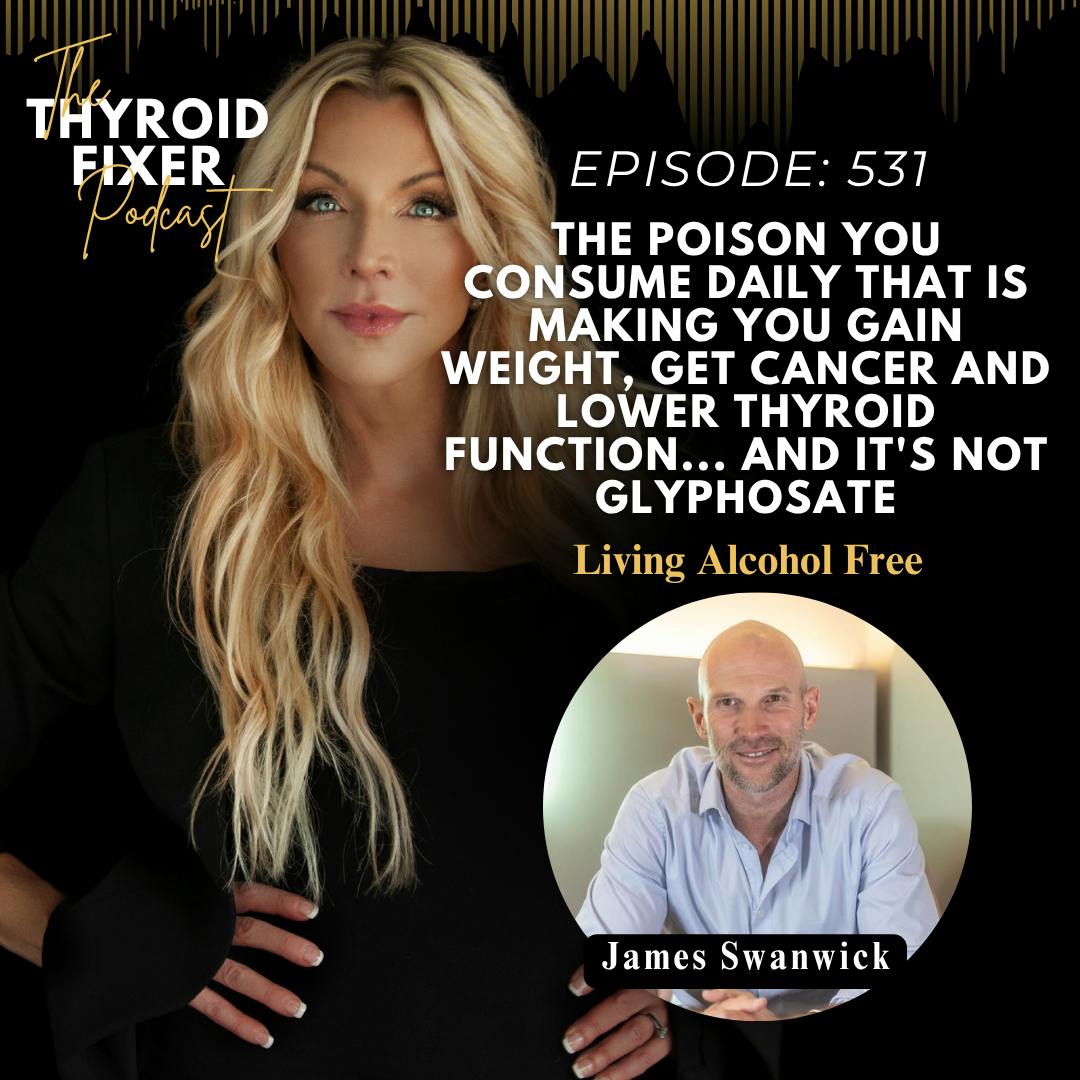
The Thyroid (and Hormone) Fixer Podcast: Thyropause, Menopause, Metabolism and How to Fix It
531. The Poison You Consume Daily that is Making You Gain Weight, Get Cancer and Lower Thyroid Function... and it's Not Glyphosate
00:53:40
Loading summary
Transcript71 lines
- [00:00]
Dr. Amy
Welcome to the Thyroid Fixer podcast, where we dive deep into the world of thyroid and hormones, especially for you ladies navigating perimenopause and menopause, and really for anyone struggling with hypothyroidism, I'm your host, Dr. Amy, thyroid and hormone specialist and CEO of a global telemedicine practice where we prescribe the right thyroid treatment and bioidentical hormones to all 50 states and most of Canada, helping you become that badass human that you're meant to be. So if you're battling weight gain and loss, you can't lose weight no matter what you do. Your energy levels are plummeting and your libido left town. Then you're in the right place and you have found your tribe. Remember, I want you to embrace every inch of that badass woman that you truly are. So if you're ready to dive in and fix things, let's get started. Let's talk about the power of berberine for blood sugar control and for moving you into a state of insulin sensitivity. Now, what does that mean? So when you are insulin resistant, we can look at your fasting insulin number on labs and see that's above a six. You can look at your glucose, your fasting glucose on your labs is that above an 85. Is your continuous glucose monitor that you're slapping on the back of your arm consistently reading above an 85. Is your hemoglobin A1c above a 5.2? If you answered yes to any of those. Oh, wait, let me also add in. Do you crave carbohydrates and sugar through the day? Literally, where your. Your body is screaming at you to go get something from a vending machine or eat something sweet, then that points back to your blood sugar and your blood sugar being out of whack and being on this roller coaster. Now, what this means for you is inflammation. It means weight gain. It means an increased risk of dementia and Alzheimer's. Now, if you're carrying around an extra 20 pounds, you're not really thinking about your BR and the health of your brain when you're 70 and 80. But I'm here to tell you the fastest way to age is to keep your blood sugar on that roller coaster and keep it high. To get control over our cravings, to get control over our weight, to be able to tap into our fat stores for fuel, we need to have steady, regulated glucose. And this is where Blood Sugar Fixer comes in. Blood Sugar Fixer was one of the OG supplements in the Fixer line. And I designed this because I kept seeing over and over again with the patients we were working with. Elevated insulin, elevated A1C, elevated glucose, inability to lose weight, carbohydrate and sugar cravings. And this is where Blood Sugar Fixer comes in. It takes that wild ride, that roller coaster of blood sugar, and it squishes it together to a nice wavelike pattern, steady, balanced, even, so that your cravings, you no longer get those cravings screaming at you. It allows your body to literally tap into the fat that you're grabbing on your stomach or your thigh, saying, gee, I really wish that this was gone. This big chunk. Yes, it taps into those fat stores and uses that to burn as fuel for energy. But you can't do that if you're a sugar burner. You can't do that if you're insulin resistant. You can't do that if your blood sugar is dysregulated. So what you want to do is bring in Blood Sugar Fixer. Now, I made it more economical. There's a lot of companies on the market that they only have their Berberine at 400 milligrams. Well, then you have to take three per day. The therapeutic dose is 1200 milligrams. I've also seen it at a thousand or 1200 milligrams. And if you take that all at once in one capsule, you might get some loose stool that becomes a little unpleasant to deal with. So 600 milligrams per capsule is what's in Blood Sugar Fixer. You take it twice a day, one with each main meal, and you will start to notice a difference, really, within a couple weeks of your cravings. And then as you are testing, you're going to see those numbers come into alignment. You're going to see the numbers come down on your CGM. Your A1C will come into that beautiful optimal range below a 5.2. Your insulin will become beautiful once again below a 6. And the bottom line is you will feel better, you will decrease inflammation, you will lose weight, you will gain control of your carbohydrate and sugar cravings, and you will protect your brain. So that's Blood Sugar Fixer twice a day, one cap twice a day. That's it. We're all looking to support our thyroid naturally, boost our immune system, and just really have more energy. I have found Purality Health. Now, the only problem with Purality Health is that it tastes so good. All of their supplements from the Mind Boost that I'm going to tell you about to the vitamin C Tastes so good. You want to eat it every day. You want to take it every day. It's crazy. I'm addicted to it. I'll tell you more about that. But let's start with the thyroid, something I talk about all the time. As you know, Purality offers a wide range of products that can assist you with thyroid health. But specifically, my favorite is the adaptogenic mushrooms in. In Mushroom Mind Boost, it tastes like chocolate. I will put Mushroom Mind Boost on a spoon with a little bit of peanut butter, and it's literally a treat. But not only that, it's a liposomal blend of functional mushrooms like Rishi and Cordyceps. Now, Rishi and Cordyceps, they help regulate your body's stress response. We know we need to balance our stress, balance our cortisol so T3 and T4 can work and so T4 can be converted over to T3. Then another amazing product to support the thyroid is the liposomal lion's mane. That gives us focus, clarity, cognitive support. Again, bringing down stress, Lion's mane can help boost nerve function, support your mood, both of which is significantly affected when thyroid levels are imbalanced. Now there's the vitamin C. Ooh, vitamin C for our skin, for our immune system, for our adrenal support, oxidative stress reduction. And it tastes like you're eating a starburst. It's incredible. I put in my water and it flavors my water. It's amazing. Since a thyroid is incredibly sensitive to inflammation and cellular damage, vitamin C protection is crucial. And here's the best part. Their patented liposomal delivery system makes all of these ingredients highly absorbable to your body. Is actually using what you're taking. Bonus. Right? So if you're ready to finally feel like yourself again, you want to head to purality health.com forward slash Dr. Amy and enter the coupon code Dr. Amy to save up to 45 off. So you're going to go to P U R A L I T Y H E a l t h.com forward/d r A M I E and use that same code, D R A M I e. Get your 45 off. Because your body deserves more than you know. Just. Okay. Health. James, thank you so much for jumping on the show. As I talked about kind of off air, this is not a topic that we've covered before, but it is so imperative. This whole talk about alcohol and especially when we're looking at it in the context of, yes, overall health, we're going to dive into that. That for sure and how it can create inflammation in the body. But even how it relates to what my audience is struggling with. Thyroid balance, hormone balance, weight issues, brain fog, good sleep, which we need good sleep in order to lose weight, to not be inflamed. So it all just ties together. And I find this so fascinating. I recently, I say recently, really, within the last year, year and a half, completely cut out alcohol. The only time I will incorporate alcohol or allow it into my life is if I am having the best damn steak ever and I just want a freaking glass of red wine with it. And that is it. I'm talking maybe once or twice a year is the only time that a glass, one glass of red wine. Now, throughout this discussion, you actually might tell me, I probably don't want to do that. But we'll figure that out, we'll unpack that. But I got to tell you, my life is so much better without it. I mean, just how I feel day to day, the inflammation, the whole thing. So I'm super pumped for this conversation. So thank you for jumping on.
- [08:43]
James
Of course, Dr. Amy. Thank you for having me. And I would describe you as a pioneer in that you only have that one drink of red wine in a year or so. And that is definitely putting you in the top 1% of the top 1%. Because most of society are culturally conditioned to normalize alcohol and normalize one or two drinks most nights of the week, sometimes more often more. And so let's have a discussion about that. You're probably going to learn very quickly that my thought process around this is that even one seemingly innocent drink per night is enough to severely compromise your health, your relationships and your mental health.
- [09:30]
Dr. Amy
See that? There's the clip right there that we're going to lead off the show with that, that statement right there. Okay, we have to unpack this first. I need to know before we get into all the juicy information and blow people's minds, how did you get into this whole study and writing a book about and developing a program around alcohol?
- [09:55]
James
Well, I grew up in Australia and I was a socially acceptable drinker in that I would have two or three drinks almost every night of the week. When I was younger, on the weekends I did get drunk. I went out and partied as most teenagers and 20 somethings do. But by the time I got to age 35 in the year 2010, I'd already had a 20 year drinking career. Now, to be clear, I didn't get arrested. I didn't wake up in a ditch, I didn't get a dui. However, I drank the way society says it's okay to drink. 2, 3 drinks most nights of the week. Now that would show up as half a bottle of wine, a full bottle of wine, a glass of wine, a few beers at the bar or the pub. Sometimes I'd have a gin and tonic or a scotch, etc, seven days a week, let's call it five or six days a week. But there were weeks where I drank seven days a week. And what I realized when I got to the age of 35 is that that habit for almost 20 years had caught up with me. I was in Austin, Texas at the 2010 south by Southwest Festival. I went out to a party on a Friday night and I had two innocent gin and tonics. I went back to my hotel, 15 minutes outside of downtown Austin. Went to sleep. When I woke up in the morning, I looked in the mirror and I just looked and felt blah. And blah means mediocre. I was tired, irritable, my skin was weathered. I had fat rolls. I was about 30 pounds overweight. I walked next door to this IHOP International House of Pancakes, which is literally right next door to the hotel. I sat in the IHOP and all of a sudden it dawned on me, what am I doing in an ihop? And I was like, this is crazy, James. Like, you're 35. This is mediocrity. You're in an IHOP, you're tired, you're irritable, you're envious of other people, you're overweight. Come on. So in that moment in that IHOP booth, I committed to stopping drinking for what I thought might be 30 days. It's now been 15 years. And in that time I've managed to build this organization which is called Alcohol Free Lifestyle. I recently published a book which is called Clear. It's a neuroscience based approach to help high achievers to finally quit drinking without willpower, rehab or aa. And now we have this movement going all around the world where we're really inviting people to rewire their mindset around alcohol and reposition alcohol in their life. Wow.
- [12:29]
Dr. Amy
I cannot, I mean, I. It blows me away. So you're in the 1% too. That that experience was enough to stick and, and change a 20 year habit ongoing. I mean, that's really impressive that it must have hit you. It must have impacted you enough to really shift something in your brain for that to stick with 15 years of no more alcohol. But you're right. I think anyone listening to this can relate and admit that the next morning after they drink, whether it's One glass of wine, two glasses of wine, three to seven glasses of something of alcohol that you look older. I mean, you literally age yourself and you look older, and then that catches up over time. Like you said, when you're making that habit of it coming in every single night, that's going to impact you. So now I want to get into, I want to pick your brain and get into how alcohol actually does impact our body on different levels. And there was a quote before I hand this over to you, I remember listening to an. An episode that Andrew Huberman did on alcohol, and he just said, alcohol is a poison to the brain. That's why we get all kind of loopy and lightheaded and fun and drunk, essentially, is because it's a literal poison to the brain.
- [13:57]
James
Yes. Before I answer that question, just on the the looks thing, in terms of like the aging from alcohol, let me just speak to that, if I may.
- [14:08]
Dr. Amy
Yes.
- [14:08]
James
Just a warning. You do get better looking when you stop drinking alcohol.
- [14:12]
Dr. Amy
You do, you do. I agree.
- [14:16]
James
And I always say to my clients, especially my women clients, I say, ladies, you can throw away the expensive moisturizers, the Neutrogena's, the celebrity endorsed hair things, all that kind of stuff. Just stop drinking alcohol. That is the greatest beauty regimen that you can implement in your life. I have had hundreds of women clients over the years who have come to me worried, concerned about weathered skin, visible signs of crow's feet. Their hair is losing its thickness and texture. They don't have that rosiness in their cheeks. And then they stop drinking alcohol. We have a 90 day stop drinking process called Project 90. And then they start saying things like this, my hair has got thicker. I've got like blood back in my cheeks. My friends say to me, wow, what have you been doing? You look fantastic. And all they did, all they did was stop drinking attractively packaged poison. So especially to the ladies, but also to the gentlemen as well. Stop drinking alcohol. You will get better looking.
- [15:25]
Dr. Amy
Yeah.
- [15:27]
James
Now, to answer your question, what does alcohol do? There was a 2022 study out of the UK that showed that even one seemingly innocent drink per night was enough to destroy gray and white matter in the brain. Now, that should be shocking for everyone. You referenced Andrew Huberman. He actually referenced that same study on his very famous podcast back in 2023. One drink a night, just one, seven standard drinks a week, is enough to cause some level of brain degeneration. Now, that is frightening. The consequences of that, of consuming attractively packaged poison, which is what I call alcohol, at nighttime, especially because most people are drinking close to bedtime, is that it destroys your sleep. When you are drinking alcohol close to bedtime, you are essentially clocking the body and the brain in for a night's work. At a time when we don't want to be clocking in for work, we want to be clocking out of work. We've just spent the whole day with our hormones in overdrive. We've got decision fatigue. The glucose in our brain has been depleted from all of these decisions. Especially if you're a woman, you might be running a family, you've got a partner and kids, you've got your career, you've got all these kind of things, you're drained, you want to be resting during the night. Now, when you have that drink in your mind, which is to relax yourself, to reduce your stress and anxiety after a long day, you're essentially just like checking in, clocking in for a night's work. Because now the liver and the body has to work during the night to get rid of those toxins that you've just drunk. Now, what shows up is either tossing and turning in the night, maybe struggling to get to sleep in the first place, but even if you fall right asleep, and even if you think you're not tossing and turning in the night, when you wake up in the morning, you feel just a little bit irritable, just a little bit more tired than you might ordinarily. And then that shows up with you snapping at your kids or your husband or your wife, or you don't go to the gym when you said you would. Or instead you say, oh, I'm just a bit tired, I need a bit of energy, so let me just reach for that bagel or for that soda or for that chocolate bar just to give me a little bit of a lift. And then of course, we know what happens. The glucose spikes, we have a crash, we start trying to reach for more carb laden foods. Now over time, we put on more unwanted body weight. Now we lose our confidence. That shows up in seeking comfort in what? Drinking alcohol, food, overeating, indulgence. The irony of this whole thing, Dr. Amy, is that pretty soon we're drinking to relieve ourselves of the very symptoms that drinking is causing in the first place.
- [18:18]
Dr. Amy
Yes, so true. I want to piggyback on that. There was a time before I stopped alcohol that I was at my best friend's party, birthday party, and this is so ironic how everything happened together. I was wearing a cgm and she literally said to me that day or the day before, she goes, you know, my CGM alerted me that my blood sugar plummeted after I drank alcohol. I'm like, oh, huh, that's interesting. I wasn't aware of that. I knew that alcohol would spike your glucose and then, yeah, I guess it makes sense that there's, you know, that equal and opposite low and glucose spikes high, it's gonna drop down the other side. Oh, wow, that's interesting. I had two glasses of wine. Her birthday party at 3am, an alarm is going off. My husband's waking up going, what the hell is that? I'm like, I don't know. I'm fumbling around, looking at my phone. It was my glucose alarm for my CGM. I dropped to a 30 for my blood sugar and it was literally alerting me that I'm gonna die, basically. And that was from the alcohol. She nailed it. She said it and then it happened. So I was able to put the two and two together and go, that was the wine that spiked me so high that I plummeted in the middle of the night.
- [19:33]
James
Wow, that is remarkable. And that is the kind of thing that happens with alcohol. And we're all walking around with a smile on our faces while we're consuming the alcohol. We've got these smiling assassins everywhere. It's our friend or our colleague or our husband or wife or our family. They're all saying, hey, would you like a drink? Can I get you a drink? Hey, let's have some drinks. And we're all smiling, yes, as we're consuming this poison. And then that type of thing happens. Dr. Amy, I'll reference a client I had, his name is Evan melcher. He's a 50 year old financial services manager out of Atlanta, Georgia. And he went through our Project 90 stop drinking process in 2021 four years, almost four years. Alcohol free now. But when he joined us, he was on five different prescription medications. He had high blood pressure, he wasn't sleeping well, he had stress and anxiety medication, he had acid reflux and something else that I don't recall. But anyway, he came to us and he was an aura ring wearer. You might notice here, I'm wearing an aura ring. So I track my heart rate, I track my steps during the day, et cetera, et cetera. So he had been tracking his heart rate for about a year as a drinker. When he came to us, he stopped drinking through our process, stayed, quit from drinking. And then I caught up with him on his year anniversary of when he stopped drinking. And he said, james, do you know that I've estimated that I saved 5 million heartbeats this year. And I said, 5 million heartbeats? What do you mean? And he said, well, my Oura ring tracked how fast my heart rate was beating as a drinker. And then it tracked how fast my heart rate was beating as a non drinker. And I figured it out. I saved 5 million heartbeats this year because my heart just slowed down to a more healthy level. Instead of beating like this as a drinker. Yeah, it slowed down to.
- [21:34]
Dr. Amy
Nice, right?
- [21:35]
James
Five million heartbeats. That's extraordinary. And that's just one person. So imagine for the listener who's listening to us right now, imagine how your body would change if you just stopped feeding it poison and how then that would show up in your confidence and how you interact with your family, including your husband or your wife, your kids, your colleagues or your staff. Think about the impact there. Not to even mention we haven't even got to the generational impact you can create from choosing to be alcohol free. Because our kids are watching, they're watching our every move and they're mirroring mommy and daddy's behavior and they're going to continue mirroring it. If mommy and daddy are drinking, little Johnny, little Sally are going to grow up to be drinkers.
- [22:21]
Dr. Amy
Oh, sure, absolutely. I mean, we absolutely learn that. And then that's compounded by society. Going back to what you said about everybody's smiling if you watch a TV show. My husband and I did this a year or so ago. We just paid attention to a normal television show that everybody loves. How many times someone has a drink in their hand, is drinking, pours a drink, meets at a bar, it's astronomical. When you really start to tune in and focus on it, it is astronomical. The amount of commercials on TV for beer, for wine, for liquor. Now the funny thing is, and I'll give it to, I believe it was Bud Light, they actually made fun of this. They're actually not allowed to take a sip of alcohol on a TV commercial. So you'll see people happy and, and toasting and they're on a beach and they're at a party, but not one of them actually takes a sip of it because they're not allowed to. But we're being bombarded with that information. So of course it makes it socially acceptable.
- [23:22]
James
And where it started was the adult figures in our life. Most of the time a mother or father said to us when we were little girls and little boys, oh, no, no, little Amy, no, no, little James, you can't drink, you can drink when you're older, right? And so in that moment, our seven year old, eight year old self formed an idea, got a lesson that drinking is a rite of passage, that drinking is something that adults do, that drinking is something for me to aspire towards. And that's what happens. And then of course, that shows up. We're 15, 16, our parents say, all right, have a beer, have a glass of wine at dinner, that's fine. And then of course, we have college. And then smiling assassins are everywhere, right? The kids are all smiling, laughing, joking. We're getting drunk. We associate it with good times, we associate it with romance. We join the workforce. Of course, our colleagues say, hey, do you want to come out and bond with us on a Friday night? A few of us are going out for drinks and of course you're going to say yes because you want to connect and make friends and acquaintances in the workplace. And then of course, we later on we have weddings. And what do we do at weddings? We toast the bride and groom with what? A bottle of attractively packaged poison, which we call champagne. And a very clever marketer at one time in history came up with associating champagne with elegance and celebration and sophistication. They were all sitting around a boardroom and said, how are we going to sell this piss? This flavored piss, how are we going to sell it? Someone said, I got an idea. Let's get a very handsome man and a very attractive woman. Let's put the man in a tuxedo, the woman in a night dress or a very elegant dress. Let's have some fireworks, let's make it high society and let's associate this piss with that kind of mentality, that kind of sentiment and feeling. And of course, that's what happened. And now over years, over the years, that shows up with, let's toast to the bride and groom. Let's celebrate with champagne. Oh, let's create some romance. Can I get you some champagne? And on and on and on this cultural conditioning goes. It's all preposterous. And thankfully, many people, an increasing amount of people, are now opening their eyes. And once your eyes have been opened, it's very, very challenging to shut them again, right?
- [25:36]
Dr. Amy
And that's what I'm trying to do. I'm really trying to open people's eyes with this episode because I think, you know, and you could call it fear tactics or whatever, but it's the truth. And like you said, once you know the truth, once you see the truth, you can't unsettle, see It. So I love that, though. I mean, that's, that's. I was laughing when you were describing that, but it's so true and so on point. And that's how, that's how we are sucked in to it being a societal norm. We could go on and on about that. I could argue that whole situation of, of making it a Norman society for days, and I'm sure you could too. But back to what it is doing in the body. Now, you said earlier that one glass of alcohol of this beautifully packaged poison per night, and I love that, by the way, per night is, is enough to do damage. I always told my patients, especially those that were looking to lose weight, that one glass of whatever XYZ insert your favorite poison per night will shut your fat burning processes down. And we don't know if it's for 12 hours or 24 hours. So let's say, just say it's for 24 hours. You are not burning fat. So you're doing all of these things. You're going to the gym, you're. You're packaging your meals, clean, healthy meals. But you just got to have that one glass of wine every night to decompress after work. Well, then that shuts down your fat burning ability for 24 hours. So all of this work that you're putting into yourself is literally being negated by the poison. And then you go, well, gee, why aren't I losing weight? I'm doing all, all the things. Well, are you really doing all the things if you're drinking that one glass of poison every single night? Can you talk to the effect on fat burning in our metabolism?
- [27:26]
James
It slows it down. Yeah, it literally slows it down. I mean, a lot of us have got our foot on the accelerator trying to go faster, trying to get results, while simultaneously with our foot on the brake. So what I always say to our clients is instead of trying to go faster by pressing down more on the accelerator, how about you just take your foot, your foot off the brake, and in this case, the brake is alcohol. And when you take your foot off the brake now, it's a very smooth highway. I know that you help a lot of folks who have thyroid issues. Dr. Amy so alcohol is like a dimmer switch for your thyroid. It turns down hormone production without you even noticing at first. So imagine your thyroid is a furnace that keeps your metabolism warm. And running alcohol throws a wet blanket over it, slowing everything down. If you've got Hashimoto's, alcohol's like poking the immune system with a stick it stirs up inflammation and chaos. So if you think of your immune system as a watchdog, like with Hashimoto's, it's already overly reactive. Alcohol is like feeding it caffeine and giving it a megaphone. Alcohol disrupts liver function and hormone conversion. So your body's T4 thyroid hormone is like, it's like a raw ingredient. Like, your liver has to cook it into the active form, T3. But then alcohol, essentially, to use this metaphor, clogs the kitchen.
- [28:54]
Dr. Amy
Yeah.
- [28:54]
James
So you can be taking all the right medication, but if alcohol is slowing down your liver, it's like mailing the right letter to the wrong address. Like it never gets delivered to your cells. Okay, so a lot of people have shared anecdotally, a lot of clients that when they stopped drinking alcohol, suddenly they lose weight. I mean, when I stopped drinking in 2010, I thought I was going to quit for 30 days, but it's been 15 years. But during those first 30 days, Dr. Amy. I lost 13 pounds. It just fell off me. 13 pounds fell off me. No, I didn't exercise more. I didn't change anything about my exercise, my mobility. The only thing I did was stop drinking. And as a result of stop drinking, I stopped eating as much burger and fries and crap. Because usually when you're drinking, not only does it slow down your metabolism, but it also leaves you craving more food. It actually increases your appetite. And so folks who are trying to lose weight burn fat. If they're drinking, not only are they consuming undesirable additional calories, but now they're also from the alcohol. But now their hunger increases and now they. I'll just have a little dessert. I'll just have a little snack. I'll just eat a little bit more. Which of course puts on more calories.
- [30:13]
Dr. Amy
Yes. So the whole weight thing, so we could tie in, it's disrupting your sleep, which. That will impact weight because disrupted sleep can actually cause insulin resistance, which impacts weight. It increases your cravings. To your point that you just said, now you're eating and we all do this. I'm sorry. If there's somebody out there going, no, not me. I stay on my ketogenic diet when I'm drinking my wine. I'm calling bullshit on it. You know that you reach for the crackers, even if they're the gluten free crackers, and you eat the whole damn box when you're drinking. Because we all do that. And then we had the direct impact on the thyroid. Just what you. Which I did not know. So this is very enlightening, and I'm gonna shout this from the rooftops to my patients too, that when they have that conversion issue, that T4 to T3 conversion issue, could it be that you are drinking alcohol and that's literally the dimmer switch. So now your thyroid isn't producing enough T4 and T3. It's not converting the T4 into T3. I mean, you're literally hitting your body from multiple different angles to literally prevent it from losing weight. So alcohol is the, the weight loss prevention department, essentially, in, in the, in the organization. That's what it does.
- [31:26]
James
Yeah.
- [31:28]
Dr. Amy
Do you want to know the biggest health secret that nobody is talking about? Everything. I mean, everything certs in your gut. But every day your gut is fighting the silent war against all the processed foods and the stress and the pesticides and the toxins in the air that you bring breathe. And then when your gut's in trouble, your whole body feels it, not just your gut. So here's where it gets a little bit crazy. Most people are spending money on probiotics that don't even work. I see this every day in the practice. Why? Because 99% of those traditional brands die in your stomach acid before they even reach your gut. So you might as well just flush them down the drain. That's what makes Just Thrive spore based probiotic completely different. I have tried it and I am sold. I am totally sold. And when I learned more about it after I interviewed the founder of Just Thrive, my eyes were opened up. I said, this is why I see no change in patients when they throw in a typical probiotic that they got at the grocery store or at the nutrition shop. You need these live probiotic strains in order to do anything in your gut. Just five is the only one clinically proven to arrive at 100% alive in your gut. That is crazy. 100%. And it does something no other probiotic can. It turns your gut into an antioxidant factory, creating protective compounds exactly where you need the most. So that means better digestion, better immunity, more energy, a lot easier weight management. Just Thrive probiotic comes in capsule or berry flavored gummy. So there's an option for everyone in the family. So if you're actually ready to transform your health in 2025, you gotta take this 90 day challenge, love the way you feel, or get a full product refund, no questions asked. So to join the gut health revolution and take control of your health Today, visit Just Thrive.com and save 20% on your first 90 day bottle of Just Thrive Probiotic with the promo code Dr. Amy D R A M I E. So don't forget to check out all their other natural, clinically proven products to like their newest product, Digestive Bitters. Focus and memory. Gluten away and more. So that's just Thrive. JU S t T H R I V E Health H E A L T H.com promo code Dr. Amy D R A M I E There's a.
- [34:09]
James
Woman named Jessica Gaines and she's a realtor out of Louisville, Kentucky. And she went through this 90 day stop drinking process in March of 2019. And as we're recording today, she's still alcohol free, loves life. She text messages me all the time. Wow, I'm loving this. It just gets, keeps getting better and better. She lost I think 18 pounds if I recall correctly, from her 90 days of not drinking. But more than that, she said she just felt better and got her confidence back. And confidence is something that's a little bit challenging to create tangibility from. It's a non tangible thing sometimes if we are all honest with ourselves, when we feel confident, we make healthier choices. When we're confident because we look the way we think nature intended us to look, we feel the way we think nature intended us to feel. We're happier, we're calmer, we're relaxed, we've got a positive outlook, that self confidence flows through us and that shows up in making better choices. And those better choices include drinking alcohol free alternatives, not alcohol, but drinking alcohol free alternatives, eating more nutritious food, having a daily gratitude practice, making sure we're walking enough, getting some sunlight, drinking lots of clean water, and I would submit when we're in that state, the cravings for alcohol are extinguished. In fact, there was a fascinating study, I think it was out of Oxford University, but don't quote me on that, I'll have to double check. That showed that even a daily gratitude practice was enough to destroy cravings for any drug, including alcohol, by something crazy like 33, 33%. That's amazing. So we have our clients write down what I've called the Daily 20, which we have them write down 20 things they're grateful for every single day of the 90 days they're with us because we know that reduces cravings by 30%. And anecdotally our clients say, wow, oh my goodness, I'm just seeing so many things to be grateful for that I didn't see when I was drinking.
- [36:23]
Dr. Amy
That's amazing. That's absolutely amazing. So, okay, we know about the wait, before I get into some strategies that people can implement that you mention in your book, what else should we know about alcohol? What else haven't we brought up or discussed about the damage? Because I'm still on this fear tactic thing. I still want people to truly understand. Because I think when you understand it, change can come. And I think when you have that motivation, whether it is weight loss, whether it's protecting your brain, if you were from a family that I was from, where I literally saw my mother and my grandfather disintegrate from Alzheimer's disease. So there's the whole brain protection aspect, but what else are we missing that alcohol does to the body that I haven't brought up yet?
- [37:13]
James
I'm going to share those things now. Dr. Amy. In fact, I know that our listeners can't see it, but I'm just going to share some slides that I have that I show to folks over the years.
- [37:22]
Dr. Amy
It'll be on YouTube. So if you guys are listening to this, pop up to see the slides.
- [37:27]
James
There you go. Alcohol is a poison and it's toxic to the body. It takes seven to 10 days in most cases for the body to rid itself of all the toxins. Alcohol raises the risk of breast cancer in women.
- [37:39]
Dr. Amy
Mm.
- [37:40]
James
It lowers testosterone levels in men, causes libido issues in the bedroom, kills your brain cells, restricts brain growth, leads to a leaky gut, causes you to gain weight, gives you a fatty liver, underperforming kidneys, high blood pressure. But wait, but wait. Isn't a glass of wine a day good for your heart? Well, it turns out, no. Professor Tim Stockwell from the psychology department at Canada's University of Victoria reviewed more than 100 previously published studies on alcohol consumption. And those studies involved nearly 5 million research participants. And Professor Stockwell's research revealed that almost all of those studies claiming that a glass of wine was good for your heart were either completely skewed or biased. When he dug in a little further, he realized that most of the studies were funded by links to big Alcohol, while not necessarily directly to an alcohol company, to a lobbyist group that represents an alcohol company. One beer, same amount of calories as a slice of pizza or a donut or a packet of chips or crisps or chocolate bar or Bornetto ice cream. So every time you're having that large glass of white wine at night, 250mils. You may as well be eating a big Cornetto King ice cream.
- [39:01]
Dr. Amy
Yes.
- [39:02]
James
A chocolate donut someone likes. Pinot Grigio. Pinot Grigio. White Wine. Just eat a chocolate. Eat a donut.
- [39:08]
Dr. Amy
Eat a donut.
- [39:10]
James
Messes with your sleep, causes your skin to get dehydrated. There was a study out of the UK 2021 where they showed a selection of drinkers and non drinkers faces and they showed it to a study participant group and said, who of these people do you find the most attractive? Guess who most of the people picked out as the being the more attractive people? The non drinkers.
- [39:34]
Dr. Amy
Non drinkers. Wow. Yeah, those slides were perfect because it just summed it up nicely. It does. Alcohol does so much to your body on so many different levels.
- [39:47]
James
Yeah. And it's socially acceptable. That's the thing. And I get this is why it's so hard for people. I mean, if it was easy to just say, I'll just stop drinking, okay, then everyone would stop drinking. But it's hard not, I would submit mostly to do with the physical addiction that you have. It's more of a mental, cultural, societal addiction. Because most people fear who they will be if they're a non drinker. The biggest fear is, am I going to be dull? Am I going to be boring? Second biggest fear is what are my friends and family going to think? Are they going to think, oh, doctor, Amy's an alcoholic.
- [40:23]
Dr. Amy
Right, that's why she stopped drinking. Yeah, exactly, yeah, she must be an alcoholic.
- [40:28]
James
And so people have that fear. And I get it because centuries ago, thousands of years ago, when we roamed to the earth in tribes of about 160, there's a very famous phrase called Dunbar's tribe, which a gentleman by the name of Dunbar put forward a hypothesis that we used to roam the earth in tribes of 160. And back then, if we were ostracized from the tribe for whatever reason, we did something wrong, we were kicked out, something happened. If we were kicked out, that meant certain death. Because either a rival tribe would murder us or the bear or the wolf or the saber toothed tiger would kill us and eat us. And so that was like certain death. And while that is unrealistic to happen in the modern world because we've evolved as a society and there's no tiger chasing us down the street and there's no murderers really trying to kill us, nevertheless, we still have that reptilian brain, that fear in our unconscious formulated over centuries, thousands of years, that if we do something different from the tribe, we will die. And the way that shows up today is if I stop drinking, my friends and my family will think there's something wrong. They will not approve. They'll try to encourage me to drink anyway. I might be ostracized from the tribe. And so we just keep drinking because that's the easier of the options. You know, changing my identity, this fear of who I might become is so great. I ain't gonna do that. I'm just gonna keep on drinking because that's safe.
- [42:00]
Dr. Amy
Yeah, no, you hit on really good points there that I guess I never thought of, because coming from the health perspective, I just go, well, gee, I want to not get breast cancer. I want to look good as I age. I want to be able to control my weight, and I want to feel good every day to be an entrepreneur and be successful, plain and simple to me. But I never thought about that deeply ingrained societal impact. And it's funny, we actually call them beer bullies. You know, the. The people in your life that are like, come on, one drink's not gonna hurt you. You know, what are you gonna do? Just sit around, live life? You know, you're. You only have so many days. It just. It. I can see where people really get pulled down the rabbit hole and make this a more difficult decision than it has to be. So, James, I'm sure you talk about this in your book, but can we. Can we just give people just some nuggets of what they can do? Like, what are those first steps that you take with people to get them to still be in society but not necessarily consume the poison while they are with their friends, celebrating or just being social? Or does that depend on where they are in the spectrum? Because you mentioned earlier, I mean, you. You can do your clear program and avoid aa. So is this for the deep alcoholics or just for those social people that can't break out of the. The societal norms?
- [43:30]
James
First of all, let me say this. Would you be surprised to learn that the term alcoholic and alcoholism is no longer used in modern medicine?
- [43:38]
Dr. Amy
Oh, really? Okay.
- [43:39]
James
It's actually called alcohol use disorder. Now, here's why this is a big deal. I submit there are millions of people walking around mistakenly calling themselves an alcoholic when they're not an alcoholic. When they're saying, I'm an alcoholic, you are very much stuck in an identity that's very challenging to move from.
- [44:00]
Dr. Amy
Okay?
- [44:02]
James
This is what they do in aa. This is what they do in rehab. They say, I'm an alcoholic. My name's James, and I'm an alcoholic. I have to surrender to this higher power. I am powerless over this disease. So that's the traditional modality. Okay? That's the way it's been for about 85 years. AA was created in 1935, more or less. Now, the challenge with that is that repeated Studies suggest that AA's actual success rate, if you judge success by long term power over drinking, is actually only 7%. 7.
- [44:37]
Dr. Amy
It's not too good.
- [44:38]
James
It's a 93% failure rate. Now, has it helped millions of people? Absolutely, yes. And I would probably suggest that someone listening to us right now might have been saying that they're an alcoholic, they know someone, maybe they've been alcohol free or sober now for 20 years using AA and they're feeling like, oh wait, this guy's attacking AA. I'm not attacking AA. I'm simply putting forward what the research suggests, which is it's ineffective for 93% of people who attempt it. Now, the reason that I think it's ineffective, and this is going to lead into answering your question as to what your listener can do in terms of first steps. The reason why I think it's ineffective is because being sober and surrendering to a higher power and saying I'm an alcoholic doesn't leave you much room for growth. It leaves you stuck in an identity, lamenting the past, stuck in shame. And more than that, you have to white knuckle your way through life. Under normal circumstances, you would drink, you'd choose to drink, but you can't because you're an alcoholic. You can't because you've got a problem. Now, the problem with that is that when we're walking around telling ourselves what not to do, this bundle of nerves in the front of our brain called the reticular activating system doesn't understand the negative command. It only understands what you're telling it not to do. But it ends up doing that very thing. So when you're saying, I need to quit, I have to stop, please don't drink, I can't drink tonight. All you're doing is telling the ras drink. That's all it hears. So instead, what we do in our 90 day process, in our process, which I outline in the book clear, is we get folks to focus on what they will do. And what they will do is they will drink soda water, ice and a piece of lime tonight. They're going to powerfully walk up to the bar and say, hey, I'd love a soda water and splash of cranberry. What delicious mocktails do you have tonight? I'm going to drink mocktails tonight. And so now we're giving ourselves a positive command as opposed to a negative command. And when we give Ourselves a positive command. The brain can focus in on that goal. It's very simple and easier to accomplish that goal as opposed to don't do this, I need to stop, I have to be sober. In my book Clear, I outline that in our Project 90 process. We don't use verbiage like sober, sobriety, recovery, clean surrender. No, the phrase we use is alcohol free. The lifestyle we promote is an alcohol free lifestyle. The name of my organization is called Alcohol Free Lifestyle. Focus on that third word, lifestyle. It is a style of life. We're choosing the style of life as opposed to rejecting the alcohol. So to answer your initial question, what's the first step? First step is inviting people who are pondering either reducing or quitting alcohol to choose this lifestyle. Choose it, love it, embrace it, own it, share it, celebrate it. Not because you're an alcoholic and you need to be sober, but because you are willingly choosing this lifestyle. The second point is most people, when they stop drinking alcohol, feel like they're in a prison. It's why these 30 day challenges like dry January, sober October, dry July, they're effective at getting people to 30 days not drinking, but they're ineffective at getting people to make long term change. Why? Because people who participate in those 30 day challenges feel like they're a prisoner. They're white knuckling it, just trying to get through to day 30 where guess what? They're going to celebrate with a drink and return to the city. Same level of drinking that inspired them to start the 30 day challenge in the first place.
- [48:15]
Dr. Amy
True.
- [48:15]
James
What do most prisoners want to do, Dr. Amy? They want to break free from prison. So again, this is to answer your question, what can your listeners do? Stop looking at not drinking as deprivation and pain. Start looking at alcohol consumption as deprivation and pain. It's depriving you of joy and clarity and a great relationship in the body that you desire and great night's sleep. Start looking at an alcohol free lifestyle as the preferable lifestyle as the gift. I hear people saying I'll just drink on a special occasion. Why do you think drinking poison is a special occasion? Every day you choose to be alcohol free and live the life that nature intended you to live, that's the special occasion. You get to create a special occasion every damn minute and hour and day and week and month of your year. And if first of all I can just rewire your mindset around that, then I can come in and give you some more tactical things on how to talk to people who are encouraging you to drink, what to say what not to say, how to show up, what to drink instead, what to do when you're craving a drink in the moment. Then we can give you these tactics during our coaching process or it's outlined in the book Clear. But first of all, it's really a rewiring of that mindset to look at an alcohol free lifestyle as the desirable, preferable lifestyle.
- [49:40]
Dr. Amy
Oh, that is so good. That is so. I love how you unpack that because you touched on every single point that I wanted to touch on. And to your point, yes, it does have to be a lifestyle because if we don't incorporate it into our hearts, into our life, and, and we don't rewire, and that really hit me when you were saying on the negative, because we always hear how the brain doesn't hear negative. So we, when we say I, I don't want to drink, our brain hears I want to drink.
- [50:10]
James
Yes.
- [50:10]
Dr. Amy
And we have to rephrase what we're saying to ourselves, but also what we're saying to other people and how we're following through with those actions. And I gotta tell you, I'm starting to see a small shift in the community, in socialization. At bars where more places do have mocktails listed on the menu where they didn't before, they're carrying non alcoholic beer, non alcoholic wine, they're carrying GABA and CBD drinks so that you get a little bit of that nootropic euphoria without the poison. And I'm starting to see a small shift. But I think that the big conglomerates, big alcohol and the lobbyists are going to prevent that from becoming the prevailing option at restaurants and bars. But it still at least is an option. And then to your point, you always do have the club soda in line with a splash of cranberry.
- [51:01]
James
I think smokers get this wrong all the time. They say, I've got to quit smoking. I submit if you just changed it to I only ever breathe in fresh air, then you would no longer smoke cigarettes. It's like I easily only ever breathe in fresh air. The only air that I put in my lungs is natural fresh air. But instead they're walking around going, quick, quick, quick, I got to quit, I got to quit smoking. I got to quit smoking. I got to like put the, you know, same thing. It's like give yourself a positive command, just rephrase the verbiage. And all of a sudden you get a different outlook and therefore you have a different thought, a different feeling, you take a different action, you get a different result. Interestingly, what you are talking about there in terms of the cultural change and seeing menus with mocktails. Ireland, the country of Ireland is rolling out cancer warnings on alcoholic drinks now on bottles. The US Surgeon General in January of 2025 said the US was going to do that too. That might take four or five years to roll out, but that's coming. There are millions of millennials. So Generation X have never drunk less. They're drinking considerably less than previous generations. They are increasingly health conscious. There's a lot more access to knowledge and information now about the damaging effects of alcohol. And so they're wakening up to that and that's showing up in them increasingly turning their back on alcohol. There is a plethora of alcohol free drinks brands now. I'm an investor in a company out of Denver, Colorado, which is called Groovy G R U V I. You can check them out@getgroovy.com they're very good. They have lots of alcohol free alternatives. So there is a title change happening, a tidal wave of change happening. My hypothesis is that in the next 20 to 30 years we're going to look back on alcohol with the same level of disdain that we currently do. Cigarettes.
- [52:57]
Dr. Amy
Yes.
- [52:58]
James
In the 1950s, there were television commercials and billboards of doctors in white lab coats encouraging people to smoke certain brand of cigarette, Camel cigarette, the, the cigarette trusted by doctors. And then we look back at that now and we shake our heads and we go, what were we thinking?
- [53:17]
Dr. Amy
Right?
- [53:18]
James
That's what's going to happen with alcohol. It's going to take longer. I think my 20 to 30 year prediction, I'll either be right on the money or it might take 40 or 50 years or maybe it'll take sooner, I don't know. But it's happening.
- [53:33]
Dr. Amy
Yeah. And that's very hopeful. I mean, that at least gives us hope that we can move into a more health conscious state. Because you're right, nowadays you see a smoker, you're like, ew, what is wrong with you? That's so like 1985. So it'll be interesting to see how long it takes. But I do, I feel you. I think that that will be a movement that will start to permeate the norm. And we'll look back at all of these TV shows that I reference and the commercials and think, wow, we were really pushing that, weren't we? And we were making it very normal for everyday life to incorporate alcohol in. Of course you would. So, James, I know that you, you have the book, but you also have a program too. So if people are like, ah, I don't want to DIY it with reading a book. I want somebody to actually work with me. Can you get more into, into that how you actually work with people?
- [54:27]
James
We have a 90 day or a year long coaching community and program. It's called Project 90 and Project 90 is a 90 day coaching process which we do with other like minded people. So it's group coaching, it's all virtual. You don't have to physically go to a meeting like an AA, for example, in your local city or state. And what we do is we provide coaching, a like minded community, appropriate accountability. We try to make it as fun as possible. And then you have to have skin in the game and the skin in the game is your time, your focus. There's a minimum requirement there as how much you participate. Candidly, the price of admission and the demographic that we work with is predominantly folks in their 40s, 50s and 60s. It's usually about 55% female, 45% men, but that can just fluctuate. Let's just call it 50, 50 very successful people in many areas of their life, except this area, alcohol. They've been able to overcome things in their life, deal with adversity, solve problems. They just can't solve this alcohol problem. Most of our clients are very well educated, they're articulate, financially comfortable, dare I say affluent in many cases it's a very sophisticated demographic and we do that deliberately. Like we curate the people that we allow in and who we accept as clients. Because if you're a 40, 50 year old woman, well educated, you're running a family or a business and you go to an AA meeting, you may be sitting next to a 19 year old meth addict who's holding up a gas station. Now of course you want the best for that person, but there's no relatability there.
- [56:08]
Dr. Amy
Right.
- [56:09]
James
Of course you support that person always. But can you really relate to someone who's a teenager or mid-20s, who's got DUIs and assault charges and they're being court mandated to go there? You don't want to go there. It's not motivating, it's not inspiring for you to go there as much as you might be inspired by some of their stories. Right, right. So what we do is we curate a like minded group of high achievers, an entrepreneur, an executive, a retiree, a realtor, a doctor, a lawyer or an attorney, someone who's very successful, that just can't beat this alcohol thing. And then through those 90 days or a year, depending on which process you go through. We help to rewire the mindset first of all, and then we give you practical tools on how to carry on in your business and go to a triggering moment like a Christmas party or Thanksgiving or Fourth of July or a birthday party or a wedding, and remain alcohol free. But most importantly, love remaining alcohol free. Not being there, white, knocking it again, but loving it. So that's what we do. That's called Project 90. The University of Washington conducted a scientific study on that process in the first quarter of 2023, and it resulted in a 98% reduction in drinking amongst the study participants. And Professor David Bellon, who's from Cambridge University in the United Kingdom, read the study report and described it as groundbreaking in the sense that he's seen lots of stop drinking modalities around the world, but this certainly has them the highest success rate. And so, yeah, that's, that's what we do. It's called Project 90. I've been running this process now since 2018. We've put thousands of people through. On day 90, what happens is participants now have the power to choose. It doesn't mean they got to quit drinking forever. We don't make them swear that they're never going to drink again. We just make them swear that they're not going to drink for 90 days. And then on day 90, I can just share. Anecdotally, most people choose to remain alcohol free and keep going. Those who return to drinking say that they have returned to a level which is now completely manageable. Alcohol no longer controls them. They control alcohol.
- [58:26]
Dr. Amy
I love it. I just love this. You're doing such great work in the world because I know I've seen many people go through aa and just like you said earlier, I'm sure there's a listener out there that's like, wow, it saved my family. It saved. Saved my life. Saves my, saved my, my spouse's life. But. But for the most part, you are correct. I see that it drops the ball and it doesn't provide the level of support to match that person, where they are in their life. And that's really what you need. So we're going to put the links for that in the show notes. Also for your book, because your book is. Is a must read as well. You know, if you are an entrepreneur, busy entrepreneur. Get it on Audible. It's on Audible, right, James?
- [59:09]
James
Yes. If you can tolerate my Australian accent for eight hours, you can get it there. Yeah. It's an author read.
- [59:15]
Dr. Amy
American women love Australian accents. We think it's sexy. So we actually might get all the way through a book on Audible with your accent as opposed to going halfway and then stopping. So we know that that's true.
- [59:27]
James
You can put me on two speed or one and a half speed if you like. Anyway.
- [59:31]
Dr. Amy
Exactly. We're efficient entrepreneurs here. We're good.
- [59:35]
James
Yeah. That book's available anywhere where books are sold online. You can get it on Amazon, you can listen to it on Audible. It's also available@alcoholfreelifestyle.com clear and that's where you can get most of the details about the book.
- [59:49]
Dr. Amy
Amazing. Well, thank you so much for just unpacking this for us. Really driving the point home because that was my goal. A little bit of fear, you know. But. But knowledge is power. Truth is power as well. And thank you for creating exactly what you've created from the book to your 90 day program. It's just so needed in this world. So I. I appreciate your time greatly. And for all the listeners, we're going to put all this information in the show notes as well. So any last parting words, James, or just. I just wanted to thank you overall.
- [60:18]
James
Well, thank you, you, Dr. Amy. I've had a life with alcohol, a life without. And without is way better.
- [60:24]
Dr. Amy
It is, it is. I will agree with that since I'm there with you. So thank you once again. The information shared on the Thyroid Fixer Podcast is intended solely for informational and educational purposes. It is not a substitute for professional medical advice, diagnosis or treatment. Always consult with your physician or other qualified healthc care provider with any questions you may have regarding a medical condition, treatment, or before making changes to your healthc care regimen, including medications, supplements or other therapies. Use of the information provided in this podcast does not establish a doctor, patient or client, provide a relationship between you and the host or between you and any other healthcare professionals featured on the show. Any medical opinions or statements made by guests are their own and do not necessarily reflect those of the host or affiliated parties. Statements regarding dietary supplements or health related products mentioned in this podcast have not been evaluated by the fda. These products are not intended to diagnose, treat, cure or prevent any disease. Some episodes of the Thyroid Fixer Podcast may include sponsorships or affiliate links. The host may receive compensation for discussing or promoting certain products or services. Any such sponsorships or affiliations will be clearly disclosed during the episode. All opinions expressed are those of the hosts or guests and do not necessarily reflect the views of any sponsors. The inclusion of a product or service does not imply endorsement by any healthcare professional featured on this podcast.