← The Thyroid (and Hormone) Fixer Podcast: Thyropause, Menopause, Metabolism and How to Fix It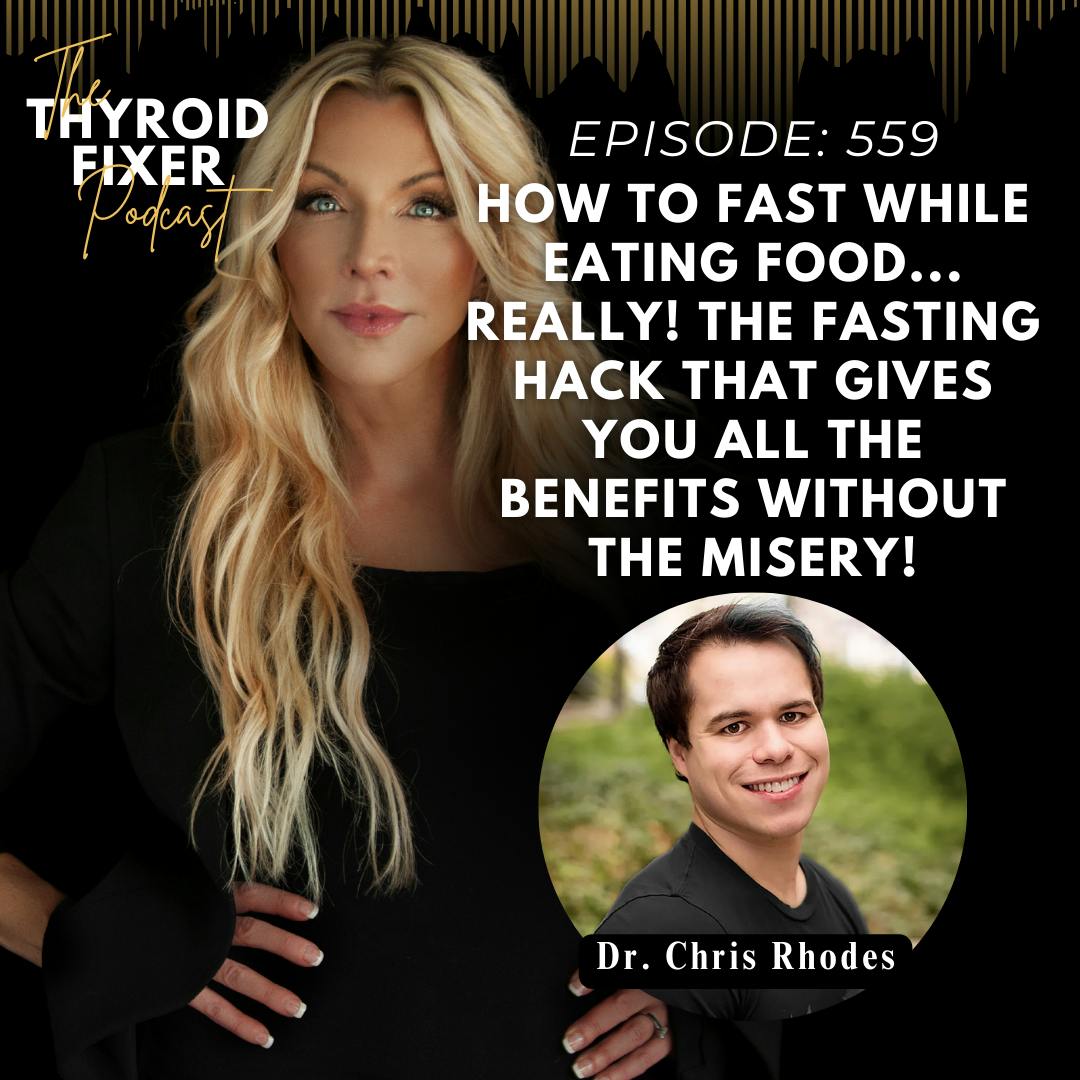
The Thyroid (and Hormone) Fixer Podcast: Thyropause, Menopause, Metabolism and How to Fix It
559. How to Fast While Eating Food...Really! The Fasting Hack That Gives You All The Benefits Without the Misery!
00:47:22
Loading summary
Transcript47 lines
- [00:02]
A
Welcome to the Thyroid Fixer podcast, where we dive deep into the world of thyroid and hormones, especially for you ladies navigating perimenopause and menopause, and really for anyone struggling with hypothyroidism, I'm your host, Dr. Amy, thyroid and hormone specialist and CEO of a global telemedicine practice where we prescribe the right thyroid treatment and bioidentical hormones to all 50 states and most of Canada, helping you become that badass human that you're meant to be. So if you're battling weight gain and hair loss, you can't lose weight no matter what you do. Your energy levels are plummeting and your libido left town. Then you're in the right place and you have found your tribe. Remember, I want you to embrace every inch of that badass woman that you truly are. So if you're ready to dive in and fix things, let's get started. You have questions about your thyroid, about your labs, what they mean. What about your hormones? What about insulin?
- [01:00]
B
What.
- [01:00]
A
Why are you gaining weight? Why are you so tired? Why are you losing your hair? Why won't my doctor listen to me? Why won't my doctor test these things? All of these questions that you have running around in your brain and you know that if you just had the answers that that could push you over the edge into optimal health, that you could be that badass human that you are meant to be. Well, I got you covered there because I am going live every single week. If you the just fix your thyroid Facebook group. That is my Facebook group. A beautiful community just filled with amazing people where I am in there, my nurse practitioners are in there. My health coaches are in there. There are patients in there that have been with me for so long, they're experts in their own right, and they answered just the way that I would. So we have you completely covered in this group. So not only can you post your question every single day, every single hour, if you want, you can mark your calendars for our weekly live Q and A sessions where you get to ask your question to me and I'm going to answer it live on air. And not only that, we are doing product giveaways. We're doing working with our team giveaways. You're going to want to be in there and actually be live on that call. You're at work. Go into the closet. Just shut the door. Take minutes for yourself. Take a half an hour for yourself. Take an hour for yourself so that you can get the information that you need to Bring yourself into optimization land, where you're not looking sideways at a brownie and gaining weight at the same time, where you can feel amazing every single day. Because that's my goal for you. You know that I love, love, love to answer your questions and this is the place where you can get them answered live. Are you absolutely frustrated with working with doctors that keep telling you that you're normal and everything is fine, or are you frustrated with going the functional medicine or integrative medicine route and you're still not getting optimized? Maybe because they're focusing on other things other than the thyroid and hormones or they're not a thyroid and hormone expert. Listen, just because you go to a functional medicine practitioner, it does not mean they know what they're doing with your thyroid and with your hormones. They might tell you they do, but the reality is, if you claim to be good at everything, you're really good at nothing. That is why we focus on thyroid and hormones now. Yes. What else is involved in thyroid and hormones? You got insulin, you got your adrenals, you got cortisol. Of course the gut is important. Of course it is nutrient deficiencies, all the things. But we look at all of that and the bottom line is you could do all the gut healing protocols, detoxes, adrenal fairy dust sprinkling that you want to do. And if your thyroid is in the toilet, if you're not being treated properly, if your free T3 is low, if your reverse T3 is high, if your hormones are in the tank, then it doesn't matter. You're going to be wasting your time, you're going to be wasting money, you're going to be throwing a bunch of supplements at it, just getting more and more frustrated and getting supplement fatig week. You need to work with people that will hold your hand, actually care about you, ask you how you're feeling, not have a cap on any kind of dosing. Oh, that drives me crazy too. All those docs out there that say, well, you can't go above XYZ dose of T3. That is complete BS. Do not listen to them. Or doctors that tell you that hormones cause cancer. No, no, do not listen. We can get you you to optimization land where you feel amazing, where you're not gaining weight, looking sideways at a brownie, where you have consistent energy through the day, your hair is not falling out, and yes, you actually poop and detox every single day. That is a win. So you're going to want to book a call with my team and this is totally free. And this is where we go over. Hey, what have you tried? What has worked, what hasn't worked, where are you at on the frustration spectrum? And, and here's how we can help. And we are going to tailor a program for you and your needs to get you to optimization land because I always talk about it. It's a beautiful place to live and I invite you all to join me there. Because in Optimization land, you are confident and strong. You want to go out, your brain works, you have energy, you have motivation and you feel so good every time you get dressed. Oh, and you have a libido. It's a beautiful place to live. So I'm going to invite you to click the link below. We always put it in the show notes how to work with us. So you're going to book a free call, no obligation. We're just going to go over everything with you and at least you'll have some guidelines and know what your next steps should be if you really want to get optimized. We got you. We've been doing this long enough. You're not a tough case, I always say that. But it is time to put you first. Because like I say, we only have so much time on this planet. Let's live it in Optimization land because you deserve to be the badass human that you're meant to be. So I look forward to seeing you in one of our programs so we can help you level up and bring you into Optimization land. Are you able to fast easily? I'm not. I know, I know. I should be fasting. Especially post cancer, for goodness sake. We know that fasting, caloric restriction, just giving your body a break from food is the thing to do. So many benefits. Autophagy, cleaning out dead zombie cells, helping us reverse the clock and extend longevity, literally become a younger version of ourselves. Why is it so hard to do? And on top of that, to be honest, I really don't recommend women fast for long periods of time, like 12 to 14 hours. Ladies, 16 max. Okay? But when you're doing the 20 and the 24 hour fast with the Omads, one meal a day, there is no way you're getting in the amount of protein that you need. So there's a solution that I have found that I'm bringing to you. So my guest today is Dr. Chris Rhodes. He has his PhD in nutritional biochemistry from UC Davis and he is an expert on human fasting as a health and longevity intervention. So over the course of all the research he's done, especially for his Dissertation, he and his team mapped out the biochemical changes that happen in the human body during prolonged periods of fasting, which I can't do. And Dr. Rose discovered that the body produces multiple unique bioactive metabolites during this 36 hour fast that literally you can put in a capsule. So when given as a supplement, it recreates the, the cellular health and longevity benefits of fasting and including extending your lifespan by 96%, meaning you can fast without fasting. If you don't believe me, you're rolling your eyes, you're like, oh, stop, Dr. Amy, come on. No, I'm serious. When you hear this episode, your mind's going to be blown, your jaw's going to be on the floor and you're going to go, oh, my God. Thank you, Jamie, for bringing this to me. Because I'm like you. I just don't like to do the long pass. I feel like I lose muscle, I go flat. I can't think, I give in, whatever. I want to have dinner with my family. It's too hard socially. That's okay. That's okay. Now, you don't have to feel pressure. You don't have to feel the guilt that I feel when I don't fast. You don't have to feel pressure. You don't have to feel guilty. This is going to be your answer. It's going to be eye opening. Fasting is such a hot topic. I mean, it really has been for years. And it's definitely come more on my radar recently because of my recent cancer diagnosis, which most of my audience knows already. But I was diagnosed with uterine cancer in April of this year and underwent a hysterectomy in June of this year, still recovering. But now I'm in the phase of what can I do to never hear the C word again? And, you know, I mean, like we were talking about there a lot of people, you think, okay, I need to prevent cancer, Prevention of cancer, prevention of cancer. But in the back of your mind, if you're really honest with yourself, you think it's not going to happen to me because I was the same way. I thought, oh, yeah, yeah, I'll prevent cancer. That's, that's a cancer preventative. But it's not going to hit me, of course, because I'm healthy. But the reality is cancer doesn't discriminate. It can hit all of us. And we should all be a little bit more heightened in our awareness of prevention these days, especially with the world that we're living in. The toxin exposure, the Chemicals, the pesticides, all of it, which greatly increase our, our risk of cancer. And that's not even taking into account the DNA and genetics and genetic snips and all of that. So needless to say, I am now on a prevention journey to never hear that word again. And fasting is a huge component of it. But, Dr. Chris, I'm going to be honest with you. I'm not a huge fan of over fasting. We're going to get into that today. And if I'm being honest, it's hard. And it's hard too. Fast.
- [10:55]
B
Oh, yeah.
- [10:56]
A
So when I heard that there might be a way to get all of the benefits in without actually having to totally restrict my eating for 14, 16, 18, 24 hours, I was pretty excited. So thank you for jumping on the show and really unpacking fasting and the benefits and what we can do to make it easier. Thank you for jumping on because that's what we're going to talk about today.
- [11:19]
B
Yeah, absolutely. I'm really excited to be here. I think it's gonna be a great show.
- [11:22]
A
Okay, so let's start, let's start with the benefits of, you know, we've all heard it, but I think it's, it's great to just lay it out there on the table because maybe you haven't heard a fasting podcast in a while and you forget, you're like, what are all those benefits of fasting? So how does fasting help us? Yes, of course, with cancer and then just in general, longevity.
- [11:42]
B
Yeah, that's a great question. So fasting is really, really fascinating because it's one of the only ways that we know of to reliably extend, extend the lifespan in animal models. So when you're doing fasting, usually what we're looking at in terms of lifespan extension is like an alternate day fasting regimen. So that's like one day of normal eating, one day of fasting, one day of normal eating, one day of fasting, rinse and repeat for an entire animal's life. And what we see there is that you can get anywhere between, you know, a 30 to 80% lifespan extension just by doing that alternate day fasting protocol. And what's really interesting about that is that in addition to the lifespan extending effects, you also have really big health span extension effects. So fasting, both in the animal models and in the human clinical data that we have, has also been shown to really treat, prevent or delay most major diseases. So whether that's cancer or whether that is like neurodegenerative diseases or autoimmune diseases or cardiovascular diseases. Fasting has been shown to be really beneficial for all of that. And the reason why fasting seems to be so beneficial is because it's activating this kind of innate survival and longevity mechanism within our cells that really puts them into a repair, protect and maintenance mode. So if you think about it in terms of, you know, fasting versus being in a fed state, right, when you're, when your cells have plenty of nutrients, when you're in a fed state, they're going to be kind of, you know, running dirty, so to speak. You know, they have plenty of nutrients. They're not going to care how efficient their metabolism is. They're not really going to be worried all that much about creating damage. They're going to be really focused on doing, you know, cell growth, cell replication, which of course involves a lot of, you know, DNA damage that can happen as well. Because essentially what the cells are kind of thinking at that moment is, all right, fine, I have all these nutrients around me. If something goes wrong, not a big deal, right? I can just always make a new cell and everything will be fine. In a fasted state, that really gets flipped on its head because your cells suddenly are like, oh crap, like if something goes wrong with the cells that I have now, I don't have enough nutrients to be able to make a new cell. So what does that mean for them? Essentially, it upregulates all of these survival maintenance, protection and repair mechanisms within the cell. So one of the big ones there is autophagy, where it's, you know, cellular recycling and cleanup processes. We're going to be producing less damage from our mitochondria. We're going to be transcribing proteins less. We're going to be doing cell division and DNA replication less. So that's preventing DNA damage from happening. We're going to upregulate cellular stress response elements and increased cell stability to make sure that our cells are more protected. So all of that, because we're taking care of our cells and turning on all of these repair and protection mechanisms, ultimately ends up creating better healthspan and better lifespan for the entire organism. So that's really what's going on at the cellular biochemical level of why fasting is so beneficial for health.
- [14:57]
A
So it's not just a caloric model, it's not just that we're, let's say, reducing calories when we fast, because technically, if you did incorporate, I'll just go with a 20 hour fast. You have a four hour eating window, really the goal is to get in the amount of food that you would take over the course of a day, of an 8 or 12 hour day, and shove it into a 4 hour eating window. So it's not about caloric restriction, right?
- [15:26]
B
Correct. Yeah. When you look at the scientific research, it's really fascinating too. For a long time, everybody kind of thought that caloric restriction and fasting were two sides of the same coin, right? But we have done studies since then that have basically shown, all right, if we alternate day fast animals but don't reduce their calories at all. If you keep the calories the same between groups, fasting still has this lifespan extension effect to it. It's not as robust as when you do both chlorophytician and fasting at the same time. But there are definitely distinct effects of fasting. And that's really, really fascinating because all that's really happening is there is not changing total caloric intake, but actually just switching around meal timing. And one of the reasons why we think that this works right now is obviously all of those cellular processes that I talked about before do get activated during fasting. Just, you know, having that period of time without food kind of forces the cells into that mode of action, that longevity bio program, as I call it. But really when you think about it from the other direction, what's going on in the body when we adopt more of this traditional western meal timing, meal frequency, three meals a day plus snacks, we're kind of always eating. Our body goes through what's called the postprandial response after a meal. So basically before a meal we're in like a homeostasis, rest, relax, repair, that kind of thing. When we eat a meal, all of our energy goes into digestion, absorption, metabolism. So we take a lot of resources that we were focusing on other parts of the body, especially cellular maintenance and repair, and put that into digestion absorption metabolism. And that kind of throws the system out of whack, right? You've got all these nutrients that are coming into the body, all these proteins and carbohydrates and lipids, and we have to, you know, get them out of circulation. We have to be shuttling them to where they need to go. We need to be burning them for energy. We need to be putting them away as, you know, as storage, whether that's glycogen storage or fat storage or protein storage. So that's really putting your body into this kind of stressed out state where it's literally like kind of fighting for survival against the Nutrition to a certain degree, just to make sure that everybody gets to where they need to go. And then you also have on top of that dietary inflammation that happens. So, you know, when you're taking food into your body, that's a foreign molecule, right? So your immune system has a reaction, reaction to it. You can get digestive issues, bloating, intestinal inflammation, things like that gut leakage that happens there as well, which then causes a transient inflammatory response in the body. And so when you have that happen three times a day, plus snacks in between, it takes around four to six hours after a meal for the postprandial response to really die down. And so if we're eating those three meals a day plus snacks, you're basically always in this kind of like chronic state of nutritional stress and dietary inflammation. And that's really something that's going to be underpinning a lot of these cellular dysfunctionalities that can happen with disease.
- [18:34]
A
Well, and I'll even take it one step further with weight. A lot of people fast just for weight loss, but really it's again, not caloric restriction. That's not why we're fasting, to reduce our calories. We're fasting to just what you said, give our body a break from pulsing that insulin every single time we eat. So every single time we eat, when we do this grazing throughout the day or in a constant fed state, our bodies are always pushing out insulin. So the pancreas will push out insulin in response to the food that we eat to lower our blood glucose. So when we're in this constantly fed state, it's always, insulin goes out, glucose is high, needs to be dropped down, more insulin. Glucose goes high, it needs to drop down. We can very easily get into an insulin resistant mode where our bodies are literally storing everything we eat as fat as fuel for a later time. And it can hinder even the best laid out diet, the cleanest diet in the world. If you're not incorporating some type of break in between the food throughout the day, you could easily derail your weight loss efforts. So another layer to fasting, I know a lot of people do it for weight loss, again outside of the caloric restriction, but more for the rest and digest, giving their pancreas a break, giving that blood sugar response a break as well.
- [20:02]
B
Yeah, yeah, absolutely. And I think something that you also see that happens within these states of fasting is like you said, you kind of just really give yourself a break to focus more on that homeostasis, that repair, that maintenance, that really can't happen in a constant overfed state. And you know, getting into that state of just basically chronic nutritional inflammation, chronic dietary inflammation, you know, that's going to mimic this other phenomenon that we call inflamma aging, right? Which is the chronic inflammation that starts popping up as people get older. So chronic overnutrition can really accelerate that process as well. And that of course leads to accelerated aging.
- [20:45]
A
So those are the benefits of fasting. But just like I started off saying, it's not always a great idea for every single person out there to incorporate a fast. And, and I'm talking about a longer fast. It's one thing if you're just not eating through the night as you're sleeping. Okay, well most of us don't wake up in the middle of the night and have a feast. But you, you have that natural fast that occurs when we're sleeping. But then outside of that, especially in my community, my listeners are mostly women and they will try to incorporate these longer fasts into their day. And I see a couple problems with this. Number one, just like I mentioned in the beginning, when you reduce your eating window, you're essentially reducing the amount of time that you can get in protein. And we know that protein is vital, especially as we age. We need more protein to protect our muscles, to protect against sarcopenia or the loss of muscle tissue. So how is a 60 year old woman going to get in 120 to 130 grams of protein in a four hour eating window? She's not going to do it. So what's going to happen on the other side? Yeah, she gets the benefits of fasting like you just discussed, but now she's losing muscle. Now she's at a greater risk of breaking a hip when she falls because she doesn't have that muscle tissue or wrapping around her skeleton. And that's where you start to go, okay, pros, cons here, like what do we do? What's more important? And I think it's important to talk about this because so many people are almost white knuckling their way through a fast. They're not enjoying it, they're not getting in the protein, they're seeing detrimental effects. But they're sitting back going. But I'm hearing all these experts talk about the benefits of fasting. So this is why I love where our conversation is going to go, that there might be an alternative to this where we can find a happy medium.
- [22:40]
B
Yeah, absolutely. And that is really what Mimeo is all about. And all the research that I was doing to get my PhD in nutritional biochemistry at UC Davis was all just surrounding, you know, what is happening in the human body during these long fasts. And is there a way that we can recreate those benefits but, but without actually having to do the fasting in and of itself?
- [23:04]
A
Well, yeah, and, and one step further before I, I dive into the science with you, which I'm fascinated about, when you just said longer fast, and that just triggered in my mind again, coming back to cancer. You know, they say if you did a five to seven day water fast once a year, you significantly reduce your risk of cancer. I gotta tell you, Dr. Chris, like that it doesn't appeal to me. I don't know that I could be doing this and doing interviews and seeing patients and running a business without food. And I get it, there are people out there that's like, no, your brain gets better after day three. But, but I gotta tell you, like, I don't even wanna jump into day one and two. So I need a tool where I can get the benefits without the hurt.
- [23:47]
B
Yeah, yeah, absolutely. And yeah, that's really what Mimeo was designed to do. So the basic story behind the product, where it all came from, how I really got interested in it in the first, was I was coming out of my undergraduate degree, got my BS in biochemistry from Loyola Mary Mountain University. But then, you know, like, a lot of college kids just like, didn't really know what I wanted to do with that. I knew I wanted to be something in research, but wasn't sure what I was really passionate about. So took an immunology fellowship at Stanford where I basically just started pouring through all of the research that I could get my hands on, going to seminars, trying to find something that really interested me. And of course then came across healthy aging and longevity research, which I thought was so fascinating because it used to be, you know, myth and legend, right? Ponce de Leon, the fountain of youth, and is now like this very rigorous, very real portion of scientific research. So when you're in that space, eventually you come across fasting, right? Because like we said before, fasting is one of the only ways that we know of to reliably extend lifespan, reliably extend healthspan. And the real interesting thing about fasting for me was that it does all of that without actually adding anything into the system, right? So it's not like this superfood or this wonder drug that is giving you these benefits. It's somehow fasting is activating that, you know, longevity bio program that we all already have inside of us that isn't ordinarily turned on. And when that clicked for me, it actually made me really mad because I was basically like, great. So my body knows how to live to be 120 years old and in perfect health, but it's just not doing it. So that's really what kind of catapulted me into being like, all right, let me see, you know, at least at first, let me start doing some fasting. Let me take my cells, let me take my blood, let me see what actually happens here. And what I found was that I got really, really functionally enhanced from, you know, like a 24 hour fast, a 36 hour fast, a 48 hour fast, a 72 hour fast. I could track it all through on my cells and my blood, you know, they had become more anti inflammatory, more antioxidant, more cytoprotective, they had better resilience to stress, they were more cardioprotective, they had better metabolic flexibility, all of these really crazy things. So I got very, very into fasting very, very quickly because it's like kind of like a the ultimate quantified self experiment where you can see everything that's happening in your cells. And so I kind of got addicted to it, right? I was like, okay, great, we're gonna do alternate day fasting forever, right? And it'll be great. And so I kind of adopted that lifestyle. But after around, you know, two years of doing it, there's a weird element of social isolation that comes along with that kind of lifestyle, right? Like our society is not built for people to only eat every other day, you know, and you're not having lunch with coworkers, you're not having dinner with friends and family, or if you are, you got to be that weird guy. He's just like across from the table, like just, you know, with a glass of water. And I'm like, it's fine. I'm just going to watch you eat, you know, it's great. And nobody wants that. At a certain point, my sister basically told me, like, yeah, sure, Chris, you're gonna live longer, but what is the point of living longer if you have to live less? And that for me was like, very powerful and kind of again, like, catapulted me into being like, yeah, is there a way that we can get these benefits without having to do this crazy alternate day fasting lifestyle? And so that's why I spent my whole PhD looking into and ultimately what became Mimeo.
- [27:19]
A
So fascinating. Okay, so we were dangling the carrot for a while, but yes, to the audience listening There is actually a way to kind of hack fasting and get the benefits without the pain. Do you ever feel like your energy is just off, like you're not fully alive during the day and then you're restless at night? Chances are your circadian rhythm, your body's natural clock, has been disrupted by a lack of sunlight. So what's the solution? This is where I bring in the Mitolux sun lamp. It is designed to mimic the best of the sun, helping restore your body's rhythm. UVB for vitamin D, that helps our energy. Red and infrared light for mitochondrial, mitochondrial support. And let's not forget our skin and collagen formation. It's amazing. It's like a reset button for your health that you just turn on and then sit in front of and enjoy. And during those long, gloomy winters, those long days, it's a lifesaver. No more winter blues, by the way, improves your mood. No more low energy. Improves your energy. So you need to get yourself a mito luxe lamp. It's so portable, it's so easy. I sit it on my desk, I take it with me to my bathroom, I stick my face in front of it. After I wash my face, put on my serum. It is amazing for your skin, but amazing for your energy. Amazing for your mood. You want to go to mitolux.com forward slash Dr. Amy. So that's M I T O L U X.com forward slash dash R-A M I E. You're going to use the code. Dr. Amy. They are giving me the code to give to you for 10 off. You will not regret it. This is the best, best, best red light, hands down. I have many of them in my house. This is the only one that I use. It is so easy, portable and it works. The most important thing is it works. So mitoluxe.com forward/doctor Amy don't forget to use the code. Doctor Amy. So here you are, you're, you're diving into this research, you know, the benefits, you've experienced the benefits. What did you find? And tell, tell me, how did Mimeo come about and what's the science behind it? How does it work in our bodies to literally mimic a fast?
- [29:48]
B
Yeah, absolutely. So, yeah, Mimeo is a fasting memetic supplement that was designed from all the research that I was doing as part of my PhD. And so what we did for that was we had 20 people come in, 10 men, 10 women, to avoid the gender bias and make sure that we were looking at kind of these universal responses to fasting that are just part of human biology and non gender specific. And we had people fast for 36 hours, looked at a before and after. And what we found there, just like with me, was that when these people fasted for 36 hours, they became more functionally enhanced, more anti inflammatory, more antioxidant, more cardio protective. And we also found that there was this unique set of molecules that were produced by the body that are really only elevated during a fast. We found that there were over like 300 of these molecules significant differences between a baseline state and a fasting state. And so we basically just combed through those molecules looking for ones that had some kind of literature results of having bioactivity, whether that's creating the anti inflammatory effects or creating the antioxidant effects or what have you, and narrowed that list down to around two dozen or so. And then from there took those individual molecules and then screened them through our cellular assays to find ones that could recreate these beneficial effects of fasting that we were seeing in the study. And so after doing all that and like crossing a bunch of these things together, looking at how they all stacked, we found this synergistic combination of four of them that when we combine them together could recreate all of the beneficial effects of fasting that we had been seeing in the cells. So those same, you know, anti inflammatory, antioxidant and cardioprotective metabolic health benefits. And because we were also really curious about fasting as a longevity intervention, right. We took that formulation and did a C. Elegans lifespan extension analysis and saw that we could increase their lifespan by 96% just through supplementation. So basically doubling their lifespan with this fasting mimetic combination.
- [31:55]
A
That is so mind blowing. This is crazy. I mean this can really change the face of health. Okay, so tell me, how should I properly. Because I've just been taking it every day. But how should I properly take Mimeo to get the. The benefits are, are there rules around it? What should I be doing?
- [32:14]
B
Yeah, so there actually aren't a ton of rules around it. So you can use Mimeo as a fasting mimetic, right? That's what all three of our clinical studies that we've done with the formulation have been. People just taking the supplement, not changing their diet, not changing their lifestyle at all. Or you can use it as a fasting enhancer, which is actually how I use it. So I still do one meal a day style of fasting. And so I'll take Mimeo in the morning alongside My green tea. And it really helps to just kind of, you know, supercharge the benefits of my fast, give me these deeper stage benefits that I wouldn't ordinarily experience during my shorter fasts. And then it also helps make fasting easier because the formulation itself actually does have some effects. You can feel like appetite suppression effects, mood elevation, pain relief, these really interesting things that are coming from the individual molecules within the formulation itself. So if you want to use it to get the benefits of fasting, even when you're eating, it's totally great for that. If you want to use it to enhance the benefits of the fasting they're already doing and just make them easier, then it's great for that too.
- [33:22]
A
So taking it with food won't necessarily negate the benefits of it. It will still activate those benefits of fasting. Now, I'm also going to tie on to that question and then I'll hand it over to you. I'm assuming that the types of food matter. So if you have someone that, let's say takes mimeo and they're eating a nice clean whole food diet, maybe they just took it with a beef isolate protein shake or chicken and asparagus, versus a person that's like, I'm going to pop some mimeo and go through the drive through McDonald's, that's probably, they're probably not going to get the benefits, right?
- [33:59]
B
Well, they'll certainly get fewer benefits overall. We can say that. So in the clinical studies that we've done with the mimeo formulation, like for example, our first pilot study, we basically had people come in, eat a standardized breakfast alongside a placebo control, and then looked at their cellular functionality, their plasma functionality, like we did in the original fasting study. Then we had those same people come back after a washout period, eat that same breakfast, but then with supplementation with mimeo. And what we found was that when people ate the standardized breakfast with the placebo, they had this big loss of cellular and plasma functionality, right? The postprandial response like we were talking about before. So they became pro inflammat oxidant and less cardio protective and less had less metabolic flexibility. But what we found was that when they ate that same breakfast, but then with supplementation with mimeo, we could not only prevent all of that loss of function, but then actually add gains of function on top of that. That mimicked what we saw when people were actually fasting. So instead of being pro inflammatory, their plasma became anti inflammatory and antioxidant and cardio protective and had better metabolic flex flexibility. So you can get these fasting like benefits even when you are eating. And obviously, yes, the type of nutrition that you're taking in at the time is going to determine how robust of an effect that is and what the overall health story is going to be. But we are pretty confident that, you know, eating a burger plus mimeo is probably better than eating a burger without mimeo.
- [35:35]
A
Okay, all right, I see that. That's amazing. So I want to go back to the over fasting under eating protein aspect, especially for women. Now you're young and you're a guy, so you can get away with doing an omad a one meal a day and still get in a pretty decent amount of protein in that one sitting. Because you're young and you're a guy, you're going, you're going to have a larger appetite, you're going to be more active, you're going to be able to consume that steak plus whatever else is in that meal. But for from the ladies out there, my paramenopausal, menopausal ladies, or even my thyroid peeps, because this is, this is big for thyroid. You don't want to over fast and you want to make sure that you're getting in the protein. I think in a perfect world, when I say over fast, I'm really talking about kind of you, Dr. Chris, like the omads or really anything up to like 16 hours of fasting, like 16 to 24, that's just too much for a woman to do. I think that puts an additional stress on the body. So for thyroid, you know, we don't want to be raising our cortisol. Cortisol will interfere with thyroid hormone conversion, thyroid production. So we want to keep our cortisol nice and steady. Fasting as we know is a stressor on the body. So I don't want my ladies doing 16, 18, 20, 24 hour fasts. Number two, I want them to get in the required amount of protein. What I love about being able to take mimeo and get the benefits is really we can get people out of that almost orthorexic mindset that many have gotten sucked into over the years because of the benefits of fasting. We know that there are benefits, but people overdo it. They just get in that mindset and they just go and they overdo it. And it's almost like you have to back them off the ledge and let them recognize that too much fasting is actually detrimental on the body. Now you're negating the benefits of fasting by not getting enough protein, raising your cortisol, affecting your thyroid. What I love about this is it's the best of both worlds. So all that being said, the question goes to you. Now, in your research, have you found like a sweet spot with mimeo and real fasting specifically for women or have. Is that an area that maybe we need to dive into and study?
- [38:06]
B
Yeah, I would say that just by and large, in general there is not enough clinical research right now on women in fasting, especially at the longer stages of fasting, like you know, the one meal a day, 36 hours and beyond. Kind of like we were talking about a lot of the research that has been done on the shorter phases of fasting, like the 168 style. Those do include women, but unfortunately usually those studies are just looking at kind of basic blood markers and weight loss because those are what those studies are about. And that's usually where you see kind of like unimpressive results. Right. So they'll do things where we look at intermittent fasting, that 16:8 style versus just normal caloric restriction. Right. The calories between the groups are the same and you don't really see all that much difference in weight loss, which makes total sense. Right. But it doesn't give us a deeper picture in terms of like what is actually happening on a gender by gender basis. What is the proper length of fasting for women and yeah, how is this really different than men? There's just not a lot of very good research and evidence about that. What we have seen in terms of how mimeo can help women is really just kind of getting them over the initial hump of fasting. I think 16, eight, like 14 hour fast, something like that. That's a good sweet spot. And then mimeo can be really beneficial to get there because it has these appetite suppression effects and metabolic enhancement effects. So you know, you're not going to be running into the situation where you're like really slowing your metabolism down in order to do the fasting in and of itself. You, you're going to be, you know, suppressing appetites. You're not going to get that hanger. That can also happen. And you're going to be getting those cellular benefits as well from the full formulation working together. And like we said before, Nimio was designed from a 36 hour fast and uses molecules that are really only upregulated at that 36 hour mark. So you're not going to be experiencing these metabolites with these shorter fasts. Otherwise this can be just a really great Way to make sure that you're maximizing the benefits and of your fasts, but without going too much into that kind of yet cortisol spiking metabolic problem.
- [40:16]
A
Oh my gosh, so exciting. It's so exciting. And I'm, I'm sitting here also thinking about the group of people that they can never fast. They're hypoglycemic, they, they can't. I mean, they need to basically wake up and eat. And you know, that could signal a whole other issue that they need to look, look into. But there are people out there that they literally, they cannot fast and they might even have a medical issue that requires them to, to eat as soon as they get up or to eat food with their medication they have to take in the morning. So fasting is just out of the question for them. This gives them that tool so they can get the benefits and it's just mind blowing that now we can make this biohack really available for the masses.
- [41:02]
B
Yep, yep, absolutely. And I think that that's kind of the really big purpose and power of mimeo, right? Like going back to why I got started in all this in the first place, that kind of anger or like the cognitive dissonance around the fact that our body knows how to do all these things, right? Like nothing knows how to heal a human body better than a human body, right. It's just like these mechanisms for it to happen just aren't getting switched on and switched off within our control. So the point of mimeo is really to allow us to activate those regenerative systems, get those cellular health benefits, but just on demand, right? Use the power of our biology, but put it at our fingertips.
- [41:44]
A
Now, is there any benefit to taking mimeo multiple times a day? I'm thinking about in the cases of, let's say, myself post cancer or let's say even after a surgery for recovery. We need more of that autophagy, we need more of that clearing of the dead cells that we want to get rid of out of our bodies. Is there ever a time where you would say, you know what, let's double up on it, take it multiple times a day to really get into a, a deeper fasted state?
- [42:14]
B
Yeah, I think that you could definitely do that and I think that there, there are even just, you know, on a day by day basis reasons why you would do that. Right. If you are really trying to, let's say in my case, right, you're starting off on a 16, 8. You really want to push yourself out to Omad, right? You could take the mimeo in the morning, then take a second dose probably, you know, in the afternoon to get more of those consistent appetite suppression effects all day, to really be, you know, cranking out the cellular benefits before getting into that, that last meal. I would also say, you know, you could do that in the other direction. You take Mimeo the first thing in the morning, right? You do your fasting and then as soon as your big meal of the day comes around, you take more mimeo on top of that to really help to minimize those negative impacts of eating that we were talking about before and help to maintain those fasting benefits kind of through the meal.
- [43:07]
A
Oh, I love that. I love that. This is, this is just crazy. It's blowing my mind talking to you because this is just opening up doors for people to accelerate their health, to extend their longevity, to reduce disease, to, to balance their weight, to get the effects of, essentially, which I'm going to ask you about next, the effects of GLP1, let's say reducing appetite, maybe not to that extent, but I'm, I'm actually opposed to people using GLP1s at their highest level. I'm more of a microdose fan because again, when you kill your appetite, you are not going to get in the protein that you need. You are going to lose muscle at a maximum dose of GLP1s. So if you're using a GLP number one, sometimes it's cost prohibitive. Number two, oftentimes it comes with side effects that are very much unwanted, including muscle wasting. So you're saying that mimeo will take the edge off or actually reduce people's appetite? That's another layer of benefits even on top of the fasting.
- [44:14]
B
Yeah, yeah, absolutely. And that's something that we proved out in our latest clinical study. So this was our big randomized double blind placebo control study with both men and women equal proportion as before. And there basically no one was changing their diet, no one was changing their lifestyle. It was literally just, okay, one group is taking up placebo control, the other group is taking mimeo and then they're living their lives for eight weeks for the before and after. And what we saw after eight weeks of supplementation with Mimeo is that we had really, really, really robust improvements to hunger control, appetite suppression, satiety. So people were rating their overall and maximum daily hunger levels significantly lower. They had way easier time eating only when they were hungry. They had less distractions from cravings, less food noise throughout the day, and that improved satiety. So getting fuller Faster and staying fuller longer after they were actually eating. And then on top of that, we also saw a lot of great metabolic effects that you would also expect from fasting. So we had improved blood glucose levels, we had improved cholesterol levels, we had lower LDL levels, the bad cholesterol, we had lower LDL particle number, which is, you know, an even better metric of assessing CBD risk. Then we also had much lower levels of oxidated ldl. So basically that's a measure of cellular stress and oxidative stress within the body and then, you know, anti inflammatory effects as well. So basically everything that fasting should be doing for you, but just way more.
- [45:48]
A
Simplified, just so incredible. You're just blowing my mind the whole time we talk. Okay, so from a nerds out there, it's so cool. It is so cool. Now, I know you have over a hundred clinical trials, clinical studies out there on the. Give me another one for my nerds out there. You just went over a very fascinating one, but give me another, another study.
- [46:07]
B
Yeah, yeah, absolutely. So the 100 clinical studies, those are ones that are for the individual ingredients themselves. So like the individual ingredients within the mimeo formulation have been assessed in, you know, a hundred plus clinical studies. We have assessed the full mimeo formulation in three clinical studies. So we mentioned our randomized double blind, mentioned our pilot study. Another one that we've done was a clinical case study study with the Dave Petrino lab at Mount Sinai. And basically same thing there, just looking at an eight week supplementation with mimeo and the before and after. And what we saw there was very similar to what we ended up seeing in the big randomized double blind trial. Basically, really great improvements to appetite control, really great improvements to metabolic markers. So better glucose levels, better insulin levels, better HbA1c levels, better total cholesterol, triglyceride levels, better HDL levels, better LDL levels, a 50% increase in circulating testosterone. And then the big one for me was we got a two and a half year reduction in biological age. So in just that eight week period of time, we were able to, you know, take him from, I think it was like, you know, 51 years old on the biological age down to, you know, 48 essentially.
- [47:24]
A
Okay, I'll take that, I'll take that.
- [47:27]
B
Mad for eight weeks of, you know, just taking a pill.
- [47:30]
A
And that's just eight weeks. That's crazy. Oh my gosh. All right, well, Dr. Chris, you have laid out the benefits so beautifully. I thank you for diving into this research because this is, it's Needed. It's mind blowing. There's nothing else on the market like this and you have the research to back it. So this is one of those, you know, I have these categories of supplements that I talk about all the time. And the one category, it could be called essentials, but I call them my no dust supplement supplements, meaning of course, die. You're going to take these every day because there are so many benefits. Why wouldn't you? And to me, mimeo really falls into that category because I can't think of anyone who wouldn't benefit. I know it's a double negative, but basically it's saying that everybody will benefit. Is there anyone that shouldn't use Vimeo?
- [48:19]
B
I mean, mainly what we say right now, and this is more just out of an abundance of caution than anything else, is just, you know, if you're pregnant or if you're nursing, you know, not the right time to be taking it, but otherwise pretty much for everyone. We also generally say that, you know, kids shouldn't take it. Right. Because kids don't need to be fasting.
- [48:36]
A
So that they're still for good. They don't need it.
- [48:37]
B
Yeah, they're young and healthy already. So that's really the thing. And yeah, to your point, there are just a ton of benefits, like even beyond the ones that I've been saying here. Right. So those 100 clinical studies on the individual molecules, whether that's, you know, enhancing autophagy, right. Or creating these, you know, anti inflammatory pain relief, mood cognition enhancement effects, the appetite suppression effects, the metabolic enhancement effects, just crazy amounts of data and science that have been done on these individual ingredients. And then of course the science that we've done on the full formulation itself.
- [49:11]
A
And I think that's important to note. And you know, the listeners, they might not think this deeply, but this is an important piece. Whenever you are talking about a supplement, yes, there are those individual ingredients that they might all have their own set of benefits, but it's very important to look at how those ingredients work when they're combined. And kudos to you for looking at exactly that, looking at the ingredients that you found highly beneficial on their own. But now what happens when we put them together and that's key. So I, I admire you for doing that.
- [49:48]
B
And it was really cool to see too kind of the, how the molecules work synergistically together, activating these kind of complementary pathways. Because when we did that lifespan extension analysis, you know, we assessed each of the individual molecules on their own and then assess them, you know, in X, Y, and Z combinations. And basically so for like, you know, nicotinamide, nicotinamide could increase lifespan by like 5%. For spermidine, it was like 10%. For oleoyl ethanolamide, it was like 20%. For palmitoy, it was like 27%. Right. But you put all those four together and that's where we see the 96% lifespan extension. So these molecules really are actually having synergistic benefits to each other, creating effects that are greater than the sum of their parts.
- [50:33]
A
That's so good. So good. You guys have really gone the, the extra mile at creating such a beneficial supplement that has a boatload of research behind it. So again, mad kudos to you. I'm so happy to be able to introduce this to my audience and incorporate it into my own regimen, my own supplement regimen. Because like I said in the very beginning, I'm on a cancer prevention journey now and fasting slash, Mimeo is part of it because I am, I'm not strong enough to fast for five to seven days. I'm not going to do it. It's just not going to happen. So I'm using Mimeo instead. And you have been so gracious to offer my audience a 20% discount for them to try it out. So to get that, we're going to put this down in the show notes, but you're going to go to mimeohealth.com so it's M I M I O H E-A-L-T-H.com. you're going to use the code Dr. AmY-R-A M I E. Again, we'll put that down in the show notes too, but that's going to save you 20%. So thank you for, for gifting that to my audience. I appreciate that.
- [51:39]
B
Yeah, absolutely. I'm happy to do it.
- [51:41]
A
So everybody, I hope you enjoyed this episode. Dr. Chris, thank you so much for just blowing my mind on this show. It's like, of course I looked into the supplement and what you have on your site, but talking to you and getting so much deeper, that just, I mean, that just impresses me even further. And to understand the science and to understand the benefits of Mimeo, this has really been, this is an enjoyable eye opening interview today. So I really thank you for your time and your expertise in this.
- [52:13]
B
Oh yeah, absolutely. I'm so happy to hear that. And thank you for having me on. This was a blast.
- [52:18]
A
Absolutely. So everyone listening, you try it out. I want to know your results. Write in to me, let me know. But the discount code and the link is in the show notes Dr. Chris, thank you once again.
- [52:28]
B
Yeah, absolutely.
- [52:35]
A
The information shared on the Thyroid Fixer Podcast is intended solely for informational and educational purposes. It is not a substitute for professional medical advice, diagnosis or treatment. Always consult with your physician or other qualified healthcare provider with any questions you may have regarding a medical condition treatment or before making changes to your healthcare regimen, including medications, supplements or other therapies. Use of the information provided in this podcast does not establish a doctor, patient or client provider relationship between you and the host or between you and any other healthcare professionals featured on the show. Any medical opinions or statements made by guests are their own and do not necessarily reflect those of the host or affiliated parties. Statements regarding dietary supplements or health related products mentioned in this podcast have not been evaluated by the fda. These products are not intended to diagnose, treat, cure or prevent any disease. Some episodes of the Thyroid Fixer Podcast may include sponsorships or affiliate links. The host may receive compensation for discussing or promoting certain products or services. Any such sponsorships or affiliations will be clearly disclosed during the episode. All opinions expressed are those of the hosts or guests and do not necessarily reflect the views of any sponsors. The inclusion of a product or service does not imply endorsement by any healthcare professional featured on this podcast.