← The Thyroid (and Hormone) Fixer Podcast: Thyropause, Menopause, Metabolism and How to Fix It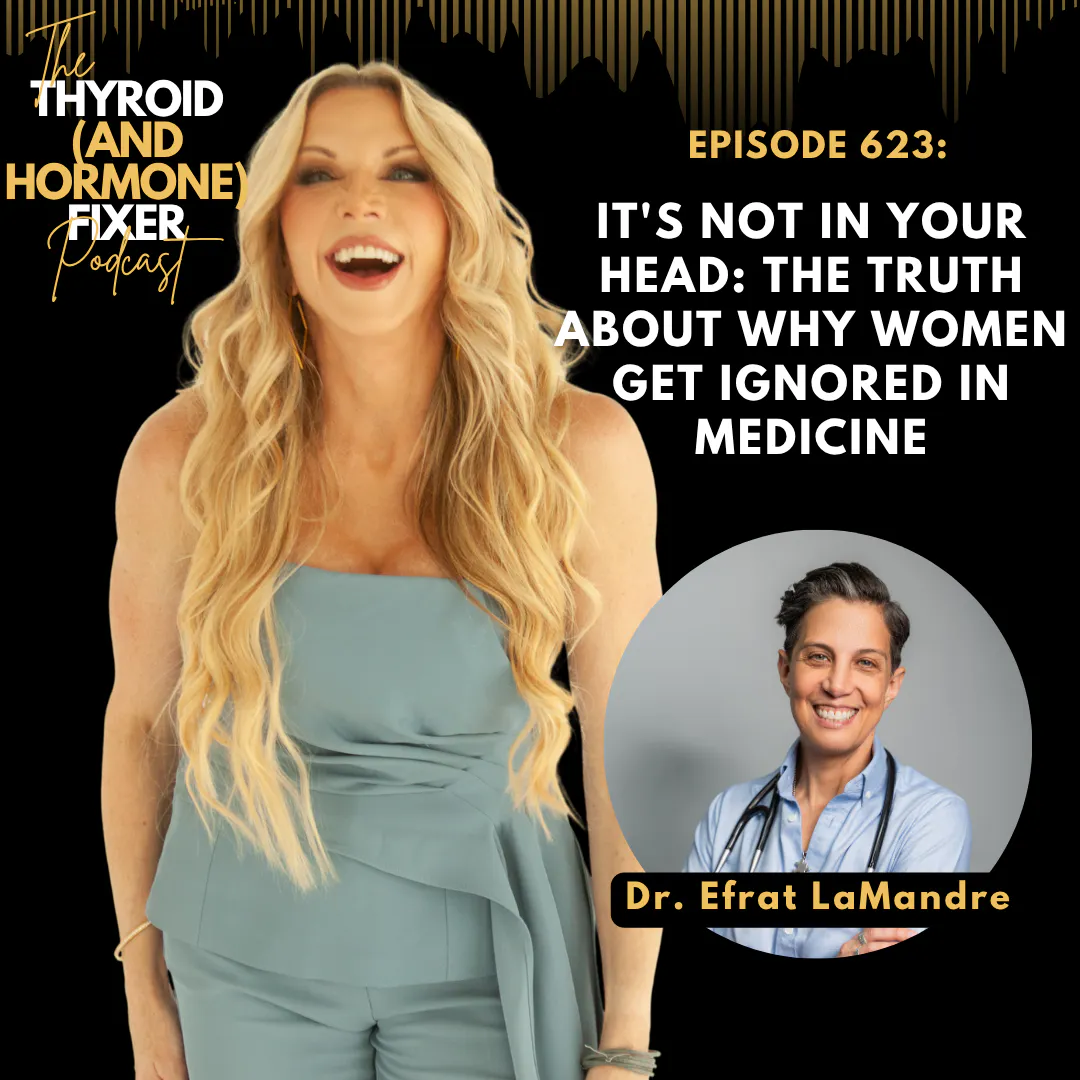
The Thyroid (and Hormone) Fixer Podcast: Thyropause, Menopause, Metabolism and How to Fix It
623. It's NOT In Your Head: The Truth About Why Women Get Ignored in Medicine
00:46:30
Loading summary
Transcript72 lines
- [00:00]
A
Everywhere else in your life, you build a team. You plan a wedding, you have a dj, you have a cake maker, you have a florist. You don't expect one to do the other job. You need your primary care and your functional and if you have it, your acupuncturist and your life coach, all of them together to get you the health that you need.
- [00:19]
B
Welcome to the Thyroid and Hormone Fixer podcast. If you've been told everything is fine, but you're gaining weight despite doing all the right things, struggling with brain fog, mood swings, low libido, or feeling like a stranger in your own body, you're in the right place. I'm Dr. Amy, the thyroid Fixer. And I want you to know right now, I see you, I believe you, and you don't have to figure this out alone anymore. We're going to do this together. But I'm also not here to play nice with bad medicine or empty promises. This show is meant to disrupt the entire health space. We're going to challenge the status quo, connect all the dots other providers miss and give you real practical science back. Tools you can use. Today. You're not going to get any more recycled biohacking advice. Just truth, strategy, and hope. Let's get you back to feeling like the badass human you're meant to be. Okay, ladies, are you in your 40s or 50s like I am and possibly wondering why your energy is just fell off a cliff? Well, you're not imagining it. And it's not just thyroid and hormones. A huge part of midlife fatigue happens deeper, like at the cell level because of your mitochondria. We talk about this all the time. Your mitochondria, those parts of your cells that make energy and it naturally declines with age. So I totally noticed this myself. Turned 52 in February. And of course my labs look good, I'm optimized, but sometimes I just don't feel like the same person, energy wise. So I started taking Mito pure gummies. My friend told me about it. I'm like, okay, let me try it. And it's a gummy, so it's not another pill, which is nice. So, Mitrepure gummies from Timeline Nutrition. These little bad boys have the clinically proven form of urolithin A, which. That's a whole big science word, right? But basically, what urolithin A is, is it helps to renew your mitochondrial function. And remember your mitochondria, key driver, healthy aging, strength, stamina. And it's just simple. It's two gummies in the morning. So no more pills, no more supplement fatigue. Plus they taste good so you're going to want to pop the gummies in the morning. It feels like I'm supporting my body at the root instead of just chasing symptoms with more caffeine or nootropics. Think of Mito Purolithin A as helping your cells make energy basically the way they used to back in your 20s and 30s. So if you are experiencing midlife fatigue and it's dragging you down, this is a great place to start. Go to timeline.com T I M E L I N E just like it sounds timeline.com forward/doctor Amy-R A M I E to get up to 3939 off your Mito Pure Gummies. So that is timeline.com forward slash Doctor Amy I need to talk to every woman who's been told your labs are normal while your body is is screaming at you and rebelling against you. Fatigue, brain fog, the weight that will not come off, mood swings, hair loss, feeling dismissed, frustrated and confused. I get it. And that is exactly why I wrote my new book the Thyroid Fix the Nonsense Guide to Fix Fatigue, Fogginess and Fat that Won't Budge that just says it all is and it is now available for pre sale. So I need your help to spread the message. I am giving you an ask as my listener and a promise at the same time. If you pre order the Thyroid fix, my promise to you is to continue delivering all kinds of free advice, information, content, education, empowerment, patience. Because that's what I love to do. Whether it's here in the Just Fixture Thyroid Facebook group or I'm on live. I will give you everything I possibly can if you do me one favor which will be a favor for yourself as well and pre order the Thyroid Fix. Now. This book is not another list of supplements, vague advice. It's not a diet plan. It's not filled with recipes. You it is a clear, honest guide. It is the Thyroid Bible. It is the last thyroid book that you will ever need because it teaches you how to read your own labs. No other book has done that. It teaches you what medication and dose you need. No other book has ever done that. It will help you to understand why you are being misdiagnosed, why you're being undertreated, and why you can't talk about hormones, weight loss or menopause without talking about the thyroid. I called it Thyroid Bible because like I said, this is going to be the thyroid book of the next few decades when you pre Order. You're not just supporting me, you're telling the publisher. This message matters and it needs to get out to the world and it needs to get into the hands of women who have been ignored for far too long. So will you go to thyroid fixbook.com and pre order a copy of yours today? It'll be shipped to you on May 12th and you will get free entry to our all day live event where I will be there answering your questions live, teaching live, and bringing in amazing guests for you to also connect with and ask your questions too. So thyroid textbook.com pre order yours today. So your doctor told you your labs are normal, like we all hear, but you're exhausted, your hair is falling out. You know something is wrong. And I always say you know your body so well. So today's guest, a nurse practitioner turned medical disruptor, is going to explain exactly why this keeps happening and what you can do about it. Here's what we have been missing from this whole conversation. Today's guest, Dr. Efrat Lamondre, known as Dr. E, family nurse practitioner with a PhD in integrative medicine, IFM certified functional medicine practitioner, founder of one of the largest NT owned primary care practices in the country, serving over 20,000 patients, author of the bestselling book it's not in your head, the host of the Medical Disruptor podcast, and as of this year, the editor in chief of the Nurse Practitioner Journal. Her journey in the functional medicine that we're going to talk about today started with something very near and dear to my heart. Something very near and dear to your heart. Somebody in her life was told that they were normal and they really weren't. So we are going to dig into all of this medical gaslighting that is happening ad nauseam right now. And quite honestly, it hasn't changed in the 30 years since my misdiagnosis. So we're going to pick that apart and we're going to talk about something that Dr. E talks a lot about, about this pre disease state that your doctor isn't telling you about. Of course not. So welcome Dr. E to the Thyroid Fixer podcast. I'm so excited. Like I said, off air, you and I are so damn similar. So this is going to be a really disruptive conversation.
- [08:02]
A
I'm looking forward to it. Thanks for having me.
- [08:04]
B
Absolutely. So I want to start with you. So you were a conventional primary care provider for years. You know, you trusted the system. Then your wife got sick and everything basically changed. So can you walk us through that moment when you realize the System that you were in, that you trusted was literally failing someone you love. Because I know every woman listening has her own version of this story.
- [08:31]
A
Well, first I want to say I still trust the system. I just trust it. I just trust it with different things. I understand what it can and can't do. We'll get to that. I haven't lost trust. I've just redefined what it could do. So my story is, yes, I have medical practice. My wife is also a pa. So we are very medically inclined. Our friends are. In medicine, this is important because access is not a problem. Right. So she was diagnosed with an autoimmune issue called pmle. For those who don't know what that is, it's basically an allergy to the sun. So when in my keynote speech, I always say, when I met my wife, she was a vampire because we couldn't get out in the sun. Yeah. So that was the start. And we both read the journals. We understood that there's nothing you can do. And we went to a lot of specialists and they're like, there's nothing you can do. Here's some creams for the outbreaks, the flare ups. And we just changed our lives, as many of your listeners do. They just, just adapt. Then she got the second autoimmune because now we all know where every. All your listeners are savvy enough to know that until we figure out why the first one's happening the second and the third is going to come. We didn't know that then, by the way, just so everyone knows, this is pre Internet days, right? So a lot of what our listeners know was not common knowledge back then. So no one knew functional medicine. No one knew gut skin connection. This is very, you know, the Internet has just pretty much was still doing. I don't know what it was, but it wasn't doing this. So we lived it. And I knew that there was nothing else that can be done. Like, I just knew it and she knew it and we just lived with it. And then I was in a shared office space with some people who are like alternative folks, and I just happened to tell the story and they're like, you know, there's so much you can do. I was like, what are you talking about? This is like nonsense, 100% quackery. I read all the journals, like, there's nothing I could do for my wife. And by the way, the second autoimmune was really severe psoriasis. It was on her hands and her feet, like she couldn't open a bottle she couldn't button her shirts. If she would walk, her skin would bleed. So, like, really affected her quality of life. Can't go outside the sun. Can't use your hands or your feet. I mean, you're really debilitating stuff. So when they were like, you have to talk to this guy. Dysfunctional medicine. I was like. At the same time, I was rolling my eyes, I was also like, but what do I have to lose? Like, let me just go listen to this guy. But fully skeptical, Fully going to just waste my money. That was. I was like, it's just whatever. Let me listen to this guy. So we give him the consult, and now he has this insane idea that all this is connected to what we eat. First of all, no. There's nothing in the journal ever said that. Second of all, we're supposedly healthy. Supposedly, you know, thin, athletic women. We're not eating McDonald's. What are you talking about? Like, nutrition. And over it, like, this is so foreign. And then he did these crazy tests we never heard of. We never learned in school. And we were like, okay, let's just roll with it. And so we went on this AIP diet. I'm sure your listeners know it, which is insane.
- [11:24]
B
It's rough. It's. It's. It's rough. Like, you only go on now and you're desperate.
- [11:28]
A
Exactly. You're like, ready? Whatever you tell me to do, I'll do. We're like, we literally. So we did it. And the amazing thing about it is, because she had psoriasis, we were able to document improvement. This is not a subjective. I think I feel better. We would take pictures every day, and we're like, holy shit, this is working. Like, we couldn't believe it. And then the psoriasis was gone. And then one day, she was able to go out in the sun. Like, we just got our life back.
- [11:54]
B
That's crazy.
- [11:55]
A
And so I was like, what is this, witchcraft? And then I started taking classes. I started taking classes. Still practicing primary gear, Taking class here, taking class there, eventually getting certified and eventually realizing, like, holy cow, so much is left on the table in med school and P school, PA school. But it was a true unlearning. I had to unlearn and relearn a lot of things. So that's how I got into this crazy world.
- [12:22]
B
Dang. I mean, that is powerful because that really is. I mean, thyroid is bad, right? Hashimoto's is bad, but it doesn't prevent you from going outside. It doesn't prevent you from going on a walk. For goodness sake, on a sunny day. Like that is a crazy, like you said, very rare autoimmune condition that you even figured out how to basically treat unconventionally, which is just mind blowing. So I, you know, I think, and I want to get your take on this too. I see different facets of functional medicine and I think you and I are very similar in that I do not discount conventional medicine. There's a time, there's a place. There are medications that are life saving, life changing. There are. Sometimes we have to add them in. I mean, thyroid hormone being one of them. I never tell people they can heal their thyroid naturally by doing a rain dance and, you know, grounding outside. Like, no, we have to bring in thyroid hormone replacement. There are times where medication is needed and western medicine is freaking fantastic. But we have to blend the two. But we do see some functional and integrated practitioners that they're like all on the woo side. You know, they're totally dissing all of conventional medicine and everything that conventional medicine holds. The one thing I love about you is you really do kind of fall in the middle and, and you say repeatedly, this medical gaslighting that's happening, it's not intentional. I do believe that conventional medicine can even come into the middle where we are. So I guess my first question is, what are your thoughts on what I just said about the differences in functional medicine? We have this end of the spectrum, that end of the spectrum. And then I want you to expand on this, the whole concept that, that, you know, the medical gaslighting that you're getting from your doctor, it's not like they're out to harm you. Right?
- [14:08]
A
Yeah, yeah, yeah. Let me answer both of those. Thank you. Those are great questions. Let's. Let me first answer the part about why it's not intentional? Because I think some people are like, what do you mean it's not intentional? Like I am telling you, my experience was so bad. So I want to be really clear that this is not victim blaming and the horrible feeling you feel in the exam room is real. I don't want to take that away from anyone experiencing that. So I want to just say when we look at doctors globally, and I'm saying doctors, but I mean all provider, local clinicians. Yeah, let's just say 5% are real assholes. Okay, 5%. So let's just remove them from the conversation because there's always 5% in every industry. So I'm not talking about those. If you had a horrible experience, dismissive experience, misogynist experience, whatever. Okay, Those Guys are out.
- [14:50]
B
Yep.
- [14:51]
A
The other 95%, listen, my son's in med school. Like all these munchkins, like, they go into school truly just wanting to help. No one goes to med school to harm or to be dismissive. Like these young kids, like, they just really want to save the world. And even though they grew up in a medical house and they see all the downsides of medicine, like they really, like he and his friends, like they're in. Right. So I want everyone to imagine that this doctor they're seeing now was a kid at one point and with all fervor went into med school. And then they went into school for a really, really long time. And the curriculum is very intense and very robust, but also extremely indoctrinating. So the curriculum is based on this word. Right? It's like going to church. It's like, this is the gold standard. Evidence based medicine is gold standard. So you start understanding that anything that's research is the best. I mean literally gold standard, like doesn't get more indoctrinated than that. And anything that doesn't have research is dangerous. It's snake oil, it's anecdotal. And so anything that doesn't have that level of research, by the time you're done in this church of medicine, you really see the world as like, if it's evidence based, it's gold and safe. And if it's not, even if you tell me that as soon as you stop drinking dairy, your eczema went away, that's anecdotal and unsafe. And so when you're coming in, the listener coming in and saying, listen, I could tell you that, you know, all my kids eczemas are gone since I took them off dairy or whatever. To them that sounds dangerous because it wasn't. So anything you bring to them that's not from their church is going to be looked at as like, that's, that's. I don't know if that's safe for you. I don't know if that's okay. They were never taught that. So that dismissal of like, what you're bringing is not good. Or let's just do the other thing, like labs, or your labs are fine. So if you come in and you say, you know, I have all these symptoms, every one of those providers wants to do the best by you. They're going to run every test that they learned in school and then when they find nothing of, of all this amazing gold standard testing that they did, they're going to look you in the eye and fully with so much passion, tell you, but you're fine. There's nothing wrong with you.
- [16:59]
B
Yeah.
- [17:00]
A
And they don't say that to dismiss you. They feel like they've left no stone unturned. And that's a really important point. But then we receive it as a dismissal. The listener receives it as a dismissal because it's like, I don't feel fine. And you're insisting that I'm fine. You're taking away my experience. They don't mean to do that. They've used everything. So I empower listeners. When someone tells you that they're fine, what you're actually hearing is the end. The limitations of their toolbox. So it's missing a phrase. You're fine based on the tests that I've learned to run. And no matter how much a listener will argue, that will always be the case. You're fine with all the tests. They just don't say that part. They just say, you're fine.
- [17:40]
B
Right.
- [17:40]
A
So I really want listeners to be empowered and. Because when you understand that, it won't land as a dismissal, it will land as a limited person talking to you. It's like the electrician saying, I'll try to fix your toilet. But, you know, I come down like, I don't really know how to fix your toilet. You wouldn't be mad as an electrician. You'd be like, okay, you don't know plumbing.
- [17:56]
B
Right.
- [17:56]
A
So it's like that. This leads into your second question, which is like, so then people go into functional medicine, and some people go too far. In the only functional medicine piece, they had a very bad experience in their primary care. The primary care. You know, Lord knows I still see so many people come to primary care, and they've been everywhere and no one's listening to them. Everyone's just missing them. And then they go and they find this functional medicine who spends two hours with them, really hears their story, and they're like, that's it. I give up on conventional medicine. And they go all in. And I did that for a while, too, as a provider. I was like, it was very hard for me to practice medicine for a while. Like, this is crazy. And so you do that for a while. But that has its own problems. Yep. Because functional medicine inherently is for chronic illness that can be managed with lifestyle. It is not going to fix your pneumonia, is not going to fix your tumor. It is not going to fix your broken bone. It is not going to fix your appendicitis. There are so many things that it's not going to fix. And so if you close the door on conventional medicine, you've closed the door on a lot of things for yourself. And so the last thing I will say is answer this question is like everywhere else in your life, you build a team. You plan a wedding, you have a dj, you have a cake maker, you have a florist. You don't expect one to do this job. You need your primary care and your functional, and if you have it, your acupuncturist and your life coach, all of them together to get you the health that you need.
- [19:20]
B
Oh, I love that. I absolutely love that. Going back to the first question, I had a patient and her daughter, so they were both patients. And then she actually became my assistant for many, many years. So so treated her, treated her daughter, got them better through the use. You know, we were dealing with thyroid, so obviously we got them off of T4, only brought in NDT and T3 and found the right combination for them. And both of them were doing great. So the woman, the mom, stays with me as an assistant. The daughter goes on to nursing school. During that time in nursing school, I literally saw the indoctrination to the point of almost a brainwashing effect because she literally would then say to her, mom, mom, you don't need that T3. All you need is Synthroid. This is all I'm taking. And I'm like, we just got her better on NDT and she's going to go back to Synthroid and her reverse T3 is a 22. I was like, oh, my gosh, I am watching the brainwashing happen in real time. I mean, it was like a total, total shift in her thinking, and it's total indoctrination. So to your point, no, she didn't go in thinking, you know what? I am going to unlearn everything that held my mom and I forget it. I'm throwing it out the window. No, she just got indoctrinated. And it's crazy to me to see.
- [20:39]
A
She'll say to herself, like, okay, that just worked out for my mom and her crazy doctor. But that won't be the evidence. And my colleagues are still the same way, right? My colleagues still think this. A lot of this is crazy. But when I used to have a functional medicine practice, they also sent me their family members when they could, you know, when they hit a wall. So the indoctrination is real. The indoctrination serves a purpose. There's a lot to learn. There's a huge curriculum. Right. You can't Learn everything in the world. So someone, you know, we could debate what the reasons are, but someone decided what the curriculum is. You have a lot to learn. I wouldn't want someone, like, operating in my brain that didn't go through this curriculum. So there's a lot of positive to it. But the downside is, is that they really truly, when they come out, they believe what they believe. And the only time I noticed this, whether it's my guest or other people in Institute of Functional Medicine, the only time people are willing to think outside the box is when they or a loved one gets sick and their tools don't work anymore. They have to hit a wall. Otherwise they won't listen.
- [21:38]
B
Yeah, no, you're right. You're absolutely right. Now, you also talk about. Let's flip the tables a little bit. You talk about how many patients will gaslight themselves. So can you expand on that? Because I love this and it's not what you think. Right. As soon as I heard that from Dr. Y, I was like, oh, no. Are we placing the blame on them? But that's not what you're doing at all.
- [21:59]
A
Definitely not.
- [21:59]
B
And once you explain it, people listening will be like, ding, ding, ding. Oh, this is what I'm doing to myself.
- [22:06]
A
Yeah, I'm glad that you said that because every once in a while, somebody on Tick tock will be like, I can't believe you're victim blaming. I'm like, listen, that's the last thing I would do, for goodness sakes. But what I do say is it takes two to gaslight, right? It takes someone to do the gaslighting and then someone to receive it. And so there's a few parts of that. Patients have been indoctrinated also patients, especially patients of our generation. Like, I could see my kids are already different in general with authority. So it's lovely. But our generation is still very much of doctors knows best. We grew up 20, 30 years ago, 40 years ago, and we were pediatrics. Right. There's a lot of messaging that happens in pediatrics. You know, you're. You're such a good boy. You're such. Oh, you didn't cry. Oh, that was really quick.
- [22:50]
B
All right.
- [22:51]
A
So we get a lot of messaging of how, you know, good we are as patients. We become good patients. By the time we're adults, we've got the message, it's quick, don't cry, don't complain, don't ask too many questions. Notice if it's busy. I'm so sorry that I'm wasting your time. How Many of you say that, I'm so sorry, I'm going to be quick. I'm so sorry. And every time my patients say that, I'm like, do not. You spent the time you filled out the forms, this is your time.
- [23:18]
B
Yeah.
- [23:19]
A
So we erase ourselves, listeners, patients erase themselves before they even get in the room. They may make a list, some of them, and then they're like, wow, that waiting room is busy and they already start taking things off the list or they deprioritize the thing that's really bothering them. Right. So they're already coming in indoctrinated. Also, it takes two to play this game. Now I'm not saying that we should throw tables and like get mad at our doctors, but we do need to use the skills we have everywhere else in life and apply them here, right? And so before I tell the skills, the last thing I want to say is, so we, we're indoctrinated as patients and then we're indoctrinated to believe that the data is more important than our lived experience. So that looks like patient comes in and says, I really don't feel well. Dr. Says, all your labs are normal. You go back in the car and say, maybe I'm exaggerating, maybe I am being dramatic, maybe I am anxious. You go and you say, you take all the data your body's giving you and you've decided the hierarchy of data, the labs are more important than your experience. And then you start gaslighting yourself and you align yourself with it. It's like, oh, maybe, maybe I should just go work out more. Maybe it is stress, maybe I do need to lose a few more pounds. And we just take it on ourselves. So we bring a lot in to this to the table. I've had women who are like, have argued in front of the Supreme Court, go to the ER and completely lose their ability to have a cohesive explanation of what's going on. I'm like, what are your skills? So leave all our skills at the exam room door.
- [24:54]
B
Okay? You know that I love peptides and I love what peptides can do for our skin. Now we know with age and UV exposure we're getting wrinkles, our skin is aging, it's getting age spots. So there's one company in particular, one Skin, which side note, founded and led by an all woman team of skin longevity scientists, they looked at over 900 peptides. And from diving into the science of these 900 peptides, they combined many of them and developed OSO1, which is the first ingredient Scientifically proven to interrupt our core aging process, where our cells just really stop functioning normally. And then that collagen and elastin that plumps our skin and makes it look good and youthful goes into the toilet. And then what happens with age and UV exposure, the release of harmful inflammatory chemicals that's just going to damage our skin and make you look older than you already are. That's not good. We don't want that. We want to look younger and we want to stop our skin from aging. So OSO1 switches off these bad cells, these toxic cells, and it addresses the root cause of skin aging, which helped your skin stay younger and healthier. It's your largest organ. It's not just about appearance, but, you know, appearance is great when you start to look a little bit better and you look a little bit younger and you take a couple years off of your face. Who doesn't want that? So that's why I love my one skin. OSO one. I chose one Skin because of the research, because of the peptide action on our face. As much as peptides work in our bodies, they also work topically. You just have to try this. Just try out one skin. You can let me know about your skin's appearance after you use it for a month or so. So you're going to go to one skin dot co, that's O N E S K I N dot co forward slash. Dr. Amy. Use the code Dr. Amy. D R A M I E. This is giving you 15% off your first order. You are not going to regret it. Your skin is going to thank you and then you're going to thank me. Yeah. Yeah. Oh my gosh, that's so true. We totally do. And I mean, even as you're talking, I'm thinking about myself and what I tell myself after any kind of authority figure, doctor or, or whoever in your life that has a, holds a position of authority that you don't have the training in. Right. You just tend to do that. Now, I would also say, and I want to get your take on it, the five to seven minute visit doesn't help either. I mean, the, the patient is already going in feeling rushed. Right. Like you said, it's a full waiting room. They know the doctor is back to back. They just waited an extra 45 minutes past their appointment time. So they know that he or she is rushed. And then you get it and you're like, you're trying to get it all out.
- [27:59]
A
But.
- [27:59]
B
But you have five to seven minutes and that's all insurance is going to pay for. So that's another hurdle, right?
- [28:05]
A
It's true. But what I say to that is that is not going to change. It doesn't matter how much we complain about it, it only going to get shorter, right? So yeah, the five to seven, 10 to 15 minutes, this is all you're getting. Doesn't matter. Unless again, we're stepping outside of system, going to functional medicine, paying out of pocket. This is how the system is built. For many reasons. The doctors don't like it. I could tell you myself I work and I have very high value in practice. I don't enjoy seeing 50 patients a day. There's not one part I am exhausted. Nobody likes nobody who's working. The system enjoys this. Okay? This is not the doctor's fault. It's just not sustainable to see one patient hour, you just have to close shop. So the 5, 15 minute meeting is what you have. So what does that mean? That means you better come prepared. That means you get or utilize these five to seven minutes. So what I do as a clinician is I make sure that my time is wholly spent with the patient. So I've invested in scribe, so I'm not looking at the computer, I'm looking at my patients. I've invested in a lot of pre work that gets done before I enter the room so that when I'm with my patient, I'm fully engaged. Because a lot can happen if I'm not looking down elsewhere, if I'm giving you my full attention. So I'm coming in prepared. I need you to come in prepared. And that means the list of what's important to you. But also prioritize the list like don't leave the most important thing to last. Don't be like, yeah, and then this and then this and oh, and then on the way out, like, and by the way, I get chest pain every go every time I go upstairs. Like, hello, we could have talked about that first. So one of the things, because I know my patients aren't prepared, one of the things I ask my patients to do when I come in, I'm like, read me your entire list. Also, sometimes things are connected. So read me your entire list. And then we go through it one by one. If you're a good clinician, you should be able to do this. And if it requires more time, there's ways to restructure your time. There's ways because not everyone is complex. Some people are just there for an ear infection. So you go see your ear infection, then you come back to your complex Patients, I do that all the time. You know, like, I have an ear infection and, I don't know, a toe infection or like, something very easy, but take two. It really takes two minutes. Or uti. It takes two minutes, and I can come back to my complex patients. So clinicians know how to do this. You don't have to figure this out. And if clinicians really press for time, they can say, I really want to spend more time with you. Let's set up a virtual for tomorrow. Let's get more time. There's ways around it, but don't pre cancel yourself because of it. That's not a good thing. And then you have skills also that we leave at the table. So, for example, we talked about team building. You know how to build a team. You know how to plan a party.
- [30:40]
B
You.
- [30:40]
A
So you got to do that. You know how to build a case. In the book that I just wrote, I really laid out, like, how doctors hear. So you know how to structure your story in a way that they hear. Because I have a particular listening. Doctors have a particular listening. Okay.
- [30:54]
B
I want to go over this in detail because. Okay, I have a feeling, because I talk about this in my book. You talk about in your book. I think we could totally write a book together called how to talk to your doctor and get what you want. Like, let's share some notes.
- [31:05]
A
Okay, so tell me. Tell me what you think.
- [31:08]
B
All right, I'll tell you what I think, and then you can expand on it. Then give your perspective, too. So I tell people go in with a bulleted list of symptoms. Because I know. I mean, I've had patients come in and they, you know, give. They give me, like, two pages of their life story from 1995 till now. And it's like, you're not going to read it. Your doctor's not going to read it. Like, you already see that. That. That life story, and you're like this missing, right? Go in with a bulleted list of symptoms. And then if it's just that, that first appointment where you're just trying to get the labs done that you need, then go in with that list of labs that you want and have that conversation with your doctor. Like, these are my symptoms, so therefore I want to check these markers. And then my rule of thumb is from that point, if your doctor says no to labs, it's time to get a new doctor. Because if they don't even want to look and see what's going on inside you at a deeper level, then how are they going to take that next step and actually be able to help you. But I, I'd love to get your take on that.
- [32:08]
A
Yeah, I definitely want to talk to my listening, but I just want to say about that labs, it depends on the labs, okay? Because some labs if, if the doctor doesn't know how to interpret them, right. What people don't understand is when you order something, you are now liable for those results. Anything I order on my name, I'm liable for those results. So if I'm ordering a test that I have never heard of, there's a concern, right? So I wouldn't say that's necessarily like a deal breaker. You went to like this, you know, very esoteric person and they gave you the stuff that no one's ever heard of. Especially if you live in a rural place and access is a problem. I wouldn't necessarily never go back to that doctor lab. It depends on the labs. So just wanted to put that out there. What I'm talking about specifically is also when you go to school, you are taught how to listen. So when someone comes in and tells you this whole story about I went to the barbecue and then I found, fell down the stairs and then I hurt my ankle and it's like all this information about your aunt and what ketchup you put on and everything we have to as clinicians take out of your story the things that fit into that will later be the paragraph in our note called the HPI history of present illness. And there's a way that we're taught to do this. And by the time we finish school, we've done thousands of hbis. No matter what story you tell me, we can in a second create an hpi. So why are you telling me about the barbecue and whatever I'm listening and saying patient five days ago fell, you know, hurt their ankle. The ankle was in a. You know, hyperflexed. Like I'm just listening or pulling out the information I need. Because to your point about symptoms, each symptom has to be described with an acronym. The acronym I learned is Old carts. Everybody has different acronyms. So it's like not to overly complicated. But old cards stands for onset, location, duration, characteristics, aggravating, relieving and timing and severity. And so as you're talking, no matter what you're saying in my head, I'm going O, O, L, D, C, A, R, T S. That's all I care about is old cards. When did it start? How long did it last? What does it feel like? What makes it better? What makes it worse? That's it. I don't care that you couldn't go to your daughter's recital.
- [34:10]
B
Right.
- [34:10]
A
Like nothing else gets into the story.
- [34:12]
B
Right.
- [34:13]
A
And so knowing that is how you come in with your symptoms. You say, I have headache. You don't say, my head's killing me. My head hurts all the time. The things that we use on dinner language to tell our friends how debilitated we are is not the information that will help you in the medical room. We need specifics. Right. If you're going to get dramatic and say this. This back hurt to me, always. Always. When you were 2, you had a back pain. No, not when I was 2. Okay, so not always. So when did it start? Right. Like, so the hyperbole doesn't work in the exam room. The specifics really help. Okay.
- [34:48]
B
Okay. I love that. Now, going back to the labs, though, I do want to pick your brain on that. I totally get it. If it's like you said, the esoteric, wild, crazy labs that I've never even seen. I'm just talking about the basic thyroid panel and hormone panel. I mean, doctors are saying no to reverse T3. Do they not know what that is? Is it that complicated to know What a reverse T3 and testosterone progesterone is? Like, those are the labs. And I'm like, come on, let's just run them.
- [35:13]
A
No, I agree with you. If they're not. These are. These are not crazy labs I just want to put in there because sometimes people do come in, and I was like, I haven't never even heard of this acid. I don't even know what we're talking about. Yeah. So. But I do agree with you, especially if the patient says, I have somebody who's managing my thyroid. I'm not going to ask you to make any changes in my medication. I just need this. I'm working with someone because you could document that you could say, did this for the patient she's working with, thyroid specialist. And then you could say that that's. You know where that goes. I agree with you 100%. I get very mad for the women who are going through perimenopause post menopause, and no one's talking to them about HRT or during their hormones. I agree with you 100% on that.
- [35:51]
B
Yep. Yep, Exactly. You got to fight for what you want. Honestly, you got to. You got to be your own patient advocate, and you talk about that all the time. Now, I do want to go to your book because it's super amazing, and I believe everybody should Get a copy. It's not in your head. I love the title. So you talk about a pre disease state where the la. Like he said, the labs are looking normal, but something is clearly going on inside. Right. And the patient feels it. So can you break that down? Because I think that's really. I mean, most of the listeners are stuck right there.
- [36:23]
A
Yeah. This is so important. So back to what we were saying about conventional versus functional. Conventional is great once you have a disease, right. I take a blood test. I think people are familiar with diabetes and prediabetes. I take a blood test, it shows I'm diabetic. This is a great spot for me to be in conjunction. Here's some metformin, here's some medication. Come back and see in three months. Now we're in this world. I choose diabetes because many of us know pre diabetes. It's one of the few diseases that we can tell by blood. Hey, you're dying like a diabetic. Need medication yet. But you're in this pre state. You're in this pre diabetic state. This would be a great time for lifestyle intervention, by the way. Conventional medicine cannot help you. You're on your own. Figure it out. And then people, you know, go to functional nutritionist, and if they make the right lifestyle changes, they could truly prevent from being diabetic. We all have this basic understanding because there's a test. We know pre diabetes versus diabetes. If we don't have it ourselves. We know our aunt who's pre diabetic. We understand the concept. But for some reason, on every other Crohn's disease, we don't talk about that. There's also a pre dementia, but we don't talk about that. This is a pre everything, right? So you can say, you know what, I have brain fog. I can't remember my keys. I can't remember. You go, you take the test, you pass the memory test. You're fine, you're fine, you're fine, you're fine. For years you can go to the neurologist, until one day you mess up the memory test and then three seconds later you're fully demented and you need a home health aid. This entire time that you went and said, I have brain fog, I don't feel right. That entire time was you were in the state of pre disease. But conventional medicine does not have testing for pre dementia. Right? We don't have for a lot pre autoimmune. We don't have these things. And so the entire time that you're in this Pre state, you're going to be told you're fine. Cause you haven't passed a threshold to be diseased yet. So many of us live in this pre disease state. We don't feel optimal, we don't feel great. But there are no tests to run. And when you run a test, you're basically running a test that says, am I diseased? And the answer is no. And therefore you're fine. But you're not fine. You're in a state of pre disease. So this is the moment where we feel the gas lit the most, where we go again and again and again and reconstitute till we find. I just had a patient come in my primary care. Young, lean, she in her 20s. She's like, I am in pain all the time. She described her pain to me and she's like, I've been to tumor metrolysis, I've been to two PCPs. She's like, I don't see functional. But some people come to my primary care because they see me on socials. I'm like, baby girl, first of all, I believe you, but you're in the wrong room. Everyone you've gone to, you already have to have the diagnosis. So your pain is real, your experience is real, you're in pre disease. Conventional medicine doesn't deal with pre disease. And that's where functional medicine shines.
- [39:16]
B
Right.
- [39:17]
A
And in your world and thyroid world, we kind of do have a pre disease state, which is high antibodies, normal T3, T4, normal TSH. Right. So anyone who's running around with antibodies is in a pre thyroid disease state. Conventional medicine doesn't run antibodies until you already have the disease.
- [39:35]
B
Right, right. I mean, and then they wait for the antibodies to be. Well, the, the biggest one that cracks me up is like the less than 34 for TPO. It's like, who came up with 34? And so what? Okay, we're gonna wait till you have 35 antibodies to officially diagnose you with Hashimoto. But if you have 33, then you're still dismissed.
- [39:53]
A
It shouldn't literally be 0 or 1.
- [39:55]
B
Exactly. Exactly. Yes. Well then even the TSH, I mean that's been debated for years. That's been knocked back down for years. Where it started at a 10, then I think it went to a 6, now we're at a 4.5. But where do you. I mean, I know TSH isn't the be all end all test, but where do you like to see the tsh?
- [40:15]
A
Yeah, you're right. It's not the Be all, end all. I'm sure all your listeners already know because some people could certainly have falsely anything, tsh, but I would prefer to be between 2 and 3.
- [40:25]
B
Yep.
- [40:25]
A
And that is definitely not primary care. Primary care. It's definitely like four or five. If you're elderly, forget it. You go up to eight. Like, I don't know why we decided that our elderly just like, they don't need to be optimized. I don't know why.
- [40:37]
B
I know, it's crazy. I know. And anybody else would be, well. And then we use the term subclinical hypothyroidism, which that's kind of that pre disease state. But really by the time you get told you're subclinical by conventional medicine, I would argue in our world you're full blown. Because if they're seeing subclinical, you're gone. You're full blown now.
- [40:58]
A
And you probably have so many symptoms that you've just managed and accepted as normal. And that's a really important thing. Your symptoms are super real. Your doctor may not find it. Then you go, Dr. Amy and she'll be like, oh yeah, here are all the things that you could do.
- [41:14]
B
Right? Yeah, overlaying. Because I always overlay and I know you do the same thing. Let's look at your symptoms, let's look at your labs, let's put them together. So I always say you're more than a lab value and, and your symptoms, like you've been saying the whole time, your symptoms are real, like you are experiencing them. No one can take that away. So let's look at them and then look at your labs, preferably from an optimal standpoint. Again, not just that standard lab value range. And let's see where you fall based on that. Can you go into and explain to the listeners where we came up with the standard lab value range and how that's so deceitful when it comes to actually helping someone get better?
- [41:55]
A
Yeah. I don't know for every lab where it came from, but generally speaking, most lab values come from the sickest patients. They didn't do the labs of everybody who's normal in the country and then come up with an average. Most labs run in the hospital when you're already sick. Right. Or someone who's already symptomatic. And so now you're taking the average of, of the sickest people. But you didn't take the. Is the average include. My son is 21 years old and he's like fine. Like where is this average coming From. And so when you take the average of the sickest people, it's going to take you, a healthy person a long time to get to that number. And that's part of the problem of why these numbers tend to be problematic. And forget nutritional things. Like, nutritionally, it's really just about like extremes of nutrition that have to do with diseases. But there is no conversation optimizing. People are like, can you test my magnesium? I'm like, for what? I'm sure it's normal. Here, take some magnesium. Right? You still need it. You haven't pooped in three days. I don't, I'm not checking your magnesium levels. I'm sure they're fine. Take the magnesium. So our nutritional labs are just outrageous.
- [43:04]
B
Oh yeah. And I mean you're not going to find a conventional doctor or practitioner that's going to run a GI map, you know what I mean? Like you're, they're not going to bring in these functional tests that we have into conventional care. So that's where really the message like you, you said to the, the young girl that's coming in with pain, like you're in the wrong room. You, you might have to step outside of this insurance based model and go into the world of self pay functional medicine, because that's where you're going to get the help that you need. Because if you expect your conventional practitioner to know nutrition, to know that an AIP diet would literally heal an autoimmune condition that was stealing quality of life, like, no, nobody knew that in the conventional system for you.
- [43:51]
A
Right? And the flip side of that is I just want to speak to any clinician who is accidentally listening because I feel like clinicians don't listen to our podcast, but if they accidentally listen, I want to say this, I try to say this all the time. You don't have to go to Functional Medicine, you don't have to get certified, you don't have to change the way you practice. I brought that example up because all you have to say is, I believe you. I believe you. I don't have any more tools. I've tried everything I can. And then get on your referral list a few people locally that maybe you've created a relationship with or maybe someone on YouTube that you really like, but give people where to go. It's like this woman never heard of functional medicine. Sounds like, here's what I want you to do. I want you to go to ifm. They have a great directory. You put in your zip code, find people near you, go on Their website. Get to know. I gave her a way to go. I'm not taking her on, but I gave her a way to start going and it was already therapeutic. She already felt better. So for clinicians out there, all you have to do is just believe your patients. You have to change what you practice. And just like you would give them a referral to a neurologist, direct them where else they can go.
- [44:55]
B
Yeah, yeah, exactly. And you're so right. If they just say those words, I believe you, that takes that patient's stress level down. Now they don't, they don't feel medically gaslit and they're probably not going to get in the car and medically gaslight themselves, you know, because they finally feel heard and believe. Even if you don't have the tools like you're saying, even if you don't have the tool, that's okay, refer out whatever, but just saying those words, wow, that is just so powerful. So powerful. Yeah. You know, I've heard you say too, it doesn't matter how educated you are as a patient, but when you become a patient, you become vulnerable. Now I think every woman listening literally just felt that hit her in the face. What do you want to say directly to the woman that's listening right now who's been told she's fine, she knows she's not. I mean, we talked a lot about that. But if you had to summarize this conversation, what kind of power can we put into her hands to move the needle?
- [45:55]
A
First of all, you must trust that inner voice. I want to take a moment to talk about the inner voice. Right. Because that inner voice, what it actually is, is pattern recognition. And when we talking about very male dominated fields, pilots, firefighters, economists, they get rewarded for understanding patterns. And pattern recognition, like, I can't tell, something's off, it's not right. And people are like, what did you see? What did you see? And then when they get it right, they're like, wow, he really saw it coming. When we have it about ourselves or our children, it's dramatic, it's sensitive. We get different adjectives for this feeling. Your intuition is pattern recognition. There's something inside of you that's like, I'm usually feel like this, it doesn't feel like this. Pattern recognition, this skill is celebrated everywhere else except for when women do it about their bodies or their children. Right? Then it's helicoptering or it's. So when I say trust your voice, I am telling you, not in a woo woo sense, I am telling you that is a Scientific pattern recognition that is celebrated in every industry. So I want you to own that. And the next part is I use the word advocate. But I'm not telling you to fight your doctor. I'm not telling you to re educate your doctor. I am telling you to use everyone to the top of their ability. Go to the PCP for the PCP stuff. You go to cardiology for the cardiology stuff, the functional and functional. And you keep going until you get answers that you feel. But you don't have to battle anyone. You just use them for what they're good at. Plumbing is for plumbing electric. And when you start seeing people as like skilled workers in your building you're building, it changes the whole power dynamic. Like, no, no, no. This is how I want my kitchen built. You tell the plumber I want the sink moved here and I want this until this is how you're going to manage your health. That's how you take the power back. Everyone, corn disco. You're not trying to educate anyone and you really and truly believe what you see in yourself, in your child.
- [47:51]
B
I love that.
- [47:52]
A
I love that.
- [47:53]
B
That's so powerful. But it just, that just, it's like landing. We need to take a moment of silence. Just let that land for a moment. Second to last question for you. Turning the tables on you. So you're running this crazy practice, you're hosting a podcast, you're speaking, you wrote a book, you know, you got kids, you got a family. How do you take care of your health? Do you actually, you know, practice what you preach? What are your non negotiables?
- [48:17]
A
Yeah, I love that question. I try practice what I preach in my daily routines, but also in how I run my businesses. So my daily routines, my mornings, I never start early unless there's a conference or something. My mornings are for myself, my red light therapy time of my wife, a walk in the morning. I start my days a little bit later. That's because the rest of the day kind of is out of my hands. So I don't even take the morning to myself. I try to stay as nutritionally sound as possible, considering how often I am on an airplane and always walking. Like if I can't get to the gym, I try to get my 10,000 steps in so there's always activity. So I'm not over the top, I'm not taking 40 supplements, I'm not cold, plunging and sauning. I think I have a pretty realistic version of how to do that, like how to incorporate some basic health and day to day, that's not extreme. And in my businesses, there's a few things. One, I believe all my businesses have to serve the people who work in it so very much. Making sure I take care of my team, which has been very powerful. Like to be able to create platforms that help other women put food on the table. In various companies that I own and my podcast. One of the reasons I stopped doing functional medicine is, and this is just me, I don't sell consults, I don't sell supplements. It's not necessarily a red flag. By all means. Everyone has different things that work for them. But the podcast is in service of the patients only. So if there's commercials from the platform that they put on, that's fine. But you'll never see me say, here's a coupon code and a thing. Again, no shame to anyone. But I really wanted to create a space where people who don't know where to start can be like, okay, do I listen to the person who just did like a weekend course unpeptized, or do I listen to the person who, like, when, like, how do I find my people? And so my guests are all clinically trained first. And so that I find is also to. Your question is because I try to create harmony in the things I put my name on and where I put my energy in that is not always, and this is very much feminine energy. It's not always about the return on investment, and it's just about producing the right thing in the world. And so that means that some days you're tired, but then if you feel like you're doing this for a different goal, it's energizing. So that is how I try to practice what I preach.
- [50:26]
B
I love that. That's 100. Similar to me, but from the morning to the supplements to the not overdoing to the. I'm totally honest with my audience. Like, I'm not 100% percent perfect. Are you kidding me? I had like donuts and a stromboli last week. I'm not gonna lie, you know, keeping it real. Keeping it real. I love it. I love it. Well, finally, you have to tell people where they can find you. Your book, your podcast, which is amazing. Highly suggest subscribing to it. Highly suggest getting the book. So you gotta follow Dr. E. I mean, you gotta. After this podcast. Come on, you gotta love her like I do. So tell people where they can find you.
- [51:02]
A
You're so kind. If you want to go on the website, it's medicaldisrupter.com that's also the name of the podcast. And if you want to follow me, it's just my name which is really hard to spell, Dr. Afrat Lamondre. But you'll find me. So I'm on every platform and I try to produce as much education as possible for whatever people need.
- [51:17]
B
I love it. I love it. Keep doing what you're doing. You're changing the world. I appreciate you. My listeners appreciate you. So make sure you guys check the show notes and subscribe to her podcast because it's awesome.
- [51:29]
A
Thanks. Thank you so much for having me. I really appreciate it.
- [51:31]
B
Absolutely the information shared on the Thyroid Fixer Podcast is intended solely for informational and educational purposes. It is not a substitute for professional medical advice, diagnosis or treatment. Always consult with your physician or other qualified healthcare provider with any questions you may have regarding a medical condition treatment or before making changes to your healthcare regimen, including medications, supplements or other therapies. Use of the information provided in this podcast does not establish a doctor, patient or client provider relationship between you and the host or between you and any other healthcare professionals featured on the show. Any medical opinions or statements made by guests are their own and do not necessarily reflect those of the host or affiliated parties. Statements regarding dietary supplements or health related products mentioned in this podcast have not been evaluated by the fda. The these products are not intended to diagnose, treat, cure or prevent any disease. Some episodes of the Thyroid Fixer podcast may include sponsorships or affiliate links. The host may receive compensation for discussing or promoting certain products or services. Any such sponsorships or affiliations will be clearly disclosed during the episode. All opinions expressed are those of the host or guests and do not necessarily reflect the views of any sponsors. The inclusion of a product or service does not imply endorsement by any healthcare professional featured on this podcast.