← The Urbanist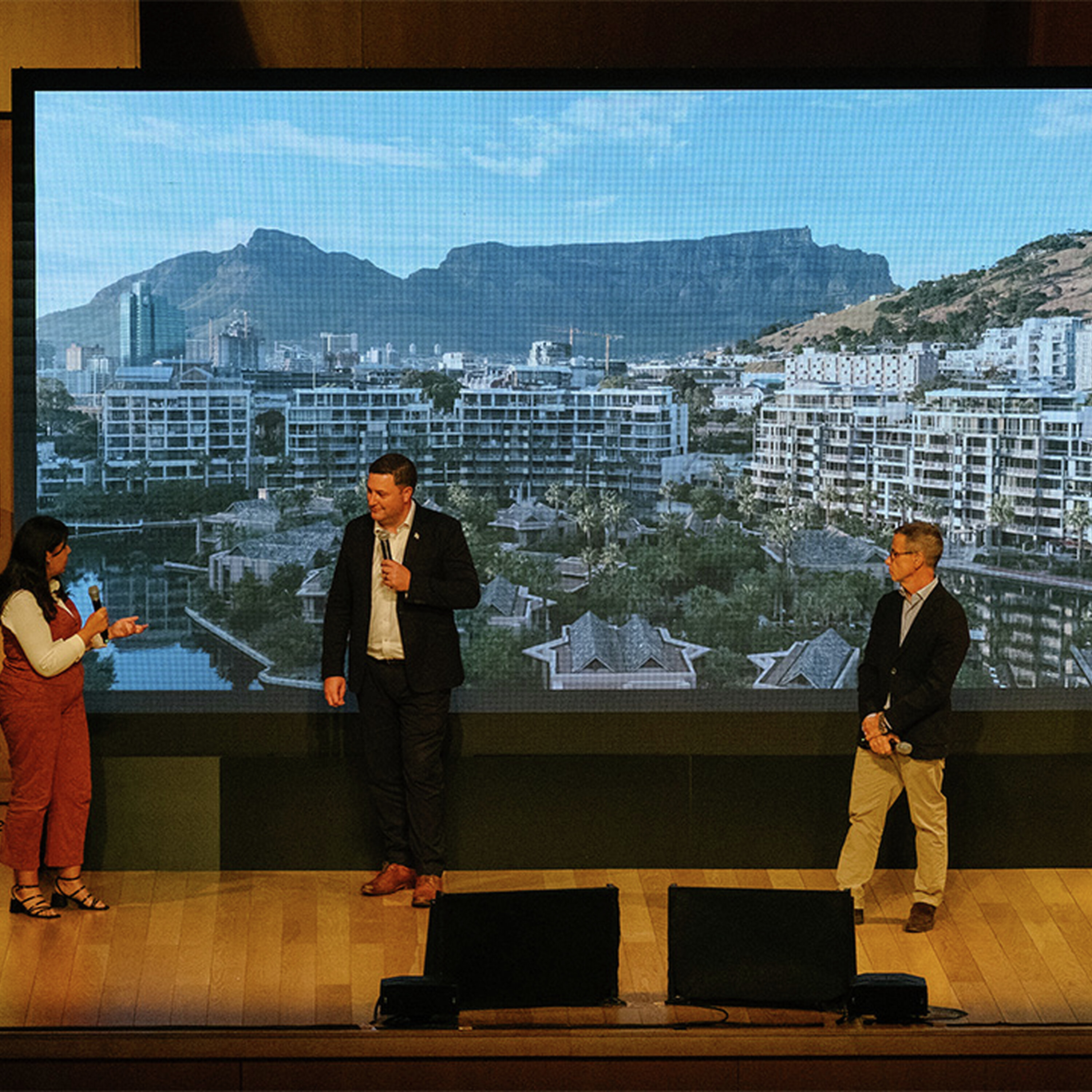
The Urbanist
Cape Town’s liveability secrets – highlights from Monocle’s Quality of Life Conference
00:27:58
Loading summary
Transcript44 lines
- [00:12]
A
Hello and welcome to the Urbanist Monocles program, all about the built environment, and I'm your host, Andrew Tuck.
- [00:19]
B
Coming up, if our mission is to give people a sense of hope about the future and make sure that more people are included, then we can't be surprised when they actually respond to that and say, we want to be there where this good thing is happening.
- [00:31]
A
What are Cape Town's secrets to livability? On this week's show, we recap some of the most interesting conversations from our annual Quality of Life conference, which took place last week at the Palau de la Musica Catalana in Barcelona. We speak to the mayor of Cape Town to learn how to welcome visitors with open arms while inviting all residents to take part in a livable city. We also learn some of the local quirks of our host city with one of Barcelona's best known illustrators. And we explore why the United Arab Emirates might be the best place to bring people together. That's all ahead in the next 30 minutes, right here on the Urbanist with me, Andrew Tuck. To start today, we want to set the scene in the city that we found ourselves in for the 10th quality of life conference. Barcelona. Editorial illustrator Jordi Labanda knows a thing or two about what makes this fascinating city tick. And we roped him in to share some of the things that make Barcelona special for him, along with some corresponding illustrations from his archive. Monocle's editor Josh Fennett joined him on stage to pose the questions. And Josh began by asking Geordie about why the Gothic Quarter is so important in telling the story of this city.
- [01:57]
C
For me, it's like the laboratory of the city, because everything happens there first. It's a place that is based on layers and layers of different cultures that have been visiting us. The Romans, the Arabs, the Jewish, I mean, a lot of cultures.
- [02:17]
D
And really sums up maybe that welcoming spirit that you feel today, or maybe Barcelona's openness to fresh ideas. Now, when we did our discussion beforehand, I was thinking of the things that I think most people think of about Barcelona, which is the sea. But you made this point that the city spent most of its history looking away from the sea. Why is that?
- [02:34]
C
Yeah, especially during the big plague land of Barcelona that was in 19th century, the bourgeois people for any reason thought that the ocean was not good and they preferred to watch to the mountain. And then the city didn't see to the ocean.
- [02:54]
D
So the sea was a place to work. It was full of trade, it was a port. People here wanted to escape it. Until the 20th century, the late 19th century and a sense of rejuvenation and creativity that so defines the city. Modernisme, this is a big question, but why does it matter? What does it tell us?
- [03:13]
C
Modernisma, for us is something very special because it surrounds us. I mean, it's part of us. Modernisma was especially for me, a new way to understand life. The architects, especially Gaudi, took a very careful look about how nature is developing. If you see details of Gaudi's architecture, you will see many things related to.
- [03:37]
D
Nature and even the beautiful building that we're in today. Art Nouveau happened in other parts of the world, but it didn't quite happen like this. What is it about the Catalan character? You mentioned a word to me yesterday. Yeah, I'm going to butcher the pronunciation of. But what is it about this idea of rautia and what does that mean?
- [03:55]
C
We have a Catalan word that defines us very well. In fact, it's two. It's sen and raua. Sen means being very strict and focused, and rau means some kind of crazy audacity. So in this way, I think modernisma is a very good example of Raussia.
- [04:18]
D
This city has been a canvas, obviously for your own work, but for some of the greats of art and architecture, why did they converge here? You mentioned on our discussion beforehand that Barcelona sometimes look to Europe rather than to Spain for inspiration.
- [04:33]
C
One of the nicest things of Barcelona is that maybe because all this continue visiting of cultures, it's that we are really welcoming, we love everybody. So I think that all these personalities found really, really well here.
- [04:52]
D
We're talking about the city and obviously incredible talent from across the peninsula. But we kind of have to mention one of the most famous pieces of architecture and design, and maybe two dates that can help people place the creative development of the city. One is 1929, the International Exhibition where Mies van der Rohe designed his pavilion, the German pavilion. And the other is the Olympics in 1992. Now, today, the Olympics can seem like a big burden for cities, but really you feel it changed Barcelona quite profoundly.
- [05:20]
C
Definitely from 60s 70s, there was a group of very interesting people in Barcelona called La Gol Di Bin. That was an unorganized group of architects, designers, filmmakers, publishers. They work really hard. Remember that Spain, at that moment we.
- [05:43]
D
Were under Franco, Franco's in charge. The Catalan identity is suppressed.
- [05:48]
C
And so they work very hard trying to be more European instead of Spanish. So they were masterminds of design and.
- [05:58]
D
New things and that sense of creativity and sometimes decline. So suppression and activity has really summed up Barcelona's creative spirit, hasn't it? A moment of being down at heel and then a moment of being up. I guess we have to talk about Barcelona today, the trajectory of it. And you had a wonderful image that you said to me. You described Barcelona as being a little bit like your lover. You said sometimes you need to have tough words with lovers. What on earth did you mean?
- [06:26]
C
Yeah, in fact, well, I'm in love with Barcelona. I mean, I decided to live here and I'm very happy for, for my decision. But as all the relationships sometimes is hard now for me and I think that I speak for many Basilonians, we're in a difficult moment because maybe it's too popular and then the people who live here are feeling like we have a feeling of loss and uncertainty. But, I mean, I love her and I know she loves me and we need to talk, but I Trust this relationship 100%.
- [07:05]
A
Jordi Labander there in conversation with Josh Fennert. Next up, we head to Cape Town, a city that has been topping livability indexes in recent months. Now, we believe that critical success comes down to good urban stewardship. And we invited the city's mayor, Jordan Hill Lewis, to tell us how infrastructure investment, addressing housing pressures and building resilience paired with a long term vision can help transform a city. Myself and this show's producer, Carlo Toribello, joined Jordan on stage and I began by asking him what made him want to be the mayor of Cape Town.
- [07:48]
B
I was a member of parliament before, during the pandemic. And it was very tough on Cape Town as it was on many cities around the world. And I just felt a growing sense of dissatisfaction sitting on the back benches at Parliament, not being able to get stuff done that I really wanted to.
- [08:08]
E
Because you're an MP since you were 24.
- [08:10]
B
That's right, yes. Okay. But I was in the opposition party. This was before the big political shift that's happened in South Africa in the last year and was, you know, for a long time a backbencher. And I just had this growing sense that I was just frustrated that I couldn't get things done. And I could see these things happening. I had really clear ideas about what I thought should happen. And it was just bursting inside. That's when the cog started to turn and I started thinking maybe I should just go for this. And I had to run against an incumbent from my own party. So it was quite a hectic primary process, but got there in the end.
- [08:47]
E
Just give us in a couple of sentences, sketch an image for us of Cape Town. The number of people, the way that you make wealth, the number of people below the poverty line. Just give us a few key statistics that shape your day.
- [08:58]
B
Cape Town is a magnificent city right at the bottom of Africa. South Africa's second biggest city, 5 million people has this incredibly rich history in global trade routes, has history from Malay and Indian slavery, Dutch and English colonialism, this political history of the 20th century and the struggle against apartheid. All of this mixed into this incredibly eclectic, wonderful city. And of course, located in this place with just exceptional natural beauty. A very strong tourism economy, very strong shipping and shipbuilding and maritime economy, and agriculture as well. The only significant and really excellent wine area in the whole of Africa.
- [09:39]
F
Now, you touched upon tourism there, and of course it is one of the main sectors and economic drivers of the city. And I'm just really curious about how you balance, you know, that desire for investment and growth with the challenges that many cities like Barcelona are facing with ensuring that life remains good for locals, ensuring that quality of life, while as well welcoming tourism and foreign investment.
- [10:03]
B
Cape Town is in a very different. I had this discussion with the mayor of Barcelona yesterday. Cape Town's in a very different position. We have just achieved record tourism numbers, but that record number is one and a half million, whereas Barcelona is about 15. So literally 10 times that. And Barcelona, the mayor told me in the month of June this year, had more visitors than we have annually. And the other key difference, this is probably the most important difference, is that while Cape Town has the lowest unemployment in South Africa, it's still 20%. So the most important priority in our government is getting more people out of poverty and into employment. That is how we make sure that everyone is included and everyone has access to a more dignified and hopeful life. And so for us, we are desperate to keep growing tourism. We think that, you know, one of our priorities should be to make one and a half into three million and beyond, because already it employs 110,000 people in the city. And it should be much more than that, and it will be much more than that. So it's just a very, very different context. We are nowhere near over tourism. When we get to 15 million, we'll discuss over tourism.
- [11:11]
F
Well, but saying on this idea of, you know, having stewardship and long term vision, I'm really interested in this idea of delivering tangible things for people. And I know that there was this big push for the reopening of the public swimming pools. And it relates to this idea of, you know, connection to water, connection to nature, mental health and Also, you know, ensuring social equity between citizens. Tell us a bit more about some of those initiatives.
- [11:36]
B
So, you know, Cape Town has 38 magnificent public swimming pools and 19 coastal tidal pools. Magnificent. But when I became mayor, the huge majority of those were closed to the public. They hadn't been maintained properly for years. And if you live in a township anywhere, in a developing world context, heat is a really important thing that you have to take consideration of. There's just nowhere to escape it. And especially as many of these climates, Cape Town as well, are getting hotter. So I said we have to fix these. These are essential public. These are not luxuries. These are essential public amenities. If you're a young kid growing up in a township, in the heat of a Cape Town summer, you have to have a place where you can go and relax, cool down, have a picnic, enjoy yourself, have fun. And so we've got back up to 37 out of 38 are rebuilt and reopened and all 19 of the coastal tidal pool. So this is this year we will have literally only one which has to be totally rebuilt that will still be closed.
- [12:36]
E
And tell me, when we look at South Africa, we see some of the challenges in other parts of the country, in Joburg and the like. We've covered those stories in the magazine. Is your success at being a more livable city, is there a downside that more people come to the city at a pace that you can't almost cope with because you have a lot of people living in informal communities.
- [12:57]
G
Yeah.
- [12:57]
E
Where it's hard to run the service to sometimes as fast they grow. Describe that dichotomy for us.
- [13:02]
B
Oh, so that is the central dichotomy in Cape Town. It's not unique to Cape Town. If you many cities in developing world context. We've got 1.2 million people living in informality, unplanned settlements. And a huge part of our priority, our mission is to make sure that those people are included in a base basic, better and improving quality of life. You know, quality of life has a somewhat more basic meaning when you don't have access to basic services. And so we are rolling out the most ambitious infrastructure and basic service delivery expansion program of any city in South Africa ever to extend basic services and make sure that Cape Town includes this beautiful Cape Town, this Cape Town success story, this Cape Town growth story includes everyone. And everyone can experience more dignity and better quality of life. The flip side of that, of course, is that many, many more people come. But that is a feature of successful cities everywhere. And so I say to My team, we're not even going to talk about that as a problem. We're just going to run faster and push harder to keep up. Because if our mission is to give people a sense of hope about the future and make sure that more people are included, then we can't be surprised when they actually respond to that and say, we want to be there where this good thing is happening, so we're going to just keep running to keep up.
- [14:25]
E
But is there a sense that the Cape Town story is separate from the rest of the South African story? Or do you feel that? Because when you look at what's happening in Cape Town and that you see the attractiveness and we've covered recently, the craft industry is there and all these things happening, is it an exceptional story in South Africa, or do you feel that you are part of the national story?
- [14:43]
B
It has hitherto been exceptional, and that was a very deliberate part of our mission. We wanted to show everyone in South Africa, whether you lived in Cape Town or not, that this could be a model for the success of our country. The national economy has been in a tight spot for the better part of a decade. It really hasn't ever properly recovered from the 2008 crisis, never mind Covid. But what we've had in the last 12 months is an extraordinary political shift. And so now, really, I think we have the prospect of it not being an exceptional story. For example, just a few very small examples. Some of the visa reforms that we have been pushing for in Cape Town for years to open up South Africa for more tourists, those have happened now instantaneously, in the last few months because of the political shift we've seen at the national level. So I think the question is, can the political reform go fast enough to deliver the social change that we need? That is an open question, but we're trying to answer that positively in Cape Town.
- [15:45]
F
Cape Town, as people know, is a port city. You alluded there to the issues and challenges with heat as well. But one of the priorities as well of your office has been to address resiliency and climate change. Tell us about some of the conversations that have been happening there and how easy or difficult are our day. It is a big challenge for any city, let alone yours. With all the intricacies, as we've been.
- [16:08]
B
Discussing, Cape Town is a city right on the front line of dealing with climate change. So most people, if I ask everyone in the room, what have you heard about Cape Town? You will. You might reference a really serious drought that we had in the late 2010s, 2017, 2018, where we came within weeks, probably about six weeks of running out of fresh water. And since then, we have been on a serious investment drive to secure additional sources of water on the assumption, which has so far proven accurate, that our rainfall will steadily decline year on year. And that is exactly what's happening. So it is getting warmer and drier. That's great for the weather, great for tourism, but not great for water sustainability. So we're investing in water reuse, in aquifer extraction, in desalination, Huge investment drive from the city. Besides the basic services I spoke of earlier, the difficulty in that conversation is when you have that conversation with the public, the public will say, well, the crisis is over. So why do we need to pay for this desalination plant or this water reuse plant or this aquifer extraction well field or whatever it is? These things come at enormous cost, and we've got to be farsighted and prepare for future and prepare for a drying climate. That's a tough conversation to have with the public when it comes at a real cost.
- [17:27]
A
Cape Town Mayor Jordan Hill Lewis there, who joined myself and Carlotta Rebelo on stage at the Quality of Life Conference last week. Finally today, we hear from the Minister of State at the UAE Ministry of Foreign Affairs, Her Excellency Nurabind Mohammed Al Kabi, who has been enhancing the UAE's global presence. So what's making the country perhaps the next geopolitical frontier? Well, we think it comes down to soft power, diplomacy and the art of bringing people together. Monocle's editorial director, Tyler Brulee and I joined Her Excellency on stage. And we began by asking, given the UAE was only founded in 1971, how her story and that of the UAE are intertwined.
- [18:16]
G
My personal story, I mean, starts in 1978. In 1978, I was born in Sharjah, which is an emirate in the uae. I think what makes maybe my childhood kind of diverse is my mother is from the northern side and my father is from the eastern side of the uae, which is Al Ain, which is an oasis town that is connected to Abu Dhabi, which is the capital. I studied my whole life in the uae. Specifically, we were in Abu Dhabi. My father used to be in the military, and it was just for one year. It was during my junior high. We had to fly to the us he used to study there. And it was in the mid-90s. And I don't know if you've witnessed the mid-90s in the US the Bronco chase on a big screen. So I'm like, the first time in the country there's a chase on tv. Is it normal in this country that they're showing us a chase? Of course, that's the O.J. simpson case. And that by itself also opened us as a family to a new culture. And sometimes you're in a bubble back then when you're in the States with the news and everything that is from a dissemination perspective, what is there in that continent? Back studied back in the uae, I, I worked in energy, I worked in the military, I worked in media and culture, and I worked in the Parliament. And now I'm working at the Ministry of Foreign Affairs. So this is just a quick snapshot, but the UAE formation for me is luckily something I witnessed specifically in Abu Dhabi. My childhood was in a place called the Cultural Foundation. It's a beautiful Bauhaus kind of an architecture next to one of our old forts in Abu Dhabi. It's 200 years old. And yes, we are formed in 1971. And we're, you know, we're tribes. It's a country with tribes. Seven main tribes, seven emirates. The ruling tribe in Abu Dhabi is Al Nahayan, has been there in Al Husson Fort, which is next to the cultural center, for the past 200 years. There's always kind of this beautiful thread line when it comes to the tribal element. And then you move fast forward, you know, to the political changes in the that part of the world and protecting the trade route from India to the UAE to go to Great Britain. So Great Britain, I mean, it was a protector of our coast for more than 400 years. We were never colonized as a country. The Ottomans didn't reach the uae, so there's no any signs of that. But currently we do have beautiful signs of archaeology that goes back to the ages of early Christianity.
- [21:08]
H
When you think about the diplomatic mission, what are the key topics that you're talking about right now? When you think about the UAE out in the world? And again, you're talking about perceptions, many different views, whether it's economically, culturally, etc. What are you trying to push and get across?
- [21:24]
G
Well, number one, it's a nation of ideas. The relationship of a diplomat shouldn't be transactional, it should be personal, it should be connecting people to people, and there should be respect with our differences. There are differences in many areas in our belief system, in our culture, in our identity. But there has to be always a bridge. There has to be a way that we can conversate with one another. And I think we unfortunately live in a very polarized world. There's a zero sum game that is happening, and how can you be in the midst of being able to carry such conversations and maybe be the middle person that takes that conversation from one point to another point? We also look at the idea or the point of diversification. And I'm inspired by the podcast I listened to on Emirates from Dubai to Barcelona, that in diversification we find our unity. And specifically in the uae. I grew up in a classroom where we were just few Emiratis. I worked in an environment where mainly all of my bosses weren't from the uae. And that by itself, you know, we have a saying in Arabic. You tend to get used to something if you grow with it. So I think it's the ideas perspective is connecting people. How can you have that platform of connecting individuals in one platform and stop being transactional. Try to have a conversation even if. I don't know, even if you hate the person in the room. So I think if we can put our feelings aside, because I think the future generation deserves a better earth than the one we have currently.
- [23:10]
H
Andrew, just sort of. When I came back, we were in your lovely office. I came back just to say to Andrew that I thought it was one of the most sort of profound conversations I'd ever had with a diplomat. It was this notion of sort of dialogue. And you and I were discussing about this notion that in this world where things move so quickly, we're so fast to condemn. And we talked a lot about power of forgiveness moving on and what that means today, of course, when we know that, yeah, you can shout people down on digital channels. And I thought this idea of just this role that the UAE plays and sort of just moving forward, and sometimes it's actually, it's. You have to just, I think, look over the horizon, not look back in a negative way. And I thought this was such an extraordinary and powerful message and. And one that we always sort of tried to get across. The sort of. This power of. Not to be sort of, you know, overly religious or spiritual about it, but just. Yeah, the power of forgiveness and what that means.
- [24:03]
G
I mean, yeah, I mean, our region, I mean, it's still a region of conflict from an ideological perspective, from a belief system, it's tough. And it's getting tougher, unfortunately. A couple of days ago, I was in Iraq. We went for the inauguration of the Nuri Mosque and the two churches. The Nuri Mosque is the mosque where the Daesh Khalifat rose their flag to proclaim that this will be the beginning of taking over. Now. Is my religion even part of this? No. I don't know Daesh. I'm a Muslim. I really don't know what is the belief system of Daesh. It's something that I've never even with were taught in school and even, you know, sometimes you get some extreme ideas with some religious teachers back then, but they were never that extreme. They were silly in a way, but not in that sense of darkness, pure darkness. Now you see this darkness in some politicians as well, in terms of what they're trying to do with certain lands, with certain people, with. With certain cases that are happening within our region or outside of our region. At the end of the day, I think after visiting Mosul, we visited the old town and we saw young children and young people just happy that there's a reawakening of such an important element of their heritage. And that takes us from a diplomatic perspective about the shared humanity line. And that shared humanity is us before the borders, before the parties and before the divide. You see hope, you see people want to live, want to create their own communities. I think what made the project successful beyond the BRICs and the dollar sign is the belief of the Iraqi young people that they can continue carrying the baton to next. They can rebuild, they can restore, then they can, I don't know, they can maybe teach the others because there was a capacity building element. Maybe they can go to Syria and rebuild Aleppo in a way, or Lebanon or in the future Gaza, or in the future Ukraine. And I was in a session in UNESCO with Iraqis and young Ukrainians and young Ukrainians connected with the Iraqis to see how can they learn from one another in restoring their old site. So when you see youth are very connected to a heritage and a very historical kind of maybe, you know, storyline of their history or their ancestors, I think that's sense of belonging is really important for us to cherish and to help them also maintain and protect.
- [27:07]
A
Her Excellency Noora bint Mohammed Al Kabi speaking with Tyler Bralet and me at the Monocle Quality of Life conference in Barcelona. Well, that's all for this week's episode of the Urbanist. You can follow us for new editions of the show every week. And you can subscribe to Monocle magazine for reports on all things design, architecture and urbanism too. Just visit monocle.com the Urbanist is produced by Carlos Rebelo and by David Stevens. And guess what? He also edits the show. I'm Andrew Tuck. Goodbye and thank you for listening. City lovers.
- [27:50]
H
Ra.