Loading summary
Transcript3 lines
- [00:10]
A
Attempting to find inspirations in ruins is a challenge that many cities have and will have to face over the years. For Budapest, a section of the Hungarian capital's Jewish Quarter which lay in ruins, gave birth to one of the city's most exciting mixed use hospitality venues. You're listening to Tall Stories Monocle Production brought to you by the team behind the Urbanist. I'm Andrew Tuck. In this episode, Geetan Jali Krishna takes us to Budapest pioneering Ruin Bar to see how our urban environments persevere through destruction.
- [00:49]
B
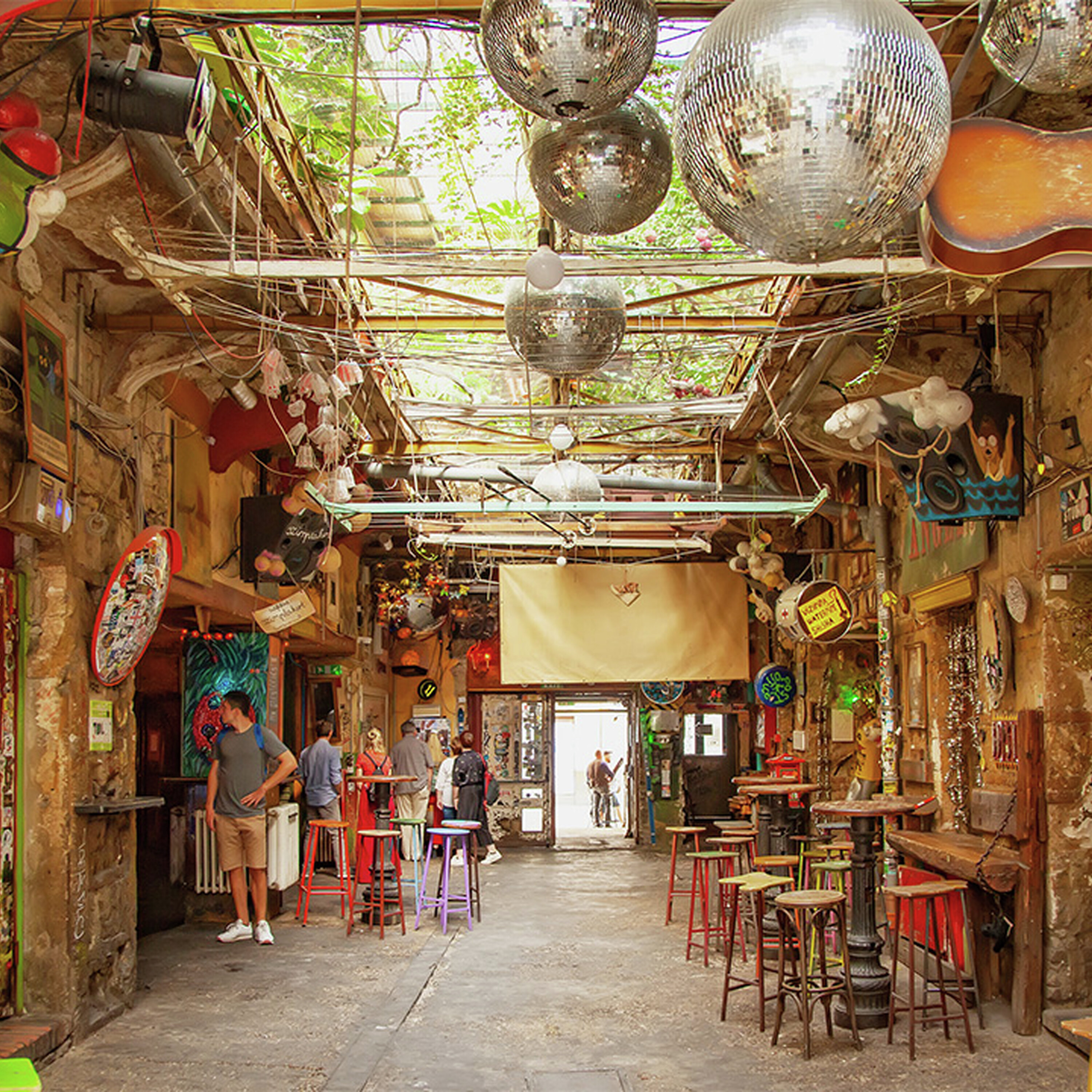
In a narrow lane in the Jewish quarter of Budapest, there is a large derelict building. Its crumbling walls, rusty window grills, massive door with graffiti everywhere should look uninviting, but they don't. Somehow, the first thing I notice when I enter is darkness. And then, slowly, I take it all in. There are twinkling fairy lights, dim little rooms, a courtyard full of creepers with their green tendrils creeping between disco balls. A crazy assortment of lights. As if in a mad botanist's dream, all sorts of objects are crammed into every nook and cranny, from bathtubs and discarded road signs to old radios and boxy TVs and mismatched chairs, some so rickety that they probably should come with a warning sign and a safety disclaimer. It's a chaotic dream world inside a crumbling behemoth of a building. And somehow it's making me thirsty. Unfortunately, I'm in the perfect, perfect place to get a drink. This is Simpla Kurt, Budapest's first and the most popular Ruin Bar. The story goes that back in 2004, this building was saved from demolition by a group of entrepreneurs looking to open up a community space. Instead of rebuilding, they decided to save their money and celebrate the ruins. Over the next few years, their collection of furniture and decor grew out of the things that sensible people threw away. And their patrons were mostly impecunious local students who needed a place with cheap booze to debate the affairs of the world. They added graffiti, street art, a permanent pall of cigarette smoke, and most importantly, a vibe that's hard to describe and impossible to create from shiny new things. Everyone simply loved Simpla Kurt, and it became the template for a new generation of ruined bars and in the Hungarian capital's Jewish district. And of course, each bar vied with the other, with decor that can best be described as turn of century decay. And Budapest's ruined pubs started to redefine its urban character and became the it places for tourists and locals alike to hang out. The pandemic proved to be the ruin of some of these ruined pubs. But Simpla Kurt is going stronger than ever today. Perhaps the reason for this is that it isn't just a pub that's busy only at night. By day, Simpla Kurt is a community space. Movie showings, live gigs, art exhibitions, etc keep it lively all day long. You can drop by in the afternoon to hunt for knickknacks at its flea markets, or go on a weekend morning for some locally made cheese, salami, jam and even fruit from its weekly farmers market. When you walk around its various nooks and crannies, you feel like an explorer discovering messages on the walls hidden in graffiti. You'll hear a dozen languages being spoken all around, a testament to its popularity with the tourists. It's easy enough to find a quiet spot to observe the action during the day. There are several different rooms, each serving different beers and cocktails. And on the first floor, again seemingly derived from a botanist's fever dream, there are pink plastic flamingos amid lush greenery for you to feast your eyes on. At this point, if you find a three legged stool or a bench that has definitely seen better days, I'd advise you to park yourself on it and don't let go. Because from 5pm on the farmers, the crafters and the families start to leave and the bar starts to fill up. Peep down from the window to the street below and you'll see a long line of hopeful pub crawlers all waiting to be let in. The place has a capacity of 600, but people say that it's had as many as 5,000 pub crawlers in a single night. Many wonder how this crumbling building, which was rescued from demolition two decades ago, continues to draw crowds like this. There's really no one good answer to this, but one thing is for sure, Simpla Kurt's popularity makes the new seem overrated, and the shiny, passe.
- [05:21]
A
Tall Stories is a month production from the team behind the Urbanist. This episode was written by Geetan Charlie Krishna and produced and edited by David Stevens. Be sure to subscribe to the podcast to receive new episodes every week. I'm Andrew Tuck. Goodbye and thank you for listening. City Lovers.