← This American Life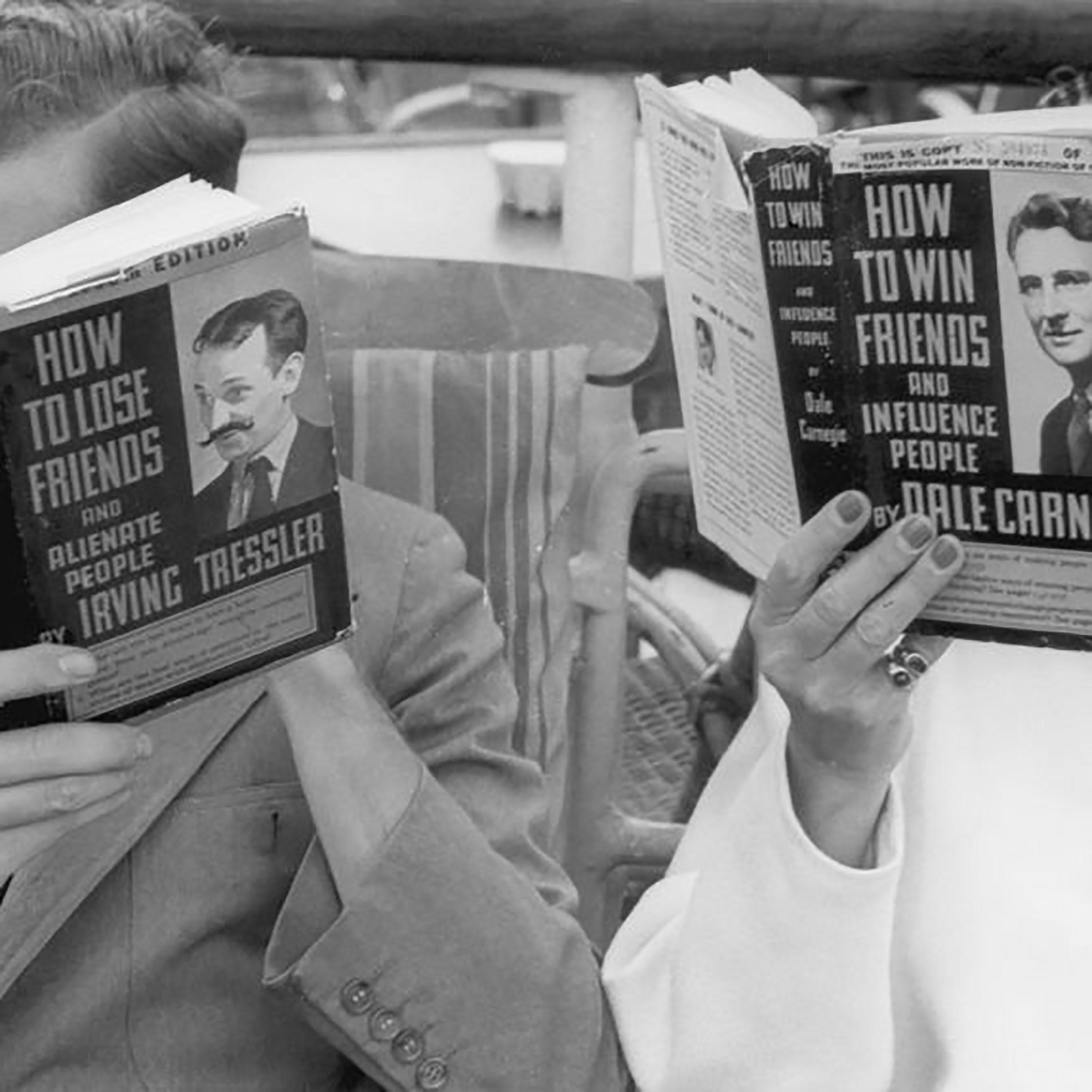
This American Life
198: How to Win Friends and Influence People
00:59:48
People climbing to be number one. How do they do it?
Loading summary
Transcript86 lines
- [00:01]
Ira Glass
Support for this American Life comes from Squarespace, the all in one website platform with features. To help you start a fully custom on brand website, use Squarespace's latest AI enhanced website builder, Blueprint AI. It can transform basic information about your brand or business into an elevated online presence with curated premium quality content automatically added and matched to your profile and aesthetic. Head to squarespace.comamerican for 10% off your first purchase of a website or or domain.
- [00:33]
Paul Feig
How to Win Friends and Influence People first published in 1936 you know when you read this thing you can see why it is number one. Dale Carnegie writes in this pepped up style. You don't think of the word moxie much anymore, but when you read this, this is typical. He writes in preparation for writing this book. He read everything he could find on the subject and then he lists all the stuff that he and his trained researcher read to figure out how the great leaders of all ages had dealt with people. He says, I recall that we read over 100 biographies of Theodore Roosevelt alone. We were determined to spare no time, no expense, to discover every practical idea that anyone had ever used throughout the ages for winning friends and influencing people. Anyway, on page 61 of the edition that I have, Dale Carnegie tells one of the many, many stories he uses to illustrate the very main idea that underlies the whole book. He says, I often went fishing up in Maine during the summer. Personally, I am very fond of strawberries and cream, but I have found that for some strange reason fish prefer worms. So when I went fishing I didn't think about what I wanted, I thought about what they wanted. I didn't bait the hook with strawberries and cream. Rather, I dangled a worm or a grasshopper in front of the fish and said, wouldn't you like to have that? Why not use the same common sense when fishing for people to win friends and influence people? Dale Carnegie says over and over in the book, think about what they want. People, he says, are only interested in themselves. And if you can get yourself to the point where you are genuinely interested in them and what they like and what they want, then they will like you and they will do your bidding. Okay, so imagine you are 11 years old and your dad notices that you don't bring many friends around the house and he takes you aside and he gives you a copy of this actual book. This happened. This happened to Paul Feig growing up in suburban Michigan.
- [02:40]
David Sedaris
At first I didn't know what to think. First of all, if you've ever seen the book, it's got this Picture of Dale Carnegie on the front, who is, you know, somewhere in his 60s or 70s, wearing, you know, those Mr. Menace glasses the Menace's dad used to wear with this kind of white slicked back hair. And he looked like every guy that was in my dad's Kiwanis with him. And didn't seem to me like a guy who particularly would have that many friends or much influence over people. He'd written the book. So my father went on to make this speech, basically about how now that I was getting older, I was 11 years old, that it was time for me to kind of get social skills that he assumed I didn't have.
- [03:26]
Paul Feig
Now, in fact, in school, Paul had plenty of friends. He was kind of a class cut up. And his way of winning friends was the same as other kids. He talked about what they saw on tv and he tried to be funny. It was just around the house that he was quiet and withdrawn, but he figured, you know, he wanted to be more popular, he wanted more friends. So we decided to try out some of the techniques in the book.
- [03:48]
David Sedaris
And I went through these and, you know, principle number one was become genuinely interested in other people. Principle number two was smile. Principle number three was remember that a person's name is to that person the sweetest and most important sound in any language.
- [04:04]
Paul Feig
Yeah, I was wondering about that one in particular if as an 11 year old, you tried to employ that one.
- [04:09]
David Sedaris
Well, the hard thing was, when you're 11 years old, the only thing you ever call anybody is by their last name. So I was kind of confused as to whether that sort of applied. And this started a bit of a panic in me because I suddenly didn't know, well, maybe people would like me better if I did that. And so I remember getting to school the next day and my friend Dave Fleury, who I'd always called Flurry, I remember going up to him going, hey, David, how's it going? And he gave me the strangest look.
- [04:37]
Paul Feig
Paul used techniques from the book to try to talk to girls, asking them about themselves, what their dads did for a living, just, you know, showing an interest in them, as the book suggests. And it kind of freaked them out because, you know, kids do not talk like that.
- [04:52]
David Sedaris
And I would sit at lunch with my friends and kind of they would be on a story and I would want to throw in, as I normally would, but kind of went, oh, wait, no, I should. I should sit back and listen and really be attentive and would nod and go, oh, oh. And then what did your brother do. Oh, he punched you, really? And what happened then? And I became this sort of mini analyst with where I was sort of trying to get kids to tell me their innermost secrets. But what happened was my father kept checking in with me at night, and he goes, so did you read that book? Have you tried any of these things out? So I felt like I needed more proof and more proof to take to your dad? Yes. I needed a tangible thing to show my father that I had become popular and was winning friends and influencing people.
- [05:45]
Paul Feig
So when Paul's teacher decided to do this exercise where they elected a class president, he ran and he won. And his father was very, very pleased the book was working. There was just one problem.
- [05:59]
David Sedaris
One of the things I hadn't banked on was that as class president, I actually had to do something. I was so not into this. I was just hating it because I just wanted to get back to my life with my friends. Well, the teacher was dissatisfied, and the students were dissatisfied. And the teacher suddenly decided, well, you know what? And she got up and she said, there's a process in our political system in this country called impeachment. And she looked out and she said, how does everyone feel about our class president, Pa?
- [06:41]
Paul Feig
What would he say to his father? The whole experience with Dale Carnegie actually left Paul with fewer friends and less influence over people. It was confusing all the ideas the book put into his head.
- [06:53]
David Sedaris
I couldn't get out of my head the fact that my dad had given this to me and the fact that he was so concerned that I didn't have friends. And so I started getting nervous, like, well, maybe he's seen something that I. It was strange. I would start to see things that weren't there. Like, somebody would sort of laugh at what I say, and they turn away to look at something. And suddenly I was envisioning that as they're turning away with their back to me, they're making this sort of face and rolling their eyes of like, oh, what an idiot. And started noticing in the teacher that when I would raise my hand and answer a question, something in her face that kind of was like she was tolerating me.
- [07:33]
Paul Feig
You know what's so interesting about that is that the book made you act in a way which was completely phony and calculating. And so then the thought entered your head, maybe everybody else is acting phony and calculating as well.
- [07:44]
David Sedaris
Yeah. It was almost like I had been given this sort of handbook to the human mind that I didn't want.
- [07:54]
Paul Feig
Well, from WBEZ Chicago, it's this American life. I'm Ira Glass. Today on our program with the New Year upon us, people making resolutions, some of them trying to figure out how to be more successful this year than they've been in the past. We ask the question, how do you win friends and influence people? We have stories today of people climbing to be number one. How do they do it? What is the fundamental difference between them and everybody else? We answer that question today in four simple lessons that will change your life forever. Or possibly won't. Lesson one To Make a Friend, Be a Friend David Sedaris has an instructive tale of how, as a boy, with the help of his dad, he tried to bridge the chasm that divides the popular kids from the unpopular. Lesson 2 Stay in touch. Yes, my friend, you can learn so many things about being a better friend, a better spouse, a better business person if you would simply imitate recent US diplomatic and foreign policy. Lesson 3 People like you if you put a lot of time into your appearance. In that lesson, we hear the story of how a simple Superman costume changed one man's life for the better. Just be Yourself. Jonathan Goldstein demonstrates how to be bested by the most popular, most handsome, most powerful man in the world and not feel bad about it. Stay with us if you care about your future.
- [09:32]
Ira Glass
Support for this American Life comes from Squarespace, the all in one website platform with features to help you start a fully custom on brand website. Use Squarespace's latest AI enhanced website builder, Blueprint AI. It can transform basic information about your brand or business into an elevated online presence with curated premium quality content automatically added and matched to your profile and aesthetic. Head to squarespace.comamerican for 10% off your first purchase of a website or domain. Support for this American Life comes from BetterHelp. Every January brings you 365 blank pages waiting to be filled. What do you want your 2025 story to be? Therapy can help you craft the next chapters with purpose. BetterHelp offers therapy 100% online with a diverse network of over 30,000 therapists worldwide. Visit BetterHelp H E L P.comTAL today to get 10% off your first month.
- [10:32]
Paul Feig
This American Life. Today's show is a rerun how to make friends and influence people. Lesson one To Make a Friend Be a friend. Well, writer David Sedaris tells this story about the popular crowd and how easy it is to enter. This was recorded for a live audience. His story begins on Labor Day when David was a kid at the Raleigh Country Club in North Carolina.
- [10:55]
Mark Weisenbeek
I was in the snack bar listening to a group of sixth graders who lived in another part of town and sat discussing significant changes in their upcoming school year. According to the girl named Janet, neither Pam Dobbins nor J.J. jackson had been invited to the 4th of July party hosted by the Pyle twins, who later told Kimberly Matthews that both Pam and Mike were out of the picture as far as the seventh grade was concerned. Totally, completely out, janet said. Hoof. I didn't know any Pam Dobbins or JJ Jackson, but the reverential tone of Janet's voice sent me into a state of mild shock. Call me naive, but it had simply never occurred to me that other schools might have their own celebrity circles. At the age of 12, I thought the group at E.C. brooks was, if not nationally known, then at least its own private phenomenon. Why else would our lives revolve around them? I myself was not a member of my school's popular crowd but recall thinking that whoever they were, Janet's popular people couldn't begin to compete with ours. Then I worried that our popular crowd couldn't compare to those in Charlotte or Greensboro, not to mention the thousands of schools located in other states. What if I'd wasted my entire life comparing myself to people who didn't really matter? Try as I might, I still can't wrap my mind around it. They banded together in the third grade. Ann Carlsworth. Christy Kmore. Deb Bevins. Mike Hollowell. Doug Middleton. Thad Pope. This was the core base of the popular crowd, and for the next six years my classmates and I studied their lives the way we were supposed to study math and English. So complete was their power that I actually felt honored when one of them hit me in the mouth with a rock. He'd gotten me after school, and upon returning home I ran into my sister's bedroom, hugging my bloody Kleenex and crying. It was sad. Lisa was a year older, but still she understood the significance. Did he say anything? She asked. Did you save the rock? My father demanded that I retaliate, saying I ought to knock the guy on his ass. Oh, dad. Oh, baloney. Clock him on the snot locker and he'll go down like a ton of bricks. He was mistaking Thad for a bully, which was a different crowd altogether. Besides, who did my father think I was? Boys who spent their weekends making banana nut muffins did not, as a rule, excel in the art of hand to hand combat. I mean, come on, dad, lisa said. Wake up. The following afternoon I was taken to Dr. Pavlich for X rays. The rock had damaged a tooth, and there was some question over who would pay for the subsequent root canal. I figured that since they'd conceived me, given birth, and raised me as a permanent guest in their home, my parents should foot the bill. But my father thought differently. He had decided the Popes should pay, and I screamed as he picked up the phone book. But you can't just call Thad's house. Why the hell not? He said. Don't they have a telephone? Well, of course the Popes had a telephone, probably three or four, with a separate line for the children. I imagined Thad's as a state of the art desk model with blinking red lights alerting him that Doug or Christy was waiting on line one. Equipment was not the issue. My father's voice simply did not belong on the Pope's telephone. It wouldn't fit with their things. A meeting was arranged for the following evening, and before leaving the house I begged my father to change his clothes. He'd been building an addition to the carport and wore a pair of khaki shorts smeared with paint and spotted here and there with bits of dried concrete. Through a hole in his tattered T shirt, without squinting it was possible to see his nipple. What the hell is wrong with this? He asked. We're not staying for dinner, so what does it matter? I yelled for my mother, and in the end he compromised by changing his shirt. From the outside, Thad's house didn't look much different than anyone else's, just a standard split level with what my father described as a totally inadequate carport. Mr. Pope answered the door in a pair of sherbet colored golf pants and led us downstairs into what he called the rumpus room. Oh, I said. This is nice. The room was damp and windowless and lit with hanging Tiffany lampshades, the shards of colorful glass arranged to spell the words bush and Budweiser. Walls were paneled, and the furniture looked as though it had been hand hewn by settlers who'd reconfigured parts of their beloved Conestoga wagon to fashion such things as easy chairs and coffee tables. He directed us towards a sofa and asked if we wanted anything to drink. Coke? A beer? I didn't want to deplete Thad's precious cola supply, but before I could refuse, my father said, sure we'd have one of each. The orders were called up the stairway, and a few minutes later Mrs. Pope entered the room carrying cans and plastic tumblers, and as she set the drinks before us I noticed that her son had inherited her blunt, slightly upturned nose, which looked good on him but caused her to appear overly suspicious and judgmental. So she said, I hear you've been to the dentist. She was just trying to make small talk, but due to her nose, it came off sounding like an insult, as if I just had a tooth filled and was now looking for someone to pay the bill. I'll say he's been to the dentist, my father said. Someone hits you in the mouth with a rock, and I'd say the dentist office is pretty much the first place a reasonable person would go. Mr. Pope held up his hands. Whoa, now, he said. Let's just calm things down a little. He yelled upstairs for his son, and when there was no answer, he picked up the phone, telling Thad to stop running his mouth and get his butt down to the rumpus room asap. A rush of footsteps on the carpeted staircase, and then Thad sprinted in, all smiles and apologies. The minister had called. The game had been rescheduled. Hello, sir. And you are? He looked my father in the eye and firmly shook his hand, holding it in his own for just the right amount of time. With others our age, the gesture appeared forced and sloppy, but Thad seemed born to it. While most handshakes mumbled, his clearly spoke, saying both we'll get through this, and I'm looking forward to your vote this coming November. I thought that seeing him without his group might be unsettling, like finding a single arm on the sidewalk. But Thad was fully capable of operating independently. Watching him in action, I understood that his popularity was not an accident. Unlike a normal human, he possessed an uncanny and wholly natural ability to please people. Much like a Whitman sampler, he seemed to offer a little bit of everything. Pass on his athletic ability, and you might partake of his excellent manners, his confidence, his cultish enthusiasm. Even his parents seemed invigorated by his presence. All right then, Mr. Pope said. Now that everyone's accounted for, I'm hoping we can clear this up. Sticks and stones aside, I suspect this all comes down to a little misunderstanding between friends. I lowered my eyes, waiting for Thad to set his father straight. Friends with him. I expected laughter or the famous Thad snort, but instead he said nothing, and with his silence he won me completely. A little misunderstanding. That's exactly what it was. The immediate goal was to save my friend, and so I claimed to have essentially thrown myself in the path of Thad's fast moving rock. What the hell was he throwing rocks for? My father asked. What the hell was he throwing them at? Mrs. Pope frowned, implying that such language was not welcome in the rumpus room. I mean, Jesus Christ, the guy's got to be a complete idiot. Thad swore he hadn't been aiming at anything, and I backed him up, saying it was just one of those things we all did, like in Vietnam or whatever. It was just friendly fire. My father asked what the hell I knew about Vietnam, and again Thad's mother winced, saying that boys picked up a lot of this talk by watching the news. Aw, you don't know what you're talking about, my father said. What my wife meant, Mr. Pope said, oh, baloney. I looked at my father then, a man in dirty shorts who drank his beer from the can rather than pouring it into his tumbler, and I thought, you don't belong here. More precisely, I decided that he was the reason I didn't belong. How was a person expected to fit in when he'd been steadily poisoned by his parents, fed little doses until he was ultimately so contaminated that no one would have anything to do with him? The hokey Greek phrases, the how to lectures on mixing your own concrete, the squabble over who would pay the stupid dentist bill. Little by little it had all seeped into my bloodstream, robbing me of my natural ability to please others. Well, Mr. Pope said, I can see that this is going nowhere. My father laughed, saying, yeah, you got that right. It sounded like a parting sentence, but rather than standing to leave, he leaned back on the sofa and rested his beer can upon his stomach. We're all going nowhere. At this point I was pretty sure that Thad and I were envisioning the same grim scenario. While the rest of the world would move on in a year's time, my filthy bearded father would still be occupying the rumpus room sofa. Christmas would come, friends would visit, and the Popes would bitterly direct them towards one of the easy chairs. Just ignore him, they'd say. He'll go home sooner or later. In the end, they agreed to pay for half the root canal, not because they thought it was fair, but because they wanted us out of their house. Some friendships are formed by a commonality of interests and ideas. You both love judo or camping or making your own sausage. Other friendships are forged by a mutual hatred of a common enemy. On leaving Thad's house, I decided that ours would probably be the latter. We'd start off grousing about my father maybe going so far as to scratch up his car, and then, little by little, we'd move on to the hundreds of other things and people that got on our nerves. You hate olives, I imagined him saying. I hate them, too. As it turned out, the one thing we both hated was me. Rather, I hated me. Thad couldn't even work up the enthusiasm. The day after the meeting, I approached him in the lunchroom, where he sat at his regular table surrounded by his regular friends. Listen, I said, I am really sorry about that stuff with my dad. I'd worked up a whole long speech, complete with imitations, but by the time I hit my second sentence, he turned to resume his conversation with Doug Middleton. Our perjured testimony, my father's behavior, even the rock throwing. I was so far beneath him that it hadn't even registered. Poof. The socialites of E.C. brooks shone even brighter in junior high, but come 10th grade, things began to change. Desegregation drove a lot of the popular people into private schools, and those who remained seemed silly and archaic, deposed royalty from a country the average citizen had ceased to care about. Early in our junior year, Thad was jumped by a group of the new black kids who yanked off his shoes and threw them in the toilet. I knew I was supposed to be happy, but part of me felt personally assaulted. Yes, he'd been a negligent prince, yet I still believed in the monarchy. When his name was called at graduation, it was me who clapped the longest, outlasting even his parents, who politely stopped once he'd left the stage. I thought about that a lot over the coming years. He's the poet laureate of Liechtenstein, the surgeon who cures cancer with love, the ninth grade teacher who insists that the world is big enough for everyone. When moving to another city, I'm always hoping to find him living in the apartment next door. We'll meet in the hallway and he'll stick out his hand saying, excuse me, but don't. I Shouldn't I know you? It doesn't have to happen today. But it does have to happen. I've kept a space waiting for him, and if he doesn't show up, I'll have to forgive my father.
- [24:37]
Paul Feig
David Sedaris, recorded at the Detroit Institute of Art by wdet. He is the author of many fine books. He's on tour this year in New Zealand, Australia, Hawaii, and so many of the 50 states. Find out when he's coming to your town@davidsedarisbooks.com Coming up, it's okay if you're not Superman. Unless, of course, your girlfriend used to date Superman. That's in a minute on Chicago Public Radio when our program continues.
- [25:06]
Ira Glass
Support for this American life comes from Capella University. Learning doesn't have to get in the way of life With Capella's game changing flexpath learning format, you can set your own deadlines and learn on your own schedule. That means you don't have to put your life on hold to earn your degree. Instead, enjoy learning your way and pursue your educational and career goals without missing a beat. A different future is closer than you think with Capella University. Learn more at capella. Edu Support for this American life comes from Mint Mobile, who doesn't love a great deal and one with no hoop jumping? Mint Mobile is making it easy to get a wireless plan for $15 a month with the purchase of a three month plan. For high speed data and unlimited talk and text plans, go to mintmobile.com American$45 upfront payment required. New customers on first 3 month plan only. Speed slower above 40gb on unlimited plan. Additional taxes, fees and restrictions apply. For details see see mintmobile.com American.
- [26:06]
Paul Feig
This is American Life. Myra Glass, each week on our program, of course, we choose some theme, bring you different kinds of stories on that theme. Today's show, how to win friends and influence people. We have four lessons on the subject. Today. We've arrived at lesson number two. Stay in touch. Well, the United States of America, of course, does all kinds of things to try to win friends and influence people among the world's nations. We organize sanctions against rogue states. We rally countries on trade issues, and once upon a time on environmental issues. And sometimes you get the sense that when we're rallying nations into a coalition for this or that, US Diplomats have to make the kinds of phone calls that are not easy to make. They have to talk to countries that are angry at us for one reason or another. They have to talk to countries that we'd acted all interested in for a while in the past. And then we just kind of stopped. Stopped calling. Interesting case in point. Shortly after September 11, back in 2001, as the United States tried to organize nations into a coalition to fight the Taliban, the Secretary of State back then, Colin Powell, was in the paper saying things like our sudden interest in Pakistan was not just a temporary spike in American interest, that we had an enduring commitment and that Pakistan was a great Muslim nation. Which makes you wonder, what were those first phone calls like back then? Well, back in 2001, when we first broadcast today's show, one of our contributors, Tammy Sager, tried to imagine exactly that.
- [27:44]
Tammy Sager
Hi Pakistan, hi, it's America. How are you? Oh my God, I almost didn't recognize your voice it's been so long. Listen, I was just getting together this little coalition and I was like, oh, who have I not seen for Pakistan? Oh, yeah? Well, how are you? How's Kashmir? That's yours, right? Oh, you're kidding me. Now, when I think of Kashmir, I think it's yours. Just straight out, Pakistani Kashmir. Oh, God. Well, we will see you at the coalition then. Oh, God, I can't believe I forgot this. Also wondering maybe if you could bring along some full exchange of intelligence and use of ports. No big deal if you forget, but if you do, that would be great. All right.
- [28:31]
Mark Weisenbeek
Okay.
- [28:31]
Tammy Sager
See you soon. India. It's America. Yes, you remember. Hi. Ah, no, I have been thinking about calling you like every night. I was like, gotta call India. But you know, the time difference. Oh, how are you? How's cashmere? You're kidding. No, come on. That's yours, isn't it? So how are you? Listen, getting together a little coalish. Wondering if you'd be up to join Pekka. Who? Pakistan. I didn't even think of calling them. Well, do you want me to? Because I will. I don't know. I don't care. This is about you, India. Yes, it is. Okay. Okay. We'll see you real soon. Love you. Is that weird to say? It doesn't feel weird.
- [29:35]
Luke Burbank
Okay, bye.
- [29:36]
Mark Weisenbeek
Bye.
- [29:48]
Tammy Sager
Hello, may I please speak to Iran? Hi, it's America. Hi. Yeah, yeah. God, it feels so weird to talk to you again. I know we haven't talked. God, since the hostage crisis. And that was just. Well, you know, it was one of those things where it was just, you know, it was easier to just stay away and just sort of repair myself a little bit. So. And I just figured you were in the same place, you know, maybe I'll see you. Maybe I'll fly overhead in your airspace. Okay, don't freak out if I do. All right, talk to you soon. Bye. Hello? China? Hi, it's America. Hi, I am. This is hard. I wanted to apologize about the plane. Yes. I'm so sorry. Yeah. And about the embassy and blew up. And about that fishing boat. Oh, my God, you write it was Japan. I'm so. Ah, no, you do not look alike. I'm sorry. No, that is me being a big fat jerk. I am so sorry. Ah, well, now I feel like twice a jerk. Okay, listen, I am getting together coalition and wondering if you'd be up for it. Oh, good. No, I. You know what? I know you share a border with Afghanistan, so I don't want that to be weird because I'm not inviting them, but if you could come, that would be great. Okay. Really look forward to seeing you. You know what? I bet in an hour I'm gonna want to call you again. No, I'm just kidding. That's a terrible joke, but I. I know. I make it every time. Okay, I'll talk to you soon. Bye.
- [32:06]
Paul Feig
Tammy Sager. She is a performer and writes for tv, most recently on the brand new show, they call it Late Night with Jason Kelsey. Lesson three. People like you, if you put a lot of time into your appearance. To prove this simple point, we have this true story of moral instruction told by Luke Burbank about something that happened to him years ago.
- [32:33]
Jonathan Goldstein
I was in the Las Vegas airport when I noticed this guy dressed like Superman. I'm talking red boots, blue spandex leggings, a yellow belt, a big S on his chest, and of course, a long red cape. I was struck by how authentic the outfit was and the fact that he didn't have any baggage. No suitcase, no backpack, no wallet, no keys. He looked calm and happy and sort of out of place. Since I was in Las Vegas, I figured he was some performer from one of the casinos who was running late and didn't have time to change or something. I didn't think too much more about him until I was getting on the plane and noticed that there was much more excitement in the air than I'm used to on a flight home from Las Vegas. They were talking about this guy dressed as Superman. Turns out he was sitting right behind me. At one point, the co pilot got on the intercom and announced that Superman's hotel had called and that he'd left his Pokemon pajamas in his room and that they wanted to know where to send them. Everyone cracked up, including me. But Superman didn't say anything. He just sat there with a slight smile on his face. During the flight, a steady stream of guys on their way to the bathroom would ask, hey, Supaman, what do you need the plane for? Women tended to ask why he had the costume on. Generally, he kept his answers short and polite. He didn't parade around the plane or call extra attention to himself. And I remember thinking that he seemed pretty normal for a guy in a Superman costume. My friends and I came up with a theory that he'd lost a bet. So when the plane stopped over in San Jose, I decided to talk to him. His real name is Mark Weisenbeek. I met with him a week later at his condo in Auburn, Washington, a suburb about 20 minutes south of Seattle. He wasn't wearing the costume when I showed up. And I asked him how often he actually did.
- [34:23]
Luke Burbank
Every weekend I get a chance to put it on. I'll put it on. Every day that I don't have too much scheduled, I'll pop it on. A lot of times I can't wait to pop it on. Because, you know, as soon as someone sees you, their day is different. They've got a story to tell and it's something that they're always going to remember. And I'll guarantee you that the pilot on that flight that we were on is still talking about this. That he had Superman on his plane.
- [34:53]
H
Yeah.
- [34:53]
Jonathan Goldstein
By the way, did that didn't get on your nerves when they said that thing about your Pokemon pajamas?
- [34:58]
Luke Burbank
Nah, nah. You get used to it. And it's. I don't see it as a cut, but more a compliment that they even mentioned to the whole plane that Superman was on their flight.
- [35:16]
Jonathan Goldstein
His two bedroom apartment is filled, and I mean filled with Superman memorabilia. Superman dishes, Superman sheets on the bed, a Superman mouse pad, Golf tees, paper clips, you name it. In the living room, just to the right of the tv, hang five Superman costumes side by side. Then there are the Batman masks, probably eight of them sitting on dummy heads. It feels like a locker room for superheroes. He started dressing as Superman two years ago after his wife died in a car accident.
- [35:48]
Luke Burbank
Well, I'd never had anyone real close to me pass away before. Your grandparents, they've lived a full life and you're expecting that. But someone so young and beautiful with their whole life ahead of them, it just, it just really hit me that she doesn't have any more tomorrows. And I thought, well, I better start getting as much out of today each today as I can. And what would help me do that? And I enjoy wearing the costumes. And I just couldn't wait to go out somewhere and have a bunch of people see it. And it's just been a real kick ever since.
- [36:32]
Jonathan Goldstein
Do you remember the first time you wore it out in public? What was that like?
- [36:37]
Luke Burbank
When I completed my first costume, I had to go down, put some gas in the car, and I climbed out of the car and I'm putting the fuel in and the car's pulling up to the signal. We're going nuts. And I knew right then that I'm onto something. This is going to be a lot of fun. And the neat thing is when they honk at you, they're all looking and you hear this talk in the car, oh, look, there's Superman. There's Superman. And the neat thing is, they won't stop honking until you look at them. They have to have that eye contact with you, knowing that they're looking at you and that you see them looking at you. And then the whole cycle is complete, and then everyone's having a good time.
- [37:24]
Jonathan Goldstein
Mark had always been a collector of Superman stuff, but after his wife died, he decided to go for broke and spend most of his money on an original costume from the TV show Superboy. He's only tried that costume on once, but it's too special to wear outside. Instead, he taught himself how to sew and started making his own Superman outfits, which, frankly, I thought were better looking than the one he bought. Mark also owns a Batman costume that George Clooney actually wore in the Batman movie. He wears Superman in the summer and Batman in the winter. The Batman outfit is made of foam rubber and is warmer, which he needs because he doesn't like to cover the costume with a coat when he goes outside.
- [38:04]
Luke Burbank
But here's the Superboy costume as seen on TV by millions, worn by Gerard Christopher. He took over the show in the second year through the fourth year. They had a different actor do it the very first year. But as you can see, the seam along most of the yellow here is hidden, except for these three areas.
- [38:25]
Jonathan Goldstein
And like I mentioned, Mark's attention to detail when it comes to his outfits is incredible. He says that authenticity is the key to being taken seriously.
- [38:34]
Luke Burbank
If it wasn't 100%, then I would be letting down the costume. I'd be letting down the people looking at it. You can get your little $40 Halloween costume, ones that are great for the office party, and that's fine. But to go out in public, unless you look like you're right off of the movie screen, then I don't suggest that you do it because you'll be a joke. Then.
- [39:06]
Jonathan Goldstein
Does it feel like. Have you replaced your wife? Or the void that your wife's passing left? Have you replaced that a little bit with your pursuit of the Superman and Batman stuff?
- [39:16]
Luke Burbank
It definitely takes your mind off of it. Any kind of a diversion or activity, instead of thinking about things that you've lost is. Is always a plus. The costumes, to be able to wear those in public. I don't know exactly how she would have taken it. I miss her a lot. I. I think of her every day. But the way I think of her now is that I just have a feeling that. That. That she's out there and that. That she's helping with this two or.
- [39:59]
Jonathan Goldstein
Three times a week, Mark goes to bars in costume. I asked if I could go with him to see for myself. He suits up, and we climb into his car. A white 1992 Pontiac Grand Prix with customized Superman plates.
- [40:11]
Luke Burbank
We'll just hop in the Superman mobile here, as you can see by my license plate. So you've got the.
- [40:19]
Jonathan Goldstein
The Superman floor mats.
- [40:21]
Luke Burbank
Floor mats. I got the neat little hanging flying thing here. A nice little custom logo on my steering wheel.
- [40:29]
Jonathan Goldstein
Now, I noticed you put down a T shirt. Is that so your boots don't get scuffed?
- [40:33]
Luke Burbank
Yeah, I just want to scuff the back of the heel there.
- [40:41]
H
Yeah.
- [40:42]
Luke Burbank
I was gonna get a vet, but then for my work, I needed a back seat. I thought, well, I'll just get something that's spunky and corners and accelerates to something that's fun.
- [40:54]
Jonathan Goldstein
So where do you figure Superman wants to go on a night like tonight?
- [40:59]
Luke Burbank
Geez, on a Monday night. Gosh. We could head down to a couple of local places here. I don't know how busy they're going to be.
- [41:15]
Jonathan Goldstein
Auburn, where Mark lives, is not exactly a hotbed of nighttime activity. Its claim to fame is that you drive through it to get to the area's only ikea at night. Your options are fast food or a sports bar. We go to a sports bar. As we got closer, I started to get nervous. I worried we were going to get laughed right out of the place. Mark and I were like anti superheroes. He a grown man dressed as Superman, me a grown man following him around with headphones and a shotgun microphone. He was like super geek, and I was his geek protege. We pulled up to the sports page pub. Mark was excited. I was worried.
- [41:55]
David Sedaris
What's the occasion, guys?
- [41:57]
Luke Burbank
Just out having fun. Man of Steel. Man of Steel.
- [42:00]
Jonathan Goldstein
Let me tell you.
- [42:02]
H
Give me credit.
- [42:04]
Jonathan Goldstein
It was Monday, so the bar was only about half full. Most of the people were in their 20s, and they were playing pool. A lot of them had tattoos and piercings. Mark said the crowd looked a little young. He said the outfit does best with people over 40, people who grew up with Superman.
- [42:21]
Luke Burbank
How about a diet coke? And a coke, please.
- [42:23]
Jonathan Goldstein
Mark, who doesn't drink, gets a soda and goes straight for the area with the most people. In this case, over by the pool tables. He stands there with his diet Coke and waits for people to approach. Out of the first six people we talked to, four had the same question.
- [42:39]
H
You got a sock in there?
- [42:42]
Mark Weisenbeek
No, just kidding.
- [42:43]
H
Superman.
- [42:44]
Luke Burbank
Man of Steel.
- [42:45]
Jonathan Goldstein
I started to feel really protective of Mark. I wanted to explain to everybody the story of his wife wife dying. I wanted them to like him. But even though I thought things were going badly, Mark was enjoying himself, sipping his coke and fielding questions about the costume. I should point out that Mark's in pretty good shape. He looks good in the costume. After we'd been there about 20 minutes, we decided to leave. On the way out, we bumped into a group of guys sort of blocking the exit.
- [43:13]
Luke Burbank
Are you aware to wearing tights?
- [43:16]
Jonathan Goldstein
The guy stood chest to chest with Mark for a second. Mark had told me he'd never had anyone try to beat him up before and I was thinking this might be the first time. Then, before I knew it, the guy was giving Mark a hug. Not a full blown hug. It was one of those I'm not gay side hugs that guys give each other. Still, it was a pretty big change of attitude for someone who seemed ready to fight. 30 seconds earlier he was saying, dude, it takes a lot of guts to wear that and that sucks about your wife.
- [43:46]
Mark Weisenbeek
Up, up and away.
- [43:50]
Jonathan Goldstein
When people talk to him like this, Mark chalks it up to the costume. But I'm not sure that I agree. I think they actually like him in spite of the costume. He's out there all vulnerable with no defenses and no aggression. And he's excited to be in spandex leggings and a superhero cape.
- [44:09]
Luke Burbank
I don't know all the classic one liners. I don't know all the current icebreakers. You can go into a bar and you can be a fly on a wall and just look and watch what everyone's doing and you can be yourself and not really have to interact with a lot of people. You can turn around and go into that same place with a costume on and everyone just has to interact with you.
- [44:39]
Jonathan Goldstein
It helps that he doesn't seem to notice when people laugh at the costume. He assumes that everyone who approaches him is into his outfit and it's kind of a self fulfilling prophecy. He acts like they're into it and so he acts nice. And when someone acts so nice, it wins them over.
- [45:00]
Mark Weisenbeek
Foreign.
- [45:08]
Paul Feig
Burbank here's the public radio show Livewire as well as the daily podcast Too Beautiful to Live. They're available wherever you get your podcasts. Now the final lesson of our show. Lesson four, Just be yourself. Some people are very clear that they are not Superman and they are at peace with that. And so what if you know that you are just yourself? Just regular size, no special powers. We have the story of one such man whose lack of superpowers is pushed into his face. All the time because of circumstances that will become all too clear to you. Jonathan Goldstein tells the story.
- [45:47]
H
She missed normal men. Lois wanted someone normal. I'm not going to say I won over a class act like Lois Lane through anything other than the fact that I was a normal mortal. She had had her fill of the night rides over Metropolis on Superman's back. She had done the demystifying I'm letting you get to know the real me. Trips to the Fortress of Solitude. He had even taken her to Niagara Falls to see the statues made of wax that honored him there. And because she insisted they took the train, it drove him crazy. He would turn to her and say, do you have any idea how ridiculous this is for me? And then he would laugh. He would laugh because he loved her. And despite all of this, she had decided to leave him. I first met Lois at a charity penny arcade event. At one point in the evening, as I stood hunched over a pinball machine, I looked over to my side and there was Lois Lane just standing there watching me. The left flipper wasn't working, so I tried to keep the ball on the right. But when it came down on the left together we would yell like a couple of kids rolling down the side of a mountain. I've always wanted to reach in there and hold the silver ball in my hand, I said. I never thought of it that way, said Lois. And five minutes later she was ripping open an empty pack of Clorets and writing her number down on the white inside. Lois was the kind of woman I had always dreamed of. Lois was the kind of woman who made you feel like I am a man who dates Lois Lane. And as simple as all that sounds, it's the best way I can describe it. When I was a child, she was the girl who brought Oreos for lunch and during recess held me cruelly aloft on the high end of the seesaw as I squirmed and begged. In high school, she was the teeny bopper who wanted nothing to do with me, who saw me as nothing more than a bad aftertaste. Like the kind you get when you almost vomit and can taste the vomit but you don't actually vomit. That's what I was to her in college. Lois was the bored coquette who, in a show of university, learned largess, languidly offered me her leg in the cafeteria and said, feel how strong my calf muscles are. She was all of these. But then, the moment Lois handed me her phone number, she became something else entirely. She became a woman who had chosen me at first, I was a novelty. In the beginning, Lois would kiss my forehead and tell me she loved how squishy my arms were. In a good way, she'd say. They're so easy to fall asleep on. I wasn't embarrassed by my softness. In fact, all the things my old girlfriends found unattractive and gross about me, Lois found charming. Once, I drew eyelashes above my nipples and smeared lipstick around my belly button. Lois swooned as I made my fat gut sing her sweet songs of love. I liked making Lois laugh. One evening I purchased a jar of olives simply because one of them, pressed up against the glass, looked like an old man. With a little stroke, mouth full of pimento, I gave him a voice. I made him say things like, get me out of here and my ass is asleep. Lois appeared to find this delightful. Although they were broken up, Lois and Superman decided to remain friends. And since they traveled in the same circles, I knew it was only a matter of time before Superman and I would meet. And I knew that when we did, by any possible system of measurement, he would destroy me. Lois told me that I should expect a call from Superman one of these days because he was really anxious to meet me. And several weeks into our relationship, I got the call. When I answered the phone, I felt my chest tighten. Look, I'd like to keep Lois in my life, he said. And I guess that means we should get to know each other. I don't want to make this into a big deal, but Lois tells me you're between jobs right now, and I could use a sidekick. I'm trying to change my image. I don't want to come off as such a lone wolf anymore. It would be part time, and I could teach you a thing or two. Look, don't get me wrong, I said. You do great things, wonderful things. And what do I do if I make it to the post office to buy stamps before noon? It's a miracle. Silence, he said, cutting me off. But he didn't say it in the way you'd think. All capital letters. He said it quietly, sadly, almost silence. Just think about it. When I saw Lois that night for dinner, she had already spoken to Superman, and she was going on about my sidekick ship like it was already a done deal. It's just what you need to get back on the workforce, she said, and she looked so pleased that before I knew it, I was drinking glass after glass of red wine, promising her that it really was no big thing. Lois is just so beautiful when she's pleased. The next morning I met Superman for lunch, and before I could sit down in the booth, he handed me a rumpled picture paper bag. What's this? I asked. Your new outfit, he said. He shooed me off to the bathroom and in the toilet stall I changed into what was essentially a skin tight black unitard. There was no cape. The whole thing succeeded in making me look skinny legged and rotund. Across the chest in small new courier font was the word Stewart. I pointed to the name as I walked back to the table. It's your sidekick name, superman said, and you're not supposed to wear underwear with your uniform. I spent most of my time wearing my Stuart outfit in his apartment, ironing his costume, fielding calls from the press and popping boils on his back with a nail and an almanac. And in between Superman had me doing non stop sit ups. He called my gut a crime against humanity. His favorite joke was to put his hand on my stomach and ask how many months. But he wasn't perfect either. From up close, Superman stank of brill cream and he had this way of getting when he was being all solemn where he would use words like shall and vex. Also, he's really full of himself. But through all of his talk I would try to maintain eye contact with him and as I did I would think to myself, I have seen Lois in her underwear and tonight when I go home I might see her in her underwear some more. I wouldn't put it past the bastard to read minds. As horrible as it all got in the evening, there was Lois and she seemed so proud of me. But still, Superman was always an unspoken presence between us. I always knew he was out there feeling better than me, and when I looked at Lois sometimes, I knew she knew I was thinking it and I guess it sort of made her want to think about it a little herself. It all came to a head one Thursday night. There was this Thursday night tradition where all the superheroes got together for beer and chicken wings and on this particular Thursday night Lois was going to join us. The superheroes would sit together at one table, capes all undone, laughing and slapping each other on the back while the sidekick sat over at another table commiserating and trash talking. I looked around my table. There was an angry looking hunchback the Green Lantern worked with and Wonder Woman had brought along a sad eyed mousy college aged girl who sat sketching on napkins all night. The Flash had taken on this grizzled old sack of bones who smelled of cabbage and urine that he called Benjamin. Superman told me that Benjamin was the Flash's dad, who the mother had recently thrown out. The Flash was afraid that if he left him alone, he would commit suicide. So he put him in a leotard and took him around with him, mostly leaving him in the car. And then, of course, there was Batman's sidekick, Robin. I looked over at them, Superman and Batman, the best of buddies, and I imagined what their conversation was on the night they learned of me and Lois. It was as I sat there imagining the two of them laughing at me their massive upper torsos jerking in a manner that is impossibly manly that I saw Lois walk through the door. Superman caught her eye and she made a beeline right over to him. Instinctively, I rose from my seat. Superman turned to me and our eyes locked. Much has been written about Superman, but there is an aspect to him that is very difficult to describe. There's a certain feeling one gets when looking into his eyes. And of all the articles I've read, there's nothing that touches on it. It's inhuman and hypnotic. But it's not just that being looked at by Superman makes you feel more there than anything, even a dozen TV cameras. And it's not simply that you're there, but that you're there, swaddled in layers of reassuringly moistened towelettes. It's comfy and cozy, and I cannot explain it well enough. As she kissed Superman's cheek hello, I turned around and walked out of the bar. Because I was in my Stuart outfit, I didn't even have pockets to dig my fists into. Sometime after one in the morning, Lois showed up at my place full of apologies. She had gone over to sit with me, but I had already left. She spent the whole night talking with Superman. She said that he's been really depressed. I've never seen him like this, she said. I'm actually a bit worried. He's obsessed with the emptiness of the universe. He said that after we broke up, he went looking for God. Literally looking for God, zipping across the universe. And he came back with nothing. I wasn't in the mood for a big Superman as a man of constant sorrow routine. But she was clearly on a roll, and I didn't have the heart to stop her. I never realized how obsessive he can be, she said. He told me there was once a certain way I flipped my hair that so beguiled him. He spun around the earth, reversing the moment 75,000 times. I never knew that. I felt myself almost throw up. He's just so intense, she continued. And this planet can be so cold. Did you know that on Krypton, when two people fell in love, they became inseparable and they learned to move together in unison. They even had special clothes they wore. He said that on Earth, these kinds of garments had names like fundies and were only sold in the pages of pornographic magazines. Superman says the Earth is a sick, sick place. My fear wasn't that Lowes would get back together with Superman, because by this point I knew it was only a matter of time before she would, but that she would describe the summer we spent together as the most miserable, depressing and disgusting time of her life. I already knew how it would infuriate him. I could hear him making his stupid jock jokes with her. You don't need supervision to see through that zap, he would say. After she went home, I decided to take a walk and clear my head. I did so while cursing Superman until there were tears in my eyes. I had only walked a couple of blocks when I ran into Clark Kent. I had been introduced to Clark at a couple of Lois soirees, and although I hardly knew him, he was someone I really liked. He possessed what I felt from my citified point of view with genuine small town warmth. And I just enjoyed being around him. He told me I looked terribly sad. Terribly sad. People didn't say stuff like that anymore. Having him call me terribly sad instead of depressed or bummed made me already start to feel a little bit better. He asked me if I wanted to grab a beer and I said sure. I told Clark all about the evening, and he listened to me. That was all I really needed just then, to be listened to. How do you know she'll go running back to Superman? Asked Clark. You should hear the way she talks, I said. Do you have any idea how much Superman can bench press? Superman once went back in time and beat up Hitler. I mean, who can compete with that? Clark started laughing so hard, people at the other tables turned around to look at us. I was on a roll with his laughter, egging me on. I told him all the things that over the last few weeks I wished I had said to Superman. You're such a phony, I said. You have this idea of what it means to be human, but it's a parody. Humans feel pain, and you don't understand what pain is. You may be super, but you are certainly not a man. Clark thought that was just perfect. He put his arm around my neck and rocked me back and forth, and we both laughed and laughed.
- [58:53]
Paul Feig
Jonathan Goldstein, his podcast heavyweight, is going to be coming back soon with a brand new season of their show. Royal Broken was produced today by Starlykind and myself with Alex Bloomberg, Wendy Dore and Jonathan Goldstein. Senior producer for today's show is Julie Snyder. Technical director is Matt Tierney. Production help from Michael Garofalo, Laura Smith and Lily Sullivan. Help on today's rerun from Henry Larson. Special thanks today to Alan Mazur, Kevin Petrowski, Leslie Zane at the Carriage House Theater, Montalvo. Thanks to Brian Mandel for real advice on influencing others. Thanks to Edie Rabinowitz, Lee Thompson, BJ Fogg, Dan Lewis Music help for Today show by Sarah Val this American Life is delivered to public radio stations by prx, the public radio Exchange to become a this American Life partner which gets you bonus content, ad free listening and hundreds of our favorite episodes of the show right in your podcast feed. Go to thisamericanlife.org LifePartners that link is also in the show Notes. Thanks as always to our program's co founder, Ms. Tory Malatea. You know we remind him over and.
- [60:12]
H
Over and over you're not supposed to wear underwear with your uniform.
- [60:16]
Paul Feig
I'm Ira Glass. Back next week with more stories of this American Life. Next week on the podcast this American Life, Alan cut down two trees in his front yard and when he did, he made some enemies.
- [60:50]
David Sedaris
There was this crow sitting in the front lawn and as soon as the crow was out of my sight, that's when I got this thump on the.
- [60:59]
H
Back of my head.
- [60:59]
Paul Feig
Bros are vengeful. They hold grudges. Alan tried to make amends, but is that possible with an Angry Bird? Next week on the podcast or on your local public radio station.
- [61:20]
H
This message comes from Schwab.
- [61:22]
David Sedaris
At Schwab, how you invest is your choice, not theirs. That's why when it comes to managing your wealth, Schwab gives you more choices. You can invest and trade on your own. Plus get advice and more comprehensive wealth solutions to help meet your unique needs. With award winning service, low costs and transparent advice, you can manage your wealth.
- [61:43]
Paul Feig
Your way at Schwab.
- [61:45]
David Sedaris
Visit schwab.com to learn more.