Loading summary
Transcript435 lines
- [00:00]
A
A list of sensitive themes and topics included in this episode can be found in the episode description. Welcome to this Guy Sucked, the show where we prove that it's never too late to have haters and you can't libel the dead. I'm your host, Dr. Claire Aubin, and I'm a historian, writer, and most importantly, certified hater. On this show, we talk about people from throughout history. It makes me laugh every time I say that. I feel like it's wild that I have a job hating on people and people pay me US Dollars.
- [00:46]
B
Yes, exactly.
- [00:47]
A
Yeah.
- [00:47]
B
It's actually a career path that more people should be pursuing.
- [00:51]
A
I'm just saying there are so many openings in the field. On this show we talk about people from throughout history with legacies that need a little updating. Whether it's because of their politics, their behavior, or their impact on society and culture, these guys actually kind of sucked. And we bring in a new scholar every week to tell us why. But today we're doing a little switcheroo and I'm gonna be the scholar. So with me today is Akilah Hughes, who is a writer, a comedian, a podcaster, someone you've probably seen on television. She. She's the host of a weekly pop culture and news show from Courier newsroom called How Is this Better? Talking about the way things are going and if they are better. We were just saying this before we started recording. Are things usually better?
- [01:35]
B
Pretty much no. Pretty much never. I think anyone could have guessed it's a 50 50, but it's actually more like 90 10. It's never better.
- [01:43]
A
Sure.
- [01:43]
B
Hi, I'm Akilah.
- [01:45]
A
Yeah, welcome to the show. So normally this is the moment where I say something like, what's your favorite archive? Or what time period is your favorite? Because normally you would be the historian, but instead I'm just going to ask. And also looking back at this question, this is a crazy thing for me to have written. If someone gun to your head was like, you have to do a PhD on something this totally normal and reasonable scenario, you must do a PhD. What would you dedicate many brain cells and years of your life to studying if you could?
- [02:16]
B
Ooh, wow. What a beautiful question. This sounds insane. Given all of that you've introduced me with. It's completely out of left field. I would say, like interior design. I feel like all I watch on YouTube are videos of people renovating their small apartments in their homes and making them beautiful. And I think that, like, throughout most of history, from what I can tell, people just really didn't have the time or money to care about that sort of thing. Like, if you look at pictures from the dust bowl, they weren't so concerned about the patterns in the room. They were trying to keep dirt out of the house.
- [02:50]
A
Sure.
- [02:51]
B
Now that we're all so privileged, I think it's interesting the way people choose to design their homes. And also, like, I'm curious about how often people can redesign them, like, realistically. And so, you know, sort of talking about the sort of quarter turns of styles coming in and out of fashion. Millennial gray, which is really Gen X gray, but, you know, we're getting blamed for it.
- [03:12]
A
Sure.
- [03:13]
B
All of these things. I think that I could spend a lot of American dollars in a school learning, listening and learning and then writing to the ends of the earth about what's going on inside people's houses.
- [03:25]
A
You know what's funny is that if I went back to school and did something different and someone said, also, in my case, gun to my head, you can't be a historian. I would also do interior design. So I love that that's your answer. And you're actually, I think, the third person on the show to say that. It's actually a very.
- [03:41]
B
We all just want a cool house.
- [03:43]
A
We all just want a cool house. We all just want to live somewhere nice. And I also think, especially for, like, I would extend this past historians, but because you also, like, what you're working on is also deeply depressing. Being able to be like, I just live in this nice house that makes me feel good and is cozy and warming and is not, like, steeped in the aesthetics of fascism or something crazy like that.
- [04:05]
B
Like, totally. Exactly.
- [04:07]
A
That's a nice, comforting thing, and I totally, totally agree with you, and I get it. And also, I also spend so much of my time watching interior design stuff that it's wild. Like, my YouTube algorithm has been just destroyed by interior design shows. And then, like, really bizarre ambient stuff. Like, I watch a lot of, like, ambiance ambience videos.
- [04:28]
B
Oh, yeah. Like, where they're like, this is sort of a background. And then there's like, I love the ones that are, like, soft music playing in the 1930s in another room. 100%, and it's snowing outside.
- [04:39]
A
Exactly that. And the ones that are like, you're on a train car, slow sleeping, and behind you, you know, like, that stuff. I. Or like, medieval scriptorium ambience. Because I'm writing my book and I need something that makes me not feel like I'm trapped in this room. Yeah. Yeah.
- [04:54]
B
Honestly, trapped in this country, trapped in this life. I mean, I feel like you're so right. YouTube ambiance has been really, really helpful lately.
- [05:02]
A
Yeah. I mean, like, I joke about it a lot because so many of these things are so fake. Like, one time I posted a video on Blue Sky, I think, of my favorite, like, Shakespearean writing room ambiance. And I wasn't thinking about the fact that the people I know are all people who are experts on such things. And so I posted this, and someone was like, immediately, that's not the right music. Immediately, not the right music for the 16th century.
- [05:25]
B
You're like, okay, I didn't know hater ambiance was on next.
- [05:29]
A
I was like, okay, never. You're ruining the illusion. But thank you. Let me go back to my writing minds. To my little dungeon.
- [05:36]
B
Yeah, never mind. Exactly. I'll listen to whatever new music Friday has to offer.
- [05:40]
A
Yeah, exactly. Opening daylist to discover. It's like Japanese dungeon pop or whatever.
- [05:47]
B
Exactly.
- [05:49]
A
We should probably talk about some history stuff.
- [05:53]
B
I think we might need to.
- [05:54]
A
One would think most people who are listening to this are actually here for that and not for our takes on scriptorium ambiance. Let's get into what we're all here for. Are you ready to learn some deeply infuriating stuff about a woman named Phyllis Schlafly?
- [06:10]
B
Ah, always.
- [06:12]
A
Also, can I say horrible name that.
- [06:16]
B
So many elves. Why? What, like, was there, like, a cell on elves? Phyllis Schlafly is.
- [06:25]
A
If I met this person and they said their name was Phyllis Schlafly, I would be like, huh, that sucks. And, you know, that's actually not even an important thing.
- [06:34]
B
The worst thing, she's horrible.
- [06:35]
A
Like, that's not even kind of high on the list. I want to note before we do this, that I've been excited to talk about her for a very long time because I find it particularly distasteful when women argue for the inferiority of women.
- [06:54]
B
Yeah.
- [06:54]
A
Like, not just of other specific women, but women are, like, across the board. We're awful.
- [06:59]
B
We're worse, actually.
- [07:01]
A
Yeah. And they're like. And I'm proud of that. And I think her particular brand of doing so has been so enormously detrimental to America and also to the relationship of American political culture to women and to women's social positions, like, right now at this very moment.
- [07:18]
B
Agreed.
- [07:19]
A
And we see so many resurgences of the things that she's saying and doing, and it just makes me feel so angry. Like, I feel so mad about her that I was really Excited when this is who you picked as the person that you wanted me to talk to.
- [07:34]
B
You know, I just felt like we needed to let it out. There's somebody who needed to really get it from us, and she's the one. Yeah, I can't wait to hear all of your feelings about it.
- [07:43]
A
Yeah, I mean, we always say like, or when I say we, often I say we on this show. And I mean just me. Like, I'm the we. Me and my child. This guy sucked. A podcast from Multitude Collective. But often I'll say to other people, like, oh, this ends up being kind of an exorcism for us when we record an episode. Or, like, cathartic, because at the end of the episode, guests are often like, I feel so glad. I feel so cleansed of this. And, like, I need that. It's my turn.
- [08:11]
B
Exactly. We've earned it.
- [08:13]
A
What do you personally know about Ms. Schlafly going into this?
- [08:21]
B
I'll tell you, the first time I heard that wretched name was when Mrs. America was announced as a TV show. Sure, I had a full ignorance to who she was and what she was about, even though her influence is obviously so grand and we'll get there. But I just knew there was a TV show, and I was like, okay, well, anytime there's a TV show about, like, some sort of impactful woman in history, I like to, like, you know, do a little reading and see if I really am interested. And, you know, she's impactful in the way you don't want to be. I think she was kind of just like the worst case scenario. Yeah, I know that she was incredibly regressive in her politics, specifically about the role of women in the world. She was against the Equal Rights Amendment. She really sort of set us back when women were really, you know, starting to make giant leaps and strides in the 70s and late 60s. And so just knowing that she dedicated her life to being, you know, really, like, the biggest op for women. Yeah, that's what I know about her. And as I. I tried to do a little bit of research, and then I. I actually got so disgusted, I was like, you know what? I'll learn later, I will learn. So I'm excited to be guided through the eras of her horribleness.
- [09:25]
A
Yeah. And I think that's fair. Like, this is one of the episodes that, as I was doing the research and it was different during the prep for this episode versus other episodes, because normally I'm just doing sort of like surface level prep where I can fill in dates and times and stuff. And for this one, I was like, no, I want to make sure that I have everything really locked down. Because I. I went into this knowing how much I disliked her. And even doing the prep and finishing the prep last night was making me so angry. I kept having to take breaks because I was like, this is so infuriating and so horrible, and it makes me so mad. And one of the that I think is interesting, actually, is in your framing of her as regressive, which I think is the traditional view on her. I would actually argue historically she's not regressive. She's also not progressive. So, like, she's not wanting anything to go forward or backwards. She's kind of inventing a new category and creating a new version of history, which happens a lot with people that we remember as, like, Particularly in, like, conservative politics and circles where they start to say, this is what we used to be. And I want to go back to that. But the thing that they're saying, we used to be never really existed in the first place. And I think she is a perfect example of that. So modern, like contemporary politicians, especially like women in contemporary politics, especially women in contemporary conservative politics, even I would go further now, will be regressive, but they're not. And this is this sort of like ouroboros of insanity here. They're not regressing to a time pre Schlafly. They're regressing to Schlafly's vision of a time that existed before her. So it's all.
- [11:01]
B
All fake.
- [11:01]
A
It's all fake when someone says, this is what people believed and thought in history most of the time, unless they're a historian, it's fake. Like they're just inventing the past.
- [11:10]
B
Yeah, that's actually really a good point. I want all of that specifically on a T shirt, like the longest T shirt that you have to get close to read. But it's like, yes, all of this is just made up or like such a limited experience. Like the experience of one person in a fairy tale that was older that kids read, but not like, yeah, a.
- [11:30]
A
Thing that was like, common 100%.
- [11:32]
B
And so they're like, this is what women are going to live. Like, and it's like when they never did, they don't want to. They never wanted to.
- [11:39]
A
They never wanted to, and they didn't in the first place. Like, a thing that happens a lot is people will say, well, this is what women did at this time. And I have to say, which women like, which race, which class all of These things. You are talking most of the time about an extremely narrow subset of people.
- [11:54]
B
Right.
- [11:54]
A
And truly, the majority of people do not have that experience. They just usually like, the thing that allows us to understand a specific past is were they literate or not? Like, that's actually the thing that allows us to know about a specific subset is like, were they literate and. Or did they have their stories written down?
- [12:12]
B
Exactly.
- [12:13]
A
Most people aren't.
- [12:15]
B
Exactly. To this day. To this day.
- [12:17]
A
You're so right. Actually, the thing that has made my life easier since becoming a very public online historian is remembering that most Americans do not read above a fourth grade level.
- [12:29]
B
No. And any. The ones who can haven't read since they were 15, so.
- [12:34]
A
Yeah, exactly.
- [12:34]
B
If it didn't happen at Catcher in the Rye, it didn't happen.
- [12:37]
A
And they're the ones who, like, have those, you know, those book lists now that are like books that you can read. Read the first three pages and you'll understand it. Or like, we do an AI summary of this book for you, and I think we are cooked.
- [12:51]
B
Yeah, exactly. Like, it's all right. Yeah, we're. There's gonna be four people left standing, and I'm proud to say I'll be one of them. I will be.
- [12:57]
A
I'm sarc. Safe from that.
- [12:59]
B
Thank God.
- [13:01]
A
I just want to say everyone who comes on this podcast can read. That's the minimum requirement for being on the pod.
- [13:08]
B
Exactly. And honestly, it's. It's a high bar, but we're clearing it.
- [13:12]
A
And for some of us, just barely. It depends on what time of day I'm recording. Let's do a little bit more Schlafly talk. As much as I hate her, maybe we can start with some early life stuff, because I think her early life truly over determines everything she does after that, because it comes up over and over, over and over again, literally until she's dead. Which happens, by the way, in September 2016. She lives from 1924 to September 2016. That date does matter.
- [13:40]
B
It's too long. Yeah, it's too long normally. Yeah.
- [13:47]
A
Well, yeah, I would say it's a long time. She lives, what, 92.
- [13:51]
B
Yeah.
- [13:51]
A
She has a good, long life. Some might argue about the good part of that, but she. She lives till September 2016, and that is important. Later, which we will get to the fact that I've included the month here, but her full name is Phyllis McAlpin Stewart Schlafly. She gets married, and that's where the Schlafly comes from. Born in St. Louis Missouri. Dies in St. Louis. Missouri. Her whole personality is in part based on the fact that she is from Missouri. And I don't know what that says about anybody, but you guys have to claim her. Not me.
- [14:21]
B
Yeah, it's not on me.
- [14:22]
A
It's not on me. Her father, John Bruce Stewart, is this, like, engineer, sales guy. Her mother is a librarian slash teacher. This is actually very important to her life story because during the Great Depression, her father loses his job and her mother goes back to work and is a teacher and a librarian for basically, I think, the rest of her life, or at least for like, a significant period of time. She, at one point, is a librarian for the St. Louis Museum of Art. And so she does this to support her family financially during this period that her father is unemployed. I am not joking when I say that Phyllis Schlafly builds her entire personality for the rest of her life around the fact that her mother went back to work and she didn't like it.
- [15:06]
B
Yeah, it seems like she took the wrong lesson from that, where it's like, we could have all just died, but at least your mom could get a job. And she's like, actually, I think it's on the government to make sure only men can be employed. And then that way my mom never leaves. It's like, okay, well, yeah, okay.
- [15:21]
A
I say this all the. On this show. Like, it comes up almost every episode. My partner is a psychoanalytic therapist. Like, he's like a Freudian. Etc. Okay. Sometimes it gets mad when I call him a Freudian. He is a Freudian, but he's also a bunch of other stuff. But truly, so much of my life is me being like, my God, a lot of people never, ever exit their childhood. No, Like, a lot of people literally build their whole life forever around their childhood, which is once again proving that Freud was right.
- [15:48]
B
Yeah, exactly. Unfortunately, he was cooking. He was.
- [15:51]
A
He was cooking with that.
- [15:52]
B
He was like, not another person doing this. Let it go.
- [15:56]
A
And she will openly say that. So later in Schlafly's life, she's in doing all these interviews because that's the thing. She's being interviewed all the time, forever. And she gets asked regularly, like, so your mother worked as kind of a gotcha. And she's like, yeah, and that was bad.
- [16:12]
B
You know, like, she's like, the times were hard. It's like, okay, but like, you would be dead. But you. You ate, right? You guys have food, right? So, like, actually, I think there's sub pluses.
- [16:23]
A
Surely we are grateful to our mother in this scenario, rather than, like, because it's not like she wishes her mother had this, like, easier life. Like, I think she kind of does. But to me, it also feels like some of this is misdirected. And maybe it's like, maybe your father could have retrained in crypto or whatever. Like, maybe your dad could have done something different. I don't know.
- [16:45]
B
He could have. Exactly. It's not everybody else's fault. But it's also like, and this is my read as not in any way a credentialed psychotherapist, but I think that, like, when I hear stuff like that, like, just historically, it's always like, oh, you were stuck at home with your dad, who was probably complaining about his wife and the fact that his life was so hard and needed someone to blame for it. And so suddenly the person who's not there is the easiest target. And you, like, ran with it instead of thinking critically. Once you were old enough to, like, leave the house and do so, it was just like, this is all Mom's fault.
- [17:17]
A
Yep.
- [17:17]
B
This is all the fact that she had a job's fault. Like, we wouldn't be poor if she had more money. It's like, but your dad didn't have a job.
- [17:23]
A
Yeah, hold on.
- [17:24]
B
Zoom out further. Zoom out further. And she's like, no, I couldn't possibly.
- [17:28]
A
Well, yeah, and I think it's.
- [17:29]
B
It's.
- [17:30]
A
I just find it so infuriating. Like, if I took a thing that was a source of resentment for me at, like, age, what, eight for her, if I took that as a source of resentment for the rest of my life, that would be me being like, I think it's fucked up that older sisters get bigger rooms. Like, that would be, you know, like, that would be my.
- [17:51]
B
Yeah, you're like, you're going to the Republican National Convention being like, the rooms are still too big.
- [17:56]
A
The rooms are too big. And actually, I think. I think younger sisters are oppressed. Like, that would be my whole hand.
- [18:03]
B
Me downs are actually messed up. I think that it should only be my little clothes going up. Yeah.
- [18:09]
A
Abolish thrift stores is basically. Would be my argument. And so I think it's embarrassing. So many things that she does I find kind of embarrassing, which I don't know if that's the take that a lot of historians have on her. I think it's kind of embarrassing and pathetic for some of these things. I'm just like, I don't know. If this were a video game, you'd be like, okay, so just get good. Like, if. If you're mad that you're.
- [18:30]
B
Skill issue, bro. Skill issue.
- [18:32]
A
Exactly. Like, I don't know. I. I think it's distasteful. And her whole thing is distasteful and embarrassing. Which is funny because she builds her whole life on being this sort of, like, tasteful homemaker, smiley lady.
- [18:41]
B
And isn't that the funny thing, too? Is that, like, not only is she working, but, like, it's kind of not a real job. Yeah, she's kind of just telling people what to do as a job. And it's like, okay, I think maybe if you just went and were a librarian for, like, six months, you would see it. It's not the root of all evil. And you might read a book or two that opens your mind beyond what they taught you in St. Louis, but.
- [19:03]
A
All right, sure. Hi, it's Claire. Thank you for listening to the show. You're currently hearing the free version of this Guy Sucked, so I'm here to tell you about our Patreon. In order to make the show sustainably and independently, episodes switch off between free weeks and Patreon weeks. So if you're a fan of good, accurate public history made by actual experts, consider supporting us and joining our honorary haters club. It's only one tier, which means everyone who subscribes gets access to the same perks across the board. For the price of a pastry at your local hip coffee shop, you'll get to listen to a new episode every week instead of just the bi weekly free ones, and they'll all be ad free for you. You'll also get access to the full episode archive, bonus content, early access to merch, and lots of other fun Patreon exclusives to sweeten the deal, just head over to patreon.com this guy sucked or follow the link in the episode description to sign up. So for some more backstory on her life, she gets a BA in Political Science at Washington University in St Louis, which also educated. Interesting. Then she gets a master's in government in 1945.
- [20:13]
B
But not hoping to get a job right, doing all this work, but just like, where was it gonna lead? It's like her whole body is telling her, yes, this is right, but her.
- [20:23]
A
Mind is saying, I love to work. Actually, yes, this is another important sort of life event. In World War II, during the Second World War, she worked as, quote, a ballistics gunner and technician at the largest ammunition plant in the. According to her. So before she was working, she was working. She literally worked her whole life.
- [20:46]
B
Right.
- [20:47]
A
Which I think is an interesting thing to have done as a person who will then make your entire career about how women should not work.
- [20:53]
B
Right.
- [20:54]
A
Your career.
- [20:55]
B
It's also not like she just like threw the money away. Like, I feel like there were benefits to working jobs that she's not really mentioning.
- [21:03]
A
Yeah, one would think so. Then after this. Actually, an important part of this is in 1946, right after she graduates from her master's, she gets a job working for the American Enterprise Institute, or aei, which is, I would say, vaguely evil conservative think tank that still exists to this day.
- [21:18]
B
Seems bad.
- [21:19]
A
So now it's more. And someone who's listening can correct me if I'm wrong because this is not as much my area of expertise, but I think it's more of like a libertarian, business economics oriented conservative think tank. But like, literally the second she gets out of college, she is working a job in politics. So, like, this starts to not really fit with her.
- [21:40]
B
Right.
- [21:40]
A
What will become? Again, a career in telling women not to have careers, which I think is interesting. She works in like national defense research, including at the American Enterprise association, which I think turns into the American Enterprise Institute. Again, someone listening can tell me I'm an idiot if I'm getting this wrong, but that's. That's not so much my bag. But then in the 50s, she runs for Congress because what else is a girl to do?
- [22:04]
B
Yeah. Couldn't just go start that family and sit down like she said.
- [22:08]
A
Well, no. She gets married in 49. She marries this guy named Fred, Fred Schlafly, and runs for Congress and inevitably loses. But this is the moment when she starts to be like, oh, some of the stuff that I've been doing could coalesce into like a level of political platform and career that I hadn't like. It seems like she had been thinking about but hadn't really seen a sort of like, inroad for it.
- [22:34]
B
Yeah, totally.
- [22:35]
A
And she ultimately loses, like, by a pretty significant amount. But her voice on this sort of like, scene of conservative women becomes more important now. Yeah. She then publishes a book called A Choice, not an Echo, which basically says you want a conservative choice, not a liberal echo. Like you want conservative politics to be conservative on their own rather than echoing liberal policies. Again, this is what she says she's doing. I don't know if that's what she's actually doing, but she becomes really influential in Barry Goldwater's page.
- [23:08]
B
Great. Cool. A guy who history has remembered fondly and no one has ever had a problem with. And he had no problems in his own life.
- [23:16]
A
Any big Goldwater heads in the coffin.
- [23:19]
B
Exactly.
- [23:19]
A
Yeah.
- [23:20]
B
Goldwater Hive. Are we eating Goldwater Hive? Jesus.
- [23:27]
A
Goldwater Hive. Are we eating? That's the first time that sentence has ever been uttered.
- [23:34]
B
It's actually wild.
- [23:35]
A
We're actually inventing history as we speak.
- [23:38]
B
Yeah.
- [23:38]
A
That's what we're doing.
- [23:40]
B
I don't know if anyone has ever been a Goldwater. He wasn't in Goldwater.
- [23:43]
A
He wasn't in Goldwater. Phyllis Schlafly, only person who was ever in. And what's funny is, later, they actually have some, like, differences. They have a little split because she doesn't. She doesn't like some of his policies, she thinks he's too libertarian, etc. Etc. But she really makes her name by being initially, like, the Goldwater Girl.
- [24:03]
B
Yikes, bro. Goldwater Girls.
- [24:05]
A
Another option for fans of Mr. Chief.
- [24:10]
B
All the Goldwater Girls. It's just her.
- [24:13]
A
Oh, Golden Girls. Like, cursed.
- [24:16]
B
Yeah. Rough. Yeah. She has the worst taste anyway. I mean, she married someone with the last name Schlafly. It's only going downhill from there.
- [24:26]
A
Yeah. And to be fair, like, actually, I just had a merch idea, and I think Goldwater Hive, or, like, Goldwater Girls is a hilarious merch idea. That being said, I fear that someone who actually likes Barry Goldwater will purchase it.
- [24:36]
B
Who? Her? She's dead. Don't worry about it.
- [24:42]
A
So what happens next? She then has another congressional run in 1970, and you know what she does? She loses.
- [24:49]
B
Yeah.
- [24:49]
A
Once again.
- [24:50]
B
And she's like. And that's exactly where women are supposed to be.
- [24:54]
A
Second place publicly. Yeah.
- [24:57]
B
Upholding her values. And I love that for her. You know what?
- [25:00]
A
If that's what she's doing, she's actually playing the long game on this. And more power to her. She's actually playing 5D chess. And none of us are aware of what's going on.
- [25:08]
B
We didn't know.
- [25:10]
A
Actually, you have to respect the Schlafly game. I wrote in my notes. After she graduates, it's all downhill, which is hilarious, because for her it would be all uphill. And for me.
- [25:20]
B
Yeah.
- [25:22]
A
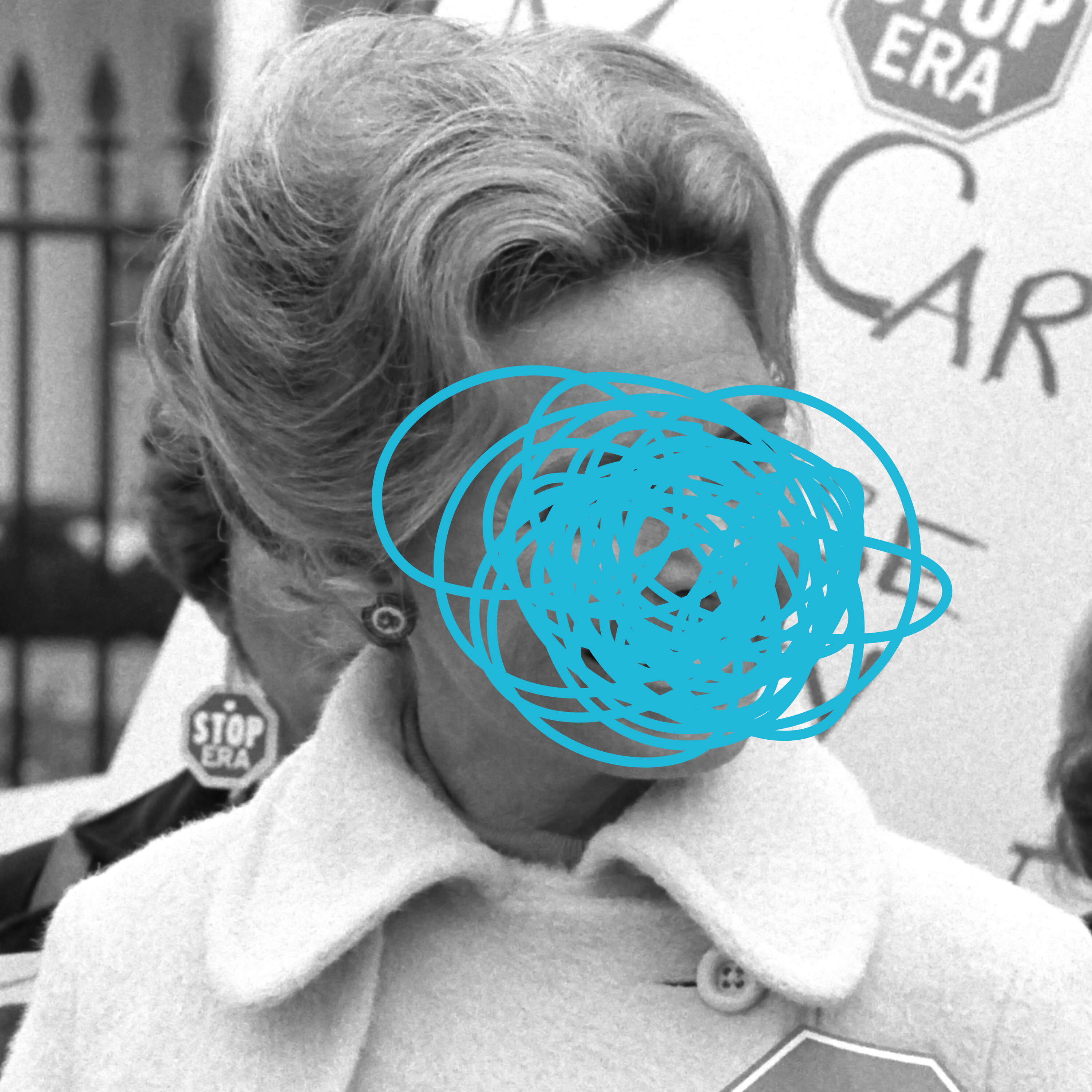
But the real moment that matters here, that will turn into literally the rest of the episode, is in 1972, she found something called Stop Era, which is pretty important to her and also totally fucks up the rest of America forever.
- [25:40]
B
Yeah.
- [25:40]
A
Like, it is not an exaggeration to say that she is directly responsible for this. She, since the 60s, had been publishing this newsletter and having this syndicated radio commentary show. So unfortunately, evidence that Podcasters and radio hosts have been evil forever.
- [25:56]
B
Yeah, true.
- [25:57]
A
But starting in 60s and it's called the Phyllis Schlafly Report, and it continues for literally the whole rest of her life, which I think is really sad and weird. And it's at one point has this huge, huge membership, but it allows her to have this audience of like grassroots conservative women basically who are listening to her and hearing justification and validation for the life that they are living or that they wish. Wished that they were living. Yeah. And she starts being this like. I mean, she kind of already was, but she starts being this family values lady always. It's important to note that the concept of family values is like this amorphous thing that has meant different things forever. But she helps to solidify it into what we think of as family values today.
- [26:43]
B
Yeah.
- [26:44]
A
What we. The sort of modern conception of what family values are is based in her and other members of what we now call the New Right and their thoughts around what families are and what roles within a family should be. So, like, reminder to people that stuff is all retconned. Like it's all this weird psyop retconning thing where people are going back and projecting that into the past when it is an invention. This is another one of her weird inventions. But because of that, when something called the Equal Rights Amendment or the era, and I'm, you know about this, but for people who are listening, they might not. When that starts to gain steam again in the 70s, late 60s, early 70s, she's like, not on my watch.
- [27:31]
B
Exactly. If I actually have rights, I'm gonna lose it.
- [27:37]
A
I'm gonna be pissed.
- [27:38]
B
Exactly.
- [27:39]
A
Which not good.
- [27:41]
B
Yeah.
- [27:41]
A
As a sidebar, let's talk about what the Equal Rights Amendment is. For people who don't already know about this. Just a spoiler for everyone. We still don't have it. Yeah. But it is a proposed amendment to the U.S. constitution that would legally enshrine equal rights for everybody, regardless of sex. They. Sex would be the language that they use here. And so there are a lot of questions about like gender and sex and whatever, but we'll just use sex because that's the language of the amendment. It essentially works to prohibit sex based discrimination, with the argument being that an explicit federal, constitutionally protected right is and I think understandably inherently stronger than a state level right or an implied right. So like when you say everyone should have rights, people are like, okay, but we need to drill down and say, what do you mean by these rights? And who do you mean by everybody? Yes. And There are a lot of people who don't like it if you say that.
- [28:33]
B
Yes. Oh, totally. They're like, no, no, no, no. Why are you adding people? Keep the list short and make it only me.
- [28:40]
A
Yeah. Your definition of people is not my definition of people. And unfortunately, yes, 100% in your definition, you'd be a person, and I don't like that.
- [28:48]
B
Yes.
- [28:48]
A
And, you know, to me, sounds good, right? Like, that sounds pretty straightforward. They're saying, look, we want all these things that we allegedly say are enshrined in the Constitution. We want them to actually be enshrined in the Constitution. Seems pretty straightforward. But unfortunately, people have been arguing about it since 1923, which is when it was first written and introduced. So only about three years after women get suffrage in the first. Some women, Some women in some circumstances, some women. Which.
- [29:15]
B
I mean, this is my own sort of, like, take on it. But I. We were talking a little bit before we started recording about, you know, I think her very vague feelings about race. But one of the criticisms of the era is that, like, black women are then considered inherently women, if you're talking about all women and black women are women. But it's like, the idea that, like, if you create this separation. Right, exactly. And I mean, I think in the language that, like, we often hear today, people are always like, black people and women, as if there is no, like, crossover.
- [29:46]
A
Yeah.
- [29:46]
B
And I think that that's not by accident. I think that that's just sort of like a subconscious part of our culture is like, black people will be discriminated against. And that only really works if we're not doing that in, like, chunks. Like, it's just gotta be, like, black people writ large. And so I'm not, you know, here to hypothesize that that is the main reason why she's against it. Obviously, she has regressive thoughts about what women's roles should be publicly and in the home. But I think that, like, it isn't lost on me that, like, that's where she went. Because, like, if you think of the time period, you have all of these wins for civil rights leading into the 70s, and I think that that is a big inspiration. You know, I do a podcast for Courier that that's. We've talked about, like, Tradwives and sort of, like, the future of this. But I also do a podcast called rebel spirit for iHeart. And it's like, this is where we see all of this regressive shit coming up, where it's like, oh, suddenly, like, A family is defined by very slim descriptors. And, like, we'll do everything we can to stop the progress that's happening. And I think that it's the first big jump, obviously, post Jim Crow for rights for people of color. And so it's like, I think that it's just easy to slow down all, like, pump the brakes on these rights, stop changing things. Things are changing too quickly. And, you know, to use her language, we sort of see echoes of that from there on out.
- [31:08]
A
Yeah, absolutely. And I mean, one of the things that's interesting is you're right, like, race is this inherent thing in all of us. And we'll talk about it a little bit more with. In terms of Schlafly, but, like, even when we're talking about women's suffrage, right. In the 1920s, there are a bunch of suffragettes who are famously incredibly racist.
- [31:24]
B
Yes.
- [31:25]
A
And these are also the people, like, really, really racist. And these are also the people who are arguing over whether the ERA should exist. So, like, this is a thing that has shown up over and over again when there is a major civil rights movement in whatever context. In this case, we're talking about in the. The twenties, we're talking about women's, like, civil rights in terms of suffrage, but also then you have, like, racial civil rights later. There are this, like, when this happens, people start to feel this swell and, like, this surge of opportunity. And they say, like, well, what can we get now? And there are always people like, Schlafly being like, shut the door. Like, we need to close the door immediately.
- [31:59]
B
Exactly. Yeah. Literally. Right. Like, and. Yeah, shut the door. And if we could just go back eight years and, like, take some things. Yeah, like, let's go way back. Let's go way, way back.
- [32:08]
A
Yeah. And for more, like, ERA stuff. Because I do want people to kind of understand the context of the ERA and why her whole deal is so. So incredibly annoying is that the era from Jump, like, from the 20s, was an incredibly controversial piece of legislation, in part because women cannot agree on what women's rights should look like. And this is a recurring problem with the era, but also, like, even now, in terms of things like abortion and marriage and stuff, like, women cannot agree on what they want to be their rights. We know what men want women's rights to be.
- [32:43]
B
Yes, but.
- [32:44]
A
But women can't, like, seem to come up with, like, a cohesive, coherent argument on this.
- [32:49]
B
Yeah. And we're all on the same page, and they're like, no, no, I want less.
- [32:52]
A
Yeah, exactly. And this is actually the STOP thing. We'll talk about that in one second. But that is like one of the most infuriating things about this. Her organization is called Stop era Literally Stop giving me things. It's called Stop Taking our privilege. Which to have the first word of your acronym, which is Stop Be. STOP infuriates me.
- [33:09]
B
Yeah.
- [33:09]
A
Like you can't have the word that your acronym is in the acronym.
- [33:14]
B
Right. That's, that's. Now it's confusing. Now it's worse. Stop.
- [33:18]
A
Stop taking our privileges.
- [33:19]
B
Yes.
- [33:19]
A
But at the time that they. To go back to the 20s once again, at the time that the era was introduced, part of the issue is that women in many cases had very specific restrictions on the amount and types of work that they were allowed to do. So lots of people saw the ERA as primarily a sort of labor and economic issue rather than a social or civil issue. Total. And some women would argue or did argue basically that these restrictions were probably the argument that you and I would make. Were arguing that these restrictions were hampering women's abilities for economic self determination. Totally like keeping you from having economic freedom and therefore social freedom. Essentially, yes. The others on the other side were arguing that these restrictions were actually privileging women and protecting them from the difficulties of intensive labor, et cetera. So it's not like just a case of men not wanting women to be equal, although that's obviously also happening. But that women have different conceptions of womanhood and safety and protection. And schlafly is going to play on this when it shows back up in the 60s and 70s.
- [34:25]
B
Yeah, yeah. I mean, for jumping back to the 70s, I remember just reading that like a large part of her platform was like this idea that I guess like the time she's living in. Right. There's no ERA ratification. And then there's like the reality that women are considered dependents like children are. And so it's like, oh well, I can just get everything from my husband's job. Which is funny to me because if her dad had no job. Yeah. Then why is that beneficial to you? Like you're not getting anything.
- [34:55]
A
I'm just saying your husband could be a loser. Like that is an option.
- [34:59]
B
Right? Exactly. Like, you know, historically I feel like that's happened.
- [35:03]
A
So it's just like there have been cases.
- [35:05]
B
Yeah. Many such cases. And I just think that like, you know, it's interesting to limit your opportunities in that way, but there's a lot going on in that noggina hers. Not necessarily like firing at all cylinders but stuff's going on, stuff's knocking around.
- [35:19]
A
Stuff's happening. For sure.
- [35:21]
B
There's at least one bad man.
- [35:23]
A
Yeah. Bouncing around like a DVD menu or whatever. There's something going on there. The era is basically killed after the 20s for a while because. And this is not necessarily like the only argument, but one that I would make. It's kind of hard to argue during the twenties and intervening period. It's kind of hard to argue that everybody should have equal rights to anything when Jim Crow is still, like, raging in the South.
- [35:48]
B
Right.
- [35:49]
A
Like, women should have equal rights and everybody should have equal rights. And there are a significant portion of people who are like, can we even.
- [35:56]
B
Get like half rights?
- [35:57]
A
Yeah, I don't feel like that's what's happening here.
- [36:01]
B
Yeah, exactly. Like, I don't think we're that close.
- [36:04]
A
Yeah, exactly. But then when the women's lib movements happen after civil rights or in conjunction with civil rights.
- [36:12]
B
Yes.
- [36:12]
A
Not after. Should say like, alongside. It starts to gain steam because people are like, hold on. Women can organize around social and civil and economic freedoms. And there are people who are like, the ERA is this sort of next necessary legal step towards that. And so in 1972, after years of organizing, the ERA goes to state legislatures for ratification. This is the boring part. The requirement is that it can become the process of becoming a US constitutional amendment once it is ratified by 3/4 of the state legislatures or 38 states by a given deadline, which was originally March 1979. They had seven years, and then it later gets extended to 1982. So in response, Phyllis Laughly said, absolutely not. Like, absolutely not.
- [36:54]
B
She's like, Well, I know 38 states and I'm on my way.
- [36:57]
A
Exactly. I have heard of at least 30. She launches this Stop Era campaign, which ends up being one of the most successful grassroots organizing campaigns in American history. It is not an exaggeration to say that the ERA fails because of her.
- [37:12]
B
Yeah.
- [37:13]
A
Like, literally her, the one person who decides to come up with this. This stupid ass campaign.
- [37:17]
B
Awful.
- [37:18]
A
So, like, there are times on the show where I don't want to hang. Like, I don't want to lay something at someone's feet and be like, this person's fully to blame. She is fully to blame for this.
- [37:29]
B
Right, Right. If she didn't exist, like, there's no world where, like, there was somebody who was number two. Like, I think it's easy to look now at sort of our social systems and like our media landscape and be like, okay, well, like, if that guy's gone. There's like 80 other guys behind him, you know, carrying the same water of regret of politics. But for her, it's like she was sort of the. The trailblazer and, like, the leading voice. Like, maybe she's inspired people now, but, like, back then, it's not like there were a million women with radio shows that were also saying it. It was really her. It was her personal brand.
- [38:01]
A
Yeah, exactly. She's not just, like, at the vanguard of this. And there are people who are sort of coming behind her. That is not what's happening. The people who are coming behind her. I mean, there are conservative women doing other stuff, but the people behind her are people that she is dragging along with her, that she is holding by the hand and saying. Saying, let's go, girls.
- [38:19]
B
Exactly. Let's go back inside, girls.
- [38:21]
A
Yeah.
- [38:23]
B
Let's go under the house, girls.
- [38:25]
A
Yeah.
- [38:25]
B
Literally.
- [38:26]
A
It's awful because you can't say back in time because, again, this isn't real before. Like, she's existing at a time where the sort of, like, what we imagine to be the 60s housewife, like, she's fighting against all these 60s housewives.
- [38:38]
B
Right.
- [38:38]
A
It's also not as commonly of a shared belief as one would think. It might have been. Like, this morals that she holds or the sort of values that she holds are not widely shared for the most part, until she makes them a problem and convinces women that that's what they need to be doing.
- [38:54]
B
Totally. And if only they could just have that again, again, in quotes for those listening. If they can have it again.
- [39:01]
A
Yeah.
- [39:02]
B
Then they can. You know, things will be fixed. And it's like, maybe you just don't like your husband. Maybe all your problems aren't this.
- [39:08]
A
Yeah. Also, again, a reminder, this woman did not have this ever at any point.
- [39:12]
B
Her mom didn't. It's not in her lineage.
- [39:14]
A
Like, dad was at home. Her mom was working. She's been working her whole life. This thing that she imagines going back to you, she literally has never, ever had in her entire life. So it is so wild to me that people are buying what this grifter lady is selling.
- [39:27]
B
And why doesn't she go first? Like, why don't you. You go first. You shut up and, like, you know, stay in the house for a while.
- [39:32]
A
Sure.
- [39:33]
B
And then come back out and be like, it's good in here, but you never do that.
- [39:36]
A
Yeah. And people have been saying that forever. And we're saying that to her at the time. Like, well, why don't you just lead by example then, lady and if it's so great, then other people might do it, too. But she's like, I don't need to do that.
- [39:47]
B
She's like, well, they don't give you a microphone from inside my house.
- [39:50]
A
Yeah, exactly. Podcasts don't exist yet, unfortunately. She would have the worst TikTok on the planet.
- [39:58]
B
Horrible.
- [39:59]
A
Everyone we talk about on the show would be a horrible person on TikTok. But I'm telling you, we have women now that I'm like, like, ban them.
- [40:06]
B
Yes, same.
- [40:07]
A
And she is that.
- [40:08]
B
I'm like, you know, we'll get to it. But objectively, I feel like there's so many people who are trying to make the Phyllis Schlafly brand their personal brand. Today in 2025, 2026, whenever this comes out, and it's funny because it's like they just won't go home, then I'm like, why don't you just get in the house? Like, if it's so nice in there, why are you outside? Why are you on a stage?
- [40:31]
A
Like, yeah, you could just do it for you.
- [40:34]
B
Yeah, right.
- [40:35]
A
Like, you could just do it for you. Why does it have to be for everybody? Right? Like, why does everyone have to have this thing enforced for them, too? And.
- [40:44]
B
Right.
- [40:45]
A
That is like, the confusing sort of paradox of all of this is like, you could just do that. Nobody is preventing you from hanging out. So why are you mad that other people don't want to hang?
- [40:56]
B
Right.
- [40:56]
A
I don't know. I find it so infuriating and so many people have thought about this forever. I talked about this forever at length and written about it. But, like, it still is, like, fundamentally, at base, I just am like, I don't get it.
- [41:08]
B
I think the truth is they don't want it either. I mean, that would be my, like, take is like, they don't really want it. It gives them something to talk about. If they never get what they want, then they always have something to talk about. And it's like, right. But like, no one is holding you hostage at work. Like, you could quit at any point. No one would be mad. In fact, zero people might notice. And unfortunately, it's like. But then you're gonna be in your house complaining about what. Yeah, the fact that you made a bad choice. Like, I think it's a lot of just, like, you know, needing something to rail against, needing to feel oppressed when there is no real oppression. And I think that that is, like, a psychological issue that I hope is being studied deeply.
- [41:47]
A
I hope so. That's actually what we're doing right now public scholarship on women being extremely weird and like, needing to feel important in a way that is like, by actively harming other people around them as much as human totally. And making the argument that what they're doing is not harming people, they're saving them. Like that to me is. And that's been the rhetoric forever. That's Schlafly's rhetoric for all of this. The people around her, that's what they're arguing and have been arguing since she, you know, showed up on the scene to give you some, like, arguments that she makes against the era so that people can hear the, like, level of, like, infuriation, infuriating feelings that you'll have from this one. She says gender differentiated laws should remain so things like alimony provisions where women should be paying less alimony in the case of a divorce or have alimony paid to them, Social Security, dependent wife benefits, women should be getting more benefits. And that's like all of these things could just be made equal. But she's like, no, no, no, we need these to be better for women.
- [42:45]
B
Right. Which is funny because it's like she is arguing the opposite of what men's rights people would be arguing. Like, it's not fair that women get all this stuff and yet they were, you know, historically voting the exact same way.
- [42:56]
A
Yeah. And she would be aligned with them, to be clear.
- [42:59]
B
Yeah.
- [43:00]
A
She would be aligned with them while also saying all of this just makes me so mad because none of it makes any sense. Like, none of it logically works out at all.
- [43:09]
B
Right.
- [43:09]
A
She's very in favor of mother's presumptive custody norms, which is like, like, mothers should have custody automatically unless there's some reason that the mother can't have custody. Rather than men and women, it should be between whoever is better equipped for this.
- [43:23]
B
Yeah. It's both of their kids, one might.
- [43:25]
A
Think, but not Schlafly. She's also really into what she calls a sort of traditional family structure. The ERA would downgrade the role of the homemaker. Again, you can just be that.
- [43:36]
B
Right. There's nobody saying you can't. Yeah.
- [43:39]
A
If I said you could go to work, work and be equal, or you could just stay at home and nothing would change for you. What is the problem with the first one? I truly don't understand it.
- [43:49]
B
Right.
- [43:49]
A
She says things like gender distinctions are going to be removed by judges, not by democratic debate. Again, this is a woman who's saying she doesn't want judges to do things. She wants everyone to Debate them. But she also wants to actively ensure that judges rule her way. Yeah. So she likes judges for her. I like laws for me and not for you.
- [44:07]
B
Right.
- [44:07]
A
Is what's happening here.
- [44:09]
B
Exactly. I need the judges to say a different thing.
- [44:13]
A
Yeah. And actually judges who don't say a different thing are bad and wrong. And activist judges.
- [44:18]
B
Yeah. They shouldn't actually be allowed.
- [44:20]
A
Yeah. And it's the same thing we hear now. Judges who rule a certain way are viewed as activist judges. Judges who rule a certain, like, most often towards the left are viewed as activist judges. But judges who vote in a sort of right leaning direction are not viewed as activist judges.
- [44:36]
B
Right.
- [44:36]
A
What's going on there?
- [44:38]
B
Yeah. Right. It's only activism if things get better, I guess.
- [44:41]
A
Yeah. Well, one thing, part of that is her, because she helps to frame the concept of an activist judge. Like so many of the things that are normal in American political culture now are schlafliest. And it makes me so mad. And people aren't even aware of that. They just think that that's just like a normal conception. That's just how American culture works.
- [45:00]
B
Right. That we. Yeah. Like, this is something that's been talked about. Totally. And I think it's also just sort of like, at least like enlightening that one person in a time with way fewer communications options was able to be that impactful. And I guess that's the truth about all history. Right. It's like, it's always just like one guy who maybe was really too good at talking to people and had terrible ideas.
- [45:22]
A
Yeah.
- [45:23]
B
So maybe if you guys have good ideas, you could say them louder. That's all. That would be my. Keep going, guys.
- [45:28]
A
I agree. And here we are saying them louder. So I think that's one thing. And I actually think some of this is heart because to me, it says if a person is capable of making the world worse by talking or rallying people or whatever, the inverse must also be true. That a person can make the world better by talking and rallying people and thinking a different way. The idea that thought is only impactful when it's bad is itself a bad thought. Like, it totally prevents us from doing anything. So, like, sometimes the schlafly stuff, you look at it and you're like, okay, but. But like, all that says to me is that anybody could do this. Like, anybody could actually make the world better if they wanted to. It's just an option. I'm just saying.
- [46:08]
B
Totally. Maybe rally the troops, guys.
- [46:10]
A
Yeah. Oh, it's a Goldwater hive. Rise up at The.
- [46:15]
B
I love that your fans are now going to be called the Goldwater Hive.
- [46:19]
A
That's so bad, because Goldwater is horrible.
- [46:21]
B
Horrible. But I will also say, like, the.
- [46:24]
A
Reason that we're not succeeding at good things happening because of people thinking and talking out loud is because the media landscape does not privilege that for the most part.
- [46:31]
B
Yeah, no, not at all.
- [46:33]
A
She has that sort of, like, sympathetic to her at the time that she's rising, but, like, you know, maybe one day.
- [46:37]
B
Hey, yeah, maybe.
- [46:38]
A
What other things? She's like, her whole thing is that she says she's pro woman. Like, that's a big sort of, like, pillar of. Her argument for everything is that she is pro women. And she says, like, I actually want to protect women. I want to privilege them. One of her big things is, and you'll hear this all the time, actually, if we make women equal to men and give them equal rights. Rights. When I say make women equal to men, I mean, like, legally women will be drafted into the military. Like, that's one of her big arguments. And everyone's like, well, I don't want that.
- [47:07]
B
Yeah. And they also never go to the further step of like, what if no one was drafted?
- [47:11]
A
Well, yes.
- [47:13]
B
And then they're like, but what if we need people to fight the war? We gotta have the draft. But we hate the draft. And it's like, guys, work that out on your own time. I think we should just get our rights and then we can talk about that later. Because the draft is bad for everybody.
- [47:25]
A
My thought is it sucks that you have to get drafted. I think the solution is that no one gets drafted. Not that we all do.
- [47:33]
B
Yeah, exactly. There was actually, like, there's other math that could have been taken place, but.
- [47:38]
A
There'S another kind of equality we could have here. But we're not ready to talk about that at this moment.
- [47:44]
B
Never that. Never that.
- [47:46]
A
It reminds me of. Did this ever happen to you in middle school or am I just. Did I just go to a bed. Middle school? Which I definitely did, actually. But, like, you could be like, no, women are equal to men. Girls can do anything boys can do. And guys are like, okay, so then I could punch you in the face. Or like, oh, so men could just hit women and that's allowed. Like that thing where, like, what if the argument is nobody hits anybody?
- [48:07]
B
Right, exactly. What if women don't hit you and you don't hit women? And now we keep moving forward in the conversation. Yeah, what about that?
- [48:13]
A
What if nobody gets hit?
- [48:15]
B
What about other things that people do? Yeah. Why is that a thing that you think about where it's like, that's. The rights that I'm losing is to hit you. You don't have the right to hit men either, actually. Did you know that?
- [48:25]
A
Yeah. Also, I want to be clear, like, when people, when guys say that, I'm like, I bet you're saying that because if you could hit a woman, you fucking would.
- [48:34]
B
Right? Exactly. You're. You're looking for legislation to say, I'd like to hit a woman, not anything else.
- [48:39]
A
And also, again, men hit women all the time, law or no law. I'm just saying. Right.
- [48:45]
B
Actually, good point.
- [48:46]
A
And women hit men all the time. Like it's the same thing.
- [48:49]
B
Yeah. Hitting is the problem.
- [48:52]
A
Well, yeah.
- [48:53]
B
Why don't we get to that point? They're like, no, no, no, no. It's about rights and it's about women.
- [48:58]
A
Yeah. It makes me so mad because it's just. It's the same thing with, like, the same sex spaces and stuff where. Because she also is really about that. She's like, you don't want men in your bathrooms. And it's like, if a man wants to walk into a bathroom, he can and he will.
- [49:11]
B
Yeah.
- [49:11]
A
He has the same argument we have now where I'm just like, yes. What do you think a legal prohibition is? The thing that's keeping scary people from doing scary stuff. Stuff like they just do it.
- [49:21]
B
Right. And why do we only believe that it's possible for the things that they think are bad? Like someone having to pee and going to the bathroom versus, like, oh, well, somebody with a gun will just, like, shoot somebody. And they're like, no, no, that's different. Because they have to have the right to that gun. It's like, okay, so guys, you're not making a lot of sense. Like, the logic is not logicking at this point.
- [49:42]
A
Yeah. The internal logic here does not make sense, and it's not real. And like, that's the thing that's important here is that, like, all of these things are inventions. They're not logical. And I will also say there are plenty of on the left that are not logical, but, like, at least they're, like, aspirational. Like here it's about this idea of, like, shoving things down and making them smaller and more difficult in service of a past that never, ever existed in the first place. And it makes me feel crazy. Like, it makes me, as a historian feel crazy reading some of these things.
- [50:11]
B
Yeah.
- [50:12]
A
Especially because now we have a society that's, like, so built around some of the stuff that she comes up with. Yes, we somehow believe that it's been the case forever over and it's not. And it just makes me feel. It's crazy. Making it makes me feel insane.
- [50:23]
B
Yeah.
- [50:28]
A
Hi gang, it's Claire with my usual quick mid episode shout out to tell you about other multitude shows I think you might enjoy listening to. If you like history that suggests you're the kind of person who's into bizarre and esoteric lore about people doing inexplicable things for equally inexplicable reasons. What if I told you there was a video game series that was basically just many, many hours of that exact same thing, which has been leaving people saying what the hell for the last 23 years? What if I told you there was a podcast about that video game? Simple and Clean is a show where hosts Misha Stanton and Myana Barron talk about Kingdom Hearts, a little video game franchise about really big feelings. Join them every week as they discuss the plot, characters, world building, music, fashion and societal impact of a thing that by all means, probably shouldn't even exist. Never heard of Kingdom Hearts? That's okay. They're here to break it down for you, explain why they love it, and hopefully convince you that it deserves a place in your heart too. In each episode, Mayonna and Misha attempt to unravel how this deceptively expansive game series has touched an entire generation of deeply earnest weirdos. They put out new episodes every Sunday, so go check out simple and Clean wherever you listen to podcasts, tests if you've been stuck on a six month wait list for a psychiatric appointment or are bouncing between online mental health sites trying to find medication support, Talkiatry was built for you. It's virtual psychiatry that actually fits your life and your insurance. Talkiatry is a 100% online psychiatry practice that provides comprehensive evaluations, diagnoses, and ongoing medication management for conditions like anxiety, depression, insomnia, and more. Unlike therapy only apps, Talkiatry is psychiatry. That means you're seeing a medical provider who can diagnose mental health conditions and prescribe medication when it's appropriate. All of their 600 plus clinicians are in network with major insurers so you can use your existing insurance instead of paying monthly subscriptions or out of network fees. You'll meet with an experienced licensed psychiatrist who takes the time to understand what's going on, builds a personalized treatment plan, and can prescribe medication when it's right for you. This means that your care stays consistent and evidence based. Head to tokiatry.com TGS and complete the short assessment to get matched with an in network psychiatrist in just a few minutes. That's tochiatry.com TGS to get matched in Min.
- [52:57]
B
It's also, like, I mean, just like, as a quick aside, like, I think we live in a time of, like, deep conspiracy theories and people feeling like they've been gaslit and lied to.
- [53:05]
A
Yeah.
- [53:05]
B
And it's like, this is an example of, like, you explicitly being lied to about, like, the experience of women historically. Like, there wasn't some time when everybody was just in the house chilling all day, and, like, their husbands were making money, and it was very simple. And now suddenly we have to read books. It's so hard. And like, no, no, no, no, no, no. Like, it's just not real. But it's like, people want to be lied to. I think about some things. Yeah. Like, they want an explanation for why their life is hard, and it's much easier to come up with a fantasy or fairy tale about how well, back in the day, I would have been so taken care of. It's like, no, you probably would have had to marry somebody out of convenience because you didn't have any money of your own, and it probably wouldn't have been a very good relationship, and you probably would have had to have kids whether you wanted to or not. You probably had aspirations that you shoved down. And then ultimately, if you didn't poison your husband, you thought about it. So, like, that's. That's the story of most people's grandparents. And unfortunately, we're not talking about. Phyllis didn't want to bring that up. Her mom probably wanted to poison her husband and vice versa. And she never talks about that.
- [54:02]
A
Well, yeah, I mean, I think what's so funny about all of this is, like, it makes no sense. It has no historical grounding. And also, like, if you use that same logic, like, if you say, okay, I'll make a concession here. Women were working in the home. And then you say, okay, but let's look at which women were staying at home and not working. Right?
- [54:23]
B
Yeah. Some people were always working.
- [54:25]
A
Well, yeah. And that's the real fundamental argument against, like, that you can offer against any of this is like, basically, first of all, Schlafly has nanny, so she's not doing the thing.
- [54:34]
B
Right. Someone's working, so someone's working.
- [54:36]
A
And then also, like, if you look back to, for example, a time that a lot of people will look at is like, the antebellum period and be like, well, women are at home. And we know that if someone likes the antebellum period, it's because they're a racist. Let's be very clear. That's what's going on there.
- [54:48]
B
Yeah, exactly. Yeah, yeah. They're like. But I just like the linens. Oh, no, you don't. Because you know those people smell crazy. You like the racism. You know that they smelled absolutely like horses. So you need to understand that what you like is racism and do some internal work.
- [55:03]
A
It's a very, like, miss me with the plantation wedding situation. Unfortunately, I will not be attending.
- [55:09]
B
Yeah. And you're not going to convince me. It's just a house. House is not just that. There's a graveyard. Talk about the graveyard.
- [55:16]
A
Yeah. Where's your home? Cemetery, to be clear. If it has one. If people were allowed to even have one. First of all.
- [55:21]
B
Right, exactly.
- [55:22]
A
The thing here is, like, if someone looks at the antebellum period and it's like, I love that. And using your example of like, I don't want to read books. Right. There are a group of women who are reading books and sitting in their house and they're loving reading the books. And they're people who have. Slaves.
- [55:35]
B
Yes.
- [55:35]
A
Who have enslaved people.
- [55:37]
B
Yes.
- [55:37]
A
Working for them, Raising their children. Children, Right. Like that's what you're imagining.
- [55:41]
B
Yes, exactly. Someone's always working.
- [55:44]
A
Someone is always working. And it's always a woman who is in a position who is lower than you and, like, socially lower than you. Economically lower than you. If you look at, for example, the early 20th century, and you're looking at women in the 20s, for example, and you're imagining, like, they could just like, make their home, whatever. They most likely have a working class immigrant mother raising their children for them or keeping their house or whatever. In all of these scenarios that we're looking back at, the reason that women are able to not work is because other women are working.
- [56:16]
B
Yes.
- [56:17]
A
Like, it's not real. It's all fake.
- [56:21]
B
Right, right.
- [56:21]
A
There are always women doing this for them. But the way that she's able to conceptualize of this and convince women to, like, follow along with her is by appealing exclusively basically to middle class women, to middle and upper class, economically women.
- [56:35]
B
And in America, I would say, poor women who believe that that is actually their future, who have bought into some idea where it's like, this is a temporary condition.
- [56:44]
A
Yes.
- [56:45]
B
I'm actually going to have that. And it's like, you know, statistically. No. Like, you're not getting there. Like, people tend to never change classes in any meaningful Way. So, like the idea that, oh, well, we're just currently poor, but, like, I should be that woman at home. It's like, well, you're not gonna be.
- [56:59]
A
Yeah.
- [57:00]
B
And you never were. And unfortunately, that's the economic system we live in. Things are not equal. And so instead of fighting for better economic outcomes, you're fighting to give someone richer than you even more.
- [57:10]
A
Well, yeah. And part of this is like, you know what? Scientifically, when we're talking, like, economics, I have people who listen to this and will hear me be like, economics isn't real science, but, like, a lot of it is imagination that we're hoping comes real.
- [57:23]
B
Yes.
- [57:23]
A
And I love shout out to all the economists right now.
- [57:26]
B
Yeah, what's good?
- [57:27]
A
What's good? We actually do like you.
- [57:28]
B
But.
- [57:29]
A
But there is so much evidence, historically speaking, that what allows women to experience real economic upward mobility. This will shock you. Is the ability to work.
- [57:39]
B
Right, Exactly.
- [57:41]
A
The idea that women who are in working class positions and, like, support her because they think that what she thinks is saying is this sort of aspirational life are actively preventing themselves from being able to access that.
- [57:54]
B
Yeah.
- [57:54]
A
It's infuriating. Yeah, it's the same thing. You see now basically, where this lie is being sold to people, this aspirational lie is being sold to people. And the way it's being sold to them is by advocating for policies that actively prevent people from achieving that aspiration.
- [58:10]
B
Totally.
- [58:11]
A
And that's what she is doing.
- [58:12]
B
And it also is just like, I guess, the antithesis of what we're seeing. Like, I'm not a historian, but I have eyes. And so it's like the idea, like, we all grew up in some town. The idea that some woman or some teenage girl getting pregnant becoming a mom, in no way is the reality that that is like, and now she's rich and her life is comfortable and better, and we should all be doing that. Like, everyone knows, and rich people know it better than anybody. I mean, like, you know, if abortion goes, they're still getting them for their teenagers. So it's like this idea, this fallacy that, like, the problem is that these women are going to college and looking for higher achievement and getting jobs. And, you know, maybe their aspiration isn't just to be in the home doing stuff for some guy. It just bumps against this idea of, like, and we would be richer or we've lost something. Like, nothing historically or with your own eyes tells you that that is true. Yeah, Everyone I know who had a kid in high school is like, you know, What? I love these kids and unfortunately I'm like a 35 year old grandma and I have nothing.
- [59:16]
A
Yeah. And it's like, and if my child considers doing that, we're gonna have a serious conversation about what their life is going to look like if they make that choice for themselves. You know, like if my kid gets pregnant in high school, it's going to be a problem. Right. Like, like the people that, you know, who were teen moms are like, I would not wish this on anyone. Basically, I love my child. Like I. And I mean, I'm from Oregon. That's happening in Oregon, let's be clear.
- [59:37]
B
Yeah, I'm from Kentucky. It's happening.
- [59:40]
A
Yeah. And like it was so interesting at my high school because like being from Oregon and I'm from Portland. But like there's a lot of weird dynamics a lot of people aren't aware of. But like there is really like some of the people go and work for Nike, which is, your options are like become a psychic or work for Nike or get pregnant. Like those are your three. Those are them. The three genders in Oregon.
- [60:05]
B
Be a psychic is sounding really good. But you know, maybe it's pregnant or Nike. Who's to say?
- [60:10]
A
You don't know. You get, they draw it out of a hat halfway through middle school. But like that, that is the thing. And like people like Schlafly for example, to bring it back to Ms. Schlafly, she is one of the most influential anti abortion activists advocates within the Republican party starting in 1970. Like she is the girl for anti abortion activism for a really long time. She repeatedly advocates for overturning Roe v. Wade. Unfortunately, we grant her wish after she dies. So yeah, that's sucks.
- [60:40]
B
Right?
- [60:40]
A
But at least she wasn't around to see it. So. Hey, that's okay.
- [60:43]
B
Yeah, exactly. She's looking up at us now. Darn. She's like, wow, it's hot. But thank goodness I've ruined a bunch of women's lives.
- [60:55]
A
She has this will shock no one. A no exceptions position. So she opposes abortion in all circumstances, including in the cases of rape and incest. Her only thing is saving the life of the mother. But a question mark on what that actually means. Nobody actually knows that. And that's evidence of what we have now where people are like, we should save mother's lives. And then they go to the doctor in Texas and Texas says, I don't care.
- [61:16]
B
Yeah, bleed out in the parking lot, good luck. Like, we're not, we're not touching it. Yeah, it's not our fault.
- [61:21]
A
Say, drive to Colorado. Catch you later, basically.
- [61:24]
B
Exactly. Yeah.
- [61:25]
A
And so she is, like, a huge person in this movement, so we have her to thank for that. You want to know about reproductive health and education. She's also really against federal programs that distribute contraception to teens. Teens or without parental involvement. She opposes comprehensive sex education. She supports abstinence only programs, which only become popular or like, really, really take off in the 90s and 2000s. So that's from her.
- [61:48]
B
Yeah.
- [61:48]
A
She argues that sex ed promotes promiscuity. She says it undermines parental authority. Like, really the most regressive things that women have experienced since the passing of Roe v. Wade.
- [62:00]
B
Yeah.
- [62:01]
A
Are this woman coming from her. Yeah. And the people around her, because she starts something called the Eagle Forum, which is, like, for conservative women. She hires almost exclusively white women to staff. Still exists to this day. Shout out to any Eagle Forum listeners.
- [62:17]
B
Yeah. Stop listening to Shafley. Yeah. What if you just did something else with your life? Join the Goldwater Hut.
- [62:26]
A
You could be my intern. I will hire you. No, I actually will not hire you.
- [62:31]
B
If you have to put. Prove you can read. And unfortunately, the jury's out. But in any case, like, yeah, I mean, it is like, really amazing that conservative people, evangelical Christian people, have sort of latched on to these and consider them like deep, long standing beliefs when really these are like, sort of the ideas of a one woman over the course of like, 30 years. And they all have the same end. Right. Like, if the government is not going to take away these rights, then, like, what. What can we do to limit, I guess, like, the opportunities for women? And it's like, yeah, if you have kids and you're 15, guess what? That limits your ability to go to college. That limits your ability to find job success. That limits your ability to have anything in life. And honestly, it's like, I kind of think that's what she wants. Like, if. If she wants women back in the home, then it's like, however we can do that. So I guess it's like, yeah, like making children a burden instead of like a beautiful gift.
- [63:24]
A
Gift. Yeah. And the thing is that's so interesting is that's what she argues feminists do, right? Like, she argues that feminists are viewing babies as burdens. That feminists are, like, presenting themselves as forever victims. She says this, like, pretty famously in 1977 in an interview that, like. And she does it in a lot of other ways in other places, too. But she says, like, feminists are viewing themselves as victims of oppression when actually they're the most privileged group that has ever existed. And American women are the most privileged group that has ever existed in history. And that they are sort of abdicating their responsibility, their sacred, beautiful responsibility as mothers and treating their beautiful, wonderful children as burdens. And you know when she is recording this at bedtime, when her kids are somewhere else.
- [64:13]
B
Yes, exactly. When someone else is doing that, what she considers not a burden, allegedly. Yeah, yeah. Someone else rearing her kids. I mean, it is just hypocrisy all the way down. And I think that, like, the moment you think about any of this stuff critically, it's so apparent, but it is wild that it has like taken root. And I also think that, like, this happens a lot of times, or like it be it gains steam in times of economic turmoil because people want a scapegoat. And so it's like you see the 80s with Ronald Reagan where certain people are getting really rich, but that money never trickles down. You see it now where it's like, okay, well, things are really expensive. It would be great if a man could just handle this burden and I didn't have to work so hard. Hard. And it's like, well, it's not about, I think, gendered politics that people are having a harder time economically now. It's just that that is the scapegoat. Yeah, it's an easy scapegoat, especially when you never have to prove anything.
- [65:04]
A
Yes.
- [65:04]
B
Like, has she ever been forced to prove any of her theories?
- [65:08]
A
No, of course not. And that's part of this because what she can do is work with institutions like AEI or the Eagle Forum or other people in the New Right. Or she also at one point is associated with the John Birch Society, but then they have to pretend that she's not associated with them. So there's a whole big thing. But they're actually distributing her books in California. So there's a whole bunch of things like she then works with institutions who then basically find studies or commission studies that will argue that the things they're saying are right. And so they find the conclusion after they've already drawn it. And so it's a very interesting thing where then you can say, well, here's the science behind this. But like the science is initially again, based off this like, fake thing that's been made up in the first place place. And so it's this really like self sustaining environment that just keeps going on and on and on and on in a way that it feels now like just a normal feature of American life. But at one point was not totally. And that's kind of the thing I want people to really take away from this is like, this is actually a new thing. Like, this is not a long term approach to American politics. It's also not like it's a sort of breaking off or a separation from long term gender politics around the world. Like, this is a new thing.
- [66:19]
B
Totally. I mean, you know what's funny is like, when I think about the era in which she gains a lot of like, popularity. So like let's say the 70s, and you see someone like Sally Ride going to space and like, people are lining up to see her. She is the future. She shows you what women are capable of and becomes the most popular astronaut of all time. You know, and women are really driving that. It's so fascinating to see, like her happening as almost a counterculture at the same time. But lying to everyone and saying, like, this is actually what people really believe.
- [66:51]
A
Yeah.
- [66:51]
B
Because I think born out, that's just not ever been true. Like, yeah, people are always excited when women are achieving things. And I think that, like, okay, maybe there's been a limit in this country, especially politically, but I would say that, like, generally speaking, like, it is regressive, like in the purest sense of the definition. Like, I think human achievement is very much ingrained in women's achievement. And it's strange to be in a place where it's like, well, we should do less. It just doesn't really track.
- [67:18]
A
No.
- [67:19]
B
And I also think that right now we're sort of in a regressive era. I think we could all agree with that. But I guess I take heart as someone who doesn't study history but tries to notice some things, that this seems like another phase. And maybe it's a dimming phase. Maybe what comes after this could be better. I like to hope. Yeah.
- [67:38]
A
I mean, I think if you do anything other than that, like, you're basically screwed. So you, like, that's the only way to look at this. Like, you have to be like, there is going to be a shift somewhere. Otherwise, like, what's the point? Right? Like, otherwise what? We just succumb to the Schlafly vision? She's underneath Sally Ride with a net trying to catch her.
- [67:56]
B
Yes, 100%. 100%. She's like cutting the brakes five minutes too late.
- [68:02]
A
Yeah. Like, I don't want, I don't. We don't, we don't actually have to. To do this. We don't have to buy into it.
- [68:07]
B
Yeah.
- [68:07]
A
You know, so she has this, because we gotta wrap this up eventually. She. She has this, like, really polarizing legacy because there are a few things that she does really well. And this is not in. I want to give her her flowers kind of situation, because it's not like that. She's good at talking. She's very personable. Like, that's part of her things that she can go on TV and sound like she's having a reasonable conversation while she's saying, get back into the dungeon.
- [68:29]
B
You know, like, that's like, that's literally she's like, tying you to the stake and she's like, it's literally. I. I just want to say this with love. I hope you burn it out.
- [68:38]
A
Yeah, like, that is what's happening. So she's an incredibly effective speaker. She knows who to use for her political aim. So there are a lot of things that, like, other organizing campaigns, especially on the left, have used from her in terms of her tactics. She's really good at organizing with churches. That's kind of her big thing, is you get churches to work with her and hold sort of like organizing drives and grassroots campaign stuff with churches, with women's groups. Like, she is really, really good at mobilizing sort of in terms of grassroots organization. She's a great speaker. Like I've said, she's doing all this organizing stuff and she finds a way to seek out political vacuums and voids and fill them with her ideas. So there's a moment in the 70s when women are basically saying, like, should we pay attention to older women or should, like, older middle class women who are kind of being screwed over by social reforms and economic reforms? Or should we focus on working class women and women of color? Which, again, these are not separate ideas. Right. Like, there are plenty of middle class older women who are women of color. Like, but there is this blind spot that can sort of continuously happens.
- [69:46]
B
Yeah. And also, like, I think, like, a media blind spot of, like, absolutely, listen, this is what we believe exists, not the reality.
- [69:52]
A
Yeah, absolutely. And so there's this moment where everyone's trying to figure out what they do and they decide to go with, like, working class women, women of color, as being, like, sort of their focus for this. And she says, great, let me snap up all the grannies. Basically, like, that literally, like, she finds these political vacuums and snaps up all these people and, like, basically gets her organization to fill these voids immediately. And that is like, really her strength. And it's something that, again, I don't want us to learn from schlafly. But like, something that, like, modern political organizing can learn from is like, be like, find out the holes and you. You need to plug it.
- [70:26]
B
Yeah. Find the opportunity where. Who are we not speaking to?
- [70:29]
A
Exactly. And that's something that the right has excelled at in the last however many years. The one thing I want to sort of end with, because, like I said, we've already gone over, but we need to end this. She does one kind of final thing in her life, and I mean, anybody who has read about her will know this, but in 2016, she says, I've got one big final fuck you to the world, and that is she endorses Donald Trump and writes a book called the Conservative Case for Trump. She literally does this right before she dies. Like, her last act of her, like, one of her, like, last few months of her life is endorsing Donald Trump for president. She literally gives us Donald Trump because if he had not gotten her endorsement, you can't say that. Like, he wouldn't have gotten nominated. But he needed someone who had said that they were a family values person, like, social conservative.
- [71:18]
B
Right. Someone who would vouch for him in that direction because his life does not. Not. Yeah, yeah.
- [71:24]
A
It does not reflect.
- [71:24]
B
And also, I mean, like, you know, if her audience is mostly white women and it's 53%, I mean, if we could shave off a couple percentage points, it might be a completely different world we're living in.
- [71:35]
A
Well, yeah. And like, she, for example, spends a lot of time advocating against no fault divorce. Like, that's a big part of her platform that she wants. Basically, you have to prove why you should be allowed to get divorced, which ultimately either traps people in marriages or makes people lie about their partners in order to get divorced.
- [71:52]
B
Yeah. Oh, yeah. And I'm sure that, you know, spousal homicide is probably through the roof in those instances.
- [71:58]
A
Absolutely.
- [71:59]
B
The poison budget has gone up. And I just think.
- [72:02]
A
And if nothing else, you know what? Schlafly does help the poison lobby, the.
- [72:08]
B
Arsenic lobby is eating right now. But I do think that, like, that's not better.
- [72:14]
A
No. But she basically, basically because of her endorsement, she can be like, well, Trump doesn't have to be pro abortion because he doesn't initially even start out pro life or anti abortion. But he gets all these people like her to say that he's a safe dude for this, and then he gets pushed further and further on this from positions he didn't originally start out on because he has. He's just an insane person with no backbone. He actually literally has no conscience or backbone. But she basically, like, gives him. Lends him the veneer of validity and of respectability that he does not have before that. And then she kicks the bucket. And now we're all left with this guy.
- [72:54]
B
Right, Right.
- [72:55]
A
And like, it's. Again, we can't say that he wins because of her, but like, she certainly didn't hurt him.
- [73:00]
B
I certainly think that, like, she didn't hurt. Right, exactly. You know, she could have said nothing and we could then be talking about that, but unfortunately that's kind of her last mean things.
- [73:09]
A
She could have been like, this guy's a philandering evil freak.
- [73:12]
B
Right. This guy's not good for women. Yeah.
- [73:14]
A
He doesn't do anything. Literally does not support any of the platforms that I have spent l. My whole life advocating for and running on. But instead she says, I'm going to write a book about how great he is.
- [73:25]
B
Yeah.
- [73:25]
A
Deuces. And then takes a slide straight to hell, basically.
- [73:30]
B
Exactly. She uses her fast pass straight to hell and that's good for her. Am unreal. Unreal.
- [73:37]
A
And that's the end of her life. Bad from start to finish, basically.
- [73:41]
B
Yeah.
- [73:42]
A
The nice part about this episode is that I don't write about her. Like, my work as a historian is not on her, so I'm allowed to say these things. Cuz she's never going to show up in a book that I write.
- [73:52]
B
Right. Yeah, exactly. She died in this podcast and good riddance.
- [73:56]
A
Yeah, we burned her at the stake, thank God. Side note, she's also very often cited as. As like the inspiration or speculated to be the inspiration behind Serena Joy Waterford in Handmaid's Tale. I don't know if that commander's wife believes. So who this person who's like sort of constantly capitulating to the aims of this patriarchal regime and getting totally screwed over by them and then having relative power and political or public presence, which then allows her to trick herself into thinking that she's living in a way that's good or. Right.
- [74:22]
B
Yeah. And she has some sort of gender parity, personally, even though, you know, there is a big glass ceiling to how far she. She can go and. Yeah, yeah.
- [74:30]
A
And it's still being treated horribly all the time. Schlafly is going on TV talking about all this stuff and all the men around her like, she's so great. And then going back rooms and being like, she's shrill. I hate her.
- [74:40]
B
Like, exactly. Yeah. Like I. I would love less of Phyllis. Right.
- [74:44]
A
Yeah, exactly. Well, that's probably the place to end this because I too, would love less of.
- [74:50]
B
Yeah, exactly. If we. If you think we haven't beat her to death, even though she's already dead enough, unfortunately, we of time. So do it in the comments you guys can add.
- [75:00]
A
Please add your thoughts here.
- [75:02]
B
Yes.
- [75:02]
A
I normally have to say whether I think you made a convincing argument, but I was the one making the argument. Do you think I've made a convincing argument?
- [75:10]
B
Yeah, I think you've convinced me. But I think Phyllis on her own, I mean, I think that you presented her the only way that could be presented. The reality is, like, what her life work has wrought is absolutely abhorrent. And we're dealing with the fallout to this day. So, yeah, yeah. She not only did this guy suck, but, like, really sucked. This guy super sucked.
- [75:28]
A
Yeah, really, really sucked. And like, it's so great because I am using my autonomy as a childless woman to talk about how much I currently. Childless, yes. Living in sin with my partner in my house that I pay for.
- [75:43]
B
Yep. Every month.
- [75:45]
A
Like, I'm having a great time. I'm gonna be honest with you. And right now I'm getting paid to be mean about her. Her.
- [75:50]
B
So, yeah. Cheers to that. Eat some Phyllis. Take that. I'm gonna stomp on the floor for good measure.
- [76:01]
A
Thank you so much for coming on.
- [76:03]
B
Thank you for having me.
- [76:05]
A
Where can people find you?
- [76:06]
B
Oh, I'm everywhere. On the Internet. At Akilah, on Instagram, still unfortunately floundering. On Twitter. If you use that. At Akilah, obviously.
- [76:15]
A
But I finally left it last week. Last week. Because people were making AI porn of me on it and I was like, it's time to get out.
- [76:21]
B
Oh, my God. Yeah. Yeah, you were right. You're right. And I've been wrong forever and I gotta leave. So don't even follow me there. Honestly, don't encourage it. But I would say what you really want to check out is my podcast from Courier newsroom. It's called how is this better if you're a podcast girly, which you would be. You're listening to this. I would say go listen to it wherever you get podcasts, Apple, Spotify, but Also we make YouTube video versions of it every week. So please go subscribe to at howsthisbetter. Yeah, new episodes every Friday and the second season has been a real hoot. So go check it out.
- [76:56]
A
Hell yeah. And all of these things will be linked in our episode description.
- [76:59]
B
Okay.
- [76:59]
A
Have a good day.
- [77:00]
B
Bye. Bye.
- [77:05]
A
Thanks for tuning in to this episode of this Guy Sucked. A member of the multitude podcast. Podcast Collective. This episode was Hosted by me, Dr. Claire Aubin, featuring special guest Akilah Hughes, and edited by Julia Sheffini. All of our theme music was written and produced by the Han Solo of drum solos, Marshall Dean Williams. That's a hard one to say. The Han Solo of drum solos. If you'd like to support the show and get access to all episodes, including two extra episodes per month, and access to our full archive of episodes, you can subscribe on Apple Podcasts or to our patreon@patreon.com the sky sucked. See you next week.