← This View of Life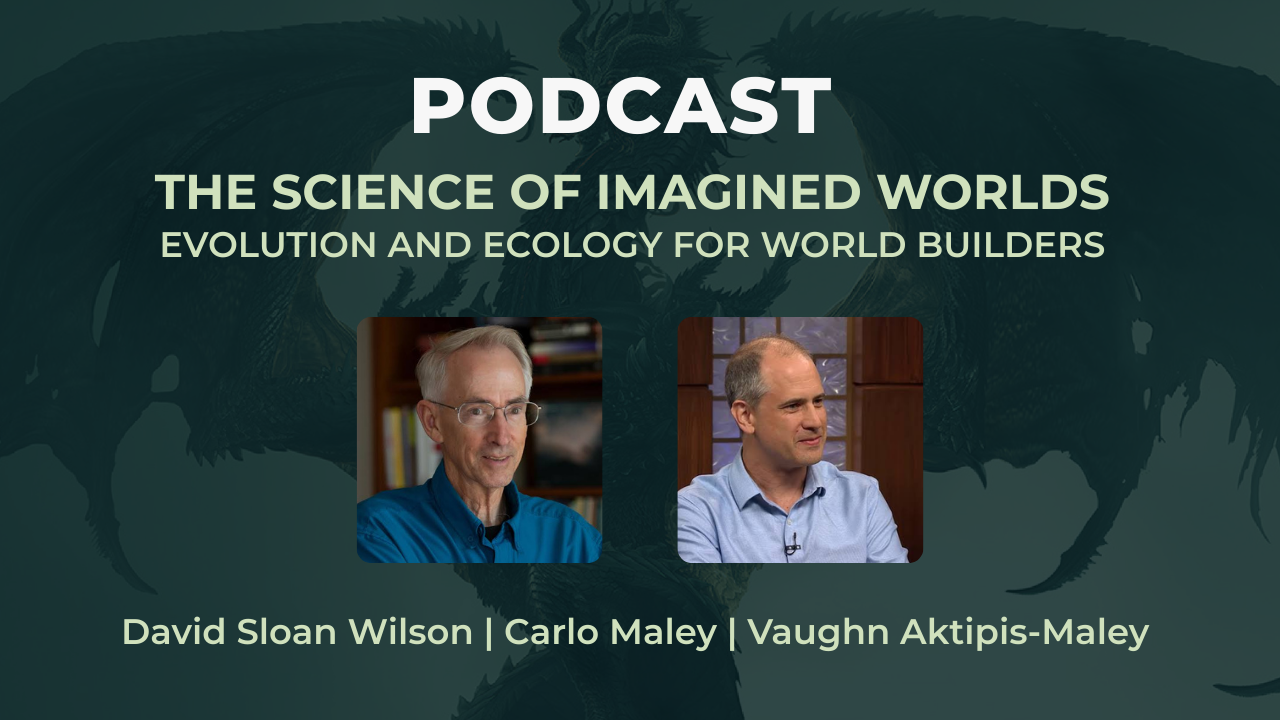
This View of Life
The Science of Imagined Worlds: Evolution and Ecology for World Builders - A conversation between Carlo Maley, Vaughn Aktipis-Maley & David Sloan Wilson
01:21:21
Loading summary
Transcript223 lines
- [00:00]
A
Still coming in. I think this is arguably the coolest project that Pro Social World and this View of Life has ever undertaken.
- [00:10]
B
Wow, thank you.
- [00:11]
A
Evolution and Ecology for World Builders. If you haven't seen it, it just has gorgeous artwork which we'll be commenting upon. And it is also a father son effort, which makes it one of the things that makes it so cool. And so I wanted to begin by asking Carlo and Vaughn. Carlo, for those who don't know, is a world expert on cancer from a evolutionary perspective, along with Athena Actopus, your spouse. And so, I mean, we have tremendous. I mean, obviously we could have given a whole talk on that topic, but instead we have this wonderful project that you started with Vaughn. And so please tell us more about how this became a kind of a family project. And then I'd like to have Eric Michael Johnson, managing editor of this View of Life, talk a little bit about his role in the project and especially in the beautiful design. So, Carlo and Vaughn, do you want to take it from here?
- [01:15]
B
Sure, I guess. I've done many things wrong as a father, but one of the things I've done right was to get Vaughn into Dungeons and Dragons. So he started playing when he was six with me, and at that point he was like, just let me know when there's a battle. I'm going to mess around until there's something interesting happening. But then after a couple of years of that, he got more and more into it and is now running his own campaigns, his own games with his friends in middle school. So both evolution is a common topic in our household, since both of Fawn's parents are evolutionary biologists and Dungeons and Dragons. And so we were tossing around ideas about how to make stories more realistic with respect to what has evolved and wanted a bunch of ideas, and I had a bunch of ideas. And our colleague Beckett Sterner at ASU is also the third author in this paper who also plays D and D with us sometimes. And so we roped him in and decided we should really just play around with some of these ideas that help us think about the world and also the worlds we're building and lead us down interesting paths.
- [02:30]
A
Awesome. Vaughn, what's your view of this?
- [02:34]
C
Yeah, I just kind of remember one day talking about how if owl bears evolved from owls or bears, and we kind of collectively decided they probably evolved from a type of bear.
- [02:44]
A
Oh, yeah, I love it.
- [02:46]
B
Yeah, that's box one in the article.
- [02:48]
A
Box one. I think, just to quote the introduction, we love owl bears as much as you do, but how could the Fusion of an owl and a bear possibly make any sense. See box one.
- [02:59]
B
Yeah, that was one's idea.
- [03:02]
A
So that's awesome. Well, Eric, can you talk a little bit about how you sort of managed this project and how you added the design element to it? Sure.
- [03:12]
D
I believe that it was over a year ago that Carlo and some co authors sent a peer reviewed paper looking at. Well, basically the topic of this article looking at role playing games from an evolutionary ecological perspective. And at that time T Vol did not have an academic journal aspect, so we unfortunately had it turned down. By the way, we do have an academic journal now, everybody. So please send in your. Your ideas for peer reviewed paper. And when we did have the journal, I contacted Carlo and asked if there was any other projects that he was working on. And he mentioned a little thing that he was about to present. I believe it was at Gen Con. Is that right?
- [04:05]
B
That's right, yeah.
- [04:07]
D
And so we began collaborating from there, talking about how we could adapt that into an article for T Vol. Which then once we. I started looking through the material, there was so many rich opportunities for adding art and making this into a product very similar to what Dungeons and Dragons would produce. And I've been a Dungeon master for about 20 years and have been. It's my primary means of social activity. And so we just began putting together design aspects, finding fan art, because art is such an integral part of fantasy landscapes and we wanted to be able to show very vividly what kinds of things we were imagining. And so then we just sort of took it from there. It's been a. A passion project, I think, for everyone involved and we were just thrilled to be able to put it out to people.
- [05:15]
A
I wonder if it's possible for Juliet or someone to actually be displaying some of the art from the document by screen sharing while we continue to have our conversation. Would that make sense? It seems to me that that would be great. Juliet, could you do that? Is that a good idea?
- [05:32]
E
Sure.
- [05:33]
B
I can get that set up in just a minute.
- [05:35]
E
Okay.
- [05:35]
A
And so with that, let's launch into the contents. Eric. And if I could just pass the baton to you and then to. And then this could. This, this part of the session could go on as long as it wants to, but need not be long because I think that there's all kinds of comments and so on. I'd like to have the. The Q and A basically carry the conversation beyond a. Beyond a certain point.
- [05:59]
D
Well, I wanted to start by asking Vaughn a question, if that's okay.
- [06:03]
C
Yep.
- [06:04]
D
What is your favorite Monster from Dungeons and Dragons?
- [06:09]
C
That's a really good question. Actually. I, I never really thought about that too much, but they're definitely a couple of my favorites. I think probably a close one for me would be the owl bear, which is partially why I was thinking about it.
- [06:25]
A
But.
- [06:26]
D
And what makes it so. Go ahead.
- [06:29]
C
No, go ahead.
- [06:30]
D
What makes it so cool for you?
- [06:32]
C
I mean, I thought the fusion of an owl and a bear was really interesting, even though it didn't really make any sense. So I was just kind of curious about the creature.
- [06:45]
B
There's a, there's a recent expansion, an unofficial expansion to Japanese and Asian culture called Rio coast guy.
- [06:54]
A
Is that right?
- [06:54]
C
Yeah.
- [06:55]
B
That has Kaiju and other Asian monsters that Vaughn and his friends are playing with now.
- [07:02]
C
Right? Yeah, we're currently.
- [07:04]
A
Oh.
- [07:04]
D
And so in talking about the Al bear and the idea of convergent evolution. Dad, how does convergent evolution help explain these familiar monster tropes in very different ecosystems?
- [07:21]
B
Yeah, so conversion evolution is when you get the same kind of body shape because there's similar pressures on the evolutionary pressures on the organisms swimming. Mammals have roughly the same shape as fish. But in this case we're trying to understand how you could get a bear type ancestor to evolve some owl features. Feathers actually are very good insulators. We thought maybe feather that it might be have been evolving in the Arctic and evolved feather like structures that would be independent of the kind of feathers that evolved on birds, but also the kind of shape that owls have. Some of the owls have in their heads for amplifying sounds and detecting creatures under the snow could easily evolve multiple times. And in this case in the owl bear for detecting prey underneath the snow. So that was our best guess of why you might get something similar to an owl bear.
- [08:19]
D
Well, all these aspects have to do with what Darwin termed as fitness. And so why is it useful for world builders to think about fitness when designing new species?
- [08:31]
B
Sure. So I mean, we're familiar with this sort of idea of the circle of life, how things fit together in ecosystems. And I remember asking a elementary school teacher one time, do they talk about why things. Things fit together? And they weren't really sure. And I said, well, it's because the things that don't fit well die and they disappear. Those only things that sort of work well in their environment survive to pass on their offspring. And that helps to make a coherent story about what's going on in the world around the protagonists of whatever world you have is to think about how the various things work together could survive. And I'm not talking necessarily just about cooperation. Right. There's predators and prey that fit together, but they're in kinds of arms races. There's a lot of interesting dynamics of all sorts in evolutionary ecology that we love to explore and think about.
- [09:28]
D
Well, one of the most unique environments in Dungeons and Dragons and Tolkien incorporates ideas from this quite a bit. In the caves that his heroes journey through. You argue in the booklet that instead of being dark skinned creatures, creatures that evolved underground, such as the drow or orcs, would probably be albino and might rely on echolocation or enhanced hearing. So if we reimagined underdog creatures through the lens of cave biology, what other kinds of changes would you expect to see?
- [10:07]
B
Yeah, so most cave creatures lose their sight. Although there is an idea in Dungeons and Dragons and some other stories of having night vision or dark vision or infrared vision. But even in Dungeons and Dragons it's very limited. And so it turns out there's a fair amount of resources that go into building an eye. And so if eyes are useless, you start getting selection for organisms that don't have eyes. And that's another example of convergent evolution. Most cave creatures have lost their sight. And then of course, it doesn't make sense to spend resources on, on camouflage or pigmentation when you can't see anything and nothing can see you.
- [10:46]
C
I kind of want to add something to that, which is there is a lot of this stuff with a lot of bug cave creatures where they do have a lot of these, you know, natural traits of living in caves, but it doesn't really make sense to not incorporate those with the other creatures that live in caves like mammals.
- [11:01]
D
And there is a mechanic in Dungeons and Dragons for this very thing. They call it tremor sense. So some creatures actually can feel the vibrations of others moving around in their environment.
- [11:11]
B
Right. And then we also see echolocation evolving multiple times. Another example of convergent evolution. And it's not just dolphins and bats, but there's some cave birds that evolved echolocation as well. So replacement for sight.
- [11:26]
D
So what are some of the storytelling opportunities that emerge when you incorporate these kinds of evolutionary conditions on fantasy creatures?
- [11:38]
B
Well, one of the ones that struck me is parasites. You know, we don't think and build parasites into our stories very much, but they're ubiquitous in the world. Everything has parasites. Even bacteria has parasites. And so, you know, one of the, one of the suggestions that we put in the article was, well, you know, what if you've just killed a dragon and you think the story is over and you can Relax. But then all the parasites emerge from the dying dragon. Dragon. Because they need to find a new host. That would be an unusual but biologically realistic situation to be in. And I think the other thing that's. I think, more obvious that shows up in ecology is that there tends to be sort of a pyramid of predators and prey. There's fewer predators and many prey. But most of our stories from underground have lots of predators and very few prey, which very unrealistic. And so if you wanted to make things more consistent with how we understand biology, you'd have to rebalance things in terms of predators and prey and different levels of the food web.
- [12:48]
D
Well, you also bring up life history strategies and how that could be a factor for fantasy creatures. So, for example, pixies versus dragons. How would you talk about life history strategies based on these fantasy creatures?
- [13:06]
B
This is actually part of the origin of this project. I teach evolution at Arizona State University, and one of the exercises I do with my students sometimes is talk about life history, which is this idea. There's different strategies for getting by, and we often put them on a continuum from live fast, die young, like mice with lots of babies and very short lifespan because they're getting killed by predators. And then they grow slow, die old, like humans or elephants. And there's a bunch of correlated traits among these strategies, which I teach the students. But then I say, well, we can actually look at a fantasy species like orcs or dwarves or elves or hobbits from Tolkien, and you can see some of these life history traits we know about the lifespan of dwarves and elves are longer than humans in these stories. But there's many other correlated traits that Tolkien never told us about that you can actually infer from life history theory. And so I was actually not happy with the. There's very little discussion of life history theory in most evolutionary biology textbooks when you're teaching. So I was trying to supplement it, and I couldn't find a good article. So eventually I wrote up this idea in an article which is, I think, what you referred to earlier, but the one we had submitted to this view of life. We eventually published that article in a journal called Evolution Education and Outreach, where we showed that you can teach life history theory through these fictional species. Then we actually did a study of our students. Half of them are randomized to read a traditional article on life history theory, half on this Tolkien article. I can tell you about the results of that.
- [14:46]
A
Don't stop.
- [14:48]
B
Okay, well, so we then measured the outcome of how they performed on the exam questions that had to do with life history theory. And we got absolutely zero effect. Like there was no difference between those who'd read the fictional story or the story about the fictional species versus real species. The editors actually thought that was interesting, that it wasn't harmful for them to take time away from real biological species.
- [15:14]
A
But.
- [15:14]
B
But we actually, because of Athena's suggestion, we surveyed the students about their experience of reading the articles. And we saw huge effects in terms of how much fun they had, how much more interested it made them in life history theory. Reading the fictional one was much better than the traditional one. They thought that it helped them on the exam when it didn't. And we had actually two control questions which was, do you know about Tolkien? And do you like Tolkien's Lord of the Rings stories? It turned out there was an interaction. The students who liked Tolkien did better on the exam if they read the Tolkien story. But there's a more general principle here, which is the end of my exercise to do with the students is I ask them, choose a fictional species that you like from whatever genre you like, whatever culture you like, and do the same exercise. What's known about the life history characteristics? And what can you infer from life history theory that isn't known? Like, maybe orcs and goblins probably had more than two mammary glands because they had to have a lot of offspring quickly. Tolkien never mentions anything. In fact, you never see any female works in Tolkien's work. And the point there is that it allows. It gives students a way through their own culture and their own interests to learn about the biology. And that's the other thing the editors really liked in that story. So that will that into a current campaign or world I'm running in D and D. That has all to do with life history theory and how orcs and goblins might change if elves and humans and dwarves have been exterminated. And the pressure, the evolutionary pressures on them had changed and which led into this article that we wrote for you guys.
- [16:57]
D
Well, I was going to ask Vaughn, how have you incorporated some of these ideas into the games that you run?
- [17:04]
C
I mean, I haven't incorporated a lot of things yet since I haven't gotten a chance to run many campaigns since, you know, we made this article. In fact, the only one I've been able to run is this one. So the one that I'm currently doing.
- [17:18]
B
The one based in the Japanese mythology.
- [17:20]
C
Japanese mythology. But I am incorporating the things such as, you know, dwarves in Druagar having, you know, white skin rather than dark skin, and Similar things like that.
- [17:32]
B
I also like that point you brought up earlier about the, the albinism, the white skin and cave creatures. Because there is some controversy of racism around Tolkien's work, that orcs are usually framed as black. And, you know, the old Western idea of black is evil and white is good. I sort of liked this. If you just sort of follow the biology, the evil or the bad guy species in a lot of these stories probably would have had white skin.
- [18:06]
D
So you also talk a lot about monstrous food webs as a way of guiding the creation of ecosystems. Why is it important to talk about these food webs rather than food chains?
- [18:23]
B
Oh yeah. So we make this point that we used to talk about food change. This is sort of linear idea that, you know, herbivores eat plants and carnivores eat herbivores. But it's a lot more complicated in real ecology because any given species will often survive off of multiple other species. So herbivore might depend on a bunch of different plants and another herbivore might depend on some of those same plants, but some other ones. And carnivores can eat both plants and, and animals. It's actually a web. So the term ecologists use is a food web, including things like parasites and then detritivores that are eating detritus on the forest floor and the organisms that are decomposing bodies. So there's all kinds of different ways of making a living, not just the traditional simplified plants, herbivore, carnivore that we tend to think of. And that opens up more ideas for possible monsters or creatures or pets.
- [19:19]
D
And how would this change the stories people tell? For example, you would think that dragons would need a great deal of food.
- [19:27]
B
Yeah, yeah. So, right. Dragons would need a huge amount of food. So one of the things we speculate in the article is that a dragon may well need to cultivate a lot of cattle or other food source and may actually cooperate with or dominate some, some creatures to help raise the, the food that it's going to need to survive on. Either that or it has to have a huge range. That is, that's that it's using to, to find prey.
- [19:57]
D
And so you can imagine an entire storyline in which the characters are interacting with the, the shepherds that work for these dragons.
- [20:06]
B
Indeed, indeed. Yeah. I'm looking forward to having that as a component of my story. A continent that's mainly dominated by dragons, but has a whole social structure underneath to support their feeding needs.
- [20:21]
A
Yeah, let me come in here because I think that it turns out that in History, Sparta. We all heard about Sparta as one of the Greek societies back then. That was one hell of a predatory culture. That was a culture of military culture. And they actually explored, exploited the farmers of the region in a predatory fashion. So their food base was very much one of being predatory and also relying in an exploitative sense on their food base. So I think you could actually take that as a real world historical example and learn from it.
- [21:04]
B
Yeah. Let me give a shout out to Brett Devereaux, who's had a great blog. He's got a series of articles called this is Not Sparta, with periods on each word. The difference between the reality of Sparta and the myth of Sparta that we tend to tell. They only won about half of their battles. They were not military geniuses, and only about 10% of their society were citizens. The other 90% essentially were slaves. It was incredibly cruel society.
- [21:34]
A
Yeah, great. I didn't know about that.
- [21:36]
B
Yeah. Brett debrow is. You search on him. He does a lot of great military history and also actually has applied it to Tolkien and other fictional worlds as well. He's a lot of fun and a wonderful thinker.
- [21:51]
F
Can I interject real quick about the dragons? I think one of the biggest things there is they probably have a huge slumber period, like where they have to digest all that food they eat. So they probably collect it. They come out and raid and create destruction for like a cycle. And then they probably have to sleep it off because if they're doing it all the time, then there's not going to be anything left unless they're right badlands. So probably they're going to be sleeping that after. That's when people are searching for the dragons, you know, just right. You have a chance. And then you wake them up and then they're really angry, like, you know, you waking a bear from hibernation.
- [22:23]
B
Yeah, that's a good point.
- [22:25]
C
Yeah.
- [22:26]
B
And a good hook for stories, too.
- [22:30]
D
So one of the things that I found fascinating about the discussion you brought up was about the species concept and how it applies to fantasy. So what does it matter for fantasy stories about who is mating with whom?
- [22:48]
B
Okay, yeah. So it turns out it's hard to define a species. It's been a long running debate in evolutionary biology and biology in general how to define a species. But the rule of thumb we use for sexually reproducing organisms is that if two organisms can mate and produce fertile offspring, they're part of the same species. You think of this gene pool of all the possible genes that could potentially combine in the future through various matings. So I think, to answer your question, there's two major implications of this. The obvious implication is if what we think of as these species like orcs and humans are not actually separate, that they can produce half orcs, then your world is going to have various gradations of half orcs and one fourth orcs and three fourths orcs, et cetera. And they're really part of the same species. And you'd get. You'd see different things in that world as opposed to if they can't reproduce, then they're going to be very separate. You'll never see those gradations. But what struck me thinking about it later was if you do accept that you can have half orcs like Tolkien has, and then Dungeons and Dragons has had until just the recent update, and half elves that are fertile, that's Clerion Tolkien, then that suggests that elves, humans and orcs are actually all versions of the same species. And, and one implication of that is that orcs should have the same kind of moral capacities that humans and elves have. And for me, that was a real sort of flipping of the, of the script, if you will. And it implies things like, well, maybe the reason we think of orcs is so evil is that because humans have written all the stories about orcs. And so it's all very biased and we should take the orcs perspective on this. And so we delve into the sort of the moral implications of that species concept, I guess.
- [24:41]
C
Yeah. I would also like to add into the conversation that in older editions, I'm not sure if this is accurate to actual D and D anymore, but there was a thing called the dwelf, which implies that also dwarves and elves are part of the same species.
- [24:54]
B
Which then, yeah, it's funny, we never, in these, in D and D and in Tolkien, we never hear about half dwarves or half hobbits or dwelves. But yeah, it's a decision in a world maker has implications. The decision world makers can make about what kinds of organisms are going to be or people are going to be populating their world also.
- [25:22]
F
So you bring up biologically compatible to create offspring.
- [25:27]
B
Right, right.
- [25:29]
D
So you bring up this question of the moral capacities of the different morphs of what could be a single species. You also bring up a interesting idea that I had never considered before about kobolds. Could you tell us about that first? Maybe explain what kobolds are.
- [25:48]
B
Okay.
- [25:49]
D
Would be good for that.
- [25:50]
B
Yeah.
- [25:51]
C
Okay. So kobolds are portrayed as like many different things. Sometimes they're dogs sometimes they're weird lizard people in dnd they're currently lizard like people who serve dragons a lot of the time. But they tend to hunt in big groups. And in fact they have an ability called pack tactics which makes them really effective in groups of three or more.
- [26:16]
B
Yeah, they're small and traditionally they're the kinds of opponents that characters run into early in their career when they're. When the main protagonists are weak and they're appropriate monsters there. But they fight in large groups. Right. So we think of them, we have thought of them as these sort of enemies, if you will. And it struck us that given that they only work in large groups, the capacity, the ability to work in large groups probably is underpinned by either a strong capacity for cooperation or genetically determined structures like we have with ants or bees, where there's a lot of sterile workers and a fertile queen. But we'd sort of delve into the former idea that, well, if they're really cooperative and there's no evidence that they have in the stories that they have this sort of queen type and sterile workers type structure, if they really are so cooperative, you probably need a lot of empathy to be able to build that kind of cooperative large scale mass action that the humans are famous for in our real world. Given that kobolds are even more cooperative than humans, maybe they're even more empathetic than humans. And that was a sort of striking idea that these thoughts led us down this path, that maybe kobals are actually the sweetest, most empathetic creatures in the Dungeons and Dragons world.
- [27:52]
D
And there's a famous painting recently of three kobolds and a trench coat. And to pull something like that off, you have to be highly cooperative.
- [28:03]
B
Right.
- [28:06]
D
So this kind of touches on some aspects of cultural evolution. And anthropologists often refer to cultural practices adaptive, like taboos that reduce disease risk. How might cultural evolution work hand in hand with biological evolution when creating believable fantasy societies?
- [28:28]
B
Yeah, actually, let me just address Ayala's comment just now. I apologize that this conversation has been so D and D focused. I mean, the whole idea behind the article is more general about world building. So yeah, we're D and D players and there's all these examples are coming from D and D. But this applies to anybody who's building a world. So if you're doing science fiction or fantasy and having your own world, these are the ideas that you might engage with to build a more realistic world. And I'm happy to talk about non D and D science fiction. Fantasy settings as well. So my apologies, Ayala, about such Dungeons and Dragons focus.
- [29:14]
D
So about cultural evolution, right, so.
- [29:22]
B
Cultural is this. You can think of culture as a set of behaviors and I'm not a cultural anthropologist, so I'm going to be very naive on this, but you can think of it as a set of behaviors that are passed down along with genes among creatures. And so those cultural innovations that, that support the fitness of the organisms will tend to persist more than cultural innovations that lead to extinction of populations. So for instance, in my current world that I'm playing with, we think of goblins as these sort of fast life history creatures that have short lifespans and also have to only can really affect the world well through cooperation. They might need to evolve cultural structures to allow them to do long term planning across generations. And so in my world, there's a whole oral history tradition in my goblins that allow them to do this.
- [30:27]
D
Well, why don't we open things up to the audience now and if there's any lulls, I can pick things up. Is there anyone that would like to ask a question to either of our guests?
- [30:39]
A
Yeah, I'd like to say we've had in the chat some people who are, are expressing disappointment and I think I would like them to speak up to see what's, what's lacking in this conversation. Don't just leave, please. But what is lacking in this conversation for those who are not, not encountering what they thought they might encountered? I think that would be the most helpful thing to do and thank you for contributing to the chat. So, so with that, let's, let's go on to a Q and A. Yeah.
- [31:06]
B
Sheila's raising her hand.
- [31:08]
G
Hi, I work in Washington in the national security space and I write war gaming scenarios. I found this discussion very interesting because there are patterns. I'm a complexity scientist and I look at complex social system behavior. And absolutely everything that you talked about is relevant to me because I write fantasy scenarios every single day across everything from deep space to cyberspace, everything in between, and cultural issues, internal and external, economic, political, social, technological. We look at threats everywhere. And a lot of your work is very relevant to me. And so I guess what I want to do is learn more.
- [32:08]
B
Yeah, so we. So actually, as David mentioned, I work on cancer, which is a complex adaptive system also. And one of the things we think about, I think is relevant to you is what are the pressures you can put on the system that will help it evolve to a more benign state. How can you interact, I guess for national security, you can ask how can you change the pressures in the system to encourage more cooperation, less warfare, et cetera?
- [32:39]
A
If I could insert my prerogative if you don't mind. That's such an important point you made, Sheila, that so many people that are doing various scenario building not in fiction but in the real world, attempting to forecast things in the real world. Their knowledge of all the psychology and evolutionary stuff is no better than people who are making fictional worlds. And isn't that amazing? So I think the basic literacy in ecology and evolution, which in this context is being applied to world build, fictional world building is just as relevant to non fictional world building that. That basic. That basic literacy and that's really gets to the central mission of pro social world is to. And this view of life is to. Is to give. Make this basic literacy available to everyone. And it's shocking when you think to the degree to which that's needed basically. So I'm really happy that you came in with that point and sorry for interjecting here, but. So let's return to our. Or maybe Carla, you might want to.
- [33:43]
B
I want to add one thing is. And one of the reasons I do this and think about this is I think that we should. We need to. We ought to take our stories seriously and our fantasies seriously. And we do that with dystopias. We think about what we don't want to happen. We do that some with utopias of things we would like to happen. But I think that taking stories and seriously and trying to make them as realistic as possible, even in a fantasy or science fiction setting can help us envision how we want to change our world for the better.
- [34:18]
G
Well, understanding system dynamics and system behavior is extremely useful. System characteristics like adaptation and open system boundaries and things that relate not just in physics but but in sociology and psychology and political science are all relevant.
- [34:40]
H
The.
- [34:41]
G
The problem that I've dealt with as starting out as a physicist and then becoming a social scientist is that they're interdisciplinary and academic departments hate me because I don't fit in in their world. And it's really one of the reasons I became a practitioner was that academia pretty much said I didn't fit anywhere.
- [35:06]
B
That's why we came to Arizona State because they. They.
- [35:09]
G
I know Arizona State's work.
- [35:11]
B
Yeah, very interesting, Brian. Yeah, good. Cheryl, did you want to say something?
- [35:18]
H
Yes. In envisioning a different future, games that are about warfare always concern me because in the natural world, well, for. For instance, we send our young men out to get. Get killed in. In droves. Okay. And in the natural world, the, the entities that die are the weaker ones. Okay. With the, the carnivores go after the weaker, the ones that won't survive and that sort of thing. So it's interesting to me because there are games. I mean if we want to look at games. I see so many games is about war. But there is one like for example, I think it's called Wildcraft, but I'm not real sure the name where, where the, the purpose of the story is everybody has some sort of, of health issue and they're going out there to see the plant, they're out to find the plants that's going to help them. But you don't win by the first one who gets their plant because when the first one gets their plant, then the next thing is they cooperate with somebody to find theirs. And so the whole purpose is they all. How much time does it take the whole group to come back and everybody has what they need. So that's my concern is that in envisioning a future we seem to be envisioning the same win, lose stuff that we're, we're that's getting us in this situation. Begin with hierarchies, all that kind of stuff. Why are we thinking hierarchies when there really is a web of life? You know, so that's, that's my concern because.
- [37:09]
B
Yeah.
- [37:10]
H
Doing anything different, you know.
- [37:12]
B
Right.
- [37:15]
E
Whenever it's my turn.
- [37:17]
B
Yes, go ahead, Karen.
- [37:19]
E
I wanted to respond to some earlier comments. So definition of culture was offered as a set of behaviors. I wrote this down, I'm reading my notes. A set of behaviors that are passed down along with genes and those that support the organization will tend to persist. I don't think that many people would. I think many people would disagree with that. There actually are hundreds of definitions of culture. But in this group, which certainly includes me, the notion of the individual is that he is enculturated. Which is to say that behaviors include the representations, the narratives, the concepts, the categories that the individual uses to interpret the world and to process information. And there are multiple equilibria, some greater dominate others and really dysfunctional ones can be passed down. A study was done a few years ago showing that that antisemitism in villages in what is today Germany at the time of the Black Plague, which is about 1350, predict votes for the Nazi party in 1928. Now no one can say that that is because these things were somehow adaptive. On the contrary, and this is why I think it is so great that people like you, whether in fiction or in the real world or a combination are looking at culture and cooperation is that there are many dysfunctional cultures out there. And one of the challenges that economists are trying slowly to rise up to is how to change culture. It's man made, so men can change it in a way that works for everybody. And, and so we, what we want first, a much broader definition of culture. And we want second, to recognize that there is no presumption that the best cultures survive. You know, just as in evolution, there's no concept, you know, there's no idea that the best creature will survive. It all depends on who the, you know, what, what, what the predators are around. And I think it's just great to bring fiction in because, you know, and I'd like to see your experiment on, you know, who's, who learns the most from a fictional account versus none. Because one thing that fiction does is it enables you to engage without feeling threatened. You know, if you talk to me about the real world, I'm going to be self protective. You know, I'm going to worry, are you accusing me? God forbid. You know, whereas it's fiction, I can throw myself into it. And something that I've been working on a lot lately is theater for development, which is an intervention, you know, participatory theater, which is an intervention that comes up with stories that really encapsulate many of the conflicts that occur in the village, but with fictional characters and, and after presenting it for, let's say, 20 minutes, then volunteers in the audience can go on stage one at a time and play the role of one of the victims, you know, put his costume on and try to change the story. And we're finding that this kind of participatory theater, which is called forum theater because it creates a forum for discussion between actors and, and the audience actually generates a reduction in domestic violence.
- [41:18]
B
Nice. Yeah, I agree. Let me say you said a bunch of things, so let me address a couple of them. I did not mean to say that that culture is determined by natural selection. I meant to say that there can be an interaction there and that that interaction that maybe a little bit of bias effect of natural selection can help us think of ideas for our stories. But, and yeah, I'm not, I'm not an expert on culture, and so I apologize for maybe misleading about that. I really like your point about the sort of distance you can get from fiction to engage with things that maybe get around defensiveness or fear. In fact, the world that I'm playing with, my friends, we're Engaging with issues of racism. And we're all, you know, basically we're all white men and it's a hard thing for us to engage with without, you know, worrying about making a misstep and getting piled on and stuff. So in our world there's hobgoblins that are sort of on the higher end of the hierarchy and they're discriminating against the goblins. And you can play a hobgoblin or a goblin or an orc or a bugbear and engage on both sides of that, take on the role of the, of the victims or the perpetrators or you know, they maybe this, this, you can be a hobgoblin that sympathizes with how awful, awfully the goblins are being treated. And so we're trying to use that, that distance to allow us to engage with those ideas in a non threatening way and hopefully grow more as people.
- [42:52]
E
Have you written on that? I'll look at it if you have.
- [42:55]
B
I'm working on a novel that. Thanks.
- [42:57]
E
Yeah, okay.
- [43:01]
A
Go ahead. Let's go on to Chip.
- [43:02]
C
Yeah, but no, do we, did we answer Cheryl yet?
- [43:06]
D
Oh, sorry. Yeah.
- [43:07]
B
Oh yeah, let me, yeah, let's, let me answer Cheryl. I apologize. Yeah, yeah, yeah, yeah, yeah, sure. I completely agree. And actually one of the things I like about role playing games is that it's, it's really a structure for group storytelling so you don't have to tell stories about war. And a lot of, there's a lot of interest and, and adventures that are all about things like finding a cure or solving other problems together. It's true that combat is often central to the stories because it's an easy way of having drama the way I think of it. But it's really up to the group what kind of stories they want to tell in these role playing games. And so there are structures, non warlike structures for dealing with this.
- [43:54]
F
As a teacher I was when I first started getting into RPGs back in like 20 shoot, 15 or so when I started thinking about ways I could use RPGs to teach. My students were around third grade. One of the ideas that I had was creating. I created a virtual world. Like, you know, I kind of took up, tried to use nonviolence as the main way to solve things because they were third graders and I didn't want them to resort to violence to solve everything. And so some of the ideas that I had was, for example, it could be used in education for teaching about, let's say pollination, bees, whatever they're Dying off and you don't know why. And you're trying to figure out what's.
- [44:42]
A
The cause of.
- [44:45]
F
Them getting sick and what's cause of something, but perhaps you don't even know it's the bees. Maybe something else in the ecology of the world is starting to fall apart, starting to break down. You know, maybe some other creatures or some other land is starting to die off. And so with that you're having to figure out what is the core thing is the bees, they're not working anymore. You know, it's like another way if you, if you want to try to avoid the more war and aggression. You could think of it in ways of ecology exactly like.
- [45:17]
B
Right.
- [45:18]
F
It's going off is making another thing. It's a chain reaction to other things. And you have to try to find your way to that core issue to be able to solve it.
- [45:26]
B
Yeah. Let me say one last thing before we get to Chip, because I'm aware that Chip and Dana have been waiting patiently in Dungeons and Dragons and a lot of these role playing games. Often it's the case that people try to avoid combat because it's, it's, it's dangerous and it drains your resources. And so there tends to be a culture of can we find a creative way of solving this problem without getting into a fight? Which is another thing I like about the game. And I guess fundamentally the game is usually about cooperation. It's a team of people trying to solve a problem. It's not one group against another and there's no winning conditions like that. So. So I actually think there's a lot of pro social aspects to these role playing games. But let's, let's go to Chip.
- [46:06]
I
So my question is actually for Vaughn, but I have to let, I have to pick up on what Sheila and now Jeff has said because what you are talking about intellectually is far more widely applicable than just the worlds that you and David work in. So Sheila, when I saw your name, I couldn't believe there were two Sheila Ronis's in the world. But as I recall, you used to work with my friend Dick o' Neill and Lynn Wells and Andy Marshall at the Office of Net Assessment and elsewhere.
- [46:45]
G
That is correct.
- [46:46]
I
Dick. Dick and I organized an event at the USC Film School with among others, a guy who did Minority Report. And so it was a group of film folk and a group of peace builders. And I. Dana, you may. I don't think you were there, but you might. People like you would have been invited. And it was a remarkable interplay of very different minds. But then, David, when we did the event at Carnegie last winter, we didn't get that far because an awful lot of national security folks and an awful lot of peace builders are locked into the existing paradigm and playing with creating dystopian and non dystopian worlds. It's really very useful. And for what, Josh, you just mentioned. I'll throw this in the chat after Vaughan answers my question. There's a remarkable guy named John Hunter who wrote a book called World Peace and Other Fourth Grade Accomplishments in which he has fourth graders do that kind of role playing work dealing with wicked problems. And it's just remarkable. But, Vaughn, the question for you, and I don't know if you'll be able to answer it, my grandson starts ninth grade on Monday, so he's like, you know, probably a year older than you, and he plays Dungeon and Dragons song, but he plays Palladium a lot, in part because he. It's only playable with his friends in real life. And you clearly play with your father and not other parents. Kirill will not play with either his parents or let alone his grandparents. How did you get your father to play with you?
- [48:47]
C
So, actually, it was kind of the other way around. I was introduced to the whole tabletop RPG from my father. So a lot of the, A lot of my experience and everything from D D comes from him. He's like the player's handbook that doesn't involve reading. So I usually just play with him or my friends. But, yeah, he. It's the other way around for us.
- [49:17]
B
You can imagine how proud I was when he started his own group and was splitting off from me and running, doing this for his friends.
- [49:24]
I
It's like, oh, well, in our, in our case, it was one of Kirill's friends, fathers who had played Palladium as a kid, who was then doing a rotation at darpa. And he introduced all the boys, it was all boys to Palladium. And then they froze all the parents out.
- [49:47]
B
All right.
- [49:47]
I
And by the way, Vaughn, my grandson, who had hair longer than yours until a week ago, decided when he's going to ninth grade, it was time to cut his hair.
- [49:55]
D
Okay.
- [49:57]
B
Whatever he wants.
- [50:00]
I
It was his decision.
- [50:01]
A
Right.
- [50:02]
B
Good.
- [50:03]
J
Dana, wonderful conversation. I had lunch yesterday with a guy named Jack park, and Chip just mentioned that because he's. The guy has been doing a lot of work in sense crafting, although he doesn't like the term gamification or gamifying, but. But sense crafting as a process. And I want to link it to the Peacebuilding at home Hub. But the discussion was around of course, crafting the game process and the reward structure to generate the kind of behaviors that you want. That also brings to mind both kind of the classic finding that the one thing that turns you into a self interested Wall street trader in behavior is taking economics classes, right? You get told you're, you're supposed to behave that way and therefore you do. And what we also know is of course that the cultural dynamics. One way of thinking as a sociologist about, about cultures is they're the rules within which individuals can behave strategically. But the dynamics of rule evolution are, it's a, it's a meta evolution, right? It's either the winners write their rules or through a memetic process, everybody sees what other people are doing and does that and that then generates a set of rules. So how do we then as a practical game design question, how could we mechanisms like that into, into a game so that if not necessarily in a single round but over a series of games, you could, you could have these, these processes illustrated. And of course this speaks to kind of the, some core debates to what I know in evolutionary theory around, you know, you know, the evolution of, of co. Cooperation and all of that kind of stuff. So it's, I think it's an, it's an interesting question both practically and then, and then kind of it also gets into the question in terms of understanding the, the dynamics of evolution.
- [52:15]
B
Yeah, it's a good point. One of the things that I like to do with my players when I'm playing these games is give them an opportunity to create things like create a religion, create a society. Like if you overthrow the evil empire, what next? What do you build in its place? And we don't usually do that a lot in our stories, but, but it gives you the, it puts in your face that well, what do you want the world to be? And then how do we build that?
- [52:48]
A
Yeah, well, my comment follows directly upon Dana's and I often use the game of Monopoly to explain multi level selection. And I asked people to imagine playing the normal game of Monopoly which was all about cooperation, competition among individuals within a single group. And so everyone knows how to play that game and it's fun in its own way. Then I asked them to imagine a Monopoly tournament in which the trophy goes to the team that collectively develops their real estate the fastest. And it turns out that people know how to play that game too, and they enjoy it probably even more. And I've actually done this transition with real people in a science club High school science club and to see the transition between the first the single game and the tournament and to see them come to life and to discuss how to do this, you know, oh, you'll be the banker, you'll be this is this and that and of course if we want. So there, what you've done there is you've changed the context from within group competition, between group competition. If you ever wanted to foster cooperation between groups, what would you have to do? But a tournament of tournaments, you'd have to add another layer on top of that. But the really point here is that what you get depends on the population structure that you put into it. And so there's, we're creating the underlying social environment basically can make all the difference and people have an intuitive grasp of what, what of the social environment in which they're operating and, and without any instruction at all, they kind of know what to do. So anyhow, I think that's a board game but I think everyone can see the implications of this for everything else that we've been talking about.
- [54:37]
B
Yeah.
- [54:37]
J
And the question is kind of like how could you build that mechanism in as of, of kind of rule, rule evolution as a subtle point so that the aha conclusion at the end of the game is oh my God, I can see how we all turned into brutal self interested.
- [54:57]
A
Well, yeah, I mean, I mean basically this brings us right back to the real world. If you want to find out why. So businesses are toxic, it's because they unknowingly created the single game of Monopoly.
- [55:08]
J
Right.
- [55:08]
A
And when we work with real groups it's all about implementing Eleanor Ostrum's core design principles. And essentially that's like setting up the Monopoly tournament. And so there's a whole pipeline here from fictional world building to actual world building. So it's, you know, I didn't expect that to come through so strongly in this meeting, but it has.
- [55:34]
B
There's a microcosm of that in these D and D games because they're cooperative. What you often see is not the people trying to make their characters the most powerful possible, they're trying to figure out how to maximize the power or the accomplishments of the team. And so they'll give each other powerful items rather than trying to hog them for themselves to try to maximize the effectiveness of the team.
- [55:59]
C
I also wanted to mention if you've ever played a D and D campaign where the team is evil, a lot of the times it doesn't work is because they're not cooperative with each other.
- [56:07]
A
Okay. The whole thing's playing itself out.
- [56:09]
B
Yeah, we saw that with some of the 12 year olds one night. Actually, David, it was what we call a one shot adventure. So it's not a whole series of adventures in the campaign, but just one off. And just like the one shot Prisoner's dilemma, it just devolves into backstabbing and getting in each other's way and not cooperating.
- [56:28]
A
Yeah, that's amazing.
- [56:29]
D
And to answer your question specifically, David, there is an event in Dungeons and Dragons called a tournament. These are often done at game cons, but we've also held them here in Vancouver for our local D and D group where you have, in our case, we had seven tables all playing the same adventure with different Dungeon masters running the game. And depending on what happens within a specific game, they're given a boon that can be passed to another table. So you are basically winning rewards you can pass on to others. And the goal is to try and get everyone to finishing the task and being successful.
- [57:11]
B
Oh yeah. Usually you're competing against the different tables and so you get a lot of cooperation within the table, but see how far you can get in the same adventure. That's, that's cool that you did the cooperation between the tables.
- [57:21]
E
Yeah. I want to pick up on some themes that Carlo just mentioned and that David mentioned maybe five minutes ago ago, and that is how incredibly sensitive people are to the social environment. And two great experiments have been published in top econ papers recently on showing how you can put two groups that never interact, that hate each other or think the other is no good together in an environment where it pays them to cooperate and you change the people. So one of the cutest studies, it was a guy's PhD thesis, Matt Lowe was creating mixed cast cricket teams. So you had the high cast and the low cast guys volunteering for cricket teams. And the experimenter puts you randomly into either a mixed cast or single cast. And if you're in a mixed cast, you know, one month later you're just a different guy. Now you're willing, you know, the high cast who willing to trade with a low cast. You're willing to have friends with a low cast. And then another study by Gautam Ra, who was at Harvard and recently went to Berkeley, shows how when there are study groups of really rich kids that have to interact for, I don't know, half an hour, an hour a day in school with really poor kids, they become, a couple years later, basically a different species. They become generous, they're not prejudiced against poor kids. They just completely change One of the things you have to understand, or at least I've learned from history, is that when one group wants to be in power and subordinate another group, they make sure to create environments where the two groups never interact as equals and never cooperate as equals. So we have segregated neighborhoods. The rich people in one, the poor in another, or the blacks in one, the whites in another. And it's that kind of segregation that is essential for supporting this kind of bad stuff. And how to get away from it in a highly unequal world is the challenge we all face.
- [59:32]
B
Yeah, that builds on. I remember studying social psychology, and one of the main interventions on racism was just getting people to work on some project together, different races, building a house together or something. One of the best ways of breaking down the barriers.
- [59:47]
E
Who are the main people in social psychology who do that?
- [59:51]
B
Oh, sorry. This is the benefit of my Oberlin education back in the late 80s, early 90s. So I don't remember who the studies were.
- [60:00]
A
It's worth doing a review. But, I mean, the original, the prototype was the Robbers Cave experiment, where they had the kids in separate camps, and then they arranged for them to get a truck unstuck in the mud. So this is all kind of. That's the grandfather of all of those experiments. And I'll bet anything there's a large literature from multiple disciplines. And so. And it'd be well worth the while for somebody to pull that literature together.
- [60:26]
I
People have. I don't have it off the top of my head, but that literature has been pulled together by, like, people like Amy Edmondson at Harvard.
- [60:36]
A
Yeah. Gwen Alport was the Roberts Cave experiment. Sheila.
- [60:41]
E
Amy Edmondson. What's her field?
- [60:45]
I
She's in. She's a Novartis professor at Harvard Business.
- [60:50]
D
School.
- [60:52]
I
And was Buckminster Fuller's last mathematician.
- [60:59]
A
Sheila.
- [61:00]
G
Okay, just. Just quickly, I. I think you would find it very interesting that at least in the circles I'm working at, at the National Defense University, we have redefined what winning means. And it isn't just a military win. And, of course, politicians hate what we're doing, so we're trying to stay low because we're having an impact within the Department of Defense. And that's that if you don't win the peace, winning the military campaign is absolutely irrelevant, and all you do is kill people. And I think it's important for you to know that at least the generals within the Department of Defense really do care about this issue. And they are changing a lot of cultural values. And this is not something that is new. This has been Going on for more than 30 or 40 years, certainly since I've been working with the Department of Defense. And most Americans have no concept of that, but that's what the truth is.
- [62:19]
B
That makes a lot of sense.
- [62:20]
A
Yeah, yeah, yeah. Sheila, do you, are you familiar with David Ronsfeld and John Aquila? You are? No. I mean, I'm so gratified that you are because that's kind of what you're talking about, right? Yes. Yeah. So we could make a. I'll have Juliet send links to this very important concept of no politic. That's as in the noosphere, Teilhard de Chardin's concept of the noosphere in contrast to realpolitik. Precisely what you were saying, Sheila. And so it's wonderful that that's already part of your worldview.
- [62:58]
G
I'm also working with a group of complexity scientists in Cambridge, Yanir Barbara, who.
- [63:06]
A
I know him. I know him.
- [63:07]
G
Yes. Well, I'm working with him on his, on politics. I was one of the organizers of a conference where, you know, groups of practitioners across, you know, all of society are just coming together and saying, we're going to deal with this issue of the pandemic. Since the government has walked away from it, we're just going to do it because we know what to do and gonna do it.
- [63:33]
A
One thing they, one thing they say is that, you know, first there was the age of empires, then there was the age of nation states. What's next, the age of networks. And so, and, and this is something that could be very bottom up and, and, and that could be the new, the new social form. And so it's very exciting. And, and, and I think that anything we can do to coordinate.
- [63:57]
G
I'll send that link too, because you might want to join us.
- [64:01]
A
No, no, I, absolutely. This has been very generative. First of all, let me just do a little time stamp here. We don't have to end quite yet. Some of us are happy to continue for, for some more minutes. We are at time. But the main thing I want to say is that if this has really stimulated your imagination and that if you want to get involved and work together and so on and so forth, then pro Social world seeks to be a hub for that with the sue of life is one of its main vehicles for that. And, and that you could type, you could email hellosocial World and, and then we can work on collaborative potential. So, so we never want these to be one offs. We always want this to lead to more progress in, in this. And so with that we. Let's continue the conversation. Great.
- [64:54]
B
Well, count me in.
- [64:56]
A
Yeah.
- [64:56]
B
To be involved. Yeah. I think we should let my son. Let it be excused.
- [65:02]
C
Let it be.
- [65:04]
A
Let it be.
- [65:07]
C
I'll be back if this ever happens again.
- [65:09]
B
Okay, great.
- [65:13]
A
Okay. We could wrap it up here too. We don't have to go on and on. So, any comments?
- [65:17]
I
Melissa David, I really want to drive home Sheila's point again because you met Robert Gorsum and Michelle Ledgerwood at AFP a year ago and you know, they're part of that world. Sheila, I don't know if you know Ann Pendleton Julian, who has done a lot of work on world building, often by building new universities. She's an architect. And so there's a, and there is this whole world in the defense community that, you know, has been redefining. You know, you've met the John and David, but there's this whole group of them and Dana who's on this call. And at least since 911 and probably.
- [66:13]
E
Before.
- [66:17]
I
Some of us in my world have been working closely with that group. And the linchpin was this guy, Dick o', Neill, who I'd known since we were in nursery school together and who died. But, you know, a lot of, we're, we're trying to keep that Dick's work going. I don't Sheil if you know about that, but.
- [66:39]
G
Well, I, I knew his work very well and of course I knew him very well. And it's one of the things that concerns me as I'm, I'm working with the, the new War Gaming center that's being built at the, at NDU at Fort McNair right. In Washington, which is going to have more of a national security focus than a war. I mean, they're calling it a War Gaming center, but it's, it's a national security focus. And it's a little worrisome to me.
- [67:16]
C
Because.
- [67:19]
G
The federal foresight community of interest, which was heavily involved in doing issues like building scenarios and various kinds of planning capabilities for the future, has kind of died in the last six months. And we were building a real community. In fact, I was hosting in my home networking events so that almost salons so that people could come and talk. But since Trump got into the White House, everybody's afraid to even email one another about such events. And so there's some serious issues that we're wrestling with and we've got to overcome those, which is why I said, yes, I will become part of the NDU team. But I will tell you a lot of changes have taken place very quickly and very concerning because people in academia are being threatened in some of our best schools. I'm also a senior lecturer at Ohio State's John Glenn College of Public affairs, and we're trying to educate the next generation of public affairs practitioners. And, you know, the kids are coming to me and saying, should I even do this or should I be getting an mba? Because, you know, becoming a public servant is. Is out of fashion. And it's. It's like, you know, oh, my God, what happened?
- [69:09]
A
Yeah, so this is all. What's happening now and why. Why this idea of this kind of flowing around if it's not going to take place, you know, at the national scale, if the. If the national administrations aren't going to be doing this, it has to be done another way. And so I think this whole concept of a third sector that is not reliant on governments because they're not consistent enough is. Could be the silver lining, basically. It could be the phoenix that arises from the ashes is something which is more polycentric and draws upon government when possible, but if not, has other ways to flow around it. So I think that that's one of the things. Who was it that raised their hands briefly and then.
- [69:53]
B
Melissa, right.
- [69:57]
C
Hi, can you hear me?
- [69:59]
A
Yes.
- [70:00]
C
Okay. I just wanted to bring. I don't. I forgot who was said. I think it was Carla. She was talking about these studies on people who are. When they're placed, they're from different, like, I guess, parts of society, like upper and lower class. And like, what's going to be the thing to, like, bring them about to be. To be on, like, equal playing ground or an equal status. I just want to put out there that AI is supposed to be the technology that helps bring about some sort of utopia, has the potential for that. And that combining that with Carla's statement, I think I will be this thing that if programmed in such a very meticulous, like, way with love and care by people who are very into this technology and are natural altruists, groups of altruists, that is what will be the thing that will allow for that type of change to occur and for the trajectory to turn from dystopia towards utopia. But, yeah, that's going to take a lot of work. And.
- [71:10]
A
And, yeah, well, Guru Melissa, that's perfect. And it reminds me that guru who's. Who's on this call in conversation today over the breakfast table was saying that one thing he did, he uses AI for is he says, tell me, please give me how someone from a far right perspective or a far left perspective, would comment or would think about what I was writing. And so he uses AI to seek the perspective of people different from himself. And I think that's a little bit related, Melissa, to what you were. A little piece of what you were. You were, I think, perhaps suggesting with the positive uses of AI.
- [71:55]
H
CHERYL well, a lot of it depends on the questions we ask, too. And so many of our questions are yes or no. And in my own experience, I discovered something because, and it was a game. It was a game Scrabble. I'm be very, very good at it, and but I enjoy playing with other people, and they didn't. I wanted them to continue liking to play with me. When I would get 500, you know, scores as a regular basis, that wasn't an incentive to play particular if they're a beginner. And so I changed the rules. And at the beginning of the game, I'll say, well, what, what kind of score do you all want to make? So it wasn't win or lose, it was, it was both, because I could set my goal for 600, you know, and then not make it, and somebody else could be much lower. And what happened in the, what happened in the game was something that really was something I hadn't anticipated. When you're playing to win, whenever you put tiles down, you want to get the maximum number of points, while at the same time not giving the opponent an opportunity to land on a triple score or whatever, okay? So with this, where I wasn't worried about anything but increasing my score, and if in the process other people were able to make theirs, it didn't matter. And that that's, it was just a simple change of the rules. And what it did was when you do the win, lose so often in games of players, everybody gets caught in this really like a quarter of the board, you know, and nobody can in. There have actually been games I've played where nobody can really do anything, okay. Whereas when everybody's kind of playing for their points and helping others along the way, okay, the board just completely opens up. And I thought, what an Allen, what an analogy for life. Because if each time when you were trying to do your personal best, you weren't having to put somebody else down in order to get there, just think of how it would open up opportunities for everybody.
- [74:22]
B
Have you ever played where the, the goal is to get the maximum total sum of the scores?
- [74:28]
H
Oh, no, I haven't tried that.
- [74:29]
G
Thanks. That's a good idea.
- [74:30]
E
Great idea. That's a great idea.
- [74:31]
H
That's a better idea. Okay.
- [74:35]
A
Give up.
- [74:35]
F
What?
- [74:36]
H
Yeah, that's good.
- [74:37]
B
Try to get the maximum total among everybody, the sum, sum all the scores and try to see how you can maximize the sum of the scores.
- [74:44]
E
And then bring in a tournament so one group plays against another group.
- [74:49]
A
Yeah. Yeah. Okay. This is awesome. This is so great. Wow. Not only is this the coolest applicant thing that this year of Life has done, but it's one of the most generative. This is, I think, far and away on the top end of, of the. In terms of being stimulating our, our podcast. But Melissa, you had more to say?
- [75:15]
C
Oh, yeah. So I just wanted to add like, even though there's tournaments and stuff, like, I just feel like there should also. The people who don't, you know, don't end up in the tournament should also always be taken into consideration and like, to the point where like, they felt like participating was worth it. That that concept of like, all participants feel encouraged to always participate in the future, regardless of what the outcome is. And any sort of, any sort of advancement, if you don't advance, there's still some other way or opportunity in which you can advance and help others to advance as well. Others who may have similar limitations or weaknesses to, or shortcomings to overcome, like you to advance in another way, in your own way so that we're all growing together.
- [76:09]
B
In my seminar course, I give extra credit for the students who help other students participate. You help the shy ones make space for the shy ones and encourage them stuff.
- [76:18]
E
So how do you do that?
- [76:21]
B
How do I do that? I just keep track who's. I tell them in the beginning, in the syllabus and at the first class. I give extra credit if, you know, if someone, if you see someone's having trouble participating to make space for them, to help them be encouraging. I tell them that we're all a group together trying to learn this stuff together. So I sort of emphasize the cooperative nature of the seminar.
- [76:44]
A
Yeah, Let me add on to that. One of our projects is called Courses as Units of Cultural Evolution. And it's the whole idea of teaching a semester length course as a unit of cultural evolution and building in the rules. So much of what we're talking about is rules. I put in, in the chat. Eleanor and Vincent Ostrom is so much about their institutional framework is about, you know, the rules of use and, and, and so much of our conversation has been based on how our behaviors, how we, how we interact, depending on it. Imagine that you were to take that enlightened approach and design an entire semester length course that way. What could you do? And so that is actually a project and, and very happy to share that project with, with others. And actually we're writing grant proposals to do this in which we're hopeful and we don't even need a grant proposal. We could just do it to have people at different universities just participate, collaborate on this, and we could assess it beautifully. We're developing methods, not just assessing kind of the outside structure and so on, but also what takes place on the inside, basically the meaning system, because part of what can take place during a course is a change in your worldview. So there's an inner dimension to this and there's an outer dimension to this, a structural dimension on the outside and a meaning system dimension on the inside. Both can be studied. So this is a really exciting project and if that piques your curiosity, then let us know and we'll include you in the conversation on that and share the grant proposal that we're. That we're writing.
- [78:29]
B
Yeah, David, I'd like to look into bringing that to asu.
- [78:32]
A
All right. Okay. Wow, this is so great.
- [78:35]
I
And Carlo, do you have connections to the ASU campus here in Washington? Do you ever get here?
- [78:43]
B
I know of it. I haven't gotten there yet, but yeah, it's open to us, so I would certainly like to.
- [78:49]
G
It's a great campus.
- [78:51]
A
Good. Okay. Wow. So, so many things.
- [78:54]
G
You're in Washington. Yeah. We should get together.
- [78:59]
I
We will. I'm going to connect to you via LinkedIn and to Carlo afterward.
- [79:04]
B
Great.
- [79:05]
A
So this has been a real catalytic moment here. Friends as good as we could hope for. And there's so many things taking place if you don't hear from me. First of all, hello, pro Social world brings Juliet and she's a big part of my brain, so. So. But if you don't get a reply in terms of following up, just nudge me again because this is so important and there's so many different threads to follow up upon. And then I've saved the chat and I'll look through it with Juliet and hopefully we'll make the most of these. Of these connections that have been started in this. In this. So all great. Anyone want the final word? Who wants the final word? Carlo? Sheila.
- [79:55]
B
Go ahead, Sheila.
- [79:56]
G
I just want everyone to know my email is S H E I L A R R O L dot com. This has been a very helpful group for me and I clearly need to be a part of you.
- [80:16]
A
Awesome. All right. So much depends on connections. That's what catalysis is. I'll have the last word. What is chemical catalysis? It's a molecule that holds other molecules in an orientation that binds them to each other and then it is released to repeat the process. And so the idea that culture can be catalyzed, cultural rates of cultural evolution could be catalyzed in the same way as rates of chemical reactions. That's not a metaphor. That's actually an analogy. And so that's what took place right here is that this was basically connections got formed in a single hour. And of course that has to lead to still more. But cultural catalysis I think is an awesome concept and I think it's what we witnessed during this hour and let it continue. So thank you so much, everyone. I'm grateful for everyone's role in, in this. And until next time, thank you so.
- [81:14]
B
Much for having us. Really appreciate it.
- [81:16]
A
All righty. Bye. Bye. Thank you. Bye.