
Podcast
This View of Life
Hosted by This View of Life · EN
This View of Life takes a deep dive with the best and brightest thinkers on anything and everything from an evolutionary perspective. TVOL is a product of the non-profit ProSocial World and hosted by co-founder and President David Sloan Wilson.
23episodes
Episodes
Newest firstAll episodes

Evolving Cooperative Systems: The Case of Housing and Homelessness
Feb 2301:21:24Tap to summarizeHomelessness is a wicked problem in its own right and is connected to the larger problem of affordable housing, which affects everyone but the wealthy. Even though these problems are complex, they are not incomprehensible. Join David Sloan Wilson for a conversation with Rosanne Haggerty, whose organization Community Solutions has had remarkable success solving the homelessness problem in communities across America.
Transcribe →
Evolving Complex Systems in Seattle and Beyond, with Marina Alberti
Feb 2301:05:29Tap to summarizeHow can cities deliver on their ambitious agendas? In conversation with David Sloan Wilson, Marina Alberti is a true pioneer of adopting a new perspective based on a combination of complex systems science and evolutionary science. She is Professor of Urban and Environmental Planning at the University of Washington and author of Cities that Think Like Planets: Complexity, Resilience, and Innovation in Hybrid Ecosystems. Their conversation ranges from how she acquired a complexity/evolution perspective to how it can be applied to the city of Seattle, along with any other city and region around the world.
Transcribe →
Evolution's Rainbow, Revisited: Sex, Gender, and Evolution
Nov 2501:02:16Tap to summarizeNature doesn't draw straight lines, and neither should we. In this special conversation, evolutionary biologist Joan Roughgarden and geneticist Nathan Lents explore how sex and gender diversity shape life itself - from fish that swap roles to humans who defy binary boxes. They'll unpack why variation isn't an exception in nature but one of its greatest strengths, and how embracing that truth can transform both science and society. This dialogue kicks off This View of Life's new series on Sex, Gender Diversity & Evolution, where academic research meets the timeless question of what it really means to be alive and diverse.
Transcribe →
The Evolution of Place: How Environments Shape Us
Oct 2701:24:18Summary readyWhat if your neighborhood is quietly shaping your stress levels, immune system, and trust in others? In this episode, David Sloan Wilson talks with David McAleavey, Amy Clair, Blair Gross, and Rick O'Gorman about how environmental cues – such as order, greenery, and decay – act as signals to our brains and bodies. From the Generalized Unsafety Theory of Stress to the Social Baseline Theory, we explore why where you live affects how you feel, think, and connect. Tune in to see your environment through a whole new lens. Builds on this TVOL article.
Summary
Evolving Prosocial AI: A conversation with Peter Fenton and David Sloan Wilson
Oct 2201:04:03Summary readyArtificial intelligence is evolving faster than most of us can think about it—but few of its creators understand evolution itself. Venture capitalist Peter Fenton joins evolutionary biologist David Sloan Wilson for a wide-ranging conversation about how evolution and artificial intelligence might shape each other. Fenton, a central figure in the AI startup world and a lifelong student of philosophy, brings a unique lens to technology. Together, they explore how the principles of variation, selection, and replication—the core of evolutionary theory—can guide AI's growth toward cooperation and cultural progress rather than self-destruction. The discussion moves from Fenton's personal journey to a larger argument: understanding evolution isn't just for biology anymore—it's essential for building the future.
Summary
Forever Green: Building a cooperative innovation platform for diversification in Midwest agriculture with Nick Jordan & Whitney Clark
Sep 2301:00:36Tap to summarizeDavid Sloan Wilson speaks with Professor Nick Jordan and Whitney Clark, Executive Director of Friends of the Mississippi River, about their work on the Forever Green Initiative – a regional effort to scale regenerative agriculture in the Upper Midwest. They reflect on seven years of cross-sector collaboration to develop new crops and farming systems, and how their partnership with ProSocial World has helped strengthen the initiative.
Transcribe →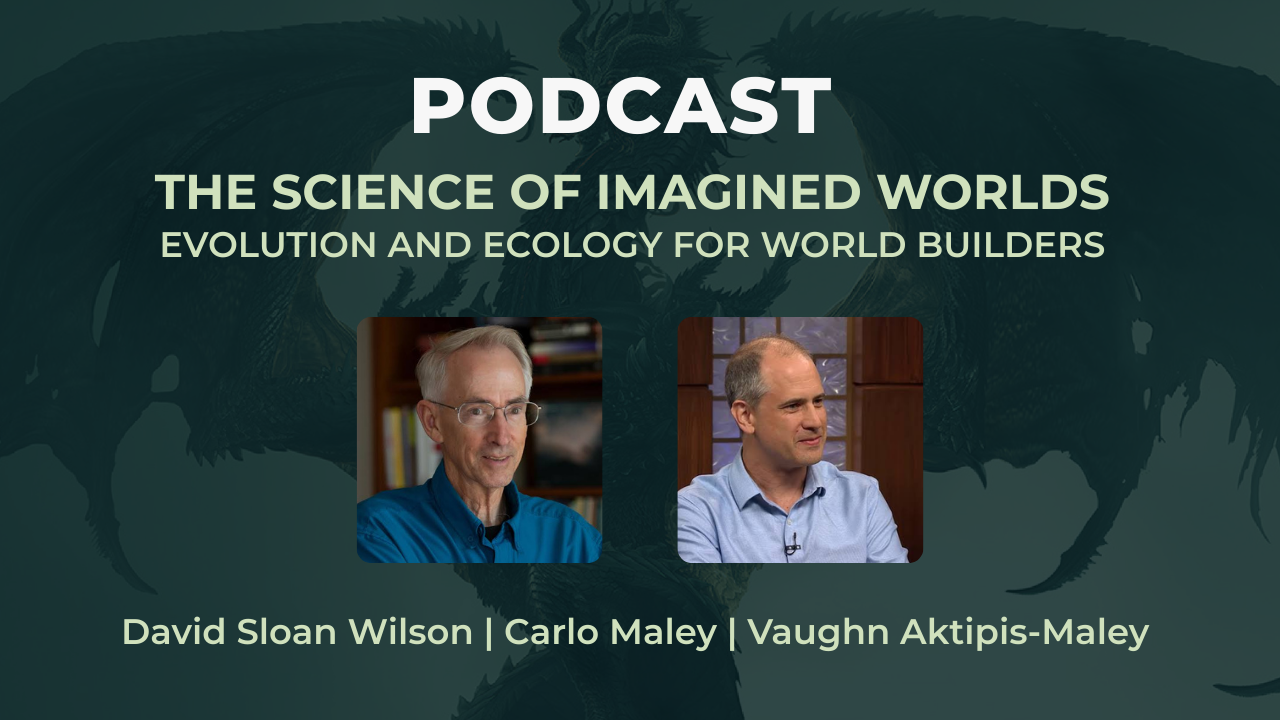
The Science of Imagined Worlds: Evolution and Ecology for World Builders - A conversation between Carlo Maley, Vaughn Aktipis-Maley & David Sloan Wilson
Aug 2201:21:21Summary readyJoin David Sloan Wilson in conversation with Carlo Maley and Vaughn Aktipis-Maley as they explore how evolutionary science can inspire deeper, more internally consistent worldbuilding. Based on their recent publication Evolution and Ecology for World Builders, this episode blends fantasy storytelling with real-world biology to ask: What makes a creature believable? What makes a society work? And what can fiction teach us about cooperation in reality?
Summary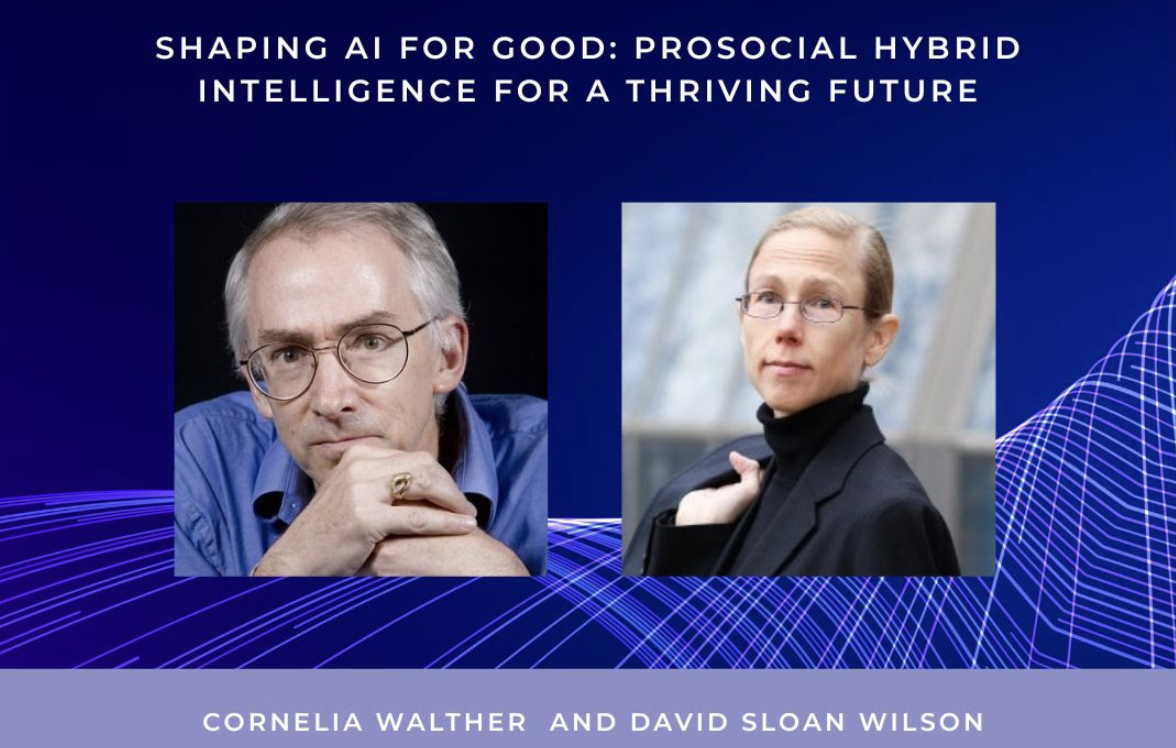
Shaping AI for Good: Prosocial Hybrid Intelligence for a Thriving Future - A conversation between Cornelia Walther and David Sloan Wilson
Jun 27, 202501:18:14Tap to summarizeAI is no longer a distant future - it's shaping our lives right now. But what if we could design it not just to be smart, but to be good? In this powerful conversation, Cornelia Walther and evolutionary biologist David Sloan Wilson explore how we can build AI systems that truly serve people and the planet. They dive into the concept of Prosocial AI, technology that's designed to support human connection, equity, and environmental sustainability—and the emerging field of hybrid intelligence, where human empathy and creativity team up with AI's speed and precision. You'll hear how we can deliberately shape AI with inclusive voices, transparent practices, and a strong ethical foundation to ensure it aligns with our highest values. From development to deployment, this episode outlines a path forward: one where technology empowers communities and nurtures a healthier, fairer world. Whether you're an AI enthusiast, a changemaker, or simply curious about how tech can uplift humanity, this is a conversation you won't want to miss.
Transcribe →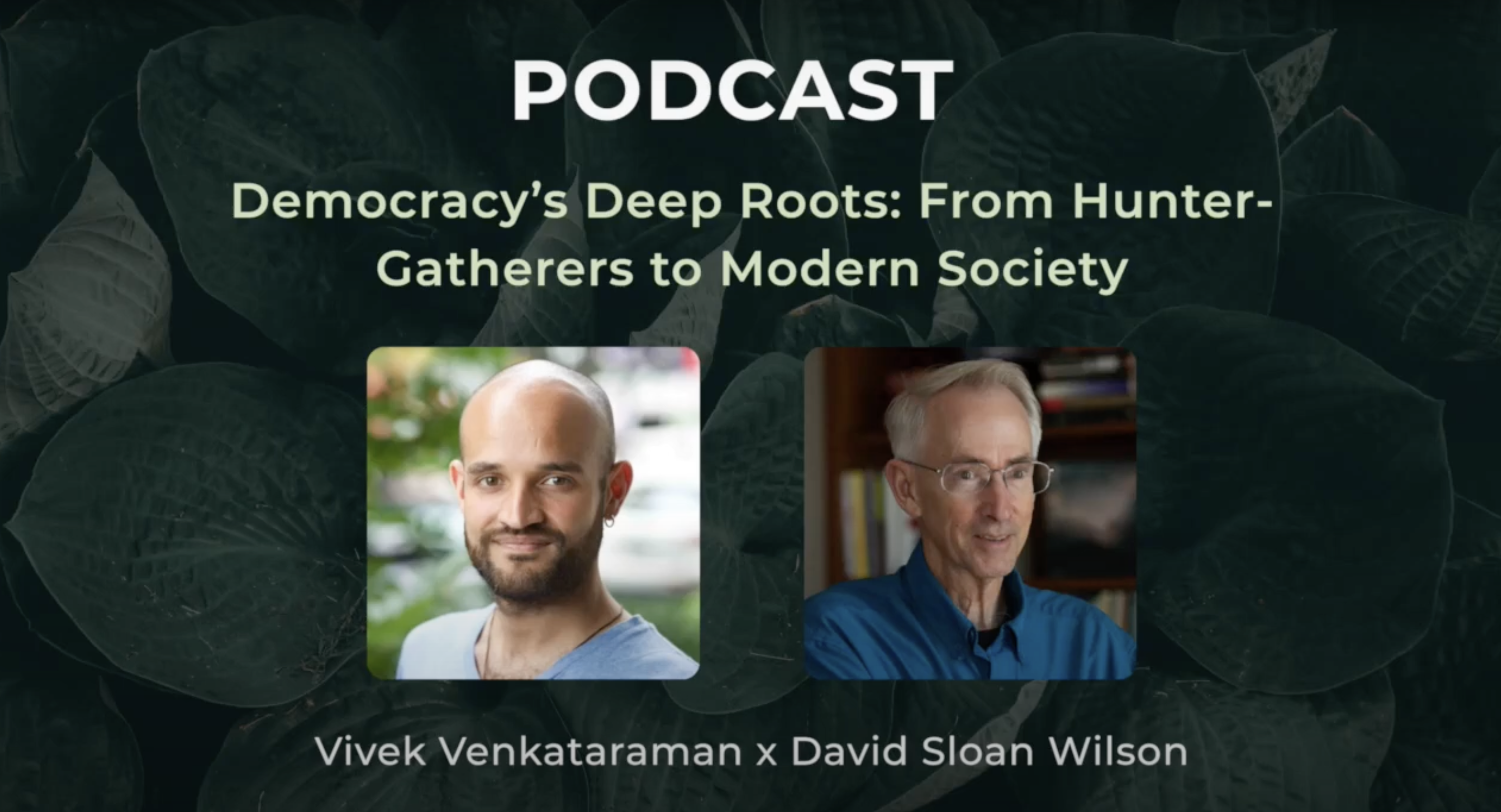
Democracy's Deep Roots: From Hunter-Gatherers to Modern Society -- A conversation between Vivek Venkataraman and David Sloan Wilson
Jun 2, 202501:19:12Tap to summarizeWhat if the roots of democracy run far deeper than ancient Greece or Enlightenment Europe, but back to our evolutionary origins as humans? In this thought-provoking conversation, evolutionary anthropologist Vivek Venkataraman and renowned scientist David Sloan Wilson dig into how early human societies, particularly hunter-gatherers, managed to balance individual freedom with the needs of the group. Long before constitutions and parliaments, our ancestors developed powerful, organic systems for cooperation, decision-making, and fairness. This discussion explores how evolution shaped us into an ultra-cooperative species, and what modern societies can learn from these ancient ways of living. The implications aren't just academic; they offer practical insights for strengthening both formal and grassroots democratic governance today, from local communities to global systems. Whether you're into anthropology, politics, or just curious about what it really means to live well together, this is a conversation that bridges past and future in a surprising and meaningful way.
Transcribe →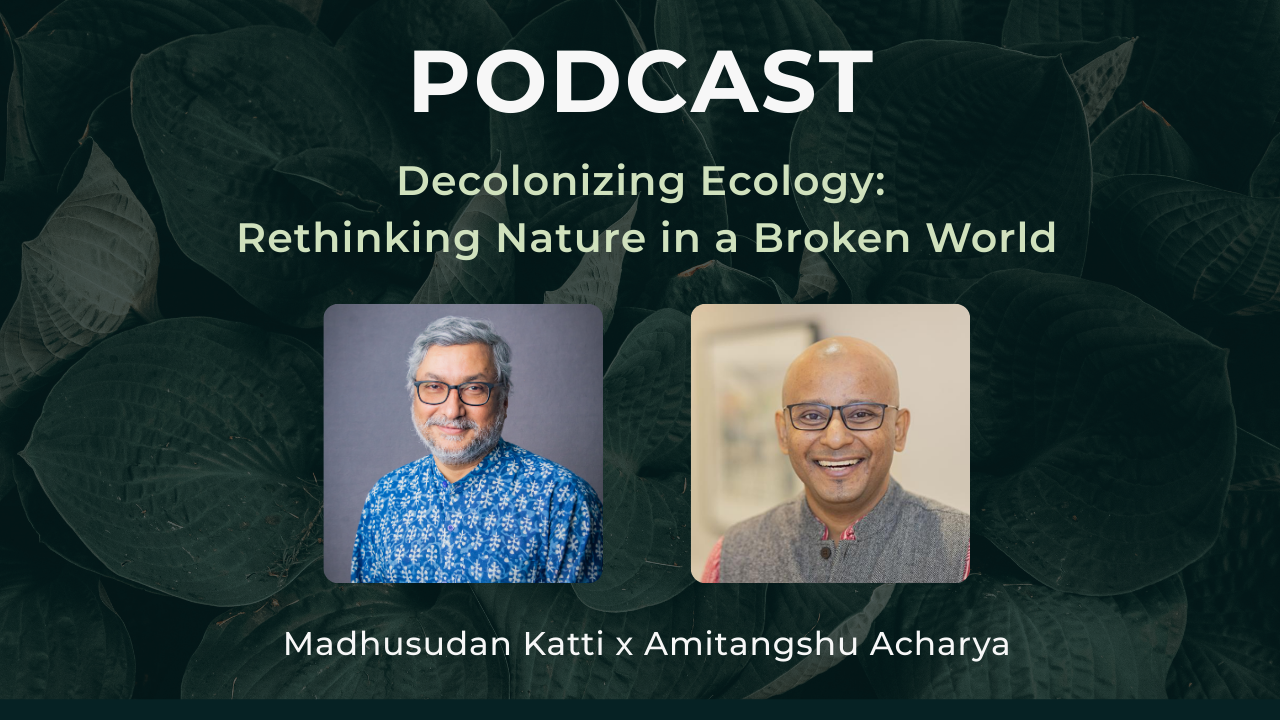
Decolonizing Ecology: Rethinking Nature in a Broken World
May 2, 202501:19:48Tap to summarizeA conversation between Madhusudan Katti and Amitangshu Acharya Join us for a thought-provoking virtual dialogue exploring how colonial worldviews have shaped modern ecology - and what it means to decolonize our relationship with nature in an era of social and environmental upheaval. Building on themes from the This View of Life series "Decolonizing Science", ecologist Madhusudan Katti and writer-researcher Amitangshu Acharya delve into questions at the intersection of science, history, and justice. Together, they'll challenge dominant narratives and invite us to reimagine ecological knowledge that is rooted in compassion, context, and community.
Transcribe →