← Threads Magazine Podcast: "Sewing With Threads"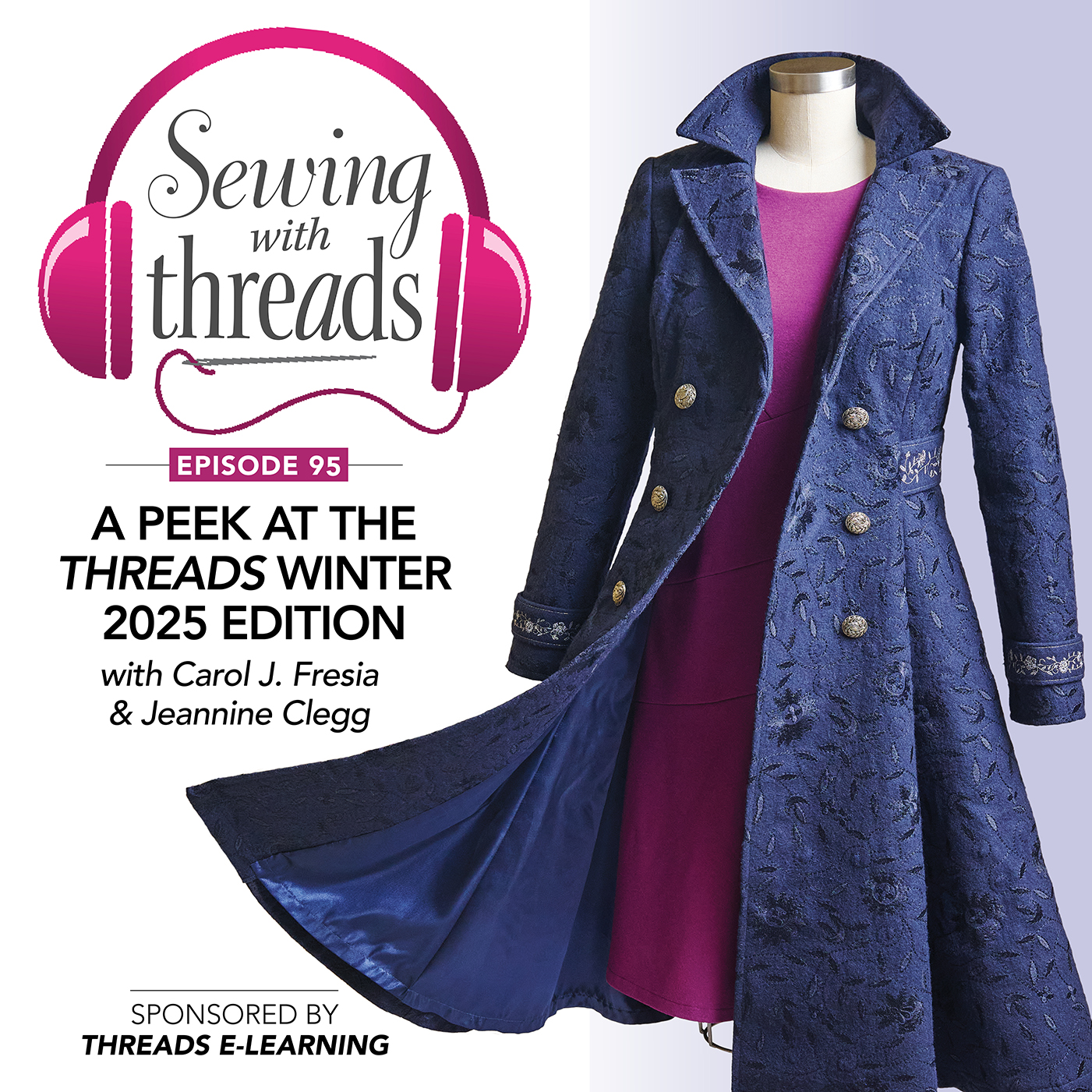
Threads Magazine Podcast: "Sewing With Threads"
A Peek at the Threads Winter 2025 Edition | Episode 95
00:34:57
Loading summary
Transcript69 lines
- [00:01]
A
Check out our just released elearning course your go to Easy Fitting and Refined. Taught by the late Cynthia Guffey, this on demand video class walks through constructing a versatile jacket with high end details. In nearly seven hours of instruction, you'll learn to fit and sew the jacket step by step. The course even comes with a downloadable pattern. You'll discover valuable tips to improve all your sewing while making this stylish wardrobe staple. To sign up and to find other on demand learning opportunities, go to courses.threadsmagazine.com.
- [00:44]
B
Welcome to Sewing with Threads, the monthly podcast for the staff of Threads magazine. I'm your host, Carol Fraser, and today I'm joined by my colleague, Janine Clegg.
- [00:53]
A
Hey, Carol.
- [00:54]
B
Hi, Janine. I'd just like to say to everyone that Janine's title is Managing Editor Production, but she does so much more than that. This week she guided our winter 2025 issue through its final stages to the printer. And that's a job that requires patience, a very sharp eye for detail, and a huge amount of persistence. And I really hope that you are recovering Janine from that ordeal.
- [01:20]
A
Well, I take you are a good example and so I follow what you do, but you're right, I think we both need a break and I feel like this is our little happy hour. So I'm just gonna, you know, put my, put a drink together.
- [01:32]
B
Oh, she's got ice cubes. Our. Yes, our, our technical producer for the podcast suggested that we do this as happy hour, but it's only 2 o' clock here and we thought some people might judge us harshly if we actually cracked out the booze. So we're not doing that.
- [01:49]
A
It's really just a soft drink. And I think, yeah, the parent company would be wondering if we're imbibing during work. No, it's just a soft drink.
- [02:00]
B
So the last little bit of this issue finally went in on Tuesday and then we had a day of sort of rushing around. And then yesterday we went to New York to do our model shoot. We with our fashion photographer in New York. And Jeanine stepped up, as she always does, and she not only helps kind of run those shows, but she was also like at the ironing board for several hours because we have a number of garments that are linen or that type of fabric because that'll be the spring issue. And no matter what you do, they always arrive in a state of sort of crumple tude that needed to be dealt with. So that's an area of great expertise, Virginia. And she's very Good at ironing. And if you ever see anything that looks really great, that's cause she, Janine did it.
- [02:46]
A
But we're actually, you're overstating things a bit. And now everyone's going to be looking at every wrinkle in the magazine. Now I'm going to get emails from everyone saying, hey, you missed a spot.
- [02:58]
B
Well, sometimes that those wrinkles are not there in person, but they are there when you get the lighting on. This is what the other thing we discover with these photo shoots is that things that you do not see with your naked eye show up on camera and you have to kind of try to fix that. So that's, that's always a challenge. And we spent some time troubleshooting that yesterday too.
- [03:16]
A
Well, there was one garment that we didn't have to worry about that with, and that was the pleated pants. I am so excited about this article. Oh my goodness. For spring. So please everybody grab a spring issue. One of our authors, couture expert Mary Funt, did a piece on pleating. And I know I'm giving away secrets, but I was so excited about this article. So stay tuned.
- [03:40]
B
Yes, I'm looking forward to that one too. And that issue comes out in January. Late January, early February. Yes, February.
- [03:50]
A
It'll arrive in our subscribers mailboxes. So. Yeah.
- [03:54]
B
But in the next few weeks, you subscribers should be receiving our winter 2025 issue. And they will be on the newsstand shortly after that. And we hope people will take a look at that. When we're editing, we are working in a way where we look at each article very, very deeply, many, many times. But it's not till that last week or so that we kind of see the whole issue together. And it's always revealing. I mean, you'd think we would know what it is. But it feels very different when you see all the pages kind of in a row and you start seeing the articles play off each other and sort of echo each other a little bit. And it gives you, it brings back the excitement that you have when you're planning the issue. And that slightly diminishes during the difficult weeks of trying to actually put it all together. So we tried to end on a high note, but there's some great things in this issue coming up.
- [04:48]
A
Absolutely, Carol, I totally agree with that. And one of them is the gift guide. I know a lot of people look forward to that and we had fun putting that together. I will let you in on my little secret, that there was one book in the issue that we included that I absolutely love it's the Liberty book. Liberty of London is celebrating their 150th anniversary this year. And by the way, Threads is also celebrating its 40th anniversary this year. So I felt like, oh, this is nice. Two entities to be able to celebrate their anniversaries. Well, we don't have a separate book on that, but Liberty does, and they have done a fine job. This book is beautiful. It is so inspiring. There's so many different colors and designs from their past, and they have a whole section on their history, but it's not too dense. It's just very readable, and you just want to keep turning the pages. And I think if you're ever stuck in trying to figure out what color you want to use or what kind of design you want to use, picking up this book will really help you out.
- [06:09]
B
And if you have somebody that you know who sews and is a textile fan, it's a really nice gift. It is a really beautiful book, and it reminds you that Liberty's not just little floral prints, that they really covered a lot of different stylistic types of prints, and they come from an aesthetic viewpoint from the 19th century that's actually really fascinating to know about. So it's a good little, little history. But it's the sort of thing that if, you know, I could sort of see myself choosing to read one page a night for a long time, just because each page you could sort of sink into. They are really beautiful. And I think, you know, I think.
- [06:50]
A
I really appreciated this book, too, because earlier this year, I went on the tour, the Threads tour to London, and we had a great group, and we did get to go to the Liberty store and walk around. And I don't know, it was a nice way to remember that trip, having this book. But you don't necessarily have to go to the Liberty store to get this book or to appreciate this book.
- [07:19]
B
But if you do get the book and look at it, you will want to go. And then when you go to Liberty, you will be well prepared. Also in the book section, there's a really nice book by Zoe Hong, who you might know from her YouTube videos on fashion design. And this book came out about a year ago. It's called Fashion School in a Book. And it has a second book that goes with it called Fashion School in a Book design Journal that is almost like a workbook that goes with it. Zoe knows every element of fashion design, of the industry, from start to finish, from the actual designing to working with companies and all kinds of things. That those of us who sew for ourselves don't really think about. And it's distilled into this book. That's really amazing and very engaging. So if you are interested in thinking about going into design or you know somebody who, who might be, this would be very enlightening. You could just follow along, do it yourself maybe. I think this is being used as, as a textbook in some places too. So it's a. It's a good way to get introduced to what it is to really be a professional designer. Marketing.
- [08:29]
A
Yeah.
- [08:30]
B
Yeah, I like that. And another, another area that, that we covered in this, in this gift guide is we always try to include a few sewing machines and especially some of the new releases. And this time we have three machines with a wide range of prices. All of them are sewing in embroidery machines. And I have not particularly been interested in getting an embroidery machine because I have no time to sew anyway. And I think I would just be a little bit, a little bit panicky knowing that I have this big piece of technology that I'm not using. So I haven't gone there yet. But I have been thinking about sort of future projects a little bit more lately. And it's amazing what you can get. It is amazing what you can get for a very affordable price. If you have a young person in your life or somebody who's getting started in sewing and wants to do personalization or cosplay or something. I mean, for well under $2,000, you can get an embroidery machine that will really work and be very effective.
- [09:33]
A
Yeah. And you get good results.
- [09:34]
B
Yeah, yeah, yeah.
- [09:35]
A
But, you know, you also included a Cadillac of machines. And for those who are more advanced and who really do enjoy taking advantage of those embroidery stitches. So there is a range there. And you know, the sewing machine manufacturers are always coming up with new models and always adding great technology. You. It was such a big deal. I remember when, you know, they had the thread cutters on there. Well, this is well beyond that. Well beyond.
- [10:04]
B
I know these top of the line ones and the one that we have is a baby lock radiance. It is amazing. It's got so much stuff on it that I think I would just basically, if I retire ever, I will spend the next five years understanding everything that's in this machine. And it's got. They now have really giant hoops. You can do incredibly ambitious projects. And there's so much like onboard technology that on the touchscreens you can practically digitize anything, you know, from a photo on your phone, you can almost Turn that into it immediately, almost into an embroidery design. So the more you know about it, the more you can build your creativity and come up with all kinds of new and different things to do. So I thought that was, that was actually really fun to learn about. And it really makes me see possibilities that I had not kind of allowed myself to get into previously.
- [11:01]
A
And, you know, we always do see some really interesting possibilities. When we look at the entries for the make it with Wool contest, the national make it with Wool contest. The winner, there's usually a winner who has done some outstanding work with machine embroidery. This year was the case again. And we have another article on the latest make it with Wool winners. So that I found to be a really inspirational article that we included in this issue. I don't know, Carol, I don't know if you had a favorite, but they were all great to me.
- [11:35]
B
Oh, in the make it with Wool.
- [11:37]
A
Yeah.
- [11:39]
B
No, I really don't have a favorite because they are all really good and very impressive. The meticulous, I think the youngest person, the youngest person is 16 or 17, maybe 18 years old. And then they go up to an adult winner also. But the quality of the work is uniformly amazing and the design ideas are clever. And each one of these winners has a really interesting story about how they decided to make this particular garment or ensemble and where they plan to wear it. And, and most of them have come from many years of competing in 4H or in local, regional, state, make it with Wool competitions. Something that I never had heard of until I was working for Threads. I certainly didn't know about that when I was young. I'm not sure if I am competitive enough or was good enough at sewing to really do that. But it clearly shows that there is a generation of newer sewists who are really striving for and achieving this excellence that is really impressive.
- [12:54]
A
And you know, it's funny, I don't know that all of the entries, the winning entries are making their garments specifically for, you know, competing or, you know, wanting to win. I think a lot of them, you know, start out, like you say, trying to make a garment for a particular event or place to go. And it just so happens that it ends up being beautifully sewn. And you know, they had a great time making it and getting advice from their friends and other people, like minded people who are also sewing. And it just happened that they happened to be a winner.
- [13:34]
B
Yeah. And most of them, most of them also noted that they had a teacher or mentor who helped them either in their early days or all the way through into completing these projects. And this made me really think about the importance of all of us in our. I mean, I'm in the older generation now of sewers, and I don't feel like it. I don't think most of us do, but some of us are. And the idea that we really should be sharing what we know and we should be encouraging people who show signs of being interested. I don't know that every young person who's interested in sewing is going to go on to become a Make it with wool winner, but they might go on to be somebody who knows how to hem their own pants, and that's fantastic. Or make a costume for an event or whatever, mend their clothing, you know.
- [14:25]
A
And I think of Mary Ray, our author, who put together a piece on upcycling sweatshirts. And, you know, Mary taught for many years. She was an instructor, a college instructor for many years. And I think she had a mending workshop going on in the later years until she retired at the college. But for this issue, she just took some old sweatshirts and showed us how a little creativity and attention to color matching can really turn an old sweatshirt around into something beautiful you'd want to wear all the time. Comfortable and beautiful.
- [15:08]
B
Yes, that's. It's true. And when she first kind of pitched this article to me, she said, I've been making these bougie sweatshirts. And I said, what do you mean by bougie sweatshirts? I didn't really understand it, but she's like, you know, just, you know, whatever. And I. And I still didn't get it. And she sent me some pictures, and I thought these are great because they are really very artistic, but they're also very casual and unique, but not weird and just kind of fun and interesting. And she said that one thing she loved about it was she just got together with a friend and got out at just a bunch of stuff, and they had some old sweatshirts, and they just went to work doing this. And it made me realize that this is something I may try doing over maybe over the holidays when I have my daughter at home or bring one of my sisters down. Because a lot of this is done by hand. It's just easy hand stitching, almost like a boro stitching technique or Sasha Co. You know, sort of straight running stitch. And. And as Janine mentioned, it has to. Do you want to sort of think a little bit about how you put together these fabrics to make kind of a little patchwork design on the front so that it looks arty, but not kitschy and. Or whatever you like. Actually, if kitschy is your, is your vibe, then it's great to do that too. But I thought, oh, I'd love to do that. I really would love to. You know, it's kind of challenged myself design wise to come up with just a small little piece that will speak to my, my aesthetic without having to be a huge garment. And you can kind of do it while you have your hot tea or your cocktail or whatever it is, and nobody's going to be hurt in the process and you come out with something nice. You can also take it off if you want later and put a new design on.
- [16:50]
A
Right. Well, the other thing that I like about this too is she didn't go out and buy a whole bunch of new stuff. She didn't go buy some new notions or new fabrics. She used what she had at home. And you know, it's going to be probably colors and fabrics that she picked out earlier that she loves and she finally gets to use them or she's using scraps from another project that she had used the fabric for before. So win, win. I mean, use your stash and make a beautiful reusable garment upcycles.
- [17:26]
B
Absolutely. Yeah. I mean, and the pieces that you need to put in this are, you know, small. I mean, nothing is bigger than the front of a sweatshirt. It's much smaller than that usually. So if you have a lot of pretty scraps, you haven't known what to do with them, this is an ideal project and you'll have something completely unique and have fun in the process of doing it. It's seems very enjoyable. Mary mentions that she, she really likes to hand sew, but she said, you know, she gets, as she gets a little older, she feels like she's not doing, you know, the very fine level of hand sewing, but you totally don't need that for this. This is something where you can just do some bold stitching with a nice piece of embroidery floss, and it'll look great. So it's, it's one of those forgiving projects that, that gives you a great result. And I have been thinking about how important it is for most of us to come up with something like that where we feel like you feel empowered to do it. You don't feel oppressed at perfection. You can just enjoy the process and come out with something that you like at the end.
- [18:28]
A
Absolutely. The other article that we've included, a how to article I think is really helpful. We've gotten letters over time Asking us to do some stories about maternity wear, how to. How to, you know, make a pattern into a maternity garment. And we've finally gotten around to it. In this issue, Ray Cumby has written a piece because she, her daughter was a mom to be for a little while, and of course now she's a mom and Ray wanted to make some clothes for her. And so she shares with us, Ray shares with us how she went through that, how she, you know, the how to's for that. And I think that's really helpful. And they're cute like they are, but.
- [19:20]
B
You can, I mean, these are very cute and you can make them any, any style that really fits, you know, the person. It's just a, it's a pattern alteration that's really helpful and it's really clever because she. You enlarge the pattern just through the front where you might, where you would need it. You don't enlarge it in the back. You start with something that fits you before pregnancy, and then you enlarge the front and sew it with big seam allowances and a deep hem at the beginning. And then after a few months, you can let those out again and let the hem down as the baby bump gets bigger so that the hem stays even and you give yourself a little bit more room around the front. Which I, I have to say, I love that idea because you, you know, in the first, there are a few months where you're not fitting in your clothes, but you don't need to be wearing a tent. And then at the end, you also don't necessarily want to be wearing something that's you're popping out of because that's not comfortable. And those last couple months, you're maybe not comfortable to begin with. So it's good to have something that looks good and feels, feels good to wear too. So it's very clever. And when I was editing this article, I took a minute to look in the pattern companies because I remember making maternity clothes myself. And, and that was quite a few years ago. And there were Vogue, had some nice dresses, nice maternity dresses, things that I wore and I liked a lot. But there's not very much now at all. And people don't want to be wearing the sort of same old kind of tent dresses that were around in the 50s, 60s and 70s. So this is a way that you could take a contemporary style that you like and turn it into something and just make it feel fit for those months. So it's a, it's a clever way to kind of keep A sense of style and also feel like you're. You're fitting well.
- [21:07]
A
Yeah.
- [21:07]
B
Janine has worked in this issue, has worked with the young designer Annika Geisberg, who was featured in an article in the spring issue, I think. Spring issue? Summer issue?
- [21:18]
A
Yes, in the spring issue. Annika Geisberger. Yes. She's a brand new designer. She just graduated from college earlier this year and with a bachelor's degree in, I believe it's fashion merchandising. I'm not sure. But she is an excellent sewist and very creative, a real creative mind. She loves to do the designing. She, of course, got picked up immediately after she graduated and she's working for a bridal designer in Manhattan right now. We had talked, the two of us had talked a bit and I really was interested in having her do an embellishment article for us. And she was excited about this. We thought about smocking, but not the smocking that you remember from on little children's clothing. It's beautiful. It really is. But we wanted to do something that was a little more contemporary, something that an adult would feel comfortable wearing. There is a lot of smocking out there now I've seen on things. Anneke took it a step further and created. She designed a blouse herself and added the smocking to it. And it was. I love it. I think it's great. And I had a lot of fun with this because when I was in London with the tour group. I know I keep bringing up London, but we had a good time when we went. But when I was in London, I was looking for fabric for Annika for this story. And shout out to Marilyn, who helped me when we were shopping on Goldhawk Road. Marilyn does a lot of smocking for children's clothing. She has a lot of little ones in her family and she's done some beautiful work. My goodness. And so she was helping me choose the fabric. And so the fabric that you see came from London and it's a fine cotton batiste. And Anneke loved working with it and I thought she did a fabulous job with this. So it's a how to. For adding smocking to a. You can use it for a, you know, a pattern, a plain pattern that you already have. You don't have to get a smocked pattern because she shows you how to add the smocking to it.
- [23:50]
B
Yeah, that was great. That was interesting. She explains how you calculate the amount of extra width and length you need to pattern so that when you smock it all together, it is the size it needs to be.
- [24:03]
A
That's.
- [24:03]
B
Yeah, that's an obstacle that would have gotten in my way if I were going to be trying to smock something. So that was really helpful. And it's. It's such a. It's such a pretty blouse. It's kind of romantic, but it's also kind of this neat, modern, sophisticated color of gray green that's beautiful and muted. I love that kind of color myself, so I really enjoyed that.
- [24:26]
A
Yeah, the fabric is a chameleon kind of thing. It looks olive green, but then in a different light, it looks a little more gray. Yeah, it was a good. It was a good fabric to choose, because that color, I feel like, is in the winter palette.
- [24:41]
B
Yeah, I think so. I think so.
- [24:43]
A
Yeah.
- [24:45]
B
So one other article that's coming out in this issue that I think will be of interest to just about anybody who's listening right now is an article by Stephanie Miller, who was an editor for Threads for several years, about what happens now that Joanne's is closed. Because we are all concerned about what we're going to do to get our supplies and our patterns. And we may not buy all our fabrics there, but some fabric and all the things that you usually get and what's going to take place of Joann's.
- [25:21]
A
Right. We took Joann's for granted. In many ways. It was just a quick stop. I think a lot of people were critical of joann's for a while. I was like, oh, yeah, Joanne's chain store. But you know what? We all went there. We all picked up notions and thread. It was very convenient. But, yeah, now that it's gone, it's like, okay, where are we going to get these things? Because I know a lot of folks out there don't live in an urban area where there are a lot of choices for finding fabrics and notions. And you don't always want to shop online. Sometimes it's okay, but I like to feel the fabric myself. So that was tough for me. Figure out, okay, how am I gonna. How are you gonna do this now? So Stephanie has some really good ideas in her story. Yeah.
- [26:14]
B
And this is a changing landscape. I think if you've been paying any attention to what's been coming out, Michaels is picking up quite a few things. And so my local Michaels is just opened not too long ago, and it has some thread. Not. Not the huge, big display of thread, but enough thread that I could probably get by with that. So if you have a local Michaels, that would be good. They may be Bringing in. I think they are going to bring in some fabrics and sewing machines. I wouldn't buy my sewing machine there personally, but that's, that's just me. But I'm, I'm hoping they have things like zippers and closures. I think Joanne's was training us because they cut back on their buttons supply a few years ago, so there was just nothing good. And that is a really, that is a pain point for me for sure. Trying to buy buttons when I'm trying to get them for the pattern review garments. Trying to order those online is really hard. You, you kind of, you know, you think you know the size and then they come in a different size or the color looks different and you just are really kind of flying blind with that. That's tough. So they're going to be. If you are listening to this on the threadsmagazine.com website in the comments or if you're on YouTube, please put down any information that you have of places that you like to shop so that we can all benefit from your knowledge. If they're, you know, if you have great sources for anything in particular that.
- [27:35]
A
You like and you know, like you do probably, you know, you can make adjustments too. I mean, if you are in short supply of thread, you know, Stephanie gives suggestions, but you know, Carol, I don't know if you remember this, A while ago you wrote an article about how you can get away with neutrals if you buy just a few spools of neutral colored thread, grays, you know, tans and you know, have a black and white, you know, you can pretty much get by on those no matter what you're sewing.
- [28:14]
B
Oh yes, that's a, that's actually a video. That's actually a little video clip.
- [28:17]
A
Okay. Sorry.
- [28:18]
B
Our, our producer, Carrie helped with that video. She was a technical producer for that video too. And she helped with the, getting the lighting so that you could see what was going on there. But yes, I'm a great believer in having a, a reasonable assortment of neutrals from light to dark and some red things and then you can get, you can cover a lot of ground with that. But I feel like if it's an invisible zipper, you can do sort of similar. But I don't know. I don't know. It does, it worries me a little bit some of that, that it makes me nervous. And we didn't talk about patterns in the, in the, in the article because all that still was up in the air when that started, when that went off to press. So we're, we're waiting to hear what of the sale of that. Of the pattern companies has been. That's going to be an interesting, an interesting situation too. We really.
- [29:14]
A
Yeah, yeah.
- [29:15]
B
I mean, we really wish the best to those pattern companies and to the indies that are out there that are. That are really coming into the marketplace. We need all of these and we want them all to succeed so that there are choices. I consider a pattern, not just, you know, like the template for making a garment, but like it's a learning opportunity. And the more different patterns you have written by different people with different ways of sewing, you can learn something from every one of them. And that's one of the exciting things about sewing, I think.
- [29:47]
A
I agree. Absolutely. And yeah, we kind of have to wait and see what happens with the pattern, the Big Four. And we, we understand that there has been a buyer and we have to just find out a little bit more as time goes on how that will influence the availability of the patterns and how that will affect the Indies too, because a lot of the indies get their patterns printed. Have gotten their patterns printed through the press that's used by the Big Four. The Craft Industry alliance has a lot of information about that right now, and it's helpful to take a look at what they've written about it. Yeah.
- [30:34]
B
At the end of the issue, there's a nice little closure story by Brooks Ann Kamper, who is a very gifted teacher as well as sewist and designer. And it's. I think. I think everyone should just read it and give themselves a pat on the back for what they're doing.
- [30:56]
A
Yes. Without giving too much away. It's a very reflective, thoughtful piece for all of us who sew to read about.
- [31:06]
B
Yeah, yeah, exactly. It's very, it's, it's. It was very nice. I always enjoy communicating with brooksann. She's got the upbeat way of looking at everything that makes you feel like, yeah, I know why I'm doing this now.
- [31:24]
A
Well, we are looking forward to just, you know, giving you more stories, interesting articles, and, you know, we welcome comments. I think a lot of times people are reluctant to say what they'd like to read about, and we are all ears all the time. So feel free to drop us an email, let us know if there's anything in particular that you'd like to read about, and we will do our best to see if we can make that happen.
- [31:56]
B
I'd also like to encourage you to write in if you think you have a story for us. We always like to reach out and many of Our authors have started out, really, as readers who've just written in and said, oh, you know, like, I tried this and I got a different result, or I found another way. And then we say, well, why don't you write that up for. For us? I think people will want to know about that. So we also encourage you write in. And it's threadsmagazine.com that's the email address you can write to us, and we look forward to hearing from you. Yes, one last. One last plug for what we have to offer you online. We have courses, as, you know, probably e learning classes online. And we've recently put up some legacy classes by Cynthia Guffey, and there will be another couple of them coming out in the next month or so. So keep your eye out for those. I have been looking through them in sort of a final edit of those videos, and I cannot believe how many wonderful tips I have learned along the way. Just watching Cynthia explain why she does things the way she does, it's really fun. You feel like you've read everything at a certain point. I don't know about you, Janine, but I do, because I've been working for Threads for more than 20 years, and it feels like not. Not that I'm bored by it, but that I. That things keep coming around. You know, you just. The same thing keeps coming around. And then I was watching these Cynthia Guffey things and thinking, wow, I never knew that, or, oh, that's a new way to do this that I hadn't heard of. That'll increase, you know, my accuracy or. Or whatever.
- [33:26]
A
Yeah, there's always something to learn with sewing. Really.
- [33:31]
B
There definitely is. Yeah.
- [33:33]
A
Well, it was great to talk to you about the. What's the issue? I'm excited all over again. I hope the readers will find an article or two that's particularly helpful for them at this point in their sewing. And again, we look forward to hearing from you and we look forward to moving on to the next issue. I think this spring issue is going to be exciting as well. Yeah.
- [33:54]
B
I hope the issue will keep you company through the holiday season. If you need to step away from sometimes the sort of overwhelm of holiday things, you can breeze through the Threads magazine a little bit. Maybe you'll find some little projects that you'd want to play around with. And we will be back with you. Well, on the podcast by December.
- [34:19]
A
That's right.
- [34:20]
B
And then with a new issue in January or February, rather.
- [34:23]
A
That's right.
- [34:24]
B
Thank you so much for listening. You can find show notes@threadsmagazine.com and keep on sewing with Threads.
- [34:32]
A
Thank you to our guests for joining us and thanks to all of you for listening. Please remember to send your comments, questions and suggestions to thhreadsmagazine.com and please like comment and subscribe wherever you are listening. Until next time, Keep on sewing with Threads.