← Threads Magazine Podcast: "Sewing With Threads"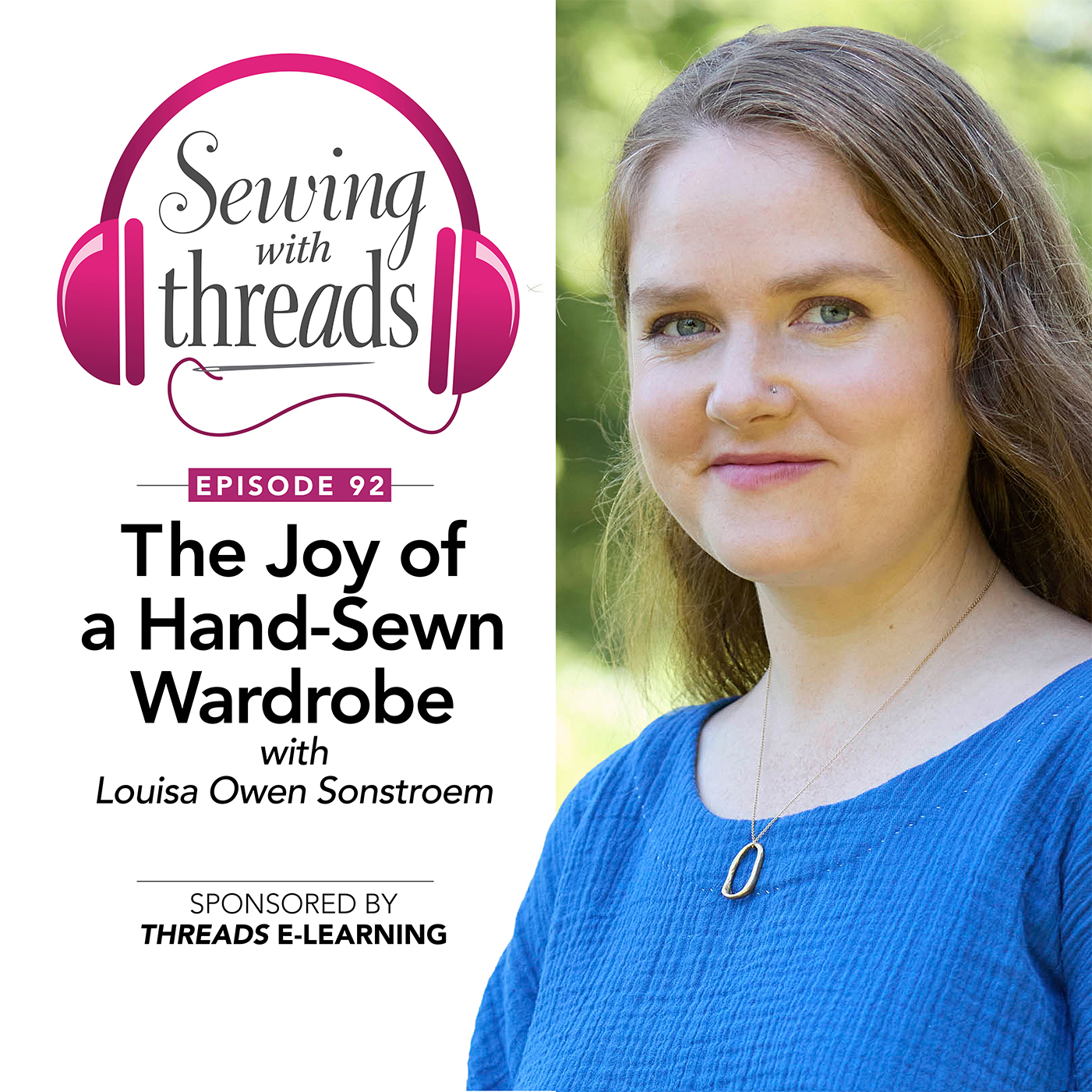
Threads Magazine Podcast: "Sewing With Threads"
The Joy of a Hand-Sewn Wardrobe, with Louisa Owen Sonstroem | Episode 92
00:40:41
Loading summary
Transcript33 lines
- [00:00]
Carol Frase
Check out our newly available elearning course, Women's the Best of Everything. It's taught by the late Cynthia Guffey. With nearly seven hours of expert instruction, this class offers countless tips and techniques for sewing a professional looking shirt. The downloadable pattern is included so you can get started on your perfect shirt right away. Go to courses.threadsmagazine.com to sign up and to discover other on demand learning opportunities. Welcome to Sewing with Threads, the monthly podcast with the staff of Threads magazine. I'm your host, Carol Frase and in this episode I'm joined by Louisa Owen Sonstrom. Louisa considers garment making skills to be deeply empowering. By day she works in technical design and pattern making, most recently for Eileen Fisher and Macy's. In her spare time, she writes and teaches about pattern making and hand stitching clothing. This summer, Louisa is celebrating the August release of her newest book, the Hand Sewn Wardrobe, A complete guide to making your own clothes from pattern making to the finishing Stitches, in collaboration with Story Publishing. You can find out more about her@louisamary.com that's spelled L O U I S A M e r r y.com welcome Louisa.
- [01:25]
Louisa Owen Sonstrom
Thank you so much for having me.
- [01:27]
Carol Frase
It's so nice to talk to you. I got a copy of your book sent to me and I found it very exciting and new and different. And so I'm really looking forward to hearing a little bit more about your journey from technical training and technical design, which you still do, to hand sewing most of your clothes or all of your clothes. I'm not sure how far you are with that at this stage, but can you give us a little summary about what your book includes?
- [01:56]
Louisa Owen Sonstrom
Sure. So this book is, on the face of it, a project book. So it after some introductory skills for pattern making and hand sewing, the book basically goes chapter by chapter through nine different modern garment basics. Tops and T shirts and skirts and hoodies, jeans, jean jacket, all sorts of things. And so for each of those projects there is a pattern making segment so that people can learn how to make their own pattern based on their own bodies, their own preferences, all of that. And then there's a hand sewing portion which goes through one of the infinite ways that you can use hand stitches, no sewing machine involved, to construct these clothes. So it's, it's kind of two books in one. And I highlight that because you can pick and choose. You can just do the pattern making if that is what you'd like to be learning, and then go off to your sewing machine to construct them. Or you can find A similar pattern that already exists and then hand stitch it.
- [03:15]
Carol Frase
Yes, that was the thing. From reading the title, I thought, oh, I'm going to learn what hand stitches I need to make clothing. And then I thought, oh, my gosh, I'm getting a lesson in how to draft, or you have for jeans. You show how to trace off how to rub off a pattern, which is another really important skill for people. If they don't want to be using patterns or they have a garment they really like and want to copy. That's. That's fantastic. So, yeah, I felt like I came out of this learning a lot. It's really rich and it's a nice read, too. So you say you're a technical designer, and I know that you have training in pattern making and that aspect of clothing making. How did you get from there to this?
- [03:54]
Louisa Owen Sonstrom
I guess one way of saying it is that for me, sewing and pattern making, although they're sort of two different skills, have always been deeply related to each other. So as a young girl, I learned some hand stitches from my mother, and that was very exciting. And then in middle school, I started learning how to use a sewing machine, and that was very exciting. But I did kind of pause around high school in my avid sewing practice because I didn't love the patterns that I had access to and I didn't. They didn't seem to fit me well. I didn't also really know that much about fitting, but I just. I was sort of hitting a wall because of not knowing how to make my own patterns and not knowing how to kind of refine other people's patterns. And so then toward the end of college, I. The very last semester of college, in fact, and I was an English major, I came across a course listing for a continuing education pattern making intro class in a different state. I was in Connecticut, and I saw that at Mass Art in Boston, they had this intro to pattern making class. And I said, oh, that sounds like magic. Like I have to take that. So I was able to work out my sort of senior year of college schedule to be able to go to that. And that just blew open my world. But of course, it was just a starting place. I had so many more questions than answers at the end of that semester. And so I spent a few years just kind of playing around with pattern making skills on my own. And so of course, I was sewing in service of trying out my patterns that I was making. And I was working as a journalist and had this funny split schedule. And I would just find that in every spare Moment I was like crouched on my little apartment living room floor making patterns. And so I realized, you know, if this is my favorite part of every day, maybe I should kind of look into it a little further. So eventually I went back to school to Fashion Institute of Technology in New York, which was an amazing experience. So I'm just going to kind of like pause and summarize the fact that, that I started by sewing, but I needed pattern making too. And they just for me have always kind of had to go together. You know, you do one to be able to do the other. And I just found that pattern making was so magical. I mean, you take measurements and then you make these two dimensional shapes on paper, but the whole time you're thinking about how they're going to combine to make three dimensional forms and then you stitch it up and there are changes you have to make. So then you're thinking about what they'll look like two dimensionally and it's just like, it's so cool. It's just so cool. So anyway, went to school, had still so many more questions that I realized I was probably going to be learning once I got on the job, especially about fitting, which is its own whole thing that I, by the way, do not have a lot of space in this book to spend time on. But it's. That is its own whole discipline really. And then I've been working in technical design pretty much ever since. I worked doing some pattern making at a factory toward the end of school. And then I worked in like a pattern grading service in Manhattan for a little bit, which was interesting. And you learn from all of these jobs. And then I started into technical design at Macy's and now at Eileen Fisher, where I'm also starting to do a little bit of pattern making with them, which is very cool. And again, you just always learn and I think that is so cool. And so hand sewing came into my life partway through my time working at a large brand in Manhattan. I was feeling kind of uncomfortable with the level of waste in the fashion industry and the fact that I was contributing to that. I mean, I was, you know, just doing my job. And I, I do think that technical design does help to create clothing that is better fitting. People are going to want to keep it longer, it holds up better. But I still felt increasingly uncomfortable with what the industry was doing, what my role was within it. And also my own sewing practice at home. You know, I was making all these patterns and I had to test them out and then I just ended up with these Bags of clothing that did not necessarily all, they weren't all keepers. And I started saying, I wonder if there is some way that I can keep making clothing but also feel more comfortable with my volume of output. Like, is there a way that I can keep making just as many hours with just as much joy, but end up with a smaller pile? And I said, well, I mean there is hand sewing. And then I said, well, nobody really hand sews their clothing. I mean, maybe like historical clothing, of course, you know, that's how it was all done up until the mid-1800s. That's pretty much all that was available, right? And so it was possible, but what would that look like to hand stitch a pair of jeans or a bathing suit or you know, a workout tank top or whatever. And so I started experimenting and sort of hungrily searching after all of the resources I could find from the library and looking at historical garments and on and on and on. And so all that to say, I figured out some things that were really exciting to me and started sharing them with other people. First I think just sort of on Instagram and I started teaching a little bit and then I started trying to make a course booklet which turned into a 200 page self published book. And it just kind of kept going because I found it just so exciting and energizing and fascinating. And a lot of other people seem to really be excited about it too.
- [11:06]
Carol Frase
I found it so fascinating, I mean actually this explanation that you give that you were trying to have as much time sewing as you as you need for your sort of self care kind of thing, but that you also don't want to just whip through creating a zillion pieces of clothing that are not going to work for you or be wasted or whatever. That, that is not an explanation I've heard from anybody before. And I think it's actually really smart. I think, you know, a lot of people knit for that reason, but I think hand sewing does a lot of the same kind of thing. Gives you that, that wonderful, repetitive, contemplative work that you can do that feels productive, but you don't wind up with this excess all the time. And I think a lot of us, I know that I wound up sewing less because I didn't need more clothing and I didn't want to be doing that. I mean, now I don't sew because I have no time to, but that's a whole different story. I just, I think that's really fascinating. And I also think it's interesting that your book talks about how to make underwear and how to make jeans and jean jackets. These are items that probably, well, jeans, I don't think they existed before the advent of sewing machines, so they never were sewn by hand before this. This is actually like going backwards, but also forwards with it. It's pretty neat. I'm not sure I have it in my joints anymore to stitch through that much denim, but they come out looking really good.
- [12:30]
Louisa Owen Sonstrom
Yeah. And so, yeah, you mentioned that a lot of these modern garments, there is no historical precedent for how to stitch them by hand. And that's part of what I think I enjoy about it so much, is that there's no right way to do it. So you just figure out a way that works and that is your right way. And I think that's one point that I would love to emphasize for people. I think a lot of people probably assume, oh, my goodness, you know, hand sewing your clothing, that sounds incredibly fussy and perfectionistic and oh, my goodness, I would never. But really, for me, it's so freeing because you can't really say this is the wrong way to do it because there is no right way. I mean, I will say that there are stitches that are better suited to certain seams, certain contexts than others. And so in my book, I share the best techniques that I've currently seen, come up with, you know, tested out that I think produce pretty good clothing that will definitely be sturdy, long lasting. All of those things look pretty good, but there are a million ways to do it, and you get to figure out what, what that should look like for you as a, as a sewist.
- [14:01]
Carol Frase
Yeah. And it is actually really interesting. The, the photography is nice. You get some nice close ups on your finishes and your edges and the way you attach different parts together. And yeah, there might be visible stitches where maybe you wouldn't have had those or you would have a different type of visual stitch if you machine sew it. But it looks really nice. It just gives it this really nice feel. Who is it? Brooks Ann Camper, who talks about the hand of the maker. She likes seeing that in a garment. And you definitely can see some of these clothes. Not, it's not obviously it's not like that. Awful. Like, oh, my God, I made a Franken shirt, you know, and it's all big, ugly stitches. It's very nice. It's very neat looking. Even if you're not being a perfectionist about it, it still comes out looking really, really good. And I mean, according to you, you've, you've, you've done some very Rigorous testing of the seam strength in the past and it holds up really.
- [14:53]
Louisa Owen Sonstrom
So yeah, two things there. One in the book I use I think all contrasting thread color and that's on purpose so that in the photos you can really see like, okay, that's what that looks like. That's, you know, all of that. But of course most people will probably choose to use matching thread for their final garments. And in general I find that those little hand stitches in matching thread are less visible than, you know, a machined, straight stitch, top stitch kind of thing. So yeah, it can be as sort of visually obvious or subtle as you want.
- [15:35]
Carol Frase
Yeah, I think for listeners who've ever done a pick stitched zipper, it's, it's that sort of thing. I mean, I liked it with the contrasting thread. I thought it was really nice. It had that, it had a good look, like, you know, like an intentional look. And there's no reason why you wouldn't necessarily want that, but you might not, you might want to match it so you, you can get the result that you like with these. So say I am a person who has grown up using a sewing machine and purchased patterns and I like to get my clothes done with. Not necessarily the minimum of time invested, but you know, just the way that I know how. How do you talk me into say, trying to make a shirt by hand?
- [16:18]
Louisa Owen Sonstrom
Well, for starters, you might be doing it in the way that works best for you, in which case I am definitely not on a mission to convert all sewists to exclusive hand stitching. I myself am not exclusively hand sewing, which we can talk about too if you want, but I think it's very much something that, you know, if it appeals to you, if it works with your lifestyle, your goals, whatever, then that's wonderful. And you may not realize how well it would work for you without trying it, but you also don't have to. But my book is more an invitation for people to imagine something that they might not have imagined before. And if it appeals to them, you know, enter. But in my own sewing practice these days I have a, an almost three year old and so, and I have other caretaking and I have day job. So my sewing oftentimes is machine sewn and then finish by hand or do one seam by machine and one by hand, depending kind of what my life has a container for. And I think that that is just as good. I don't feel, you know, kind of purist about hand sewing, which I think is also worth considering for people. You know, you don't have to choose one or you can. But if I were trying to entice somebody to consider hand sewing who had not before, I think that I would first tell them that I myself used to avoid hand sewing at all costs. I used to love the speed of a machine sewn project that I could just whip out in a few hours. And I did not believe I had the patience for anything that would take more than one sitting. And hand sewing does not take forever. Believe it or not. You can hand sew a garment in some number of hours, you know, depending on the garment, depending on the techniques use, it might take four hours, it might take 10 hours. If you're really doing something intensive, it might take you 50 hours. You know, it really depends. But it's, if you're a knitter, you know, like you can finish a sweater eventually, you know, you can finish a hat eventually, whatever it is, you can finish a hand sewn project too. But anyway, I did not believe that I had that patience until I kind of had other reasons to try it. And so again, it was just an experiment at first. Just sort of like a creative, intellectually driven experiment for me at first. And what I found immediately was that I got just as much of that, like, ah, I did a thing. Satisfaction from completing one or two hand sewn seams. Because you still have these units of accomplishment, you just kind of like focus in on smaller units of accomplishment. Because with a sewing machine, I mean you do one shoulder seam and then you're immediately onto the other shoulder seam, you know, without breathing practically. But with hand sewing, you know, you like stitch along. It takes you five minutes, 10 minutes, whatever it takes you. And then you got to the end and you go, ooh, I did that. And then you go into the next one and you do that too. And oh my goodness, I just did two seams. And then maybe I'll even have time to, you know, fell them and finish those seams before I have to go pick up my, whatever, you know, pick up my kid, whatever it is. And there's just so much reward along the way that it, I, I think most people, once they allow themselves to try, find it to be a lot less awful than it may sound at first.
- [20:42]
Carol Frase
Yeah, I don't think it sounds awful. I, I mean, I don't really think it sounds awful. I think of it as more like, as you say, when you're machine sewing, sometimes things happen so quickly that before you know it, you're like, oh my God. I wanted to just sort of enjoy this part of the process and Suddenly I'm at the tough part. Like, I did the easy things and now I have to, like, put on this difficult collar. Whereas if you're hand sewing, you have this sort of slow walk up to the cliff. You don't drive right off it, you know, you get there and you've prepared yourself for it and you've got control of it and you know what you're doing and your, your hands are ready and you know, your mindset is there and you feel. And the other thing about hand sewing is, of course, it does give you that nice control of the fabric so things don't go zooming out from under your presser foot and do something weird, which I think has happened to everybody at some point. Yeah, yeah.
- [21:30]
Louisa Owen Sonstrom
There are so many benefits to hand sewing. I mean, you can bring it with you everywhere, you know, like knitting, but very unlike a sewing machine. You know, I used to do, I used to live in New York City and commute up for like two and a half hours to work and back down. And I got so much hand sewing done I could never have done with a machine, you know. And you can bring it camping. It's quiet. So I can hand stitch next to my sleeping baby and he doesn't wake up. I mean, there's just, it's beautiful, it's contemplative. You can make it kind of a meditative practice. It just, it goes on.
- [22:09]
Carol Frase
Well, it takes a while, I think, for people, because nowadays we don't sew by hand too much. You know, you finish a hem or you might do a little other type of finishing that way. But how long do you think it takes to kind of feel like it's almost a little bit automatic and you're comfortable and you sort of, you know, you can, you can let muscle memory get the stitch length okay and the seam width okay. And all that kind of thing.
- [22:36]
Louisa Owen Sonstrom
That's a good question. I think it, of course, depends on the person. I certainly don't think it's a very long term investment before you start to enjoy yourself or something. I think, you know, like a couple weeks maybe. I mean, it depends how, how long you're stitching per day. Right. But if you're doing a little bit of stitching every day, I think you'll feel very comfortable within a couple of weeks. And also if you're not feeling comfortable, consider that it may not be you. It may be that the stitch you're using or the needle you're using isn't really working with your fabric or, you know, there are so many little refinements you can make to make it a more comfortable and effective process. I mean, you mentioned stitching through all those layers of denim. So the jean jacket project does not. There are stitches that would be just a headache to use through multiple layers of denim by hand and others that are really okay. There's a lot of, like, hem stitching to finish the seams on that project so that you're. It's just more comfortable than kind of trying to, like, stab through all the way down and all the way up every time.
- [24:11]
Carol Frase
Yeah, that's. That's actually what I was thinking, how you want to have the needle kind of going across rather than up and down when you can, to sort of save effort and save the, you know, pressure and stress on your hands if you can. And you talk about learning how to use the thimble, which is really important. I know that there are people who. I mean, most people probably don't use them too much and don't care about them all that much, but, you know, I think they're. It's. It's definitely worth practicing with something like that to save your hands. And if you wear it long enough, you've. I mean, it doesn't even have to be that long. You start forgetting that it's there. It can take, like, a day or two, and then you stop remembering that it's on your finger. So.
- [24:52]
Louisa Owen Sonstrom
Absolutely. I think nobody is born feeling like. Like it's a comfortable thing to have at the end of their fingertip. And so I think a lot of people, including me for most of my life, try it on and say, ooh, I don't think I. I don't think that's going to be comfortable for me. And they put it aside, which is fine. You. Many people do lots of beautiful hand stitching without a thimble, but if you can put in a day or two or a week or however long it takes for you to feel like you're using it in a way where it's supporting you, you'll be able to stitch for longer periods of time. You can stitch faster. You can stitch more kind of accurately and intentionally. Like, I'm a big fan of thimbles. Of course, though, you can stitch without them, and that's okay, too.
- [25:43]
Carol Frase
Yeah. And it's worth reminding people that there are quite a few different types of thimbles that you can get. They're not expensive. You could get like, a three or four different styles and try them and see what feels good to you. And my tip for people Always is. Like, I have very small fingers and I've never found a contemporary thimble that fits. But I have found antique thimbles that are a good size for me because they used to make them for kids. And then they. You can still find those things. And they're actually often very pretty because they were given as gifts. So you can get like a nice special thimble and it feels good to wear it. So that's, that's for anybody who is looking for a small thimble size. So you talk about taking your sewing with you. And I. I was trying to envision this because a lot of times, like if you're basting something long, you kind of want to spread it on a table. Do you do that or do you kind of sew with it sort of draped on you on your lap?
- [26:35]
Louisa Owen Sonstrom
I usually just kind of have it on my lap. Definitely the proper way is to use good posture to be sitting in a well aligned way. I'm like sitting up as I. Right, me too. But in real life, what I usually do is not what is recommended. What I usually do is I slump somewhere and I have it in my lap. And that works fine. But what I will say is that I do lots of prep at the ironing board. Prep on a table between steps. And so oftentimes. So I mentioned that I used to have that very long commute every day. And I mean, you can't spread anything out in your lap on a little, you know, in your little seat on a New York City subway. So I would spend, you know, 20 minutes that morning before I left at my table with an iron, you know, pinning or basting or whatever, a bunch of different little steps from different parts of the garment. And that would keep me pretty busy during my stitching moments for the day. So I would definitely recommend use an iron, use a table. But when it's actually time to sew, take it wherever you want to go.
- [27:59]
Carol Frase
Well, this is a little bit off topic, but did you get any interesting responses from people when you were sewing on the subway?
- [28:08]
Louisa Owen Sonstrom
Well, New York being what it is, most people avoid eye contact, avoid interactions, but certainly people would kind of notice. I did once have my thimble fall off my finger as the train was hurtling along and it kind of rolled across the subway. So that was a bit of an adventure to retrieve. But I think, I mean, the thing about New Yorkers is that they don't tell you, but they notice, you know, and they're thinking about it.
- [28:44]
Carol Frase
I used to knit when I used to commute into the city from Long Island. And I knitted baby blankets for various nephews that were being born and nieces at the time. And every once in a while, somebody would say, oh, nobody knits anymore. Because this was long enough ago that it wasn't sort of the. The rise of knitting hadn't happened yet. But. And it was one of those things where you. Even though it was a big project, I used circular needles because you can knit with your elbows, like, locked into your rib cage. You don't take up any space at all. Yeah. But mostly people were like, they. They did give you that little bit of that side eye. Yeah, it's good. It's good. These days, there's a lot more making happening, I think, and people are more tolerant and more curious, more like openly curious about what. What people do and what they can do. And this actually brings me to, again, a little bit of a tangent, but your pattern making in public places project that you have done, can you tell us a little bit more about that? That sounds interesting.
- [29:39]
Louisa Owen Sonstrom
I love talking about that project. Yes. So I find that hand sewing is actually a much easier sell to people than pattern making. And pattern making was my love, actually, long before I really got into hand sewing. And so I will not try to force anybody to hand stitch, but I might try to make a very, very compelling argument in favor of trying some pattern making, because I really believe in how cool it is. So the kind of intellectual background to pattern making in public places was that I always felt that it was very difficult for people to have access to learning about pattern making or even knowing what it was. I mean, so I now live in a fairly rural area, and most people in this area, if I say, oh, I love pattern making, they say, what are patterns? Pattern making? What does that mean? You know, So I think even people who don't sew know what hand sewing is, but pattern making is just. It's like kind of locked behind closed doors for so much of this country, the US And. And even people who do so, I think tend to find it very intimidating the way that. Well, I mean, I think there are many compelling theories about why that could be, but even the way that it's taught in fashion schools is pretty limiting. And it can be a difficult thing to learn from a book. I say that having just written a book that includes pattern making, but I really just felt that we all need more access to seeing what pattern making is, what it looks like. And so in the summer of 2019, I did a pattern making demonstration, which Was kind of like a class, but I was just sort of making a pattern and talking about what I was doing. And in each of the five boroughs in New York City where I was living. And so I did it in a public park in each borough. And I had so much fun. It was so, so cool to do pattern making outside. I mean, like I was saying, you can do hand sewing outside and people might kind of give you a look, but they know what you're doing. But try making a pattern outside. I mean, nobody ever makes patterns outside, right? Like it's literally inside, behind doors.
- [32:40]
Carol Frase
And they wouldn't know what it was for. What is that for?
- [32:44]
Louisa Owen Sonstrom
So did I convert the entire city to pattern making? Certainly not, because the whole city did not attend my events, unfortunately. But definitely a few heads turned. Some people stopped. I had like a little booklet that I was passing out for free in case people wanted to kind of take home some ideas about it. So it was, it was very much a manifesto driven project. And so that was the first year, and then the next year was 2020, which, as we all know, was kind of a wild year. And so in person, events were not so much the way to go. So. So I said, okay, so it should be virtual this year. And I also wanted to take the pattern making ideas and skills beyond my own, because I personally believe that nobody knows everything about pattern making. Certainly I don't. And I also think nobody does. And if they tell you that they do, question it, because. So I said, okay, what we should really do this year is to have a bunch of different people, you know, each do a little virtual demonstration of how they make a pattern. And, you know, I sort of approached all of these people with the request and I explained, you know, all of these programs, the goal is to expand access to pattern making. So we had one program that was pattern making without numbers, where you draft a pattern, but you don't use any, like, numeric measurements. You know, you could do spatial things with a string or whatever. But you're never. For those who are sort of get nervous about numbers because they feel like they didn't do well in math or whatever, there's. You can still make patterns or we had another one in Spanish like et cetera. So it was just a very exciting time.
- [35:01]
Carol Frase
I think that's. Yeah, go ahead.
- [35:04]
Louisa Owen Sonstrom
Yeah. And all of that is recorded and still available on the patternmakingpublicplaces.com website.
- [35:12]
Carol Frase
Oh, thank you. That's good. I hope people will go and watch that. Yeah, I feel like there has been A sort of gatekeeping to pattern making, but largely because once everybody stopped making clothes at home, it was just something that became a technical training kind of deal, I think, in fashion schools. And nobody needed it because they could just buy a pattern and it was just so much easier to buy a pattern. But these days, if you're sewing your own clothing, it's not generally, I don't think, because you want to absolutely copy the ready to wear. It's because you want to copy. Maybe you want to copy a particular thing that is the size and fit that you like, or you want a style that's different. And so you need that knowledge, you know, you kind of need to know how to branch out. Even if you. Even if you simply start with a basic pattern and say, I want to make the skirt fuller or I want to make shorts, not pants or whatever, it is a little bit of sewing knowledge and you feel free to experiment and find out, you know, what's going to actually work for you. So it does feel to me like the book is very empowering in that way. You know, the idea of drafting. And I have to say to any listeners that the pattern making just comes across as like really very can do and not, not complicated. And I love that you have suggestions for. Don't use numbers if you don't want to. When I went to Colonial Williamsburg, they showed that they measure on a piece of white paper tape that doesn't have any numbers. And then instead of calculating a half of your waist, they just fold it in half so that you don't have to worry about the size of your waist. If that's a problem for you. It all feels very welcoming and very encouraging. Maybe all of New York City didn't attend your events, but I certainly hope that some people realize that there are things you can do that they didn't realize you could do. We are getting to the end of our time. I wanted to call out a couple things that I learned from a book that I hope listeners will want to look at because they were very fun for me. One was your pages on sleeve drafting theory and the height of the sleeve cap. That's really interesting. I. I knew that kind of. But it had never been drawn that way for me. I hadn't really seen the sort of this is the shape of the pattern and this is what it's going to look like on you. So if anybody's ever curious, that's a good thing to look at. I like your discussion of the third hand. Something that you can use to help control your fabric. When you're sewing something, there's a lot of description and explanation of how to do the stitching, which is really good. But then you have some really interesting one, the, the diagonal back stitch, which is something that you created to provide a really nice finish, but also some stretch. This is something that I think everybody could learn about it. It could be used for repairing something if you needed to that was knit if you can't get into it with a machine. And your description of stroked gathers, which sounds like maybe that's sort of period clothing technique brought to modern day to make really good gathers. So everybody, if you get your hands on this book, those are some really nice little tidbits. In addition to the really big good information on how to draft and sew your own clothes by hand, do you have something else coming up soon? Do you have another book in mind, Louisa or.
- [38:33]
Louisa Owen Sonstrom
My family hopes not because this, this project was quite a lot to make happen while also birthing a child and raising him and everything else. But naturally I do have more ideas, so we'll see. Right now I'm taking things one step at a time, but certainly ere long I'll be working on the next one, I'm sure.
- [39:06]
Carol Frase
Well, I think that's great and we will have to keep up with you because I'm really interested to see where this goes. I think, I think this idea has real legs and it feels like it is hitting the world at a good time. I was talking to somebody who doesn't sew at all yesterday about this book. I was at my physical therapist getting like knots massaged out of my back. I'm like, I just read this book and she's like, oh, that's so interesting. I've been doing sourdough and crochet and that sounds like maybe the next step. And I thought that's great.
- [39:36]
Louisa Owen Sonstrom
So. Oh, that's great to hear.
- [39:37]
Carol Frase
Yeah, that was kind of fun. It was nice to feel like there's a way to communicate with people about what is really great about making your own clothing. Thank you so much for joining me, Louisa. And again for listeners, her recent book is the Hand Sewn Wardrobe A complete guide to making your own clothes from pattern making to the finished stitches by Story Publishing. And that'll be out in August, so take a look for it in stores. And thank you to all of our listeners for spending this time with us. You can find show notes for this episode@threadsmagazine.com along with lots of other sewing related content. As always, we invite you to Keep on Sewing with Threads thank you to our guests for joining us and thanks to all of you for listening. Please remember to send your comments, questions and suggestions to threadsmagazine.com and please like, comment and subscribe wherever you are listening. Until next time, Keep on Sewing with Threads.