← Threads Magazine Podcast: "Sewing With Threads"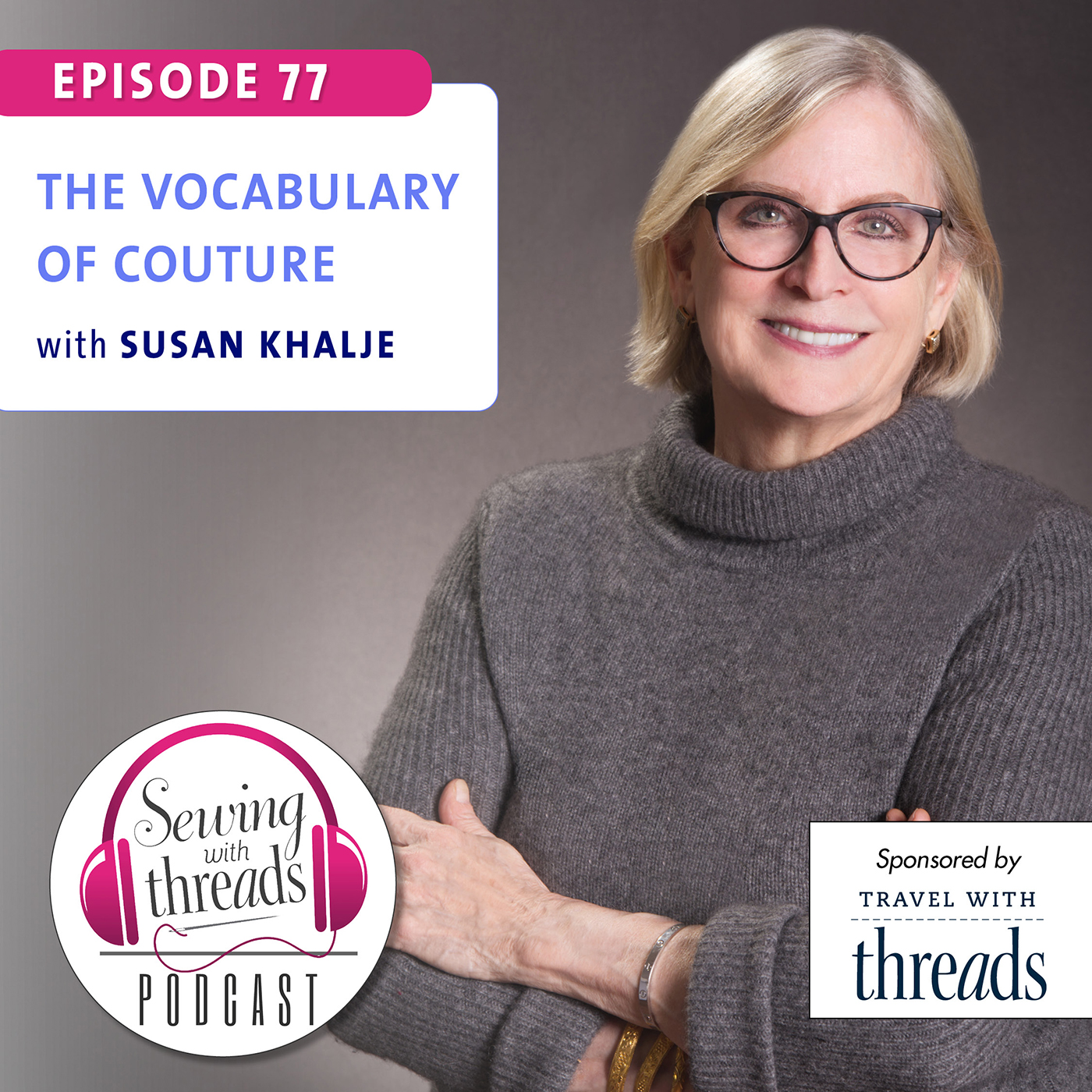
Threads Magazine Podcast: "Sewing With Threads"
The Vocabulary of Couture, with Susan Khalje | Episode 77
00:43:12
What does it mean to sew a couture garment? Learn from an expert the five elements of couture pieces and how to start sewing them yourself.
Loading summary
Transcript73 lines
- [00:00]
Carol Frazier
Carol we must tell everyone about the trip we're planning and inviting you, our Threads audience, to take with us. October 5th through the 14th of 2024. We've put together an exclusive tour to the Netherlands to visit textile ateliers, museums and fabric shops.
- [00:17]
Susan Kalge
And as the main event, we've arranged a three day workshop with Saskia Trevella of the Dutch Couture Academy. She'll give Threads travelers in depth instruction in draping on a half scale form along with couture embellishment techniques. The trip is packed with activities that are sure to inspire you.
- [00:35]
Carol Frazier
To find out more about the Travel with Threads Netherlands Tour, go to tours.threadsmagazine.com the group is limited to 20 participants, so reserve your place now.
- [00:52]
Susan Kalge
Welcome to Sewing with Threads, the monthly podcast with a staff of Thread Reds magazine. I'm your host, Carol Frazier, and I'm joined today by Susan Kalge. Susan hardly needs any introduction as she's well known to our readers and listeners, but here's a very abbreviated overview of her background and accomplishments. Susan was fortunate to work at a small couture house in New York, and that training then took her for a short time to a ready to wear business on 7th Avenue, followed by a long career making custom wedding gowns and evening wear in Baltimore. From there she shifted her focus to teaching nationally and internationally, hosting the HGTV television program so Much More, writing books including the Classic Bridal Couture and lots of articles for Threads. She's our longest serving contributing editor. You'll also find her leading couture focused trips to Paris and London and now an online sewing club. Her greatest interest, she says, is couture construction, and much of what she does in her teaching and writing relates to that. And that's why I invited Susan as a podcast guest today. Welcome Susan.
- [01:59]
Well, welcome to you. I'm delighted to be here.
- [02:01]
Well, I'm really happy that you could find time to do this. I know you're really busy, but I've been wanting to talk to you about a few things that you and I have discussed ourselves, and one of them is what we were kind of talking about as the vocabulary of couture. And I feel like there's so much to talk about when it comes to couture sewing and couture clothing, and I wanted to see if we could kind of sort out some definitions that might make sense to people who sew rather than people who maybe, you know, buy fashion magazines or spend a lot of money in boutiques. So could we start by Having you define what couture means and also haute couture.
- [02:37]
Absolutely. Because they're funny terms and I think they get bandied about. So, you know, who knows what they've come to mean? But couture really means sewing. That's what it means. That's the French word for sewing. Haute couture means literally high sewing or sewing on the highest level. So it's a little more complicated than that. If we could talk about haute couture for a moment. That's the term we hear with the fashion shows in Paris. And the term haute couture is really kind of. It's very strange, strictly regarded by the French. There's a government governing body that controls it. And it's a term that, at least in France, is reserved for people who have an atelier. There are certain rules they have to follow, certain numbers of workers they have to have the fashion shows they have to do. So haute couture is its own special little universe. But going back to couture, you know, doing what I do, you know, your elevator speech, People say, what do you do? And I say, oh, I teach couture sewing. And people's eyes usually glaze over. So I say, well, it's kind of sewing's equivalent of gourmet cooking. That's one way I think of it. Or I'll say it's probably the way your grandmother used to sew. And I think of it as sewing where you take care to do what you do. So to go back to the gourmet cooking analogy, you know, if you're doing a gourmet meal, you go across town to the best butcher and you take out the sewing, or rather the cooking equipment that you don't want, always use, and you get The Julia Child 8 page recipe and you really, you really take care with it and you end up with something absolutely lovely. So I think there are some comparisons with that, with couture sewing, to me, I don't know, I think it's just. Just taking your time and doing something with care. You know, there was such a big thing in sewing. It was probably in the 60s where speed became a virtue in sewing. Why, I do not know. But suddenly, you know, it was the two hour jacket and it became a good thing to sew really fast. So I think that kind of sidetracked sewing for a while, where fast became good. And I always say to my students, do you want the fastest dentist? Do you want the fastest cardiac surgeon? No, you want the best. So sewing, to me, good sewing takes time And I think that's, to me, that's what couture sewing is all about.
- [05:06]
I find that so interesting. You know, there's this movement for slow sewing. Right now. It seems to be focused on the slowness more than on the quality. I mean, I think it's meant to be very good quality. But I think that with couture sewing, there's more expertise in a lot of the techniques that you use that might not fit into slow sewing.
- [05:27]
Yeah, I mean, certainly it's. It's sewing that takes time, but, you know, it's interesting. So obviously there's a lot of hand sewing in couture sewing. And we'll talk more in a minute about the whole issue of control, because that's really what I think fine sewing comes down to. You're controlling every step of the process. But, and I always tell my students this, you know, those repetitive motions, you know, doing the same catch stitch over and over, the same slip stitch, the same fell stitch, the same whatever. Apparently it's very good for your brain. Those repetitive motions are very calming. And I think people, they penetrate deep levels of the brain, so they're good for you in that way. And maybe that's one of the benefits of slow sewing, that it just kind of calms you down and centers you. It becomes almost a kind of meditative exercise. But I think what interests me more is the results you get from taking that kind of care with the sewing. You really get a very beautiful result if you get these techniques in your fingers and then you apply them to what you're sewing.
- [06:31]
Right. And when you said it's the kind of sewing maybe that your grandmother did, that also interests me. I know that I've seen some garments that were made by either my mother or other people's mothers or grandmothers, and they have so many of the elements of the kind of clothing that you make too. The clothing was different from what we make. We're much more structured, more hand stitching, finishing of seams and stuff.
- [06:53]
Oh, absolutely. You know, we've just. I had a vintage coat I bought from someone and we just turned it into a pattern we're going to use. And this is, I guess you could call it a kind of an evening coat. Not super fancy, but it's a nice evening coat. And it would have been made, I guess, the 50s or 60s in this country. And it's beautifully made. I mean, the collar is totally sewn on by hand. There's like a built in gusset under the arm. It's really gorgeous. And you know, there's a label in it. It was made by the garment makers union in this country. You know, this was not. This is not a couture garment. This is, you know, ready to wear, but really beautiful. Ready to wear from the 50s. And I agree with you. You see these. You know, I remember my mother had a. It was a little black dress. Gosh. There was a waist stay in it. A grosgrain. A proper grosgrain waist stay. I do not think you'd see that in too many dresses these days. Certainly not, you know, kind of a regular dress.
- [07:48]
No, I don't think so. And I think, you know, when the 60s arrived and there were a lot more knits and clothing was less structured and briefer and short and no sleeves, and there didn't seem to be a need to do that. And I also suspect that when, you know, when there were more imported clothes and the price of ready to wear went down, then it was easier to get a lot of clothes. And the impetus to want to make something that was going to be really nice and last a long time probably became minimal for many people. But I have wondered about. Once you've put the time and effort into something, you've sewn it slowly and worked so hard at it, then you want to keep it. That is one step toward less waste and less of this sort of obsolescence within your wardrobe.
- [08:34]
Totally. And I think that's always been the French attitude. You know, you might have, I don't know, three skirts, but they fit you beautifully. They are of the best fabric. They're beautifully made. You only need three skirts. You don't need 20 cheap ones. You just need three really good ones or whatever. But it's certainly that idea of quality over quantity.
- [08:56]
Yeah, definitely. What would you say is. What are some of the hallmarks of what you would consider to be a couture garment? What do you think? I mean, I know it differs from piece to piece, but what sort of elements would you be looking for?
- [09:12]
Oh, well, we touched on this a little bit the other day, and to give a bit of an overview, a sort of foundation of how I look at the whole process, to me, there are five parts of it. And I remember years ago, I had to give a speech and I somehow cooked up. I called it the couture star. It was like this five pointed star. But those are the five elements that I think are really critical. So first of all, fabric. Fabric has to be wonderful. You want this garment to last, so you want wonderful fabric or fabrics. And I should say, I think couture garments often combine fabrics in beautiful ways. Satin and lace, you know, just beautiful combinations of fibers. So the fabric has to be really very, very special if you're going to put all this time into it. And then, of course, the design. And what does the design say? I always ask myself, is it saying enough? Is it saying too much? We've all seen garments and say a little too much. So the design has to be something special. And then, of course, fit. The biggest challenge of all for anyone and everyone, that has to be absolutely right on. And part of fit, I always think of the forgotten stepchild of the equation is proportion, because it's not just fit, but proportion is really a critical part of that. Is the hem in just the right place? Are those shoulders exactly where they should be? That's a proportion call as much as anything. And then, of course, engineering plays a part in these garments. We've all seen people at the Oscars kind of tugging up their dress. So it has to engineering, because these can be very special garments that put certain demands on something, you know, a huge skirt or something off the shoulder or whatever. So the engineering is a really critical part of it. And then, of course, it all comes together with the construction, and that has to be. That has to serve the design, the fabric, and all of those things, the engineering. But the process, to me, has to start with a Muslim and sometimes tedious to have to make one. I'm not always thrilled that I have to make one, but if I don't, I regret it. And the muslin, that's how any couture garment starts, and certainly how any haute couture garment starts. So the muslin is your laboratory. It's where you. You check to see is this. Is this even something you want to proceed with? You know, sometimes you. You make the muslin and you try it on and you think, oh, that looks terrible. Well, not going to bother with that. Or maybe you're trying to choose between two designs. So you make them both up, and then you'll. You'll know pretty clearly what works. So that's. That is the absolute essential first step, I would say. And then the. The great thing about the Kutcher process is that once you have your muslin, once you're happy with it, you know, it has all the information, has all the seam lines, everything you need, the muslin is taken apart and that becomes your pattern. And it's a very sturdy pattern. It's not going to rip like tissue paper. You've got the Whole thing and you have a full pattern and, you know, then you go to the underlinings and so on. But often it's just. It's easier to use a full pattern than half a tissue pattern that you have to double. I don't know how people do that. So there are lots of reasons why we start with this, with this toile, with this muslin. And it's interesting. I have a gal in a class that's coming up and she's doing. It's a vintage pattern. I'm not sure who it's by, but anyway, it's on the bias and she's doing it on double wool crepe. So I said, we'll see if you can get something similar for your muslin. Because if we've made the muslin out of a firm muslin, it's confusing. The muslin is made for muslin, but if we'd use just a plain, plain weave cotton for her toile, it wouldn't have draped the way the double wool crepe will be. So we. I said, see if you can find something similar to that for making your toile, for making your muslin. So often, you know, if you're doing a coat, you might want a heavier weight. You know, you can kind of mimic sometimes the garment that you'll be making with the weight of the fabric you're using for your toile for your muslin. So that's simple. That's really critical. That has to be your first step.
- [13:39]
When you're looking at a muslin or a toile on the person who's going to wear it. That's, I'm assuming, when you're checking for proportions generally and fit everything.
- [13:48]
Yeah.
- [13:49]
What. How? Do you have any strict rules for proportions? Or is it like, just different for every person in every garment?
- [13:55]
I think it's different for every person in every garment. You know, it's kind of silly to say anyone can wear anything, but they kind of can. I mean, if the proportions are right and if the fit is right, you know, and you pay attention to what fabric you're going to be using, I think you kind of can. Yeah, I think, you know, and it's funny, when you're fitting people, sometimes you end up taking so much of something apart. I'm sure people think, well, I don't know why I bothered to sew this thing together in the first place if all she did was dismantle it. But you have to have a first look at it. You have to see, okay, what's going on Is this a good design for this person? Is there a possibility here? What's our fabric going to be? Do they look comfortable in the design? Is this something they're going to enjoy wearing? Does it look good on them? And I think. I think people have a pretty good sense of what works for them. I think it's pretty rare that I think something just flat out isn't going to work. I don't even remember that happening. But, yeah, I'd like to get an overview of things. And then you kind of get to the specifics of making things fit, which to me, is a fun puzzle. You know, when I first. Oh, golly, I don't know how many years ago now. It's something like 30 years ago when I first started doing these couture classes, I thought, well, you know, it's really all about couture techniques, fitting. Well, that's just kind of side issue. That's not really my focus here. Well, it's pretty stupid assessment. There's nothing more important than getting things to fit. And to me, I love the puzzle of it. I love. Okay, the first thing you do is assess what's going on in the body. Right. Because that's where it all starts. That's what has an effect on your fit. So you kind of size that up, and then you see, okay, just what do we have to do? What are my tools for getting this to fit? How am I going to get this to work? So I think I find it kind of a fascinating little. It's a puzzle. It's a puzzle to get it all to balance and work.
- [16:02]
Yeah. I remember when one time you came and you did a little fitting on the French jacket for the thread staff at the time, and there were probably six or seven of us there, all of us with very different shapes and sizes, if you recall. And totally. I mean, I feel like in the realm of the world, we're not that diverse, but it really is. We're just very differently shaped. And it was so fascinating to see. You know, just. Here, let me give you an extra inch of room across the hips and take some out of the shoulder. And then all of a sudden, a jacket that looked bizarre and awkward becomes something elegant.
- [16:37]
And that's exactly what you're headed for, because you've got to get it to that point. Point of being elegant, because it's. It's lurking there. So you just kind of have to push it. Push it in that direction of being elegant. And that's when, you know, fashion is only. It's any dress Any garment, it's only the means to the end, and the end being making you confident and happy when you're wearing it. So it's kind of serving that purpose. It's just a tool for that. So that's your guide, right? How can I. How can I bring out the best in this person wearing that garment? Right. The garment is the tool to get you to that, to get you to that place.
- [17:19]
Do you ever have somebody who wants to make something that is. You just think it's ill advised?
- [17:25]
Not so much. No. No, nothing really, Nothing really glaring comes to mind. And I mean, sometimes, you know, somebody might present a choice of things. You know, we might be in touch in advance of a class, and they might say, I'm thinking of these things. Which do you think would work best? But no, no, my feeling is pretty much, if that's what you want, okay, we're gonna. We're gonna do this, and we're gonna do it as well as we possibly can.
- [17:56]
I'm impressed by that because, you know, you look on the red carpet and there are a lot of people who. We probably needed somebody to say, let's take another look at this seriously.
- [18:06]
But all kinds of other things come into play with that, I think publicity and lots of stuff.
- [18:13]
Exactly. Well, can we go back a little bit to the couture atelier that you mentioned in France? I realize that they're strictly regulated as a sort of part of the business, but how many people do you have to have to have a couture studio? And what. What do they specialize in?
- [18:31]
Well, couture studios are generally broken into two parts, the flu and the trailer. So the flu, you can tell from that word. It's things that are fluid. This is where the dresses are made, the gowns and so on. And then the trailer is. The more tailored things are done in the other, other part of it. And I think. I think you have to have 15 or 20 people working for you. You have to show it the two shows per year. And the couture, the haute couture shows are in January and July in Paris. You have to. What else do you have to have? Of course, you have to see people by appointment. And I think, oh, gosh, I was looking this up the other day. Back in the day, in 1939, there were 70 haute couture establishments in Paris. Now there are 16. It's really shrunk. And some of those members are what are called corresponding members, you know, like Valentino, for instance, whose workrooms are in Italy. They're not in Paris. So that's a corresponding member. There are guest members. So the numbers have shrunk tremendously from what they used to be. But yeah, you still. It's, it's very strict and it's actually a government body, there's a federation which oversees all fashion and there's a part for women's fashion, a part for men's fashion, and then there's a part for the haute couture. And it's a governing body and they're very, very strict about it. I love it because I think it sort of speaks to the importance that fashion has always had in France. This isn't a silly frivolous thing. This is tremendously important to the economy and I think to the whole, I don't know, the whole nature, the whole personality, the whole atmosphere. It's just tremendously important thing. It's kind of like when you're in la, everybody's kind of involved with it or aware of the entertainment business in France and certainly in Paris. It's a very, very important part of what's done. I don't know what the numbers are, how many people are employed anymore in the couture houses. But back in the day, in the heyday, you know, when Dior was so big in the 50s, there were thousands and thousands of people employed at the couture houses. A huge part of the economy especially, you know, it had a real resurgence after World War II and that's actually when the Chambray Sandy Cal made its laws so strict about the use of haute couture. So it's a very, very carefully guarded assignation, name, description of something.
- [21:03]
It's like wine, you know, it's part of the cultural patrimony in such an important way. Oh yeah, it's certainly not, not here. So is there any kind of test for the quality of what they produce? Or is the assumption that if you follow the rules for employing people then you're going to produce something?
- [21:20]
No, I think it's sort of self policing. I don't think you'd last very long if you weren't very good. And the quality obviously is superb. And of course there are all sorts of supporting industries too. You know, the beadwork and the people who do feathers and the embroidery. You know, there are all kinds of supporting industries as well.
- [21:40]
I was going to ask about that. So none of that is really done in the ateliers. That is you generally, I hate to say, farmed out. That sounds like a terrible phrase to say for something like this.
- [21:53]
It Is farmed out.
- [21:54]
Commissioned.
- [21:55]
No, it is farmed out. There's a wonderful embroidery, Italian, called Vermont. Looks like Vermont. Vermont. And they used to be independent and in fact, for a while with my group, we were able to visit them, which was. Was incredible. They showed us the archives, we went into the workrooms. And we can no longer do that because they're now owned by Dior. At least all the work they do is. They do a lot of the work for Dior. So, yeah, that's not something you would have on your own. But you would contract. You would get in touch with Vermont and say, well, this is the sort of dress I have in mind. Can you do some samples for us? And they would send the samples. You choose something and then it would. Then you would send. You would send the garment. Pieces of the garment to them, the garment in process to them. They would do the embroidery and then it would come back to you.
- [22:45]
Oh, it sounds like a dream. It really does sound so amazing.
- [22:49]
It does. But, you know, it's still subject to money and deadlines and, you know, getting stuff done and last minute push. A lot of the embroidery work has gone overseas. Some couturiers do it in the Middle East. Lesage has a big operation in India. So, you know, gets down to money, I suppose, and just practicalities.
- [23:14]
Right. And who knows if there isn't a heritage? I mean, I think in India there is a heavily embellished fabric.
- [23:21]
Yes, well, there certainly is. And, you know, you used the word patrimony a minute ago. And that's such a big part of all of these industries in. In France, you know, the French word patrimoine, this heritage, this idea of things having been done for generations, you know, of something going down through a family. And you see it so much in these smaller supporting industries.
- [23:44]
Oh, yes, I can imagine family that their family owned and passed down.
- [23:48]
Yeah, yeah, yeah.
- [23:49]
So let's point this in the direction of somebody who is a home sewer, who doesn't have a studio with 15 people and no access to Lesage or any of those other places, but most of us don't. Is it possible for somebody who's a home sewer to really achieve a great couture finish on something and.
- [24:10]
Absolutely. Oh, yeah.
- [24:11]
What level do they have to be advanced already, or can you start when you're not an advanced sewer?
- [24:19]
I guess you could. I mean, there's no reason why you can't do things in a couture way right from the beginning. I don't think any of it is smoke and mirrors. And I think what appealed to me when I started working at that small couture house in New York was the logic of all of it. And I was, you know, I had studied sewing in home EC and I, you know what it was like back in the day. You'd always buy a more complicated pattern, right? Oh, I get a pattern with a, with a collar this time around. Oh, look, this one has this kind of a cuff. I've never done that. So you kind of educated yourself as you went along. And I think I probably got about as far as you could get on your own. And then this new world of couture sewing opened to me. But it's not brain surgery. And as I said, it's all absolutely, it's dead logic. And I think that's what appealed to me the most. And I think that's something that maybe appeals to a lot of the people who choose to sew this way. So certainly you get better with practice doing things. But honestly, I think, I think if someone. You could start with an, a line skirt or a straight skirt. You could start with something simple and just, you know, if you start with a muslin, start with a toile, get the thing to fit first, then you have the pleasure of sewing it, knowing it's going to work right, because you fitted it, then all you have to do is put it together. And, you know, I think the concept of underlining is a big one in the Kutscher universe and it's something we've written about a lot over the years in threads, but that's not a difficult thing to do. You just, you know, things are hand basted together. Well, hand basting is not too hard to master. So that's something you could do. Putting in a zipper by hand. Oh, my goodness. I can't tell you how many people will say, oh, that's so easy. Oh, if I'd only known. I'll never put a zipper in by machine again. So that's not difficult. Putting a grosgrain stay inside a waistband. Not difficult to do again, is it? Speed can't be your. I don't think speed can be your goal with such a thing, but I don't think, I honestly don't think these are wildly difficult things to do. I really don't. No.
- [26:39]
So what you've got me thinking about is the idea of the idea of taking your time and working on what you know that you're doing now and getting ready to go to the next step and not feeling overwhelmed by the entire project because you figured out as you go along. And I've heard a few people recently talking about how they arrange their sewing like that so that it all breaks down into something that's manageable or something that you can easily undo and redo and that you have to be prepared for your practice and put in your 10,000 hours or your however many hours and know that there's always going to be progress and that you don't expect that you're going to start today and have, you know, something that looks like a ready to wear coat made tomorrow. Just don't have that expectation.
- [27:26]
No. And one of the lovely things about this is that you can redo it. I think endlessly. Maybe you get to certain things where you kind of cut something, you can't redo it, but an awful lot of this stuff, you can, you can redo it again and again and again. And I think you pretty quickly see some lovely results. Now, the one, the one tricky thing is the fitting. And that's hard. That's just, you know, we talk about this a lot. It's the elephant in the room. It's, it's, it's a tricky thing to do. It's difficult to fit yourself. I wish it weren't. I wish I could say to people, oh, yeah, you can fit yourself, no problem. It's just not true. So what do you do? Well, sometimes you can visit a professional. You can do a zoom fitting with someone. You can go to a friend, if you have a friend who sews, you could maybe find someone at the American Sewing Guild or the sewing and design professionals. You could go to somebody who would do some fitting. And actually, one thing that I think is not a bad idea, let's face it, there are only a certain number of designs out there, right? So if you had a well fitted muslin jacket, a sheath dress, a skirt, a princess seam dress with sleeves, you'd kind of have it covered. And then you could use those things to do variations on. So, you know, if you're serious about this, it wouldn't be a terrible idea to go to someone to go to a professional and say, look, I'd like you to fit these five or six garments. And honestly, then you'd be, you'd be good to go. So that's, that's one approach.
- [29:08]
Do you ever make pants?
- [29:10]
I don't. No, I don't. I can tell you how to make them, but I guess I make them. I just don't know how to fit them because, you know, in a traditional couture atelier, we don't do pants. We don't. Pants are actually drafted. And a lot of the fitting in a couture atelier is draped. It's done right on that person. You know, at the. The atelier I worked at, you know, each. Our best clients had their own dress forms. You know, we had a shelf, and there they all were. And so you would. You would fit to that. That way you didn't have to have the customer coming in all the time. And if they were a good customer, you would have their muslins, their toilets, anyway. But we never did pants. And like I said, those pants are drafted. They're not draped. If you think about it, be kind of weird to drape a pair of pants on someone. So there. It's something that's just drafted from measurements, and I don't know how to fit them. You know, I see those lines. Nope, not my. Not my territory. So I don't know how to correct the problems that there are with them. So, no, don't do pants.
- [30:16]
So if someone were. If someone had a pant pattern that fit well and they wanted to make them in a couture style, is there anything particular you would recommend for just improving the construction?
- [30:27]
Oh, I guess I. Well, you know, we almost always use underlinings in couture sewing, and I think that would probably help to keep the fabric from bagging out, you know, when you. When you sit down. Yeah. And I'd say use an underlining as well as a lining, you know? Right. Silk hands is kind of our go to underlining the one we use so much of the time. And a lot of people find that scratchy to wear. I don't. Plus, it sort of softens over time. But I think if you were making a really beautiful pair of pants, you'd want to have a lining in there anyway.
- [30:57]
Right. I agree. And I think there are some waistband styles that you have talked about in the past that might work for a nice pair of pants, too. Sort of.
- [31:06]
Definitely.
- [31:06]
Yeah.
- [31:06]
I always. I can tell you how to make them. I just. I don't want to fit them. I would. I would feel out of my depth. Not my. Not my thing.
- [31:14]
Yeah. Yeah. Well, I think you can kind of couturize a lot of different things when you stop to think about it, if you want to. But I also know that many people want to just, like, sit down on the weekend, make a sundress, and be, you know, walk away and be happy with that. And I think there's room for all of this.
- [31:30]
Oh, absolutely. Oh, my goodness. You know, to go back to the gourmet cooking analogy, do you make a gourmet meal, you know, twice a day for lunch and dinner every day? Probably not, so. Oh, that, I think, is the great thing about sewing. There's every level out there. You know, if you do want to make that quick dress, absolutely. Then you kind of get somebody like me. I. And I realize I'm. I'm out in left field because it's the only kind of sewing that. That I like to do. I can't sew quickly, or I should say in a. In a kind of a quick manner. But that's just me, you know, that. That's just. That's just what satisfies my way of doing things. But I. I think it's wonderful if you can dash something off. Yeah. Why not?
- [32:14]
Oh, no, I know. I know that there are people who fall at both ends of the spectrum, and, you know, that can do the whole range, but it's kind of good to specialize, especially if it is ultimately complex. In the article that is coming out in the summer issue, Susan has a really nice article about a great couture project that she did. You said, oh, this was easy and very familiar to me. And I'm like, oh, my gosh, that is complicated stuff.
- [32:35]
Well, yeah, but it's very known territory. What she's referring to. It was a. A very tight brocade bodice off the shoulder with great big sleeves and boning. And. Yeah, I mean, I'm not saying it was uncomplicated, but it. To me, again, it's extremely logical, something like that. You know, you. You fit the muslin carefully, and then you think, okay, what kind of structure do I need in this thing? The sleeves were very heavy, so therefore, you got those kind of pulling off on the bodice, which means the bodice has to be really firm and well supported, which means you need a lot of boning in there. So you. Yes, it's pretty. Pretty logical in its own way. And that's what I said. There's what I love about it. There's no mystery. There's no. It's every time you do something in couture. And this is what I love about it. There are good, solid reasons why you do it. It's never, oh, oh, I don't know. That's just the way we do it. No, that's never the answer you get. It's because of boom, boom, boom, boom, boom. I give you 10 reasons why we do this. And, you know, why do you use the catch stitch instead of the fell stitch or instead of the slip stitch. You know, there are reasons for all of these things, and I think that's. That's why it stood the test of time. You know, that's why a couture garment that was made by, you know, Christian Dior. The same techniques more or less are. Are used today. You know, the same basic vocabulary, the same elements that go to create a couture, a successful garment are used, right?
- [34:16]
And that brings back to the. What we were talking about at the beginning, the vocabulary of couture, which is you have your five. You know, your five elements of what makes a couture garment. And also, just as you say, each piece, the catch stitch, for example, what it does for you, it's not just there because it's cool to know it. It's there because it has a certain flexibility. You just need to know that you do.
- [34:36]
And I can tell you why we use this instead of the other. And I guess the word. So all of this kind of heading down the finish line to what makes a good garment. And I think every single one of these elements speaks to control. You're controlling every step of the process. And I always joke with my students if I could stamp the word control on their foreheads, because that's what all these things serve, right? You're controlling how it fits. You're controlling how the fabric behaves by your underlining, by the stitches you choose. You control how it works on the body by your engineering. You just control. And I guess, I don't know, maybe control has a. Has bad connotations, but I. Maybe there's a better word for it. But to me, that's what this is all pointing at, right? The control that it gives you. Let's say you. Let's say you buy a pattern, you go to the store and you come home into the pattern, you cut it out, you set. Sew it up, and it doesn't fit at all. Well, yeah, you didn't control the fitting, right, because you didn't make a muslin, you didn't make a toile. So you didn't control that. That didn't work. So, you know, it just allows you to control in the best possible way. I have to think of another word for control that serves negative implications well.
- [35:55]
Because everybody wants to put freak on the end of it and say control freak. It's not being a control freak. It's being in control of your process. And if you want a good result, you kind of have to be in control of Your process. I think if you want to just throw things together and have a great time and have fun and you're happy with what you get at the end, that is fine. But I feel that a lot of people want to throw things together and have a great time and then they're not happy with what they made. And it's because, as you say, they didn't control elements that would, that were important to control.
- [36:25]
I think so. Because, you know, like, if you do want that eight page cassoulet recipe that Julia Childs has to work well, then you kind of have to, you know, go through the paces. You have to get all those special ingredients, you have to do kind of plot it out. You're not going to be able to throw together in 10 minutes. Yeah. So I think control and also the thing we talked about at the time. And you know, I think to me there's always a generosity in the couture process. Certainly in the haute couture process. I mean, the sky's the limit. You know, you have all the time in the world, all the money in the world. So I think the way time is spent in a very generous way. And I have to say, one of the things that I loved when I worked at our little Kutcher place in New York, we were never rushed. You know, it was never, get this done, come on, quick, quick, quick. Never, ever, ever. We could take our time. I mean, certainly there were, there were times, you know, Mrs. Rockefeller needs her evening down by tonight and it was all hands on deck. But much of the time there was a real, ah. And I'm so glad I'm kind of getting to this real enjoyment of the process and that. I think if you're going to do this kind of couture sewing, gosh, hopefully, boy, if you don't, it would be torture. But hopefully you enjoy the process. You enjoy every step of the way. And, you know, very often in a class, I'll say, oh, let me help you with your basting. Well, yeah, I want to help you with your basting, but it's fun for me too, because I love doing all these things. They're, they're, they're fun to do. So if you didn't love the process of it, I think it would probably be torture. So maybe you wouldn't even last five minutes. Maybe you just think, you know, this isn't for me, this isn't the way I want to spend my time. But I do think so. That generosity, time and intention and budget for fabric, all of that stuff There's a generosity, but also that love you've got to have. You've got to have a love of the actual doing of it. You know, you have to love doing the fold stitch for hours. You have to love playing with the lace on the bodice of a wedding gown. You have to really love that because you're going to be doing it for days and it would be horrible if you didn't. That would. Gosh, that'd be torture.
- [38:47]
The people who don't love it are. The people who don't do it. I mean, that's really what it comes down to. Those people are the ones who want to get a serger and make, you know, all, all knit wearing again. That is completely fine.
- [38:57]
Some. That's.
- [38:58]
That's what your life needs. That's what you enjoy. That's your way of doing it.
- [39:01]
Oh, sure, yeah. It's funny. Every now and then I'll do. I'll do a garment that's relatively quick to put together and think, oh, wow, that's. That's interesting. That's a concept made something in a day. Wow. Very, very different from the way I usually work. But yeah, you. And that's, that's really, really important. That, that enjoyment of it and that love of it. And I think, you know, once you get kind of hooked by that, that becomes kind of what prepares, propels you through it and makes you get better. Right? Because, you know, you'll spend time. And then these, these stitches get in your fingers and they become wonderful tools. That's what they are. I mean, all of this stuff, these are tools. Everything you use, and underlining, your beeswax, your basting thread, these are all your tools that serve you. And yeah, once you kind of, Once you kind of embrace all that, then the sky's the limit. Then it really does become fun. The thing I say that couture always does so beautifully. It combines form and function. You know, you look on the inside of a couture garment and it just looks beautiful. All those stitches, it's so beautifully done. You've got the underlining in there and all your under stitching. It's just a gorgeous thing to look at, but it works. I mean, it stands up from that engineering construction perspective. Right. So, you know, under stitching in a bodice looks beautiful, but wow, it. It really is very cleverly done because it keeps the, it keeps the layers in place, it controls things. So. And I think that's when couture is at its very, very best, when you get that meeting of form and function when they. When they mesh so well, it looks great, but yeah, it works really well, too.
- [40:53]
Yeah. You know, I've been thinking about it as, you know, as learning a language. If you go and immerse yourself in a country where you know the language a little bit and you really just use it and use it and use it, it's like using the vocabulary of couture. You can't help getting better.
- [41:07]
Oh, absolutely.
- [41:08]
You have to get better at it and you become more expressive with it. You have. You can say what you really mean to say. You can get the results you want and just be and feel really familiar and as you say, just kind of full of joy with using all of this vocabulary and the language you are.
- [41:27]
And that's what you know. And I think I always thought as a teacher, you know, my job isn't to say, oh, put this stitch here, put that stitch there. My job is to teach my students to think right? That's my job. So that the next time when I'm not there and they have to figure something out and they think, okay, which tools do I have at my disposal? Where would the boning go? Which is the best stitch to use? Where should the zipper go? Where's the best place to put the closure? Because then, like you say, that's when you own it. That's when it becomes you. When you have all of these, not just tools, all these options, and you can put them together in a really wonderful way. You can have that conversation in French, you know, you're not repeating, wrote what you learned in, you know, 10th grade French. You can put this all together yourself and express yourself.
- [42:18]
Well, Susan, we are running out of time and I want to thank you so much for telling us all about this. This is really inspiring and exciting. It makes me feel like this is something that anyone could do if they decided to just dip their toe in and then keep moving.
- [42:33]
100%, absolutely. You know, I promise, give it a go. Your results will astonish you and they'll make you want to go further with it. Susan.
- [42:42]
Well, that's very wonderful and thank you for joining me today, Susan. And thank all of you for listening. If you want to know more about Susan Kalji, Visit her@susancalge.com Please remember to.
- [42:53]
Carol Frazier
Send your comments, questions and suggestions to threadsmagazine.com and please like, comment and subscribe wherever you are listening. Until next time, keep on sewing with threads.