← Through the ESV Bible in a Year with Jackie Hill Perry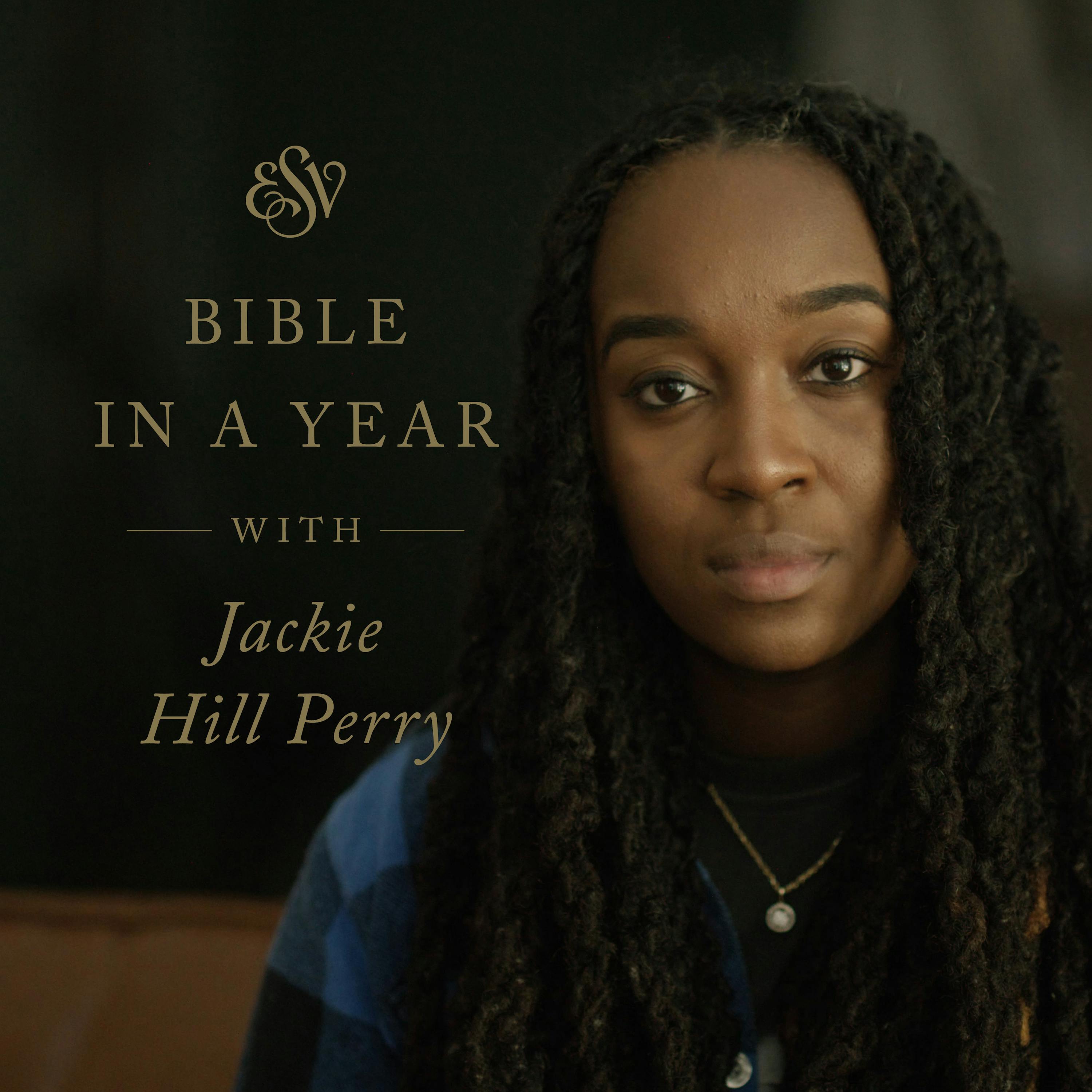
Through the ESV Bible in a Year with Jackie Hill Perry
January 19 (Genesis 34–35; Psalm 18:25–50; Matthew 22)
00:13:32
Loading summary
Transcript109 lines
- [00:02]
Narrator
A reading from the book of Genesis. Now Dinah, the daughter of Leah, whom she had borne to Jacob, went out.
- [00:09]
Reader
To see the women of the land. And when Shechem, the son of Hamor.
- [00:13]
Narrator
The Hivite, the prince of the land, saw her, he seized her and lay with her and humiliated her.
- [00:18]
Reader
And his soul was drawn to Dinah.
- [00:20]
Narrator
The daughter of Jacob. He loved the young woman and spoke tenderly to her. So Shechem spoke to his father Hamor, saying, get me this girl for my wife.
- [00:30]
Reader
Now Jacob heard that he had defiled his daughter Dinah. But his sons were with his livestock in the field. So Jacob held his peace until they came. And Hamor, the father of Shechem, went.
- [00:40]
Narrator
Out to Jacob to speak with him.
- [00:42]
Reader
The sons of Jacob had come in from the field as soon as they heard it.
- [00:45]
Narrator
And the men were indignant and very.
- [00:47]
Reader
Angry because he had done an outrageous.
- [00:49]
Narrator
Thing in Israel by lying with Jacob's daughter. For such a thing must not be done. But Hamor spoke with them, saying, the.
- [00:57]
Reader
Soul of my son Shechem, longs for your daughter. Please give her to him to be his wife. Make marriages with us.
- [01:03]
Narrator
Give your daughters to us, and take our daughters for yourselves.
- [01:06]
Reader
You shall dwell with us, and the.
- [01:08]
Narrator
Land shall be open to you. Dwell and trade in it, and get property in it. Shechem also said to her father and to her brothers, let me find favor.
- [01:16]
Reader
In your eyes, and whatever you say.
- [01:18]
Narrator
To me, I will give. Ask me for as great a bride price and gift as you will, and I will give whatever you say to me. Only give me the young woman to be my wife. The sons of Jacob answered Shechem and his father Hamor deceitfully because he had defiled their sister Dinah. They said to them, we cannot do.
- [01:35]
Reader
This thing to give our sister to.
- [01:36]
Narrator
One who is uncircumcised, for that will be a disgrace to us.
- [01:40]
Reader
Only on this condition will we agree.
- [01:41]
Narrator
With you that you will become as we are by every male among you being circumcised. Then we will give our daughters to you, and we will take your daughters to ourselves, and we will dwell with you and become one people.
- [01:52]
Reader
But if you will not listen to.
- [01:54]
Narrator
Us and be circumcised, then we will take our daughter and we will be gone. Their words pleased Hamor and Hamor's son Shechem.
- [02:01]
Reader
And the young man did not delay.
- [02:03]
Narrator
To do the thing because he delighted in Jacob's daughter.
- [02:06]
Reader
Now he was the most honored of.
- [02:07]
Narrator
All his father's house.
- [02:09]
Reader
So Hamor and his son Shechem came.
- [02:11]
Narrator
To the gate of their city and.
- [02:12]
Reader
Spoke to the men of their city.
- [02:13]
Narrator
Saying, these men are at peace with us.
- [02:16]
Reader
Let them dwell in the land and trade in it.
- [02:19]
Narrator
For, behold, the land is large enough for them. Let us take their daughters as wives, and let us give them our daughters.
- [02:25]
Reader
Only on this condition will the men.
- [02:27]
Narrator
Agree to dwell with us, to become one people.
- [02:30]
Reader
When every male among us is circumcised.
- [02:32]
Narrator
As they are circumcised, will not their livestock, their property, and all their beasts be ours?
- [02:38]
Reader
Only let us agree with them, and.
- [02:39]
Narrator
They will dwell with us. And all who went out of the.
- [02:42]
Reader
Gate of his city listened to Hamor.
- [02:44]
Narrator
And his son Shechem. And every male was circumcised, all who went out of the gate of his city. On the third day when they were sore, two of the sons of Jacob.
- [02:54]
Reader
Simeon and Levi, Dinah's brothers, took their swords and came against the city while.
- [02:58]
Narrator
It felt secure and killed all the males. They killed Hamor and his son Shechem.
- [03:02]
Reader
With the sword and took Dinah out.
- [03:04]
Narrator
Of Shechem's house and went away.
- [03:06]
Reader
The sons of Jacob came upon the.
- [03:07]
Narrator
Slain and plundered the city because they had defiled their sister. They took their flocks and their herds.
- [03:13]
Reader
Their donkeys and whatever was in the.
- [03:14]
Narrator
City and in the field, all their.
- [03:16]
Reader
Wealth, all their little ones and their.
- [03:17]
Narrator
Wives, all that was in the houses.
- [03:19]
Reader
They captured and plundered.
- [03:21]
Narrator
Then Jacob said to Simeon and Levi, you have brought trouble on me by.
- [03:25]
Reader
Making me stink to the inhabitants of.
- [03:27]
Narrator
The land, the Canaanites and the Perizzites. My numbers are few, and if they.
- [03:32]
Reader
Gather themselves against me and attack me.
- [03:34]
Narrator
I shall be destroyed, both I and my household. But they said, should he treat our.
- [03:39]
Reader
Sister like a prostitute?
- [03:41]
Narrator
God said to Jacob, arise.
- [03:44]
Reader
Go up to Bethel and dwell there. Make an altar there to the God who appeared to you when you fled.
- [03:49]
Narrator
From your brother Esau.
- [03:51]
Reader
So Jacob said to his household and.
- [03:53]
Narrator
To all who were with him, put away the foreign gods that are among you, and purify yourselves and change your garments.
- [03:59]
Reader
Then let us arise and go up.
- [04:00]
Narrator
To Bethel, so that I may make.
- [04:02]
Reader
There an altar to the God who answers me in the day of my.
- [04:05]
Narrator
Distress and has been with me wherever I have gone.
- [04:08]
Reader
So they gave to Jacob all the foreign gods that they had and the rings that were in their ears. Jacob hid them under the terebinth tree.
- [04:15]
Narrator
That was near Shechem. And as they journeyed, a terror from.
- [04:19]
Reader
God fell upon the cities that were.
- [04:21]
Narrator
Around them, so that they did not pursue the sons of Jacob.
- [04:25]
Reader
And Jacob came to Luz, that is.
- [04:27]
Narrator
Bethel, which is in the land of Canaan. He and all the people who were with him.
- [04:31]
Reader
And there he built an altar and.
- [04:33]
Narrator
Called the place El Bethel.
- [04:34]
Reader
Because there God had revealed himself to him.
- [04:36]
Narrator
When he fled from his brother and Deborah, Rebekah's nurse, died.
- [04:40]
Reader
And she was buried under an oak below Bethel. So he called its name Alan Bacoth.
- [04:45]
Narrator
God appeared to Jacob again when he.
- [04:48]
Reader
Came from Paddan Aram and blessed him.
- [04:50]
Narrator
And God said to him, your name is Jacob.
- [04:53]
Reader
No longer shall your name be called.
- [04:55]
Narrator
Jacob, but Israel shall be your name. So he called his name Israel. And God said to him, I am God Almighty. Be fruitful and multiply. A nation and a company of nations shall come from you. And the kings shall come from your own body. The land that I gave to Abraham and Isaac I will give to you. And I will give the land to your offspring after you.
- [05:17]
Reader
Then God went up from him in.
- [05:18]
Narrator
The place where he had spoken with him.
- [05:20]
Reader
And Jacob set up a pillar in.
- [05:22]
Narrator
The place where he had spoken with him, a pillar of stone. He poured out a drink offering on it and poured oil on it.
- [05:28]
Reader
So Jacob called the name of the.
- [05:30]
Narrator
Place where God had spoken with him.
- [05:31]
Reader
Bethel.
- [05:32]
Narrator
Then they journeyed from Bethel. When they were still some distance from Ephrath. Rachel went into labor, and she had hard labor. And when her labor was at its hardest, the midwife said to her, do not fear for you have another son. And as her soul was departing, for she was dying, she called his name Benoni. But his father called him Benjamin.
- [05:54]
Reader
So Rachel died, and she was buried.
- [05:55]
Narrator
On the way to Ephrath, that is Bethlehem.
- [05:58]
Reader
And Jacob set up a pillar over her tomb. It is the pillar of Rachel's tomb.
- [06:03]
Narrator
Which is there to this day. Israel journeyed on and pitched his tent beyond the tower of Eder.
- [06:08]
Reader
While Israel lived in that land, Reuben.
- [06:10]
Narrator
Went and lay with Bilhah, his father's concubine. And Israel heard of it. Now the sons of Jacob were 12. The sons of Leah, Reuben, Jacob's firstborn, Simeon, Levi, Judah, Issachar, and Zebulun. The sons of Rachel, Joseph, and Benjamin. The sons of Bilhah, Rachel's servant Dan and Naphtali, the sons of Zilpah, Leah's servant Gad and Asher.
- [06:35]
Reader
These were the sons of Jacob who were born to him in Paddan Aram. And Jacob came to his father Isaac.
- [06:41]
Narrator
At Mamre and at Kiriath Arba, that is Hebron, where Abraham and Isaac had sojourned.
- [06:47]
Reader
Now the days of Isaac were 180 years.
- [06:49]
Narrator
And Isaac breathed his last and he died and was gathered to his people.
- [06:53]
Reader
Old and full of days.
- [06:55]
Narrator
And his sons Esau and Jacob buried him.
- [06:59]
Reader
A reading from the Book of Psalms.
- [07:02]
David
With the merciful you show yourself merciful. With the blameless man you show yourself blameless. With the purified you show yourself pure. And with the crooked you make yourself seem torturous. For you save a humble people. But the haughty eyes you bring down. For it is you who light my lamp. The Lord my God lightens my darkness. For by you I can run against a troop, and by my God I can leap over a wall. This God, his way is perfect. The word of the Lord proves true. He is a shield for all those who take refuge in him. For who is God but the Lord and who is a rock except our God? The God who equipped me with strength and made my way blameless. He made my feet like the feet of a deer and set me secure on the heights. He trains my hands for war so that my arms can bend. A bow of bronze you have given me the shield of your salvation. And your right hand supported me. And your gentleness made me great. You gave a wide place for my steps under me, and my feet did not slip. I pursued my enemies and overtook them and did not turn back till they were consumed. I thrust them through so that they were not able to rise. They fell under my feet. For you equipped me with strength for the battle. You made those who rise against me sink under me. You made my enemies turn their backs to me. And those who hated me, I destroyed. They cried for help, but there was none to save. They cried to the Lord, but he.
- [08:26]
Narrator
Did not answer them.
- [08:27]
David
I beat them fine as dust before the wind. I cast them out like the mire of the streets. You delivered me from strife with the people. You made me the head of the nations. People whom I had not known served me. As soon as they heard of me, they obeyed me. Foreigners came cringing to me. Foreigners lost heart and came trembling out of their fortresses. The Lord lives, and blessed be my rock. And exalted be the God of my salvation, the God who gave me vengeance and subdued peoples under me, who rescued me from my enemies. Yes, you exalted me above those who rose against me. You delivered me from the man of violence. For this I will praise you, O Lord among the nations, and sing to your name. Great salvation he brings to his king and shows steadfast love to his anointed. To David and his Offspring forever.
- [09:17]
Reader
A reading of the Gospel according to Matthew.
- [09:21]
Jesus
And again Jesus spoke to them in parables, saying, the kingdom of heaven may be compared to a king who gave a wedding feast for his son and sent his servants to call those who were invited to the wedding feast. But they would not come. Again he sent other servants, saying, tell those who are invited, see, I have prepared my dinner. My oxen and my fat calves have been slaughtered and everything is ready. Come to the wedding feast. But they paid no attention and went off. One to his farm, another to his business, while the rest seized his servants, treated them shamefully and killed them. The king was angry, and he sent his troops and destroyed those murderers and burned their city. Then he said to his servants, the wedding feast is ready. But those invited were not worthy. Go therefore to the main roads and invite to the wedding feast as many as you find. And those servants went out into the roads and gathered all whom they found both bad and good. So the wedding hall was filled with guests. But when the king came in to look at the guests, he saw there a man who had no wedding garment. And he said to him, friend, how did you get in here without a wedding garment? And he was speechless. Then the king said to the attendants, bind him hand and foot and cast him into the outer darkness. In that place there will be weeping and gnashing of teeth. For many are called, but few are chosen. Then the Pharisees went and plotted how to entangle him in his words. And they sent their disciples to him along with the Herodians, saying, teacher, we know that you are true and teach the way of God truthfully. And you do not care about anyone's opinion, for you are not swayed by appearances. Tell us then what you think. Is it lawful to pay taxes to Caesar or not? But Jesus, aware of their malice, said, why put me to the test, you hypocrites? Show me the coin for the tax. And they brought him a denarius. And Jesus said to them, whose likeness and inscription is this? They said, caesar's. Then he said to them, therefore render to Caesar the things that are Caesar's and to God the things that are God's. When they heard it, they marveled, and they left him and went away. The same day Sadducees came to him, who say that there is no resurrection. And they asked him a question, saying, teacher, Moses said, if a man dies having no children, his brother must marry the widow and raise up offspring for his brother. Now there were seven brothers among us. The first married and died. And having no offspring, left his wife to his brother. So too the second and third, down to the seventh. After them all the woman died. In the resurrection. Therefore, of the seven, whose wife will she be? For they all had her. But Jesus answered them, you are wrong, because you know neither the Scriptures nor the power of God. For in the resurrection they neither marry nor are given in marriage, but are like angels in heaven. And as for the resurrection of the dead, have you not read what was said to you by God? I am the God of Abraham and the God of Isaac and the God of Jacob. He is not God of the dead, but of the living. And when the crowd heard it, they were astonished at his teaching. But when the Pharisees heard that he had silenced the Sadducees, they gathered together. And one of them, a lawyer, asked him a question to test him, Teacher, which is the great commandment in the Law? And he said to him, you shall love the Lord your God with all your heart and with all your soul and with all your mind. This is the great and first commandment. And the second is, like it, you shall love your neighbor as yourself. On these two commandments depend all the law and the prophets. Now, while the Pharisees were gathered together, Jesus asked them a question, saying, what do you think about the Christ? Whose Son is he? They said to him, the Son of David. He said to them, how is it then that David in the Spirit calls him Lord? Saying, the Lord said to my Lord, sit at my right hand until I put your enemies under your feet. If then David calls him Lord, how is he his son? And no one was able to answer him a word. Nor from that day did anyone dare to ask him any more questions.