← Through the ESV Bible in a Year with Jackie Hill Perry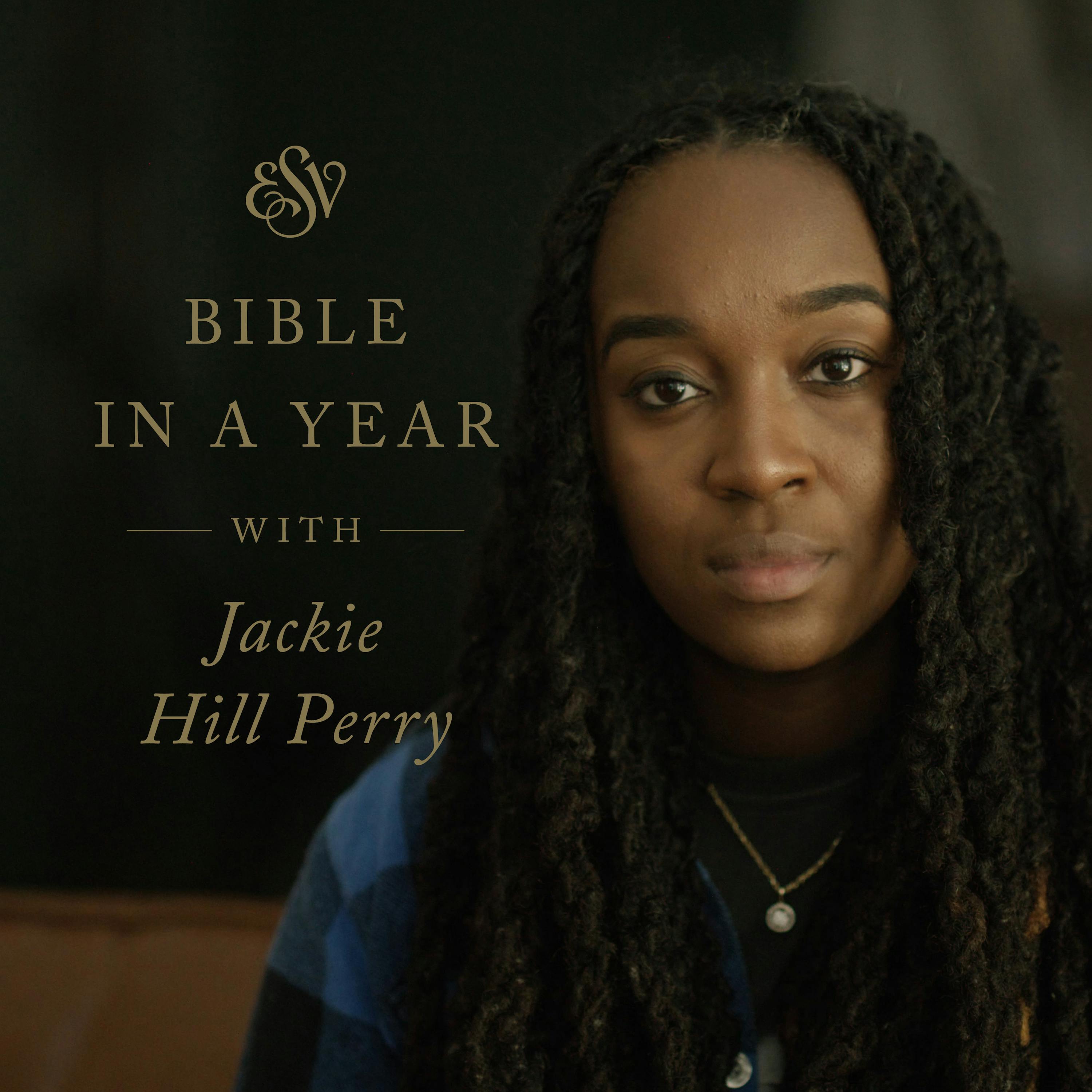
Through the ESV Bible in a Year with Jackie Hill Perry
July 10 (1 Chronicles 12–13; Psalm 9; Matthew 11)
00:12:04
Loading summary
Transcript37 lines
- [00:01]
Narrator
A reading from the book of 1 Chronicles.
- [00:05]
Reader
Now these are the men who came to David at Ziklag while he could not move about freely because of Saul the son of Kish. And they were among the mighty men who helped him in war. They were bowmen and could shoot arrows and slingstones with either the right or the left hand. They were Benjaminites, Saul's kinsmen. The chief was Ahiezer, then Joash, both sons of Shemaiah of Gibeah, also Jezael and Pelet, the sons of Asmopheth, Barakah, Jehu of Anathoth, Ishmael of Gibeon, a mighty man among the 30 and a leader over the 30 Jeremiah, Jahaziel, Johanan, Jozabad of Gedera, Eluzi, Jeremoth, Bealiah, Shemariah, Shephatiah the Haruhite, Elkanah, Ishiah, Azarel, Joezer and Jashobeam, the Korahites, and Joelah and Zebadiah, the sons of Jeroam of Gidor. From the Gadites there went over to David at the stronghold in the wilderness, mighty and experienced warriors, expert with shield and spear, whose faces were like the faces of lions and who were swift as gazelles upon the mountains. Ezer, the Chief Obadiah, 2nd Eliab, 3rd Mishmanna, 4th Jeremiah, 5th Attai, 6th Eliel, 7th Johanan, 8th Elzabad, 9th Jeremiah, 10th Machbeni 11. These Gadites were officers of the army. The least was a match for a hundred men, and the greatest for a thousand. These are the men who crossed the Jordan in the first month, when it was overflowing all its banks, and put to flight all those in the valleys to the east and to the west. And some of the men of Benjamin and Judah came to the stronghold to David. David went out to meet them and said to them, if you have come to me in friendship to help me, my heart will be joined to you but if to betray me to my adversaries, although there is no wrong in my hands, then may the God of our fathers see and rebuke you. Then the Spirit clothed the Maasai chief of the 30, and he said, we are yours, O David, and with you, O son of Jesse. Peace, peace to you, and peace to your helpers, for your God helps you. Then David received them and made them.
- [02:11]
Narrator
Officers of his troops.
- [02:13]
Reader
Some of the men of Manasseh deserted.
- [02:15]
Narrator
To David when he came with the.
- [02:16]
Reader
Philistines for the battle against Saul. Yet he did not help them, for the rulers of the Philistines took counsel and sent him away, saying, at peril to our heads he will desert to his master Saul. As he went to Ziklag, these men of Manasseh deserted to Adnah, Jozabad, Jediel, Michael, Jozabad, Elihu, and Zillathai, chiefs of thousands in Manasseh. They helped David against the band of raiders, for they were almighty men of valor and were commanders in the army. For from day to day men came to David to help him until there was a great army like an army of God. These are the numbers of the divisions of the armed troops who came to David and Hebron to turn the kingdom of Saul over to him, according to the word of the Lord. The men of Judah bearing shield and spear were 6,800 armed troops of the Simeonites, mighty men of valor for war, 7100 of the Levites, 4600 the Prince Jehoiada of the house of Aaron, and with him 3700 Zadok, a young man, mighty in valor, and 22 commanders from his own father's house of the Benjamites, the kinsmen of Saul, 3000, of whom the majority had to that point kept their allegiance to the house of Saul of the Ephraimites. 20,800 mighty men of valor, famous men in their fathers houses. Of the half tribe of Manasseh, 18,000 who were expressly named to come and make David king of Issachar, men who had understanding of the times to know what Israel ought to do. 200 chiefs and all their kinsmen under their command of Zebulun, 50,000 seasoned troops equipped for battle with all the weapons of war to help David with singleness of purpose. Of Naphtali, 1,000 commanders, with whom were 37,000 men armed with shield and spear of the Danites, 28,600 men equipped for battle of Asher, 40,000 seasoned troops ready for battle of the Reubenites and Gadites and the half tribe of Manasseh. From beyond the Jordan, 120,000 men armed with all the weapons of war. All these men of war arrayed in battle order, came to Hebron with a whole heart to make David king over all Israel. Likewise, all the rest of Israel were of a single mind to make David king. And they were there with David for three days, eating and drinking for their brothers had made preparation for them, and also their relatives from as far as Issachar and Zebulun and Naphtali came, bringing food on donkeys and on camels and on mules and on oxen abundant provisions of flour, cakes of figs, clusters of raisins and wine and oil, oxen and sheep. For there was joy in Israel. David consulted with the commanders of thousands and of hundreds, with every leader. And David said to all the assembly of Israel, if it seems good to you, and from the Lord our God, let us send abroad to our brothers who remain in all the lands of Israel, as well as to the priests and Levites in the cities that have pasturelands that they may be gathered to us, then let us bring again the Ark of our God to us, for we did not seek it in the days of Saul. All the assembly agreed to do so, for the thing was right in the eyes of all the people. So David assembled all Israel from the Nile of Egypt to Lebo Hamath, to bring the Ark of God from Kiriath Jearim and David. And all Israel went up to Baalah, that is, to Kirioth Jearim, that belongs to Judah, to bring up from there the Ark of God, which is called by the name of the Lord, who sits enthroned above the cherubim. And they carried the Ark of God on a new cart from the house of Abinadab. And Uzzah and Ahiho were driving the cart, and David and all Israel were celebrating before God with all their might, with song and liers and harps and tambourines and cymbals and trumpets. And when they came to the threshing floor of Kaiden, Uzzah put out his hand to take hold of the ark. For the oxen stumbled, and the anger of the Lord was kindled against Uzzah. And he struck him down, because he put out his hand to the ark and he died there before God. And David was angry because the Lord had broken out against Uzzah. And that place is called Perez Uzzah to this day. And David was afraid of God that day. And he said, how can I bring the Ark of God home to me? So David did not take the Ark home into the city of David, but took it aside to the house of Obed Edom the Gittite. And the Ark of God remained with the household of Obed Edom in his house three months. And the Lord blessed the household of Obed Edom and all that he had.
- [06:30]
Narrator
A reading from the Book of Psalms.
- [06:33]
Reader
To the choirmaster, according to Muthlabin, a psalm of David.
- [06:39]
Narrator
I will give thanks to the Lord.
- [06:40]
Reader
With my whole heart.
- [06:42]
Narrator
I will recount all of your wonderful deeds.
- [06:45]
Reader
I will be glad and exalt in.
- [06:47]
Narrator
You I will sing praise to your name, O Most High. When my enemies turn back, they stumble and perish before your presence. For you have maintained my just cause. You have sat on the throne giving righteous judgment. You have rebuked the nations. You have made the wicked perish.
- [07:04]
Reader
You have blotted out their name forever and ever.
- [07:07]
Narrator
The enemy came to an end, and everlasting ruins their cities you rooted out, the very memory of them has perished. But the Lord sits enthroned forever. He has established his throne for justice, and he judges the world with righteousness. He judges the peoples with uprightness. The Lord is a stronghold for the oppressed, a stronghold in times of trouble. And those who know your name put their trust in you, for you, O Lord, have not forsaken those who seek you. Sing praises to the Lord, who sits enthroned in Zion. Tell among the peoples his deeds, for he who avenges blood is mindful of them. He does not forget the cry of the afflicted. Be gracious to me, O Lord. See my affliction from those who hate me. O you who lift me up from.
- [07:50]
Reader
The gates of death, that I may.
- [07:52]
Narrator
Recount all your praises, that in the.
- [07:54]
Reader
Gates of the daughter of Zion I.
- [07:56]
Narrator
May rejoice in your salvation. The nations have sunk in the pit that they made in the net that they hid, their own foot has been caught. The Lord has made himself known. He has executed judgment. The wicked are snared in the work of their own hands. Hegeyein, Selah, the wicked shall return to Sheol.
- [08:15]
Reader
All the nations that forget God for.
- [08:18]
Narrator
The needy shall not always be forgotten, and the hope of the poor shall not perish forever.
- [08:23]
Reader
Arise, O Lord, let not man prevail.
- [08:26]
Narrator
Let the nations be judged before you put them in fear, O Lord. Let the nations know that they are but men. Selah.
- [08:35]
Reader
A reading of the Gospel according to Matthew.
- [08:39]
Narrator
When Jesus had finished instructing his 12 disciples, he went on from there to teach and preach in their cities. Now when John heard in prison about the deeds of the Christ, he sent.
- [08:49]
Reader
Word by his disciples and said to.
- [08:51]
Narrator
Him, are you the one who is to come, or shall we look for another? And Jesus answered them, go and tell John what you hear and see. The blind receive their sight, and the lame walk. Lepers are cleansed, and the deaf hear, and the dead are raised up. And the poor have good news preached to them. And blessed is the one who is not offended by me. As they went away, Jesus began to speak to the crowds concerning John. What did you go out into the wilderness to see a reed shaken by the wind. What then did you go out to see? A man dressed in soft clothing. Behold, those who wear soft clothing are in kings houses. What then did you go out to see a prophet?
- [09:29]
Reader
Yes, I tell you.
- [09:30]
Narrator
And more than a prophet, this is he of whom it is written. Behold, I send my messenger before your face who will prepare your way before you. Truly I say to you, among those.
- [09:42]
Reader
Born of women there has arisen no.
- [09:43]
Narrator
One greater than John the Baptist. Yet the one who is least in the kingdom of heaven is greater than he. From the days of John the Baptist until now the kingdom of heaven has suffered violence and the violent. Take it by force for all the prophets and the law prophesied until John. And if you are willing to accept it, he is Elijah who is to come. He who has ears to hear, let him hear. But to what shall I compare this generation? It is like children sitting in the marketplaces and calling to their playmates. We played the flute for you and you did not dance. We sang a dirge and you did not mourn. For John came neither eating nor drinking. And they say he has a demon. The Son of Man came, eating and drinking, and they say, look at him. A glutton and a drunkard. A friend of tax collectors and sinners. Yet wisdom is justified by her deeds. Then he began to denounce the cities where most of his mighty works had been done because they did not repent. Woe to you, Chorazin. Woe to you, Bethsaida. For if the mighty works done in you had been done in Tyre and Sidon, they would have repented long ago in sackcloth and ashes.
- [10:47]
Reader
But I tell you, it will be.
- [10:49]
Narrator
More bearable on the Day of Judgment for Tyre and Sidon than for you. And you, Capernaum, will you be exalted to heaven. You will be brought down to Hades. For if the mighty works done in you had been done in Sodom, it would have remained until this day.
- [11:02]
Reader
But I tell you that it will.
- [11:03]
Narrator
Be more tolerable on the Day of Judgment for the land of Sodom than for you. At that time Jesus declared, I thank you, Father, Lord of heaven and earth, that you have hidden these things from the wise and understanding and revealed them to little children.
- [11:20]
Reader
Yes, Father.
- [11:20]
Narrator
For such was your gracious will. All things have been handed over to me by my Father. And no one knows the Son except the Father. And no one knows the Father except the Son. And anyone to whom the Son chooses to reveal him come to me. All who labor and are heavy laden and I will give you rest. Take my yoke upon you and learn from me. For I am gentle and lowly in heart and you will find rest for your souls. For my yoke is easy and my burden is light.