Loading summary
Transcript135 lines
- [00:00]
NPR Announcer
This message comes from Sony Pictures Classics with the Coral, directed by Nicholas Hittner, written by Alan Bennett, starring Ralph Fiennes as a choir master in 1916. Yorkshire making music as war rages on, now playing only in theaters.
- [00:16]
K (Iranian Graduate Student)
The ROM was nothing like it was three years ago. You know, the people's attitude, the people's words. I could clearly sense that no one is truly satisfied anymore. The city felt like fire under ashes.
- [00:32]
Ramtin Arablouei (Host/Reporter)
Fire under ashes. This is the voice of an Iranian graduate student currently living and studying in the us. She asked that we refer to her as K. Back in early December, during her university's holiday break, she and her husband went back to Iran to visit family. They plan to stay a month. This was her first time back in three years. She says Iran kind of felt like a tinderbox when she got there.
- [00:58]
K (Iranian Graduate Student)
Not only because of economic problem or economic crisis, but also because of the suffocating atmosphere and the lack of civil freedoms.
- [01:10]
Ramtin Arablouei (Host/Reporter)
We will not be sharing her name because she asked to remain anonymous in order to protect her family in Iran.
- [01:17]
K (Iranian Graduate Student)
When I went to supermarket or hospital, bank, I've seen like conversation, I've heard conversation that people talk about Iranian currency and why it's really low and it's getting worse and what's going to happen. They didn't see any future upon them.
- [01:36]
Ramtin Arablouei (Host/Reporter)
Over the last several years, Iran's economy has been struggling. Sanctions from the US and its allies, mismanagement from the government. They've both played a major role in the downturn. But things got way worse in late December of 2025 when the rial, Iran's currency, basically collapsed. One US dollar became worth over 1 million riyals. This meant the buying power of Iranians was down by nearly half since 2022.
- [02:06]
K (Iranian Graduate Student)
My friend is like Nairs and even though she has to work hard, like long shifts with her husband, and they had to sell their golds to be able to live in even a smaller apartment in downtown. But they had to because they had no choice.
- [02:28]
Ramtin Arablouei (Host/Reporter)
Gold is something married couples usually receive as a gift at their weddings. In Iran, it's like something you use one day to help your children or for your own retirement or to buy a house. This kind of story is very common. Many Iranians have had to resort to selling family heirlooms, working multiple jobs and even selling their own organs just to pay for rent or food.
- [02:52]
K (Iranian Graduate Student)
They told me we can't see any future upon us with this economic situation.
- [02:59]
Rund Abdelfatah (Host/Producer)
The economic pain triggered anger towards the government. And on December 28, 2025, within days of the currency Collapse. Protests began in Tehran, Iran's capital.
- [03:21]
K (Iranian Graduate Student)
In the downtown of Tehran, there is a big bazaar that we call Tehran Bazaar.
- [03:27]
Rund Abdelfatah (Host/Producer)
The Tehran Bazaar is Iran's biggest market. It's an important central hub for all kinds of commerce. And the merchants who have shops there were very angry about the collapse of Iran's currency. They took to the streets and began protesting.
- [03:44]
K (Iranian Graduate Student)
Protests started from there, and then following that other part of the city started to protest. It was like, I don't know, dominoes spreading to all over the country.
- [03:57]
Rund Abdelfatah (Host/Producer)
Protests started in cities and spread to small towns. They even reached the quiet suburbs where K was staying.
- [04:05]
K (Iranian Graduate Student)
It started at night, like about 8pm People from every background, like old, young kids, our neighbors, all of them, even with their kids, were outside.
- [04:22]
Ramtin Arablouei (Host/Reporter)
What were they saying?
- [04:24]
K (Iranian Graduate Student)
The message was really clear down to the government. We don't want this government. They were calling like, death to Khamenei.
- [04:34]
Ramtin Arablouei (Host/Reporter)
Death to Khamenei. Iran's supreme leader, Ayatollah Ali Khamenei, has been in power for 37 years. Calling for his death publicly is a very dangerous thing to do in Iran.
- [04:47]
K (Iranian Graduate Student)
This type of, like, things to say, narrative to say in Iran, it was really like you have to pay a high price.
- [04:59]
Ali Alfoneh (Iranian Political Scientist)
Are you saying.
- [05:00]
Ramtin Arablouei (Host/Reporter)
Can I clarify? You're saying that saying death to harmony for you growing up was seen as something you couldn't do because you could be killed for it?
- [05:10]
K (Iranian Graduate Student)
Yeah. Yeah, exactly. This government, like, actually they say we are from God, and if you say we are against you, we don't want to think like you. You're labeled as someone who is at war with God and they accuse you of acting against national security and then execute you. I couldn't even myself believe that people shouting and calling this even myself, even me and my family, we were shouting this in roof of a house, roof. And even our neighbors, we weren't like, afraid.
- [05:59]
Rund Abdelfatah (Host/Producer)
But it would be a mistake to see this level of anger and fearlessness from protesters as only a response to economic issues. Iran is a theocracy. There is no separation of mosque and state. Every detail of one's life is subject to religious law and decree. This caused the massive protests in 2022 when Mahsa Jina Amini, a young woman, died in police custody after being arrested for allegedly not following Islamic laws around modest clothing or hijab.
- [06:33]
K (Iranian Graduate Student)
There was like, really a police dedicated to hijab, that if you don't wear good clothes or you don't wear hijab, they. They will follow you in the street. It happens to me. I was but I was with my father and one of the police came to me and like they warned me, cover your hair.
- [06:56]
Sponsor Announcer
Wow.
- [06:57]
K (Iranian Graduate Student)
And this is not appropriate clothes that you wear here. And my father, he said, I'm with her, I'm, I'm her bother you, you're not allowed to tell her anything and what are you doing? And it was like, like the argue between my father and the police and they, they, they were like, it's none of your business. Your daughter has to wear hijab. And if you like argue more than this, I, we will arrest both of you.
- [07:29]
Ali Alfoneh (Iranian Political Scientist)
Wow.
- [07:29]
K (Iranian Graduate Student)
Can you imagine? I was terrified. So this fear is everywhere is chasing you.
- [07:39]
Rund Abdelfatah (Host/Producer)
The latest round of protests went on for days. And by early January, the security forces of the government began cracking down hard.
- [07:49]
K (Iranian Graduate Student)
They start to suppress and kill people. I've seen them with my own eyes. Riot police and special forces. They were armed to teeth, all of the body covered and they were carrying a kind of military grade weapons and they were stopping cars on the roads and setting up checkpoints. And yeah, they were a little scary.
- [08:19]
Ramtin Arablouei (Host/Reporter)
So did you at any point start hearing, did you all hear gunfire?
- [08:23]
K (Iranian Graduate Student)
Yeah, yeah, I've heard that, I've heard that. I've heard like some gunshotting and it was, it was really scary.
- [08:31]
Rund Abdelfatah (Host/Producer)
Kay and her husband were set to come back to the US on January 10, but her flight was canceled. In response to the protests, the Iranian government cut off the Internet and blocked outgoing calls for the entire country. Planes were grounded too.
- [08:48]
K (Iranian Graduate Student)
We were, both of us, we were like confused. What's going to happen if we can't find a flight? What's going to happen to our life, both of us?
- [08:58]
Rund Abdelfatah (Host/Producer)
After two days of going back and forth to the airport, they were finally able to secure a ticket. They made it out of Iran. They are back in the US now, carrying on with their lives, but always with an eye towards what's happening in their homeland.
- [09:13]
K (Iranian Graduate Student)
We are 90 million people that we are fighting for our life on the streets. And I myself as an Iranian, it is my responsibility to be their voice, just because of my sisters and all my sisters around their country.
- [09:34]
Ramtin Arablouei (Host/Reporter)
Since the protests started in the last days of 2025, the Iranian government has used its security forces to stop the unrest. The violence has worked. The streets of Iran are mostly quiet, but the cost paid by demonstrators lingers. The Iranian government says at least 5,000 people have been killed since the protests started. U. S based human rights activist news agency reports more than 25,000 people have been arrested. NPR has not been able to independently confirm these numbers how did this happen? On January 14, I called up two experts on modern Iran, Ali Alfoneh and Hali Dagrest, to ask them three central what were the conditions that brought about the current uprising in Iran? How are these protests different from past ones? And how should the United States and its allies respond? We try to answer those questions on this episode of Throughline from NPR.
- [10:41]
K (Iranian Graduate Student)
Foreign.
- [10:45]
Ramtin Arablouei (Host/Reporter)
This is Joe from Portland, Oregon, and.
- [10:47]
Ali Alfoneh (Iranian Political Scientist)
You'Re listening to Throughline on npr.
- [10:53]
NPR Announcer
This message comes from Prolon Feeling heavy and depleted after the holidays, Prolon's five day Fasting Mimicking diet aims to make it easy to reset your body habits and energy heading into the new year. Developed at USC's Longevity Institute, the the goal of Prolon's nutrition program is to rejuvenate you from within by working at the cellular level to support fat loss, glowing skin and Sharper Focus. Get 15% off plus a bonus gift when you subscribe@ProlonLife.com NPR this message comes.
- [11:25]
Sponsor Announcer
From NPR sponsor 1Password Anyone else feel like 99% of your emails and texts are password reset codes trusted by millions of users and over 175,000 businesses? 1Password lets you skip the res and sign in securely. With strong, unique passwords that autofill across all your devices, you can safely share logins, store cards and files. And finally, stop using your pet's name as a password. Try it free for two weeks@1Password.com NPR.
- [11:59]
NPR Announcer
Support for NPR and the following message come from Warby Parker, the One Stop Shop for all your vision needs. They offer expertly crafted prescription eyewear plus contacts, eye exams and more. For everything you need to see. Visit your nearest Warby Parker store or head to warbyparker.com part1origins to start this.
- [12:23]
Ramtin Arablouei (Host/Reporter)
Episode, we need to go over how this current Iranian government, the Islamic Republic, came to power. Okay, so before 1979, Iran was a monarchy ruled by a US backed Shah or king named Mohammad Reza Pahlavi. He was installed by the US in 1953 after a CIA backed coup against the democratically elected government of Mohammad Mossadegh. He stayed in power until 1979 when he was overthrown after a massive protest movement erupted against his autocratic rule. Iran's Muslim clerics emerged as the ruling force in the country and Iran became a theocratic republic. In other words, it is ruled by Islamic law or Sharia, but it also has a president, legislature and Supreme Court. On paper, it doesn't look much different from many other countries, but there is.
- [13:18]
Rund Abdelfatah (Host/Producer)
Also a parallel government in Iran led by supreme leader Ayatollah Khamenei. He is unelected and has the final word on everything in domestic and foreign policy. There's also a parallel security force called the Revolutionary Guard Corps, or irgc. This began as a small paramilitary force, but has ballooned into a massive military with its own army, navy and air forces which answer to the supreme leader. The Revolutionary Guards are the sword that enforces the regime's rule. But they've also expanded to become one of the largest players in Iran's economy, controlling significant parts of the construction, telecommunications, banking, mining and import export industries.
- [14:06]
Ramtin Arablouei (Host/Reporter)
Since 1999, the Islamic Republic has seen unrest from its population regularly. A repeating cycle of protest and repression. But each of these cycles has been unique. In 1999, it was a student led protest movement focused on freedom of expression. In 2009's Green Revolution, the protest happened in response to what was perceived to be a stolen election. There were smaller scale protests in the years after until the next major1 in 2022. The Women Life Freedom Movement started after Mahsa Jina Amini died in the hands of authorities after she was arrested for allegedly not observing Islamic dress codes.
- [14:47]
Rund Abdelfatah (Host/Producer)
Fast forward to today's protests sparked by economic crisis. For years, Iran has been under sanctions by the US and its allies on its two biggest exports, oil and gas. It has some of the largest reserves of each in the world. Iran also has a solid manufacturing base. It's one of the biggest exporters of agricultural products in Asia. On paper, it should be a wealthy country. Yet according to a report from the Iranian government, 30% of Iranians live in extreme poverty.
- [15:22]
Ali Alfoneh (Iranian Political Scientist)
Purchasing power of the average Iranian has been hollowed out. The value of the Iranian currency is gone.
- [15:29]
Ramtin Arablouei (Host/Reporter)
This is Ali Alfoneh. He's a senior fellow at the Arab Gulf States institute in Washington D.C. this.
- [15:36]
Ali Alfoneh (Iranian Political Scientist)
In turn means that a regular school teacher is no longer even capable of purchasing a new pair of shoes once a year for a relatively long time now. Been very difficult to purchase meat for the kids. People who can afford to purchase meat, they are too ashamed of, for example, having a barbecue in their backyard because they do not know how well or poorly the neighbor is doing. And the smell of food would be a problem for the kids of the neighbor. So this is the kind of disaster that Iran's middle class, the average school teacher, the fireman, the nurse, even doctors, the professional middle class has been experiencing for the past year.
- [16:22]
Ramtin Arablouei (Host/Reporter)
Wow.
- [16:22]
Ali Alfoneh (Iranian Political Scientist)
Nowadays it is almost difficult. It really truly is hard to distinguish between the middle class and the poor. There is no longer any difference.
- [16:32]
Ramtin Arablouei (Host/Reporter)
You might remember Ali Alphone from our episode called Soleimani's Iran. He is an Iranian born political scientist and an expert on the country's leadership. Ali says that these economic problems have been exacerbated by the fact that the pain is not being felt by everyone.
- [16:49]
Ali Alfoneh (Iranian Political Scientist)
Iran's middle class and also the poor who can afford to have a mobile phone and have access to the Internet. They can watch YouTube channels. They see on TikTok, the rich kids of Tehran who can afford $10 cup of coffee at the luxury shopping malls in northern Tehran. And Even worse on TikTok they can see son of a former ambassador of the Islamic Republic of Iran to Venezuela light up a Cuban cigar with a hundred dollar bill. Now this creates resentment, this creates anger and frustration and this makes people just go to the street and demand ousting of a regime which clearly is caring for its own but is not caring for the large middle class and the poor.
- [17:45]
Ramtin Arablouei (Host/Reporter)
So would you say that the response from the regime to this economic crisis has been insufficient?
- [17:52]
Ali Alfoneh (Iranian Political Scientist)
The Islamic Republic is incapable of attending to the economic problems of the Iranian state unless Iran manages to do something about the corruption, the rampant corruption which is making the country as such poorer and poorer. But a very small part of Iranians who are engaged in sanction busting and engaged in smuggling Iran's oil and selling it in the black market internationally but nevertheless managed to fill their pockets. Unless Iran attends the issue of corruption at home and also reaches an agreement with the U.S. the Islamic Republic is not capable of solving Iran's economic problems.
- [18:40]
Ramtin Arablouei (Host/Reporter)
One question that the American audience might ask is what impact the the tightening sanctions have had on this economic crisis for Iran. These are American sanctions on Iranian oil and other products I'm referring to.
- [18:53]
Ali Alfoneh (Iranian Political Scientist)
The Islamic Republic's main export has been oil and to some extent smaller stand gas. And this money is not reaching the Iranian state as much as before due to several reasons. One of them is the US sanctions which has made it very difficult for for foreign buyers of Iran's oil to purchase the oil simply because there are no banking links between Iranian banks and the international banking system. So even if there is a buyer, an international buyer, they cannot transfer the money through international banking system. The transfer either needs to take place through Chinese or Russian banks and then connected to Iran. This has left only one serious buyer in the international market for oil and that's China. They can negotiate the price of Iranian oil even lower than it is in the global oil markets. What makes things even worse, you have the smugglers, a new class of Iranian merchants, usually connected with the Revolutionary Guard, who have their own shipping companies, and they are transferring and selling Iran's oil to the market to the Chinese buyers. And they pocket huge sums of money in commission for their services.
- [20:15]
Rund Abdelfatah (Host/Producer)
Corruption, mismanagement, sanctions, they've made Iran virtually unlivable for most of its population. But there is another major element in these protests. We wanted to understand social issues. After the Woman Life Freedom protests In 2022, the Islamic Republic seemed to loosen restrictions on women's clothing. Yet that did very little to quell the resentment and anger on the streets.
- [20:45]
Ali Alfoneh (Iranian Political Scientist)
No longer having hijab patrols patrolling the streets of the big cities arresting women just because they are not sufficiently covered or not covered enough, as according to the prescriptions of the government. That actually managed to calm the country for a while. But at the same time, no longer enforcing the hijab legislation also taught the Iranians a lesson, and that is that if you fight for a specific cause, the regime will make a retreat from its previous positions. They say that the government is not listening to our voice when we talk with them normally. So we have to take our protest to the streets.
- [21:29]
Holly Dagres (Iranian-American Analyst)
This is because of the Woman Life Freedom movement, that Iranians have recognized that they need to take matters into their own hands. And this is just a continuation of that pushing back against authority.
- [21:40]
Ramtin Arablouei (Host/Reporter)
This is Holly Dagres.
- [21:42]
Holly Dagres (Iranian-American Analyst)
I'm a senior fellow at the Washington Institute. I am also the curator of the popular newsletter on all things Iran, the Iranists on Substack. I'm Iranian American and I spent my formative years in Iran.
- [21:55]
Ramtin Arablouei (Host/Reporter)
Hawley went to high school in Tehran, Iran's capital. And witness firsthand how much the desire of young people for more social freedom has fueled uprisings in the country.
- [22:06]
Holly Dagres (Iranian-American Analyst)
I would say arguably that it was Iranian Gen Z that started this Trend with the 2022 Woman Life Freedom uprising. Everybody talks about this being a girl and women led movement, but I would say It's a gen Z1. And what you're seeing play out in Iran since December 28th was, I would argue it was youth led. And a lot of the videos coming out of the country seem to suggest that these are young people. And we've had at least over a dozen under the age of 18 that have been killed by security forces. It's been extraordinary, extraordinary watching over and over again Iranians risking their lives, knowing full well they'll be met with bullets and batons. And that's what we're seeing play out in the past few weeks.
- [23:14]
Rund Abdelfatah (Host/Producer)
Coming up, how the current protests in Iran are different from ones in the past. You're listening to Throughline from npr.
- [23:31]
K (Iranian Graduate Student)
Hi, my name is Duveria Sahil and I'm calling from London, United Kingdom. You're listening to Throughline from npr. Thank you so much for such a brilliant show and for helping me to understand the world that we are currently inhabiting.
- [23:44]
Ali Alfoneh (Iranian Political Scientist)
Thank you so much. Keep up the good work.
- [23:46]
K (Iranian Graduate Student)
Bye.
- [23:47]
Sponsor Announcer
This message comes from NPR sponsor Capella University. Interested in a quality online education. Capella is accredited by the Higher Learning Commission. A different future is closer than you think with Capella University. Learn more@capella.edu this message comes from Netsuite. Every business is asking, how can they make AI work for them? No more waiting with Netsuite by Oracle. You can put AI to work today, trusted by over 43,000 businesses. It's the unified suite that brings your financials, inventory, commerce, HR and CRM into a single source of truth. That connected data is what makes your AI smarter, helping you make fast decisions right now. Get the business guide demystifying AI free@netsuite.com story this message comes from Bombas. You need better socks and slippers and underwear because you should love what you wear every day. One purchased equals one donated. Go to bombas.com NPR and use code NPR for 20% off part two new.
- [24:58]
Rund Abdelfatah (Host/Producer)
Resistance for a very long time, the words Iran and protests have been paired regularly in the news. Iran has been here before, but there are some key differences this time around. Many of the past protests have focused on reforming the country, bringing about incremental changes on voting, freedom of expression, women's rights. But this time around, protesters appear to be demanding the end of the Islamic Republic entirely.
- [25:31]
Ali Alfoneh (Iranian Political Scientist)
The number of people going to the streets does not even amount to 5% of Iran's total population. But the people who go to the streets, they truly mean what they are saying. And the 5% opposing the regime? They do want to bring down the regime, but unfortunately for them, the regime is better armed and is better organized. The opposition, on the other hand, has no effective leadership, has no effective organization, has no real funding and has no unifying vision for Iran after the collapse of the Islamic Republic.
- [26:11]
Holly Dagres (Iranian-American Analyst)
I think it's important to talk a little bit about the former Crown Prince Reza Pahlavi's role in these protests.
- [26:18]
Ramtin Arablouei (Host/Reporter)
Reza Pahlavi is the son of Mohammad Reza Pahlavi, the Iranian shah, or king, who was deposed in the 1979 revolution that brought the Islamic Republic into power. For most of the last 47 years, Reza Pahlavi has been living in exile.
- [26:34]
Holly Dagres (Iranian-American Analyst)
In the us I remember Iranians used to be like Samana Shah at the time of the Shah, when they wanted to talk about when things were better. And that I think that nostalgia has only grown because of the access to information. There's documentaries about pre revolutionary Iran. There's also all these nice pictures and photos that go viral. And now with AI, there's also these, like, AI versions of what they're seeing. And that's why you've also been seeing these, I would say, pro Pahlavi chants you've heard. This is the last battle. Pahlavi will return, Referring to the crown prince. And long live the Shah.
- [27:21]
Ramtin Arablouei (Host/Reporter)
Javid Shah, Javid Shah.
- [27:23]
Holly Dagres (Iranian-American Analyst)
And then Reza Shah Ruhid Shah. Reza Shah, may your soul be blessed. Referring to his grandfather, the founder of the Da dynasty. And there's a real sense, at least among some Iranians, that he should be a transitional leader or that he is just a symbol, the antithesis of the Islamic Republic.
- [27:50]
Ramtin Arablouei (Host/Reporter)
This is one of the many messages Reza Pahlavi has directed towards the Iranian people in the last few weeks. Dear people of Iran, my brave compatriots, you have over the last two weeks shaken the Islamic Republic at its foundations.
- [28:09]
Holly Dagres (Iranian-American Analyst)
He made a call and said that Iranians, regardless of your political chants that you want to use, you should be out on the rooftops or in the streets making those chants. And I saw activists and celebrities in Iran endorse this call for change in Iran that he pushed for.
- [28:28]
Rund Abdelfatah (Host/Producer)
Reza Pahlavi has said he wants to be a transitional leader if the Islamic Republic falls, helping the country towards a referendum on what the future government should look like. He's also cozied up to the Islamic Republic's biggest enemies, like Israel and the United States. With all of that, Ali Al Fodeh is not convinced that Reza Pahlavi can actually deliver on his promises.
- [28:55]
Ali Alfoneh (Iranian Political Scientist)
I'm still not seeing Mr. Reza Pahlavi as an effective leader of the revolution. But I do see him as a symbolic figurehead. And I also do believe that many Iranians, when looking at him, they think of an almost mythical era when there was no air pollution in Tehran, the grocery was inexpensive, and taxi drivers were really polite. That nostalgia is Something that endears Mr. Azarbi to many, many Iranians. But is he an effective leader of the revolution? I'm not entirely sure. Perhaps he will emerge as a leader in the coming years.
- [29:47]
Ramtin Arablouei (Host/Reporter)
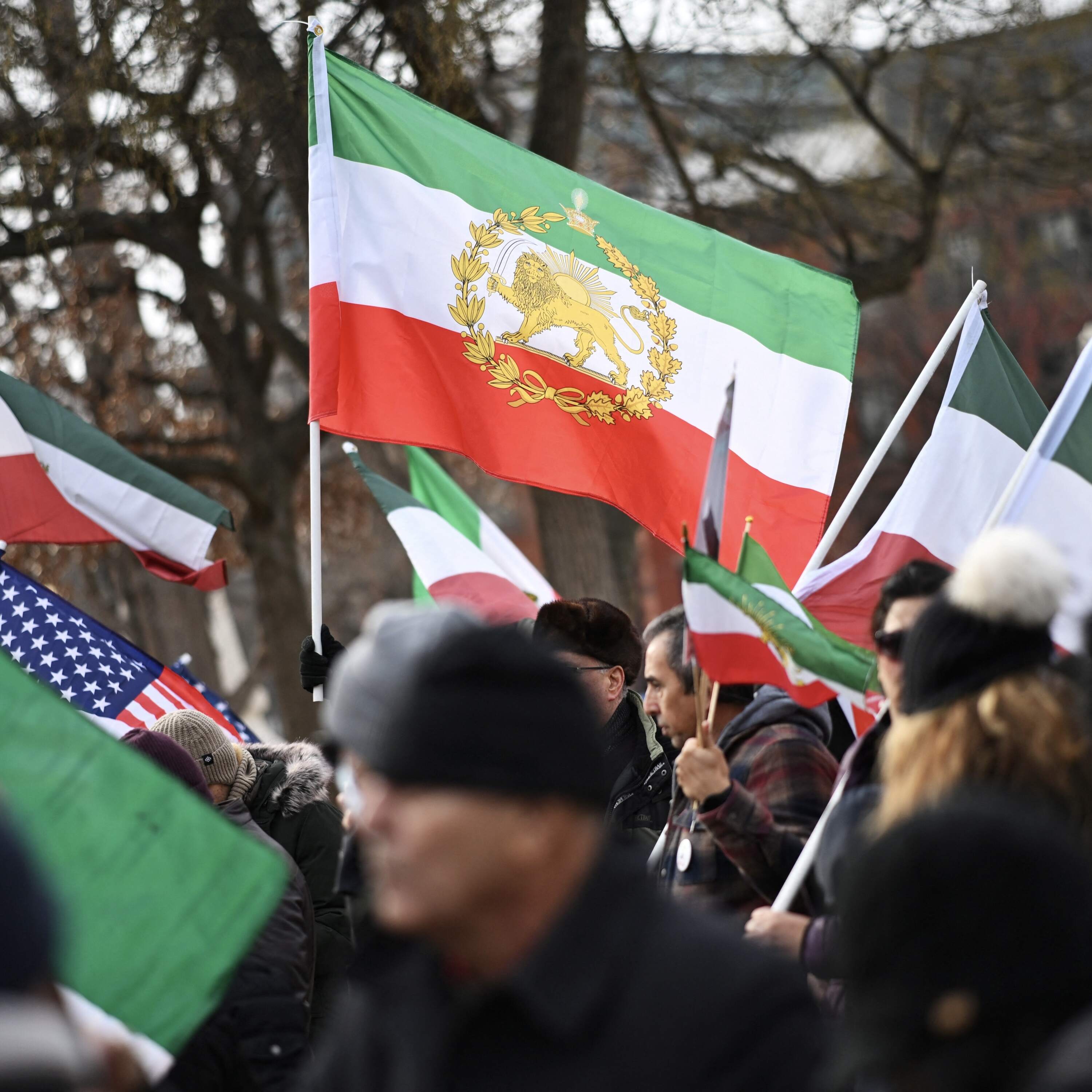
There's something that I've noticed about these protests that seem to be different from the ones in the past. And it's centered around sort of what we can tell at least from the symbol, from symbolism. And one is the flag that many people are flying. Can you talk about what the lion and sun flag is basically and how it differs from Iran's official flag and what that means?
- [30:10]
Holly Dagres (Iranian-American Analyst)
I know that some associate the lion and sun flag with the monarchy, but it's actually a flag that's been around for a very long time. There's been various, there's been different variations of it throughout history.
- [30:23]
Rund Abdelfatah (Host/Producer)
The sun and lion is a symbol that's been around since ancient Persia. It's a symbol that represents a couple of key concepts that have been important to Iranian people throughout its history. The lion represents strength, kinship, protection, basically a stand in for great heroes. The sun symbolizes light, life, wisdom and divinity, representing God. It was used on the Iranian national flag for generations and it was only.
- [30:55]
Holly Dagres (Iranian-American Analyst)
After the 79 revolution was the lion and sun replaced with an Allah, which is God in it. Yes, but big picture why it's being utilized, it's for several reasons. It's because it runs counter to the Islamic Republic. It's seen as a symbol of patriotism. I think the clerical establishment has recognized it. They've dabbled with nationalism here and there. It really surprised me how hard they leaned into the Shahnameh or the Book of Kings, which is the epic of the Iranian people written by the poet Ferdowsi.
- [31:31]
Ramtin Arablouei (Host/Reporter)
That's a change, right? To me it shows that there's this underlying deep desire for sort of a nationalistic pre Islamic cultural identity to re emerge in Iran.
- [31:42]
Holly Dagres (Iranian-American Analyst)
I think what happened was that they realized that Iranians going to take the Islamic version of events, they'd shoved it down their throat for so long that they had thrown it up and they weren't going to take it anymore. And so the regime has spent time and energy for years trying to invest in this pre Islamic identity to kind of bring the people back on their side, tapping into nationalism, tapping into ancient Persian mythology. And as it's clear from these anti regime protests, it didn't work.
- [32:19]
Ramtin Arablouei (Host/Reporter)
The regime's response to these protests, like the like they have in the past, has been extremely violent. The numbers we are seeing even on the conservative side are shocking. If you could describe their strategy, these response traditionally, like why they respond in this way, what are they thinking?
- [32:36]
Ali Alfoneh (Iranian Political Scientist)
Their logic is that now we are facing the regime is facing not just peaceful protesters, but also an armed opposition and possibly an ethnic armed insurgency.
- [32:52]
Ramtin Arablouei (Host/Reporter)
Kurdish armed groups based in Iraq have said that they are conducting operations to protect protesters in Iran where there is also a Kurdish minority.
- [33:01]
Ali Alfoneh (Iranian Political Scientist)
Therefore, the regime can take liberties and engage in excessive response against the protests. That is how they legitimize extreme use of force, how this type of things. But how can a regime live with this kind of history? That is again up to the leaders of the Islamic Republic. And it is a tragedy unfolding in front of us. Truly, truly. I have only one word for it. Tragedy.
- [33:34]
Rund Abdelfatah (Host/Producer)
There's another element that makes these protests different. The fact that the Islamic Republic has suffered devastating losses and its foreign policy during the last few years. For decades, the Revolutionary Guard, or irgc, have carefully built proxy military forces in Lebanon, Syria, Iraq and Yemen. These military forces were created to project the Islamic Republic's power in the Middle East. But over the last few years, Iran's proxy forces have fallen in Lebanon and Syria, dealing them a great blow. On top of all that, in 2025, the United States and Israel attacked Iran's nuclear and missile production facilities and Israel assassinated many of its leaders. This conflict was dubbed the 12 Day War by President Trump.
- [34:26]
Ali Alfoneh (Iranian Political Scientist)
The Revolutionary Guard has lost prestige due to its continued debacles in the region. First we saw Israel's near destruction of Lebanese Hezbollah in 2024. Then we saw the collapse of the Assad regime. And of course there was the 12 day war with decapitation of half of the IRGC's leadership. But nevertheless, due to its decentralized structure and organization, the IRGC managed to continue its operations. It is capable of to suppressing the protesters.
- [35:01]
Ramtin Arablouei (Host/Reporter)
I mean, your description makes it sound like the IRGC kind of backed into a corner, more or less. What options do they have at this point?
- [35:10]
Ali Alfoneh (Iranian Political Scientist)
The Islamic Republic needs an economic solution. And the economic solution for Iran's ills can, can be found in Washington. In other words, what the Islamic Republic needs is an agreement with President Trump. President Trump has, on the other hand, at times indicated that he would be open to a Venezuela style agreement with the Islamic Republic. What happened in Venezuela? In Venezuela, there was a change of leadership, but not necessarily a change of the regime. The same, I believe, could be applied to the Islamic Republic. Who knows what will happen to Ayatollahi Khamenei, who is currently 86 years old? He may pass away, perhaps under mysterious circumstances. And the leadership of the Islamic Republic could perhaps make an agreement with President Trump. There is no need for them to tie their own destinies to the destiny of Ayatollah Ali Khamenei. Why should they not survive if the Venezuelan regime can survive?
- [36:17]
Ramtin Arablouei (Host/Reporter)
Okay, but are you saying that Ali Khamenei, the Supreme leader could be betrayed by the Revolutionary Guard who were supposed to take orders from him. I think for a lot of us who've been watching Iran for a long time, that's almost unthinkable.
- [36:33]
Ali Alfoneh (Iranian Political Scientist)
Roman emperors were at time kept captive by their own Praetorian Guard. Ottoman sultans at times were kept captive and were hostages and in the hands of their Yenisari Guard. Nowadays it is the Revolutionary Guard which at times pursues its own interests. It is a, an enterprise of more than 150,000 active duty soldiers and officers. It is an economic enterprise with billion dollars worth of investments inside of Iran and it is a cultural entity, it is a political party. It is so many things and all of these bureaucracies they would want to survive and they are not interested in tying their own destinies to the destiny of an 86 years old man. They think about the future, not about the past.
- [37:33]
Ramtin Arablouei (Host/Reporter)
One I think confusing element for Americans and non Iranians or people outside of Iran is that we're hearing so much about Gen Z and about how much of the country is turning away from the vision of the Islamic Republic but at the same time someone is doing the shooting in the security forces who's actually the ones taking up the guns and shooting these protesters. Despite the fact that the regime has essentially more or less failed the entire country. Regardless of their ideological beliefs. Economics affect everyone. So where are they finding this base of support?
- [38:06]
Holly Dagres (Iranian-American Analyst)
I think that's a very important question. You have to remember there's, there's still a 30% rule. 30% rule of thumb is that an authoritarian regime can survive. That was the New Yorker's Robin Wright that said that. And I think there's something to it. And so I would say that's probably a safe number to say how much regime support's left of this country.
- [38:32]
Ramtin Arablouei (Host/Reporter)
That's significant though.
- [38:33]
Holly Dagres (Iranian-American Analyst)
It is and it isn't because yes, it's enough to send to hand a gun over to someone and shoot protesters, but it beats its very, it's dwindling. It's dwindling time after time, year after year. And you know, the more Iranians see and learn, the more they know. This actually played out in this movie that was nominated last year at the Oscars. The seed of the sacred figure. This movie was basically the microcosm of Iranian society was this conservative family, but these Gen Z young siblings that are pushing back against the parents and they're brainwashing. And it was very much like a symbol of the fight between the youth and the clerical establishment and I think that thanks to social media and the Internet and satellite dishes, young people are increasingly seeing and peeling away from maybe the conservative household or pro regime household they live in. It doesn't mean that everybody feels that way. I mean, there's always going to be those die hard believers, but I think that's what brought us to this moment, that that number's so small today.
- [40:07]
Rund Abdelfatah (Host/Producer)
Coming up, how will the US Respond to the protests and where does Iran go from here?
- [40:16]
Ali Alfoneh (Iranian Political Scientist)
Hi, this is Justin Whitlow from Lester, North Carolina, and you are listening to Throughline.
- [40:24]
Holly Dagres (Iranian-American Analyst)
I want to say that the show is an absolutely wonderful show.
- [40:27]
Ali Alfoneh (Iranian Political Scientist)
I appreciate your deep dives into really interesting stories and the work that you do. Thank you so much.
- [40:38]
NPR Announcer
Support for this podcast and the following message come from Strawberry Me. If you could go back and talk to your younger self, would you tell yourself that you have a job that truly makes you happy? Many people are stuck in jobs they've outgrown or never really wanted. A career coach from Strawberry Me can help you move on to something you actually love. Benefit from having a dedicated coach in your corner, and get 50% off your first coaching session at Strawberry Me.
- [41:06]
Sponsor Announcer
NPR this message comes from Lisa. Lisa has a lineup of beautifully crafted mattresses tailored to how you sleep. Each mattress is designed with specific sleep positions and feel preferences in mind. Leesa mattresses are meticulously designed and assembled in the USA for exceptional quality. Plus they back it all up with free shipping, easy returns and a 120 night sleep trial. Go to leesa.com for 25% off mattresses. Plus get an extra $50 off with promo code. NPR.
- [41:40]
NPR Announcer
Part 3 Fire Under Ashes since.
- [41:45]
Ramtin Arablouei (Host/Reporter)
The taping of these interviews on January 14, 2026, the protests in Iran have mostly been ended by the Islamic Republic. The death toll is in the thousands and continuing to rise. President Donald Trump has expressed support for the Iranian protesters and has threatened the Iranian government. On January 9, he warned the Islamic Republic to not kill demonstrators, saying, I tell the Iranian leaders, you better not start shooting because we'll start shooting too. Iranian Supreme Leader Ali Khamenei responded by calling President Trump a criminal, and the US Military has sent an aircraft carrier to the Middle East. Bringing up more questions about how the US Intends to engage military action is.
- [42:30]
Ali Alfoneh (Iranian Political Scientist)
Probably not the first priority of President Trump, but should he engage in such an endeavor, his options will also be relatively limited because he presumably would not want to kill the protesters. He only wants to kill and neutralize or weaken the Revolutionary Guard, perhaps by attacking their bases. But I'm sure that the Revolutionary Guard will also have its countermeasures to protect itself.
- [42:56]
Ramtin Arablouei (Host/Reporter)
I'm reminded of 2009 in that President Obama made some hints at or encouragement to the Iranian protesters then and then ended up with a kind of nuclear deal. President Trump has made even more severe threats. If he doesn't fulfill those threats, what might that do to the future of a protest movement?
- [43:16]
Ali Alfoneh (Iranian Political Scientist)
In the 1950s and 60s, whenever there were popular uprisings against communist dictatorships in Hungary, in Czechoslovakia and Poland, Radio Free Europe would send and transmit messages to the people saying that the US Government was supporting them. So these people took arms and they fought against the Soviet occupation army and they lost because there was no U.S. intervention to protect them. I am afraid that by sending messages and by encouraging the protesters, but not necessarily using military means to protect those protesters, President Trump is committing the same mistake as his predecessors during the Cold War. And again, these two will make Iranians even more cynical about future yeah, okay.
- [44:14]
Ramtin Arablouei (Host/Reporter)
So We've covered the U.S. let's switch gears for a second and talk about Israel. Israel and Iran's conflict is ongoing and it's really ratcheted up since October 7th for obvious reasons we've covered on this show. Would you say that this is an opening of a new chapter where Israel is more on the offensive vis a vis Iran and within Iran? And what does that spell for the future of this protest?
- [44:41]
Ali Alfoneh (Iranian Political Scientist)
The Islamic Republic has been meddling in the internal affairs of Israel and has also tried to mobilize Israel's neighbors against it. Israel is not doing exactly the same thing with Iran, trying to steer the ethnic minorities in the periphery regions against the central government in Iran. So it's a tit for tat. But unfortunately for Iran, Israel is this almost impenetrable fortress and Iran is not. The borders are wide open. The government of Israel fundamentally believes it is capable of overthrowing the government in Tehran. But they perhaps also believe it is possible to foment a civil war in Iran and partition of Iran may be one of the objectives of some Israeli planners. And should the opposition win, should the Islamic Republic collapse and let's say Master Pal Ali take over power in Iran? I'm actually not sure that it would satisfy the government of Israel. We have seen that the government of Israel was not happy with Mr. Shara taking power in Syria despite Mr. Sharrah's best efforts to normalize relations with Israel. And Israel is still continuing to undermine Syria Syria. So I am not seeing why Israel should treat Iran in a kinder way than it has treated Syria, we're on.
- [46:06]
Ramtin Arablouei (Host/Reporter)
Here January 14th, taping this. The regime has obviously used extreme violence to try to put this protest down, as they have in past protest cycles. Is there anything different about this set of protests you're seeing right now that will lead you to believe that we might see a different outcome? Because in the past, it's been protest, violence, end of protest, wait a few more years and another protest will start. Is there anything different you're seeing here?
- [46:36]
Holly Dagres (Iranian-American Analyst)
I mean, I think the level of brutality they've committed under the communications shutdown, this massacre that we keep talking about, I don't think the Islamic Republic can come back from that. And it's not just me saying it. We've seen this before the massacre happened. We had Carnegie's Karim Sajapur and Jack Goldstone, an expert on revolutions and upright co author, A Peace in the Atlantic, and they said that this winter, for the first time since 1979, the Islamic Republic had checked all boxes for collapse. I think it really tells you the direction of where things are going. And after this massacre, they've seen, they've crossed a line that I don't think any Iranian can see past anymore.
- [47:34]
Ali Alfoneh (Iranian Political Scientist)
As of January 14, I, Ali Alphonid, believe that the Islamic Republic manages to contain and effectively suppress protests for a time, but then these protests will flare up, up again because Iran's economic woes remain unresolved, and therefore the Islamic Republic has to reach an agreement with President Trump and receive sanction relief. So I do believe that this regime, its demise and collapse is neither imminent nor inevitable. The regime will fight for its survival. And one of those ways is. Is a negotiated solution with President Trump.
- [48:21]
Ramtin Arablouei (Host/Reporter)
People, you know, I make this assumption, but how much do you think this is about democracy versus just getting rid of the regime? Are those things too? Look, hand in hand.
- [48:30]
Holly Dagres (Iranian-American Analyst)
Well, I get the sense that this is for a call for a transition, and transition you have to. In order to have a transition, arguably, you should have free and fair elections. The Iranians could decide they want a monarchy tomorrow, but that needs to be decided in an election.
- [48:49]
Ramtin Arablouei (Host/Reporter)
So it's. Yeah, I mean, I guess democracy is one word to use, but choice seems like the other choice that they have not had one up to now.
- [48:56]
Holly Dagres (Iranian-American Analyst)
Absolutely not. And I think this is. When you say you don't want the regime, it means you want something positive. What's the opposite of the Islamic Republic? I would think of an authoritarian regime. I would think it's democracy. But again, these things will be decided in a free and fair elections and a free Iran. And that's what we should be aspiring for, a free Iran.
- [49:15]
Ramtin Arablouei (Host/Reporter)
What is the most important thing for the American audience to know about what's happening in Iran right now?
- [49:20]
Holly Dagres (Iranian-American Analyst)
I would say that the Iranian people have been living under a dictatorship they don't want for 47 years, and they have the same needs and wants as people everywhere, including Americans. And they are probably the most pro American in the Middle east. And we should be paying attention to them because we are a country that believes in freedom and democracy. And that's exactly what Iranians are aspiring to.
- [50:01]
Rund Abdelfatah (Host/Producer)
That's it for this week's show. I'm Rund Abdelfatah Rami.
- [50:05]
Ramtin Arablouei (Host/Reporter)
I'm Ramtin Arablouei and you've been listening to Throughline from npr.
- [50:09]
Rund Abdelfatah (Host/Producer)
This episode was produced by me and.
- [50:12]
Ramtin Arablouei (Host/Reporter)
Me and Lawrence Wu, Julie Kane, Anya.
- [50:15]
Holly Dagres (Iranian-American Analyst)
Steinberg, Casey Miner, Christina Kim, Devin Kadayama, Irene Noguchi, Kiana Mojatem, Thomas Coltrane.
- [50:26]
Rund Abdelfatah (Host/Producer)
Fact checking was done by Andrea Lopez Cruzado.
- [50:30]
Ramtin Arablouei (Host/Reporter)
Also, thank you to Johannes Dergi, Beth Donovan, Tommy Evans, Arizu Rezvani, Tony Cavan and James Heider.
- [50:38]
Rund Abdelfatah (Host/Producer)
This episode was mixed by Jimmy Keeley. Music for this episode was composed by Ramtin.
- [50:44]
Ramtin Arablouei (Host/Reporter)
And finally, if you have an idea or like something you heard on the show, please write us@throughlinepr.org and make sure to rate us. And leave us a comment on Apple or Spotify. It helps other people find the show.
- [50:59]
Rund Abdelfatah (Host/Producer)
Thanks for listening.
- [51:09]
Sponsor Announcer
This message comes from ukg, the workforce operating platform that puts workforce understanding to work, delivering AI powered HR pay and workforce management tools that help businesses empower their people. More@ukg.com work this message comes from NPR sponsor Capella University. Interested in a quality online education, Capella is accredited by the Higher Learning Commission. A different future is closer than you think with Capella University. Learn more@capella.edu this message comes from International Medical Corps. When crises strike, every second matters. And that's why International Medical Corps moves fast. They rush in with life saving medical care and supplies while training local health workers to ensure care continues long after the emergency ends. Your support saves lives today and builds resilience for tomorrow. Learn more or donate today@internationalmedicalcorps.org NPR.