Loading summary
Transcript214 lines
- [00:01]
Sponsor/Advertiser
This message comes from Green Chef. Green Chef is certified clean with organic produce, responsibly sourced proteins and real whole food ingredients backed by Nutritionists. Choose from 40 plus customizable recipes each week tailored to your needs, delivered straight to your door. Enjoy Mediterranean, plant based, verified, gluten free and more. Get 50% off your first box then 20% off for two months@greenchef.com 50 NPR
- [00:29]
Rund Abdelfatah
with code 50 NPR when Defense Secretary Pete Hegseth recently spoke to the Senate Armed Services Committee, he talked about the massive amounts of money the US Military wants to dedicate to its drone program.
- [00:43]
Narrator/Host
You're looking at $54 billion in the FY27 budget dedicated to drone dominance.
- [00:50]
Rund Abdelfatah
Drone dominance isn't just a buzzword, it's the Defense Department initiative to scale up its drone program and the money being requested has been called the largest single commitment to autonomous warfare in history. In other words, drone AI drones have reshaped warfare and given all kinds of countries a powerful weapon.
- [01:16]
Historical Figure/Archive Voice
President Trump attended the dignified transfer of the remains of the first Americans killed in the war.
- [01:21]
Rund Abdelfatah
On the day after the US And Israel launched war against Iran, an Iranian drone made it past air defenses in Kuwait, striking a U.S. command center at a civilian port.
- [01:33]
Historical Figure/Archive Voice
Six army reservists killed by an Iranian
- [01:35]
Expert/Analyst
drone strike in Kuwait.
- [01:36]
Rund Abdelfatah
They were the first US Casualties in the war. Since then, thousands of drone strikes have been launched throughout the Middle east, and
- [01:45]
Co-Producer/Narrator
it's catching the US off guard.
- [01:48]
Expert/Analyst
The Pentagon has begun a huge push to buy hundreds of thousands of small attack drones.
- [01:53]
Rund Abdelfatah
They were once the domain of major
- [01:55]
Co-Producer/Narrator
militaries, but they are now spreading rapidly.
- [01:57]
Rund Abdelfatah
They are cheap, efficient, and easy to dispatch.
- [02:02]
Expert/Analyst
Now the fastest growing sector in the Ukrainian economy. Russia, which was already using AI to automate how its drones pick targets, now has begun experimenting with fully autonomous systems.
- [02:14]
Rund Abdelfatah
Even in the war between Ukraine and Russia, drones have allowed a much smaller, less powerful country to defend against a superior one. Although most of the hundreds of thousands of drone strikes have come from Russia, in some places a nightly occurrence, Ukraine has been able to strike back with accuracy and increased cadence.
- [02:35]
Expert/Analyst
Drones are responsible for about three quarters
- [02:37]
Sponsor/Advertiser
of that war's casualties.
- [02:39]
Rund Abdelfatah
Drones are also being used in civil wars. In Myanmar and Sudan this year, there's
- [02:44]
Expert/Analyst
been a surge in attacks, and while
- [02:48]
Rund Abdelfatah
many drones never reach their destinations, intercepted by intricate defense systems, those that do can demolish anything from a single soldier to entire bridges and beyond. And the ability to be more precise than, say, carpet bombing plays into a larger narrative that many politicians on all sides sell to us that somehow technology can make war less ugly, less costly and more distant. This is what war historian James Rogers
- [03:19]
Expert/Analyst
calls war by remote control. And that remoteness isn't just in the technology, but it's also in our minds as well, because no one's going to write a letter to the family of a drone if it gets shot down. It is a robot in the sky. That is the point. It has zero risk of taking a drone out to American military lives. Now, of course, it has lots of risk to civilians within that theater of conflict, but it means that you have that public disconnect and that democratic disconnect to the conflict of which you're involved in and what you're waging.
- [03:58]
Rund Abdelfatah
As more and more countries embrace this war by remote control, we have to confront some difficult questions. What is the cost of distance? How does it change the way we as a society think about killing? And what happens when precision attacks go wrong? So on this episode of Throughline from npr, we're exploring the past, present and future of drone warfare, because one thing is this is just the beginning.
- [04:31]
Listener Call-in
This is Tori in Corvallis, Oregon, and you're listening to Throughline from npr.
- [04:37]
Sponsor/Advertiser
This message comes from Wise, the app for international people. Using money around the globe, you can send, spend and receive in up to 40 currencies with only a few simple taps. Be smart, get wise. Download the WISE app today or visit wise.com Ts and Cs.
- [04:53]
Apply support for this podcast and the following message come from Strawberry Me. If you could go back and talk to your younger self, would you tell yourself that you have a job that truly makes you happy? Many people are stuck in jobs they've outgrown or never really wanted. A career coach from Strawberry Me can help you move on to something you actually love. Benefit from having a dedicated coach in your corner, and get 50% off your first coaching session at Strawberry Me, NPR
- [05:24]
this message comes from NPR sponsor Carvana. Your time is worth more than a waiting game. Carvana gives you a transparent offer for your car in minutes and picks it up from your door. Sell your car today@carvana.com Pickup fees may apply. This message comes from Thumbtack avoiding your unfinished home projects because you're not sure where to start. Thumbtack knows homes, so you don't have to don't know the difference between matte paint, finish and satin or what that clunking sound from your dryer is. With thumbtack, you don't have to be a home pro. You can. You just have to hire one. You can hire top rated pros, see price estimates and read reviews all on the app. Download today.
- [06:06]
Rund Abdelfatah
Hey Rund here. We want to try something new on the show and we need your help. Have you ever had a question about something in the news? Or wondered why something is the way it is? Anything from big geopolitical things like how Russia's Vladimir Putin came to power to everyday quirky things like how did astrology make such a strong comeback? We already have an episode about both. By the way, if you really are wondering, we would love to hear your questions. Send them to us at throughlinepr.org or call 872-588-8805 and leave a voicemail. And if you're open to us giving you a call back, leave your number too. We might feature your idea in an upcoming episode. And thanks.
- [06:51]
Co-Producer/Narrator
Part 1 Destroy everything. On a cold cloudy day In December of 1903 on the Outer Banks of North Carolina, two brothers made history.
- [07:11]
Historical Figure/Archive Voice
The world's first airplane, created by Orville Wright and his brother Wilbur, is about to take flight here at Kitty Hawk, North Carolina. This primitive kite made aviation history.
- [07:23]
Co-Producer/Narrator
Wilbur Wright had tried and failed to pilot their newly invented flying machine just a few days earlier. So on this next attempt, his brother Orville geared up, braved the wind and climbed into the flyer with this first
- [07:37]
Historical Figure/Archive Voice
catapult to take off, man's age old dream of flight became a reality.
- [08:11]
Co-Producer/Narrator
The invention of aviation would change the world forever. It would change travel, it would change trade, and it would change war.
- [08:25]
Historical Figure/Archive Voice
It is a fearful thing to lead this great peaceful people into war, into the most terrible and disastrous of all wars, civilization itself seeming to be in the balance. But the right is more precious than peace, and we shall fight for the things which we have always carried nearest our hearts for democracy.
- [08:45]
Narrator/Host
On April 2, 1917, less than 15 years after the Wright brothers took that first flight, President Woodrow Wilson asked Congress to formally enter World War I.
- [08:56]
Historical Figure/Archive Voice
Free peoples that shall bring peace and safety to all nations and make the world itself at last, free.
- [09:08]
Expert/Analyst
And so you have hundreds of thousands of American troops who are deployed onto the bloodiest battlefields of Europe, into those entrenched, muddy, bloody places.
- [09:19]
Narrator/Host
The trenches were cold and damp and dirty, full of rats and lice, infections and disease. These dugouts were places full of nightmares, not dreams.
- [09:31]
Expert/Analyst
And you have a vast amount of casualties.
- [09:34]
Narrator/Host
Over 100,000 US soldiers died and almost twice as many were wounded.
- [09:47]
Expert/Analyst
And as this generation comes home, this lost generation, as it's often called, you have mass public outcry, you have protests in the streets. Why is it that America is sending its troops, its best, its brightest, its youngest, its sons over abroad to fight these foreign wars. There wasn't the public appetite for this.
- [10:11]
Rund Abdelfatah
This is James Rogers. He's a war historian who's written several books about drones, including drones. What everyone needs to know.
- [10:20]
Expert/Analyst
And there's a branch of the military, a fledgling branch of the military, that starts to listen to this public outcry. And this is the US Army Air Service.
- [10:33]
Narrator/Host
The American people made it clear that they weren't going to stand for so many casualties. And so the military responded not by deciding to fight fewer wars, but how to fight wars with fewer deaths. A novel pursuit of how to fight ethically. And this brand new branch of the military, the Air Service, thought, well, planes could help.
- [10:55]
Expert/Analyst
They're like, well, if we don't want to send our troops on the ground into these trench warfare battlefields, then maybe air power can provide us with an alternative. And they come up with this idea of instead of going through the enemy, you go over the enemy, over the
- [11:13]
Narrator/Host
enemy with planes and bomb specific targets that were crucial to the enemy war effort, maybe weapons depots or industrial sites.
- [11:22]
Expert/Analyst
And actually, they ended up using the term precision bombing doctrine. So this term precision goes all the way back to 1917.
- [11:28]
Narrator/Host
And here's how it worked.
- [11:32]
Expert/Analyst
You fly over the enemy, you bomb their ammunition factories, you bomb their oil refineries, you bomb the places they make tanks, you bomb the places they make rubber. You bomb these things that weaken their ability to fight on the battlefield. And that means that when you eventually do send troops in to face the enemy enemy, you won't have that entrenched, bloody, muddy warfare where it's a stalemate for years on end because the enemy has nothing to fight with. So you move through, and you move through swiftly to victory, because air power allowed you to do it.
- [12:06]
Co-Producer/Narrator
Because World War I sparked a public outcry over the hundreds of thousands of American dead and wounded, the pressure was on politicians to figure out a way to avoid this from ever happening again. And they saw precision bombing as the golden ticket.
- [12:21]
Expert/Analyst
And so quite a lot of money then goes into developing technologies that will allow this to happen.
- [12:28]
Co-Producer/Narrator
Money that funded the first iteration of
- [12:31]
Expert/Analyst
the drone, although it was perhaps more accurately known as the aerial torpedo. And this was the Kettering Bug.
- [12:37]
Co-Producer/Narrator
The Kettering Bug.
- [12:41]
Expert/Analyst
And this was invented by somebody called Charles Kettering, who was responsible for inventing all sorts of strange things. And it was a partner project with someone called H.H. arnold.
- [12:54]
Co-Producer/Narrator
H.H. arnold, one of the first ever military personnel who was taught to fly by some of the only people who knew
- [13:02]
Expert/Analyst
how to fly, the Wright brothers. This is how early we're talking here. This is fledgling air power. I mean, the planes have only just taken off the ground and now we're already thinking how to use them and how to bomb and how to bomb in more of an ethical way, I suppose, if you can call it that.
- [13:17]
Co-Producer/Narrator
So 1917 is when Charles Kettering developed this first drone prototype, or aerial torpedo, and as many male inventors like to do, named it after himself, the Kettering bug. And what made this plane so drone? Like, there was no pilot.
- [13:34]
Expert/Analyst
It was about the size of a normal single engine plane.
- [13:38]
Co-Producer/Narrator
It was set on rails.
- [13:39]
Expert/Analyst
It had a Sperry Gyroscope to keep it stable in the air.
- [13:44]
Co-Producer/Narrator
It had a motor.
- [13:45]
Expert/Analyst
And so it would take off in the air off these rails. It would fly straight as the crow flies. And then once that motor had spun its certain amount of revolutions, it would shut off. Because technically then that would be when it was above the target.
- [14:01]
Co-Producer/Narrator
At that moment, the wings would fold up against the body of the plane
- [14:05]
Expert/Analyst
and then it would swoop down on its enemy, on its prey, like an eagle.
- [14:11]
Narrator/Host
And it was automated, right? Yeah. Wow.
- [14:15]
Expert/Analyst
It was as high tech as you could get in 1917, 18, which turns
- [14:19]
Co-Producer/Narrator
out wasn't high tech enough. The bug had some bugs. It was a complete flop.
- [14:26]
Expert/Analyst
In reality, it was worse than useless. It would flail around in the sky and it would even sometimes turn back on its. On its own people who were testing it. So it was really unpredictable. But that almost doesn't matter in what we're talking about, because what matters is the intention behind it. And the intention there was to separate the human from the practice of killing, to separate American troops from having to be sacrificed in war and to be put at risk by deploying robots, remote systems, systems that could be sent off to go and kill the enemy without putting American service personnel at risk. And that was the birth of this idea.
- [15:12]
Narrator/Host
The Kettering bug was revolutionary, but at the same time, a failure. The idea of a plane without a pilot that shed its wings and turned into a torpedo that could hit a precise target was literally too good to be true. But lessons were learned.
- [15:29]
Expert/Analyst
They learned that they had to use piloted aircraft to do the bombing because you needed the pilot to guide the aircraft.
- [15:37]
Narrator/Host
That, in order to be precise, you still needed a human being to make the call. You needed a person behind the robot.
- [15:45]
Expert/Analyst
And what they did actually was they invented a thing called the Norden Bomb Sight. And this was by an engineer called Carl Norden.
- [15:53]
Narrator/Host
Right in time for the US to use this technology in World War II. The Norden bombsight wasn't a drone, but was basically an early analog computer that helped the pilot drop bombs with more precision.
- [16:06]
Expert/Analyst
You could put in wind speed, you could put in altitude, the velocity, and it would compute when you should drop the bomb. And so when you were over the enemy cities and you had your target, it would tell the bombardier when they needed to release the bomb.
- [16:25]
Rund Abdelfatah
Strategically, this was important. In the past, hitting targets was so
- [16:29]
Co-Producer/Narrator
unlikely that you had to fly tons of planes overhead over and over and over again and drop bombs over and over and over again in order to finally hit the intended target. This obviously wastes fuel, manpower, weapons, and
- [16:43]
Rund Abdelfatah
causes massive civilian deaths. The Norden bomb site allowed you to, for the first time, somewhat successfully hit your target with just a few, or sometimes even just one plane.
- [16:56]
Expert/Analyst
So there's a strategic element to it there, but there's also that moral element. I remember reading through the archives, and it said explicitly to avoid the enemy populace and their livelihoods, so you can
- [17:07]
Co-Producer/Narrator
stick to striking a weapons factory without obliterating the neighborhood next door.
- [17:12]
Expert/Analyst
Now, of course, there are blurred gray lines there, but that's the ambition. This is the core of American bombing strategy through the early years of the war.
- [17:21]
Rund Abdelfatah
This is in stark contrast to the strategy of their allies in Britain and enemies in Germany. Their air strategies were almost the opposite. To bomb the morale of the enemy,
- [17:34]
Expert/Analyst
to bomb their cities into submission. Carpet bombing, you could call it. Destroy everything in order to destroy something, including civilians, especially civilians, because if you bomb the morale of a population, then you will force those civilians to go to their political leaders and say, stop this war. That's the theory behind it. I mean, you think of a Hamburg, you think of. Think of a Dresden, the firebombing of these places. You think of the destruction of London during the blitz of Coventry, of Hull, of Grimsby, of Plymouth. I mean, they are destroying each city systematically, one by one by one, in order to destroy the will of those publics.
- [18:14]
Historical Figure/Archive Voice
The face of London changed. Historic landmarks disappeared night after night. London was left a sea of fire.
- [18:26]
Co-Producer/Narrator
Britain's Winston Churchill tried to convince the US to follow suit, telling them they needed to go big to win the
- [18:32]
Expert/Analyst
war, that in order to destroy something, you have to destroy everything.
- [18:36]
Co-Producer/Narrator
And by the end of the war, the US gave in.
- [18:40]
Expert/Analyst
And so you have this twist, this turn towards area bombing, carpet bombing, which you see in places like Tokyo, super
- [18:49]
Historical Figure/Archive Voice
forts on Saipan, a task force of B29s. Their noses point towards Japan. Their shining bellies are filled with bombs for Tokyo.
- [18:58]
Expert/Analyst
180,000 dead in one night. With the firebombing of Tokyo, the Nakajima
- [19:04]
Historical Figure/Archive Voice
aircraft plant is the main target.
- [19:11]
Narrator/Host
The irony of this shift in strategy is that when the US Decided that it needed to destroy something in order to destroy everything, like the firebombing of
- [19:19]
Expert/Analyst
Tokyo to create maximum destruction, they use
- [19:24]
Narrator/Host
the technology invented to do the exact opposite, the Norden bomb site.
- [19:29]
Expert/Analyst
And so this precision technology with its moral and ethical intentions behind it, was turned to unintended extremes when it comes down to the dropping of the atomic bombs on Hiroshima and Nagasaki. What, what bomb site are they using to make sure that the bombs are dropped in the place they want to? Well, it's. It's the Norden bomb site.
- [19:52]
Historical Figure/Archive Voice
The bomb was finally released exactly at the designated hour, and the explosion occurred as planned.
- [20:03]
Expert/Analyst
It's madness. Why are you thinking about precision when it comes to nuclear bombs?
- [20:08]
Narrator/Host
Well, for maximum impact pact to make
- [20:12]
Expert/Analyst
sure that these expensive weapons are successful in their first test on an enemy target.
- [20:22]
Co-Producer/Narrator
The original intentions behind the creation of precision bombing was to save lives. But people discovered as precisely as these weapons could save lives, they could take them.
- [20:34]
Expert/Analyst
Yeah, exactly. I mean, some of the most heinous things in the history of humanity have happened with the best intentions.
- [20:44]
Co-Producer/Narrator
When we come back, precision gets an upgrade.
- [20:55]
Listener Call-in
Hi, this is Margaret from San Francisco, and you're listening to Throughline from npr.
- [21:01]
Sponsor/Advertiser
This message comes from Wise, the app for international people. Using money around the globe, you can send, spend and receive in up to 40 currencies with only a few simple taps. Be smart. Get wise. Download the WISE app today or visit wise.com Ts and Cs apply.
- [21:20]
Co-Producer/Narrator
The world changes every hour. So do we. On NPR News now, the podcast that brings the latest headlines in five minutes with new episodes posted at the top of every hour. Clear, fact based, and ready when you are. Listen to NPR News now on the NPR app or wherever you get your podcasts. Part 2 White Flags
- [21:50]
Narrator/Host
After World War II, the United States military continued to experiment with both precision bombing and with pilotless spy planes. In every war, they tried something new, but it wouldn't be until the Vietnam War that they started to find some success with the drone.
- [22:26]
Expert/Analyst
When you think of Vietnam, you don't really think of precision, do you? There's not much precision in napalm, and there's not much precision in these vast conscripted wars in which thousands of US Troops are sent into this battle.
- [22:39]
Historical Figure/Archive Voice
I can't say that I'm scared Steph. But I'm scared. I mean, after a while, you know it's gonna come. You can't do nothing about it and you just look the guy. It's about the only thing you can do.
- [22:53]
Expert/Analyst
There's one side where precision missiles continue to be developed and there's another side where drones continue to be tentatively developed.
- [23:00]
Historical Figure/Archive Voice
Some of the most remarkable contributions to aerial reconnaissance during the Vietnam War came from an unusual assortment of remotely piloted vehicles.
- [23:09]
Narrator/Host
And those remotely piloted vehicles, those drones flying high above the thick rainforest canopies of Vietnam, became known as the Lightning
- [23:18]
Historical Figure/Archive Voice
Bug, the Ryan Firebee drone, otherwise known as the Lightning Bug.
- [23:30]
Narrator/Host
The Lightning Bug was a small aircraft, so small that it would be attached to a much larger one. And once that was in the sky, the Lightning Bug would be deployed and split off from it.
- [23:42]
Expert/Analyst
They were used to take pictures over enemy territory and then the drones would swing back round and they would crash land almost at a designated location.
- [23:55]
Historical Figure/Archive Voice
In time, the drone shut off its engine and deployed a parachute system.
- [23:59]
Expert/Analyst
And then they would be picked up by intelligence corps and then that film would be taken back to US bases and it'd be processed and pieced together. And then you would try and create a picture of where the enemy were. They were also used, quite interestingly as almost wingmen to crewed aircraft, to bombers going in. They would fly off the wing of them to draw enemy fire. They would be like a deflective shield for aircraft. It would look like more aircraft were coming in and so it would hopefully protect the central aircraft going in and fulfilling its mission. They were disposable in the air. In order to try and reduce the risk to American pilots lives,
- [24:44]
Narrator/Host
The US military believed the Lightning Bug drones saved American lives. And so they called it a success. The only problem was initially the Lightning Bugs had a short lifespan.
- [24:57]
Expert/Analyst
They weren't particularly reliable. They would crash an awful lot and you would just lose drones. And that's why well over a thousand of them were used during Vietnam, because they just churned them out almost to disposably to try and use them for those intelligence and surveillance gathering uses.
- [25:18]
Historical Figure/Archive Voice
While more than 200 drones were ultimately shot down, their use prevented the loss of at least that many reconnaissance crews and undoubtedly many more. Scout 101, they're blocking the street. 1700 block.
- [25:54]
Co-Producer/Narrator
During the Vietnam War, thousands of American soldiers and millions of Vietnamese people died.
- [26:01]
Historical Figure/Archive Voice
The time has come for America to hear the truth about this tragic war.
- [26:10]
Rund Abdelfatah
It was a bloody and brutal conflict
- [26:12]
Co-Producer/Narrator
fought by a large number of drafted
- [26:14]
Rund Abdelfatah
soldiers, meaning they had no choice but to go fight.
- [26:18]
Co-Producer/Narrator
And this meant many, many Americans had a loved one in Vietnam. The longer the war went on, the more people in the United States took
- [26:27]
Rund Abdelfatah
to the streets to protest against it.
- [26:29]
Historical Figure/Archive Voice
Some 175,000 people from all walks of life with differing ideologies and purposes marched from the White House to the Capitol.
- [26:39]
Co-Producer/Narrator
Once again, like In World War I, there was public pressure on politicians and the military to end the war and bring American soldiers home. And the impacts of this protest movement would be felt in American politics for decades to come.
- [27:06]
Historical Figure/Archive Voice
Five months ago, Saddam Hussein started this cruel war against Kuwait. Tonight, the battle has been joined.
- [27:15]
Co-Producer/Narrator
In 1991, the United States went to war against Iraq's dictator, Saddam Hussein in Kuwait for the first Gulf War, Operation Desert Storm. There was no draft. The US Military was all volunteer. And from the beginning, the American military was focused on keeping their own casualties as low as possible.
- [27:36]
Historical Figure/Archive Voice
It is a prescription for war, this Iraqi invasion of Kuwait, the tiny country that is a primary source of oil for much of the Western world.
- [27:44]
Expert/Analyst
Saddam Hussein chooses to invade Kuwait because he wants to have the financial gain of the vast oil reserves in Kuwait. And so he goes into Kuwait thinking that America will not send in vast amounts of troops onto the ground to stop his military. They won't repeat the mistakes of Vietnam. He says that America is not the type of country that can take 10,000 casualties in one battle.
- [28:16]
Co-Producer/Narrator
In some ways, Saddam Hussein was right.
- [28:20]
Expert/Analyst
What he does not realize, however, is that there has been vast advancements in technologies in the U.S. vast advancements in microcomputing, in the ability to achieve precision strike in aircraft, in everything that you need to win a new super fast high tech war.
- [28:37]
Co-Producer/Narrator
By 1991, the US military had an assortment of new technologies to conduct precision war. Laser guided missiles, stealth aircraft, and better drones. Pilotless planes could fly higher, go farther than they ever had before, and had advanced computer software on board and they were ready to use them.
- [28:58]
Expert/Analyst
And it's at this point the drone becomes an incredibly useful surveillance and target acquisition tool. So it is able to then fly back and to tell US targeters where Saddam's troops are. And then they can send in the ever more advanced cruise missiles and they can send in the precision bombing and the, the U.S. air Force aircraft in to go and bomb those troops.
- [29:27]
Co-Producer/Narrator
And the US dropped a lot of bombs, over 88,000 tons on Iraqi military and civilian infrastructure, killing thousands of people.
- [29:52]
Expert/Analyst
It's here that you start to hear stories coming out that when Saddam's troops saw drones flying high above them, they knew that it meant Certain death and certain destruction was coming. And so they tried to surrender to the drones in the sky.
- [30:12]
Narrator/Host
The live video feedback showed five Iraqi soldiers waving white flags as they surrendered to the drone.
- [30:19]
Expert/Analyst
It's the first time in the history of warfare that you had a human try and surrender to a robot.
- [30:33]
Narrator/Host
During Operation Desert Storm, precision weapons seemed to do their job. The war only lasted about a month. There was no massive protest movement like Vietnam. And the US military lost 143 soldiers, a relatively low number. And then something happened that would totally change the game.
- [30:52]
Expert/Analyst
You start to see this coupling of the lethal targeting and the utility of the drone itself. And this continues now.
- [31:01]
Narrator/Host
Drones became armed with missiles. The angel in the sky watching out for soldiers had now become the angel of death.
- [31:10]
Expert/Analyst
The Air Force's Predator system, its unmanned
- [31:12]
Sponsor/Advertiser
reconnaissance and strike plane, hunts enemies covertly
- [31:15]
Expert/Analyst
from the sky, attacks on commands received by satellites, and removes enemy leadership with
- [31:21]
Narrator/Host
precise geographic target information.
- [31:24]
Expert/Analyst
And so you have the merging of the drone and the precision missile into one integrated system.
- [31:30]
Co-Producer/Narrator
But it's good enough if we see
- [31:32]
Rund Abdelfatah
a truck or an hvt, a high value target that we need to prosecute
- [31:36]
Co-Producer/Narrator
immediately, that we would be able to
- [31:37]
Rund Abdelfatah
at least scare them a lot.
- [31:39]
Co-Producer/Narrator
It's a precision asset and it's very, very accurate. With this new weapon, some in the US military believed they'd fulfilled the promise of the Kettering bug, the Norden bomb site, and the lightning bug.
- [31:56]
Rund Abdelfatah
It was the culmination of generations of research and development. And it suddenly gave the US High
- [32:02]
Co-Producer/Narrator
command a godlike ability to stalk enemies and kill them at a moment's not. You do definitely get the sense that you are sort of a guardian angel. You're like an eye in the sky for them. You're sort of their third eye, if you will. When we come back, the drone wars begin.
- [32:36]
Listener Call-in
Foreign. Hi, my name is Lindsey. I'm calling from unceded Duwamish territory and you are listening to Throughline from ncr. I love the show. I've been binging all of the episodes for probably two weeks now. The ones that I think I'm not going to be that interested in are always the ones that I end up being the most interested in and learning the most from. So thank you for all the work and labor and knowledge that you put out there. Bye.
- [33:22]
Sponsor/Advertiser
This message comes from Wise, the app for international people. Using money around the globe, you can send, spend and receive in up to 40 currencies with only a few simple taps. Be smart, Get Wise. Download the Wise app today or visit wise.com Ts and Cs apply.
- [33:40]
This message comes from NPR's sponsor, Shopify. No idea where to Sell? Shopify puts you in control of every sales channel. It is the commerce platform revolutionizing millions of businesses worldwide. Whether you're a garage entrepreneur or IPO ready, Shopify is the only tool you need to start, run and grow your business without the struggle. Once you've reached your audience, Shopify has the Internet's best converting checkout to help you turn them from browsers to buyers. Go to shopify.com to take your business to the next level today.
- [34:09]
Co-Producer/Narrator
Part 3 Death from above
- [34:14]
Narrator/Host
for the
- [34:15]
Expert/Analyst
angel of death spread his wings on the blast and breathed in the face of the foe as he passed. And the eyes of the sleepers waxed deadly and chill their hearts but once heaved and forever grew still. Lord byron.
- [34:59]
Historical Figure/Archive Voice
Good afternoon. On my orders, the United States military has begun strikes against Al Qaeda terrorist training camps and military installations of the Taliban regime in Afghanistan.
- [35:13]
Narrator/Host
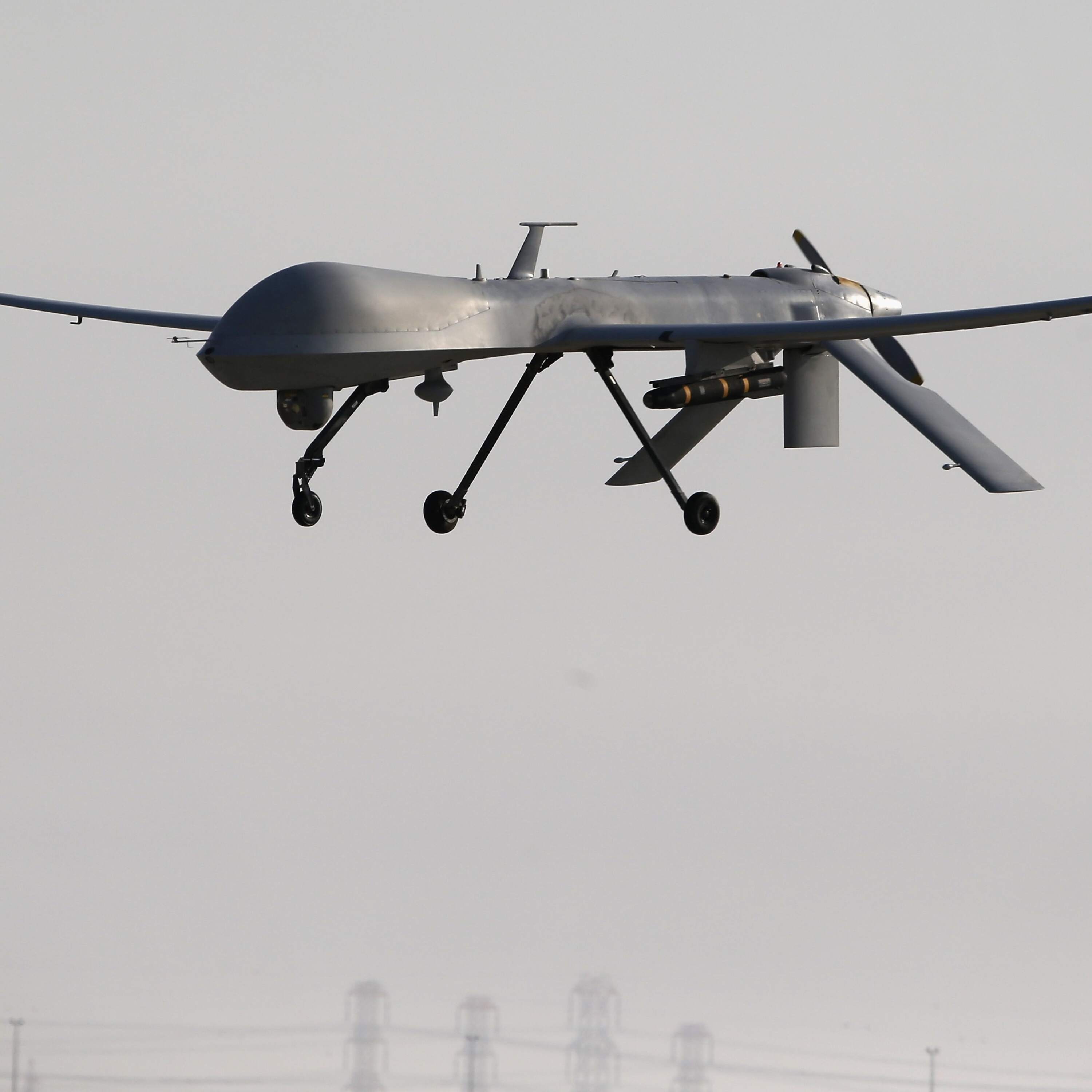
On October 7, 2001, a plane glided in the sky over the city of Kandahar, Afghanistan. It looked down on earth like a giant hawk circling its prey. But there was nothing alive inside it. No pilot. This was an MQ1, a Predator drone controlled by operators thousands of miles away. It was a 27 foot war machine carrying Hellfire missiles and it was looking for a target. It flew so high that it would have been virtually undetectable by anyone looking up at the night sky.
- [36:09]
Co-Producer/Narrator
Almost one month had passed since the US was attacked on 911 by Al Qaeda, a terrorist group based in Afghanistan. The Taliban, the rulers of Afghanistan, were harboring Al Qaeda's leader, Osama Bin Laden. And it appeared they were in the crosshairs of the US military. But on the ground on October 7, the stillness of a Kandahar fall night would tell you nothing of the things that were to come.
- [36:38]
Narrator/Host
Yet. The target for the Predator drone was a man named Mullah Omar. He was the leader of the Taliban government. The US Military thought maybe if we take him out, the Taliban will fall apart. This was it. This is what the drone was built to do. Use precision bombing to take out the leader of the enemy and use limited numbers of Special Forces fighters and their allies to avoid a costly full scale invasion saving thousands of of American lives.
- [37:25]
Co-Producer/Narrator
Mullah Omar sat in a building with no idea that a Predator drone was above him, watching and waiting for the Command to fire. U.S. military and intelligence staff were keeping tabs on him through a satellite feed from thousands of miles away. But what they were seeing wasn't some crystal Clear image of the ground. Nothing even close to that.
- [37:48]
Expert/Analyst
Back at that point, it's like viewing the world through a kind of grainy straw. I guess you're looking through a straw at a small part of that country focused in on what these people are doing. But you can't really tell. You're kind of just filling in the gaps.
- [38:05]
Co-Producer/Narrator
Even with this fill in the gaps type of information, the US military personnel see still had to make a call. They had to decide where the drone should shoot its missile.
- [38:17]
Expert/Analyst
They take the strike, But they end up blowing up a truck near to his compound. Sends loads of smoke into the sky, loads of dust into the sky, and Mullah Omar escapes. Just think of the implications for that. What different war would we have had if a drone had taken out the head of the Taliban? On the first day of the war in Afghanistan?
- [39:07]
Narrator/Host
The Predator drone strike missed its mark. Mullah Omar would live and the US ground invasion of Afghanistan would follow. But this wasn't seen as just a failure. No, in fact, the drone program continued. So this tells us that many of the military personnel in that room, the officers, drone operators and intelligence experts must have on some level realized that they just witnessed the beginning of a new era in warfare.
- [39:35]
Expert/Analyst
You know, I've spoken to a few of those who were in the room on that first strike, and they were in the room thousands of kilometers away watching the video feed. This is that first case of remote warfare. And you can't escape feeling that that is a fundamental revolutionary change in war. It's that achievement of that long standing U.S. air Force ambition that goes back to U.S. air power thinkers all the way back in 1917 after that first
- [40:10]
Narrator/Host
failed strike against Mullah Omar. The Predator drone, the great technological breakthrough, would be used over and over by the CIA and US military under, under President George W. Bush.
- [40:23]
Expert/Analyst
We can Talk to about 50 plus drone strikes during the Bush administration.
- [40:31]
Historical Figure/Archive Voice
There are some who feel like that if they attack us, that we may decide to leave prematurely. They don't understand what they're talking about. If that's the case, Let me finish. There are some who feel like that, you know, the conditions are such that they can attack us there. My answer is bring them on.
- [41:02]
Co-Producer/Narrator
In 2003, the US invaded and occupied another country, Iraq. And as that war intensified, drones were used there too. And they continued to get more advanced.
- [41:15]
Expert/Analyst
So the technology improves. Of course, that is the nature of humanity. We improve technologies over time. We are ever more high tech.
- [41:24]
Co-Producer/Narrator
Drone communications got more reliable. The aircraft could fly longer and faster. And with every year, their Impact on the war increased.
- [41:33]
Expert/Analyst
Here's the key thing about a drone. I guess if you have a piloted aircraft within a conflict, you have to send it from a base to fly over. It can take maybe 10 minutes to get there. It then has to fly, hit the target, turn around, and go back. And it cannot linger, because the longer it lingers, the more it is at risk of being shot down. With a drone, it flies high in the sky almost unseen, and it just loiters. It can sit there above troops, above a key area where, you know, the Taliban are operating, and it can just wait until a target presents itself, Like an eagle hovering over its prey, looking for a field mouse on the ground. And then when it sees it, it can swoop in and it can strike. And that's what a drone can do. If you want to kill in war and you believe that that war is something that increases your national security, then you want to be effective as possible. And so the drone is an effective way to kill in that regard.
- [42:46]
Political Figure (e.g., Barack Obama)
We've lost thousands of American lives, spent nearly a trillion dollars, alienated allies, neglected emerging threats, all in the cause of fighting a war for well over five years in a country that had absolutely nothing to do with the 911 attacks.
- [43:05]
Narrator/Host
When President Obama campaigned for office in 2008, the US was embroiled in two wars, both very messy, that had caused the death of thousands of US Soldiers and thousands more Afghan and Iraqi civilians.
- [43:18]
Expert/Analyst
Public support invariably faded as the body bag started to come home, as the improvised explosive device, the ied, started to make it so that you couldn't have troops on the ground, the infantry personnel couldn't trust the ground they were walking on. Well, it was at this point that President Obama was as elected. Of course, he made a promise to the American people. He would withdraw them from the bad war in Iraq and he would win the good war in Afghanistan. But over time, he would reduce that risk to American military lives, and he would make it so that would be less of a human footprint, an American military human footprint on the ground, because we no longer had the appetite for the war on terror.
- [44:02]
Political Figure (e.g., Barack Obama)
As a candidate for president, I pledge to bring the war in Iraq to a responsible end for the sake of our national security and to strengthen American leadership around the world.
- [44:16]
Expert/Analyst
But that leaves you with a dilemma, right? How do you continue to take on the global threats of terrorism, but without deploying your troops on the ground? Well, here is where the drone is a panacea, because it allows you to deploy force thousands of miles away with a minimal footprint and this, of course, in turn reduces the risk of the threat to life to American military personnel. But if you have a reduction of the amount of troops, or at least you're trying to reduce the amount of troops, then you want to fill that gap. And that gap for Obama, who becomes known as the drone president, is filled by the drone. And under the Obama administration, there is a real change in strategy. It starts off with what we call signature strikes. Now, signature strikes are based upon a predefined terrorist signature. And that signature can be based upon the gender of a target. And it could be based on how you define a terrorist. Right. So, for example, they could be males of fighting age in regions where the Taliban are known to operate. What do you think the fighting age is?
- [45:35]
Narrator/Host
Oh, man,
- [45:38]
Expert/Analyst
15, 16, 14 years old and above is what we're talking about him. And again, it's hard to tell an age through the grainy image of a drone. And that, it's argued, leads to a confirmation bias. You think you're seeing a terrorist conducting terrorist activity, and so you take the strike because it fills out all of your tick boxes. And so you've had vast amounts of mistakes that happen as a result of signature strikes. The aftermath of a drone strike in Pakistan's South Waziristan region in 2008. Amongst the victims were numerous civilians.
- [46:24]
Co-Producer/Narrator
I no longer love blue skies. In fact, I now prefer gray skies. The drones do not fly when the skies are gray. And for a short period of time, the mental tension and fear eases.
- [46:38]
Expert/Analyst
In Yemen's rugged and barren countryside, people live in constant fear, fear of what they call the killer planes or drones. Eighteen male laborers, including at least one young boy, 14 year old Saleh Khan, were killed by a US drone. As the drone war spread around the world to Somalia and to Yemen, to those places that we don't really talk about because we don't know so much about the drone wars there. But you do have weddings being hit with hellfire missiles from drones or funerals being hit.
- [47:11]
Co-Producer/Narrator
It was an astonishing bulletin today. Another public enemy taken out by the United States. The Al Qaeda leader called the most dangerous man in the world the American citizen Anwar Al Awlaki.
- [47:24]
Expert/Analyst
A lot of these strikes come with the Commander in Chief's seal of approval. The Justice Department has acknowledged that four
- [47:30]
Historical Figure/Archive Voice
American citizens had been killed in drone strikes.
- [47:33]
Expert/Analyst
Today the President said only one of
- [47:35]
Historical Figure/Archive Voice
them was specifically targeted. New Mexico born Anwar Al Awlaki, a top Al Qaeda leader in Yemen.
- [47:42]
Expert/Analyst
If you're killing a US Citizen, that's going to come straight from the Commander in Chief, Mr. Mr. Obama has deployed
- [47:48]
Historical Figure/Archive Voice
drones more aggressively than President Bush. For that, the president offered no apology.
- [47:54]
Expert/Analyst
When was the last time in the history of American warfare the commander in chief was directing strikes on the battlefield?
- [48:01]
Political Figure (e.g., Barack Obama)
The decisions that we are making now will define the type of nation and world that we leave to our children.
- [48:10]
Co-Producer/Narrator
The Obama administration says it has killed more than 2,300 enemy combatants by counter terror strikes. But it acknowledged the harsh reality that the once secret drone program may have been involved in anywhere from 64 to 116 civilian deaths since 2009 in areas outside active war zones. Despite all of the controversies surrounding the use of Predator drones at a White House press center, President Obama still found a way to make a joke about it.
- [48:42]
Political Figure (e.g., Barack Obama)
The Jonas Brothers are here. They're out there somewhere. Sasha and Malia are huge fans. But boys, don't get any ideas. I have two words for you. Predator drones. You will never see it coming. You think I'm joking?
- [49:11]
Co-Producer/Narrator
Some estimate that during the Obama administration, there were almost 1900 drone strikes. The total number of civilian casualties during the Obama drone wars has never been definitively recorded. Mostly because we're depending on news reports and NGOs. The US government is resistant to providing that information and often count anyone who is of fighting age as a combatant, whether or not they were carrying a weapon.
- [49:38]
Rund Abdelfatah
The range for civilian casualties from US Drone strikes are in the hundreds to a couple thousand.
- [49:44]
Co-Producer/Narrator
In a leaked Defense Department document provided by a whistleblower to the news outlet the Intercept, it was reported that between 2012 and 2013, US Special Operations airstrike killed more than 200 people. Of those, only 35 were the intended targets.
- [50:05]
Historical Figure/Archive Voice
Well, thank you very much and good afternoon. As President, my highest and most solemn duty is the defense of our nation and its citizens. Last night, at my direction, the United States military successfully executed a flawless precision strike that killed the number one terrorist anywhere in the world, Qasem Soleimani.
- [50:29]
Expert/Analyst
You look back to January 2020 and you look back to President Trump's drone strike on General Qasem Soleimani, who is a state representative of the Iranian state, one of the most high profile and high ranking military commanders of the Iranian state. That drone killed a state representative in a third party country in Iraq without that country's permission. So the drone violated the sovereignty of Iraq.
- [51:02]
Narrator/Host
Qasem Soleimani was an Iranian military commander who'd been directing lethal attacks in Iraq for years. The US had long blamed him for the deaths of hundreds of Americans and allies there.
- [51:14]
Expert/Analyst
The precedent that is set here is that it is okay to kill representatives of a nation state by lethal drone strike in nations of a third party without their approval. What does that mean for the future of drone warfare? As a lot of hostile nations around the world are getting armed drones, will they start using them against representatives of the west when they're in Yemen or in Iraq? The US founds the United nations along with the victorious allies after the Second World War. It's meant to be an upholder of international law law. If we get to a point where the US is undermining the laws that it created itself, then how do we expect anyone else to abide by those international laws when it comes to drones?
- [52:03]
Rund Abdelfatah
Those international laws say that drones must only be used to target combatants and military objectives, and that all feasible precautions must be taken to avoid or minimize civilian harm. But as more and more countries are turning to drones for their warfare, civilian deaths continue to be an inevitable consequence.
- [52:25]
Expert/Analyst
When we look to future war, we need to see that any future conflict is going to have a drone element. And so if you want to know what your country is doing in your name, then you need to understand drone warfare.
- [52:47]
Rund Abdelfatah
That's it for this week's show. I'm Rund Abdelfatah Throughline was created by me and Ramtin Adablooi. This episode was produced by me and
- [52:56]
Co-Producer/Narrator
Ramtin and Lawrence Wu, Layne Kaplan Levinson, Julie Kane, Victor Iz, Anya Steinberg, Yolanda Sanguine, Irene Noguchi.
- [53:06]
Rund Abdelfatah
Fact checking for this episode was done by Kevin Voelkel. Thank you to Courtney Theofin, Casey Hunter Herman and Farai Masika for their voiceover work. Also thanks to Anya Grundmann, Tamar Charney, Greg Myri, Adriana Tapia and Miranda Matarigos. Thanks also to Johannes Durgi, Liana Simstrom, Julia Redpath, Beth Donovan and Tommy Evans. This episode was mixed by Gilly Moon. Music for this episode was composed by Ramtin and his band Drop Electric, which
- [53:36]
Co-Producer/Narrator
includes Naveed, Marvi Sho Fujiwara, Anya Mizani.
- [53:42]
Rund Abdelfatah
And finally, if you have an idea or liked something you heard on the show, please write us@throughlinepr.org and if you're open to us giving you a call back, leave your number too. We might feature your idea in an upcoming episode. Also make sure to follow us on Apple, Spotify or the NPR app. That way you'll never miss an episode. Thanks for listening.
- [54:08]
Sponsor/Advertiser
This message comes from Grainger. For the ones who get it done, Grainger offers the professional grade products you need to get the job done with fast delivery and access to technical product experts ready to help you meet any challenge. Call clickgrainger.com or just stop by. This message comes from Thumbtack Avoiding your unfinished home projects because you're not sure where to start? Thumbtack knows homes, so you don't have to don't know the difference between matte, paint, finish and satin or what that clunking sound from your dryer is. With Thumbtack, you don't have to be a home pro, you just have to hire one. You can hire top rated pros, see price estimates and read reviews all on the app. Download Today.
- [54:51]
This message comes from NPR sponsor Shopify. No idea where to sell? Shopify puts you in control of every sales channel. It is the commerce platform revolutionizing millions of businesses worldwide. Whether you're a garage entrepreneur, entrepreneur or IPO ready, Shopify is the only tool you need to start, run and grow your business without the struggle. Once you've reached your audience, Shopify has the Internet's best converting checkout to help you turn them from browsers to buyers. Go to Shopify.com NPR to take your business to the next level. Today.