Loading summary
Transcript236 lines
- [00:01]
NPR Host/Announcer
Support for NPR and the following message come from Warby Parker, the One Stop Shop for all your vision needs. They offer expertly crafted prescription eyewear plus contacts, eye exams and more. For everything you need to see, visit your nearest Warby Parker store or head
- [00:16]
Rand Abdelfattah
to warbyparker.com you already know the person who spent the most money supporting President Trump's campaign in 2024.
- [00:26]
Jim Bopp
His name is Elon Musk.
- [00:28]
Rand Abdelfattah
You might remember him showing up at Trump rallies.
- [00:31]
Jim Bopp
Come on up here, Elon.
- [00:32]
Rand Abdelfattah
Jumping awkwardly around on stage.
- [00:35]
Jim Bopp
Take over, Eli.
- [00:36]
Michael Kang
Yes, take over.
- [00:39]
Rand Abdelfattah
But behind the scenes, he'd spend more than $291 million to support President Trump's win.
- [00:46]
Jim Bopp
And we had one president who couldn't
- [00:48]
Michael Kang
climb a flight of stairs and another who was fist pumping after getting shot. Fight, fight, fight.
- [00:59]
Jim Bopp
Blood coming down the face.
- [01:01]
Rand Abdelfattah
Shortly, Musk was tapped by Trump to lead Doge, which would slash government spending and jobs, which he represented once by pretending to fire up a chainsaw at the conservative CPAC convention.
- [01:19]
Jim Bopp
This is the chainsaw for bureaucracy. Chainsaw.
- [01:26]
Rand Abdelfattah
Musk was the biggest spender by far, but he wasn't the only billionaire trying to influence the elections. About $15 billion was spent in 2024, and what raised eyebrows was the relatively short lists of the ultra rich people who spent it.
- [01:44]
Jim Bopp
Some major donors and billionaires have made
- [01:46]
Michael Kang
public pushes for candidates this election cycle.
- [01:48]
Rand Abdelfattah
So when it comes to following the money, there is a whole lot of it to keep track of.
- [01:52]
Henrik Schatzinger
In this race, several high profile billionaires are dumping massive amounts of money into the presidential race.
- [01:59]
Rand Abdelfattah
Fast forward to today. The 2026 midterm elections are already shaping up to be the most costly in American history. Part of a trend over the last several decades where the amount of money spent on elections has mostly been going up. So we wanted to look at one moment a big moment that seemed to open the financial floodgates.
- [02:21]
Jim Bopp
I am sick and tired of people who say that if you debate and you disagree with this administration, somehow you're not patriot.
- [02:30]
Michael Kang
In the lead up to the 2008 presidential election, it looked like at the time that Hillary was the front runner for the Democratic nomination.
- [02:39]
Ramtin Arablouei
This is Michael King. He's a law professor at Northwestern Pritzker School of Law.
- [02:44]
Michael Kang
Citizens United wanted to run a documentary that told all kinds of stories that they felt were important to tell about Hillary Clinton.
- [02:50]
Ramtin Arablouei
You might have heard of Citizens United, the plaintiff ever since its 2010 Supreme Court case. But Citizens United had for years been a conservative nonprofit that made media supporting Republicans and critical of Democrats and their film. Hillary the Movie had a strong narrative
- [03:09]
Michael Kang
generally that she was kind of an awful person. She's driven by the power, would be a terrible candidate.
- [03:15]
Jim Bopp
She does not answer questions.
- [03:16]
Michael Kang
Disaster in all kinds of ways.
- [03:18]
Rand Abdelfattah
She is the expert of not saying what she believes.
- [03:23]
Michael Kang
So they produced this documentary. Hillary Rodham Clinton. Could she become the first female president in the history of the United States? It wasn't designed to, like, make a lot of money.
- [03:36]
Ramtin Arablouei
It was designed to be seen.
- [03:39]
Michael Kang
And they wanted to distribute that movie through video on demand. Their goal at the outset was not to change campaign finance law. They just wanted to be able to show their movie.
- [03:51]
Ramtin Arablouei
Citizens United wanted to run their movie on cable TV and air ads for it on broadcast TV close to the 2008 presidential primary election. But the Federal Elections Commission opposed them. Laws banned these kinds of political ads from running 30 days before the primaries.
- [04:10]
Rand Abdelfattah
Hillary the movie would never air. But when Citizens United took the case to court, they said, why couldn't they show their film when General Electric, National
- [04:20]
Jim Bopp
Public Radio, or George Soros may freely broadcast?
- [04:25]
Rand Abdelfattah
The result of that case would completely change the American political system.
- [04:30]
Michael Kang
Today, the Supreme Court struck down federal
- [04:32]
NPR Host/Announcer
legislation that restricts how corporations can spend
- [04:35]
Michael Kang
their money in political campaigns.
- [04:37]
Ramtin Arablouei
The court's 5:4 decision opened the floodgates for corporate and undisclosed dark money to
- [04:43]
Michael Kang
pour into the election process.
- [04:45]
Rand Abdelfattah
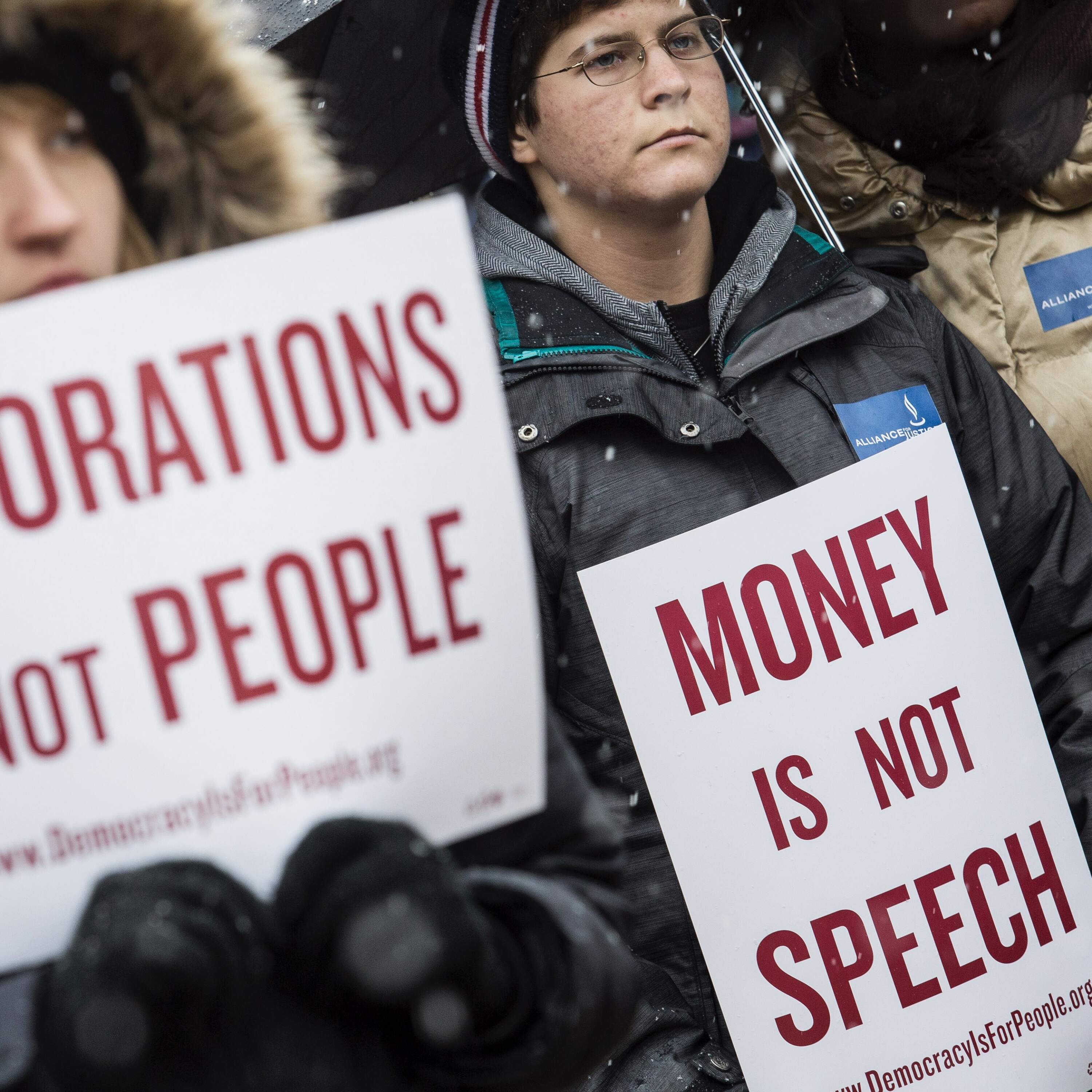
Since the Citizens united case in 2010, the amount of money being spent in elections has skyrocketed. But it wasn't the corporations that everyone feared would be spending the money. It has been ultra wealthy billionaires, and they're not spending it on their own. Most of that money has been going to political action committees or PACs that, with the help of the Citizens United decision, have been given superpowers.
- [05:12]
NPR Host/Announcer
Super PACs can raise and spend unlimited sums, unlike campaigns, which are limited with how much they're able to bring in
- [05:18]
Rand Abdelfattah
from one specific individual.
- [05:20]
Michael Kang
In the 2024 election, it was a little over $5 billion raised by super PACs. And there were about 2,500 super PACs total.
- [05:33]
Rand Abdelfattah
Super PACs can't legally coordinate directly with campaigns they support. But super PACs can control the political messaging they fund, rather than the candidates themselves.
- [05:44]
Henrik Schatzinger
They change how candidates behave, how parties compete, what donors are doing, and who really speaks to voters during a campaign. Who fears whom, and who sets the story. Voters. Remember, Super PACs did not just add money. They rewired the whole campaign ecosystem.
- [06:06]
Ramtin Arablouei
Money has always played a role in American elections, but for the most part, there were rules that kept the biggest spenders from corrupting the process. Even today, it feels like there are very few things that most Americans agree on. Yet polls have consistently shown that voters from all political parties overwhelmingly see unlimited spending in elections as a threat to American democracy. So if most people don't like all this money in politics, then who does? I'm Ramtin Arablouei.
- [06:38]
Rand Abdelfattah
And I'm Rand Abdelfattah. On this episode of Throughline. The explosion of money in elections despite America's long history of trying to prevent it.
- [06:53]
NPR Host/Announcer
Hi, this is Jill McAfee from Atlanta,
- [06:56]
Rand Abdelfattah
Georgia, and you're listening to Throughline from NPR.
- [07:02]
NPR Host/Announcer
This message comes from BetterHelp. February is full of flowers, candy and lots of relationship talk. It can feel like everyone has it all together in their love lives, but the truth is they're still figuring it out. And whether you're married, dating, or prioritizing being single, just remember you're right on time. Therapy can take the pressure off and help you feel lighter. Just a little outside perspective from a professional can lead to new understanding and a lot of progress. Visit betterhelp.com NPR for 10% off support for this podcast and the following message come from Strawberry Me. If you could go back and talk to your younger self, would you tell yourself that you have a job that truly makes you happy? Many people are stuck in jobs they've outgrown or never really wanted. A career coach from Strawberry Me can help you move on to something you actually love. Benefit from having a dedicated coach in your Corner, and get 50% off your first coaching session at Strawberry Me. This message comes from Carvana, who makes buying and financing your next car easy. Thousands of vehicles, terms up front and 100% online. Even get it delivered to your door. Buy your car the easy way with Carvana. Delivery fee may apply.
- [08:21]
Rand Abdelfattah
Part 1 Cat and Mouse In 1971, there was a rush of money heading to Washington, D.C. literally and infamously. Suitcases full of cash, all going to support the re election campaign of President Richard Nixon.
- [08:40]
Henrik Schatzinger
For four years, President Nixon has responded to the needs of the people. That's why we need President Nixon now more than ever.
- [08:50]
Rand Abdelfattah
By the 70s, it had become expensive to run political campaigns. Television had become popular, and running ads on TV cost a lot of money. But getting in front of a mass audience was a must for politicians. At the same time, Congress passed its first major campaign finance bill called the Federal Election Campaign act, or feca. FECA capped campaign contributions and spending for things like ads and also forced candidates to disclose the names of anyone donating over $100 in the weeks before the law took Effect, Nixon's campaign would raise millions of dollars from secret donors. In the end, Nixon's campaign was forced to turn over his donors list. And when they did, volunteers from a group called Common Cause started connecting the dots between corporate donors on his list and political favors that Nixon seemed to be doling out.
- [09:49]
Jim Bopp
The former head of American Airlines and the current chief of Goodyear Tire and Rubber told the Irvin Committee how they gave $55,000 and $40,000, respectively, to the Nixon reelection committee.
- [10:00]
Michael Kang
Both contributions were illegal. There's actually not a lot of campaign finance regulation before the 1970s at the federal level. Really very lax enforcement of whatever campaign finance laws we had at the time.
- [10:18]
Rand Abdelfattah
The first major campaign finance law passed in the United States was the Tillman act in 1907, when Teddy Roosevelt was accused of accepting large corporate donations for his presidential run in exchange for political favors. The Tillman act prevented corporations from making direct contributions to influence federal elections. And for most of the 20th century, corporate spending was seen in both law and culture as a potentially corrupting force in elections. Eventually, unions were also limited from making candidate contributions. But it wouldn't be until after Watergate and amendments to FECA that experts say real reforms were put in place.
- [11:02]
Michael Kang
It's really 1974amendments that put the teeth into federal campaign finance law, and they do a bunch of different things. One is they apply contribution limits across the board for everyone. So anytime you're exchanging money in the campaign finance system, there's a limit on how much you can give.
- [11:21]
Rand Abdelfattah
Fika put limits on how much individuals could give to candidates, how much they could give to political parties, and how much parties could also give to candidates.
- [11:32]
Michael Kang
So if you wanted to give to a candidate, you had a limit of $1,000. If you want to give to a party, it was a limit. If a party wanted to give to a candidate, there was a limit. It also had disclosure rules. So that meant every time a candidate receives money above a certain amount, they have to disclose it. Every time they spend money in a significant way, they have to disclose that. And anyone who's really active in federal campaign finance politics has to register. And then, in addition, there were expenditure limits, which meant that candidates can only spend so much. So as a candidate, you don't have to worry about, you know, your competitor outspending you because you were both capped the next year.
- [12:14]
Rand Abdelfattah
In 1975, a group of libertarian and conservative politicians filed a lawsuit arguing that fundraising and spending limits made it harder for newcomers to run against favored incumbents.
- [12:28]
Ramtin Arablouei
The case is known as Buckley versus Valeo.
- [12:32]
Jim Bopp
Council, you may proceed whenever you're ready.
- [12:35]
Michael Kang
James Buckley is a conservative politician. He was a former US Senator. He is one of a bunch of politicians that challenges the FICA amendments, the whole campaign finance system under the First Amendment.
- [12:48]
Ramtin Arablouei
Buckley argued that limiting the amount of money campaigns can raise and spend limited what those campaigns could say to potential voters. To Buckley and others, money was speech, and the First Amendment guarantees that right to free speech.
- [13:05]
Jim Bopp
The greatest campaign reform law ever enacted was the First Amendment. We rely on the proposition that good speech will drive out bad, and all opponents ask is that the court enforce that.
- [13:21]
Ramtin Arablouei
On the government side, attorneys argued that the caps on spending were justified in order to prevent corruption rather than to censor speech.
- [13:31]
Rand Abdelfattah
So what is the ruling that comes out of this case and how does it sort of play out over the next several decades?
- [13:39]
Michael Kang
One is it says campaign finance is First Amendment activity and it's protected by
- [13:45]
Ramtin Arablouei
the First Amendment, basically because reaching people takes money. Restrictions on spending are effectively restrictions on speech. This was a huge deal and maybe an even bigger deal today. This is the moment when the Supreme
- [14:00]
Michael Kang
Court decided that the government can regulate how much I can give to your campaign, but it can't stop me from spending a million dollars on what I believe. And if that happens to be saying how great a candidate you are, that's okay. It can't restrict that.
- [14:16]
Ramtin Arablouei
So free speech. You can spend whatever you want to say whatever you think, but you can't contribute whatever you want directly to a campaign because that could lead to corruption a la Teddy Roosevelt or Richard Nixon.
- [14:30]
Michael Kang
The court decided in Buckley, that's a big enough worry in a democracy that the government should be able to regulate that. And I think that's really where you see this cat and mouse game start up in earnest.
- [14:46]
Ramtin Arablouei
Kang says it wasn't easy for wealthy people to spend their money on their own megaphone during elections. They needed help from political groups or the parties themselves, and that money was restricted. Yet through the 1980s and into the 1990s, campaign costs were rising and people were finding ways around the FIKA laws. Enter soft money, a loophole that allowed parties to collect big sums of money for generic party building activities, things like
- [15:15]
Michael Kang
voter registration and get out the vote. And so you had this creep of ultra wealthy people spending more and more money in politics from the 90s into
- [15:22]
Ramtin Arablouei
the 2000s, which meant that candidates were focusing more and more on the money.
- [15:28]
Michael Kang
So now you have kind of this unlimited appetite for money because you want to be able to be sure you're not going to get outspent in a dramatic way.
- [15:38]
Ramtin Arablouei
And advertisements and marketing and media can make up a majority of the campaign costs.
- [15:44]
Michael Kang
And what we've seen, obviously over the FIKA era, as the money keeps going
- [15:49]
Jim Bopp
up,
- [15:52]
Rand Abdelfattah
I don't remember a time where a candidate is not immediately getting elected and then turning around and beginning to fundraise again for their reelection campaign. It's just like a constant fundraising machine. It seems like.
- [16:04]
Michael Kang
Exactly right. And that has lots of effects on politics. The politicians are spending less time doing their actual job and more time raising money. It distracts them from kind of what we consider, like, what's important about their job, which is making policy and thinking about what's good for the country. There's lots of reasons to think that's not a great development in campaign finance.
- [16:26]
Rand Abdelfattah
Then came the controversies on the Democrat side. President Bill Clinton got in hot water when his campaign received foreign donations and held fundraising events at the White House. Meanwhile, Republicans had their fair share of scrutiny for contributions they received. And then came a senator from Arizona who used these controversies in his 2000 presidential campaign.
- [16:51]
Jim Bopp
Until the last breath I draw, I will fight to eliminate this soft money, to give that government back to the people of America who have had it taken away from them. That's what this campaign is all about.
- [17:03]
Rand Abdelfattah
When John McCain ran for president in 2000, he emphasized campaign finance reform. McCain ended up losing to George W. Bush in the Republican primary and was astoundingly outspent. But in 2002, he introduced the Bipartisan Campaign Reform act, also known as the McCain Feingold Act. It was designed to end soft money contributions, which had soared by this time. And the law forced candidates to stand by their ads with messages like this,
- [17:36]
Jim Bopp
I'm George W. Bush and I approve this message.
- [17:40]
Rand Abdelfattah
And the McCain Feingold act also restricted corporations and unions from running ads or media mentioning federal candidates within 30 days of a primary election and 60 days of a general election. This was called electioneering communications and was meant to limit a kind of attack ad close to elections. And it would be this last law that would be at the heart of a case about a movie that would change the way money in American politics works.
- [18:12]
Ramtin Arablouei
So who is the real Hillary Clinton?
- [18:15]
Michael Kang
Is she a brilliant trailblazer poised to make history as the first female president? Or is she ruthless, cunning, dishonest, willing to do anything for power?
- [18:27]
Rand Abdelfattah
Coming up, Hillary the Movie.
- [18:32]
NPR Host/Announcer
Hi, I'm Carolyn from Tallahassee, Florida, and
- [18:35]
Rand Abdelfattah
you're listening to Throughline from npr. Throughline keeps me captivated with every episode,
- [18:41]
NPR Host/Announcer
unraveling history in a way that teaches
- [18:43]
Rand Abdelfattah
me something new and fascinating each time. Thank you.
- [18:50]
Sponsor/Advertiser Voice
This message comes from Lisa from Night one. You'll feel the difference. Premium materials that deliver serious comfort and full body Support. Go to Leesa.com for 30% off mattresses, plus get an extra $50 off with promo code. NPR this message comes from Jerry. Noticing your car insurance rate creep up even without tickets or claims you're not alone. That's why there's Jerry. Jerry handles the legwork by comparing quotes side by side from over 50 top insurers so you can confidently hit buy. No spam calls, no hidden fees. Jerry even tracks rates and alerts you when it's best to shop. Drivers who save with Jerry could save over $1,300 a year. Don't overpay, download the Jerry app or visit Jerry AI, NPR Today, this message comes from Instacart.
- [19:43]
NPR Host/Announcer
Let's talk groceries, specifically your groceries. With Instacart, you want your groceries just the way you like them, right? Well, the Instacart app lets you do just that. They have a new preference picker that lets you pick how ripe or unripe you want your bananas. Shoppers can see your preferences up front, helping guide their choices. Instacart get groceries just how you like.
- [20:06]
Michael Kang
Part 2 the Floodgates Open
- [20:11]
Ramtin Arablouei
in the 2000s, Jim Bop had already made a name for himself in conservative legal circles. Starting in the late 1970s, the Indiana Attorney represented a number of conservative groups, and that led him to fighting for how they used their money to get their messages out. And in the 2000s, he had become the go to guy for campaign finance cases.
- [20:33]
Jim Bopp
I think the government is just really grabbing for more regulation and more control, more prohibition on speech.
- [20:40]
Ramtin Arablouei
For Jim Bob, the more speech, the better, meaning the more ads telling you what a candidate believes or what others believe about them.
- [20:49]
Jim Bopp
One of the questions, you know, people need to ask themselves, you know, is having knowledge about the positions of candidates on issues, what they're for and what they're against. Is that good or bad? I mean, I argue that it's good.
- [21:04]
Henrik Schatzinger
His arguments boil down to four points.
- [21:07]
Ramtin Arablouei
This is Henrik Schatzinger, professor of political
- [21:10]
Henrik Schatzinger
science at Ripon College in Wisconsin, and
- [21:13]
Ramtin Arablouei
he has a book coming out called Super PACs in the city.
- [21:16]
Henrik Schatzinger
His first argument is that ordinary people should be able to pool money in groups to really compete. So he frames the decision or the case as one that will level the playing field.
- [21:31]
Ramtin Arablouei
So in other words, if a super rich person wanted to run for office, under the law, they could spend whatever money they wanted to run Ads. Bop argued that regular people would be forced to pool their money together to equal one rich, rich person's buying power. So groups of people, including corporations, unions, or political action committees, should be able to do just that.
- [21:54]
Jim Bopp
You can't stop rich people from spending money, but what you can do is have a system that, number one, people of average means can contribute and be effective, and that requires groups.
- [22:06]
Henrik Schatzinger
His second argument is that the campaign finance laws are really about protecting incumbents.
- [22:13]
Ramtin Arablouei
Incumbents had name recognition in war chests. Challengers often relied on smaller donations.
- [22:21]
Henrik Schatzinger
His third point, he argues that the laws are so complex and confusing that they then become a deterrent for people to run for office.
- [22:29]
Jim Bopp
The whole idea behind the First Amendment was to protect political speech and thereby protect the right of average citizens to participate in our democratic process.
- [22:40]
Henrik Schatzinger
And the last argument he makes is about civic courage. He argues that you should not need a lawyer and a stomach for harassment to really support the cause. He casts enforcement as intimidation, and he says the laws chill political participation.
- [23:02]
Rand Abdelfattah
And that brings us back to Hillary the movie.
- [23:05]
Michael Kang
What is the truth about Hillary Rodham Clinton?
- [23:09]
Jim Bopp
It's a recklessness that's born of arrogance that goes back to her 1960s roots in their narcissism.
- [23:16]
Rand Abdelfattah
Remember, the Federal Elections Commission rules prohibited the film from being aired. In 2007, Jim Bopp signed on as the lawyer for Citizens United, the organization behind the movie.
- [23:30]
Henrik Schatzinger
He saw Citizens United as a First Amendment rescue mission, if you will.
- [23:38]
Rand Abdelfattah
In a way, the case was similar to the other campaign finance cases he'd taken on before. Those four main arguments that show political speech and paying for political speech are protected under the First Amendment.
- [23:52]
Henrik Schatzinger
In his telling, Citizens United States is about freeing speech, not freeing money.
- [24:00]
Rand Abdelfattah
When he went before a Federal Court in 2008, he said the film was just like any other News program like 60 Minutes, and so it should be allowed to be broadcast. The judge laughed at him. Citizens United lost the case. But then it went to the Supreme Court, a court that had become more conservative in the 2000s.
- [24:24]
Michael Kang
So initially, the case is a kind of small case.
- [24:26]
Rand Abdelfattah
This is Northwestern law professor Michael Kang.
- [24:29]
Michael Kang
Citizens United was really about this obscure provision in McCain Feingold which prevented corporations
- [24:37]
Rand Abdelfattah
or unions from funding certain ads that clearly mentioned candidates on broadcast television 30 days before a primary election.
- [24:46]
Michael Kang
So the really narrow question here is whether video on demand constituted a broadcast communication under McCain Feingold. Very limited, not likely to change campaign finance. But when the case went up to the Supreme Court, something happened.
- [25:02]
Rand Abdelfattah
It was kicked off by Justice Samuel Alito.
- [25:06]
Jim Bopp
You think that if a book was Published a campaign biography that was the functional equivalent of express advocacy.
- [25:15]
Michael Kang
That could be banned. At oral argument, there's a critical moment where the deputy Solicitor General, Malcolm Stewart,
- [25:22]
Rand Abdelfattah
who represented the US Government and the FEC in this case, gets engaged with
- [25:27]
Michael Kang
this back and forth with Justice Alito. And Justice Alito starts to wonder if this sort of ban could be justified. In the same way, maybe a federal ban on books could be justified.
- [25:43]
Jim Bopp
I'm not saying it could be banned. I'm saying that Congress could prohibit the use of corporate treasury funds and could require a corporation to publish it. Using it. Well, most publishers are corporations, and a corporate. A publisher that is a corporation could be prohibited from selling a book. Well, of course, the. The statute contains its own media exemption for media, But I'm not asking what they. The statute says the government's position.
- [26:09]
Michael Kang
And Alito is kind of like a dog with a bone. He just won't let go of this point, so he keeps going after Stewart.
- [26:16]
Jim Bopp
The government's position is that the First Amendment allows the banning of a book if it's published by a corporation. Because the First Amendment refers both to freedom of speech and of the press. There would be a potential argument that media corporations, the institutional press, would have a greater First Amendment right.
- [26:35]
Michael Kang
Tries to say, this is not really what this case is about, which was true. But then Alito says, well, like, what's the answer? Could we ban corporate money from funding a book that engages in political advocacy? And ultimately, Stewart says, we could prohibit
- [26:50]
Jim Bopp
the publication of the book using the corporate treasury fund.
- [26:54]
Michael Kang
That seems to be a critical moment for Citizens United. Generally speaking, most people think it's okay for the government to regulate big money in politics and regulate campaign ads, which may influence people's views about the election and is where most of the money is spent. But banning books sounds like something else. And so Alito was kind of connecting the specter of book banning that we're sort of familiar with and has this really ugly connotation with what the government was trying to argue in that case.
- [27:28]
Sponsor/Advertiser Voice
Case.
- [27:30]
Rand Abdelfattah
Yeah. It seems like a very intentional and calculated choice of metaphor in this case. Right. Because book bans, book burning. It has a very negative, specifically connotation in most people's minds. It's like the most dramatic form of censorship that we often think of. But it's interesting then, to apply the idea of censorship of free speech to corporate spending.
- [27:57]
Michael Kang
Yeah. And I think the way that campaign finance reformers would present campaign finance regulation is we're not trying to swing the election one way or the other. We're not trying to censor speech. What we want to do is regulate how much influence people with a lot of money have over the election and equalize to some degree the amount of say we all have as citizens in a democracy. But what Alito was doing was connecting campaign finance regulation with this worry about government making choices about what's acceptable speech and picking sides in the debate, which is much more in the conservative direction. And one of the conservative anxieties about campaign finance regulation is the word that that's what the government is trying to do in some sort of more subtle way. And so instead of deciding Citizens United on this narrow question, instead the court comes back and says, we want you to re argue this case, re brief this case. We're going to do it over. But we're now going to engage this much larger question about whether the federal government constitutionally can prohibit corporate money from funding election speech.
- [29:09]
Rand Abdelfattah
In other words, the Supreme Court wanted to take on a much bigger question, one that had already been settled by decades of legal precedent. Could the government really ban corporate spending on elections? Did the free speech under the First Amendment right extend to corporations like it did to individual people? Later that year, 2009, the case came back to the Supreme Court. By this time, Barack Obama had become president after massively outspending John McCain with unprecedented help from private donors.
- [29:45]
Michael Kang
So when Citizens United goes back to the Supreme Court the second time for re argument, it's a pretty momentous oral argument. It's Elena Kagan's first argument as Solicitor General. Everyone knows that basically the future of the campaign finance system is on the line, and we're not surprised when Citizens United wins the case ultimately, because at the argument, Kagan goes in and essentially is trying to limit the loss.
- [30:15]
Jim Bopp
If you're asking me, Mr. Chief justice, as to whether the government has a preference as to the way in which it loses if it has to lose. What case of ours? What case of ours?
- [30:26]
Michael Kang
If we lose this case, we do have a preference on how we lose this case, right? We don't want to lose this case so badly that we lose all campaign finance regulations. So it's no surprise when the government loses. But it is pretty dramatic. Today, the Supreme Court struck down federal
- [30:45]
NPR Host/Announcer
legislation that restricts how corporations can spend their money in political campaigns.
- [30:53]
Henrik Schatzinger
The 5 to 4 majority, led by Justice Kennedy, said that political speech is at the heart of the First Amendment, and the identity of this speaker does not remove that protection.
- [31:09]
Ramtin Arablouei
Whether it's an individual or a group of individuals, maybe who work for a corporation, if they want to spend their money on getting their message out, they can.
- [31:18]
Henrik Schatzinger
So they rejected the idea that corporate wealth creates a special corruption risk that justifies a ban.
- [31:27]
Michael Kang
These restrictions on corporations corporate spending have been around since 1907.
- [31:32]
Ramtin Arablouei
The Tillman act of 1907, the United States first law to ban corporate spending in elections.
- [31:39]
Michael Kang
And now we've blown a huge hole in campaign finance law. And the worry along these lines is that the floodgates will open to corporate money. And that's really where all the attention is. The Supreme Court has said like people, corporations have the right to engage in political advocacy and expenditures without restriction. That had always been a critical distinction. We treated people differently than corporations and corporations don't have to be treated like people. So it's not really the reasoning of the case that gets sort of blown up in the reaction to the case, but that's the immediate reaction is like what's this going to do? How much are corporations going to spend? The irony is that Citizens United ultimate importance is really not about corporations because certainly for profit corporations for the most part there are exceptions, but for the most part for profit corporations aren't actually all that thrilled about spending a lot of money in campaigns.
- [32:42]
Rand Abdelfattah
It could be bad for business.
- [32:43]
Michael Kang
It's bad for business. I think Michael Jordan at one point is asked like, why didn't he support Democratic causes and candidates more? And he said Republicans buy gym shoes too, right? They buy sneakers. And so by being too publicly engaged in politics, you alienate people. And we've seen lots of examples of that recently. Especially in fact, there are a bunch of corporations that argued against the outcome in Citizens United. They didn't want to be drawn into this.
- [33:18]
Ramtin Arablouei
All the attention on the Citizens United ruling overshadowed another case happening around the same time in a lower court. One that would build off the ruling from Citizens United and make the case that since corporations could raise and spend whatever money they wanted, any group should be allowed to do this. Even groups that had been restricted under McCain, Feingold and other election laws before.
- [33:42]
Michael Kang
Within the same week that Citizens United is decided, the DC Circuit heroes oral argument on a case called speech now versus FEC and decides that case two months later.
- [33:56]
Ramtin Arablouei
SpeechNow was a non profit created by a small group of libertarians to promote the First Amendment. Specifically they wanted to advocate for and against different candidates, but they would have had to organize as a place political committee in order to do that. They went to court to argue that wasn't fair.
- [34:15]
Michael Kang
And two months later the D.C. circuit cites Citizens United about two dozen times in 20 pages and says essentially, Citizens United ties our hands in this case would have been a different case probably before, but because of Citizens United and what it says about the government's constrained ability to regulate expenditures, it's clear SpeechNow has the ability to be a super PAC, to be able to raise money without contribution limits as long as they're only engaging in this kind of independent speech.
- [34:46]
Ramtin Arablouei
In March of 2010, SpeechNow won. And now any group that wanted to raise and spend unlimited money on their own messages, their own speech, they could Within a few months, close to 80 new super PACs filed with the fecund in time for the 2010 midterm elections.
- [35:06]
Michael Kang
2010 ends up being by far the most expensive midterm election in American history,
- [35:12]
Ramtin Arablouei
but it wouldn't be the most expensive to date. Coming up, super PACs explode.
- [35:24]
NPR Host/Announcer
Hi, this is Susanna Callahan. I'm calling from Brooklyn, New York. You're listening to Throughline on npr.
- [35:31]
Sponsor/Advertiser Voice
This message comes from NPR sponsor Charles Schwab. When is the right time to sell a stock? How do you protect against inflation? Financial decisions can be tricky, and often your own cognitive and emotional biases can lead you astray. Financial Decoder, an original podcast from Charles Schwab, can help join host Mark Reape as he offers practical solutions to help overcome the cognitive and emotional biases that may affect your your investing decisions. Download the latest episode and subscribe@schwab.com financialdecoder this message comes from NPR sponsor the NPR Wine Club, a place to explore the exciting world of wine, including wines inspired by popular NPR shows like Tiny Desk Sauvignon Blanc. Whether buying a few bottles or joining the club, all purchases help support NPR programming and fund quality reporting developed to connect people to their communities and the world they live. More@NPRWineClub.org podcast must be 21 or older to purchase.
- [36:37]
NPR Host/Announcer
This message comes from NPR sponsor Viori featuring the performance jogger. Visit viori.com NPR for 20% off your first purchase on any U.S. orders over $75 and free returns. Exclusions apply. Visit the website for full terms and conditions.
- [36:55]
Rand Abdelfattah
Part 3 Whispering through a megaphone In January 2010, President Barack Obama gave his State of the Union address. It was just a few days after the Supreme Court ruled in Citizens United, opening the door to massive changes to election, fundraising and spending. The nine Supreme Court justices were sitting in the front row for his address
- [37:21]
Michael Kang
at one point, Obama says, last week
- [37:24]
Jim Bopp
the Supreme Court reversed a century of law that I believe will open the floodgates for special interests, including foreign corporations, to spend without limit in our elections.
- [37:36]
Michael Kang
He actually comments on Citizens United in Alito Mals. Not true.
- [37:41]
Rand Abdelfattah
All nine of the justices, including Samuel Alito, sat unmoved while legislators rose to applause all around them.
- [37:50]
Jim Bopp
I don't think American elections should be bankrolled by America's most powerful interests or worse, by foreign entities. They should be decided by the American people.
- [38:01]
Michael Kang
I think super PACs really make their impact in the 2012 elections where you have a presidential race.
- [38:08]
Jim Bopp
The jockeying to be the Republican party's next presidential nominee has begun. And for the first time in more than 50 years, the GOP is without a clear front runner at this stage of the campaign.
- [38:21]
Michael Kang
If you remember the 2012 race, Mitt Romney emerges eventually as the nominee.
- [38:27]
Rand Abdelfattah
This is Northwestern law professor Michael Kang.
- [38:31]
Michael Kang
But he has to kind of fend off challenges from like Rick Santorum, who really relies almost entirely on super PAC money. Who has the best chance to beat Obama? Rick Santorum, a full spectrum conservative.
- [38:45]
Rand Abdelfattah
Ricky this was known as the zombie candidate moment, where candidates whose campaigns appear to be dead rose from their graves.
- [38:54]
Henrik Schatzinger
Newt Gingrich's presidential campaign was effectively dead.
- [38:58]
Rand Abdelfattah
This is Henrik Schatzinger who teaches political science at Ripon College. He's got a book coming out this year called Super PACs in the city.
- [39:07]
Henrik Schatzinger
He had no money, no staff, no momentum.
- [39:09]
Rand Abdelfattah
Newt Gingrich's effort at political resurrection is not looking so good today. The top staff for the Republicans presidential campaign resigned on Monday.
- [39:18]
Henrik Schatzinger
In the old world, he would have just dropped out, end of the campaign.
- [39:22]
Rand Abdelfattah
But this was the new world where just one wealthy donor could keep a candidate alive.
- [39:27]
Henrik Schatzinger
And so Gingrich went actually from being dead in the water to winning that South Carolina primary with super PAC money.
- [39:36]
Jim Bopp
It's not that I am a good debater.
- [39:38]
Henrik Schatzinger
It is that I articulate the deepest felt values of the American people.
- [39:45]
Ramtin Arablouei
But it wasn't just Republicans who made the 2012 election significant for super PACs.
- [39:50]
Rand Abdelfattah
President Obama and his re election team have reversed course.
- [39:54]
NPR Host/Announcer
They're now encouraging big donors to finance
- [39:56]
Rand Abdelfattah
a pro Obama super pac.
- [39:58]
Henrik Schatzinger
So the turning point is when Obama's team gave the green light to a super pac. It was known as Priorities USA Action and it made a big difference. Priorities USA ran some of the most effective ads during the whole election cycle. It had some of the most well known ads about a steel worker who lost his job.
- [40:24]
Jim Bopp
I don't think Mitt Romney understands what he's done to people's lives by closing the plant.
- [40:29]
Henrik Schatzinger
I don't think he and his insurance under Bain Capital. Mitt Romney's company are some of the most well known ads.
- [40:36]
Jim Bopp
Furthermore, I do not think Mitt Romney is concerned. Priorities USA Action is responsible for the content of this advertising.
- [40:44]
Henrik Schatzinger
So why does all of this matter? This was the moment of normalization. It signaled that Democrats couldn't afford to take the moral high ground. And this unilateral disarmament was basically political suicide.
- [40:59]
Michael Kang
If you're running against someone who has this unrestricted channel of money supporting them, it's hard to compete with them unless you do it too. Campaign finance is incredibly competitive, national politics, incredibly competitive. So where you put on the table this gigantic weapon, it's not surprising that both sides reach for it and use it right. Like it would be crazy if they didn't.
- [41:28]
Ramtin Arablouei
Since Citizens United States billionaires have spent 160 times more in federal elections. They are the biggest contributors to Super PACs and there are loopholes that allow them if they want to remain anonymous. This is a term you may have heard called dark money. Super PACs by law actually have to disclose their donors. But if a billionaire chooses to donate to a group and that group chooses to donate to a super pack, I
- [41:56]
Henrik Schatzinger
call this financial pinball.
- [41:58]
Ramtin Arablouei
The billionaire's name isn't the one that gets disclosed.
- [42:02]
Michael Kang
It's really, I think, the super PAC era where the wealthy really dive into national politics in this really full throated way. And I think part of what happens is the Citizens United decision and some of these changes, the evolution of the system, kind of give a brighter and brighter green light to the ultra wealthy to do this. And that kind of changes the culture and the wealthier people spend more and more without feeling bad about it or anxious about it. But I also think what's important in all of these changes and certainly culminating in the super PAC era, is that the ultra wealthy, you don't necessarily want to run your own ad. That's not what you're good at and you don't have the infrastructure to do that. So what's really helpful is to have a political professional who's aligned with your views, who comes to you and says, hey, we'll do all the work, just give us the money. And what the super PAC allowed those professionals to do is have this uncapped channel to a few wealthy people who could fund a very sophisticated, very effective ad campaign.
- [43:09]
Rand Abdelfattah
And here's where things get a little wild. As we've established, Super PACs can't coordinate directly with candidates or specific campaigns. There's too much potential for corruption. But the law says nothing about using information that's floating out there free for anyone to use.
- [43:27]
Henrik Schatzinger
So you can frame public coordination as how campaigns whisper through a megaphone by winking in plain sight.
- [43:39]
Rand Abdelfattah
Here are just a few ways super PACs can unofficially and legally get on the same page as the candidates they support.
- [43:47]
Ramtin Arablouei
First up, red boxing.
- [43:49]
Henrik Schatzinger
This is when candidates put messages on their website, you often see a box that says voters need to know as followed by certain themes and target audiences.
- [44:00]
Rand Abdelfattah
But it's actually not for voters exactly those.
- [44:03]
Henrik Schatzinger
Those messages are directly meant for super PACs to use for their own ads.
- [44:10]
Rand Abdelfattah
Next up, silent B roll, polished soundless
- [44:14]
Henrik Schatzinger
video that's posted online on YouTube for example, or Vimeo and other spaces. So outside groups then lift it for ads so everything stays on brand without a single phone call. Public memos, sometimes candidates issue briefs and opposition research posted in public. And then outside groups can recycle the language nearly word for word. You also have what we call slow walked announcements. So once you announce your candidacy as a candidate, you can no longer coordinate with these outside groups. But before you announce it, you can do whatever. So sometimes what you see is that they delay the formal launch while the outside machine raises money and builds the infrastructure first.
- [45:04]
Rand Abdelfattah
This is why several Super PACs are headed by former campaign leaders, people who have inside knowledge of the election strategy.
- [45:12]
Henrik Schatzinger
When consultants leave the campaign, the candidate campaign, they have to sit out a cooling off period, 120 days. And then they can then join the super PAC.
- [45:24]
Rand Abdelfattah
Then there are super PAC fundraisers who ask candidates to be a guest. And you might be asking yourself, but isn't that type of coordination in order to raise money illegal?
- [45:35]
Henrik Schatzinger
Candidates can headline super PAC events and publicly applaud the group's work, but then they leave the event. And this after that is when the ask takes place for donors to contribute to the super pack.
- [45:57]
Ramtin Arablouei
These are just some of the loopholes that people like Henrik have seen. And super PACs aren't just working in federal elections. They're in state and local politics too. And this is where they can really have an outsized impact.
- [46:11]
Henrik Schatzinger
More and more cities are seeing the same experience. And no matter what office, city council, mayoral or school board, where you see outside money pouring in, you know, why are local races more and more targets of super PACs? It's because a few hundred thousand dollars in super PAC money can dwarf what candidates can raise. It can set the agenda. It can define candidates and frame the story. Local elections often have less media coverage and less voter attention. So ads do more of the teaching there and more of the persuading There is of course also a local media vacuum. We have over 200 counties in the US that don't have a local newspaper
- [46:59]
Rand Abdelfattah
anymore and may soon not have a local radio station and that too, so
- [47:04]
Henrik Schatzinger
that may have no local source whatsoever. So when local news is thin or non existent, these super PACs become the narrator of the race. They filled the silence with their own script.
- [47:19]
Rand Abdelfattah
What are the upsides to having these super PACs in our politics? And what are the downsides?
- [47:26]
Michael Kang
If you have to come up with upsides to super PAC politics, what it means is there's more money for speech, right? So that's the idea that people should be, in theory, more informed and have more information at their disposal, and that more candidates potentially have access to money and don't need to be able to reach many, many donors to be able to give flight to their campaign. So in theory, more money means more possibilities for candidates and more, more discourse for voters to hear and be informed about politics. I think that, I think that's probably the strongest argument for super PACs. I think the worry is it doesn't really work out that way in practice, that you end up still with kind of distributional problems where it just means the richest candidates and the richest people have more influence and the average voter may not be all that informed by more ads, that the ads aren't all that informative, and the money goes for all kinds of things that just make our politics worse. Depending on your point of view about things. I think all of the campaign finance law, there's this kind of irony about it, which is campaign finance law is all about the prevention of corruption. That's really what the constitutional debate is about. To what degree can the government restrict campaign finance activity to prevent corruption? But really what we're worried about in campaign finance reform is about whether the ultra wealthy just have too much influence and they sort of drown out the average people in a democracy where we're all supposed to be equal citizens. So there is this kind of disjunction between where the law sort of centers in terms of the debate and really kind of the political case for campaign finance reform. And that's always been the way that conservatives who want to take down campaign finance regulation sort of aim their firepower is to say, really this isn't about preventing corruption, this is about silencing people with money. And it's about this kind of censorship. And they're not 100% wrong about that, because a lot of campaign finance reform really is about correcting what people see as a kind of distributional problem in American politics and that the wealthy have too much money. Conservatives and progressives, though, have a different view about whether that's okay or not.
- [50:04]
Rand Abdelfattah
I mean, at this point, is it possible to reverse the amount of money that's being spent by super PACs in American politics, or is this now just a foregone conclusion of every election?
- [50:15]
Michael Kang
I think it'd be very hard to reverse things given that campaign finance law is constitutionalized. So it's not just a matter of Congress changing the laws. What the Supreme Court really does is lock in kind of the level of constitutional protection and limit what Congress can do. So that's why I think people who are trying to undo Citizens United focus on a constitutional amendment, because that's the way you would have to do it, or have a different court decide overrule Citizens United. But that's not going to happen for a very long time.
- [50:52]
Ramtin Arablouei
There are some laws that can be passed to strengthen campaign finance regulation. Despite the Citizens United and SpeechNow rulings. Henrik says that many of them would be done at the local level.
- [51:04]
Henrik Schatzinger
In some cities, we see top donor disclaimers, like in San Francisco, so voters can actually see who the top three donors are to an ad. And the Supreme Court actually has green lighted these types of disclosures. Some cities have small donor public financing. Seattle has democracy vouchers. We can also find ways to perhaps better support local journalism and local information. And so it's to build a better, if you will, infrastructure to uplift candidates so that they don't have to rely on these super PACs. You cannot buy yourself to a win. It just doesn't work that way. Ultimately, voters are not stupid if they have strong convictions. All these ads, they will not necessarily do all that much good. In fact, they can actually hurt you
- [52:07]
Rand Abdelfattah
at a certain point. Do the super pacs pose a real existential threat to our democracy?
- [52:14]
Michael Kang
That's a very big question. I think campaign finance issues can pose a real threat to the integrity of our democracy and the way that people feel about it. I think it is corrosive to the confidence Americans have about the way the country works. I think both from the left and the right, you see this lack of confidence in how fair the country works and the way that average people can't get a fair shake. You see that in polling where people feel like the system in America is kind of rigged in all kinds of ways. And I think campaign finance is certainly one part of that. We've only opened more doors to more money, certainly for the last 30 years and generally speaking. Money kind of goes in one direction. In campaign finance, it's generally been more and more rather than less.
- [53:14]
Rand Abdelfattah
That's it for this week's show. I'm Rund Abdelfatah.
- [53:17]
Ramtin Arablouei
I'm Ramtin Arablouei and you've been listening to Throughline from npr.
- [53:22]
Rand Abdelfattah
This episode was produced by me and me and Julie Kane, Anya Steinberg, Casey
- [53:29]
NPR Host/Announcer
Miner, Christina Kim, Devin Kadayama, Irene Noguchi,
- [53:33]
Rand Abdelfattah
Kiana Mojattam, Thomas Coltrane. Fact checking for this episode was done by Andrea Lopez Crusado.
- [53:40]
Ramtin Arablouei
Thanks to Johannes Durgi, Beth Donovan and Tommy Evans. This episode was mixed by Jimmy Keeley.
- [53:46]
Rand Abdelfattah
Music for this episode was composed by Ramtin and his band Drop Electric, which
- [53:51]
Michael Kang
includes Naveed Marvi, Sho Fujiwara, Anya Mizani
- [53:57]
Ramtin Arablouei
and finally, if you have an idea or like something you heard on the show, please write us@throughlinepr.org and make sure to give us a rating or review on Apple and Spotify. Helps other people find the show and we love hearing from you.
- [54:12]
Rand Abdelfattah
Thanks for listening.
- [54:26]
NPR Host/Announcer
This message comes from Amazon Business Free your team from time consuming office tasks with smart business buying tools enable buyers to find and purchase items fast. Learn more about the technology, insights and Support available@AmazonBusiness.com this message comes from ebay
- [54:43]
Sponsor/Advertiser Voice
the worst part about loving cars might just be buying them and all the parts. From Toyotas to Aston Martins. Ebay has thousands of cars and the largest online selection of vehicle parts and accessories. Ebay Things people love. This message comes from Schwab. Everyone has moments when they could have done better. Same goes for where you invest. Level up and invest smarter with Schwab. Get market insights, education and human help when you need it.