Loading summary
Transcript49 lines
- [00:00]
Paige Desorbo
This is Paige desorbo from Gigli Squad. Boost Mobile is no longer that prepaid wireless company you remember. They've invested billions into building their own 5G towers across America. With Boost Mobile's networks, customers enjoy the speed and service they'd expect from the Big three, plus groundbreaking benefits you'd only get from a true challenger of the industry. Boost Mobile will let you try the network risk free for 30 days, so visit your nearest Boost Mobile store or find us online@boostmobile.com today at Great Wolf Lodge, there's adventure for the whole family. You and your pet can splash away in the indoor water park where it's always 84 degrees. There's a wave pool, a lazy river and a bunch of massive water slides, including ones your family can all enjoy together. They even have adventure packed attractions from the Northern Lights Arcade to delicious dining. And you can't miss the nightly family dance parties. With 23 lodges across the country, you're always only a short drive away from adventure. So bring your pack together at a lodge near you. Learn more@greatwolf.com greatwolf.com and strengthen the pack.
- [01:08]
LinkedIn Representative
Does it ever feel like you're a marketing professional just speaking into the void? Well, with LinkedIn ads, you can know you're reaching the right decision makers. You can even target buyers by job title, industry company seniority skills. Wait, did I say job title yet? Get started today and see how you can avoid the void and reach the right buyers with LinkedIn ads. We'll even give you a $100 credit on your next campaign. Get started at LinkedIn.com results terms and conditions apply.
- [01:41]
Zibby Owens
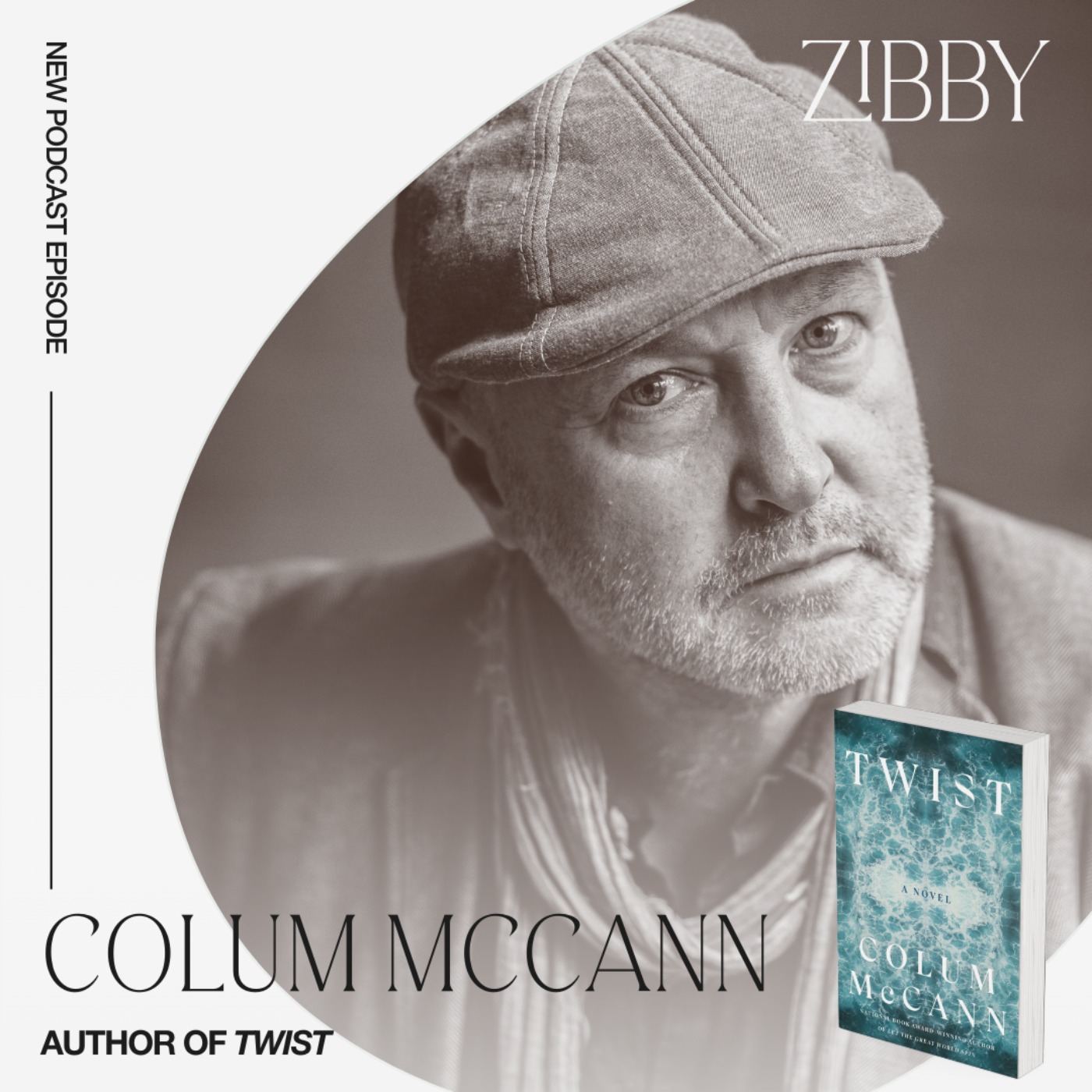
Hi, this is Zibby Owens and you're listening to Totally Booked with Zibby, formerly Moms don't have Time to Read Books. In my daily show, I interview today's latest bestselling, buzziest or underrated authors and story creators whose work I think is worth your time. As a bookstore owner, publisher, author and obviously podcaster, I get a comprehensive look at everything that's coming out and spend my time curating the best books so you don't have to stay in the know. Get insider insights and connect with guests like I do every single day. For more information, go to zibbymedia.com and follow me on Instagram. Ibbeowensk Colm McCann is the author of a novel. Colm is the internationally best selling author of the novels A Paragon, Transatlantic Let the Great World Spin, Zoli Dancer, the side of Brightness and Song Dogs, as well as three critically acclaimed story collections and two non fiction books, Letters to a Young Writer and American Mother. His fiction has been published in more than 40 languages. He has received many honors including the National Book Award, the International Dublin Literary Award, a Guggenheim Fellowship and an Oscar nomination for his short film Everything in this Country Must. He is a member of the American Academy of Arts and Letters as well as the Irish association of Artists Eostana, and he has received a Chevalier des Arts et des Lettres award from the French government. In addition, he has won awards in Italy, Germany and China. A contributor to the New Yorker, the New York Times, the Atlantic, and the Paris Review. He is the co founder of the global nonprofit story exchange organization narrative 4. He lives with his family in New York.
- [03:26]
Colm McCann
Welcome Colm. Thank you so much for coming on Totally Booked to talk about your latest novel Twist.
- [03:31]
Zibby Owens
Congratulations.
- [03:33]
Colm McCann
Thank you. It's nice to be totally booked.
- [03:36]
Aren't we all just totally booked all the time?
- [03:38]
Zibby Owens
Like everybody crazy busy.
- [03:40]
Colm McCann
I do feel that increasingly in life we're all totally booked and every minute and if it isn't taken up, then your Gmail is going to take it up or your TikTok or whatever else happens to be that every minute is booked until you hit the hay.
- [03:56]
It's true. What do we do with all of that? I don't know.
- [03:59]
I don't know. I think we get less done and just a lot of fluff in and around it. It's the disease of our times.
- [04:07]
It's true. I feel like I read to get out of the totally booked mindset. Like reading for me is the only time I'm not looking at my phone to see what time it is and all of that. That is my only sacred space.
- [04:21]
Me too. And I love the physical book. Increasingly I love just having the phys, not, you know, not on the. On the computer or any other device just to take it away. It feels like a. Feels like a bit of a friend, doesn't it?
- [04:37]
Totally. Yes. I know. I'm always like dog earing and I don't know, I haven't learned how to do that well enough online I guess. So it doesn't have the same satisfaction. Anyway, to your story, which aside from the bout of complete seasickness on the boat where I felt like I was getting sick myself, just like imagining the four days of like vomiting and whatever, I found this to be just like so utterly immersive and immersive water. Anyway. Didn't mean to anyway. But what a story and what a unique perspective on life when we go through life on land and don't spend that much time thinking about everything else below the surface, which is just mind boggling when you think about it a lot, which is of course like some of the things. So anyway, why don't you tell listeners what twist is really about now that I've sort of mangled it.
- [05:24]
It is sort of mind boggling because 95% of our world's intercontinen goes under the sea. Now I used to think before I started embarking on this book that everything bounced up into some sort of benevolent heavenly cloud and then got bounced back down. And we're all working on radio waves and there was something comforting actually about that. It was going out of the atmosphere. No, actually, all of our information, virtually all of our information travels in the cold, wet, dark bottom of the sea in these very small tubes that are no bigger than the plumbing pipes at the back of your toilet, in wires, inside those tubes that are no bigger than your eyelash. And so everything, even our conversation right now is bouncing down through fiber optic wires with billions of pulses of light per second, translated then into ones and zeros and then translated back into a machine and then translated into our voices and our images and Sudd. It's there in.006 of a second. If this is not a miracle, then I don't know what is. But these wires break. And that's what the book is about. The book is about the repair of the repair and sabotage of underwater cables and how we rely on communication and what happens when that communication breaks down. And it's kind of also a retelling of the heart of darkness in certain ways, Joseph Conrad's Heart of Darkness. Because information is power. Information is what is owned. Now the way we are owned is through the ownership of our information. And all of that information, amazingly, is bouncing around on the sea floor.
- [07:12]
I actually couldn't believe that that is how the wires get fixed. Is that all true? There are these boats and they just like put things into the water and hope to find them.
- [07:22]
I mean, isn't it crazy? So, so it's a novel and there's a crew go out on a boat and the boat in the novel is called the Georges le Contre, which is a Belgian ship. But I went out on a French ship called the Leon Thevenin and I was amazed. Yes, we can repair wires close to the shore with divers and even closer, close further out from shore with what they call ROVs, which are remotely controlled vehicles. But after 2km, you cannot sen a remote controlled vehicle that will fix These cables down. So these men and women who are out at sea, there's only 50 repair boats in the world. They have to trawl the bottom of the ocean with a basically what amounts to a grappling hook. And this. This cable may be lost, it may be buried. It could be a landslide. It could be an earthquake. It could have been a fishing trawler that snapped it. And sometimes, if a cable gets snapped, it can take up to two months to fix it, which is an extraordinary length of time, particularly if that cable is important. And guess what? There are only about 400 working cables in the world. So if a few of them get disrupted at once, it can cause chaos. And in fact, there are ways, and there are people who say that it is possible that the next 911 will happen underwater because our cables and our landing stations where the cables come in are so vulnerable to potential sabotage.
- [08:59]
I feel like maybe we need to keep this quiet. Don't give anybody ideas, Colm.
- [09:07]
It's all there on the Internet. Anybody who wanted to could easily do it. Okay, so I live in New York, and I went out to a landing station during the pandemic, granted, but I went to a landing station in Long island where I was able to access the back of the landing station no problem, Just walk the beach, walk up to the landing station where the cables come in, and they get translated and put in underground. And I stood over the manhole cover, which I could have lifted up with a crowbar and touched the cables as they bring in the pulse of the world's information. It's amazing how little security there is. And look, anybody who wants to know about this can find it. You can find the coordinates of the. Of the stations online. And it, you know, there might be a chain link fence around the landing station or there might be a camera, but there is no manned security. And really, it's quite easy to get. Startlingly easy to get at those cables. And so, yeah, part of me was like, oh, am I opening a secret? But, no, it's been there for a long, long time. And some people, the Nostradamuses, have been warning us about this for a little while now, but, you know, hopefully nothing will come. But all you have to do is look at the news. And in the past three months, several cables in the Baltic Sea have been chopped by Chinese and Russian fishing vessels dragging their anchors as part of a proxy war that, you know, builds into what's happening with NATO and information gathering and all these also to scare people, because guess what? Look, I'm not a thriller writer, but this turned in, turned into a thriller for me. I began to realize that there are submarines, there are all sorts of activities going on under the water, listening devices and people, you know, who can drop certain devices on top of the cables down in the water and listen to what's going on. Now most of that, as you and I know, is flotsam and jetsam, whether it be, you know, your local soccer match or your TikTok or the reams and terrible reams of pornography that go online. And all of that is flowing in underwater. But there's also very sensitive military and financial data. And there is $10 trillion worth of transactions go on every single day. And if somebody wanted to play a little with our heads, they would cut, strategically cut the cables because you don't want to cut your own. The United States is okay because we have so many cables. And there is a thing called, you know, there's a big built in recovery system and if one cable gets cut, the other cables take up the slack. It might slow down a tiny bit, but in general it's okay. But a continent like Africa, with so many countries within Africa, is very vulnerable to an attack because there are actually only two main cables. There are lots of other little cables funneling off the two main cables. But if they were cut, Africa, and therefore really the rest of the world would be in serious, serious trouble. And so there are men and women who go out on these boats. They spend weeks and weeks at sea and they fix our cables for us using, guess what? Nuclear fusion. It's crazy. It's crazy.
- [12:45]
Oh my gosh. It's like I didn't think I had enough to worry about until I read your book. And now my worries have expanded exponentially.
- [12:54]
I know, isn't it? I mean, I feel bad. I kind of want to write something that. Here's the deal. I honestly set out to write about repair because I do think we live in broken times. I think you're correct. I think that the times we live in are, you know, they're anxiety inducing and there is a brokenness and a shattering that's going on. And one of the things that I would like to be able to do as a novelist is to gather up all those little shattered pieces and make some sort of mosaic out of them. And in certain ways that's what I do try to do. But in other ways, by highlighting this particular problem, I understand that it's an extra little corner of the mind that's going to be taken over. Wondering is my Internet going to go out tonight. It's not just Internet because we're really, what we're talking about is hospitals and you know, all sorts of like intimate health communications and all sorts of things that, that, that could be at risk. But the other thing is let's praise the people who go out to sea and, and let's remember that behind the Internet there actually is a hardware, there are cables and there are, there are buildings and there are pipes and there are switches and a whole ream of things that we tend not to think about when it comes to our daily set of communication. So there are a lot of heroes out there who are doing the work.
- [14:19]
Zibby Owens
Today's episode has been sponsored by Wayfair. I don't know about you, but I love taking on a home design project. I love improving the house and making houses feel like homes. So it reflects who we are as a family and makes it work better for us. Right now it's home project season and if you have not used Wayfair, and I'm saying this from the bottom of my heart, I love Wayfair. This is like my go to spot for absolutely everything. Why the price is great, it is so fast. The delivery is so fast and so reliable and the quality is really great and it holds up. What else could you possibly want in home design? Recently we've gotten a bunch of new runners for this house that we're in now in Santa Monica and it changed the a hallway from something impersonal to something full of color and full of us. And it's just great. So if you have any sort of spring home goal or you're trying to make someplace new feel like you, this is the place to go shop the best selection of home improvement online. Get renovating with wayfair. Head to wayfair.com right now. That's W a Y F A I r Wayfair. Every style, every home. Today's episode has been sponsored by Quince. It is spring and I have so many travel plans, from book touring to travel with my kids to everything else. So this year I am treating myself to the luxe upgrades I deserve with Quince's high quality travel essentials at fair prices. And seriously, these prices are amazing. Whether you get this beautiful cashmere blue throw, which I got because you know, how nice is it to wrap yourself in a cozy blanket because airplanes don't give you blankets anymore and a navy blue suitcase, they have this fabulous hard shell carry on suitcase that I am just so excited to use. The best part about Quint's all items are 50 to 80% less than similar brands. By partnering with top factories, Quince cuts out the cost of the middleman and passes the savings on to us. And Quince only works with factories that use safe, ethical and responsible manufacturing practices and premium fabrics and finishes, which I just love. So for your next trip, treat yourself to the luxe upgrades you deserve from Quint. Go to quintessential quiz.com Zibby for 365 day returns plus free shipping on your order. That's quincy.com Zivi to get free shipping and 365 day returns. Quinns.com Zivi.
- [17:13]
LinkedIn Representative
Does it ever feel like you're a marketing professional just speaking into the void? Well, with LinkedIn ads you can know you're reaching the right decision makers. You can even target buyers by job title, industry, company seniority, skills. Wait, did I say job title yet? Get started today and see how you can avoid the void and reach the right buyers with LinkedIn ads. We'll even give you a $100 credit on your next campaign. Get started at LinkedIn.com results terms and conditions apply.
- [17:46]
Colm McCann
Have you seen the documentary about looking for Ernest Shackleton's boat, the Endurance?
- [17:52]
I've heard about it.
- [17:53]
You should watch it because it's about it has some similar visuals, if you will, of boats and crews and waiting. And if you don't go right to the exact spot you have to start again. The hours and hours of hoping and waiting and wondering if everybody's sleeping and the tides and all of that. So I feel like I had that visual in my head right. Thanks to this.
- [18:16]
But, but if did you ever drop a, drop anything into the ocean, like a, a coin or a ring or anything like that? You know how hard it is to find even in shallow water?
- [18:28]
Yes.
- [18:29]
Now imagine if you're searching for a wire which is one and a half inches thick that has been snapped and then by a landslide, and then that landslide has covered it for sometimes for 4km and buried it down deep in the ground so that you can't actually find it. Now you can ping electronically to find the general location, but not the specific location. And so what they do is lower a wire with a hook upon that wire and trawl the ocean floor. It's called a cutting grapnel. When they find the wire, then they got to cut it, they got to bring it up and then they got to bring the other end up and then they got to fuse them together with new wire and it's actually the Same process that they were using, believe it or not, in the 1850s and 1860s when the very first cables were set down. And in many ways the principles are the same because the people who are behind that, businessmen, guess what their, their, their, their logo, their tag word was for themselves in the 1850s and 1860s. What it was faster, faster, faster. Now you can just hear the bezos and the musks and the other people of the world and the business people saying, faster, faster, faster. If I can shave off a pico second or a milli milli millisecond, I will make tens of millions of dollars. So it is very much about speed. If that connection between Hong Kong and London is slow or it gets interrupted, it can cause panic in all sorts of ways. And then the ultimate question is philosophically is why do we rely on this? Is it the machines that are the problem or is it our relationship to the machines? And what you said earlier was really nice. Yeah. But to go away and to take a book and to not be beholden to, you know, the chips, the silicon chips that are, you know, beaming into my head is quite a, quite a lovely moment. I think we have to rediscover some of that or else we're going to be in trouble.
- [20:43]
Yes, thank you. I agree. You know, you mentioned earlier that this is in part about repair. And it is also about the repair of one man. And you see that as he goes through recovering alcoholism. You see all of his past traumas, the loss of his mom, the sad image of her at the top of the stairs, which, like, has been now emblazoned in my brain, and his son being far away, I mean, there are lots of things that he is holding onto. And even when you show his progression of how it's getting easier for him to climb up the stairs and he's not as winded, and you see the like lifting of the heaviness of him as he goes on this mission. Tell me a little bit about that character and his development.
- [21:26]
The character is interesting because, I mean, you know, often I write about other things in other places. My last book was a paragon. It was about an Israeli man, a Palestinian man, who become friends. I've written about all sorts of different situations. The Romani people living in Europe. And often I've gone sort of elsewhere. I do go elsewhere with this book, but my main character is a sort of white middle aged Irishman, so supposedly not too far from me. But he's actually. He was a difficult character to write, to be honest with you, because I was aware that I didn't want him to be like me. He's a little, little darker and, and, and, and, and, and he has, you know, a number of difficulties. But it was interesting because he spoke to me in, in, in. In. In all sorts of new ways. And I had to go chasing him at times. And his, his whole thing is that he's a bit like. Well, he's a bit like J. Alfred prufrock from the T.S. eliot poem. You know, he's one of those lonely men in shirt sleeves hanging out of windows. And the poem actually fits in beautifully with the novel. You know, do I dare to eat a peach? I've heard the mermaids singing each to each. I do not think they will sing to me. And then, of course, the last line of that poem is, until human voices wake us and we drown, referring to the bottom of the sea. So in many ways, I do use the Elliot. There's undertones of Eliot, there's undertones of Conrad. There's some vague undertones of Great Gatsby that are going on. But ultimately this is a very modern tale that takes place right now, you know, and it's what's happening in the bottom of our. The bottom of our seas.
- [23:09]
Oh, my gosh. There's also some humor when he meets Conway or somebody calls him and says, like, you know, hey, hey, big guy, or something. And you're like, okay, maybe I've won a few, but I don't really like being referred to that way.
- [23:24]
Right, that's right. That's right. Yeah. You always gotta have at least. At least a touch of humor there. I mean, he is Irish, after all. And you know, he has to. Even though he's heavy on the beer and all these things, there are moments of recovery. And I don't want to give the game away, of course, but, but, but at the end of the book, I think he escapes with a sort of realization. It's not all, you know, with the I's dotted and the T's crossed, but he does emerge from this situation with a sort of new knowledge about. Because that's what books are about. Books are about the human heart. And you know, what Faulkner talked about when he talked about love and pride and sacrifice and compassion. But as you say, also, I mean, you're going to live this life. You have to have a bit. You have to have a sense of humor. You have to look at the world and even in all its darkness and find some little thread of light. So that's what I did with this character Anthony Fennell. But then there's another Irish character who is the captain, or not the captain. He's the chief of mission, actually on the ship, which is close to the captain. There's a captain and there's a chief of mission, and the chief of mission looks after the technical aspects of the wires. And. And he's a very mysterious character, and he sort of remains mysterious for a lot of the book. And that's sort of intentional because, you know, in many ways what this book also talks about is what we don't know and what we can know. And despite all the ways that we look at each other and we communicate with each other, do we really know each other in the end? And how is it that we can get to know each other? Do we have to go back to our sort of original selves in order to get. So even these two Irish guys who are out on a boat in the middle of nowhere together, they can't communicate in the ways that they really want to communicate.
- [25:22]
Can you do a quick background update? Like, how did you become. And I've obviously read your backstory and everything, but can you just share how you became this type of writer, authority, novelist, nonprofit founder? Like, where did that come from?
- [25:37]
My favorite answer to any question nowadays is, I don't know, because I actually think it's really honest. Because a lot of time we just don't know where this stuff came from. It sort of built up. And I started out as a journalist, and in my early 20s, I started publishing books then in my late 20s. This is book number 13 or 14 for me. I think it's 14. And. And I keep going on, and I love exploring new territory. I love knocking myself off balance and even knocking my reader off balance with a different sort of story every time, and even a different form. This is simpler, more straightforward, more chronological book than what I normally would write. But it's also apparently simple because at the end, it's a bit of a head scratcher, sort of intentionally. But I also am involved with this incredible foundation, as you say, and it's called Narrative 4, where we bring young people together from around the world to step into one another's shoes and to tell one another's stories. And that is in this epidemic of loneliness and isolation which we're suffering. One of the most important things that I am involved in at any point, I mean, it's really quite wonderful. So we're in 42 countries, but we're all over the United States, and then we're in Ireland and Mexico. 12 Countries in Africa and various other places. And it's spectacularly successful because in a good way, because it just works. And we love stories, and stories can be fun and powerful, but also because it does break through those issues of stereotypes and borders and boundaries. And young people are really searching for something that exists outside that small machine that we hold in our hands. And often when we find them, it's the first time they've had a real chance to tell a story to somebody that they. They don't know. This is really powerful. It becomes an act of empathy. And not only do they tell their story, but they hear their own story told back to them by the other person. So guess what? Like, we'll bring kids together from places like, say, and this is a real example, the South Bronx and eastern Kentucky. Now, these kids are terrified of one another, completely terrified, because these kids are black and. Or immigrant. These kids are white and. Or Cherokee. These kids are urban. These kids are rural. These kids are blue. Politically, these kids are red. Go on and on and on and on and on. But guess what? When you get them in a room and they exchange not an idea, because ideas are polemical, but a personal story, that's when they begin to melt and to begin. And begin to understand in a curious way, actually, that the world is messy, that the messiness is a good thing. Because that young girl in the South Bronx who's wearing a hijab that you just thought, has only one train of thought and is suddenly revealed as somebody who has beneath her hijab, a pair of ipods, and she's listening to Beyonce. And guess what? The young boy who's driving the pickup truck with the rifle in the back rack down the Kentucky roads, he's also listened to Beyonce. And then there's this point of weird comment commonality where they come together and say, oh, maybe you're not as different to me as I thought we were. And this is the crux of where our actual repair will come in, because I do believe that, like the cables, we have been sabotaged in a way. Yes, we've had the sabotage of an alien thing almost in the pandemic, but we've also been isolated by corporations and by people who own the information and by people who make a lot of money by keeping us fearful and fearful of one another. And when that fear breaks down, and it can do so through stories and through literature, that's when something really magical can happen. So, you know, and stories can be dangerous, too. You and I know that stories can take away your house or your country or your mortgage or your identity. But stories can also be super powerful and healing and miraculous when they are, you know, properly asserted and shared with one another. That's my. My hope. I'm an optimist in the face of all the evidence, only because I'm actually a pessimist.
- [30:04]
First, I feel like you need to go into government or something. I feel like you have to, like, get in there and start making, like, big changes and spreading this everywhere and, like, scaling this in as big a way as humanly possible.
- [30:20]
I would love to do that. I mean, but can you imagine, you know, trying to get, like, members of Congress to sit down? It would only take an hour. It would only take an hour because really, they are polemical. But if they knew just a tiny bit about one another, whether they're red nor blue or green or purple or whatever else it happens to be. For example, it becomes very difficult to slam a missile into a marketplace when you know the name and the story of the woman who was, you know, managing the marketplace and. Or if you know even just a tiny bit about her or even her culture. But, you know, we're invested in, you know, our governments are invested in, you know, extending our ignorance. And this sounds, you know, almost like, you know, conspiracy theory. It's not. It's not. I mean, people are making money off of keeping us apart from one another. And, you know, one of the things that we can do is, well, you know, what all the. All the great philosophers say it at the end of their lives, you know, all the great thinkers. To be kind, to be kind, to be kind. And that's kind of the philosophy that I think that we could practice so much more.
- [31:38]
I love that. Oh, my gosh. Thank you. Thank you for leaving this on. A hopeful, inspiring note to counteract the fear and the worry. Thank you so much. And I am just ridiculously impressed by you and your intellect and the kindness and, you know, we just. We need a lot more of that. So thank you.
- [31:57]
Well, thank you. Thank you, and thank you for the chance to talk and good luck, and I hope we talk again soon.
- [32:03]
Me too.
- [32:03]
Zibby Owens
That would be great.
- [32:04]
Colm McCann
All right, cheers.
- [32:05]
Best of luck.
- [32:05]
Take care.
- [32:06]
Zibby Owens
Okay, bye.
- [32:06]
Colm McCann
Bye.
- [32:07]
Bye. Bye.
- [32:07]
Zibby Owens
Thank you for listening to Totally Booked with Zibby, formerly Moms don't have Time to Read Books. If you loved the show, tell a friend, leave a review, follow me on Instagram ibeowens and spread the word. Thanks so much. Oh, and buy the books.
- [32:29]
Paige Desorbo
If you wear glasses, you know how hard it is to find the perfect pair. But step into a Warby Parker store and you'll see it doesn't have to be. Not only will you find a great selection of frames, you'll also meet helpful advisors and friendly optometrists. Yep, many Warby Parker locations also offer eye exams, so the next time you need glasses, sunglasses, contact lenses, or a new prescription, you know where to look. To find a Warby Parker store near you or to book an eye exam, head over to warbyparker.com retail. Everyone has a reason to change. Growing old, heartbreak, a fresh start. Whatever it may be, Peloton is here to get you through life's biggest moments with workouts you can do on your time and motivation that keeps you coming back. Peloton's tread and All Access membership help you track progress in classes from runs to Pilates, making you stronger and your fitness goals a reality. Find your push. Find your power. Peloton visit 1peloton.com 1-800-Flowers.com knows that a gift is never just a gift. A gift is an expression of everything you feel and helps build more meaningful relationships. 1-800-FLowers takes the pressure off by helping you navigate life's important moments by making it simple to find the perfect gift. From flowers and cookies to cake and chocolate, 1-800-flowers helps guide you in finding the right gift to say how you feel. To learn more, visit 1-800-flowers.com acast that's 1-800-flowers.Com acast.