← Totally Booked with Zibby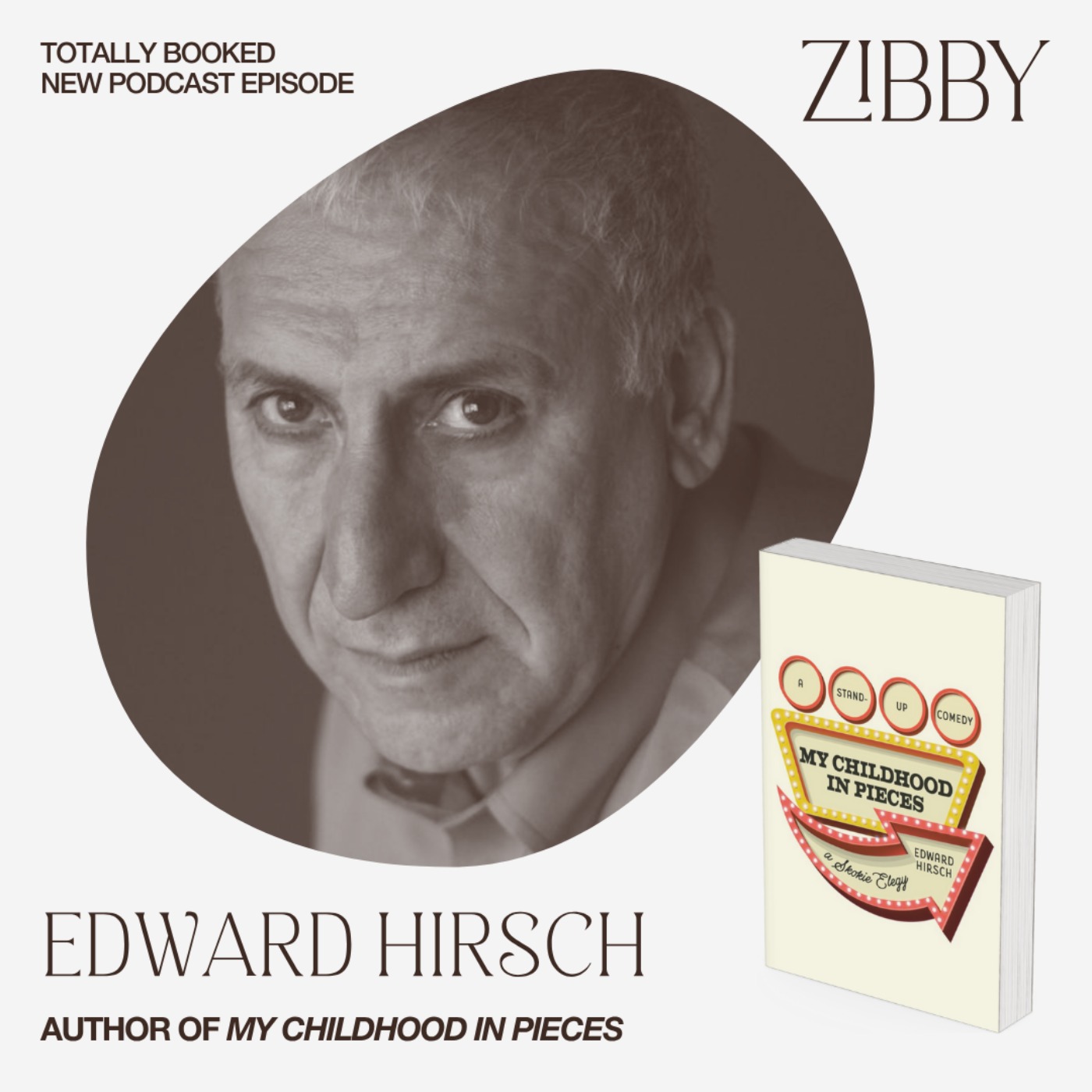
Totally Booked with Zibby
Edward Hirsch, MY CHILDHOOD IN PIECES: A Stand-Up Comedy, a Skokie Elegy
00:14:44
Loading summary
Transcript74 lines
- [00:01]
Zibby Owens
Hi, listeners of Totally Booked with Zibby. This June, we have one episode coming out every single day. And to celebrate that, I've started the June Listening Club. You can sign up on zibbedia.com or you can just keep listening and every day there'll be a little quiz on Instagram. We're giving prizes away every single day this month. You're gonna get amazing stuff. You would all be invited to a party and a zoom at the end of the month to celebrate with a special certificate. So sign up on Zibbe Media today. Make sure following Totally Booked with Zy on Instagram and get ready to listen. Make it a challenge. June is crazy. Find some airtime for yourself. Put it on in the background. Get ready to listen, learn, laugh, and enjoy life.
- [00:50]
Edward Hirsch
Ready to order?
- [00:51]
Zibby Owens
Yes. We're earning unlimited 3% cash back on dining and entertainment with a Capital One Saver Card. So let's just get one of everything.
- [00:58]
Edward Hirsch
Everything.
- [00:59]
Zibby Owens
Fire everything.
- [01:00]
Edward Hirsch
The Capital One Saver card is at Table 27, and they're earning unlim 3% cash back.
- [01:05]
Zibby Owens
Yes, Chef. This is so nice.
- [01:08]
Edward Hirsch
Had a feeling you'd want 3% cash back on dessert. Ooh, tiramisu. Earn unlimited 3% cash back on dining and entertainment with the Capital One Saver Card. Capital One what's in your wallet?
- [01:18]
Zibby Owens
Terms apply. See capital1.com for details.
- [01:20]
Edward Hirsch
Does it ever feel like you're a marketing professional just speaking into the void? Well, with LinkedIn ads, you can know you're reaching the right decision makers. You can even target buyers by job title, industry, company seniority, skills. Wait, did I say job title yet? Get started today and see how you can avoid the void and reach the right buyers with LinkedIn ads. We'll even give you a $100 credit on your next campaign. Get started at LinkedIn.com results. Terms and conditions apply. Vulnerability doesn't mean you have to be crying in front of people. Vulnerability can be just recognizing how you feel. For so many men, vulnerability gets mistaken for weakness. But why? And what's that misunderstanding costing us? On the latest episode of Mind if We Talk, a podcast from BetterHelp Host and licensed therapist, he Su Jo unpacks the pressures around masculinity and how those expectations can leave men feeling isolated, disconnected, and stuck. Whether you're working on redefining your relationship with masculinity, trying to make a change, or just want to better understand the men in your life, this episode is a must. Listen, Mind if We Talk is available now wherever you get your podcasts.
- [02:36]
Zibby Owens
Hi, this is Zibby Owens and you're listening to Totally Booked with Zibby, formerly Moms don't have Time to Read Books. In my daily show, I interview today's latest best selling, buzziest or underrated authors and story creators whose work I think is worth your time. As a bookstore owner, publisher, author, and obviously podcaster, I get a comprehensive look at everything that's coming out and spend my time curating the best books so you don't have to stay in the know. Get insider insights and connect with guests like I do every single day. For more information, go to zibbemedia.com and follow me on Instagram ibeowens Edward Hirsch is the author of My Childhood in A Stand Up Comedy A Skokie Elegy. Edward Hirsch is a MacArthur Fellow and has published nine previous books of poetry, including the Living Fire, New and Selected Poems, and Gabriel A Poem, a book length elegy for his son. He has also published seven books of prose, among them how to Read a Poem and Fall in Love with Poetry, a national bestseller, and 100 poems to break youk Heart. He has received numerous prizes including the National Book Critics Circle Award. A longtime teacher at Wayne State University and in the Creative Writing Program at the University of Houston, Hirsch is now president of the John Simon Guggenheim Memorial Foundation. He lives in Brooklyn. Welcome Edward. Congratulations on My Childhood in Pieces, a Standup comedy. Congrats.
- [04:07]
Edward Hirsch
Thank you. Thrilled to be with you.
- [04:10]
Zibby Owens
Okay, talk to me first about the unique way that you told this story in little bits and how what the whole story ended up being about.
- [04:18]
Edward Hirsch
I started out just by writing down things that my parents said to me, sort of as they were just things they said zingers really, that they gave me. But I realized that they were structured like jokes. And the very first one that I wrote was I called a conversation with my Mother. My mother was stirring soup at the stove and I said, you know, you really shouldn't make fun of me. You're my mother. And she said, don't be so sure, kid. And they're so harsh and funny. And I started just writing them down because it's all I'm not sure why, but they're, I guess maybe because they're gone now and this kind of style is gone. And I discovered that I could structure my own statements and stories and anecdotes in the same way, but not just quoting them. And this enabled me to start opening up parts of my childhood that I had never written about. And I discovered that these micro bursts with a title, these mini Prose pieces had a lot of punch, and they also gave me a lot of flexibility in telling a story. And over time, I realized that not all of them needed to be funny. They all needed to have a punch.
- [05:34]
Zibby Owens
So through these short snippets and scenes, you end up giving us a depiction of a life that, at the end, you say your sister views as traumatic. And it never occurred to you to think of it that way. Tell me more about that.
- [05:51]
Edward Hirsch
I guess this is temperamental. I mean, I have two sisters, but one of them, my sister Arlene, and I, went through everything together in our early childhood. The acknowledgement that you're talking about is that she went through psychoanalysis. So she remembers everything, but she doesn't think of it as funny. And so when I started writing this book, we were talking all the time, and she'd often say, well, this just isn't funny. And I go, well, I can make it funny. And that was sort of the joust thing that went on. But she's immensely helpful because she remembers everything. So this is a sort of. This is temperamental, but it's also a strategy of different ways of coping. I do say she thought it was funny, too. I did say that her way was more expensive, required psychoanalysis.
- [06:43]
Zibby Owens
So your book basically takes us through your parents as sort of teenagers to you when you become close to their same age as when we start the book and you're going off to college and sort of saying goodbye to the childhood era, even though we kind of know childhood extends beyond that now. But give us a quick preview. What happened after the book ended from, like, what's happened since the book ended to now in your life?
- [07:13]
Edward Hirsch
Well, the book ends. I just arbitrarily. Just ended it when I go off to college, because that seemed like one end to childhood. And the last piece is called Childhood Was Gone. And I go off to Grinnell College, and then I went to Grinnell College. And at Grinnell College, where I played football, I also became serious about writing poetry. There are sort of hints. I think of them as sort of breadcrumbs sort of leading you the way, sort of hints towards my future vocation. Because I started writing poetry in high school, but I certainly didn't think of myself as a poet. But in college, I got serious about studying poetry and becoming a poet, so I did that. And then I started winning fellowships, and I went to graduate school and got a PhD. I started teaching at Wayne State University. I published my first book, and I was kind of on my way. And I guess the only Other thing I'd add to this was at some point I also began writing about poetry and found another part of my vocation which was part of it was writing poetry, part of it was teaching poetry and then part of it was advocating for poetry.
- [08:26]
Zibby Owens
Do you view this book in a way as poetry in these short segments?
- [08:31]
Edward Hirsch
I'd like to sell some copies. So I'm going to say no. I'm going to say no. I'd say my editor said it's poetry adjacent. Okay, then I'd say it's poetry adjacent. That is, it's really not poetry, but it is. There are things that poems have in common with stand up jokes and that's that they have a turn and that that's the thing that the jokes have and that's the thing that poems often have. What an Italian poets in the Petrarchan sonnet they call the volta or turn. And so there are ways that jokes are like poems and in terms of the compression of language, this is like poetry, but it's really prose and it's more flexible than poetry. I think in sense is it gave me access to a whole kind of vernacular experience that I just hadn't been able to capture in poetry. And I think that's what was so exciting about the method for me not being poetry is it enabled me to tell things and quote people and tell stories that I just hadn't been able to tell in poetry itself.
- [09:47]
Zibby Owens
If you love to travel, Capital One has a rewards credit card that's perfect for you. With the Capital One Venture X card, you earn unlimited double miles on everything you buy. Plus you get premium benefits at a collection of luxury hotels when you book on Capital One Travel. And with Venture X you get access to over 1,000 airport lounges worldwide. Open up a world of travel possibilities with a Capital One Venture X card. What's in your wallet?
- [10:12]
Edward Hirsch
Terms apply. Lounge access is subject to change. See capital1.com for details.
- [10:16]
Zibby Owens
Ever wonder what your lashes are destined for? The cards have spoken. Maybelline New York Mascara does it all. Whether you crave fully fan lashes with lash. Sensational big bold volume from the colossal. A dramatic lift with falsies Lash lift or natural looking volume from great lash. Your perfect lash future awaits. Manifest your best mascara today. Shop Maybelline New York and discover your lash destiny. Shop now at Walmart.
- [10:42]
Edward Hirsch
Race the rudders. Race the sails. Race the sails. Captain, an unidentified ship is approaching.
- [10:49]
Zibby Owens
Over.
- [10:49]
Edward Hirsch
Roger.
- [10:50]
Zibby Owens
Wait.
- [10:51]
Edward Hirsch
Is that an enterprise sales solution? Reach sales professionals, not professional sailors. With LinkedIn ads, you can target the right People by industry, job title and more. We'll even give you a $100 credit on your next campaign. Get started today at LinkedIn.com results, terms and conditions apply.
- [11:14]
Zibby Owens
And when you thought about accessing all the memories and all the scenes and all the stanzas or whatever, what piece of it kept driving you forward and saying like, yes, I have to tell the story. Was it your relationship with your father? Was it your stepfather? Was it your blended family? Was it your siblings? Was it all of it together, like your mother? You know, what pieces of it? Were you like? Yes, yes, yes. This has to be down on paper.
- [11:45]
Edward Hirsch
You're doing really well right there.
- [11:47]
Zibby Owens
Okay, great, great.
- [11:48]
Edward Hirsch
You're doing really well. I'd say part of it was capturing my mother and her quirks. Part of it was capturing my father, my biological father, and his love for Jewish gangsters and his wild sayings. I especially like the one what's a co signer?
- [12:08]
Zibby Owens
Yes.
- [12:08]
Edward Hirsch
Schmuck with a pen.
- [12:10]
Zibby Owens
Yes, a schmuck with a pen.
- [12:12]
Edward Hirsch
Yes, I do a lot of his harsh sayings. Also my grandparents and capturing the world that they came from. And I sort of. That was where I started. And then my stepfather who adopted me, and then I was worried that it would sort of fall off after that. But I found that this also became a way as they became a little less important, I'd say, as I became more of a person myself. This method also helped me to tell my own story. Basically, how someone becomes a poet and how the traumas and stories of childhood wound you into poetry and how the difficult things that happen to me mixed with a sort of somewhat ordinary suburban high school experience of meeting girls and playing football and playing sports. And that mixed with this underlying, I guess, grief was the shaping of me. And so I saw it as the making of a person.
- [13:18]
Zibby Owens
I love this moment when you were playing. I thought it was baseball, but I could be wrong with Neil. And all of a sudden you call him dad, and you're like. It took both of us by surprise. And you're like, but from then on, I called him dad. Like when my mom wasn't around.
- [13:34]
Edward Hirsch
Yes. My stepfather, you know, we learned he was our father because my mother went and got married. And then when she came back, she said, you should not call him Uncle Kurt anymore. You should call him Daddy Kurt. That's how we knew.
- [13:47]
Zibby Owens
Oh, not Neil. Sorry, what did I say? Neil. And it's Kurt. I'm sorry. I always get names wrong. I'm so sorry.
- [13:51]
Edward Hirsch
That's okay. Yeah, it was Kurt.
- [13:52]
Zibby Owens
I Had four letters in my head. I got the wrong four letters. Okay, keep going.
- [13:56]
Edward Hirsch
It sticks with you. Because he said when he introduced himself, he said, my name is Kurt. That's Kurt with a K? Yes. We called him Uncle Kurt. We felt disloyal to our father. And then he decided I was too much of a mama's boy and he should get me interested in sports. And what you're talking about is how he took me to the batting cages, and it was pitching, and I slammed one. Felt really good. And he said, good hit. I turned around and said, thanks, dad. And then we both looked shocked. And then he said, I'm going to pick up the speed on the next one. And so slowly we started calling him first Daddy Kurt, and then we started just calling him dad. And at first my biological father, we called him dad. Then we called him Daddy Ruby, and then eventually we just called him Ruby. So it was kind of switch.
- [14:45]
Zibby Owens
If you were to point out the most painful and the funniest moments in the book, what would you say? Where is the moment where you felt most exposed?
- [14:56]
Edward Hirsch
I guess the rupture of our childhood was the court case where my father sued my mother over our last name. And I guess that was a fault line because of what happened. And certainly the most painful moment in our childhood was when our father lost the case, or we thought he lost the case, and he screamed at us that we had betrayed him and we weren't his children anymore. That was certainly the most haunting break in my childhood. And I'd never really been able to tell that story. And this method somehow enabled me to back into telling the story. And I think that would be the crux of what sent my sister into psychoanalysis, too, because it was just a tough moment.
- [15:47]
Zibby Owens
I'm sorry that that happened, too.
- [15:48]
Edward Hirsch
Well, it happened, and I'm glad to be able to tell this. I'm glad to be able to tell the story. It's not very funny, but the book is not meant to be entirely funny. The method became very flexible, I guess, and I felt excited, by the way, that what are sometimes jokes then become just turns, and then enabled me to tell stories that weren't funny but seemed consistent with the rest of the book.
- [16:14]
Zibby Owens
I love that. Well, I found the format highly innovative. You know, it's crazy when you read so many books and you're like, oh, well, why didn't anybody else do this? Short sections, and each one has a title, and the titles are often funny, and then, you know, a little bit of text, and occasionally you got longer There were like one or two sections. Like, why did he decide to make these so much longer? I don't know. They could have been a couple sections. What was? I don't know. So anyway, I found that quite original.
- [16:45]
Edward Hirsch
I'm glad you felt that because I was very excited by the method. First, I just started writing things down, but I found it incredibly flexible and amazed that no one had done it. It just felt like a very. To me, an original way to tell a story.
- [17:01]
Zibby Owens
Yep, me too.
- [17:02]
Edward Hirsch
And I'd always. It's sort of trying to channel how you tell an anecdote or you tell a funny story, as you know from your family. We all have a lot of funny anecdotes from our family. Family lore, I guess. And I figured out a way to channel those and tell them. And I felt very excited by the pop and the method.
- [17:23]
Zibby Owens
Me too. Very cool. And you have a fabulous cover, by the way. Were you so excited when you saw it?
- [17:28]
Edward Hirsch
Oh, my God. I think the COVID is so great. They had asked my opinion and I suggested cut up family photos. And they go, yeah, that's very cliche. All memoirs do that. And then they came up. This is just the Knopf art department. They came up with this. It looks like a movie screen from Chicago in the 1950s. Like a drive in movie. It's so witty.
- [17:49]
Zibby Owens
It's so good.
- [17:51]
Edward Hirsch
Yeah.
- [17:51]
Zibby Owens
And a Skokie Elegy. I should have read that when I was reading the.
- [17:55]
Edward Hirsch
It's a double subtitle. A stand up comedy and a Skokie Elegy. Because it really tries to be both things.
- [18:01]
Zibby Owens
Yeah.
- [18:01]
Edward Hirsch
It's both the method of stand up, but it's also a portrait of a vanished world.
- [18:07]
Zibby Owens
Yes. Wow. Well, thank you so much, Edward. This is so great to talk to you about having read it and understanding your whole family and your history and everything. So thank you for sharing it with the rest of us. I really appreciate it and I'm glad it was helpful for you.
- [18:22]
Edward Hirsch
Thrilled by your great responsiveness. So much appreciated.
- [18:26]
Zibby Owens
My pleasure. Okay, take care.
- [18:28]
Edward Hirsch
Bye.
- [18:29]
Zibby Owens
Bye. Bye. Thank you for listening to Totally Booked with Zibby, formerly Moms don't have Time to read Books. If you loved the show, tell a friend, leave a review, follow me on Instagram, ibbeowens and spread the word. Thanks so much. Oh, and buy the books.
- [18:52]
Edward Hirsch
Ready to order?
- [18:53]
Zibby Owens
Yes. We're earning unlimited 3% cash back on dining and entertainment with a Capital One Saver Card. So let's just get one of everything.
- [19:00]
Edward Hirsch
Everything.
- [19:00]
Zibby Owens
Fire everything.
- [19:01]
Edward Hirsch
The Capital One Saver card is at table 27 and they're earning unlimited 3% cash back.
- [19:07]
Zibby Owens
Yes, Chef. This is so nice.
- [19:09]
Edward Hirsch
Had a feeling you'd want 3% cash back on dessert. Ooh, tiramisu. Earn unlimited 3% cash back on dining and entertainment with the Capital One Savor Card Capital One what's in your wallet?
- [19:20]
Zibby Owens
Terms apply. See capitalone.com for details. Ever wonder what your lashes are destined for? The cards have spoken. Maybelline New York Mascara does it all. Whether you crave fully Fan Lashes Lash Sensational Big bold volume from the Colossal a dramatic lift with Falsies Lash Lift or natural looking volume from Great Lash. Your perfect lash future awaits. Manifest your best mascara today. Shop Maybelline New York and discover your lash destiny. Shop now at Walmart.
- [19:51]
Edward Hirsch
Moving money used to be slow.
- [19:55]
Zibby Owens
But now you can move money fast with Visa Direct.
- [20:00]
Edward Hirsch
Meet the need for speed even across more than 11 billion cards, accounts and wallets. Move money your way. Learn more@visa.com visaDirect.