Loading summary
Transcript70 lines
- [00:00]
Sleep Number Representative
My husband and I recently realized that neither of us were getting the sleep we deserved. So we sat down and talked about our ideal beds. For him, soft as feathers. For me, firm as a plank. This would be a huge issue if it weren't for the Sleep Number Smart Bed. Thankfully, with our new Sleep Number Smart Bed, we can each dial in our desired Sleep Number settings to our ideal comfort and finally get the sleep we deserve. Plus, the Climate Series feature makes sure our bed stays nice and cool through the warm summer months. We why choose a Sleep Number Smart Bed? So you can choose your ideal comfort on either side. And now it's the Sleep Number Everything Smart Bed Sale Every Smart Bed and base are on sale during our Memorial Day event. Up to 50% off limited time. Exclusively at a Sleep Number store near you. C store or sleepnumber.com for details.
- [00:51]
Noom Representative
Hold that serve. There's no time for pickleball because you're going to want to hear this. Noom now has GLP1s.
- [00:56]
Evan Friss
No way.
- [00:56]
Noom Representative
Oh yes. Wayfred psychology and meds. That's how NOOM helps you lose the weight and keep it off. They start at just 149 bucks and they're shipped to your door in seven days. Holy smokes, that's fast. But not as fast as my service game. Hey, who's ready to get pickled?
- [01:10]
Get started with the Noom GLP1 program today. Individual results may vary. Not all customers will medically qualify. No affiliation with Novo Nordisking Compounded medications are not reviewed by the FDA for safety, efficacy or quality. Not available in all states.
- [01:21]
Sarah Gibson Tuttle
Raise your hand if you want your nails to look perfect all the time. Me too. I'm Sarah Gibson Tuttle from Olive and June. And this is exactly why we created the MANI System. We wanted to make it possible for everyone everywhere to give themselves a beautiful manicure at home with our tools and our long lasting polish. Each manicure with our Mani system comes out to just $2. That's right, $2. No more. 30, 40$50 manis that you get at a salon and they take hours. Now you can paint your nails on your time and love them more than ever. And by the way, when people ask who did your nails? Where did you get them done? You're going to proudly say I did them myself. Get 20% off your first mani system with code perfectmanny20@oliveandjune.com perfectmanny20 that's code perfectmanny20 for 20% off at oliveandjune.com Perfectmanny20.
- [02:20]
Sleep Number Representative
Hi.
- [02:21]
Zibby Owens
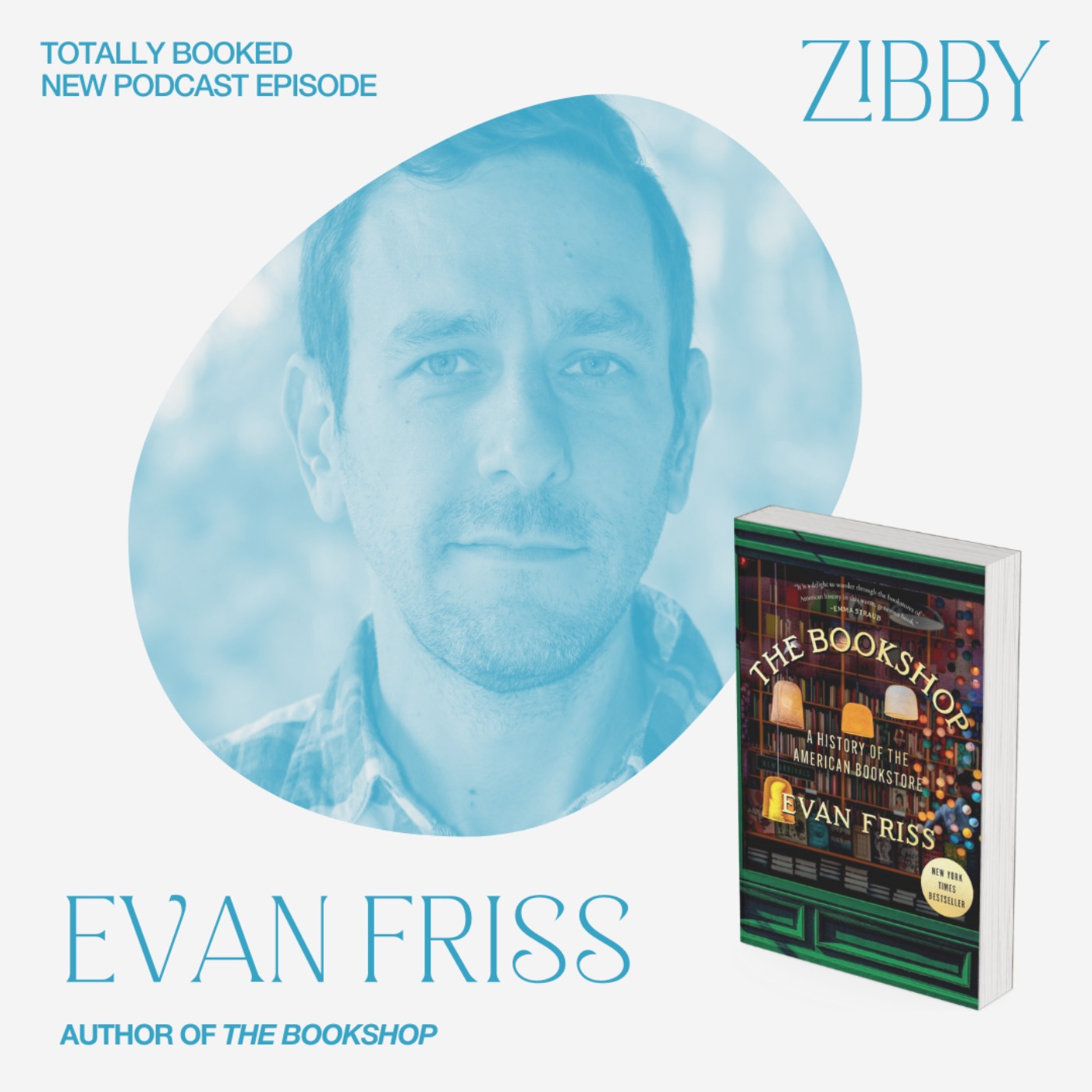
This is Zibby Owens and you're listening to Totally Booked with Zibby, formerly Moms don't have Time to Read Books. In my daily show, I interview today's latest best selling, buzziest or underrated authors and story creators whose work I think is worth your time. As a bookstore owner, publisher, author and obviously podcaster, I get a comprehensive look at everything that's coming out and spend my time curating the best books so you don't have to stay in the know, get insider insights and connect with guests like I do every single day. For more information, go to zibbymedia.com and follow me on Instagram ibeowens Evan Friss is the author of the Bookshop A History of the American Bookstore. Actually, I was on a panel with Evan at the Tucson Festival of Books. I'm sure we will talk about that. Evan is a professor of history at James Madison University. His latest book, the Bookshop, was one of Time magazine's 100 must read books of 2024, a best book of the year according to both the Christian Science Monitor and the New Yorker, and the winner the Goodreads Choice Award and fun fact. This was my Hanukkah gift from my husband Kyle. Welcome Evan. Thanks so much for coming on Totally Booked to talk about the Bookshop A History of the American Bookstore. Congrats.
- [03:40]
Evan Friss
Thanks so much for having me.
- [03:41]
Zibby Owens
As we were just quickly discussing, we met on a panel at the Tucson Festival of Books which was lovely. So thank you. That was really fun. It's pretty self explanatory from your title and subtitle. Thank you. Spot on. Good job. Talk a little bit about the book. What made you want to write this book and what can readers expect?
- [04:00]
Evan Friss
Yeah, so it's as the kind of boring type suggests, it's a history of the American bookstore. I'm a historian who always liked writing and researching, but struggled with figuring out ideas. And in graduate school everybody seemed to come in with notions, very specific ideas of what they wanted to write about. And I was always more maybe open minded as a euphemistic way of thinking about it, but I was always interested in writing things that I writing about things that I cared about. And bookshops became a passion of mine while I was in graduate school. Not just because I was a heavy reader, but because my then girlfriend, current wife got a job at Three Lives and Company, a small but mighty bookshop in the West Village of New York. And those two interests, my interest in studying history and her experience in book selling kind of created this. This marriage.
- [05:10]
Zibby Owens
I thought you meant your interest in her.
- [05:13]
Evan Friss
Yes, my interest in her. I mean, admittedly, I was always much more of a book person than I was a bookstore person. So I was a heavy reader, but never was the kind of spent hours in bookstores. I felt like a loiterer and sometimes uncomfortable, even though I liked the experience. But because I would go visit her and hear about what it was like to work in a bookshop, it opened up just a different way of thinking about these spaces and how important they are. And I began to fall in love with the spaces and thought it was ripe for a book.
- [05:53]
Zibby Owens
Amazing. And at the. At the panel, you said a lot of bookstores were upset not to have been included. Or readers who are passionate about their own bookstores could be like, why didn't you include blah, blah, blah. So how many did you include? Did you even count?
- [06:07]
Evan Friss
I don't know. I'd have to check the index. Not enough, as people have written me, lots of notes about why I included X bookstore, Y bookstore. And they don't. Those notes don't bother me. I usually read them and agree with them and say, you know, maybe I never heard of this bookstore. Sometimes I have heard of the bookshop, and it. Sometimes it was in the first draft and then got cut at some point. So there are lots of cases to be made for including lots of great bookstores that didn't make the final cut. But it's impossible to write a comprehensive history of almost anything, let alone something that has such a rich history is bookselling.
- [06:51]
Zibby Owens
Well, what you did that I loved is wrote about the bookstore owners or people really affiliated with the store and their backstory and sometimes even their ancestor story. And so you're not just talking about this bookstore was set up on this day, and these are the types of books and blah, blah, blah. But you're really, like, listen to this story about RJ Julia and how it came to be. And now I will. I, like, wanted to email Roxanne Cody after I read this. I was like, I had no idea about this backstory. Can I read that, like, little section about. About her? Do you mind, please? And you do this for so many people, including, and I'll just leave this as a teaser, Ann Patchett's virginity, which is the most sort of salacious piece of this whole book. That should be, like, leading the headlines. But that's okay. I'll just throw it out there. Okay. This is called the Grandmother. And you said you wrote just before the Second World War, a recently widowed Hungarian Jew named Julia insisted that her son finish school. The boy graduated from high school in 1942 and survived the Holocaust. Julia went to a concentration camp. She never returned. The son came to the US and started his own family. His daughter, Roxanne J. Cody, grew up in a house full of books and with a mother who read to her constantly. In 1990, Cody, leaving behind a partnership in an accounting firm, opened an enchanting bookstore in Madison, Connecticut. She named it after the grandmother she never met. R.J. julia. I did not know that. I'm so glad you included that.
- [08:17]
Evan Friss
Yeah, it's a fascinating story and one of many. You know, when I'm writing in a history, that's a kind of, in a. An institutional history, you know, what is. What have bookstores meant over time? But it's really about the people who animate those spaces first and foremost, the people who start these bookstores, booksellers, people like yourself, and also the customers, the people who work there. As I write about the UPS drivers, they become, you know, these environments that are home to so many different kinds of people. And it's those people who make this space. And RJ Julie is a great example of a shop that is an anchor of that community. If you walk up and down, you know, the streets of Madison, Connecticut, if that bookstore wasn't there, there would be something missing. I think palpably a void.
- [09:12]
Zibby Owens
I was there and did walk up and down and I was like, oh, my gosh, this is where RJ Julia is. I was so excited. It was like finding, like a miracle. I was looking at a school with my daughter or something. Anyway, you also write so beautifully about books and bookstores from a sort of sensory experience. Can I read a little bit more? Is that okay? See, I'm making this so easy on you. Aren't you glad you did this podcast? You're like, I'm just going to kick it. I'm going to check my email. You know, I'm not even going to pay attention. You wrote, bookstores also stimulate our senses. Being surrounded by books matters. Sociologists have found that just growing up in a home full of books, mere proximity confers a lifetime of intellectual benefits. Books offer warmth, comfort, and refuge. It's no wonder then that so many social media accounts deal in what might be called book porn. Glimpses of book, stuffed bookstores, libraries and wood paneled dens. At the same time, books are imbued with a near holy spirit. Many of us wince at the idea of throwing one in the trash. That's part of the reason why entering a bookstore can feel like walking into an old church. And then you also said, more so than bars or coffee shops, they are also places in which to get lost and by way of the books, to escape reality. For every chatty customer, there's another who prefers to be left alone, to be by oneself among others, to feel a book's heft, to smell a paperback's perfume, to savor slowed time. I love that.
- [10:32]
Evan Friss
Thanks. And speaking of which, you have a pretty glam background there. I thought I had an impressive display of books behind me in my office, but you have the full rainbow effect and lots of books. And that confers, as I write in the book, I mean, there's a sense of wonder, all those stories and kind of portals that are opened, but it's also just warm as a kind of design feature. And one of the things that I sort of rue about our modern world is, you know, people ask me, is anybody reading anymore? And that's a whole another discussion. But I just like the prominence of books and worry about books disappearing from the landscape as physical objects. And libraries have had to reinvent themselves and often do a lot of great community kind of events and help people write resumes and have after school kind of activities and rent drills and chainsaws and stuff. But sometimes the books are too hidden. And I think there's a real power of the kind of visibility, the smell, the touch of books that I hope we can sort of appreciate and conserve in some way.
- [11:53]
Zibby Owens
I did not know I could learn how to use a chainsaw at my local library, but now I will look up those hours. Yeah. Didn't you call it like bibliosima? What's it called? The smell of books or something?
- [12:04]
Evan Friss
Yeah, there's, there's a debate whether that word exists or not. But my, my proofreader was cool with it, so we went with it. It was borderline. But yeah, there's a whole, you know, arresting power of the scent of a book, which was fun to think about and of course is part of the allure of a library or a bookshop.
- [12:26]
Zibby Owens
I mean, it is crazy that there's an industry where a bookstore can be just a few doors down from a library, where the thing that the store is selling is completely free. I mean, it doesn't make any sense. It would be like a high end designer clothing store and then all the exact same clothes are free two doors down. Like, why would anyone go to the first store next to like rent the Runway? Would you still buy, would you still buy the dress if you could rent it, I don't know.
- [12:56]
Evan Friss
Yeah, well, booksellers assume the same. And when libraries became popular in the late 19th century, the various trade groups of booksellers assumed that this was the demise of their industry. Why would anyone pay for a book that was freely accessible? And it turned out not to be the case for a variety of reasons. But even nowadays, lots of people who come in the bookstores, and maybe you experience this at yours, too. A lot of times people will come in and get books that are on hold at the library. You know, new books that they're sort of desperate to read or that they just want to populate their shelves with because they feel like it will give them something even after they read it, just having it there, looking at the title, you know, these books behind me, most of which I've read, I guess at some point when I was in graduate school, but I occasionally will just kind of look up and down, and it's like a historical timeline. I remember the classes that I was taking or something about the book. And not to mention that I wrote in the margins and underlined stuff, which is not okay with library books.
- [14:12]
Zibby Owens
True. Very true. Yeah. I wrote a whole memoir about my history with books and how each one is. I remembered where I was, and it's so linked to a time in my life. This was linked to this loss, and this was linked to this happy time. And I remember this trip that, you know, because books. When I look around my room and I. My eye catches on a book, it's not necessarily the book. It's the part of me and my history that gets activated and the people I was with, and there's signals of. It's like photo albums. I, like, also love having photo albums around which, you know.
- [14:45]
Evan Friss
And I think the fact that libraries and booksellers are no longer enemies and in fact, often collaborate, you know, speak to what is really underlying the kind of shared mission of these two different institutions, which is, you know, to evangelize the reading and the benefit of books. And I don't know, maybe some authors are just trying to be polite. But when I speak with other authors or go to these festivals, I think. I think we're all happy for readers to find our books however they do. And I know I'm grateful when people check out my book from the library and libraries have them. And booksellers, I think, appreciate the role of libraries for people who don't want to or can't afford to spend books. And I think there's an ecosystem in which they both benefit one another and we see that probably today more than ever before as the kind of threat to reading and assaults on books make them common defenders and champions of of literature.
- [15:53]
Zibby Owens
Interesting. Very true. Today's episode has been sponsored by Wayfair. Oh my gosh, it is so nice outside. Today is one of the first spring days and it makes me so excited to just get outside and soak up the sunshine as the days get longer and warmer. And it makes me want to refresh my outdoor space and make it feel more mine. I don't know if you feel the same way, but with summer on the way, I have found so many great things on the Wayfarer site to spruce up my outdoors. There are these adorable throw pillows that I love that are blue and white. Blue is my favorite color and they have these fabulous outdoor games like Connect 4 and Croquet and things from my childhood that I am so excited for my kids to play with too. Delivery is always fast free and hassle free, which makes life so easy. I can always trust Wayfair to deliver. So if you're looking for outdoor seating or outdoor structures and gazebos or something small like, I don't know, a patio cushion, Wayfair has everything. And it's everything your home needs during the warm weather season too. Wayfair makes it easy to tackle all your home summer goals. So shop a huge, huge selection of outdoor furniture online this summer. Get outside with Wayfair. Head to Wayfair.com right now. That's W-A-Y-F-A-I-R.com Wayfair Every style, every home.
- [17:29]
Noom Representative
Hold that serve. There's no time for pickleball because you're going to want to hear this. NOOM now has GLP1s.
- [17:34]
Evan Friss
No way.
- [17:34]
Noom Representative
Oh yes way. Fred Psychology and Meds. That's how NOOM helps you lose the weight and keep it off. And they start at just 149 bucks and they're shipped to your door in seven days. Holy smokes, that's fast. But not as fast as my service game. Hey, who's ready to get pickled?
- [17:48]
Get started with the Noom GLP1 program today. Individual results may vary. Not all customers will medically qualify. No affiliation with Novo Nordisk, Inc. Compounded medications are not reviewed by the FDA for safety, efficacy or quality. Not available in all states.
- [17:59]
Zibby Owens
Worried about what ingredients are hiding in your groceries? Let us take the guesswork out. We're thrive market the online grocery store.
- [18:06]
Noom Representative
With the highest quality standards in the industry.
- [18:08]
Zibby Owens
We restrict 1,000 plus ingredients. So you can trust that you'll only.
- [18:12]
Noom Representative
Find the best high quality, organic and.
- [18:14]
Zibby Owens
Sustainable brands, all free of the junk. With savings up to 30% off and.
- [18:18]
Noom Representative
Fast carbon neutral shipping. You get top trusted groceries at your.
- [18:21]
Zibby Owens
Door and you can stop worrying about what your kids get their hands on. Start shopping@thrivemarket.com podcast for 30% off your first order and a free gift. Wow. So everybody always asks me, and by the way, as a publisher, a big percent, not a majority percent, but a percent of all our sales of every book we publish comes from libraries in aggregate, by the way. So I think authors are happy that people are reading them in the libraries because if they weren't, they would. We would lose all those library sales too. So even though it's not one on one, it makes up for the individual sales. Well, anyway, you know all this people are always asking me when I say I have a bookstore, they're like, well, why would you have a bookstore? Can you even make money? It's not profitable. It's a losing business business. Like, aren't bookstore on the decline? Why would you go there? But in reading the book, like so many people are just really doubling down or they feel like the bookstore. And the part with Ann Patchett is that she didn't even want to live in a place without a bookstore. So you had to like put a bookstore in Nashville, an indie bookstore. So what do you think about all that?
- [19:28]
Evan Friss
Yeah, it's confusing. When I first started this book, I was worried about striking the right tone and being also historically accurate about the great decimation of bookstores, which on the one hand is very true. Just the number of bookshops that we have today is a fraction of what there was a generation ago and on a per capita basis, even smaller than much of the 20th century and even 19th century. So I think that's important. But there are also much more optimistic notes that are also true in that the kind of great decline seems to have ceased, that there are many bookstores that are doing very well. But it is also true people don't get into bookselling as a way to get rich, or at least they shouldn't. And it is often a project of passion. And you know, Ann Patchett's bookstore is certainly like that, and I suspect yours is also. And not that these entities don't want to make money, but that there's a, at least a secondary, if not primary motivation which is more than the bottom line. And that's always been the case. And as I write in the book, if There is one theme of book selling. It's that it's a precarious industry on the verge of death, essentially, since the very beginning. And that's been a theme embraced by outsiders, but also to some degree by insiders. And there have been very good reasons for that. So we could look at it like there are relatively few bookstores today, which is true. But on the other hand, it's kind of a miracle that there are as many as there are when everyone walking into your bookstore knows that they can get the same product delivered to their house in a day at the same price and oftentimes cheaper than you're selling it for. So.
- [21:29]
Zibby Owens
Or just snapping their fingers and it like, appears the sound is in their ears. Like instantaneous.
- [21:34]
Evan Friss
Exactly. You can get it on your devices almost instantaneously. So, you know, people are choosing deliberately to support these institutions. And I hope that that, you know, suggests, which I think it does, just a kind of valuing of these spaces that hopefully will ensure their long term survivability. But as I write in the book, they're on the endangered species list, and so we can celebrate the success. And there are many doing well and there are people who keep opening them, but we also need to appreciate the precarity of the business and hopefully continue to, you know, find ways to ensure their legacy and. And sort of ongoing practical ability to survive.
- [22:27]
Zibby Owens
We are the polar bears of the com. Of the retail space. Is that it?
- [22:33]
Evan Friss
Polar bear, much beloved. Oh, great. And people love them. But if we don't actively support them, yeah, they're. They're certainly endangered.
- [22:46]
Zibby Owens
Sad. Okay, well, I'm happy to be a defender of the endangered species of the book world. Wait, tell me about. You started talking about your new book when we were on the panel about lists. And then I saw you sold it for some, like at auction or there was some really exciting news. Tell me all about that.
- [23:04]
Evan Friss
Yeah, so I said I can never come up with a good idea for a book. And all these ideas seem zany to me. But I was writing this bookshop book and I was finishing it up at this amazing residency at McDowell, which maybe you've heard of is in New Hampshire. I was surrounded by all these genius people and filmmakers and sculptors and poets, and I don't know what I was doing there. I think I got in. It was a mistake, but it was amazing. And I was almost done this project and my agent said, why don't you spend a day figuring out the next book? And I'm like walking around the woods waiting for ideas. To sort of, you know, lightning bolt in me and nothing's happening. But then I give this talk about the bookshop and I read from part of it. And the part that I read has this very kind of listy narrative style. And there's. There are several actual lists in the book. And this guy comes up to me after the reading and says he's a Kenyan novelist, says, you really love lists. And I said, you know what? I do? And we started trading back and forth kind of texts about our favorite lists in literature and history. And it seemed like a wild idea, but I said, what if I write a history of the list? And the essential premise of the book is that we as humans created fire, the wheel, and the list. Like, if you want to understand humanity and our psychology, our competitiveness, our various cultures over time, that lists are the lens. And I thought it was crazy, but I started reading it to people and people seem to like it, including eventually, you know, editors and. And such. So, yes, I have a contract for the book, but I have to still write the book. I'm working on it, but it's a very vast subject, which is fun, but also challenging to try and wrap my head around.
- [25:12]
Zibby Owens
When's that do?
- [25:14]
Evan Friss
I don't really want to say. I'll just say one of the things I pride myself on is I like to think of myself as a, quote, real historian. I'm a professor at a university. And the book will be well researched, I hope, or I think so. It takes me a long time because I like to. I enjoy the research, but there's a lot of digging, a lot of reading and learning. And I'm not an expert on, you know, ancient, you know, Babylonia, but there are lists and I have to try and learn as much as I can. So I'm working on it.
- [25:56]
Zibby Owens
Yeah, my to do list is a disaster. I, like, scribble it on the back of things and I throw it in my purse and then I put that into my backpack and then I can't find it. And I don't know. Do you have a to do list?
- [26:09]
Evan Friss
I. I do have various lists, and I think most of us do. That's part of what makes the subject appealing is that it's sort of in plain sight and part of our daily lives, but most of us haven't given it too much thought. And then, of course, even publishing, you know, there are the kind of lists and you mean, you know, a list authors and list authors and, you know, your lists and bestseller lists and all the rest. So there's some continuity and I think of lists as text and literature. So it's kind of related to bookshops in a way.
- [26:45]
Zibby Owens
Love it. So tell me about what you're teaching right now.
- [26:50]
Evan Friss
I'm teaching. I teach a couple of different courses here. I teach surveys of American history. I teach courses on oral history, which is essentially interviewing people about their own lives and experiences. And I teach regularly a course that I came up with a few years ago called the History of Today, where we essentially contextualize the news. So I'm not teaching it this semester, but if I was, we might read about, you know, tariff policies, you know, back in the 1920s, things that get kind of talked about in the news, but that honestly, most students don't have a lot of historical context about what's going on. You know, why are the United States and China have this kind of economic war? What is the history of that relationship? So it's not really meant to be a contentious class where the students are debating, but is really providing some basic background for hot button issues, which I think is useful. And students seem to enjoy. And they'll often admit that they really don't know a whole lot about the backstory of whatever's happening in regards to American politics, elections, or what's happening in Israel or what's happening with China or what's happening with Ukraine and Russia and all the rest.
- [28:17]
Zibby Owens
So amazing. So what's the last book that you bought in a bookstore?
- [28:21]
Evan Friss
I just bought twist by column McCann, which is. I'm really enjoying it. About underwater cables that are breaking.
- [28:31]
Zibby Owens
Terrifying though a little bit right. I left a little unsettled by the whole thing.
- [28:36]
Evan Friss
And he's. He loves lists also and uses them in his writing. So that had some nice kind of synergy. Yes, synergy. And yeah, that's the book I'm currently reading. I read Orbital this year, which I really like, Samantha Harvey's book. I read Stoner, which is this book about a middle aged English professor. So somebody recommended that it's kind of, you know, melancholy and sad, life of being a middle aged man who's a professor. So that it might strike a chord with.
- [29:12]
Zibby Owens
How uplifting. Do you see any new trends that are like really exciting? I mean, I feel like there's the niche bookstore is in popular, rising in popularity now there's like the rom com store, the LGBTQ store. Like I know you write about this, but like specialty stores that have a particular niche. But do you in your research or now like, do you see anything else on the horizon or what do you think?
- [29:39]
Evan Friss
I think booksellers have found creative ways to engage with broader audience is in a variety of ways. And I see many shops doing things beyond just a typical kind of author talk. So some are having kind of literary tours of, you know, the neighborhood or the cities that they're in and kind of just creative ways of enticing different kind of customers. The specialty shops, as you mentioned, they're the whole spate of romance bookstores that have cropped up in the last couple of years. Those tend to be very difficult as businesses because they're catering to some, you know, more niche audience. And during the great decline of bookstores in the 80s and more so in the 90s, those shops often struggled the most. But. So I hope that's not the case. But I think it's exciting to see different kinds of people entering the book selling space. And we, we continue to see that and that's exciting. But it's up to, you know, people like you have these shops to try and think about and kind of continually reinvent these spaces, which I think has been happening and drawing in different kind of audiences.
- [30:55]
Zibby Owens
Amazing. Well, Evan, thank you for highlighting the bookshop. Bookstores are one of my favorite places on earth. I am a loiterer. I am not afraid if I ever have time I could spend all day there. But yeah, I think being surrounded by books is like the ultimate anti anxiety medication.
- [31:14]
Evan Friss
Yes.
- [31:14]
Zibby Owens
And loitering better when paired with an actual anti anxiety medication. But still okay on its own.
- [31:20]
Evan Friss
Yes. And today more than ever, if you can. And I see people doing this because I occasionally pick up a shift at my wife's bookshop. Like people would just put their phone away and spend 15, 20, 25 minutes walking around the store picking up a book, reading a sentence here and there. And it's I think such a kind of powerful and restorative experience.
- [31:47]
Zibby Owens
Very true. Well, thanks for highlighting it. All right, thanks so much for having.
- [31:52]
Evan Friss
Me on and for all you do for books and literature and bookshops and all the rest.
- [31:58]
Zibby Owens
Thank you. Appreciate it. All right, take care, Evan. Thank you. Bye bye. Thank you for listening to Totally Booked with Zibby, formerly Moms don't have Time to Read Books. If you loved the show, tell a friend, leave a review. Follow me on Instagram, ibbeowens and Spread the Word. Thanks so much. Oh, and buy the books.
- [32:25]
Noom Representative
Hold that serve. There's no time for pickleball because you're going to want to hear this. Noom now has GLP1s.
- [32:30]
Evan Friss
No way.
- [32:31]
Noom Representative
Oh yes wayfred. Psychology and meds. That's how Noom helps you lose the weight and keep it off. And they start at just 149 bucks, and they're shipped to your door in seven days. Holy smokes, that's fast. But not as fast as my service game. Hey, who's ready to get pickled?
- [32:44]
Get started with the Noom GLP1 program today. Individual results may vary. Not all customers will medically qualify. No affiliation with Novo Nordisk. Compounded medications are not reviewed by the FDA for safety, efficacy, or quality. Not available in all states. Every idea starts with a problem. Warby Parker's was simple. Glasses are too expensive. So they set out to change that. By designing glasses in house and selling directly to customers, they're able to offer prescription eyewear that's expertly crafted and unexpectedly affordable. Warby Parker glasses are made from premium materials like impact resistant polycarbonate and custom acetate. And they start at just $95, including prescription lenses. Get glasses made from the good stuff. Stop by a Warby Parker store near you.
- [33:27]
Evan Friss
ACAST powers the world's best podcasts. Here's the show that we recommend. Hey, folks, it's Marc Maron from WTF. It's been more than 15 years now, and I'm still talking to all kinds of people in my garage every week. Sometimes it's Bill Burr, sometimes it's Ariana Grande. She just looks at me because she's always going like, dad, it's not that big a deal. Yeah. I go, sorry, I lost my temper. I go, I still love you. You know, Daddy has issues.
- [33:57]
Zibby Owens
Are you afraid of it? Of death? Of death?
- [33:59]
Evan Friss
Well, I don't know. I think about it all the time. How are we here already? Listen to WTF with Marc Maron twice a week on your favorite podcast app. Or get more WTF with a WTF subscription. Just go to wtfpod.com and click on WTF. Acast helps creators launch, grow, and monetize their podcasts everywhere. Acast.com.