← Totally Booked with Zibby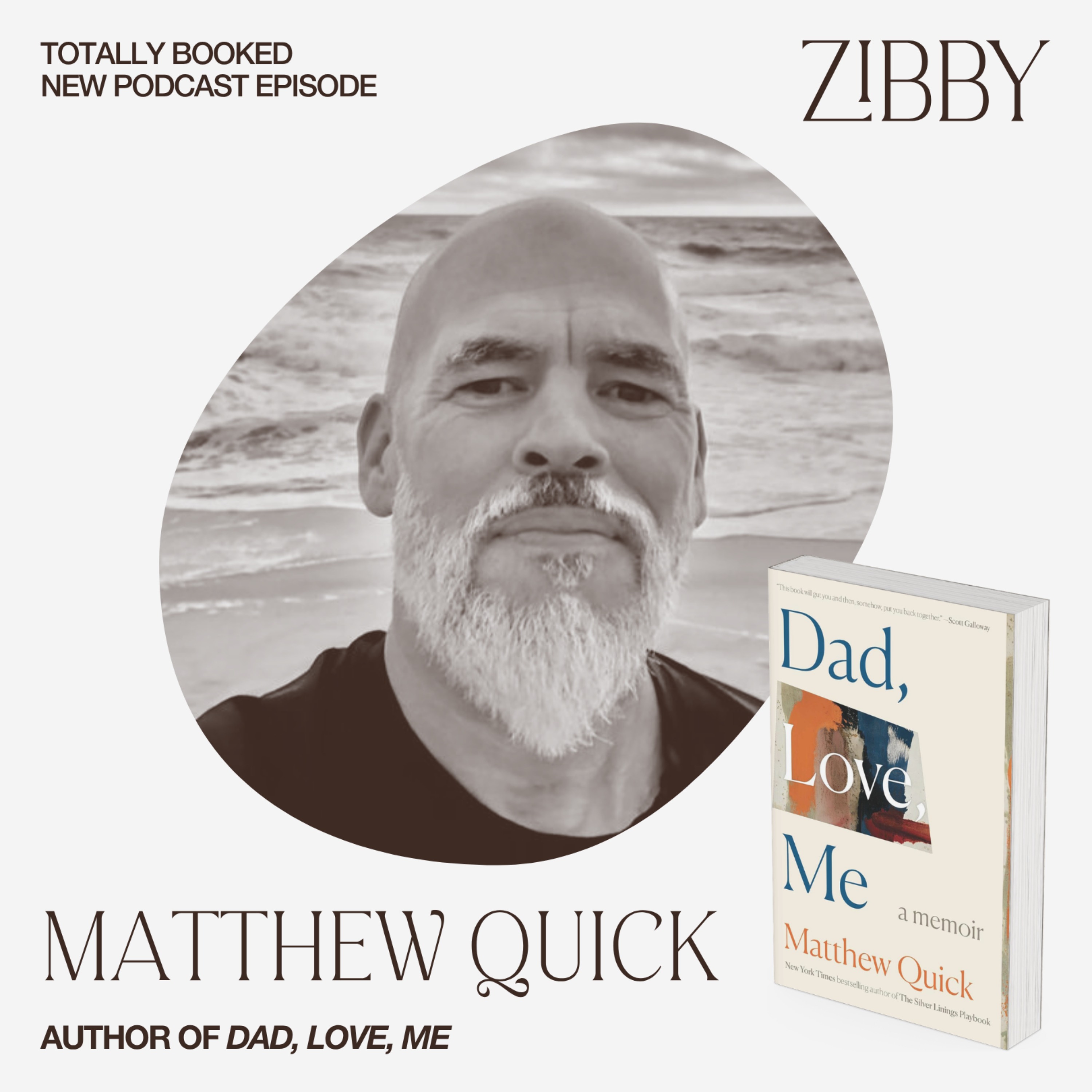
Totally Booked with Zibby
Matthew Quick, DAD, LOVE, ME: A Memoir
00:30:39
Zibby's August Book Club Pick!
Loading summary
Transcript52 lines
- [00:01]
Host 1
Welcome to Totally Booked.
- [00:03]
Zibby Owens
I'm Zibby Owens. I've interviewed more than 2,000 authors on this show and learned endless amounts about storytelling, reinvention and life itself.
- [00:12]
Host 1
Because when you talk about books, you're really talking about life.
- [00:15]
Host 2
So get ready to hear from today's
- [00:17]
Zibby Owens
best authors, the best selling and the not yet discovered.
- [00:21]
Host 2
Come find your next great read and
- [00:23]
Zibby Owens
the story behind it. Enjoy. Today is a very special episode with
- [00:29]
Host 2
Matthew Quick, author of dad Love, a memoir. And by the way, there are commas there. So it's not dad love me, although it kind of is, but it's dad comma, love, comma, me, a memoir. This is my book club pick of the month because it is so good and I am such a huge Matthew Quick fan. And this is one of the most vulnerable memoirs about a man searching for his father's love, about addiction and recovery, about just being who you are in the world. It's raw and amazing.
- [01:03]
Host 1
Really great.
- [01:04]
Host 2
I'm obsessed. Here's a little bit more about Matthew Quick. If you don't know him, he is the New York Times best selling author of the Silver Linings Playbook, which was made into an Oscar winning film that perhaps you've seen. And if not, you should go see that, but I'm here to talk about books anyway. He also wrote eight other novels, including We Are the Light, a main selection of the Book of the Month Club. His work has been translated into more than 30 languages. He was an LA Times Book Prize finalist, a New York Times Book Review Editor's Choice, and more. Enjoy. Welcome, Matthew, thank you so much for
- [01:38]
Host 1
coming on to talk about dad Love a memoir. Congratulations.
- [01:43]
Matthew Quick
Thank you so much, Zibby. It's a pleasure to be here.
- [01:46]
Host 1
So we are doing this episode really early, but we'll be releasing it close to your publication date. And this is one of those instances, as I was just telling you, where I got a galley and immediately stopped what I was doing to read it because I was so excited. And thank you for coming on to discuss.
- [02:04]
Matthew Quick
Thank you. I appreciate your enthusiasm. This is wonderful.
- [02:09]
Host 1
It was like you just gave us an entry into your brain and your heart and it was so raw and messy and real and I just, it was just amazing. It was like this unbelievably sort of intimate exploration of you. And thank you. Thank you for sharing all the stuff with all of us.
- [02:32]
Matthew Quick
Well, I appreciate your willingness to take a step inside of me, you know, and it is wild and messy in there, but we're trying to move it in the right direction, which is I think, what the memoir is about. So I appreciate your coming along for the ride.
- [02:47]
Host 1
Of course, in the book you explain why you decided to write this. Now you even describe a scene in which you talk to your parents about if, if they're okay with it, talk a little bit about that and why this sort of jumped up in the line when originally it was going to be perhaps ten years further away.
- [03:05]
Matthew Quick
Yeah, I always wanted to write a book about my father and I've tried to do that over the past 20 years and it's been very difficult and it never felt right and never worked out. And so I wrote this other novel that I submitted to my editor Jophy at Avid Reader, and he, you know, I really don't think this is your next book. He said, I think you should write about your sobriety, your relationship with your father and your Jungian analysis, which was terrifying. You know, it was something I thought I would do later. My father, because if you read the memoir, everyone will see, is going through a battle with dementia. And at the beginning, when I was starting to write the book, he was kind of in an in between place where he could actually still read books. So it was much more difficult to think of writing this book and having my father actually read it and be able to comprehend it. Unfortunately, now he's not in a position where that's going to happen. So it was really terrifying when Jophie said that to me. But I also knew that he was right. I knew that I was playing with these ideas in the novel form, kind of behind the mask of fiction, you know, these ideas of healing the child within these ideas about masculinity and fatherhood. And I think he knew that I was hiding a little bit, I was wearing a little bit of a costume. And it wasn't that the novel wasn't good, it's just that the memoir could be so much better. So once Jophie made that bid, I walked to my parents house, which is about two blocks that way right now, and I was terrified. I knocked on the door. There's a scene in the memoir where I had to ask for permission. You know, I was, I think I was 50 at the time, maybe 51, and I hadn't really asked for their permission for anything, but I knew that this was such a pivotal moment for me as a writer. But I felt I'd never written nonfiction before and I felt this sort of responsibility to do it ethically. I wanted, if I was going to do it, I wanted to tell the truth. And the truth is Hard. The truth is messy. And people don't like to talk about the truth because the truth is uncomfortable. But my analysts, who. My Zeus, throughout the book, he always says reality is medicinal. And what he means by that is when we get in proper relationship with what is actually going on, we can see the truth. It heals us. And so when I talked to my parents, I told them, I said, listen, if I'm going to do this, I'm going all the way. And, you know, you can veto it if you want. And, you know, there was just this silence for a very long, uncomfortable period of time. And I said to them, you know, I won't do it then. And my mom kind of came back at me with, you know, this line, which is in the memoir, you know, I hope I'm not spoiling things. But she said, who would play the. Who would play me in the movie? You know, that was kind of her bid, you know, and so they gave me their permission, which was really beautiful and healing. And when my mom read the book back in October, I took her out to lunch on her birthday, which is Halloween, and she handled it so well. I was really surprised because she said to me, I just want to listen to you, and I just want to be here for you. And she said. She said, I feel like I need to spend the rest of my life making this up to you. And I think that was a complicated statement in a lot of ways, but it was so healing for me to be seen, to see my truth, and to feel actually closer with my mother. My father's a different story. You know, he's. He's further along in his dementia battle, and he's slipping further and further away every day. But along the way, he knew that I was writing the book. And he often confuses me with his older brother, who's deceased, Pete. And so he would say to me things like, pete's writing the book, and I'm really proud of Pete, you know, and I'm happy Pete. So it was like this strange double speak where my father got to say he was proud of me without actually saying he was proud of me. And we could probably psychoanalyze that all day long, you know, but that kind of layer made it safe for him. And every time he would walk by my house here in the low country of South Carolina, again, my parents only live two blocks away. He would point to the house and say, my brother's in there writing a book about us. And I would say, what do you think the book's going to be? About. And he said, you never can tell. Pete's a wild man. He goes, you just can't tell. We can't control him. He's going to do whatever he wants. And I felt there was this kind of unconscious way of letting me know, you've got to say whatever you have to say. The other thing my father would always tell me is he would say, writers make the world a better place. And he's like, you have to make the world a better place through your book. And that's about as far as it would go. But he would repeat those lines over and over and over when we would walk, like, you need to make the world a better place. Writers make the better place. You have to teach people. You have to help people. So there was this really beautiful bid from my father. Again, he's not all there, but he's partially there. And after spending 50 years of him telling me I was an idiot because I wanted to be a writer, and, you know, not ever saying to me that he was proud of my work, but kind of like on the side when I wasn't around, bragging about it to people, it was a very complicated psychological machine that was really hurtful to me. There's. There's been a lot of healing that's happened over the last couple of years through writing this memoir and spending this time with my father and being around the corner from them. So it's really been. It's really been medicinal. It's really been healing for me. And I hope that by offering up this story, it will be healing for other people and it will bring out the best in people. Because before I went on this journey of sobriety and Jungian analysis and writing nonfiction, I had a lot of resentment towards my father. And I think back when I was drinking, I somehow thought that was hurting him. You know, it was like a way to get even. But through the last. Through my recovery and through all the psychoanalytical work I've done, I realized that it was only ever really hurting me. And so, you know, I think the memoir has been. It's been this beautiful way of actually presenting who I actually am and then discovering that people can handle that, or most people can handle it, or some people. And that's been really healing for me. Deeply healing for me.
- [10:07]
Host 1
Well, when you start the book and introduce it, you say that you hope our souls, or you're sure our souls will know what to do with it. You hope. That was so beautiful. Of course, now I'm misquoting it, but the whole time I was like, how it's such a profound way to look at a book. Like, it's almost like saying, take this with grace. Take what you will from it, and be kind in a way, because you. You just are connecting on such a visceral level about all of these things when you talk. Part of the book also, I feel, is about forgiveness in a way, because you reach a place where all the anger that you've had for so long, which can be argued, is justifiable. When you respond to some of these things, you understand more where it comes from, and you have. It's funny to say, give things away. It's like your life. But when you understand your grandfather more, I feel like it really put things more into context. When he kind of came and apologized, I felt like that was another really pivotal moment for you.
- [11:15]
Matthew Quick
Yeah, it was. You know, and I think that I had to learn through analysis that the architecture of my suffering was complex, and it went beyond my father. It was generational, and it was created by poverty and war and centuries of things that I don't even know about that were passed down through learned behavior, but also through DNA as well. So it's just so complex. And I think that we want to grasp onto very simple narratives because they make us feel good in the short term. But I think when we can let go of ego and humble ourselves, and to see that again, this architecture is so complex, and we're only seeing part of it, and we can calm ourselves and really put ourselves in a place of humility, to kind of stare at it with awe before we attack it and try to figure out the puzzle pieces. I think that that really was. It was a really good experience for me to do that. And I think the memoir was really a way to really have to grapple with these complicated stories that I've been carrying around and put them into some type of narrative structure and present them other people. So in analysis, we talk about bringing things from unconscious to consciousness. And so I think that all of these stories about my family and my grandfather, my dad, they're all kind of swirling around unconsciously inside of me, generating feelings, emotions, actions. But through the analysis and then writing the memoir, you lift them to consciousness and you're able to kind of sort them around if you can do so dispassionately, and then you create a better narrative. My analysts and I talk a lot about how story is medicine. The stories we tell ourselves and the stories we tell society either make us sick or well. And so I think for a long time My story was, my father was cruel to me, he wronged me, and he should be punished and I'm a victim. That story was functional for a while, but in midlife, it started to break down and I got sick. And, you know, in order to believe that story, I had to be an alcoholic. So in sobriety, I really realized that I needed a new story to function, to stay alive. And so this story that my analysts kept pushing me towards was, your father is 50% of you by DNA. You have to find a way to, to love half of yourself, because if you're going to hate your father for the rest of your life, you're going to hate half of yourself. And that was so radical. And it was something that was distasteful to me. I wanted to spit that out of my mouth, like I did not want to ingest that, but that was the bad tasting medicine that started to heal me. And as I started to look for the good in my father and try to understand his upbringing, the way that his psychology was formed, and as I started being more bold with my efforts to love my father, like taking the chance of throwing my arm around him sometimes, like taking the chance of kissing his forehead, I realized that my father's actions, not only towards me, but towards my wife, softened and he became. He did not become the dream father that I hoped he would be by any stretch of the imagination. But the more human I found in him, the more human he offered to me. And I think that that was really illuminating. My father, because of his dementia, is still occasionally out of control, you know, still sometimes abusive. But I've seen this different side of him that I never saw for 50 years. The side of him that marvels at clouds or likes to sing Joni Mitchell, or just will just randomly say I love you or thank you for being here. So that's really been a deeply healing gift that I did not think that I would ever receive even 10 years ago. And so it's a strange thing because dementia is a horrible, horrible, horrible disease. I wouldn't wish not anyone, but it gave me this window into my father where I could see his humanity. And it created this opportunity where he needed to rely on me and my mother in a way that returned him to a very young place. And so I got to see a lot of that. At the same time, I also, getting sober, I got access to much more of my own emotions because I wasn't just numbing myself all the time. And at first that was incredibly painful. For years it felt like I was on fire every day. But once I started to calibrate to feeling things intensely, you know, I would spend an afternoon with my dad and he, he'd start singing a Joni Mitchell song and I just start crying. You know, I would, it would, it would just touch me so deeply in a way. When I was using drugs and alcohol to numb myself out, I just didn't have access to that myself, to those parts of myself. So I think that the sobriety and the Jungian work, it opened up something in me. And I noticed that how that, that because I was different, the alchemy that I was, the me that I was bringing into the room changed the alchemy of my relationships with other people. And they started to open up more as well, including my father.
- [16:43]
Zibby Owens
Today's episode is sponsored by Quints. The best summer pieces are the ones you end up wearing on repeat. Comfortable, versatile, and somehow right for almost every occasion. That's why I love Quince. They make elevated essentials using premium materials like European linen, organic cotton and washable silk without the traditional retail markup. Quince's 100% European linen pants, dresses and tops are the pieces you'll reach for all summer long. They're lightweight, effortless to style and start at just $32. Their denim is soft and comfy, and their organic cotton sweaters are perfect for layering when evenings cool down. Personally, I love my white tank dress that I wear all the time. I've actually pinned it to my Instagram as one of my top three posts. I also love my new jean jacket from there. And I'm just so grateful to Quince every single day, especially because quince is priced 50 to 80% less than similar brands.
- [17:42]
Host 1
And it's not just apparel.
- [17:43]
Zibby Owens
Quince also offers elevated essentials for your home, from bedding to to bath and all the kitchen essentials and furniture. So make your summer wardrobe feel easier. Go to quince.com zibby for free shipping on your order and 365 day returns. Now available in Canada too. That's Quince Q U I n c e.com Zybee Z I B-B Y for free shipping and 365 day returns. Quince.com Enjoy. Wow.
- [18:15]
Host 1
Well, I, I found it so interesting how you and I, I'm like loving everything you're saying here. But I found it so interesting when you were talking about sobriety, how you also compensated with like excessive exercise, which I feel like men never say is an issue. Like I've never heard that before, but you were running and Running and running. And just clearly, you know, running away from stuff of running, you know, it was so like. Yeah, it's like so perfect. Right? You couldn't make it.
- [18:43]
Matthew Quick
It's such a metaphor.
- [18:44]
Host 1
Yeah, it's like classic, but.
- [18:46]
Zibby Owens
Yeah.
- [18:47]
Matthew Quick
And the compulsive running thing was really. It was really necessary for me at the time. And I was. I spent a couple years where I was only running. It was pretty much the only thing I was doing. And the thing that was so strange was I knew that it probably wasn't healthy to do nothing but run every day. But people. I lost 60 pounds and people would say, you look amazing. And people really gave me a lot of praise for that. So it was this very strange thing because I think exercise is. Is still a part of my mental health maintenance plan. But it was a strange reality because in a lot of ways it was not pro social for me. But everybody was giving me a lot of compliments. I think that exercise can be really tricky that way. It can be addictive. I think that. That men do get lost in that. And I know a lot of other people who have used running to beat alcohol and addiction. You just switch one addiction for the other and it's a more pro social addiction. It's a step in the right direction. But there are pitfalls as well, I think.
- [19:54]
Host 1
Tell me a little bit about how you decided to write the book. Because it's almost a letter to your dad, right? You're talking to him most of the time. In fact, many times you're talking to him almost to the reader. Or we'll find out about this later or we're gonna get to that. Or I had this scene, then I came home and wrote this scene. So it's almost like we're watching you write the book that we're actually reading.
- [20:17]
Matthew Quick
Yeah, I tried to write this in many different ways, and I tried to write it more formal, in a more literary style. And it just didn't feel honest. And so the only way that it would come out of me is if I told it in my own voice in the way that it felt natural for me to. To let it come out. And as soon as I gave myself permission just to speak as I would to one of my best friends or my wife or somebody that I loved in this raw, honest way, or the way that I would to Zeus and analysis, it just kind of flew out of me. And I wouldn't say that I even really knew what I was doing. The book was much longer when I. When I wrote it by about 100 pages. And my editor Jophy got. He said, everything in here is great, but it's way too long. So we. We did do a lot of fine tuning and organizing afterwards. But it was interesting because it was only in retrospect that I really saw how some of the structure worked. And there are these really poignant moments where, you know, my father. My. Be attacking me violently in a scene from 1990. And then the next scene is us, you know, together in present day, looking at a cloud and marveling at its beauty. And it's just really. The juxtaposition was so striking that you would think that I planned all of that out, but I really didn't. I just. I was writing, and a lot of the things I wrote with my father, they would happen, and I would just rush home to get them down on the page, and then that would just be the next chapter. So there was a lot of. There's a lot of kind of unconscious stuff going on with this. You know, my analysts, in a very Jungian way, will always say to me, whenever I'm stuck, he says, the problem is you still think you're writing these novels. And what he means by that is, when you put yourself in service to something greater than you, other puzzle pieces click into shape, and, you know, they click in and something happens. You know, we talked a lot in analysis about alchemy, you know, this idea of put two different substances together and creating a third thing. And so whenever I was talking to Zeus in our sessions, the two of us would come together and we would create what is known as the analytic third. And so this new thing that would happen, those chapters with Zeus are not really him. They're not really me. They're this third thing that's interesting. And I think that if you try to control that too much or shape it too much or not let it be the thing that it needs to be, you ruin it because you put too much of your own ego into it. So I've had writing friends that have read this book and said to me, first of all, I don't know that I've read anything like this. The structure completely works, but I have no idea how it works. How did you do this? And my answer is, I really don't know. I don't. I just tried to let it come through as. As it needed to. My analysts will always say, you know, let it flow down and out, you know, from the higher to the lower, you know, and just. Just let it go through you into the world without changing it too much. And I think sometimes that's the best way. Now I will say that we did a lot of editing, you know, after the book was sold, and we shaped it, but we didn't really change the structure and we didn't really change the feel of it. You know, we, we sharpened things up, we got rid of redundancies, all of those types of things. But it pretty much is as is that it came through me minus some things that we took out because they might be redundant or it just instructed things. So that was not quite a new experience for me. But I. I don't think I ever have given myself over so fully in service of a project before, which was terrifying because it takes a lot of trust and you just don't know how people will respond. So, you know, stepping out from under, from out from behind the mask of fiction is one thing, but then also just letting something rip through you and then trusting that it will be okay was pretty terrifying for most of it. You know, writing this book, I sobbed and cried for about six months, like just non stop writing this book. And just at the time it was, it just felt like I need to do this to heal my soul. My analyst kept saying, you're stitching your soul back together with, without anesthesia. And I just thought, I have to keep doing this. And then at the end it was like, what is this thing that I have created? And I think that's the way it needs to be. And the early responses have been interesting because there hasn't been a lot of, you know, Matthew Crick is a genius. It's more of what is this? And it affected me in this strange way that I think is really positive and it's making me think about things. And people are coming back to me and telling me stories about their lives, about their trauma history, particularly men who are saying things to me like, I didn't know that this is what this was called, but this happened to me too. And I didn't know we were allowed to talk about this in this way. So that's been, that's been something that I feel grateful for. I feel that that that's something that needs to happen, particularly in this time period. So I'm hopeful for the book, you know, and I think that I need, for me talking about it, I need to say that, you know, it is my story. Like these are things that happened in my life. But I think that I'm also symbolically bringing something forth that's going on with a lot of people at a time when this conversation is long Overdue. So for me, it feels humbling to be in service of that at this time period. And so I just hope that it will create conversations for people that take them closer to wholeness and health.
- [26:21]
Host 1
Well, I feel if people don't respond well to you holding out your soul for someone, then those are not your people.
- [26:30]
Matthew Quick
Or they're not my people yet, you
- [26:31]
Host 1
know, or they're not your people yet, but that's just not nice. That's just cruel. So that's the last thing you need. I feel like it's impossible not to root for you reading the book. You just want you to have a good life. You want the launch to go well. I feel like you also put in a lot about writing and about going on the highest highs in the Hollywood career and the bestseller and da, da, da to people not returning your calls, which is also something that people are not exactly excited to run around and tell other people about, like, oh, hey, you know, listen to what happened. They want to talk about the victories, not the failures necessarily. And that's another. Another thing that just makes you sort of likable in a way. Like, you're just like, everybody has rejection and everybody. Maybe not the biggest, maybe they didn't work with Bradley Cooper or whatever, but, you know, everybody can go from highs to lows in the way that you did. And. And it's just so honest and amazing to talk about.
- [27:32]
Matthew Quick
Well, I think, too, from a writer's perspective, it's important to talk about those things, because I don't think most people who want to write have a clear idea of what the writing life really is. And so the writing life is 99% failure and 1% maybe something happens. So people are often surprised when I'm honest about that. But for me, when I was coming up, I was so desperate to know how things really worked. And in Hollywood, people really don't talk about how things work. So I think that it's important. I think it's healthy to talk about that. But I also think for other writers, they need to know that even if you have a success like Silver Linings Playbook, the odds are still the odds next time around. It's like going into the casino. You win once, but the odds are still stacked again against you. And it's still a battle. And I think for those of us who choose to do that, anyway, it's a calling, you know? And I think the thing that really keeps me going is not the idea of having another huge movie, but, you know, what am I about? What do I want to put in the world what are my values and trying to align with that. And I think that's what's really supercharged me through the last couple years. And I think that's really giving me the strength to. To put this book out there. And the interesting thing is, is that people in Hollywood have been interested in this book. And so, you know, that's not what I was aiming for at all when I was writing it. And I don't even know that I would want this book to be turned into a movie for all types of complicated reasons. Do I really want someone playing my mom on silver screen? I don't know.
- [29:18]
Host 1
I mean, she would. She would love it.
- [29:21]
Matthew Quick
I think she would. She'd be very particular about who could play her. You know, she'd have a lot of opinions. But I. I do think if you find your personal truth and you put it in service of something good and relevant, interesting things can happen. And just like this conversation happening right now, you know, which is fantastic, I get to talk with you, Zibby Owens, because I wrote this book, you know, which is great, you know, and a lot of other people are interested. And so it takes courage and it takes. You know, I talk a lot. My analyst, Zeus, always talks about paying the cost. And I talk about this with my writing friends. You know, what is the cost of putting a book into the world? Like, what are you really offering up? What are you willing to give people? How much of. How much pain are you willing to go through? And so, you know, there's a line in the book, in one of the chapters where I say something that all of the suffering that I've had, you know, it might be the cost of living the writing life as I do. And after this one experience to my family, I said, I'm sure it's hell paying the cost. And I think that that's important to know, particularly if you're going to go into the arts, that there is a cost to pay. And you're going to have to offer up something real about yourself, and you're going to have to dig deep, and you're going to have to find something that is of value to other people. And oftentimes the things that we have that are of value are the things that we're most scared to show people. And that takes courage. And it took me 700 hours of analysis to find that courage and eight years of sobriety. But somehow I found a little bit to make it this far.
- [30:59]
Host 1
At least it was an overnight success, this project.
- [31:04]
Matthew Quick
Yeah, right.
- [31:05]
Host 1
Did you wear a black T shirt on purpose? Will you be wearing a black T shirt to all your interviews?
- [31:10]
Matthew Quick
I wear black very often. I feel like it's my. It's a good color for me. I don't know. But for very different reasons. I. I just feel comfortable in black. I did wear a little color today. Usually I just wear black.
- [31:23]
Host 1
I'm just joking because of you and your therapist, but you have on black, too, so. Yeah, I know. I know.
- [31:28]
Matthew Quick
But, you know, you're hearing me.
- [31:30]
Host 1
I know you wanted. I. I know you wanted Zeus to notice the black so much, and so, you know.
- [31:35]
Matthew Quick
Yeah. Yeah.
- [31:37]
Host 1
Well, we're all noticing everything. I am so rooting for you, I can't even tell you.
- [31:41]
Matthew Quick
Thank you so much.
- [31:42]
Host 1
It's really beautiful and you deserve all the best. Congratulations.
- [31:46]
Matthew Quick
Thank you, Zibby. Appreciate you.
- [31:48]
Host 1
All right, take care, Matthew. Bye.
- [31:50]
Matthew Quick
Bye.
- [31:51]
Host 2
Bye.
- [31:51]
Zibby Owens
Thank you for listening to Totally Booked with Zibby, formerly Moms don't have Time to read books. If you loved the show, tell a friend, leave a review. Follow me on Instagram at the end. Zippy Owens and Spread the Word. Thanks so much. Oh, and buy the books.