← Totally Booked with Zibby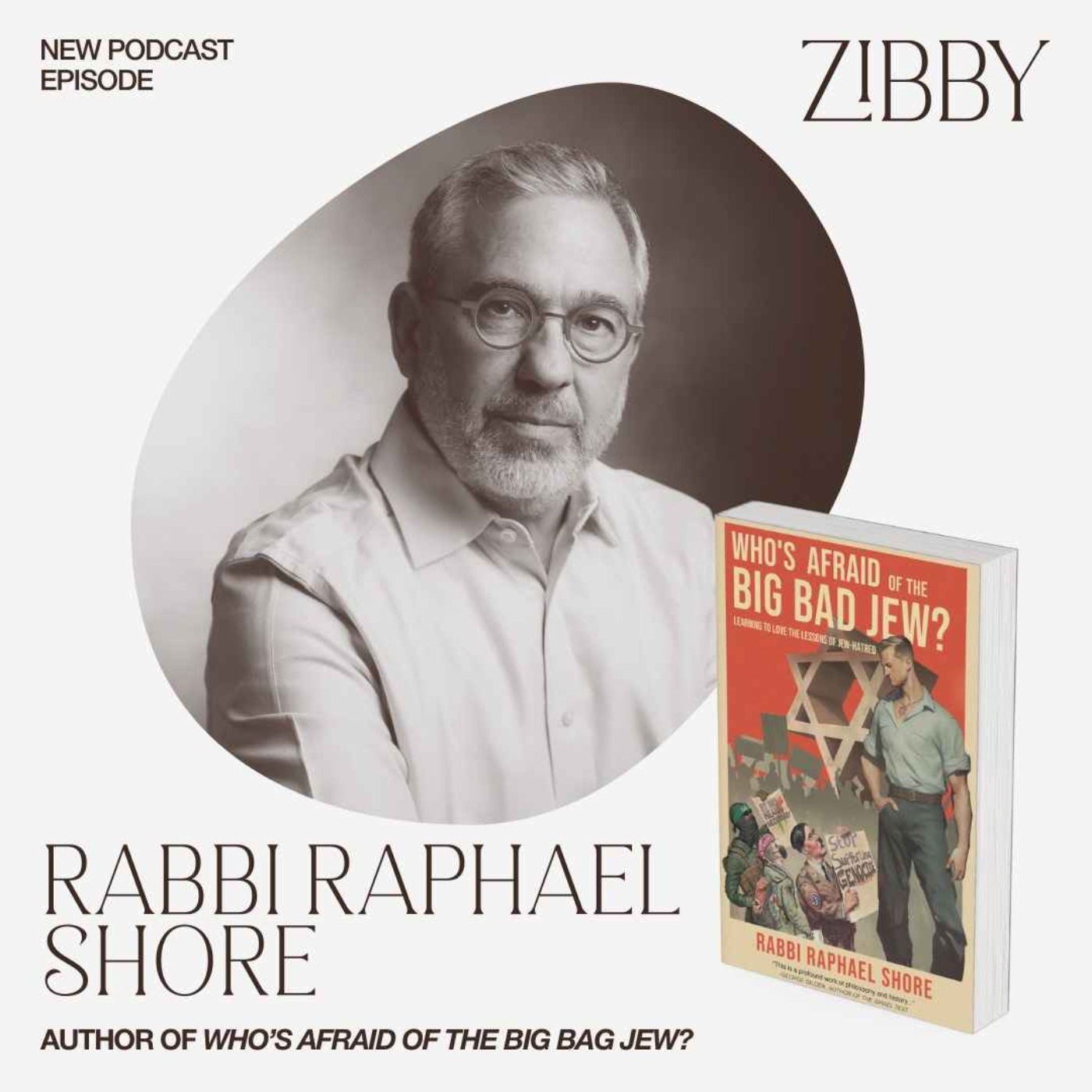
Totally Booked with Zibby
Raphael Shore, WHO'S AFRAID OF THE BIG, BAD JEW: Learning to Love the Lessons of Jew-Hatred
00:29:22
Loading summary
Transcript31 lines
- [00:01]
Zibby Owens
The recent fire in LA destroyed many schools in the Pacific Palisades area where we have our home. I am currently raising money to completely rebuild the library collections of four schools in the neighborhood. If you are interested in helping me raise up to $800,000 to restock the libraries, go to zivimedia.com donate one book donate a thousand books but please help imagine if this was your school or your kids school. Thank you. Hi, this is Zibby Owens and you're listening to Totally Booked with Zibby, formerly Moms don't have Time to Read Books. In my daily show, I interview today's latest best selling buzziest or underrated authors and story creators whose work I think is worth your time. As a bookstore owner, publisher, author and obviously podcaster, I get a comprehensive look at everything that's coming out and spend my time curating the best books so you don't have to stay in the know. Get insider insights and connect with guests like I do every single day. For more information, go to zibbymedia.com and follow me on Instagram ibyoans.
- [01:14]
Rafael Shore
Rafael Shore is the author of who's Afraid of the Big Bad Jewelry? Learning to Love the Lessons of Jew Hatred. Raphael is an acclaimed filmmaker and human rights activist globally recognized for his role in empowering Jewish identity and raising awareness of the dangers of anti Semitism. Founder of Open Door Media and the Clarion Project, Shor has established himself as a voice of reason in a crowded and hostile media landscape. To date, Shore's documentaries and feature films have amassed hundreds of millions of viewers and won multiple awards. Open Door is a dynamic factory for Jewish education, with YouTube content, podcasts, and prominent influencers. Attracting millions of hours of watch time, Open Door fosters discussion among students and educators and shares ideas with lay members of the community. The Clarion Project exposes the menace of jihadi groups and radical Islamic organizations. Rabbi Shore's films such as Obsession, The Third Jihad Iranium, and Honor Diaries received over 150 million views. These films drew sharp interest, with featured articles in hundreds of newspapers, aired on Capitol Hill and even used for training by the NYPD. In 2013, Honor Diaries won the Interfaith Award at the St. Louis International Film Festival. In recent years, the Clarion Project has moved away from film into research and lobbying. Building two powerful media organizations led Rabbi Shore little time. Having carefully passed his media organizations to the next generation of Jewish leaders, Shor has finally found time for his personal passions. His two current projects, a book and a film, are visions developed over a lifetime. Each Delves into the heart of Jew hatred, be it Nazi or radical Islamist. In both enemy camps, Shor finds surprising and life affirming answers to the age old question, why the Jews?
- [02:53]
Zibby Owens
Welcome, Rabbi, it's so nice to see you on Zoom. Even though we had coffee and that was way nicer, but it's fine. Who's afraid of the big bad Jew? Congratulations on your book.
- [03:03]
Rabbi Shore
Thank you. Thanks for having me, Zippy. It's a pleasure to be here with you.
- [03:07]
Zibby Owens
Pleasure to be here with you. Well, we talked about this when we met and it's in the book as well. But talk about how you, you didn't think that finding a Jewish path was what you were going to do until certain things happened in high school and your brother's influence and all of that, how things ended up leading you down this path.
- [03:24]
Rabbi Shore
Okay, my story.
- [03:25]
Zibby Owens
Your story? Yeah, tell me your story.
- [03:27]
Rabbi Shore
My brief stories. I grew up in Canada. Small town Canada. Not a religious Jewish family, but a very strong identity. Strong Jewish identity, strong Zionist identity. My father was a leader in the community and a member of parliament for a little while. And so we were proud Jews. But at age 20, my twin brother, no, age 18, my twin brother ended up traveling through Israel and landing on a yeshiva and spending time there. And I thought he must be out of his mind. Why would he become religious? That's crazy. And, and two years later, that's when I was 20, because he's my twin brother, I came to get him out of yeshiva. So I prepared myself at university and I studied philosophy and logic courses and religion courses to make sure that I understood the other side and I wouldn't get fooled and tripped up by, by whatever those rabbis were going to be teaching. And so I was shocked when I got there for the summer that Judaism was sophisticated, intelligent, rich, spiritual, deep. All the things that I would have said were the opposite, based on my very insufficient Hebrew school education. Growing up in London, Ontario, Canada, when I had my bar mitzvah, I was very convinced that Judaism was completely irrelevant and silly at best. And so I discovered it. And I'd already discovered that Israel was the most awesome place on the planet. And so that combined with now discovering Judaism, I decided, okay, I'm going to become more observant myself. And I studied for five years in yeshiva. And already at that time, it was when I was finishing university, I started to do the research that became the foundation for what this book is about.
- [05:28]
Zibby Owens
Interesting. And you said you had been sort of sitting on this book for 30 years. And then when the events of October 7th happened. You felt compelled to get it out the door, so to speak.
- [05:39]
Rabbi Shore
Yes, indeed. And then the part of the story that I didn't share, you just reminded me, was that in high school, my last year of high school, you know, I was in a school that had 20 Jews out of 1,000 people. And my brother and I and a couple other Jewish friends, we became part of the upper society clique. You know, the cool people, football players and everything, and the hockey players. And we were part of that group. And we would party together every weekend until one Friday night, all of a sudden there was a sign that said no Jews allowed. And they locked the door on us and we were like shot completely out of the blue, all of a sudden. Jews are not welcome. These were our. This was our social circle. And that was the one night in my life that I got into a fist fight with my girlfriend's brother, as it were, who was the leading anti Semite of the group, I discovered. And so that was a wake up call. That was a wake up call. We thought, we thought, hey, aren't we just like everybody else? Why you guys think, why do you guys think that we're different? Culturally, yeah, maybe, but not much else. So that was, that was. I don't think that was pivotal. I think my brother's journey to Jerusalem was more pivotal. Nevertheless, it was, it was a wake up call. And it was part of my journey to find out more about what being Jewish is about. So in the book I'm exploring the reason that they don't like Jews, that people don't like Jews, and why they haven't liked Jews for 3,000 something years, and why anti anti Semitism has been so much part of our history. And it's bizarre and we can't figure it out. And the double standards, and it's perplexing. And in my book I answer it in a different way than most people know about. But I always have to say that's not what the book's about. Even though that's quite a contribution to explain anti Semitism in and of itself. But really that's not the purpose. The purpose of the book is then to flip it on its head and answer why the Jews from a positive perspective of what are we all about? What is the mission of the Jewish people? What's the purpose of the Jewish people? What's the greatness of the Jewish people? And that's really what I share. But it comes through the lens of antisemitism because it turns out that the anti Semites sometimes Know us better than we know ourselves.
- [08:11]
Zibby Owens
I mean, I hate to say anything nice about the anti Semites, but. Okay, fine, I'll let that slip out now. You know, my husband converted to Judaism and we had all these meetings with the RABB as he was going through that and I remember him asking like, well, I just don't get it, but why, why don't people like Jews? Like, I don't get it. And the rabbi then tried to explain and maybe you could give like a shortened nut. Obviously the book goes into depth about it and you have all these different parts and reasons and everything. But if you could sum it up, what you found different than maybe other people, what would it be like? What would, would a kid need to know?
- [08:50]
Rabbi Shore
Yeah. And it is difficult trying to sum it up, but I will, I will do my best. I also produced a companion film called Tragic Awakening. So I'm touring around. It's a 50 minute film. Can find out more@tragic awakening.com so that helps also synthesize the ideas. In a short way, the book goes into more depth. So the first thing is what it's not and what anti Semitism is not, is the reason that everyone told us it is. In other words, my book challenges the conventional wisdom that we've all been taught to accept. It's not because we're just scapegoated. The common explanation for the Holocaust and anti Semitism is that the Jews are a minority, in the wrong place, wrong time, easy to blame for society's problems when things go sour. So that's not it. It's not. It's also not just a disease, it's not just a rational disease. Oh, and we can't explain it? No. If we're doctors, we need to go and try to find out what's the nature of the disease. So let's go further and say, yeah, it's a virus, a mutating virus, but what's it all about? And it's not the explanation, the superficial explanation that they always give because they're all opposite, they contradict each other. We're rich, we're poor, we're capitalists, we're communists. We're too much like them. We're too different from them. Every explanation and it's opposite. So that's not it either. So my book goes deeper and into the understanding that Adolf Hitler had about, about why he did the Holocaust, which sadly, he was totally clear about. The sad part is that the academics and the Jewish world have forgotten or have not informed us of what Hitler's Ideology was essentially, Hitler said that there was two ways to look at the world. One is based on humanitarian principles. Love your neighbor, peace on earth, goodwill to all men, equal rights, God based morality, ethical monotheism, that's one way of looking at the world. The other way was basically social Darwinism, natural law that the world is that humanity's not a spiritual being. Humans are part of the natural animal kingdom. We're animals. And the, the laws that govern, govern the world are survival of the fittest. And just like the animals operate by that rule. And as a result that means you don't have pity on the weak and you don't help the poor. No, just the opposite. The weak of each species and the weak species are eliminated. And as a result human, the animal kingdom thrives. And, and so Hitler understood and this wasn't a new idea, this was popular in Europe in the late 19th century, that humanity should be operating on those principles as well. The strong survive, might makes right. This was a Nietzschean principle as well. And undermining that principle was the Jewish idea that love and humanitarianism should be the governing principle. So Hitler looks at the world and says the Jewish people with their, introduced these ideas into the world. And through them and through Christianity the world has changed. Western world has bought into these Jewish ideas. And deep down the Jewish people are somehow influencing and pushing the world in that direction. And Hitler understood that means the end, that will be the end of humanity. And so Hitler is trying to save the world by eliminating the Jewish people. So I think deep down, deep, deep down most people, most anti Semites can't articulate it, but deep down there's a moral responsibility, there's a push that the Jewish people have been bringing into the world that the world rejects and reacts negatively to. They can't always articulate it as well as Hitler did, but so they say, oh, too rich, too poor, too this, too that. But ultimately there's something bothering them about the Jewish people that's much deeper. And therefore antisemitism is a moral spiritual phenomena more than anything else. Sorry, I can't get it, I still can't get it into 30 seconds.
- [13:14]
Zibby Owens
That's okay. That is okay, because that's what, that's. That was the preview you gave us too. It is this, this do good, love your neighbor philosophy and tikkun olam and all of this that makes us who we are and that also doesn't sit right with everybody. So talk about why us and why do you think Jewish people even had this? Why are these the things that characterize us as a people. Where did that come from?
- [13:44]
Rabbi Shore
Abraham? So in my book I go into great detail because first of all I trace Hitler's ideology. I trace the fact that the normal explanations that we've been given are not satisfactory. They're superficial, they don't make sense, they don't really explain the phenomena of anti Semitism. And then I explain Hitler's philosophy, but then I flip it all on its head and say, well, he's correct that he says that the Jewish people have transformed civilization with these values. And in every other aspect, he looked at Germany and he said, wow, how are the Jewish people still standing after 3,000 years of persecution? And how is it they're influencing Germany so much? And so he noticed that even if Jews aren't religious, even if they're not out there pushing religion and ethical monotheism and these things they're pushing, they're driven to create change and to and to succeed. And it made him nuts. And even if it's secularized, like human rights ideas or even communism, which is basically Judaism without God, the utopian view of peace on earth and love, he just traced it all back. Judaism, Christianity, Bolshevism, kind. It's all from the Jewish minds. Jesus, Marx, Moses, Abraham, he saw the pattern in history. So where does it all come from? It comes from the first Jew. Abraham was elected by God because Abraham chose God. And God said, okay, you know what? You're gonna be my man, you're gonna be the father of a people. I'm gonna give you the Torah, I'm going to give you the principles. Your job is going to be to bring this into the world. And that's why it says at Mount Sinai Sina came into the world. There's a Midrish that says, actually a Gomorrah Talmud that said the play on the words Mount Sinai, Sina, Sinai, Sina. At the mountain of Sinai, hatred came into the world, the hatred of non Jews to the Jews, because it's a rebellion against the ethics that Mount Sinai revealed that the Jewish people were tasked to bring into the world. So for 3,000 years, more or less, the Jewish people have been hanging on to this mission, trying to do God's word and God's Torah, getting blasted in every generation for it, but trying to hold on. Sometimes we lose our way. And even when we lose our way, so we're leading every other social cause on the planet because it's in our spiritual DNA. And that's what Hitler said. That's why when Hitler said, I Want to destroy Christianity and I want to destroy Bolshevism, Communism. It was an ideology. But with the Jews, Hitler says, I need to wipe out every single Jew. Because Hitler understood it's in our spiritual DNA. Doesn't matter. He said explicitly, even if there was no Jewish school, even if no one's practicing Judaism, Hitler said every Jew represents these ideas. He called it, of course, a germ. A germ and sedition. But he saw it in every Jewish soul. It was a spiritual DNA, and that's why genocide. And he was explicit about it. But the books basically flipping it all on its head and say, he's right, this is who we are, this is our heritage. And if you're Jewish, own it, embrace it, love it. Because it's awesome to be part of this legacy, even though we're hated for it. But if you know why you're hated for it, certainly gives you a lot of strength. And that's my motivation. That's why I wrote the book and made the film. Because I want to give strength to the Jewish people and understand it. And I want non Jews to be able to see who we are, understand who we are, understand antisemitism, and get on the right side of history, hopefully.
- [17:53]
Zibby Owens
I love that when we met, I was like, trying to solve antisemitism, which is, like, ridiculous, right? I'm like, I can fix this. But, you know, and I remember sitting there being like, but what can we do? And you were like, that's actually not the right question. Like, you can't stop antisemitism, but how can you strengthen the Jewish people? What can you do in the world? And I've actually repeated that conversation many times as I talked about the book, because it's a shift, right? It's a shift in how we approach all the communication around what is happening. And it turns to something positive instead of something, you know, we're not battling something, we're building something, which is a very different mindset.
- [18:32]
Rabbi Shore
Yeah, it's 100%. It's what I call giving inner spiritual armor to the Jewish people. Because we've been beaten down, you know, this 2,000 years, especially in the last, in the exile, it affects the Jewish mindset, the Jewish psyche. If you're disliked in every generation or if you want to stand up for Israel and you get pounded, I know, like you've bravely done it, makes you that, you know, consider, do I want to do this? Do I want to be out there saying, I'm Jewish and I'm proud? And I think Israel is a great place even with some, you know, they're not being perfect. And so that has really affected who we are and how we look at ourselves. And I think we need to really strengthen our moral self confidence. And that's my motivation. To me, that's like you just said so nicely, that's. To me the main challenge is to look at anti Semitism, look at the double standards and realize it's their problem, not my problem. And actually it's coming from our point of greatness and goodness that is creating the negative reaction so I can love myself and that creates inner armor, inner spiritual armor. That's what I think is the most important thing. And the Jewish world, as I say, I'm challenging conventional wisdom because the Jewish world invests hundreds of millions probably every year to fight antisemitism. From the ADL to all the organizations stop anti Semitism and antisemitism this. But you're not. What I'm saying is that it's a. Anti Semitism is a moral and spiritual phenomena and telling the non Jews to stop hating us is not going to be the way or creating studies that shows how much they hate us. And they say, oh, we didn't realize we hate you so much, we'll stop. You know, it's, it sounds ridiculous, but we're putting millions and millions of dollars as a Jewish people into this. And I think that if we are strong and if we embrace our values and embrace who we are, that is the best way not only to give ourselves the inner armor and self confidence that will minimize antisemitism because it's a moral and spiritual phenomenon. The last chapter of my book, I tell a dozen plus stories of amazing people who in the face of antisemitism, responded in this moral spiritual way and became proud. I think that's the message we want to take with and give to our people.
- [21:11]
Zibby Owens
So if the people who are spending the hundreds of millions of dollars fighting antisemitism were to take those hundreds of millions of dollars elsewhere to do something, what would you do with that money?
- [21:24]
Rabbi Shore
I would first and foremost use the money to educate our Jewish people on who we are. And you know, that's the core of what I'm trying to do. I think that unfortunately the, as I said, the, the Jewish people have had a superficial view of what anti Semitism is, the nature of anti Semitism. But that's only one of the two problems. The other problem is we've had a very superficial view of who we are. And as I mentioned at the beginning, that Sometimes anti Semites understand us more deeply than we understand ourselves. And if you ask a hundred Jews what is the nature, purpose, mission of the Jewish people, very, very few people, A, will say the same thing and B, will get close to what the right answer is. And so there's. We've really failed ourselves. Part of it is understandable. Our mission is heavy. Our mission is a moral burden. And that's why the world reacts negatively against us. And sometimes we react negatively against it ourselves. And we don't really want to carry it. The fact that we can explain the Holocaust for the past two generations as being not really about us, just they needed a scapegoat and the world went insane. So really it's nothing about being Jewish. It's nothing about the Jewish people. Just a coincidence. That is an escape, that's a psychological escape from facing the reality that no, he understood who you were and it was because you're Jewish. And this is what it was about. Now what do you want to do with that? How do you want to deal with that? So it's heavy. It's heavy. Being Jewish is heavy. And I think that, that it's a. It's an incredible privilege and a beautiful heritage, but it's real. So I would take a lot of that money and put it into positive, inspirational, spiritual education on who we are so that we can really love being Jewish. Because telling all the young Jews how much we're hated is not a good recipe for loving being Jewish.
- [23:41]
Zibby Owens
True. Although there has been a lot of, I guess by nature of all of the attacks, a lot of younger Jewish people are finally stepping up and, well, not finally they're young, but you know what I mean, stepping up in a way that they didn't realize they needed to. And they're seeing this firsthand. And now they're getting the same wake up call that you had around the same age. Right?
- [24:00]
Rabbi Shore
100%. And that's the opportunity here, that there's been like a wake up. And that's why I call the film Tragic Awakening. There's been an awakening October 8th, and that's wonderful and beautiful. And now ideally, we'd not only stand up for Israel and stand up for being Jewish, but really deepen our understanding of what it is and why we are.
- [24:23]
Zibby Owens
How can people watch the film?
- [24:27]
Rabbi Shore
So in the short term we can go to the website tragicawakening.com I've been touring around with it. So any community, church, synagogue, conference, who wants to screen it, they can go online, get a screening license. We've Been doing lots and lots of screenings in the short term. That's what we're going to do for the next few months.
- [24:51]
Zibby Owens
I want to do a screening. Do one.
- [24:53]
Rabbi Shore
Okay.
- [24:53]
Zibby Owens
Yes, I want to do it.
- [24:54]
Rabbi Shore
Let's do it. Okay, let's do it and we'll make that happen. Okay. Yeah, it could be in your home with a bunch of people. It could be in a larger group. We did Parky Synagogue when I was there, when I met you that time. Additionally, once a month we're doing online free screenings. The next one's February 23rd at 8:00pm Eastern. Again, you can go to tragicawakening.com sign up. Once a month, free online screenings. Newsmax is going, has licensed it and end of February they're going to do a premiere and start screening it fairly regularly. And then come this summer or so, we will put it out on some platform so everybody can see it even more easily. That's how it is in the short term. And then the book's available at Amazon if you want to go deeper and really get inspired.
- [25:42]
Zibby Owens
So in your efforts so far and traveling around and screening the movie and marketing the book and doing it all, are you sensing like success? Like, do you feel like it's getting through and making a change?
- [26:00]
Rabbi Shore
It's a great question, Zibby. So, yes, a resounding yes. I've been blown away. This is my 18th, this is my 18th feature length documentary film. So I've, I've been around the block and I have, I have never seen this kind of impact and it's only a 53 minute film, but the film really gets people's souls and, and I get this reaction, very common. Like we were, we did a 400 person event in Miami last week. 3 minute standing ovation at the end of the film. I've never seen anything like that. But it's inspirational also because it features this Arab, former anti Semite, recovered anti Semite named Rowan Osman, who's been on tour with me right now as well. And she has become a Zionist and is actually converting to Judaism. She comes from Syria and Lebanon, so her story is wild and amazing and she explores the nature of anti Semitism, the nature of the Jewish people in the film as our featured personality. But when people watch the film, they come away and they say, you know, they have this interesting reaction of I kind of knew this, but I never heard it before. And there's kind of like nothing new, but everything new. And so in other words, the way I interpret it is like, yes, you've been Sold a bill of goods on what Anti Semitone was about. And you knew, especially after October 7, that there's something more going on, there's something deeper going on. But no one told you what it was. And now that the film told you what it was, it immediately resonated with you, is, yes, that must be it. And it's so deep in that it even makes sense. And you thought you knew it already because you knew that wasn't it. And so we're getting that kind of reaction. Then it's inspirational. That's my whole point, is that this is inspirational. So it's really hard to explain the book and the film. I say it's an inspirational look at Anti Semitism. And people look at me as like, are you sure those words all go together? But. But bottom line is that I think I'm giving a lot of strength to. To a lot of people. And Jews and Christians and non Jews have been showing the film to a lot of different groups. Just in Phoenix this week was mostly non Jewish leaders in the Phoenix community. It's enlightening and inspiring and so I'm very excited. And it's growing. Every time we do one event, five more events are coming from it. So it's exciting. We want this to be seen by millions and the book read by millions, I hope.
- [28:43]
Zibby Owens
Amazing. Thank you so much. This is such great work you're doing. Obviously you know this, but it's so important and at such the right time and it's so needed and I'm not surprised about the effect of all of it. And your book is highly readable, approachable, all ages. Right. It's a distilled version in very conversational almost tone to help us understand and not be afraid of highfalutin concepts and whatever it's like, okay, here we go. I've told it like it is. Who's afraid of the big bad Jew? So congratulations on the book. Thank you for the movie and more to come. So thank you.
- [29:27]
Rabbi Shore
Thank you. Thank you so much. You're welcome here with you, Zibby, of course.
- [29:32]
Zibby Owens
Thanks for coming on. Thank you for listening to Totally Booked with Zibby, formerly Moms don't have Time to Read Books. If you loved the show, tell a friend, leave a review, follow me on Instagram, ibbeowens and Spread the Word. Thanks so much. Oh, and buy the books.